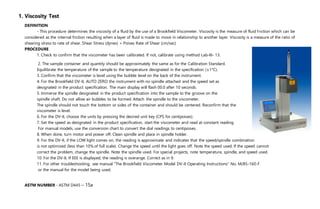
1. Viscosity Test
DEFINITION
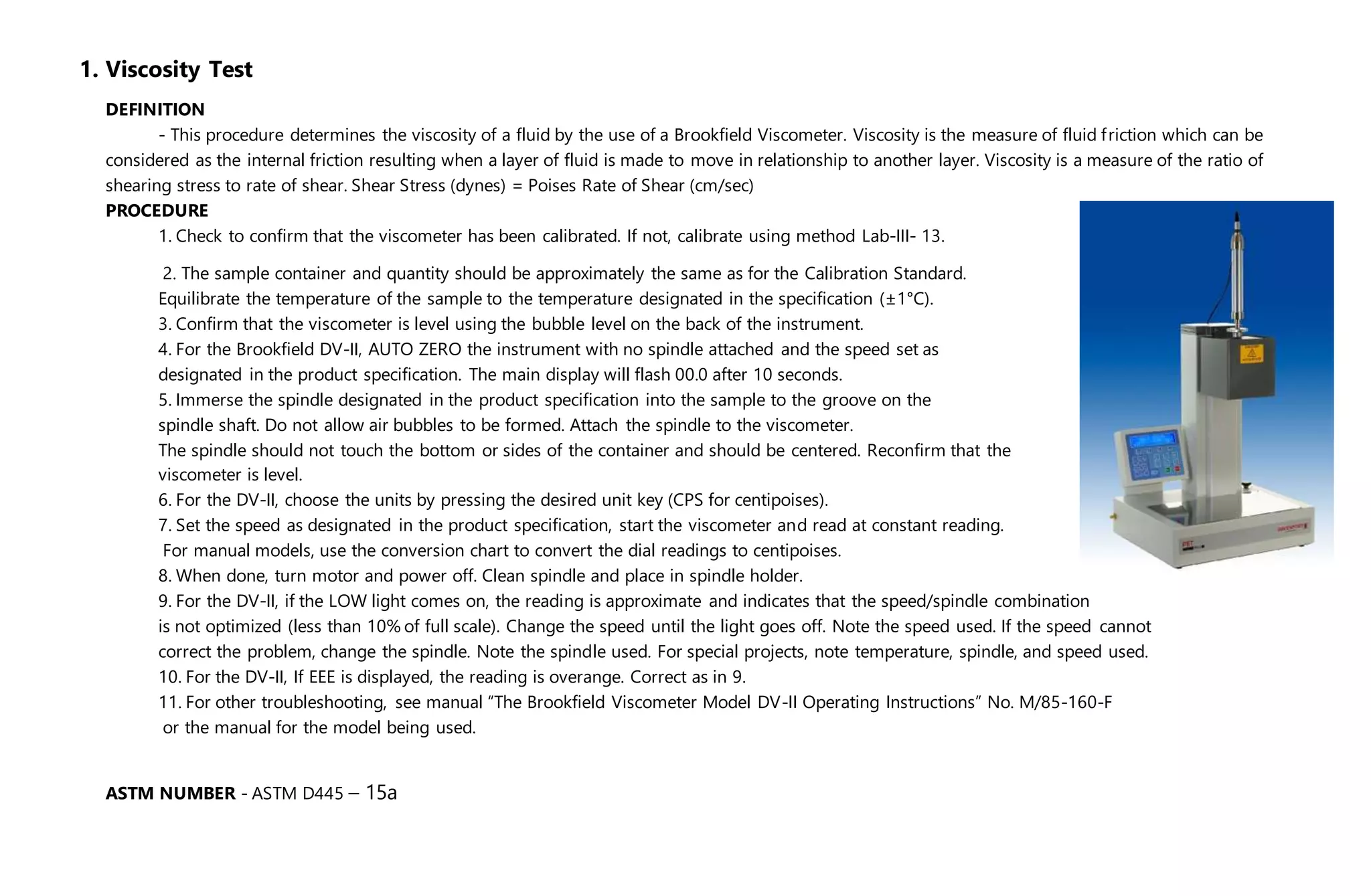
- This procedure determines the viscosity of a fluid by the use of a Brookfield Viscometer. Viscosity is the measure of fluid friction which can be
considered as the internal friction resulting when a layer of fluid is made to move in relationship to another layer. Viscosity is a measure of the ratio of
shearing stress to rate of shear. Shear Stress (dynes) = Poises Rate of Shear (cm/sec)
PROCEDURE
1. Check to confirm that the viscometer has been calibrated. If not, calibrate using method Lab-III- 13.
2. The sample container and quantity should be approximately the same as for the Calibration Standard.
Equilibrate the temperature of the sample to the temperature designated in the specification (±1°C).
3. Confirm that the viscometer is level using the bubble level on the back of the instrument.
4. For the Brookfield DV-II, AUTO ZERO the instrument with no spindle attached and the speed set as
designated in the product specification. The main display will flash 00.0 after 10 seconds.
5. Immerse the spindle designated in the product specification into the sample to the groove on the
spindle shaft. Do not allow air bubbles to be formed. Attach the spindle to the viscometer.
The spindle should not touch the bottom or sides of the container and should be centered. Reconfirm that the
viscometer is level.
6. For the DV-II, choose the units by pressing the desired unit key (CPS for centipoises).
7. Set the speed as designated in the product specification, start the viscometer and read at constant reading.
For manual models, use the conversion chart to convert the dial readings to centipoises.
8. When done, turn motor and power off. Clean spindle and place in spindle holder.
9. For the DV-II, if the LOW light comes on, the reading is approximate and indicates that the speed/spindle combination
is not optimized (less than 10% of full scale). Change the speed until the light goes off. Note the speed used. If the speed cannot
correct the problem, change the spindle. Note the spindle used. For special projects, note temperature, spindle, and speed used.
10. For the DV-II, If EEE is displayed, the reading is overange. Correct as in 9.
11. For other troubleshooting, see manual “The Brookfield Viscometer Model DV-II Operating Instructions” No. M/85-160-F
or the manual for the model being used.
ASTM NUMBER - ASTM D445 – 15a
2. Penetration Test
DEFINITION
Penetration tests are a great way to identify vulnerabilities that exists in a system or network
that has an existing security measures in place. A penetration test usually involves the use of
attacking methods conducted by trusted individuals that are similarly used by hostile intruders
or hackers. Depending on the type of test that is conducted, this may involve a simple scan of
an IP addresses to identify machines that are offering services with known vulnerabilities or
even exploiting known vulnerabilities that exists in an unpatched operating system. The results
of these tests or attacks are then documented and presented as report to the owner of the
system and the vulnerabilities identified can then be resolved. Bear in mind that a penetration
test does not last forever. Depending on the organization conducting the tests, the time frame
to conduct each test varies. A penetration test is basically an attempt to breach the security of a
network or system and is not a full security audit. This means that it is no more than a view of a
system’s security at a single moment in time. At this time, the known vulnerabilities, weaknesses
or misconfigured systems have not changed within the time frame the penetration test is
conducted.
PROCEDURE
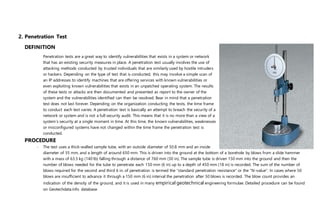
- The test uses a thick-walled sample tube, with an outside diameter of 50.8 mm and an inside
diameter of 35 mm, and a length of around 650 mm. This is driven into the ground at the bottom of a borehole by blows from a slide hammer
with a mass of 63.5 kg (140 lb) falling through a distance of 760 mm (30 in). The sample tube is driven 150 mm into the ground and then the
number of blows needed for the tube to penetrate each 150 mm (6 in) up to a depth of 450 mm (18 in) is recorded. The sum of the number of
blows required for the second and third 6 in. of penetration is termed the "standard penetration resistance" or the "N-value". In cases where 50
blows are insufficient to advance it through a 150 mm (6 in) interval the penetration after 50 blows is recorded. The blow count provides an
indication of the density of the ground, and it is used in many empirical geotechnical engineering formulae. Detailed procedure can be found
on Geotechdata.info database.
ASTM NUMBER - ASTM D1586 - 11
3.Thin Film Oven Test
DEFINITION
This method indicates approximate change in properties of asphalt during conventional hot-mixing at about 150°C [302°F] as indicated by viscosity,
penetration, or ductility measurements. It yields a residue which approximates the asphalt condition as incorporated in the pavement. If the mixing
temperature differs appreciably from the 150°C [302°F] level, more or less effect on properties will occur.
ASTM NUMBER - ASTM D1754 / D1754M - 09
4. Flash Point
DEFINITION
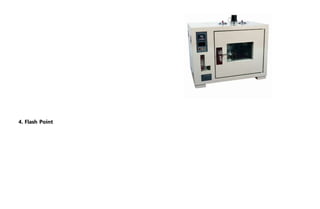
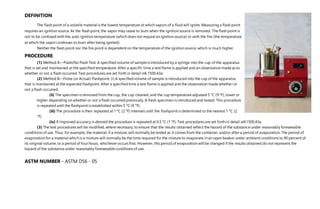
The flash point of a volatile material is the lowest temperature at which vapors of a fluid will ignite. Measuring a flash point
requires an ignition source. At the flash point, the vapor may cease to burn when the ignition source is removed. The flash point is
not to be confused with the auto ignition temperature (which does not require an ignition source) or with the fire (the temperature
at which the vapor continues to burn after being ignited).
Neither the flash point nor the fire point is dependent on the temperature of the ignition source, which is much higher.
PROCEDURE
(1) Method A—Flash/No Flash Test. A specified volume of sampleis introduced by a syringe into the cup of the apparatus
that is set and maintained at the specified temperature. After a specific time a test flame is applied and an observation madeas to
whether or not a flash occurred. Test procedures are set forth in detail in§ 1500.43a.
(2) Method B—Finite (or Actual) Flashpoint. (i) A specified volume of sample is introduced into the cup of the apparatus
that is maintained at the expected flashpoint. After a specifiedtime a test flame is applied and the observation made whether or
not a flash occurred.
(ii) The specimen is removed from the cup, the cup cleaned, and the cup temperature adjusted 5 °C (9 °F), lower or
higher depending on whether or not a flash occurred previously. A fresh specimen is introduced and tested. This procedure
is repeated until the flashpoint is established within 5 °C (9 °F).
(iii) The procedure is then repeated at 1 °C (2 °F) intervals until the flashpoint is determined to the nearest 1 °C (2
°F).
(iv) If improved accuracy is desired the procedure is repeated at 0.5 °C (1 °F). Test procedures are set forth in detail at§1500.43a.
(3) The test procedures will be modified, where necessary, to ensure that the results obtained reflect the hazard of the substance under reasonably foreseeable
conditions of use. Thus, for example, the material, if a mixture, will normally be tested as it comes from the container, and/or after a period of evaporation. The period of
evaporation for a material which is a mixture will normally be the time required for the mixture to evaporate in an open beaker under ambient conditions to 90 percent of
its original volume, or a period of four hours, whichever occurs first. However, this period of evaporation will be changed if the results obtained do not represent the
hazard of the substance under reasonably foreseeableconditions of use.
ASTM NUMBER – ASTM D56 - 05
5. Rolling Thin Film
DEFINITION
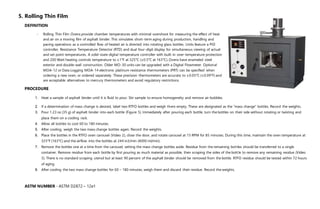
- Rolling Thin Film Ovens provide chamber temperatures with minimal overshoot for measuring the effect of heat
and air on a moving film of asphalt binder. This simulates short-term aging during production, handling and
paving operations as a controlled flow of heated air is directed into rotating glass bottles. Units feature a PID
controller, Resistance Temperature Detector (RTD) and dual four-digit display for simultaneous viewing of actual
and set point temperatures. A solid-state digital temperature controller with built-in over-temperature protection
and 200 Watt heating controls temperature to ±1°F at 325°C (±0.5°C at 163°C). Ovens have enameled steel
exterior and double-wall construction. Older MO-30 units can be upgraded with a Digital Flowmeter. Optional
MOA-12 or Data Logging MOA-14 electronic platinum resistance thermometers (PRT) can be specified when
ordering a new oven, or ordered separately. These precision thermometers are accurate to ±0.05°C (±0.09°F) and
are acceptable alternatives to mercury thermometers and avoid regulatory restrictions.
PROCEDURE
1. Heat a sample of asphalt binder until it is fluid to pour. Stir sample to ensure homogeneity and remove air bubbles.
2. If a determination of mass change is desired, label two RTFO bottles and weigh them empty. These are designated as the “mass change” bottles. Record the weights.
3. Pour 1.23 oz (35 g) of asphalt binder into each bottle (Figure 5). Immediately after pouring each bottle, turn the bottles on their side without rotating or twisting and
place them on a cooling rack.
4. Allow all bottles to cool 60 to 180 minutes.
5. After cooling, weigh the two mass change bottles again. Record the weights.
6. Place the bottles in the RTFO oven carousel (Video 2), close the door, and rotate carousel at 15 RPM for 85 minutes. During this time, maintain the oven temperature at
325°F (163°C) and the airflow into the bottles at 244 in3/min (4000 ml/min).
7. Remove the bottles one at a time from the carousel, setting the mass change bottles aside. Residue from the remaining bottles should be transferred to a single
container. Remove residue from each bottle by first pouring as much material as possible, then scraping the sides of the bottle to remove any remaining residue (Video
3). There is no standard scraping utensil but at least 90 percent of the asphalt binder should be removed from the bottle. RTFO residue should be tested within 72 hours
of aging.
8. After cooling the two mass change bottles for 60 – 180 minutes, weigh them and discard their residue. Record the weights.
ASTM NUMBER - ASTM D2872 – 12e1
6. Ductility
DEFINITION
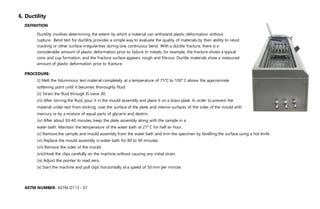
Ductility involves determining the extent by which a material can withstand plastic deformation without
rupture. Bend test for ductility provides a simple way to evaluate the quality of materials by their ability to resist
cracking or other surface irregularities during one continuous bend. With a ductile fracture, there is a
considerable amount of plastic deformation prior to failure. In metals, for example, the fracture shows a typical
cone and cup formation, and the fracture surface appears rough and fibrous. Ductile materials show a measured
amount of plastic deformation prior to fracture.
PROCEDURE:
(i) Melt the bituminous test material completely at a temperature of 75°C to 100° C above the approximate
softening point until it becomes thoroughly fluid.
(ii) Strain the fluid through IS sieve 30.
(iii) After stirring the fluid, pour it in the mould assembly and place it on a brass plate. In order to prevent the
material under test from sticking, coat the surface of the plate and interior surfaces of the sides of the mould with
mercury or by a mixture of equal parts of glycerin and dextrin.
(iv) After about 30-40 minutes, keep the plate assembly along with the sample in a
water bath. Maintain the temperature of the water bath at 27° C for half an hour.
(v) Remove the sample and mould assembly from the water bath and trim the specimen by levelling the surface using a hot knife.
(vi) Replace the mould assembly in water bath for 80 to 90 minutes.
(vii) Remove the sides of the mould.
(viii)Hook the clips carefully on the machine without causing any initial strain.
(ix) Adjust the pointer to read zero.
(x) Start the machine and pull clips horizontally at a speed of 50 mm per minute.
ASTM NUMBER- ASTM D113 - 07
7. Solubility Test
DEFINITION
Solubility is the property of a solid, liquid, or gaseous chemical substance called solute to dissolve in a solid,
liquid, or gaseous solvent. The solubility of a substance fundamentally depends on the physical and chemical properties of
the solute and solvent as well as on temperature, pressure and the pH of the solution. The extent of the solubility of a
substance in a specific solvent is measured as the saturation concentration, where adding more solute does not increase
the concentration of the solution and begins to precipitate the excess amount of solute. The solubility of a substance is an
entirely different property from the rate of solution, which is how fast it dissolves.
PROCEDURE
1. Use your masking tape and pen to label five small cups salt, sugar, Epsom salt, MSG, and unknown. Label five larger clear
plastic cups in the same way. You should have two labeled cups for each type of crystal.
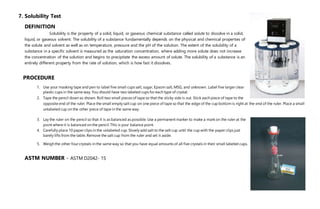
2. Tape the pencil down as shown. Roll two small pieces of tape so that the sticky side is out. Stick each piece of tape to the
opposite end of the ruler. Place the small empty salt cup on one piece of tape so that the edge of the cup bottom is right at the end of the ruler. Place a small
unlabeled cup on the other piece of tape in the same way.
3. Lay the ruler on the pencil so that it is as balanced as possible. Use a permanent marker to make a mark on the ruler at the
point where it is balanced on the pencil. This is your balance point.
4. Carefully place 10 paper clips in the unlabeled cup. Slowly add salt to the salt cup until the cup with the paper clips just
barely lifts from the table. Remove the salt cup from the ruler and set it aside.
5. Weigh the other four crystals in the same way so that you have equal amounts of all five crystals in their small labeled cups.
ASTM NUMBER - ASTM D2042- 15

Construction assignment

  • 1.
    1. Viscosity Test DEFINITION -This procedure determines the viscosity of a fluid by the use of a Brookfield Viscometer. Viscosity is the measure of fluid friction which can be considered as the internal friction resulting when a layer of fluid is made to move in relationship to another layer. Viscosity is a measure of the ratio of shearing stress to rate of shear. Shear Stress (dynes) = Poises Rate of Shear (cm/sec) PROCEDURE 1. Check to confirm that the viscometer has been calibrated. If not, calibrate using method Lab-III- 13. 2. The sample container and quantity should be approximately the same as for the Calibration Standard. Equilibrate the temperature of the sample to the temperature designated in the specification (±1°C). 3. Confirm that the viscometer is level using the bubble level on the back of the instrument. 4. For the Brookfield DV-II, AUTO ZERO the instrument with no spindle attached and the speed set as designated in the product specification. The main display will flash 00.0 after 10 seconds. 5. Immerse the spindle designated in the product specification into the sample to the groove on the spindle shaft. Do not allow air bubbles to be formed. Attach the spindle to the viscometer. The spindle should not touch the bottom or sides of the container and should be centered. Reconfirm that the viscometer is level. 6. For the DV-II, choose the units by pressing the desired unit key (CPS for centipoises). 7. Set the speed as designated in the product specification, start the viscometer and read at constant reading. For manual models, use the conversion chart to convert the dial readings to centipoises. 8. When done, turn motor and power off. Clean spindle and place in spindle holder. 9. For the DV-II, if the LOW light comes on, the reading is approximate and indicates that the speed/spindle combination is not optimized (less than 10% of full scale). Change the speed until the light goes off. Note the speed used. If the speed cannot correct the problem, change the spindle. Note the spindle used. For special projects, note temperature, spindle, and speed used. 10. For the DV-II, If EEE is displayed, the reading is overange. Correct as in 9. 11. For other troubleshooting, see manual “The Brookfield Viscometer Model DV-II Operating Instructions” No. M/85-160-F or the manual for the model being used. ASTM NUMBER - ASTM D445 – 15a
  • 2.
    2. Penetration Test DEFINITION Penetrationtests are a great way to identify vulnerabilities that exists in a system or network that has an existing security measures in place. A penetration test usually involves the use of attacking methods conducted by trusted individuals that are similarly used by hostile intruders or hackers. Depending on the type of test that is conducted, this may involve a simple scan of an IP addresses to identify machines that are offering services with known vulnerabilities or even exploiting known vulnerabilities that exists in an unpatched operating system. The results of these tests or attacks are then documented and presented as report to the owner of the system and the vulnerabilities identified can then be resolved. Bear in mind that a penetration test does not last forever. Depending on the organization conducting the tests, the time frame to conduct each test varies. A penetration test is basically an attempt to breach the security of a network or system and is not a full security audit. This means that it is no more than a view of a system’s security at a single moment in time. At this time, the known vulnerabilities, weaknesses or misconfigured systems have not changed within the time frame the penetration test is conducted. PROCEDURE - The test uses a thick-walled sample tube, with an outside diameter of 50.8 mm and an inside diameter of 35 mm, and a length of around 650 mm. This is driven into the ground at the bottom of a borehole by blows from a slide hammer with a mass of 63.5 kg (140 lb) falling through a distance of 760 mm (30 in). The sample tube is driven 150 mm into the ground and then the number of blows needed for the tube to penetrate each 150 mm (6 in) up to a depth of 450 mm (18 in) is recorded. The sum of the number of blows required for the second and third 6 in. of penetration is termed the "standard penetration resistance" or the "N-value". In cases where 50 blows are insufficient to advance it through a 150 mm (6 in) interval the penetration after 50 blows is recorded. The blow count provides an indication of the density of the ground, and it is used in many empirical geotechnical engineering formulae. Detailed procedure can be found on Geotechdata.info database.
  • 3.
    ASTM NUMBER -ASTM D1586 - 11 3.Thin Film Oven Test DEFINITION This method indicates approximate change in properties of asphalt during conventional hot-mixing at about 150°C [302°F] as indicated by viscosity, penetration, or ductility measurements. It yields a residue which approximates the asphalt condition as incorporated in the pavement. If the mixing temperature differs appreciably from the 150°C [302°F] level, more or less effect on properties will occur. ASTM NUMBER - ASTM D1754 / D1754M - 09
  • 4.
  • 5.
    DEFINITION The flash pointof a volatile material is the lowest temperature at which vapors of a fluid will ignite. Measuring a flash point requires an ignition source. At the flash point, the vapor may cease to burn when the ignition source is removed. The flash point is not to be confused with the auto ignition temperature (which does not require an ignition source) or with the fire (the temperature at which the vapor continues to burn after being ignited). Neither the flash point nor the fire point is dependent on the temperature of the ignition source, which is much higher. PROCEDURE (1) Method A—Flash/No Flash Test. A specified volume of sampleis introduced by a syringe into the cup of the apparatus that is set and maintained at the specified temperature. After a specific time a test flame is applied and an observation madeas to whether or not a flash occurred. Test procedures are set forth in detail in§ 1500.43a. (2) Method B—Finite (or Actual) Flashpoint. (i) A specified volume of sample is introduced into the cup of the apparatus that is maintained at the expected flashpoint. After a specifiedtime a test flame is applied and the observation made whether or not a flash occurred. (ii) The specimen is removed from the cup, the cup cleaned, and the cup temperature adjusted 5 °C (9 °F), lower or higher depending on whether or not a flash occurred previously. A fresh specimen is introduced and tested. This procedure is repeated until the flashpoint is established within 5 °C (9 °F). (iii) The procedure is then repeated at 1 °C (2 °F) intervals until the flashpoint is determined to the nearest 1 °C (2 °F). (iv) If improved accuracy is desired the procedure is repeated at 0.5 °C (1 °F). Test procedures are set forth in detail at§1500.43a. (3) The test procedures will be modified, where necessary, to ensure that the results obtained reflect the hazard of the substance under reasonably foreseeable conditions of use. Thus, for example, the material, if a mixture, will normally be tested as it comes from the container, and/or after a period of evaporation. The period of evaporation for a material which is a mixture will normally be the time required for the mixture to evaporate in an open beaker under ambient conditions to 90 percent of its original volume, or a period of four hours, whichever occurs first. However, this period of evaporation will be changed if the results obtained do not represent the hazard of the substance under reasonably foreseeableconditions of use. ASTM NUMBER – ASTM D56 - 05
  • 6.
    5. Rolling ThinFilm DEFINITION - Rolling Thin Film Ovens provide chamber temperatures with minimal overshoot for measuring the effect of heat and air on a moving film of asphalt binder. This simulates short-term aging during production, handling and paving operations as a controlled flow of heated air is directed into rotating glass bottles. Units feature a PID controller, Resistance Temperature Detector (RTD) and dual four-digit display for simultaneous viewing of actual and set point temperatures. A solid-state digital temperature controller with built-in over-temperature protection and 200 Watt heating controls temperature to ±1°F at 325°C (±0.5°C at 163°C). Ovens have enameled steel exterior and double-wall construction. Older MO-30 units can be upgraded with a Digital Flowmeter. Optional MOA-12 or Data Logging MOA-14 electronic platinum resistance thermometers (PRT) can be specified when ordering a new oven, or ordered separately. These precision thermometers are accurate to ±0.05°C (±0.09°F) and are acceptable alternatives to mercury thermometers and avoid regulatory restrictions. PROCEDURE 1. Heat a sample of asphalt binder until it is fluid to pour. Stir sample to ensure homogeneity and remove air bubbles. 2. If a determination of mass change is desired, label two RTFO bottles and weigh them empty. These are designated as the “mass change” bottles. Record the weights. 3. Pour 1.23 oz (35 g) of asphalt binder into each bottle (Figure 5). Immediately after pouring each bottle, turn the bottles on their side without rotating or twisting and place them on a cooling rack. 4. Allow all bottles to cool 60 to 180 minutes. 5. After cooling, weigh the two mass change bottles again. Record the weights. 6. Place the bottles in the RTFO oven carousel (Video 2), close the door, and rotate carousel at 15 RPM for 85 minutes. During this time, maintain the oven temperature at 325°F (163°C) and the airflow into the bottles at 244 in3/min (4000 ml/min). 7. Remove the bottles one at a time from the carousel, setting the mass change bottles aside. Residue from the remaining bottles should be transferred to a single container. Remove residue from each bottle by first pouring as much material as possible, then scraping the sides of the bottle to remove any remaining residue (Video 3). There is no standard scraping utensil but at least 90 percent of the asphalt binder should be removed from the bottle. RTFO residue should be tested within 72 hours of aging. 8. After cooling the two mass change bottles for 60 – 180 minutes, weigh them and discard their residue. Record the weights. ASTM NUMBER - ASTM D2872 – 12e1
  • 7.
    6. Ductility DEFINITION Ductility involvesdetermining the extent by which a material can withstand plastic deformation without rupture. Bend test for ductility provides a simple way to evaluate the quality of materials by their ability to resist cracking or other surface irregularities during one continuous bend. With a ductile fracture, there is a considerable amount of plastic deformation prior to failure. In metals, for example, the fracture shows a typical cone and cup formation, and the fracture surface appears rough and fibrous. Ductile materials show a measured amount of plastic deformation prior to fracture. PROCEDURE: (i) Melt the bituminous test material completely at a temperature of 75°C to 100° C above the approximate softening point until it becomes thoroughly fluid. (ii) Strain the fluid through IS sieve 30. (iii) After stirring the fluid, pour it in the mould assembly and place it on a brass plate. In order to prevent the material under test from sticking, coat the surface of the plate and interior surfaces of the sides of the mould with mercury or by a mixture of equal parts of glycerin and dextrin. (iv) After about 30-40 minutes, keep the plate assembly along with the sample in a water bath. Maintain the temperature of the water bath at 27° C for half an hour. (v) Remove the sample and mould assembly from the water bath and trim the specimen by levelling the surface using a hot knife. (vi) Replace the mould assembly in water bath for 80 to 90 minutes. (vii) Remove the sides of the mould. (viii)Hook the clips carefully on the machine without causing any initial strain. (ix) Adjust the pointer to read zero. (x) Start the machine and pull clips horizontally at a speed of 50 mm per minute. ASTM NUMBER- ASTM D113 - 07
  • 8.
    7. Solubility Test DEFINITION Solubilityis the property of a solid, liquid, or gaseous chemical substance called solute to dissolve in a solid, liquid, or gaseous solvent. The solubility of a substance fundamentally depends on the physical and chemical properties of the solute and solvent as well as on temperature, pressure and the pH of the solution. The extent of the solubility of a substance in a specific solvent is measured as the saturation concentration, where adding more solute does not increase the concentration of the solution and begins to precipitate the excess amount of solute. The solubility of a substance is an entirely different property from the rate of solution, which is how fast it dissolves. PROCEDURE 1. Use your masking tape and pen to label five small cups salt, sugar, Epsom salt, MSG, and unknown. Label five larger clear plastic cups in the same way. You should have two labeled cups for each type of crystal. 2. Tape the pencil down as shown. Roll two small pieces of tape so that the sticky side is out. Stick each piece of tape to the opposite end of the ruler. Place the small empty salt cup on one piece of tape so that the edge of the cup bottom is right at the end of the ruler. Place a small unlabeled cup on the other piece of tape in the same way. 3. Lay the ruler on the pencil so that it is as balanced as possible. Use a permanent marker to make a mark on the ruler at the point where it is balanced on the pencil. This is your balance point. 4. Carefully place 10 paper clips in the unlabeled cup. Slowly add salt to the salt cup until the cup with the paper clips just barely lifts from the table. Remove the salt cup from the ruler and set it aside. 5. Weigh the other four crystals in the same way so that you have equal amounts of all five crystals in their small labeled cups. ASTM NUMBER - ASTM D2042- 15