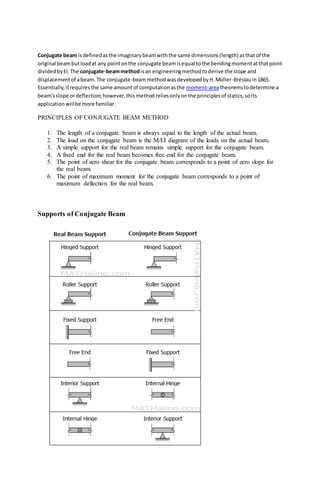
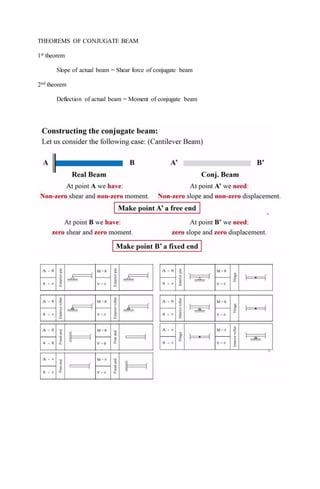
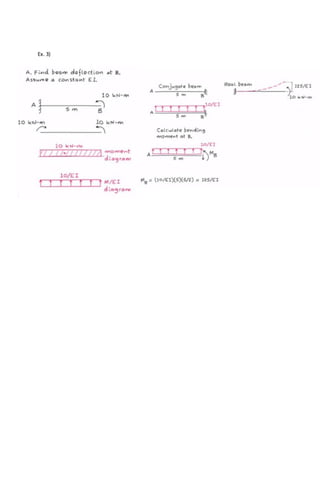
The document reports on the conjugate beam method, which uses an imaginary beam with the same length as the original beam but with loads equal to the bending moment at each point divided by EI. The method can be used to derive the slope and displacement of a beam and was developed by H.Müller-Breslau in 1865. It requires similar computations as moment-area theorems but relies only on statics principles. Key principles are that the conjugate beam has the same length and its load is the M/EI diagram of the actual beam, and that the points of zero shear/maximum moment correspond to zero slope/maximum deflection on the actual beam.



![Chapter 8 answers_to_examination_style_questions[1]](https://cdn.slidesharecdn.com/ss_thumbnails/chapter8answerstoexaminationstylequestions1-140110144610-phpapp01-thumbnail.jpg?width=640&height=640&fit=bounds)


![Civil02 sheet-03[2012]](https://cdn.slidesharecdn.com/ss_thumbnails/civil02-sheet-032012-111014064705-phpapp01-thumbnail.jpg?width=640&height=640&fit=bounds)


![[Deck] What's New in Spark-Iceberg Integration via DSV2.pptx](https://cdn.slidesharecdn.com/ss_thumbnails/deckwhatsnewinspark-icebergintegrationviadsv2-260210005337-25955b12-thumbnail.jpg?width=640&height=640&fit=bounds)


