Chapter 3
Tropical Rainforest
How Can We Save The
Rainforest?
Think about this!
How did the name tropical rainforest come about?
TROPICAL
RAIN
FOREST
Tropical Rainforest
In this section, you will explore these Guiding
Questions:
1. What are tropical rainforests?
2. Where can they be found?
3. What is deforestation and which areas have been
deforested?
4. Why does deforestation occur?
5. How does deforestation impact people and the
environment?
6. How should we manage deforestation?
• Watch a video of the tropical rainforest.
Take note of the features of a tropical
rainforest.
1. What are tropical rainforests?
Which photo do you think shows a tropical rainforest?
1. What are tropical rainforests?
Characteristics of tropical rainforest
• Thick and luxuriant
• Broadleaved (to capture sunlight for
photosynthesis)
• evergreen trees – they do not shed all their
leaves at the same time.
• Found in areas that experience high rainfall
(about 1,500 – 2,500 mm annually) and high
temperature (about 26oC) throughout the year
1. What are tropical rainforests?
Characteristics of tropical rainforest
• Diversity of plant species
• Structure of tropical rainforest
1. What are tropical rainforests?
Characteristics of tropical rainforest
Diversity of plant species
• Hot and wet environment gives rise to rich
biodiversity (range of plant and animal species found
in an area)
In Amazon rainforest in
South America
In forests in
United Kingdom
300 different plant species
within 0.01 km2
(1 football field)
40 plant species
within 27,000 km2
1. What are tropical rainforests?
Characteristics of tropical rainforest
Diversity of plant species
• Different types of food can be found:
– Fruits (e.g. bananas, mangoes)
– Spices (e.g. pepper, cinnamon)
– Vegetables (e.g. corn, pandan)
– Nuts (e.g. Brazil nuts, walnuts)
1. What are tropical rainforests?
Characteristics of tropical rainforest
Structure of the tropical rainforest
A tropical rainforest has primarily three layers:
• Emergent layer (above 30 m)
• Canopy layer (20–30 m)
• Undergrowth layer (below 20 m)
• Watch a video that describes the structure of
a tropical rainforest.
1. What are tropical rainforests?
Characteristics of tropical
rainforest
Structure of the tropical
rainforest
• Emergent layer (above 30 m)
– Uppermost layer where some
trees rise and tower above
other trees
– Can grow up to 50m – 80m
– The emergent layer is formed
by the crowns of these trees.
– Trees in this layer usually have
tall, straight and smooth
trunks with few branches
– E.g. Tualang tree, Kapok tree
1. What are tropical rainforests?
Characteristics of tropical
rainforest
Structure of the tropical
rainforest
• Canopy layer (20 – 30 m)
– The trees grow to heights of
20 – 30m to reach for
sunlight.
– Trees grow close together
(dense)
– Crowns interlock to form an
almost continuous cover
– This blocks up to 90% of the
sun’s rays from reaching the
forests floor
1. What are tropical rainforests?
Characteristics of tropical rainforest
Structure of the tropical rainforest
Canopy layer (20 – 30 m)
• Lianas: Thick,
woody vines that
twine up trees to
reach for sunlight.
• Epiphytes: Plants
which grow on trees to
reach more sunlight
(includes ferns,
orchids, mosses,
lichens)
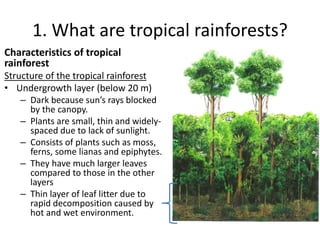
1. What are tropical rainforests?
Characteristics of tropical
rainforest
Structure of the tropical rainforest
• Undergrowth layer (below 20 m)
– Dark because sun’s rays blocked
by the canopy.
– Plants are small, thin and widely-
spaced due to lack of sunlight.
– Consists of plants such as moss,
ferns, some lianas and epiphytes.
– They have much larger leaves
compared to those in the other
layers
– Thin layer of leaf litter due to
rapid decomposition caused by
hot and wet environment.
1. What are tropical rainforests?
Characteristics of tropical rainforest
Adaptation of plants
• Leaves
– Leaves are broad
• Helps trees capture sunlight for photosynthesis
– Leaves have waxy, leathery or hairy surfaces
• Helps to minimise the loss of moisture through
transpiration due to the high temperatures
1. What are tropical rainforests?
Characteristics of tropical rainforest
Adaptation of plants
• Leaves
– Some leaves have narrow,
downward pointing tips (drip
tips)
• Allow water to run off easily
• Prevents fungi and bacteria
from growing on the leaves
1. What are tropical rainforests?
Characteristics of tropical rainforest
Adaptation of plants
• Fruit and flowers
- colourful and strong-smelling
to attract insects and other
animals to assist in seed
dispersal and pollination
Air is usually still (lack of wind)
which is hard for seed dispersal and
pollination by wind
Fruit of the cacao plant
Rafflesia, the world’s
largest flower
1. What are tropical rainforests?
Characteristics of tropical rainforest
Adaptation of plants
• Roots
– Buttress roots which grow
from 1 – 5 m above the
ground
• To support the heavy
weight of tall trees
1. What are tropical rainforests?
Characteristics of tropical rainforest
Adaptation of plants
• Roots
– Shallow roots
• Nutrients from the rapid decomposition of fallen leaves
and branches are mostly found in the top layer of the
soil
• Water is available throughout the year, therefore there
is no need for the roots to grow deep to search for
water.
1. What are tropical rainforests?
Uses of tropical rainforests
a. Water catchment
b. Green lungs of the earth
c. Habitat to flora (plants) and fauna (animals)
d. Habitat to indigenous people
e. Source of timber
f. Medical application
Uses of tropical rainforests
a) Water catchment
• Refers to an area drained by a river and the smaller
rivers that flow into it
Rain falls in tropical rainforests
Trees stop rain from reaching the ground directly
Water slowly drips from the trees
Contributes to water supply
• Because impurities in rainwater are trapped in the
soil before it flows into the reservoirs, forests help
to maintain the quality of water.
Seeps into the ground and is
stored as groundwater
Flows as runoff into the rivers
or reservoirs
b) Green lungs of the earth
• Tropical rainforests help the earth to ‘breathe’
– More than 20% of the earth’s oxygen is generated by
the Amazon rainforest
– Absorb carbon dioxide from the atmosphere and
release oxygen (photosynthesis)
– They act as the earth’s natural air purifier as they
absorb 2.4 billion tonnes of carbon dioxide in one
year.
• Dense vegetation of tropical rainforests keeps the
earth cool
Uses of tropical rainforests
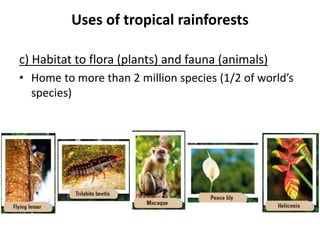
c) Habitat to flora (plants) and fauna (animals)
• Home to more than 2 million species (1/2 of world’s
species)
Uses of tropical rainforests
Habitat to flora (plants) and fauna (animals)
• Abundance and diversity of flora and fauna
– Ample sunlight is converted by the plants into energy
and food (photosynthesis) which allows plants to
thrive
 In turn, the plants are eaten by animals for survival
– Continuous canopy is a habitat where other plants can
grow and animals can live in
Uses of tropical rainforests
d) Habitat to indigenous people
• 60 million indigenous people
(original inhabitants of a country)
are wholly dependent on the
tropical rainforest
• been living in tropical rainforests
for thousands of years
e.g. Yanomami (Amazon rainforest),
Penan (rainforest in Sarawak)
An indigenous group living in the
Amazon rainforest
Uses of tropical rainforests
Habitat to indigenous people
• Tropical rainforests provide these people with daily
necessities (food, clothing and medicine)
• They obtain food by either hunting and gathering
(hunt fish, gather wild fruit and nuts), or agriculture
(growing of crops)
[As such, they are known as hunter-gatherers or shifting
cultivators]
Uses of tropical rainforests
• Yanomami Tribes
e) Source of timber
• Timber refers to the the wood (e.g. teak, ebony,
mahogany and meranti) used to build or make things
such as doors, window frames and furniture
• Tropical rainforests supply about 1/5 of the world’s
industrial timber
• provide fuel wood to people for cooking
Uses of tropical rainforests
f) Medical application
• In Amazon rainforest, nearly 3,000 plant species have
been identified to have medicinal properties
• Many of the foods (e.g. Brazil nuts) have cancer-
fighting properties
Uses of tropical rainforests
Medical application
25% of all modern
medicines come
from rainforest
plants
Uses of tropical rainforests
• Medicine in the Rainforest
• People value the rainforest for different reasons
Uses of tropical rainforests
World distribution of tropical rainforests
2. Where are tropical rainforests
found?
Global distribution of tropical rainforests
• Less than 5% of the earth’s land surface
• Equatorial climate (between latitudes 20° N and 20°
S) where there is abundant sunlight, high
temperatures and heavy rainfall throughout the year
• High annual temperatures (of more than 26oC, with
a range of 2–3oC) and high annual rainfall (1,500–
2,500mm)
• Main areas : Amazon Basin, the Congo Basin,
Southeast Asia.
2. Where are tropical rainforests found?
World distribution of tropical rainforests
2. Where are tropical rainforests found?
Amazon Basin in
South America
Congo Basin
in Africa
Southeast
Asia
Latitudes
• Are imaginary horizontal lines that run in
an east-west direction around the Earth.
• The Equator is the longest line of latitude
– it divides the Earth into two equal
halves (Northern and Southern
Hemisphere)
Latitudes
• Latitudes are
measured in
degrees and
minutes from the
Equator
• They increase in
value as they
move northward
and southward.
Distribution of tropical rainforests in Singapore
• Many parts of Singapore were originally covered with
rainforests
• After 1819: Rainforests were rapidly cleared to grow
crops and build infrastructure
• 1882: Only 7 per cent of the original rainforests
remained
• Today: Rainforests occupy an area of about 20 km2
(3% of total land area) and are mainly found at the
Central Catchment Nature Reserve and Bukit Timah
Nature Reserve
3a. Where are tropical rainforests found?
Distribution of tropical rainforests in Singapore
2. Where are tropical rainforests
found?
1819
Distribution of tropical rainforests in Singapore
2. Where are tropical rainforests
found?
2006
3. What is deforestation? (p86)
Spot the difference
An area in the Amazon rainforest
3. What is deforestation?
Deforestation
• It is the cutting down and removal of all or most of
the trees in a forested area
• If not managed properly, it can lead to the
permanent destruction and eventual disappearance
of a once renewable resource
1980 1990
Tropical Rainforest 19.1 mil km2 17.9 mil km2
3b. Which areas have been deforested?
Global distribution of deforested areas of tropical
rainforest
• Rainforests are disappearing at alarming rates
because of human activities:
– Agriculture
– Mining
– Logging
– Land clearance (for housing and industries)
• Remaining rainforests are smaller and broken up into
fragments
3b. Which areas have been deforested?
Global distribution of deforested areas of tropical
rainforest
At least 320 km2 of tropical rainforest
disappear each day
3b. Which areas have been deforested?
Global distribution of deforested areas of tropical
rainforest
Areas of tropical rainforest that have been deforested
3b. Which areas have been deforested?
Global distribution of deforested areas of tropical
rainforest (TB p92)
Tropical rainforest loss in some countries
Do “Let’s try it!” on pg 93
3b. Which areas have been deforested?
Global distribution of deforested areas of tropical
rainforest
Deforestation estimates of tropical
rainforests in Borneo
• If the present rates of
deforestation in the
world continue, our
world’s remaining
rainforests could be gone
in one hundred years.
• In Borneo, logging is one
of the main reasons that
caused rapid
deforestation.
• Deforestation Video - CNN
4. Why does deforestation occur?
• Agricultural activities
• Cattle ranching
• Logging
• Mining
4. Why does deforestation occur?
Agricultural activities
Agriculture is the growing of crops and raising of
animals to provide food
• Shifting cultivation (a form of subsistence farming
activity)
– Have been the traditional cause of deforestation
– Shifting cultivators grow crops for their own use and
consumption
– They allow land to regain its fertility and for
vegetation to regrow when they move to the next
plot of land
As such, does not pose a major threat to the forest
4. Why does deforestation occur?
Agricultural activities
• Large-scale commercial agricultural activities on
plantations
– Burn and clear large areas of the rainforest
– Crops are grown for cash and are sold to meet
both local and global needs
As a result, the rate of deforestation has increased
greatly!
4. Why does deforestation occur?
Agricultural activities
Example:
• By 2010, about 242,000 km2 of
the Amazon rainforest have
been converted into soya bean
farms
– Major ingredient in food for
cattle
– Also, processed into products
such as soya milk and tofu
Large areas of rainforest are being cleared
for soya bean farms in the Amazon Basin
4. Why does deforestation occur?
Cattle ranching
Involves operating large farms to raise cattle
• Large areas of rainforest are cleared to create land
for cattle to graze
Large tracts of the Amazon
rainforest are being lost to cattle
ranching
For example:
• 80% of deforestation in the
Amazon rainforest is caused by
land cleared for cattle ranching
• 1986: Less than 10 million head
of cattle
• 2011: 79 million head of cattle
4. Why does deforestation occur?
Cattle ranching
• A large amount of beef from cattle in the Amazon is
exported to other countries (e.g. USA, Britain)
4. Why does deforestation occur?
Logging
The cutting down of trees for timber
• Commercial logging of tropical hardwoods (teak,
mahogany, rosewood) to make furniture, building
materials and charcoal
• Growing demand for timber products
 Increases logging activities
Commercial logging is responsible
for destroying 50,000 km2 of
tropical rainforest every year!
4. Why does deforestation occur?
Logging
• Logging reduces the number of trees and damages
the rainforest as a whole
Why?
• For every tree extracted, five are badly damaged
(falling tree will destroy the surrounding trees or
smaller-sized plants)
• Also, the soil is exposed to erosion
4. Why does deforestation occur?
Logging
Example:
• To meet needs in China
– Huge demand for timber for making disposable
chopsticks and paper
– Caused heavy logging in the rainforests of Congo
and Cameroon in Central Africa, Brazil and
Indonesia
4. Why does deforestation occur?
Mining
• Precious metals and
gemstones (gold, copper and
diamonds) are found
beneath many tropical
rainforests
• Forests are cleared to
establish the mines and
construct roads to transport
the mined materials
NASA satellite image showing the
extent of deforestation caused by the
Carajás Mine, Brazil
4. Why does deforestation occur?
Mining
Example:
• Carajás Mine in Brazil has a rich variety of mineral
reserves
• In 2007: 296 million tonnes of iron ore were extracted
(18 billion tonnes of minerals including gold and
copper)
• These minerals are needed to produce electronic
products such as computers and telephones as well as
electrical wires
4. Why does deforestation occur?
Although human activities have led to
deforestation, some may view these activities as
key to development:
• The clearing of forests provides land for
communities to build houses, factories, offices
• Roads can be built and this makes trade and
transport easier
• Also, the land can be converted to agricultural land
to allow the production of more food
5. How does deforestation impact people and
the environment?
Environmental impact
• Loss of biodiversity
• Loss of water catchment areas
• Increased risk of flooding, soil erosion and
sedimentation
• Enhanced greenhouse effect
Economic impact
• Depletion of natural resources
Social impact
• Effects on indigenous people
Environmental impact
Loss of biodiversity
• Deforestation destroys the habitats of plants and
animals
• Loss of biodiversity = Loss of the variety of plants and
animals -> extinction of plant and animal species ->
lesser variety of resources (eg. Food, medicine, timber)
• Changes in biodiversity may increase the occurrence of
insect-borne diseases (e.g. malaria, dengue fever)
• lack of nutrients in the soils may not be able to support
the biodiversity that once existed on that land
5. How does deforestation impact people and
the environment?
Environmental impact
Loss of watch catchment areas
• Forests play an important role in maintaining our
water supply
• They enable water to be collected and stored within
a water catchment area
5. How does deforestation impact people and
the environment?
Environmental impact
Loss of watch catchment areas
The Amazon Basin has 7,000 tributaries
Countries
surrounding the
Amazon
rainforest
depend on
water from the
Amazon Basin,
especially
during dry
seasons
5. How does deforestation impact people and
the environment?
Environmental impact
Loss of water catchment areas
• Clearing of trees disrupts the water cycle  Less
transpiration happening, less rain  drier climate and
drier soils as the ground no longer contains and receives
as much water  decreased water supply  higher
water prices
5. How does deforestation impact people and
the environment?
Environmental impact
Increased risk of flooding, soil erosion and
sedimentation
• When trees are cleared, the ground is left bare
• No trees, moss and leaf litter to intercept and reduce
the impact of rain on the ground.
• More surface runoff, less infiltration
• This causes flooding in the surrounding areas
5. How does deforestation impact people and
the environment?
Environmental impact
Increased risk of flooding, soil erosion and
sedimentation
5. How does deforestation impact people and
the environment?
Environmental impact
Increased risk of flooding, soil erosion and sedimentation
• Soil erosion is the removal of the top layers of soil by
rainwater, wind and destructive human activities (logging)
• When trees are removed  no roots to hold the soil, no
trees to intercept the rain  land becomes exposed  soil
erosion  rain washes the soil into rivers  increases the
amount of sediments in the rivers affects water quality
and aquatic life
• Increased amount of sediments smothers fish eggs,
resulting in lower hatch rates
• Turns water cloudy and prevents sunlight from penetrating
the water  suffocates coral reefs.
5. How does deforestation impact people and
the environment?
Environmental impact
Increased risk of flooding, soil erosion and
sedimentation
Sediments enter
the sea
Coral reefs get suffocated
Sediments will eventually
settle and accumulate
5. How does deforestation impact people and
the environment?
Environmental impact
Enhanced greenhouse effect
• The gases (eg. Carbon dioxide, methane, water vapour and
others) in the atmosphere help keep the earth warm.
These are known as greenhouse gases. The warming of the
atmosphere is known as the greenhouse effect.
Without the greenhouse effect, the earth’s average
temperature will be −18°C rather than the current 15°C
• Human activities such as setting up of industries, transport
network and power station have increased the amount of
greenhouse gases in the atmopshere  more heat
trapped in the atmosphere increases the earth’s
temperature Enhanced greenhouse effect
5. How does deforestation impact people and
the environment?
Environmental impact
Enhanced greenhouse effect
• Deforestation contributes to enhanced greenhouse
effect  increased amount of carbon dioxide in the
atmosphere
• Less trees means that less carbon dioxide is absorbed
and more of it remains in the atmosphere.
• The burning of rainforests also releases carbon dioxide
into the atmosphere. Branches and logs that are left
behind become fuel for forest fires.
5. How does deforestation impact people and
the environment?
Environmental impact
Enhanced greenhouse effect
Deforestation of
tropical
rainforest
contributes
significantly to
the total
amount of
carbon dioxide
released into
the atmosphere
5. How does deforestation impact people and
the environment?
Environmental impact
Enhanced greenhouse effect
• The enhanced greenhouse effect affects people and
the environment
For example
• Increased temperatures can cause ice caps to melt
• Results in a rise in sea levels and flooding of low-lying
coastal areas
• Low-lying islands (Kiribati and Vanuatu in the Pacific
Ocean) may be submerged and disappear into the sea
• As such, people living on these islands may lose their
homes
5. How does deforestation impact people and
the environment?
Economic impact
Depletion of natural resources
• Natural resource: Anything from the natural environment
that people can use to satisfy their needs such as food,
shelter, clothing, air and water
• Tropical rainforests provide important natural resources
(timber, food and water) for human needs, and they
contribute greatly to the economic growth of many
countries
• Rapid deforestation often destroys the rainforest faster than
it can replenish itself  depletion of natural resources 
affects earnings of industries that rely on rainforest
resources.
5. How does deforestation impact people and
the environment?
Economic impact
Depletion of natural resources
Earnings of
industries that rely
on rainforest
resources get
affected
e.g. timber trade
5. How does deforestation impact people and
the environment?
Social impact
Effects on indigenous people
The Guarani
community (Brazil) is
living in makeshift
camps because parts of
the forest were cleared
for sugarcane
plantations, displacing
these people from their
homes in the tropical
rainforest
5. How does deforestation impact people and
the environment?
Social impact
Effects on indigenous people
• Indigenous people live in harmony with the forest and
obtain their needs, such as food and shelter, from it.
• Cutting down rainforests affects the lives of indigenous
people
• They lose their homes and are forced to adapt to a new
ways of living to survive  causes indigenous tribes to
disperse and cultures to disappear
5. How does deforestation impact people and
the environment?
6. How should we manage deforestation?
The worrying state of our world’s rainforests
signals a need for action!
The blue line shows the amount of forests that will be lost from 2012 onwards if we do nothing and continue with deforestation.
The red line shows a target we can meet if we take action.
• Conservation: It is the
protection of the
environment and its natural
resources from harm . It
involves maintenance,
restoration and wise
management of resources to
avoid permanent depletion
of resources
6. How should we manage deforestation?
International Year of Forests (IYF) 2011
• Sustainable resource management: It refers to the
careful use of resources to ensure their availability in
the future
• To achieve this, laws need to be passed & everyone
needs to play his part.
7. How should we manage deforestation?
4 strategies of managing deforestation
• Protection of forested areas
• Reforestation
• Controlled logging
• Public education
7. How should we manage deforestation?
Managing deforestation in the Amazon
Protection of forested areas
- Laws are passed to protect the tropical
rainforests from unfavourable activities that
might endanger the biodiversity and natural
resources.
- The indigenous tribes living in these areas are
also preserved.
- The Central Amazon Conservation Complex is
the largest protected area in the Amazon Basin.
It is set aside for the conservation of the
biodiversity, education and research
7. How should we manage deforestation?
Benefits
Protection of forested areas
• Important in the conservation of our indigenous
ecosystems and native biodiversity
• Useful for educational and recreational purposes,
and scientific study
• Has helped to reduce deforestation in the Amazon
7. How should we manage deforestation?
Challenges
Protection of forested areas
• - Protected areas are not fenced and are still vulnerable
to human impact
• In the Amazon, officers responsible for monitoring the
protected areas may give in to corruption and allow
loggers and miners to illegally enter protected areas
• - There are not enough forest rangers to patrol the huge
areas of the Amazon rainforest  families illegally
settling in the protected areas
6. How should we manage deforestation?
Managing deforestation in the
Amazon
Reforestation
- Non-profit organisations,
companies and local communities
are involved in the reforestation
projects in the Amazone
rainforest.
Eg. Reforestation in Peru
• Organised by LATA (Latin America
Travel Association) Foundation
• Buy seedlings from and pays local
communities to plant trees. 70,000
trees were planted in 2011
6. How should we manage deforestation?
Benefits
Reforestation
• Reforestation improves soil fertility  sustained
plant growth.
• Reduces erosion, maintains the water cycle, and
preserves the rainforest habitat and biodiversity
• Creates more jobs for local communities e.g.
producing seedlings to plant, tour guiding
6. How should we manage deforestation?
Challenges
Reforestation
• Can be expensive and time-consuming
• Depends on the availability of native plants for
reforestation
6. How should we manage deforestation?
Managing deforestation in the Amazon
Controlled logging
• Allows logging only in certain areas and in sustainable
manner (eg. Only selected plant species can be logged)
• Ways to control logging:
-impose penalties (fines & imprisonment) on irresponsible
timber companies
-through education & research programmes, timber
companies are informed of the damage done and the
necessary measures need to be taken to manage the
damage.
6. How should we manage deforestation?
Benefits
Controlled logging
• Greater control of illegal logging has led to a decrease in
deforestation in the Amazon
• In recent years, Brazil’s environmental enforcement
agency has stopped several illegal loggers
The Brazilian Institute of Environment and Renewable
Natural Resources
• Programme: Every tree that is logged is accounted for
• Prevents total clearance of a forest
• Benefits shared with locals who help run this programme
6. How should we manage deforestation?
Challenges
Controlled logging
• Identifying and logging selected trees is time-
consuming and difficult to implement
• Areas designated for controlled logging in the
Amazon still face threats from illegal loggers as the
rainforest covers a large area, making it difficult to
track illegal loggers
6. How should we manage deforestation?
Managing deforestation in the Amazon
Public Education
1. Publications – magazines published by World Wide Fund
for Nature (WWF) informing people about rainforests.
2. Ecotourism – activities organised by MT Amazon
Expeditions to the Amazon rainforests.
3. To people of other countries - Embassy of Brazil in
Singapore launched an “Amazonia in Singapore Exhibition”
which showcased the biodiversity of the rainforest and
raised awareness of management and conservation
strategies
6. How should we manage deforestation?
Benefits
Public education
• Helps to change people’s mindsets, and increase
awareness, understanding and appreciation of
forests
• Knowledge and awareness can lead to action and
participation from the community
6. How should we manage deforestation?
Challenges
Public education
• Turning environmental awareness into personal
behaviour and action is difficult
• Raising awareness is difficult in some countries with
low literacy rates
• Many of the countries around the Amazon rely on the
rainforest and these countries obtain income from
exports derived from the rainforest
6. How should we manage deforestation?
Discussion
What can you, as an individual, do to contribute
to the global/local efforts to save the rainforest?

Sec 1 Chapter 3 Tropical Rainforests

  • 1.
    Chapter 3 Tropical Rainforest HowCan We Save The Rainforest?
  • 2.
    Think about this! Howdid the name tropical rainforest come about? TROPICAL RAIN FOREST
  • 3.
    Tropical Rainforest In thissection, you will explore these Guiding Questions: 1. What are tropical rainforests? 2. Where can they be found? 3. What is deforestation and which areas have been deforested? 4. Why does deforestation occur? 5. How does deforestation impact people and the environment? 6. How should we manage deforestation?
  • 4.
    • Watch avideo of the tropical rainforest. Take note of the features of a tropical rainforest.
  • 5.
    1. What aretropical rainforests? Which photo do you think shows a tropical rainforest?
  • 6.
    1. What aretropical rainforests?
  • 7.
    1. What aretropical rainforests? Characteristics of tropical rainforest • Thick and luxuriant • Broadleaved (to capture sunlight for photosynthesis) • evergreen trees – they do not shed all their leaves at the same time. • Found in areas that experience high rainfall (about 1,500 – 2,500 mm annually) and high temperature (about 26oC) throughout the year
  • 8.
    1. What aretropical rainforests? Characteristics of tropical rainforest • Diversity of plant species • Structure of tropical rainforest
  • 9.
    1. What aretropical rainforests? Characteristics of tropical rainforest Diversity of plant species • Hot and wet environment gives rise to rich biodiversity (range of plant and animal species found in an area) In Amazon rainforest in South America In forests in United Kingdom 300 different plant species within 0.01 km2 (1 football field) 40 plant species within 27,000 km2
  • 10.
    1. What aretropical rainforests? Characteristics of tropical rainforest Diversity of plant species • Different types of food can be found: – Fruits (e.g. bananas, mangoes) – Spices (e.g. pepper, cinnamon) – Vegetables (e.g. corn, pandan) – Nuts (e.g. Brazil nuts, walnuts)
  • 11.
    1. What aretropical rainforests? Characteristics of tropical rainforest Structure of the tropical rainforest A tropical rainforest has primarily three layers: • Emergent layer (above 30 m) • Canopy layer (20–30 m) • Undergrowth layer (below 20 m)
  • 12.
    • Watch avideo that describes the structure of a tropical rainforest.
  • 13.
    1. What aretropical rainforests? Characteristics of tropical rainforest Structure of the tropical rainforest • Emergent layer (above 30 m) – Uppermost layer where some trees rise and tower above other trees – Can grow up to 50m – 80m – The emergent layer is formed by the crowns of these trees. – Trees in this layer usually have tall, straight and smooth trunks with few branches – E.g. Tualang tree, Kapok tree
  • 14.
    1. What aretropical rainforests? Characteristics of tropical rainforest Structure of the tropical rainforest • Canopy layer (20 – 30 m) – The trees grow to heights of 20 – 30m to reach for sunlight. – Trees grow close together (dense) – Crowns interlock to form an almost continuous cover – This blocks up to 90% of the sun’s rays from reaching the forests floor
  • 15.
    1. What aretropical rainforests? Characteristics of tropical rainforest Structure of the tropical rainforest Canopy layer (20 – 30 m) • Lianas: Thick, woody vines that twine up trees to reach for sunlight. • Epiphytes: Plants which grow on trees to reach more sunlight (includes ferns, orchids, mosses, lichens)
  • 16.
    1. What aretropical rainforests? Characteristics of tropical rainforest Structure of the tropical rainforest • Undergrowth layer (below 20 m) – Dark because sun’s rays blocked by the canopy. – Plants are small, thin and widely- spaced due to lack of sunlight. – Consists of plants such as moss, ferns, some lianas and epiphytes. – They have much larger leaves compared to those in the other layers – Thin layer of leaf litter due to rapid decomposition caused by hot and wet environment.
  • 17.
    1. What aretropical rainforests? Characteristics of tropical rainforest Adaptation of plants • Leaves – Leaves are broad • Helps trees capture sunlight for photosynthesis – Leaves have waxy, leathery or hairy surfaces • Helps to minimise the loss of moisture through transpiration due to the high temperatures
  • 18.
    1. What aretropical rainforests? Characteristics of tropical rainforest Adaptation of plants • Leaves – Some leaves have narrow, downward pointing tips (drip tips) • Allow water to run off easily • Prevents fungi and bacteria from growing on the leaves
  • 19.
    1. What aretropical rainforests? Characteristics of tropical rainforest Adaptation of plants • Fruit and flowers - colourful and strong-smelling to attract insects and other animals to assist in seed dispersal and pollination Air is usually still (lack of wind) which is hard for seed dispersal and pollination by wind Fruit of the cacao plant Rafflesia, the world’s largest flower
  • 20.
    1. What aretropical rainforests? Characteristics of tropical rainforest Adaptation of plants • Roots – Buttress roots which grow from 1 – 5 m above the ground • To support the heavy weight of tall trees
  • 21.
    1. What aretropical rainforests? Characteristics of tropical rainforest Adaptation of plants • Roots – Shallow roots • Nutrients from the rapid decomposition of fallen leaves and branches are mostly found in the top layer of the soil • Water is available throughout the year, therefore there is no need for the roots to grow deep to search for water.
  • 22.
    1. What aretropical rainforests? Uses of tropical rainforests a. Water catchment b. Green lungs of the earth c. Habitat to flora (plants) and fauna (animals) d. Habitat to indigenous people e. Source of timber f. Medical application
  • 23.
    Uses of tropicalrainforests a) Water catchment • Refers to an area drained by a river and the smaller rivers that flow into it Rain falls in tropical rainforests Trees stop rain from reaching the ground directly Water slowly drips from the trees Contributes to water supply • Because impurities in rainwater are trapped in the soil before it flows into the reservoirs, forests help to maintain the quality of water. Seeps into the ground and is stored as groundwater Flows as runoff into the rivers or reservoirs
  • 24.
    b) Green lungsof the earth • Tropical rainforests help the earth to ‘breathe’ – More than 20% of the earth’s oxygen is generated by the Amazon rainforest – Absorb carbon dioxide from the atmosphere and release oxygen (photosynthesis) – They act as the earth’s natural air purifier as they absorb 2.4 billion tonnes of carbon dioxide in one year. • Dense vegetation of tropical rainforests keeps the earth cool Uses of tropical rainforests
  • 26.
    c) Habitat toflora (plants) and fauna (animals) • Home to more than 2 million species (1/2 of world’s species) Uses of tropical rainforests
  • 27.
    Habitat to flora(plants) and fauna (animals) • Abundance and diversity of flora and fauna – Ample sunlight is converted by the plants into energy and food (photosynthesis) which allows plants to thrive  In turn, the plants are eaten by animals for survival – Continuous canopy is a habitat where other plants can grow and animals can live in Uses of tropical rainforests
  • 28.
    d) Habitat toindigenous people • 60 million indigenous people (original inhabitants of a country) are wholly dependent on the tropical rainforest • been living in tropical rainforests for thousands of years e.g. Yanomami (Amazon rainforest), Penan (rainforest in Sarawak) An indigenous group living in the Amazon rainforest Uses of tropical rainforests
  • 29.
    Habitat to indigenouspeople • Tropical rainforests provide these people with daily necessities (food, clothing and medicine) • They obtain food by either hunting and gathering (hunt fish, gather wild fruit and nuts), or agriculture (growing of crops) [As such, they are known as hunter-gatherers or shifting cultivators] Uses of tropical rainforests
  • 30.
  • 31.
    e) Source oftimber • Timber refers to the the wood (e.g. teak, ebony, mahogany and meranti) used to build or make things such as doors, window frames and furniture • Tropical rainforests supply about 1/5 of the world’s industrial timber • provide fuel wood to people for cooking Uses of tropical rainforests
  • 32.
    f) Medical application •In Amazon rainforest, nearly 3,000 plant species have been identified to have medicinal properties • Many of the foods (e.g. Brazil nuts) have cancer- fighting properties Uses of tropical rainforests
  • 33.
    Medical application 25% ofall modern medicines come from rainforest plants Uses of tropical rainforests
  • 34.
    • Medicine inthe Rainforest
  • 35.
    • People valuethe rainforest for different reasons Uses of tropical rainforests
  • 36.
    World distribution oftropical rainforests 2. Where are tropical rainforests found?
  • 37.
    Global distribution oftropical rainforests • Less than 5% of the earth’s land surface • Equatorial climate (between latitudes 20° N and 20° S) where there is abundant sunlight, high temperatures and heavy rainfall throughout the year • High annual temperatures (of more than 26oC, with a range of 2–3oC) and high annual rainfall (1,500– 2,500mm) • Main areas : Amazon Basin, the Congo Basin, Southeast Asia. 2. Where are tropical rainforests found?
  • 38.
    World distribution oftropical rainforests 2. Where are tropical rainforests found? Amazon Basin in South America Congo Basin in Africa Southeast Asia
  • 39.
    Latitudes • Are imaginaryhorizontal lines that run in an east-west direction around the Earth. • The Equator is the longest line of latitude – it divides the Earth into two equal halves (Northern and Southern Hemisphere)
  • 40.
    Latitudes • Latitudes are measuredin degrees and minutes from the Equator • They increase in value as they move northward and southward.
  • 41.
    Distribution of tropicalrainforests in Singapore • Many parts of Singapore were originally covered with rainforests • After 1819: Rainforests were rapidly cleared to grow crops and build infrastructure • 1882: Only 7 per cent of the original rainforests remained • Today: Rainforests occupy an area of about 20 km2 (3% of total land area) and are mainly found at the Central Catchment Nature Reserve and Bukit Timah Nature Reserve 3a. Where are tropical rainforests found?
  • 42.
    Distribution of tropicalrainforests in Singapore 2. Where are tropical rainforests found? 1819
  • 43.
    Distribution of tropicalrainforests in Singapore 2. Where are tropical rainforests found? 2006
  • 44.
    3. What isdeforestation? (p86) Spot the difference An area in the Amazon rainforest
  • 45.
    3. What isdeforestation? Deforestation • It is the cutting down and removal of all or most of the trees in a forested area • If not managed properly, it can lead to the permanent destruction and eventual disappearance of a once renewable resource 1980 1990 Tropical Rainforest 19.1 mil km2 17.9 mil km2
  • 46.
    3b. Which areashave been deforested? Global distribution of deforested areas of tropical rainforest • Rainforests are disappearing at alarming rates because of human activities: – Agriculture – Mining – Logging – Land clearance (for housing and industries) • Remaining rainforests are smaller and broken up into fragments
  • 47.
    3b. Which areashave been deforested? Global distribution of deforested areas of tropical rainforest At least 320 km2 of tropical rainforest disappear each day
  • 48.
    3b. Which areashave been deforested? Global distribution of deforested areas of tropical rainforest Areas of tropical rainforest that have been deforested
  • 49.
    3b. Which areashave been deforested? Global distribution of deforested areas of tropical rainforest (TB p92) Tropical rainforest loss in some countries Do “Let’s try it!” on pg 93
  • 50.
    3b. Which areashave been deforested? Global distribution of deforested areas of tropical rainforest Deforestation estimates of tropical rainforests in Borneo • If the present rates of deforestation in the world continue, our world’s remaining rainforests could be gone in one hundred years. • In Borneo, logging is one of the main reasons that caused rapid deforestation.
  • 51.
  • 52.
    4. Why doesdeforestation occur? • Agricultural activities • Cattle ranching • Logging • Mining
  • 53.
    4. Why doesdeforestation occur? Agricultural activities Agriculture is the growing of crops and raising of animals to provide food • Shifting cultivation (a form of subsistence farming activity) – Have been the traditional cause of deforestation – Shifting cultivators grow crops for their own use and consumption – They allow land to regain its fertility and for vegetation to regrow when they move to the next plot of land As such, does not pose a major threat to the forest
  • 54.
    4. Why doesdeforestation occur? Agricultural activities • Large-scale commercial agricultural activities on plantations – Burn and clear large areas of the rainforest – Crops are grown for cash and are sold to meet both local and global needs As a result, the rate of deforestation has increased greatly!
  • 55.
    4. Why doesdeforestation occur? Agricultural activities Example: • By 2010, about 242,000 km2 of the Amazon rainforest have been converted into soya bean farms – Major ingredient in food for cattle – Also, processed into products such as soya milk and tofu Large areas of rainforest are being cleared for soya bean farms in the Amazon Basin
  • 56.
    4. Why doesdeforestation occur? Cattle ranching Involves operating large farms to raise cattle • Large areas of rainforest are cleared to create land for cattle to graze Large tracts of the Amazon rainforest are being lost to cattle ranching For example: • 80% of deforestation in the Amazon rainforest is caused by land cleared for cattle ranching • 1986: Less than 10 million head of cattle • 2011: 79 million head of cattle
  • 57.
    4. Why doesdeforestation occur? Cattle ranching • A large amount of beef from cattle in the Amazon is exported to other countries (e.g. USA, Britain)
  • 58.
    4. Why doesdeforestation occur? Logging The cutting down of trees for timber • Commercial logging of tropical hardwoods (teak, mahogany, rosewood) to make furniture, building materials and charcoal • Growing demand for timber products  Increases logging activities Commercial logging is responsible for destroying 50,000 km2 of tropical rainforest every year!
  • 59.
    4. Why doesdeforestation occur? Logging • Logging reduces the number of trees and damages the rainforest as a whole Why? • For every tree extracted, five are badly damaged (falling tree will destroy the surrounding trees or smaller-sized plants) • Also, the soil is exposed to erosion
  • 60.
    4. Why doesdeforestation occur? Logging Example: • To meet needs in China – Huge demand for timber for making disposable chopsticks and paper – Caused heavy logging in the rainforests of Congo and Cameroon in Central Africa, Brazil and Indonesia
  • 61.
    4. Why doesdeforestation occur? Mining • Precious metals and gemstones (gold, copper and diamonds) are found beneath many tropical rainforests • Forests are cleared to establish the mines and construct roads to transport the mined materials NASA satellite image showing the extent of deforestation caused by the Carajás Mine, Brazil
  • 62.
    4. Why doesdeforestation occur? Mining Example: • Carajás Mine in Brazil has a rich variety of mineral reserves • In 2007: 296 million tonnes of iron ore were extracted (18 billion tonnes of minerals including gold and copper) • These minerals are needed to produce electronic products such as computers and telephones as well as electrical wires
  • 63.
    4. Why doesdeforestation occur? Although human activities have led to deforestation, some may view these activities as key to development: • The clearing of forests provides land for communities to build houses, factories, offices • Roads can be built and this makes trade and transport easier • Also, the land can be converted to agricultural land to allow the production of more food
  • 65.
    5. How doesdeforestation impact people and the environment? Environmental impact • Loss of biodiversity • Loss of water catchment areas • Increased risk of flooding, soil erosion and sedimentation • Enhanced greenhouse effect Economic impact • Depletion of natural resources Social impact • Effects on indigenous people
  • 66.
    Environmental impact Loss ofbiodiversity • Deforestation destroys the habitats of plants and animals • Loss of biodiversity = Loss of the variety of plants and animals -> extinction of plant and animal species -> lesser variety of resources (eg. Food, medicine, timber) • Changes in biodiversity may increase the occurrence of insect-borne diseases (e.g. malaria, dengue fever) • lack of nutrients in the soils may not be able to support the biodiversity that once existed on that land 5. How does deforestation impact people and the environment?
  • 67.
    Environmental impact Loss ofwatch catchment areas • Forests play an important role in maintaining our water supply • They enable water to be collected and stored within a water catchment area 5. How does deforestation impact people and the environment?
  • 68.
    Environmental impact Loss ofwatch catchment areas The Amazon Basin has 7,000 tributaries Countries surrounding the Amazon rainforest depend on water from the Amazon Basin, especially during dry seasons 5. How does deforestation impact people and the environment?
  • 69.
    Environmental impact Loss ofwater catchment areas • Clearing of trees disrupts the water cycle  Less transpiration happening, less rain  drier climate and drier soils as the ground no longer contains and receives as much water  decreased water supply  higher water prices 5. How does deforestation impact people and the environment?
  • 70.
    Environmental impact Increased riskof flooding, soil erosion and sedimentation • When trees are cleared, the ground is left bare • No trees, moss and leaf litter to intercept and reduce the impact of rain on the ground. • More surface runoff, less infiltration • This causes flooding in the surrounding areas 5. How does deforestation impact people and the environment?
  • 71.
    Environmental impact Increased riskof flooding, soil erosion and sedimentation 5. How does deforestation impact people and the environment?
  • 72.
    Environmental impact Increased riskof flooding, soil erosion and sedimentation • Soil erosion is the removal of the top layers of soil by rainwater, wind and destructive human activities (logging) • When trees are removed  no roots to hold the soil, no trees to intercept the rain  land becomes exposed  soil erosion  rain washes the soil into rivers  increases the amount of sediments in the rivers affects water quality and aquatic life • Increased amount of sediments smothers fish eggs, resulting in lower hatch rates • Turns water cloudy and prevents sunlight from penetrating the water  suffocates coral reefs. 5. How does deforestation impact people and the environment?
  • 73.
    Environmental impact Increased riskof flooding, soil erosion and sedimentation Sediments enter the sea Coral reefs get suffocated Sediments will eventually settle and accumulate 5. How does deforestation impact people and the environment?
  • 74.
    Environmental impact Enhanced greenhouseeffect • The gases (eg. Carbon dioxide, methane, water vapour and others) in the atmosphere help keep the earth warm. These are known as greenhouse gases. The warming of the atmosphere is known as the greenhouse effect. Without the greenhouse effect, the earth’s average temperature will be −18°C rather than the current 15°C • Human activities such as setting up of industries, transport network and power station have increased the amount of greenhouse gases in the atmopshere  more heat trapped in the atmosphere increases the earth’s temperature Enhanced greenhouse effect 5. How does deforestation impact people and the environment?
  • 76.
    Environmental impact Enhanced greenhouseeffect • Deforestation contributes to enhanced greenhouse effect  increased amount of carbon dioxide in the atmosphere • Less trees means that less carbon dioxide is absorbed and more of it remains in the atmosphere. • The burning of rainforests also releases carbon dioxide into the atmosphere. Branches and logs that are left behind become fuel for forest fires. 5. How does deforestation impact people and the environment?
  • 77.
    Environmental impact Enhanced greenhouseeffect Deforestation of tropical rainforest contributes significantly to the total amount of carbon dioxide released into the atmosphere 5. How does deforestation impact people and the environment?
  • 78.
    Environmental impact Enhanced greenhouseeffect • The enhanced greenhouse effect affects people and the environment For example • Increased temperatures can cause ice caps to melt • Results in a rise in sea levels and flooding of low-lying coastal areas • Low-lying islands (Kiribati and Vanuatu in the Pacific Ocean) may be submerged and disappear into the sea • As such, people living on these islands may lose their homes 5. How does deforestation impact people and the environment?
  • 79.
    Economic impact Depletion ofnatural resources • Natural resource: Anything from the natural environment that people can use to satisfy their needs such as food, shelter, clothing, air and water • Tropical rainforests provide important natural resources (timber, food and water) for human needs, and they contribute greatly to the economic growth of many countries • Rapid deforestation often destroys the rainforest faster than it can replenish itself  depletion of natural resources  affects earnings of industries that rely on rainforest resources. 5. How does deforestation impact people and the environment?
  • 80.
    Economic impact Depletion ofnatural resources Earnings of industries that rely on rainforest resources get affected e.g. timber trade 5. How does deforestation impact people and the environment?
  • 81.
    Social impact Effects onindigenous people The Guarani community (Brazil) is living in makeshift camps because parts of the forest were cleared for sugarcane plantations, displacing these people from their homes in the tropical rainforest 5. How does deforestation impact people and the environment?
  • 82.
    Social impact Effects onindigenous people • Indigenous people live in harmony with the forest and obtain their needs, such as food and shelter, from it. • Cutting down rainforests affects the lives of indigenous people • They lose their homes and are forced to adapt to a new ways of living to survive  causes indigenous tribes to disperse and cultures to disappear 5. How does deforestation impact people and the environment?
  • 83.
    6. How shouldwe manage deforestation? The worrying state of our world’s rainforests signals a need for action! The blue line shows the amount of forests that will be lost from 2012 onwards if we do nothing and continue with deforestation. The red line shows a target we can meet if we take action.
  • 84.
    • Conservation: Itis the protection of the environment and its natural resources from harm . It involves maintenance, restoration and wise management of resources to avoid permanent depletion of resources 6. How should we manage deforestation?
  • 85.
    International Year ofForests (IYF) 2011 • Sustainable resource management: It refers to the careful use of resources to ensure their availability in the future • To achieve this, laws need to be passed & everyone needs to play his part. 7. How should we manage deforestation?
  • 86.
    4 strategies ofmanaging deforestation • Protection of forested areas • Reforestation • Controlled logging • Public education 7. How should we manage deforestation?
  • 87.
    Managing deforestation inthe Amazon Protection of forested areas - Laws are passed to protect the tropical rainforests from unfavourable activities that might endanger the biodiversity and natural resources. - The indigenous tribes living in these areas are also preserved. - The Central Amazon Conservation Complex is the largest protected area in the Amazon Basin. It is set aside for the conservation of the biodiversity, education and research 7. How should we manage deforestation?
  • 88.
    Benefits Protection of forestedareas • Important in the conservation of our indigenous ecosystems and native biodiversity • Useful for educational and recreational purposes, and scientific study • Has helped to reduce deforestation in the Amazon 7. How should we manage deforestation?
  • 89.
    Challenges Protection of forestedareas • - Protected areas are not fenced and are still vulnerable to human impact • In the Amazon, officers responsible for monitoring the protected areas may give in to corruption and allow loggers and miners to illegally enter protected areas • - There are not enough forest rangers to patrol the huge areas of the Amazon rainforest  families illegally settling in the protected areas 6. How should we manage deforestation?
  • 90.
    Managing deforestation inthe Amazon Reforestation - Non-profit organisations, companies and local communities are involved in the reforestation projects in the Amazone rainforest. Eg. Reforestation in Peru • Organised by LATA (Latin America Travel Association) Foundation • Buy seedlings from and pays local communities to plant trees. 70,000 trees were planted in 2011 6. How should we manage deforestation?
  • 91.
    Benefits Reforestation • Reforestation improvessoil fertility  sustained plant growth. • Reduces erosion, maintains the water cycle, and preserves the rainforest habitat and biodiversity • Creates more jobs for local communities e.g. producing seedlings to plant, tour guiding 6. How should we manage deforestation?
  • 92.
    Challenges Reforestation • Can beexpensive and time-consuming • Depends on the availability of native plants for reforestation 6. How should we manage deforestation?
  • 93.
    Managing deforestation inthe Amazon Controlled logging • Allows logging only in certain areas and in sustainable manner (eg. Only selected plant species can be logged) • Ways to control logging: -impose penalties (fines & imprisonment) on irresponsible timber companies -through education & research programmes, timber companies are informed of the damage done and the necessary measures need to be taken to manage the damage. 6. How should we manage deforestation?
  • 94.
    Benefits Controlled logging • Greatercontrol of illegal logging has led to a decrease in deforestation in the Amazon • In recent years, Brazil’s environmental enforcement agency has stopped several illegal loggers The Brazilian Institute of Environment and Renewable Natural Resources • Programme: Every tree that is logged is accounted for • Prevents total clearance of a forest • Benefits shared with locals who help run this programme 6. How should we manage deforestation?
  • 95.
    Challenges Controlled logging • Identifyingand logging selected trees is time- consuming and difficult to implement • Areas designated for controlled logging in the Amazon still face threats from illegal loggers as the rainforest covers a large area, making it difficult to track illegal loggers 6. How should we manage deforestation?
  • 96.
    Managing deforestation inthe Amazon Public Education 1. Publications – magazines published by World Wide Fund for Nature (WWF) informing people about rainforests. 2. Ecotourism – activities organised by MT Amazon Expeditions to the Amazon rainforests. 3. To people of other countries - Embassy of Brazil in Singapore launched an “Amazonia in Singapore Exhibition” which showcased the biodiversity of the rainforest and raised awareness of management and conservation strategies 6. How should we manage deforestation?
  • 97.
    Benefits Public education • Helpsto change people’s mindsets, and increase awareness, understanding and appreciation of forests • Knowledge and awareness can lead to action and participation from the community 6. How should we manage deforestation?
  • 98.
    Challenges Public education • Turningenvironmental awareness into personal behaviour and action is difficult • Raising awareness is difficult in some countries with low literacy rates • Many of the countries around the Amazon rely on the rainforest and these countries obtain income from exports derived from the rainforest 6. How should we manage deforestation?
  • 99.
    Discussion What can you,as an individual, do to contribute to the global/local efforts to save the rainforest?

Editor's Notes

  • #3 Suggested questions for students: 1. What does it mean by tropical? 2. Where is the tropical region? 3. Does Singapore lie in the tropical region? 4. Which other countries lie in the tropical region? 5. What kind of natural environment would be commonly found in the tropical region? 6. Have you ever visited a tropical rainforest? Note: Tropical rainforests are very wet environments, as the word ‘rain’ in the name suggests. Show students some videos of tropical rainforest: Rainforest: Beneath the canopy — http://www.youtube.com/watch?v=7HfeBP3vaEI Tropical rainforest — http://www.youtube.com/watch?v=YUuA-C_I3DE
  • #5 Beneath the Canopy youtube video
  • #6 There are three different forest types presented in these pictures. Remind students about the brief discussion earlier (on the name tropical rainforest) if they find difficulty selecting the correct picture that shows a tropical rainforest. Fig 3.2 Different types of forest: Textbook pg 74
  • #7 Suggested question for students: What do you notice when you are in a tropical forest in terms of characteristics of trees (e.g. height, size, leaves, roots) and life in the forest (e.g. animals)? (This question is to help students use their senses [sight, smell, touch, hear] to observe the rainforest) You may use the pictures above to elicit answers from students, for example: Trees that are evergreen Trees and other plants grow very close to one another Habitat for many animals Source: © Wikimedia Commons
  • #12 Show students a video on the structure of the tropical rainforest: Layers of a Rainforest — http://www.youtube.com/watch?v=-Ax6zlSzyNM
  • #13 Show students a video on the structure of the tropical rainforest: Layers of a Rainforest — http://www.youtube.com/watch?v=-Ax6zlSzyNM
  • #14 Image: Textbook pg 77
  • #15 Image: Textbook pg 77
  • #16 Suggested questions for students: 1. Why do you think lianas grow and twine up trees? To reach for sunlight 2. Why do you think epiphytes grow on trees? To receive more sunlight and to increase chances of dispersing their seeds or spores by wind Images: Textbook pg 77
  • #17 Suggested questions for students: 1. Why do you think the undergrowth layer is able to grow near the forest floor? Openings created by fallen canopy trees allow sunlight to reach the forest floor 2. Why is the layer of leaf litter thin even though there is dense vegetation? - Rapid decomposition occurs in tropical climate (hot and wet)
  • #18 Image: Textbook pg 78
  • #19 Image: Textbook pg 78
  • #20 Image: Textbook pg 78
  • #21 Suggested recap question for students: Why are trees in the tropical rainforest tall? Trees in the rainforest are tall because of the favourable climatic conditions for plant growth and because of the competition for sunlight. Image: Textbook pg 78
  • #26 Image: Textbook pg 81
  • #27 Suggested question for students (before showing the pictures): What are some flora and fauna found in a tropical rainforest?
  • #29 Image: Textbook pg 82
  • #32 Suggested question for students: Why are tropical hardwoods often chosen over other materials to make doors, window frames and furniture? - They are valued for their strength, durability, texture and beauty
  • #34 Images: Textbook pg 84
  • #36 Images: Textbook pg 85
  • #37 Map: Textbook pg 88
  • #39 Map: Textbook pg 88
  • #42 Suggested recap question for students: What is the main purpose of nature reserves? - Nature reserves act as water catchment for the reservoirs where these reservoirs store water for human use.
  • #43 Map: Textbook pg 89
  • #44 Map: Textbook pg 89
  • #45 The two satellite images show the Amazon rainforest in Mato Grosso, Brazil. The first image was taken in 1984, while the second image shows the same place in 2012. These two images show that large parts of the Amazon rainforest in Brazil were cleared over the years. The green areas show the forested areas while white areas show places where the trees have been removed. Many of the areas have been replaced by soybean fields and cattle ranches. Suggested questions for students: 1. What do you think the green patches and white/brown patches represent? - Forest, farms, urban areas 2. Compare the towns Alta Floresta, Carlinda, Nova Canna in 1984 and 2012. What differences do you notice? - The forested areas have decreased and urban areas or farms have expanded 3. How much of the land was covered with forest in 1984 and 2012? About 90% in 1984, 10% in 2012 4. Which areas are not affected by deforestation? - Northern part and along the river 5. What do you think will happen in 10 years time? More areas deforested or Deforestation stopped because of laws or more green areas because of reforestation efforts Note the size of this area shown! Images: Textbook page 86
  • #46 Suggested question for students: Why are trees considered as a renewable resource? - They can be replanted after they are cut down. However, if the rate of deforestation is faster than the rate of reforestation, then it is possible to lose the trees forever.
  • #47 Suggested question for students: What happens when rainforests disappear? - e.g. there will be less biodiversity in the rainforest, trees are more exposed to winds and may fall
  • #48 Image: Textbook pg 104
  • #49 Note: You can observe that deforestation has taken place in almost every area where tropical rainforests are found. Map: Textbook pg 92
  • #50 Table: Textbook pg 92
  • #51 Note: Map shows the forest cover loss in Borneo over the years. In 2020, it is predicted that less than half of the original forest cover remains. Map: Textbook pg 93
  • #54 Suggested question for students: Do you think this activity would be a major or minor threat to the forest? - Minor
  • #55 Suggested question for students: Do you think this activity would be a major or minor threat to the forest? - Major
  • #56 Image: Textbook pg 94
  • #57 Image: Textbook pg 94
  • #58 Image: © Wikimedia Commons
  • #59 Image: Textbook pg 95
  • #62 Image: Textbook pg 95
  • #63 Suggested question for students: What are the uses of copper and gold minerals? - Many electronic products such as computers and telephones have gold components - Copper is mostly used to make electrical wires
  • #65 Let’s try it! (Textbook pg 96): 1. From the news article, what are the causes of deforestation? Farming, large-scale plantations, charcoal production etc. to meet human demands 2. What is the relationship between deforestation and ‘people moving into cities’? People shift to cities to look for better jobs. With better jobs, they would be able to afford more and better things e.g. food. So to meet with their demands, forests have to be cleared and the land is turned into a cattle pasture (for example) which will supply the beef that they can now afford etc. Article: Textbook pg 96
  • #67 Suggested questions for students: 1. Why would the changes in biodiversity increase the likelihood of insect-borne diseases? Deforestation can significantly alter a mosquito population by reducing predators of the insects or by giving mosquitoes more breeding grounds 2. Why do you think there is a lack of nutrients in the soils of a deforested area? The top soil which contains majority of the nutrients would get washed away easily because the deforested land is exposed to rain.
  • #69 Suggested questions for students: 1. Can you name the countries that surround the Amazon rainforest? - Ecuador, Colombia, Venezuela, Guyana, Surinam, French Guiana, Bolivia 2. What will happen to these countries when large-scale deforestation takes place in the Amazon rainforest? Water shortage might occur because the catchment area is affected Map: Textbook pg 99
  • #70 Suggested question for students: How does the mass clearing of trees disrupt the water cycle? There will be more surface runoff and less infiltration, leading to lesser groundwater and drier soils. No trees means less transpiration, hence drier climate and subsequently decreased water supply.
  • #72 Soil in the forests absorbs rainwater and releases it slowly into the rivers. When rain falls, forests intercept the rain and allow the rainwater to seep into the ground. Infiltration is the process where rainwater seeps into the ground. Tree roots hold the soil to the ground and keep the ground stable. The moss and leaves that cover the forest floor also serve as a soil cover. On top of that, rain is intercepted by the different forest layers before hitting the ground. Image: Textbook pg 101
  • #74 Suggested question for students: Why do you think the coral reefs will be affected by an increase in amount of sediments? Coral reefs require sunlight to grow Image: Textbook pg 101
  • #75 A greenhouse is a building made of glass, where you grow plants that need protection from cold weather. The glass allows sunlight to shine in and warm the plants and air during the day. At night, the heat is trapped by the glass and is prevented from escaping. Therefore, the greenhouse remains warm even in cold weather.
  • #76 Image: Textbook pg 102
  • #77 Suggested question for students: Why does deforestation increase the amount of carbon dioxide in the atmosphere? - Trees absorb carbon dioxide from the atmosphere and store it as carbon. The stored carbon is released into the atmosphere when trees are cut down. Less trees means that less carbon dioxide is absorbed and more of it remains in the atmosphere. The burning of rainforests also releases carbon dioxide into the atmosphere. Branches and logs that are left behind become fuel for forest fires.
  • #78 Map: Textbook pg 103. (Shows the top 10 contributors to greenhouse gas emissions due to deforestation. More than half of the carbon dioxide released is from Brazil and Indonesia, where large areas of tropical rainforests are found.
  • #79 Suggested question for students: What impact do you think the enhanced greenhouse effect will have on Singapore? - Higher temperature, rise in sea levels, more health problems (e.g. heat stress), dengue outbreaks etc.
  • #81 Note: Timber is used to make furniture. As trees are cut down at a faster rate, younger ones cannot grow as quickly to replace them. Image: Textbook pg 104
  • #82 Image: Textbook pg 105
  • #84 Graph: Textbook pg 107
  • #85 Image: Textbook pg 108
  • #97 Possible question for students: What is the purpose of creating public awareness of the state of the rainforest? - Awareness of the rich biodiversity in the rainforest - Hopefully causes people to be more mindful about the way they use rainforest resources Show students this video from Greenpeace on stopping deforestation in the Amazon: http://www.youtube.com/watch?v=Fo4WXly4QYk
  • #100 Suggested answer: Although saving the rainforest on a global scale is not going to be easy, we can do our part on the local scale. Singapore aims to promote people’s understanding of the rainforest through various events and programmes. As individuals, we can share what we have learnt about the rainforest and conservation efforts with family and friends. We can also be more thoughtful about the way we use products that come from the rainforest.