Tropical rainforest biomes
Prepared by Jintu moni Bhuyan & Sagarika Barman
M.Sc. 1st semester
Department of Environmental science, Gauhati university
We will be learned..
• What are biomes?
• Types of Biomes.
• What determines the classification of Biomes?
• Rainforest Biomes.
Tropical rainforest Biomes.
• Abiotic factors (climate, soil etc.)
• Plants Adaptations
• Animals adaptations
• Threats to Tropical Rainforests.
What are biomes?
• A biome refers to a community of flora and fauna that occurs naturally to form
significant habitats.
• Biomes are the collections of plants and animals that have common characteristics for
the environment they exist in.
• The sum of animals and plants or vegetations which develop under the same climatic
conditions.
• A biomes in an area is classified according to the species that live in that location.
• The primary factor that determine the biomes is CLIMATE. (temperature, precipitation etc.)
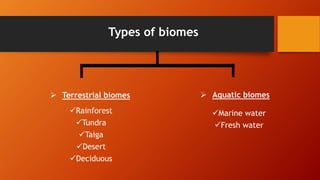
Types of biomes
 Terrestrial biomes
Rainforest
Tundra
Taiga
Desert
Deciduous
 Aquatic biomes
Marine water
Fresh water
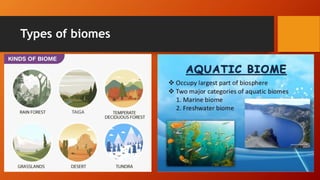
Types of biomes
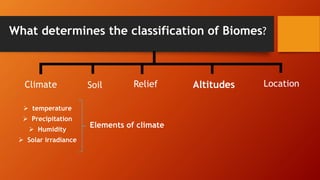
What determines the classification of Biomes?
 temperature
 Precipitation
 Humidity
 Solar irradiance
Altitudes
Soil Relief Location
Climate
Elements of climate
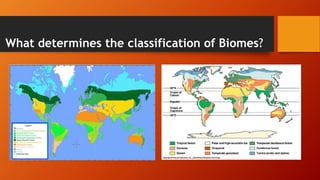
What determines the classification of Biomes?
Tropical Rain forest biomes
The tropical rainforest is the world’s most threatened biomes, despite
being of home to some most diverse and unique species on the planet.
Tropical rainforests are defined by the fact that they are hot and wet,
typical of tropical climates. ( hot and humid )
It covers about 7% of the Earth’s surface.
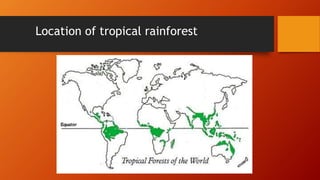
Found near equator.
Location of tropical rainforest
Abiotic factors
• Climate : hot and wet( closest to equator), it is warm and have rainfall year round,
with little to no dry season.
• Temperature : ranges from 21 degree to 30 degree Celsius . The average annual
temperature is above 20 degree Celsius.
• Precipitation : rainfall in this area is rain round, particularly there are little to no
seasonal changes in weather. Tropical rainforest receive annual precipitation
amount of 60 to 160 inches. Some rain forest in the world experience annual
rainfall amount of almost 400 inches (1000 cm).
• Soil: soil are not very fertile, red in colour.
Plants adaptations
• Sunlight is major limiting factor
• Plants grow in layers
Emergent layer
The canopy layer
The understory layer
The ground stratum
• Little sunlight reaches the floor.
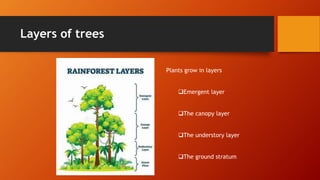
Layers of trees
Plants grow in layers
Emergent layer
The canopy layer
The understory layer
The ground stratum
Animal adaptations
• Sloths
• Snakes
• Rodents
• Frogs
• Birds
• Monkeys etc.
 identified approximately
15 million different
species of animals.
Major threats
• Human threats
Logging interest
Power plants & other industries
Paper industries
Cattle industries
Agriculture industries
Mining operations
Government & industries
Hydroelectric projects
MAJOR THREATS
NATURAL THREATS
Forest fire
Volcano activity
Drought
Tropical storm

Tropical rainforest biomes

  • 1.
    Tropical rainforest biomes Preparedby Jintu moni Bhuyan & Sagarika Barman M.Sc. 1st semester Department of Environmental science, Gauhati university
  • 2.
    We will belearned.. • What are biomes? • Types of Biomes. • What determines the classification of Biomes? • Rainforest Biomes. Tropical rainforest Biomes. • Abiotic factors (climate, soil etc.) • Plants Adaptations • Animals adaptations • Threats to Tropical Rainforests.
  • 3.
    What are biomes? •A biome refers to a community of flora and fauna that occurs naturally to form significant habitats. • Biomes are the collections of plants and animals that have common characteristics for the environment they exist in. • The sum of animals and plants or vegetations which develop under the same climatic conditions. • A biomes in an area is classified according to the species that live in that location. • The primary factor that determine the biomes is CLIMATE. (temperature, precipitation etc.)
  • 4.
    Types of biomes Terrestrial biomes Rainforest Tundra Taiga Desert Deciduous  Aquatic biomes Marine water Fresh water
  • 5.
  • 6.
    What determines theclassification of Biomes?  temperature  Precipitation  Humidity  Solar irradiance Altitudes Soil Relief Location Climate Elements of climate
  • 7.
    What determines theclassification of Biomes?
  • 8.
    Tropical Rain forestbiomes The tropical rainforest is the world’s most threatened biomes, despite being of home to some most diverse and unique species on the planet. Tropical rainforests are defined by the fact that they are hot and wet, typical of tropical climates. ( hot and humid ) It covers about 7% of the Earth’s surface. Found near equator.
  • 9.
  • 10.
    Abiotic factors • Climate: hot and wet( closest to equator), it is warm and have rainfall year round, with little to no dry season. • Temperature : ranges from 21 degree to 30 degree Celsius . The average annual temperature is above 20 degree Celsius. • Precipitation : rainfall in this area is rain round, particularly there are little to no seasonal changes in weather. Tropical rainforest receive annual precipitation amount of 60 to 160 inches. Some rain forest in the world experience annual rainfall amount of almost 400 inches (1000 cm). • Soil: soil are not very fertile, red in colour.
  • 11.
    Plants adaptations • Sunlightis major limiting factor • Plants grow in layers Emergent layer The canopy layer The understory layer The ground stratum • Little sunlight reaches the floor.
  • 12.
    Layers of trees Plantsgrow in layers Emergent layer The canopy layer The understory layer The ground stratum
  • 13.
    Animal adaptations • Sloths •Snakes • Rodents • Frogs • Birds • Monkeys etc.  identified approximately 15 million different species of animals.
  • 14.
    Major threats • Humanthreats Logging interest Power plants & other industries Paper industries Cattle industries Agriculture industries Mining operations Government & industries Hydroelectric projects
  • 15.
    MAJOR THREATS NATURAL THREATS Forestfire Volcano activity Drought Tropical storm