STARBUCKS COFFEE:Fair Trade or Fair MarketingPresented by:Jose Enrique Guadiana ChongAmy QiuTseli MohammedBrenna SchneiderAlex VolponeNa Wang14 March, 2011Managing the Triple Bottom LineInternational Business SchoolBrandeis University
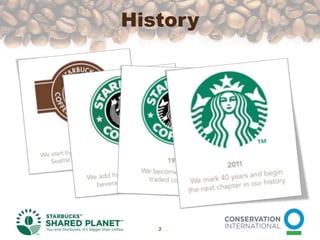
History2
Industry Setting1998: six companies control 50% of the world trade market 2000: US consumes 17% of the total consumption, but about 40% of the dollar volume sold2002: difficulty in terms of overproduction and non-responsible coffee growingNestlé, Procter & Gamble, Kraft, and Sara Lee accounted for approximately 70% of global roasting capacity and 40% of retail market.Roasters deal directly with importers, exporters or cooperativesPrice of coffee at its lowest in 30 years due to increasing supply of coffee from countries with low production costs.Supermarkets main retailers with 60% or more of the coffee sold in the USGourmet coffee market grows to 8% of the world coffee sales3
Partnership withConservation International (CI)CI and producers signed agreementsIndividual producers commit to delivering an authorized quantity of beans to their cooperatives, which in turn sign contracts with StarbucksCI had a team of three full time extensionists who” visited every farm and monitored progress and results” against the following criteria:No trees could be felled on producers’ farms or in the Biosphere ReserveNo coffee pulp could be thrown into the riversplanting of more and different varieties of shade treesCI provide training courses in the villages to the farmers, co-op managers, and technicians on quality control, organic farming methods, tree planting and pulping methods, among others.4
CSR Efforts“Our mission: to inspire and nurture the human spirit – one person, one cup and one neighborhood at a time.”Focus on:Ethical SourcingEnvironmentCommunity5
Ethical SourcingCoffee SourcingC.A.F.E. GuidelinesIncrease in Purchase of C.A.F.E. Certified CoffeeFair Trade and OrganicFarmer SupportFarmer Loans $14.5 millionCash Flow Challenges between harvests6“We've always believed that businesses can - and should - have a positive impact on the communities they serve.”
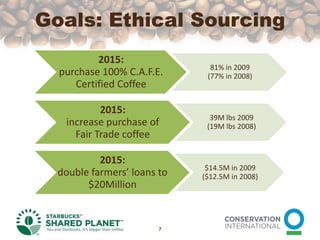
Goals: Ethical Sourcing7
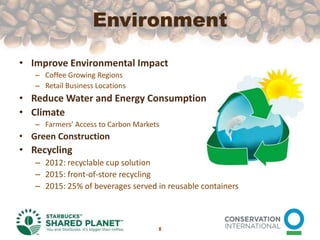
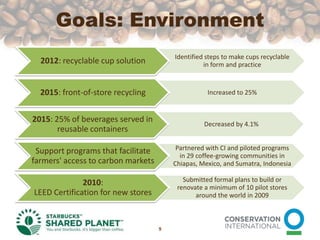
EnvironmentImprove Environmental ImpactCoffee Growing RegionsRetail Business LocationsReduce Water and Energy ConsumptionClimateFarmers’ Access to Carbon MarketsGreen ConstructionRecycling2012: recyclable cup solution2015: front-of-store recycling2015: 25% of beverages served in reusable containers8
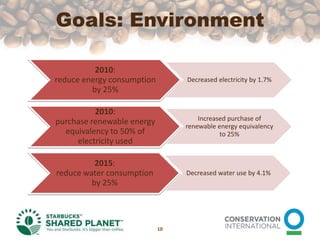
Goals: Environment9
Goals: Environment10
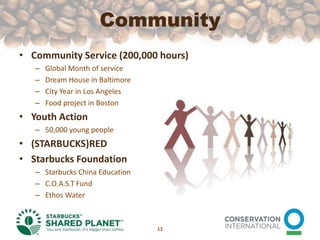
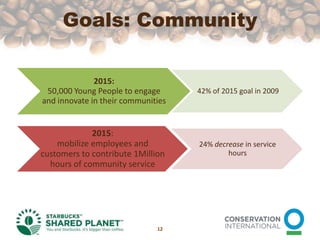
CommunityCommunity Service (200,000 hours)Global Month of serviceDream House in BaltimoreCity Year in Los AngelesFood project in BostonYouth Action50,000 young people(STARBUCKS)REDStarbucks FoundationStarbucks China Education ProjectC.O.A.S.T FundEthos Water11
Goals: Community12
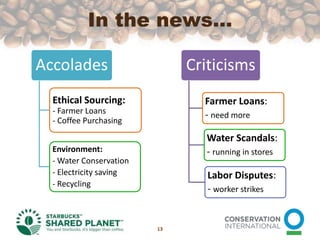
In the news…13
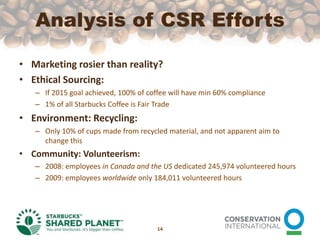
Analysis of CSR EffortsMarketing rosier than reality?Ethical Sourcing:If 2015 goal achieved, 100% of coffee will have min 60% compliance1% of all Starbucks Coffee is Fair TradeEnvironment: Recycling:Only 10% of cups made from recycled material, and not apparent aim to change thisCommunity: Volunteerism:2008: employees in Canada and the US dedicated 245,974 volunteered hours2009: employees worldwide only 184,011 volunteered hours14
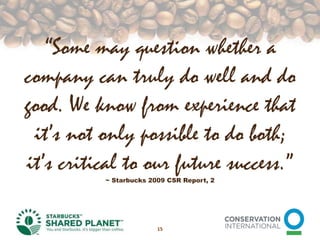
“Some may question whether a company can truly do well and do good. We know from experience that it’s not only possible to do both; it’s critical to our future success.” ~ Starbucks 2009 CSR Report, 215

Triple Bottom Line - Starbucks Coffee

  • 1.
    STARBUCKS COFFEE:Fair Tradeor Fair MarketingPresented by:Jose Enrique Guadiana ChongAmy QiuTseli MohammedBrenna SchneiderAlex VolponeNa Wang14 March, 2011Managing the Triple Bottom LineInternational Business SchoolBrandeis University
  • 2.
  • 3.
    Industry Setting1998: sixcompanies control 50% of the world trade market 2000: US consumes 17% of the total consumption, but about 40% of the dollar volume sold2002: difficulty in terms of overproduction and non-responsible coffee growingNestlé, Procter & Gamble, Kraft, and Sara Lee accounted for approximately 70% of global roasting capacity and 40% of retail market.Roasters deal directly with importers, exporters or cooperativesPrice of coffee at its lowest in 30 years due to increasing supply of coffee from countries with low production costs.Supermarkets main retailers with 60% or more of the coffee sold in the USGourmet coffee market grows to 8% of the world coffee sales3
  • 4.
    Partnership withConservation International(CI)CI and producers signed agreementsIndividual producers commit to delivering an authorized quantity of beans to their cooperatives, which in turn sign contracts with StarbucksCI had a team of three full time extensionists who” visited every farm and monitored progress and results” against the following criteria:No trees could be felled on producers’ farms or in the Biosphere ReserveNo coffee pulp could be thrown into the riversplanting of more and different varieties of shade treesCI provide training courses in the villages to the farmers, co-op managers, and technicians on quality control, organic farming methods, tree planting and pulping methods, among others.4
  • 5.
    CSR Efforts“Our mission:to inspire and nurture the human spirit – one person, one cup and one neighborhood at a time.”Focus on:Ethical SourcingEnvironmentCommunity5
  • 6.
    Ethical SourcingCoffee SourcingC.A.F.E.GuidelinesIncrease in Purchase of C.A.F.E. Certified CoffeeFair Trade and OrganicFarmer SupportFarmer Loans $14.5 millionCash Flow Challenges between harvests6“We've always believed that businesses can - and should - have a positive impact on the communities they serve.”
  • 7.
  • 8.
    EnvironmentImprove Environmental ImpactCoffeeGrowing RegionsRetail Business LocationsReduce Water and Energy ConsumptionClimateFarmers’ Access to Carbon MarketsGreen ConstructionRecycling2012: recyclable cup solution2015: front-of-store recycling2015: 25% of beverages served in reusable containers8
  • 9.
  • 10.
  • 11.
    CommunityCommunity Service (200,000hours)Global Month of serviceDream House in BaltimoreCity Year in Los AngelesFood project in BostonYouth Action50,000 young people(STARBUCKS)REDStarbucks FoundationStarbucks China Education ProjectC.O.A.S.T FundEthos Water11
  • 12.
  • 13.
  • 14.
    Analysis of CSREffortsMarketing rosier than reality?Ethical Sourcing:If 2015 goal achieved, 100% of coffee will have min 60% compliance1% of all Starbucks Coffee is Fair TradeEnvironment: Recycling:Only 10% of cups made from recycled material, and not apparent aim to change thisCommunity: Volunteerism:2008: employees in Canada and the US dedicated 245,974 volunteered hours2009: employees worldwide only 184,011 volunteered hours14
  • 15.
    “Some may questionwhether a company can truly do well and do good. We know from experience that it’s not only possible to do both; it’s critical to our future success.” ~ Starbucks 2009 CSR Report, 215