[MSB446 Supply Chain Management]
Starbucks
Case Study- Stanford Graduate School of Business
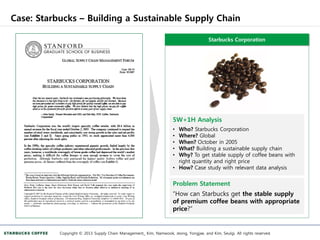
Starbucks Corporation: Building a Sustainable Supply Chain
Kim, Namwook
Jeong, Yongjae
Kim, Seulgi
2013.06.13.
Contents
Copyright © 2013 Supply Chain Management_ Kim, Namwook, Jeong, Yongjae, and Kim, Seulgi. All rights reserved.
1. Overview on Starbucks
: Why This Company and Why This Issue Matters
2. Case: Starbucks- Building a Sustainable Supply Chain
2.1 Case Introduction
2.2 C.A.F.E. Practice and results
3. Current Situation of Starbucks
4. Starbucks in Korean Market
5. Conclusion
Overview on Starbucks
Copyright © 2013 Supply Chain Management_ Kim, Namwook, Jeong, Yongjae, and Kim, Seulgi. All rights reserved.
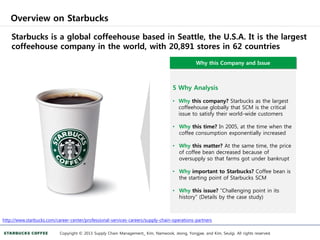
Starbucks is a global coffeehouse based in Seattle, the U.S.A. It is the largest
coffeehouse company in the world, with 20,891 stores in 62 countries
5 Why Analysis
• Why this company? Starbucks as the largest
coffeehouse globally that SCM is the critical
issue to satisfy their world-wide customers
• Why this time? In 2005, at the time when the
coffee consumption exponentially increased
• Why this matter? At the same time, the price
of coffee bean decreased because of
oversupply so that farms got under bankrupt
• Why important to Starbucks? Coffee bean is
the starting point of Starbucks SCM
• Why this issue? “Challenging point in its
history” (Details by the case study)
Why this Company and Issue
http://www.starbucks.com/career-center/professional-services-careers/supply-chain-operations-partners
Case: Starbucks – Building a Sustainable Supply Chain
Copyright © 2013 Supply Chain Management_ Kim, Namwook, Jeong, Yongjae, and Kim, Seulgi. All rights reserved.
Starbucks Corporation
5W+1H Analysis
• Who? Starbucks Corporation
• Where? Global
• When? October in 2005
• What? Building a sustainable supply chain
• Why? To get stable supply of coffee beans with
right quantity and right price
• How? Case study with relevant data analysis
Problem Statement
“How can Starbucks get the stable supply
of premium coffee beans with appropriate
price?”
Copyright © 2013 Supply Chain Management_ Kim, Namwook, Jeong, Yongjae, and Kim, Seulgi. All rights reserved.
Where the story begins – early 2000s
Problem Recognition
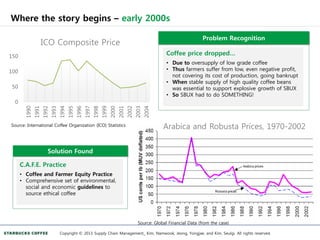
Coffee price dropped…
• Due to oversupply of low grade coffee
• Thus farmers suffer from low, even negative profit,
not covering its cost of production, going bankrupt
• When stable supply of high quality coffee beans
was essential to support explosive growth of SBUX
• So SBUX had to do SOMETHING!
Source: International Coffee Organization (ICO) Statistics
0
50
100
150
1990
1991
1992
1993
1994
1995
1996
1997
1998
1999
2000
2001
2002
2003
2004
ICO Composite Price
Source: Global Financial Data (from the case)
Arabica and Robusta Prices, 1970-2002
Solution Found
C.A.F.E. Practice
• Coffee and Farmer Equity Practice
• Comprehensive set of environmental,
social and economic guidelines to
source ethical coffee
Buyer
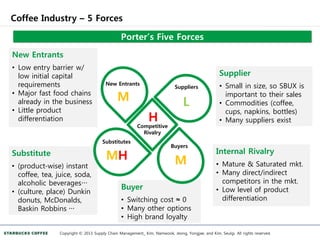
• Switching cost ≈ 0
• Many other options
• High brand loyalty
Substitute
• (product-wise) instant
coffee, tea, juice, soda,
alcoholic beverages∙∙∙
• (culture, place) Dunkin
donuts, McDonalds,
Baskin Robbins ∙∙∙
Coffee Industry – 5 Forces
Copyright © 2013 Supply Chain Management_ Kim, Namwook, Jeong, Yongjae, and Kim, Seulgi. All rights reserved.
H
MH
L
New Entrants
Suppliers
Buyers
Substitutes
Competitive
Rivalry
M
M
New Entrants
• Low entry barrier w/
low initial capital
requirements
• Major fast food chains
already in the business
• Little product
differentiation
Porter’s Five Forces
Supplier
• Small in size, so SBUX is
important to their sales
• Commodities (coffee,
cups, napkins, bottles)
• Many suppliers exist
Internal Rivalry
• Mature & Saturated mkt.
• Many direct/indirect
competitors in the mkt.
• Low level of product
differentiation
Copyright © 2013 Supply Chain Management_ Kim, Namwook, Jeong, Yongjae, and Kim, Seulgi. All rights reserved.
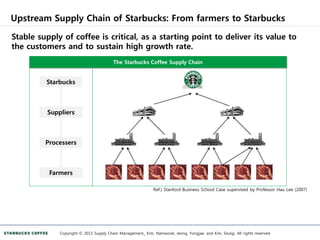
Upstream Supply Chain of Starbucks: From farmers to Starbucks
Stable supply of coffee is critical, as a starting point to deliver its value to
the customers and to sustain high growth rate.
Farmers
Processers
Suppliers
Starbucks
The Starbucks Coffee Supply Chain
Ref.) Stanford Business School Case supervised by Professor Hau Lee (2007)
C.A.F.E. Practice
Copyright © 2013 Supply Chain Management_ Kim, Namwook, Jeong, Yongjae, and Kim, Seulgi. All rights reserved.
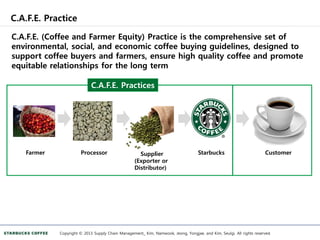
C.A.F.E. (Coffee and Farmer Equity) Practice is the comprehensive set of
environmental, social, and economic coffee buying guidelines, designed to
support coffee buyers and farmers, ensure high quality coffee and promote
equitable relationships for the long term
Farmer Processor Supplier
(Exporter or
Distributor)
Starbucks Customer
C.A.F.E. Practices
Initial Objectives of C.A.F.E. Practice
Copyright © 2013 Supply Chain Management_ Kim, Namwook, Jeong, Yongjae, and Kim, Seulgi. All rights reserved.
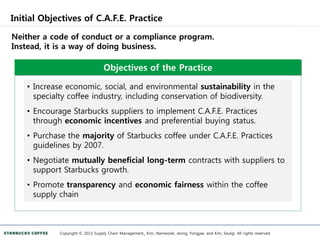
Neither a code of conduct or a compliance program.
Instead, it is a way of doing business.
Objectives of the Practice
• Increase economic, social, and environmental sustainability in the
specialty coffee industry, including conservation of biodiversity.
• Encourage Starbucks suppliers to implement C.A.F.E. Practices
through economic incentives and preferential buying status.
• Purchase the majority of Starbucks coffee under C.A.F.E. Practices
guidelines by 2007.
• Negotiate mutually beneficial long-term contracts with suppliers to
support Starbucks growth.
• Promote transparency and economic fairness within the coffee
supply chain
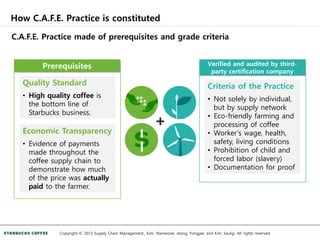
How C.A.F.E. Practice is constituted
Copyright © 2013 Supply Chain Management_ Kim, Namwook, Jeong, Yongjae, and Kim, Seulgi. All rights reserved.
C.A.F.E. Practice made of prerequisites and grade criteria
Prerequisites Verified and audited by third-
party certification company
Quality Standard
• High quality coffee is
the bottom line of
Starbucks business.
Economic Transparency
• Evidence of payments
made throughout the
coffee supply chain to
demonstrate how much
of the price was actually
paid to the farmer.
Criteria of the Practice
• Not solely by individual,
but by supply network
• Eco-friendly farming and
processing of coffee
• Worker’s wage, health,
safety, living conditions
• Prohibition of child and
forced labor (slavery)
• Documentation for proof
How C.A.F.E. Practice improved SBUX Value Chain
Copyright © 2013 Supply Chain Management_ Kim, Namwook, Jeong, Yongjae, and Kim, Seulgi. All rights reserved.
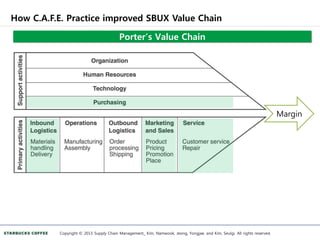
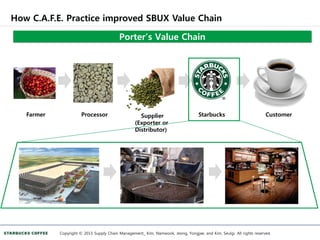
Porter’s Value Chain
Margin
How C.A.F.E. Practice improved SBUX Value Chain
Copyright © 2013 Supply Chain Management_ Kim, Namwook, Jeong, Yongjae, and Kim, Seulgi. All rights reserved.
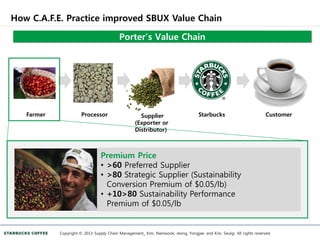
Porter’s Value Chain
Farmer Processor Supplier
(Exporter or
Distributor)
Starbucks Customer
Premium Price
• >60 Preferred Supplier
• >80 Strategic Supplier (Sustainability
Conversion Premium of $0.05/lb)
• +10>80 Sustainability Performance
Premium of $0.05/lb
How C.A.F.E. Practice improved SBUX Value Chain
Copyright © 2013 Supply Chain Management_ Kim, Namwook, Jeong, Yongjae, and Kim, Seulgi. All rights reserved.
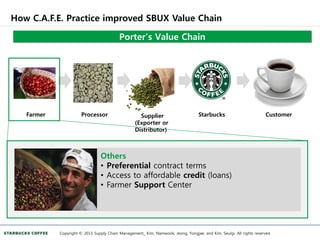
Porter’s Value Chain
Farmer Processor Supplier
(Exporter or
Distributor)
Starbucks Customer
Others
• Preferential contract terms
• Access to affordable credit (loans)
• Farmer Support Center
How C.A.F.E. Practice improved SBUX Value Chain
Copyright © 2013 Supply Chain Management_ Kim, Namwook, Jeong, Yongjae, and Kim, Seulgi. All rights reserved.
Porter’s Value Chain
Farmer Processor Supplier
(Exporter or
Distributor)
Starbucks Customer
How C.A.F.E. Practice improved SBUX Value Chain
Copyright © 2013 Supply Chain Management_ Kim, Namwook, Jeong, Yongjae, and Kim, Seulgi. All rights reserved.
Porter’s Value Chain
Farmer Processor Supplier
(Exporter or
Distributor)
Starbucks Customer
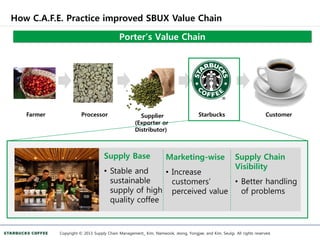
Supply Base
• Stable and
sustainable
supply of high
quality coffee
Marketing-wise
• Increase
customers’
perceived value
Supply Chain
Visibility
• Better handling
of problems
Copyright © 2013 Supply Chain Management_ Kim, Namwook, Jeong, Yongjae, and Kim, Seulgi. All rights reserved.
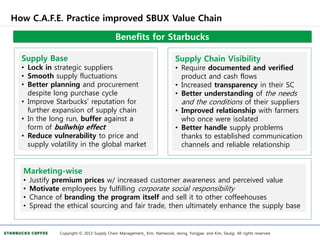
Supply Base
• Lock in strategic suppliers
• Smooth supply fluctuations
• Better planning and procurement
despite long purchase cycle
• Improve Starbucks’ reputation for
further expansion of supply chain
• In the long run, buffer against a
form of bullwhip effect
• Reduce vulnerability to price and
supply volatility in the global market
Marketing-wise
• Justify premium prices w/ increased customer awareness and perceived value
• Motivate employees by fulfilling corporate social responsibility
• Chance of branding the program itself and sell it to other coffeehouses
• Spread the ethical sourcing and fair trade, then ultimately enhance the supply base
Supply Chain Visibility
• Require documented and verified
product and cash flows
• Increased transparency in their SC
• Better understanding of the needs
and the conditions of their suppliers
• Improved relationship with farmers
who once were isolated
• Better handle supply problems
thanks to established communication
channels and reliable relationship
Benefits for Starbucks
How C.A.F.E. Practice improved SBUX Value Chain
Current Situation_ Challenges and Its Resolution
Copyright © 2013 Supply Chain Management_ Kim, Namwook, Jeong, Yongjae, and Kim, Seulgi. All rights reserved.
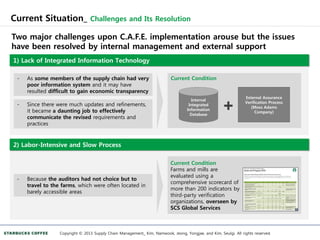
Two major challenges upon C.A.F.E. implementation arouse but the issues
have been resolved by internal management and external support
1) Lack of Integrated Information Technology
2) Labor-Intensive and Slow Process
- As some members of the supply chain had very
poor information system and it may have
resulted difficult to gain economic transparency
- Since there were much updates and refinements,
it became a daunting job to effectively
communicate the revised requirements and
practices
- Because the auditors had not choice but to
travel to the farms, which were often located in
barely accessible areas
Current Condition
Current Condition
Farms and mills are
evaluated using a
comprehensive scorecard of
more than 200 indicators by
third-party verification
organizations, overseen by
SCS Global Services
Internal
Integrated
Information
Database
External Assurance
Verification Process
(Moss Adams
Company)
Current Situation_ Coffee
Copyright © 2013 Supply Chain Management_ Kim, Namwook, Jeong, Yongjae, and Kim, Seulgi. All rights reserved.
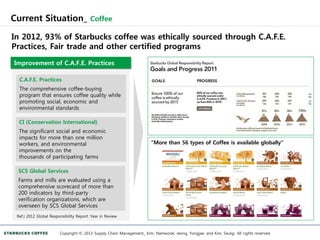
In 2012, 93% of Starbucks coffee was ethically sourced through C.A.F.E.
Practices, Fair trade and other certified programs
C.A.F.E. Practices
The comprehensive coffee-buying
program that ensures coffee quality while
promoting social, economic and
environmental standards
CI (Conservation International)
The significant social and economic
impacts for more than one million
workers, and environmental
improvements on the
thousands of participating farms
SCS Global Services
Farms and mills are evaluated using a
comprehensive scorecard of more than
200 indicators by third-party
verification organizations, which are
overseen by SCS Global Services
Improvement of C.A.F.E. Practices
Ref.) 2012 Global Responsibility Report: Year in Review
“More than 56 types of Coffee is available globally”
Current Situation_ Tea, Cocoa, and Store Merchandise Sourcing
Copyright © 2013 Supply Chain Management_ Kim, Namwook, Jeong, Yongjae, and Kim, Seulgi. All rights reserved.
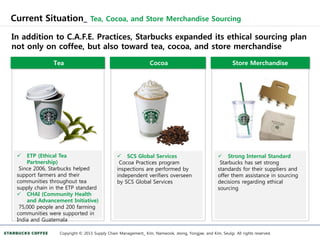
In addition to C.A.F.E. Practices, Starbucks expanded its ethical sourcing plan
not only on coffee, but also toward tea, cocoa, and store merchandise
Tea Cocoa Store Merchandise
 ETP (Ethical Tea
Partnership)
Since 2006, Starbucks helped
support farmers and their
communities throughout tea
supply chain in the ETP standard
 CHAI (Community Health
and Advancement Initiative)
75,000 people and 200 farming
communities were supported in
India and Guatemala
 SCS Global Services
Cocoa Practices program
inspections are performed by
independent verifiers overseen
by SCS Global Services
 Strong Internal Standard
Starbucks has set strong
standards for their suppliers and
offer them assistance in sourcing
decisions regarding ethical
sourcing
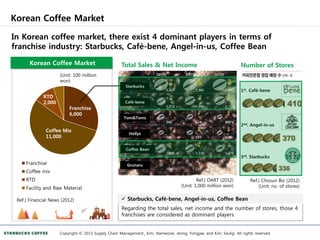
Regarding the total sales, net income and the number of stores, those 4
franchises are considered as dominant players
Copyright © 2013 Supply Chain Management_ Kim, Namwook, Jeong, Yongjae, and Kim, Seulgi. All rights reserved.
In Korean coffee market, there exist 4 dominant players in terms of
franchise industry: Starbucks, Café-bene, Angel-in-us, Coffee Bean
Franchise
Coffee mix
RTD
Facility and Raw Material
Coffee Mix
11,000
Franchise
6,000
(Unit: 100 million
won)
Ref.) Financial News (2012)
Korean Coffee Market
RTD
2,000
Total Sales & Net Income Number of Stores
Ref.) DART (2012)
(Unit: 1,000 million won)
Starbucks
Café-bene
Tom&Toms
Hollys
Coffee Bean
Grunaru
Ref.) Chosun Biz (2012)
(Unit: no. of stores)
1st. Café-bene
2nd. Angel-in-us
3rd. Starbucks
 Starbucks, Café-bene, Angel-in-us, Coffee Bean
Korean Coffee Market
Competitor Analysis
Copyright © 2013 Supply Chain Management_ Kim, Namwook, Jeong, Yongjae, and Kim, Seulgi. All rights reserved.
Information acquired via
Cold call interview on June 10
Café-bene : Mrs.Jang
(Supervisor of PR)
Angelinus : Mr. Seo
(Supervisor of purchasing)
Coffee-bene : Mr.Kim
(Member of purchasing)
Starbucks : Mr.Yoon
(Supervisor of SCM part)
HighLow Medium
1 2 3 4 5
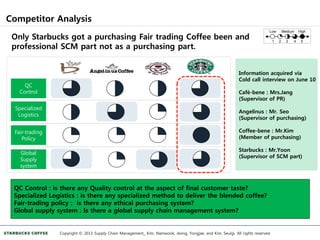
Only Starbucks got a purchasing Fair trading Coffee been and
professional SCM part not as a purchasing part.
QC Control : is there any Quality control at the aspect of final customer taste?
Specialized Logistics : is there any specialized method to deliver the blended coffee?
Fair-trading policy : is there any ethical purchasing system?
Global supply system : Is there a global supply chain management system?
QC
Control
Specialized
Logistics
Fair-trading
Policy
Global
Supply
system
Copyright © 2013 Supply Chain Management_ Kim, Namwook, Jeong, Yongjae, and Kim, Seulgi. All rights reserved.
Current Situation _ Real application
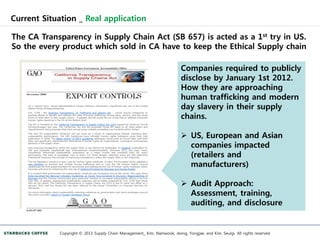
The CA Transparency in Supply Chain Act (SB 657) is acted as a 1st try in US.
So the every product which sold in CA have to keep the Ethical Supply chain
Companies required to publicly
disclose by January 1st 2012.
How they are approaching
human trafficking and modern
day slavery in their supply
chains.
 US, European and Asian
companies impacted
(retailers and
manufacturers)
 Audit Approach:
Assessment, training,
auditing, and disclosure
PEST Analysis_ Macro Factors
Copyright © 2013 Supply Chain Management_ Kim, Namwook, Jeong, Yongjae, and Kim, Seulgi. All rights reserved.
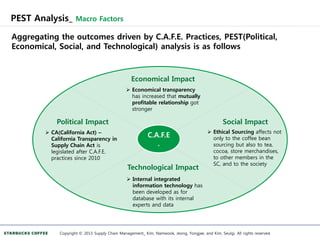
Aggregating the outcomes driven by C.A.F.E. Practices, PEST(Political,
Economical, Social, and Technological) analysis is as follows
C.A.F.E
.
Political Impact
Economical Impact
Social Impact
Technological Impact
 CA(California Act) –
California Transparency in
Supply Chain Act is
legislated after C.A.F.E.
practices since 2010
 Ethical Sourcing affects not
only to the coffee bean
sourcing but also to tea,
cocoa, store merchandises,
to other members in the
SC, and to the society
 Economical transparency
has increased that mutually
profitable relationship got
stronger
 Internal integrated
information technology has
been developed as for
database with its internal
experts and data
Conclusion - C.A.F.E Practice
Copyright © 2013 Supply Chain Management_ Kim, Namwook, Jeong, Yongjae, and Kim, Seulgi. All rights reserved.
Video Clip

Starbucks Case Study : Building Sustainable Supply Chain

  • 1.
    [MSB446 Supply ChainManagement] Starbucks Case Study- Stanford Graduate School of Business Starbucks Corporation: Building a Sustainable Supply Chain Kim, Namwook Jeong, Yongjae Kim, Seulgi 2013.06.13.
  • 2.
    Contents Copyright © 2013Supply Chain Management_ Kim, Namwook, Jeong, Yongjae, and Kim, Seulgi. All rights reserved. 1. Overview on Starbucks : Why This Company and Why This Issue Matters 2. Case: Starbucks- Building a Sustainable Supply Chain 2.1 Case Introduction 2.2 C.A.F.E. Practice and results 3. Current Situation of Starbucks 4. Starbucks in Korean Market 5. Conclusion
  • 3.
    Overview on Starbucks Copyright© 2013 Supply Chain Management_ Kim, Namwook, Jeong, Yongjae, and Kim, Seulgi. All rights reserved. Starbucks is a global coffeehouse based in Seattle, the U.S.A. It is the largest coffeehouse company in the world, with 20,891 stores in 62 countries 5 Why Analysis • Why this company? Starbucks as the largest coffeehouse globally that SCM is the critical issue to satisfy their world-wide customers • Why this time? In 2005, at the time when the coffee consumption exponentially increased • Why this matter? At the same time, the price of coffee bean decreased because of oversupply so that farms got under bankrupt • Why important to Starbucks? Coffee bean is the starting point of Starbucks SCM • Why this issue? “Challenging point in its history” (Details by the case study) Why this Company and Issue http://www.starbucks.com/career-center/professional-services-careers/supply-chain-operations-partners
  • 4.
    Case: Starbucks –Building a Sustainable Supply Chain Copyright © 2013 Supply Chain Management_ Kim, Namwook, Jeong, Yongjae, and Kim, Seulgi. All rights reserved. Starbucks Corporation 5W+1H Analysis • Who? Starbucks Corporation • Where? Global • When? October in 2005 • What? Building a sustainable supply chain • Why? To get stable supply of coffee beans with right quantity and right price • How? Case study with relevant data analysis Problem Statement “How can Starbucks get the stable supply of premium coffee beans with appropriate price?”
  • 5.
    Copyright © 2013Supply Chain Management_ Kim, Namwook, Jeong, Yongjae, and Kim, Seulgi. All rights reserved. Where the story begins – early 2000s Problem Recognition Coffee price dropped… • Due to oversupply of low grade coffee • Thus farmers suffer from low, even negative profit, not covering its cost of production, going bankrupt • When stable supply of high quality coffee beans was essential to support explosive growth of SBUX • So SBUX had to do SOMETHING! Source: International Coffee Organization (ICO) Statistics 0 50 100 150 1990 1991 1992 1993 1994 1995 1996 1997 1998 1999 2000 2001 2002 2003 2004 ICO Composite Price Source: Global Financial Data (from the case) Arabica and Robusta Prices, 1970-2002 Solution Found C.A.F.E. Practice • Coffee and Farmer Equity Practice • Comprehensive set of environmental, social and economic guidelines to source ethical coffee
  • 6.
    Buyer • Switching cost≈ 0 • Many other options • High brand loyalty Substitute • (product-wise) instant coffee, tea, juice, soda, alcoholic beverages∙∙∙ • (culture, place) Dunkin donuts, McDonalds, Baskin Robbins ∙∙∙ Coffee Industry – 5 Forces Copyright © 2013 Supply Chain Management_ Kim, Namwook, Jeong, Yongjae, and Kim, Seulgi. All rights reserved. H MH L New Entrants Suppliers Buyers Substitutes Competitive Rivalry M M New Entrants • Low entry barrier w/ low initial capital requirements • Major fast food chains already in the business • Little product differentiation Porter’s Five Forces Supplier • Small in size, so SBUX is important to their sales • Commodities (coffee, cups, napkins, bottles) • Many suppliers exist Internal Rivalry • Mature & Saturated mkt. • Many direct/indirect competitors in the mkt. • Low level of product differentiation
  • 7.
    Copyright © 2013Supply Chain Management_ Kim, Namwook, Jeong, Yongjae, and Kim, Seulgi. All rights reserved. Upstream Supply Chain of Starbucks: From farmers to Starbucks Stable supply of coffee is critical, as a starting point to deliver its value to the customers and to sustain high growth rate. Farmers Processers Suppliers Starbucks The Starbucks Coffee Supply Chain Ref.) Stanford Business School Case supervised by Professor Hau Lee (2007)
  • 8.
    C.A.F.E. Practice Copyright ©2013 Supply Chain Management_ Kim, Namwook, Jeong, Yongjae, and Kim, Seulgi. All rights reserved. C.A.F.E. (Coffee and Farmer Equity) Practice is the comprehensive set of environmental, social, and economic coffee buying guidelines, designed to support coffee buyers and farmers, ensure high quality coffee and promote equitable relationships for the long term Farmer Processor Supplier (Exporter or Distributor) Starbucks Customer C.A.F.E. Practices
  • 9.
    Initial Objectives ofC.A.F.E. Practice Copyright © 2013 Supply Chain Management_ Kim, Namwook, Jeong, Yongjae, and Kim, Seulgi. All rights reserved. Neither a code of conduct or a compliance program. Instead, it is a way of doing business. Objectives of the Practice • Increase economic, social, and environmental sustainability in the specialty coffee industry, including conservation of biodiversity. • Encourage Starbucks suppliers to implement C.A.F.E. Practices through economic incentives and preferential buying status. • Purchase the majority of Starbucks coffee under C.A.F.E. Practices guidelines by 2007. • Negotiate mutually beneficial long-term contracts with suppliers to support Starbucks growth. • Promote transparency and economic fairness within the coffee supply chain
  • 10.
    How C.A.F.E. Practiceis constituted Copyright © 2013 Supply Chain Management_ Kim, Namwook, Jeong, Yongjae, and Kim, Seulgi. All rights reserved. C.A.F.E. Practice made of prerequisites and grade criteria Prerequisites Verified and audited by third- party certification company Quality Standard • High quality coffee is the bottom line of Starbucks business. Economic Transparency • Evidence of payments made throughout the coffee supply chain to demonstrate how much of the price was actually paid to the farmer. Criteria of the Practice • Not solely by individual, but by supply network • Eco-friendly farming and processing of coffee • Worker’s wage, health, safety, living conditions • Prohibition of child and forced labor (slavery) • Documentation for proof
  • 11.
    How C.A.F.E. Practiceimproved SBUX Value Chain Copyright © 2013 Supply Chain Management_ Kim, Namwook, Jeong, Yongjae, and Kim, Seulgi. All rights reserved. Porter’s Value Chain Margin
  • 12.
    How C.A.F.E. Practiceimproved SBUX Value Chain Copyright © 2013 Supply Chain Management_ Kim, Namwook, Jeong, Yongjae, and Kim, Seulgi. All rights reserved. Porter’s Value Chain Farmer Processor Supplier (Exporter or Distributor) Starbucks Customer Premium Price • >60 Preferred Supplier • >80 Strategic Supplier (Sustainability Conversion Premium of $0.05/lb) • +10>80 Sustainability Performance Premium of $0.05/lb
  • 13.
    How C.A.F.E. Practiceimproved SBUX Value Chain Copyright © 2013 Supply Chain Management_ Kim, Namwook, Jeong, Yongjae, and Kim, Seulgi. All rights reserved. Porter’s Value Chain Farmer Processor Supplier (Exporter or Distributor) Starbucks Customer Others • Preferential contract terms • Access to affordable credit (loans) • Farmer Support Center
  • 14.
    How C.A.F.E. Practiceimproved SBUX Value Chain Copyright © 2013 Supply Chain Management_ Kim, Namwook, Jeong, Yongjae, and Kim, Seulgi. All rights reserved. Porter’s Value Chain Farmer Processor Supplier (Exporter or Distributor) Starbucks Customer
  • 15.
    How C.A.F.E. Practiceimproved SBUX Value Chain Copyright © 2013 Supply Chain Management_ Kim, Namwook, Jeong, Yongjae, and Kim, Seulgi. All rights reserved. Porter’s Value Chain Farmer Processor Supplier (Exporter or Distributor) Starbucks Customer Supply Base • Stable and sustainable supply of high quality coffee Marketing-wise • Increase customers’ perceived value Supply Chain Visibility • Better handling of problems
  • 16.
    Copyright © 2013Supply Chain Management_ Kim, Namwook, Jeong, Yongjae, and Kim, Seulgi. All rights reserved. Supply Base • Lock in strategic suppliers • Smooth supply fluctuations • Better planning and procurement despite long purchase cycle • Improve Starbucks’ reputation for further expansion of supply chain • In the long run, buffer against a form of bullwhip effect • Reduce vulnerability to price and supply volatility in the global market Marketing-wise • Justify premium prices w/ increased customer awareness and perceived value • Motivate employees by fulfilling corporate social responsibility • Chance of branding the program itself and sell it to other coffeehouses • Spread the ethical sourcing and fair trade, then ultimately enhance the supply base Supply Chain Visibility • Require documented and verified product and cash flows • Increased transparency in their SC • Better understanding of the needs and the conditions of their suppliers • Improved relationship with farmers who once were isolated • Better handle supply problems thanks to established communication channels and reliable relationship Benefits for Starbucks How C.A.F.E. Practice improved SBUX Value Chain
  • 17.
    Current Situation_ Challengesand Its Resolution Copyright © 2013 Supply Chain Management_ Kim, Namwook, Jeong, Yongjae, and Kim, Seulgi. All rights reserved. Two major challenges upon C.A.F.E. implementation arouse but the issues have been resolved by internal management and external support 1) Lack of Integrated Information Technology 2) Labor-Intensive and Slow Process - As some members of the supply chain had very poor information system and it may have resulted difficult to gain economic transparency - Since there were much updates and refinements, it became a daunting job to effectively communicate the revised requirements and practices - Because the auditors had not choice but to travel to the farms, which were often located in barely accessible areas Current Condition Current Condition Farms and mills are evaluated using a comprehensive scorecard of more than 200 indicators by third-party verification organizations, overseen by SCS Global Services Internal Integrated Information Database External Assurance Verification Process (Moss Adams Company)
  • 18.
    Current Situation_ Coffee Copyright© 2013 Supply Chain Management_ Kim, Namwook, Jeong, Yongjae, and Kim, Seulgi. All rights reserved. In 2012, 93% of Starbucks coffee was ethically sourced through C.A.F.E. Practices, Fair trade and other certified programs C.A.F.E. Practices The comprehensive coffee-buying program that ensures coffee quality while promoting social, economic and environmental standards CI (Conservation International) The significant social and economic impacts for more than one million workers, and environmental improvements on the thousands of participating farms SCS Global Services Farms and mills are evaluated using a comprehensive scorecard of more than 200 indicators by third-party verification organizations, which are overseen by SCS Global Services Improvement of C.A.F.E. Practices Ref.) 2012 Global Responsibility Report: Year in Review “More than 56 types of Coffee is available globally”
  • 19.
    Current Situation_ Tea,Cocoa, and Store Merchandise Sourcing Copyright © 2013 Supply Chain Management_ Kim, Namwook, Jeong, Yongjae, and Kim, Seulgi. All rights reserved. In addition to C.A.F.E. Practices, Starbucks expanded its ethical sourcing plan not only on coffee, but also toward tea, cocoa, and store merchandise Tea Cocoa Store Merchandise  ETP (Ethical Tea Partnership) Since 2006, Starbucks helped support farmers and their communities throughout tea supply chain in the ETP standard  CHAI (Community Health and Advancement Initiative) 75,000 people and 200 farming communities were supported in India and Guatemala  SCS Global Services Cocoa Practices program inspections are performed by independent verifiers overseen by SCS Global Services  Strong Internal Standard Starbucks has set strong standards for their suppliers and offer them assistance in sourcing decisions regarding ethical sourcing
  • 20.
    Regarding the totalsales, net income and the number of stores, those 4 franchises are considered as dominant players Copyright © 2013 Supply Chain Management_ Kim, Namwook, Jeong, Yongjae, and Kim, Seulgi. All rights reserved. In Korean coffee market, there exist 4 dominant players in terms of franchise industry: Starbucks, Café-bene, Angel-in-us, Coffee Bean Franchise Coffee mix RTD Facility and Raw Material Coffee Mix 11,000 Franchise 6,000 (Unit: 100 million won) Ref.) Financial News (2012) Korean Coffee Market RTD 2,000 Total Sales & Net Income Number of Stores Ref.) DART (2012) (Unit: 1,000 million won) Starbucks Café-bene Tom&Toms Hollys Coffee Bean Grunaru Ref.) Chosun Biz (2012) (Unit: no. of stores) 1st. Café-bene 2nd. Angel-in-us 3rd. Starbucks  Starbucks, Café-bene, Angel-in-us, Coffee Bean Korean Coffee Market
  • 21.
    Competitor Analysis Copyright ©2013 Supply Chain Management_ Kim, Namwook, Jeong, Yongjae, and Kim, Seulgi. All rights reserved. Information acquired via Cold call interview on June 10 Café-bene : Mrs.Jang (Supervisor of PR) Angelinus : Mr. Seo (Supervisor of purchasing) Coffee-bene : Mr.Kim (Member of purchasing) Starbucks : Mr.Yoon (Supervisor of SCM part) HighLow Medium 1 2 3 4 5 Only Starbucks got a purchasing Fair trading Coffee been and professional SCM part not as a purchasing part. QC Control : is there any Quality control at the aspect of final customer taste? Specialized Logistics : is there any specialized method to deliver the blended coffee? Fair-trading policy : is there any ethical purchasing system? Global supply system : Is there a global supply chain management system? QC Control Specialized Logistics Fair-trading Policy Global Supply system
  • 22.
    Copyright © 2013Supply Chain Management_ Kim, Namwook, Jeong, Yongjae, and Kim, Seulgi. All rights reserved. Current Situation _ Real application The CA Transparency in Supply Chain Act (SB 657) is acted as a 1st try in US. So the every product which sold in CA have to keep the Ethical Supply chain Companies required to publicly disclose by January 1st 2012. How they are approaching human trafficking and modern day slavery in their supply chains.  US, European and Asian companies impacted (retailers and manufacturers)  Audit Approach: Assessment, training, auditing, and disclosure
  • 23.
    PEST Analysis_ MacroFactors Copyright © 2013 Supply Chain Management_ Kim, Namwook, Jeong, Yongjae, and Kim, Seulgi. All rights reserved. Aggregating the outcomes driven by C.A.F.E. Practices, PEST(Political, Economical, Social, and Technological) analysis is as follows C.A.F.E . Political Impact Economical Impact Social Impact Technological Impact  CA(California Act) – California Transparency in Supply Chain Act is legislated after C.A.F.E. practices since 2010  Ethical Sourcing affects not only to the coffee bean sourcing but also to tea, cocoa, store merchandises, to other members in the SC, and to the society  Economical transparency has increased that mutually profitable relationship got stronger  Internal integrated information technology has been developed as for database with its internal experts and data
  • 24.
    Conclusion - C.A.F.EPractice Copyright © 2013 Supply Chain Management_ Kim, Namwook, Jeong, Yongjae, and Kim, Seulgi. All rights reserved. Video Clip