Starbucks Coffee.
Girish Jadhwani
MBA II
Index
Sr.No Topic Slide No.
1 Introduction and even in India 3
2 Corporate governance 5
3 Organizational structure 6
4 Vision 7
5 Mission 8
6 Objectives 9
8 Strategies 10
9 Aida model of Starbucks 20
10 Bcg matrix of Starbucks 21
11 Product market growth matrix of Starbucks 22
12 PLC 23
13 SWOC 24
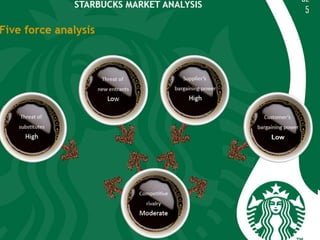
14 Five force analysis 25
Introduction
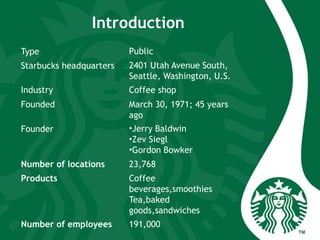
Type Public
Starbucks headquarters 2401 Utah Avenue South,
Seattle, Washington, U.S.
Industry Coffee shop
Founded March 30, 1971; 45 years
ago
Founder •Jerry Baldwin
•Zev Siegl
•Gordon Bowker
Number of locations 23,768
Products Coffee
beverages,smoothies
Tea,baked
goods,sandwiches
Number of employees 191,000
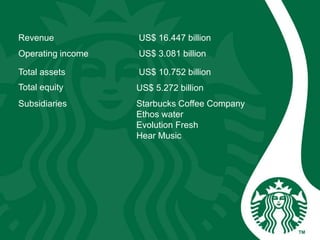
Revenue US$ 16.447 billion
Operating income US$ 3.081 billion
Total assets US$ 10.752 billion
Total equity US$ 5.272 billion
Subsidiaries Starbucks Coffee Company
Ethos water
Evolution Fresh
Hear Music
•The first Starbucks location opened in 1971.
•Starbucks original location in Seattle Washington.
•Starbucks has 20,400+ stores in 61 countries.
•Starbucks has 50-50 joint venture with TATA alliances.
Corporate governance
• January 2015, the chief operating officer of Starbucks
was Troy Alstead.
• Subsequently, Kevin Johnson was appointed to
succeed Alstead as president and COO.
• In October 2015, Starbucks hired its first Chief
Technology Officer, Gerri Martin-Flickinger , to lead
their technology team.
• Starbucks maintains control of production processes
by communicating with farmers to secure beans,
roasting its own beans, and managing distribution to
all retail locations. Additionally, Starbucks’ Coffee and
Farmer Equity Practices require suppliers to inform
Starbucks what portion of wholesale prices paid
reaches farmers
Vision
• Starbucks Coffee does not readily present
its vision statement. However, a careful
reading of the company’s website reveals
that its vision statement.
• “To establish Starbucks as the premier
purveyor of the finest coffee in the
world while maintaining our
uncompromising principles while we
grow.”
Mission
“ To inspire and nurture the human spirit -
One person, One cup, and One
Neighborhood at a time”.
• Inspire and nurture the human spirit
• One person, one cup and one neighbor at a
time
Objectives
• To maintain it’s standing as one of the
most recognized and respected brands in
the world.
• To continue to offer costumers new
coffee products in a variety of forms,
across new categories, and through
diverse channels.
• Tactical objectives are to increase their
market share in disciplined manner, by
selectively opening additional stores in
new and existing markets as well as
increasing sales in existing stores, to
support their long- term strategic
objectives and aims
Strategies
• Rapid store expansion strategy
• Domestic store expansion
• International store expansion
• Employee Training and Recognition
• Real Estate, Store Design, Planning, and
Construction
• Store ambience
• Marketing strategies.
Rapid store expansion strategy
• Domestic store expansion
− A three-year expansion strategy.
− “Starbucks everywhere” approach.
• International store expansion
− Company-owned and company-operated
stores or licensing.
− Created a new subsidiary, Starbucks
Coffee International.
− Expanded its consumer products channel
in South Pacific region.
Rapid store expansion strategy
(conti)
• Employee Training and Recognition
− Systems to recruit, hire and train baristas and store
managers.
 screening.
 training programs.
 awards for partners.
• Real Estate, Store Design, Planning, and
Construction
− A broad range of store formats (the right image and
character)
− A “stores of the future” project team
− High-traffic, high-visibility store locations
−Control of average store opening costs
−Wi-Fi availability at stores
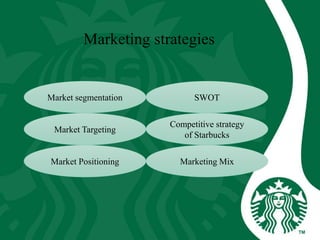
Marketing strategies
SWOTMarket segmentation
Market Targeting
Competitive strategy
of Starbucks
Market Positioning Marketing Mix
MARKET SEGMENTING
 Demographic segmentation(markets by age,
gender, income, ethnic background, and
family life cycle) .
 Geographic segmentation (markets by region
of a country or the world, market size, market
density, or climate)
 Psychographic segmentation, targeting
customers based on their lifestyle and
attitudes about ‘fairtrade' food.
 Behavioural segmentation , Occassion ,
loyalty program and rewards , benefit sought
with offers [ by using starbucks card ]
Targeting
Starbucks target market
• Age group:18 – 40
• Lifecycle: Young and adults
• Gender: Male and female
• Occupation: College students, persons in
managerial, executive, and professional positions
• Income: Middle and higher income earners
• Location: Main cities (Colombo, Kandy, Galle)
commercial areas
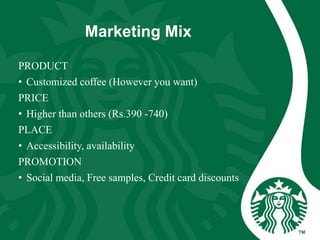
Marketing Mix
PRODUCT
• Customized coffee (However you want)
PRICE
• Higher than others (Rs.390 -740)
PLACE
• Accessibility, availability
PROMOTION
• Social media, Free samples, Credit card discounts
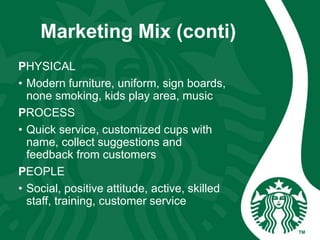
Marketing Mix (conti)
PHYSICAL
• Modern furniture, uniform, sign boards,
none smoking, kids play area, music
PROCESS
• Quick service, customized cups with
name, collect suggestions and
feedback from customers
PEOPLE
• Social, positive attitude, active, skilled
staff, training, customer service
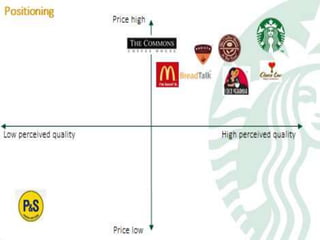
Positioning
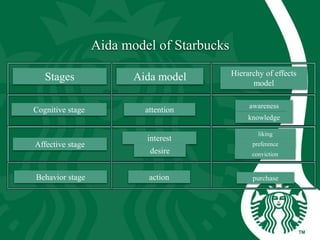
Aida model of Starbucks
Cognitive stage
Affective stage
Behavior stage
attention
interest
desire
action
Stages Aida model Hierarchy of effects
model
awareness
knowledge
liking
preference
conviction
purchase
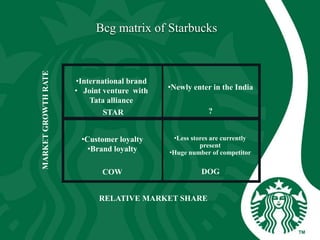
Bcg matrix of Starbucks
•International brand
• Joint venture with
Tata alliance
•Customer loyalty
•Brand loyalty
•Less stores are currently
present
•Huge number of competitor
RELATIVE MARKET SHARE
MARKETGROWTHRATE
•Newly enter in the India
STAR
COW DOG
?
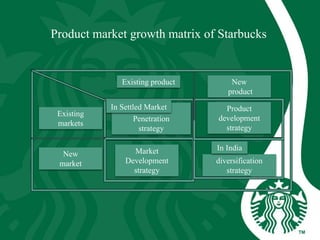
Market
Penetration
strategy
Market
Development
strategy
diversification
strategy
Product
development
strategy
Existing
markets
New
market
Existing product New
product
In India
In Settled Market
Product market growth matrix of Starbucks
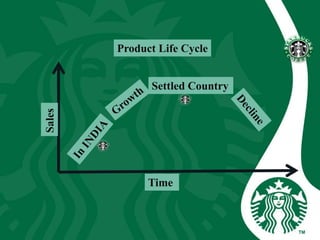
Settled Country
Product Life CycleSales
Time
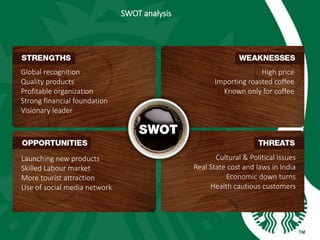
SWOT analysis
Global recognition
Quality products
Profitable organization
Strong financial foundation
Visionary leader
High price
Importing roasted coffee
Known only for coffee
Launching new products
Skilled Labour market
More tourist attraction
Use of social media network
Cultural & Political issues
Real State cost and laws in India
Economic down turns
Health cautious customers
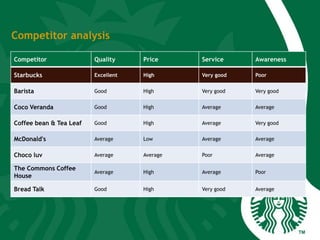
Competitor Quality Price Service Awareness
Starbucks Excellent High Very good Poor
Barista Good High Very good Very good
Coco Veranda Good High Average Average
Coffee bean & Tea Leaf Good High Average Very good
McDonald's Average Low Average Average
Choco luv Average Average Poor Average
The Commons Coffee
House
Average High Average Poor
Bread Talk Good High Very good Average
Competitor analysis
Thank
You….

Starbucks coffee

  • 1.
  • 2.
    Index Sr.No Topic SlideNo. 1 Introduction and even in India 3 2 Corporate governance 5 3 Organizational structure 6 4 Vision 7 5 Mission 8 6 Objectives 9 8 Strategies 10 9 Aida model of Starbucks 20 10 Bcg matrix of Starbucks 21 11 Product market growth matrix of Starbucks 22 12 PLC 23 13 SWOC 24 14 Five force analysis 25
  • 3.
    Introduction Type Public Starbucks headquarters2401 Utah Avenue South, Seattle, Washington, U.S. Industry Coffee shop Founded March 30, 1971; 45 years ago Founder •Jerry Baldwin •Zev Siegl •Gordon Bowker Number of locations 23,768 Products Coffee beverages,smoothies Tea,baked goods,sandwiches Number of employees 191,000
  • 4.
    Revenue US$ 16.447billion Operating income US$ 3.081 billion Total assets US$ 10.752 billion Total equity US$ 5.272 billion Subsidiaries Starbucks Coffee Company Ethos water Evolution Fresh Hear Music
  • 5.
    •The first Starbuckslocation opened in 1971. •Starbucks original location in Seattle Washington. •Starbucks has 20,400+ stores in 61 countries. •Starbucks has 50-50 joint venture with TATA alliances.
  • 6.
    Corporate governance • January2015, the chief operating officer of Starbucks was Troy Alstead. • Subsequently, Kevin Johnson was appointed to succeed Alstead as president and COO. • In October 2015, Starbucks hired its first Chief Technology Officer, Gerri Martin-Flickinger , to lead their technology team. • Starbucks maintains control of production processes by communicating with farmers to secure beans, roasting its own beans, and managing distribution to all retail locations. Additionally, Starbucks’ Coffee and Farmer Equity Practices require suppliers to inform Starbucks what portion of wholesale prices paid reaches farmers
  • 8.
    Vision • Starbucks Coffeedoes not readily present its vision statement. However, a careful reading of the company’s website reveals that its vision statement. • “To establish Starbucks as the premier purveyor of the finest coffee in the world while maintaining our uncompromising principles while we grow.”
  • 9.
    Mission “ To inspireand nurture the human spirit - One person, One cup, and One Neighborhood at a time”. • Inspire and nurture the human spirit • One person, one cup and one neighbor at a time
  • 10.
    Objectives • To maintainit’s standing as one of the most recognized and respected brands in the world. • To continue to offer costumers new coffee products in a variety of forms, across new categories, and through diverse channels. • Tactical objectives are to increase their market share in disciplined manner, by selectively opening additional stores in new and existing markets as well as increasing sales in existing stores, to support their long- term strategic objectives and aims
  • 11.
    Strategies • Rapid storeexpansion strategy • Domestic store expansion • International store expansion • Employee Training and Recognition • Real Estate, Store Design, Planning, and Construction • Store ambience • Marketing strategies.
  • 12.
    Rapid store expansionstrategy • Domestic store expansion − A three-year expansion strategy. − “Starbucks everywhere” approach. • International store expansion − Company-owned and company-operated stores or licensing. − Created a new subsidiary, Starbucks Coffee International. − Expanded its consumer products channel in South Pacific region.
  • 13.
    Rapid store expansionstrategy (conti) • Employee Training and Recognition − Systems to recruit, hire and train baristas and store managers.  screening.  training programs.  awards for partners. • Real Estate, Store Design, Planning, and Construction − A broad range of store formats (the right image and character) − A “stores of the future” project team − High-traffic, high-visibility store locations −Control of average store opening costs −Wi-Fi availability at stores
  • 14.
    Marketing strategies SWOTMarket segmentation MarketTargeting Competitive strategy of Starbucks Market Positioning Marketing Mix
  • 15.
    MARKET SEGMENTING  Demographicsegmentation(markets by age, gender, income, ethnic background, and family life cycle) .  Geographic segmentation (markets by region of a country or the world, market size, market density, or climate)  Psychographic segmentation, targeting customers based on their lifestyle and attitudes about ‘fairtrade' food.  Behavioural segmentation , Occassion , loyalty program and rewards , benefit sought with offers [ by using starbucks card ]
  • 16.
    Targeting Starbucks target market •Age group:18 – 40 • Lifecycle: Young and adults • Gender: Male and female • Occupation: College students, persons in managerial, executive, and professional positions • Income: Middle and higher income earners • Location: Main cities (Colombo, Kandy, Galle) commercial areas
  • 17.
    Marketing Mix PRODUCT • Customizedcoffee (However you want) PRICE • Higher than others (Rs.390 -740) PLACE • Accessibility, availability PROMOTION • Social media, Free samples, Credit card discounts
  • 18.
    Marketing Mix (conti) PHYSICAL •Modern furniture, uniform, sign boards, none smoking, kids play area, music PROCESS • Quick service, customized cups with name, collect suggestions and feedback from customers PEOPLE • Social, positive attitude, active, skilled staff, training, customer service
  • 19.
  • 20.
    Aida model ofStarbucks Cognitive stage Affective stage Behavior stage attention interest desire action Stages Aida model Hierarchy of effects model awareness knowledge liking preference conviction purchase
  • 21.
    Bcg matrix ofStarbucks •International brand • Joint venture with Tata alliance •Customer loyalty •Brand loyalty •Less stores are currently present •Huge number of competitor RELATIVE MARKET SHARE MARKETGROWTHRATE •Newly enter in the India STAR COW DOG ?
  • 22.
  • 23.
  • 24.
    SWOT analysis Global recognition Qualityproducts Profitable organization Strong financial foundation Visionary leader High price Importing roasted coffee Known only for coffee Launching new products Skilled Labour market More tourist attraction Use of social media network Cultural & Political issues Real State cost and laws in India Economic down turns Health cautious customers
  • 26.
    Competitor Quality PriceService Awareness Starbucks Excellent High Very good Poor Barista Good High Very good Very good Coco Veranda Good High Average Average Coffee bean & Tea Leaf Good High Average Very good McDonald's Average Low Average Average Choco luv Average Average Poor Average The Commons Coffee House Average High Average Poor Bread Talk Good High Very good Average Competitor analysis
  • 27.

Editor's Notes