20/01/2013   1
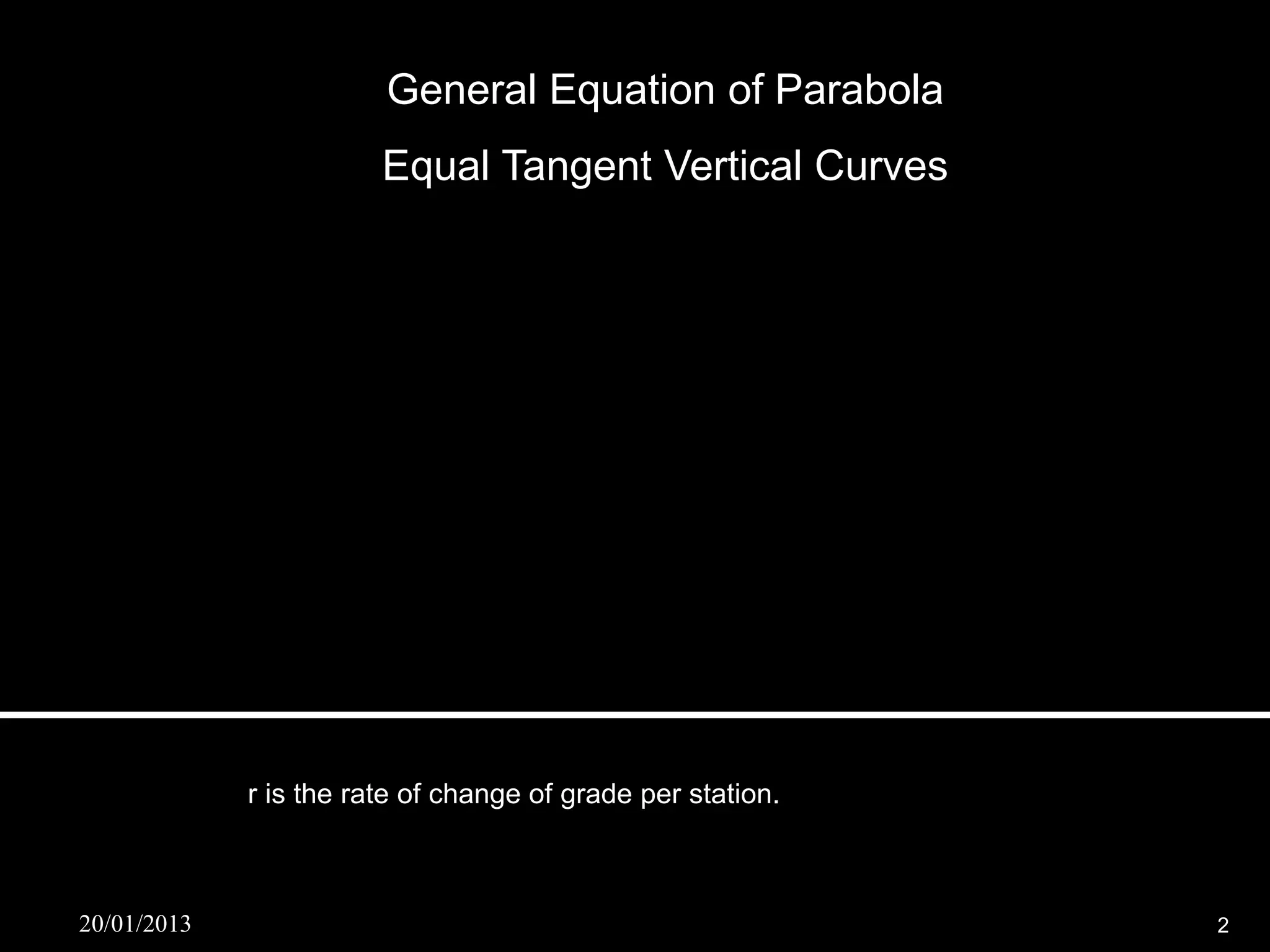
General Equation of Parabola
                        Equal Tangent Vertical Curves


              y  a x2  b x  c


              y  a x 2  g1 x  (elevation of BVC )


                    A
             2a      r
                    L

                   r 2
              y     x  g1 x  (elevation of BVC )
                   2


             r is the rate of change of grade per station.


20/01/2013                                                   2
Design of a Vertical Curve

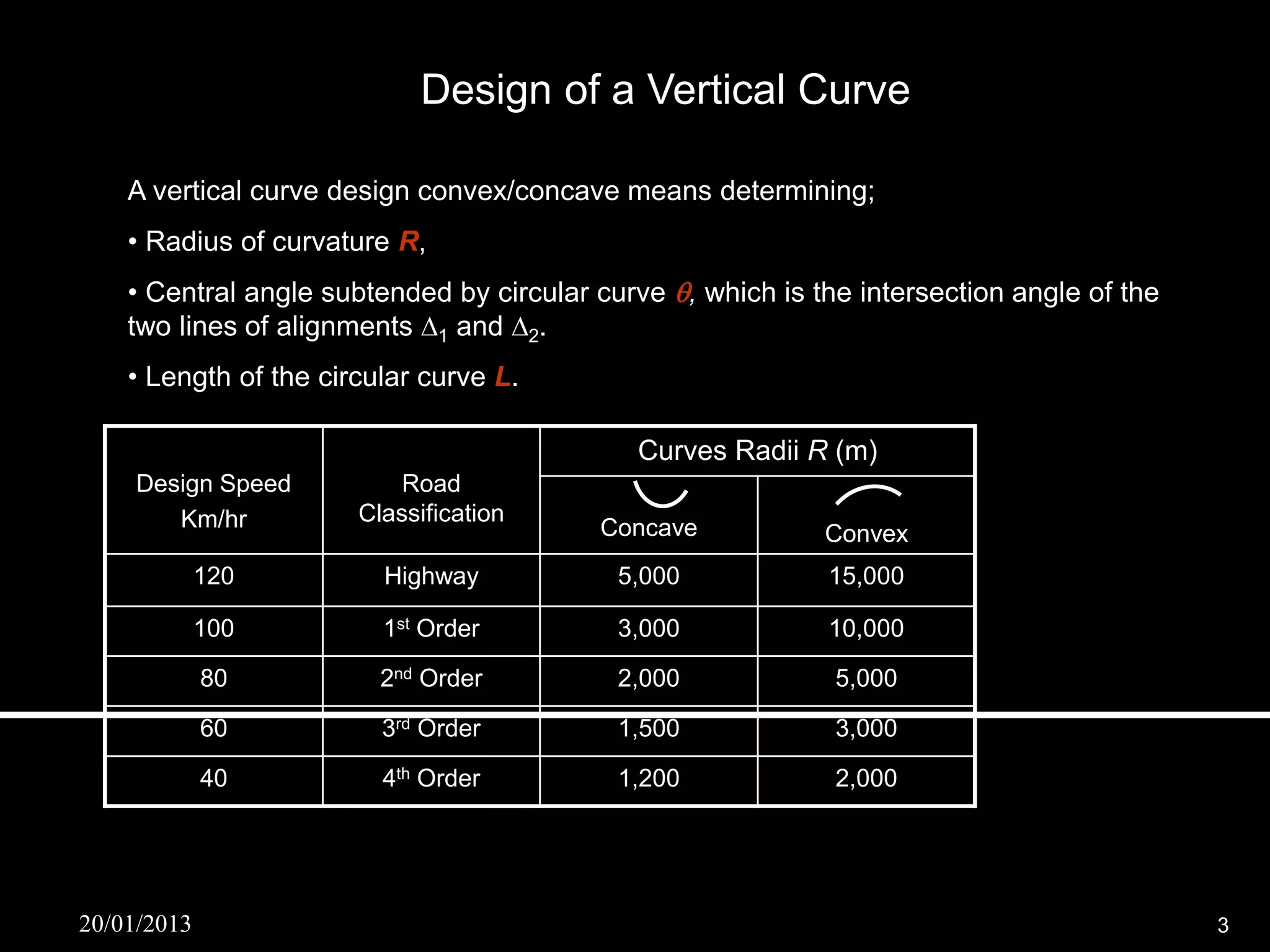
    A vertical curve design convex/concave means determining;
    • Radius of curvature R,
    • Central angle subtended by circular curve , which is the intersection angle of the
    two lines of alignments 1 and 2.
    • Length of the circular curve L.

                                              Curves Radii R (m)
     Design Speed          Road
        Km/hr          Classification
                                          Concave            Convex
             120         Highway            5,000            15,000

             100         1st Order          3,000            10,000

             80          2nd Order          2,000             5,000

             60          3rd Order          1,500             3,000

             40          4th Order          1,200             2,000


20/01/2013                                                                                  3
Design of a Vertical Curve

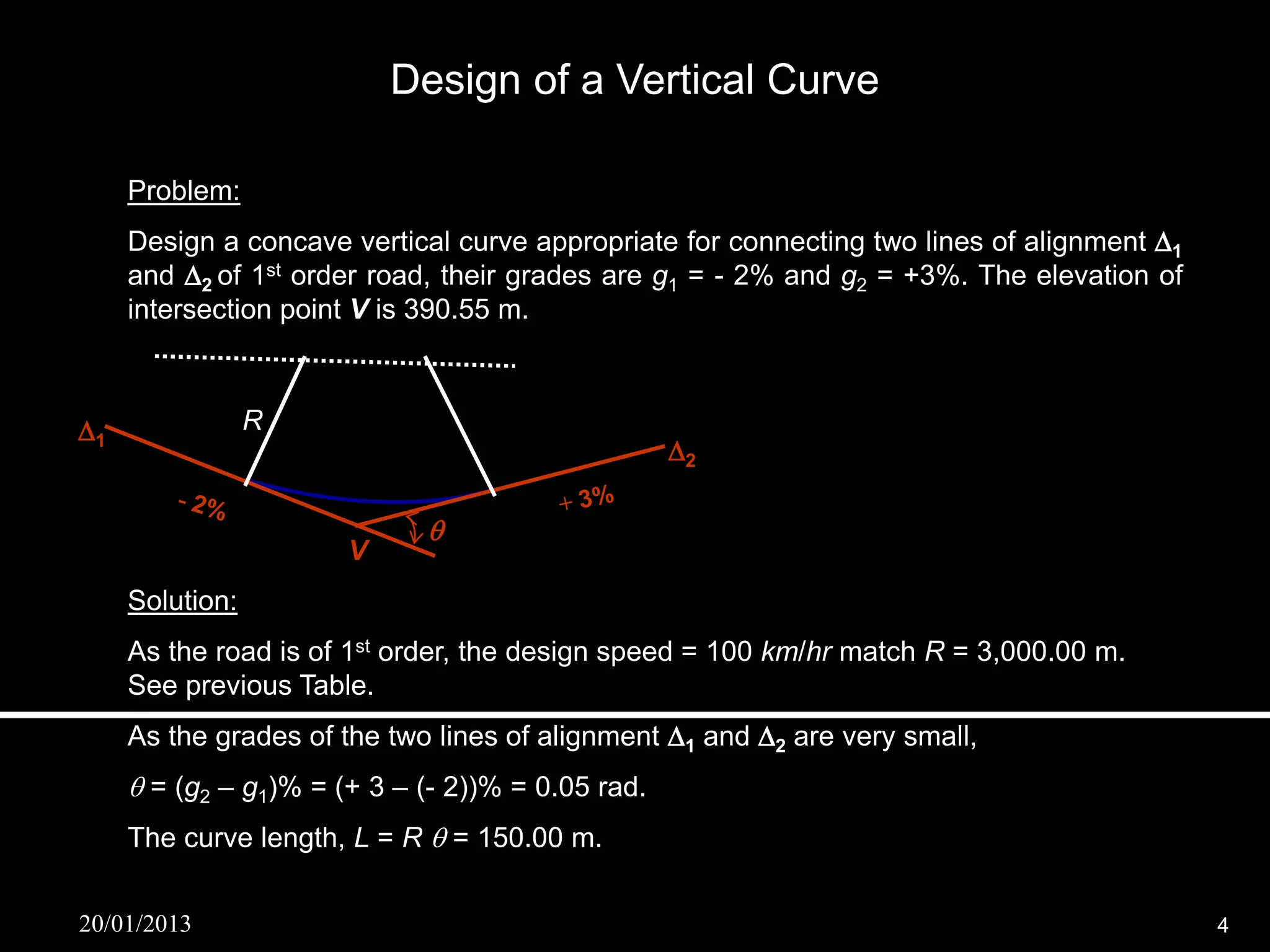
     Problem:
     Design a concave vertical curve appropriate for connecting two lines of alignment 1
     and 2 of 1st order road, their grades are g1 = - 2% and g2 = +3%. The elevation of
     intersection point V is 390.55 m.


1               R
                                                   2

                             
                       V
     Solution:
     As the road is of 1st order, the design speed = 100 km/hr match R = 3,000.00 m.
     See previous Table.
     As the grades of the two lines of alignment 1 and 2 are very small,
      = (g2 – g1)% = (+ 3 – (- 2))% = 0.05 rad.
     The curve length, L = R  = 150.00 m.


20/01/2013                                                                                  4
Passing a Vertical Curve
                                  Through a Fixed Point
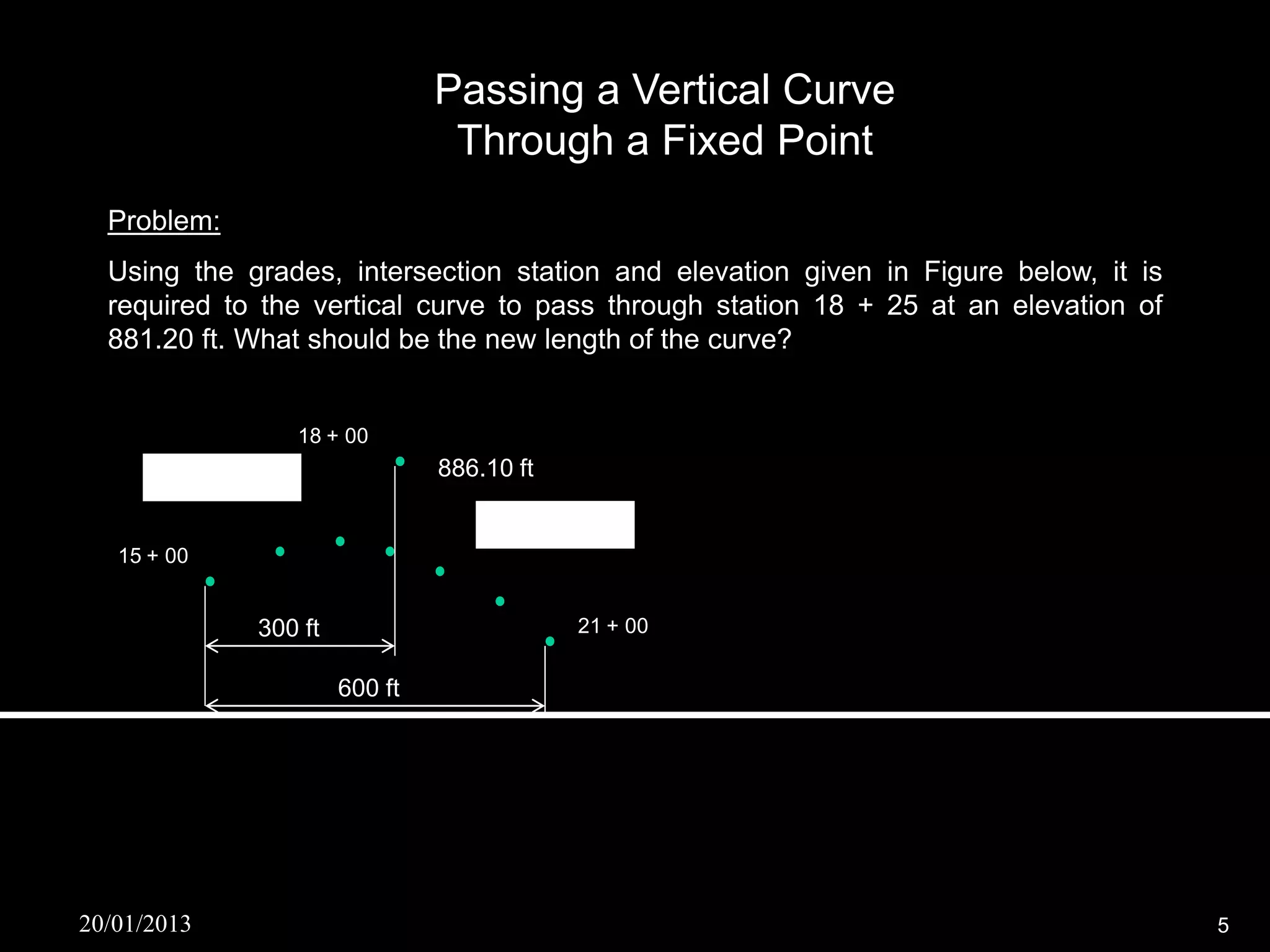
  Problem:
  Using the grades, intersection station and elevation given in Figure below, it is
  required to the vertical curve to pass through station 18 + 25 at an elevation of
  881.20 ft. What should be the new length of the curve?


                     18 + 00 V
      g1 = + 1.25%               886.10 ft

                                     g2 = - 2.75%
   15 + 00

         BVC                                  21 + 00
               300 ft
                                       EVC
                        600 ft


20/01/2013                                                                            5
Passing a Vertical Curve
                                   Through a Fixed Point
  Solution:
  The curve must be lengthened. The new value of L must be computed and a new
  value for r results.
         r 2
    y     x  g1 x  (elevation of BVC )
         2
    r     A     g  g1  2.75  1.25
             2       
    2 2L          2L           2L
         L
    x   0.25
         2
                                  gL
    elevation of BVC  886.10  1
                                   2

         r 2
     y    x  g1 x  (elevation of BVC )
         2
                 2.75  1.25 L                    L                     1.25L
     881.21  [              (  0.25) 2 ]  [1.25(  0.25)]  [886.10        ]
                     2L       2                    2                       2
     L2  9.425L  0.25  0


20/01/2013                                                                         6
Passing a Vertical Curve Through a Fixed Point

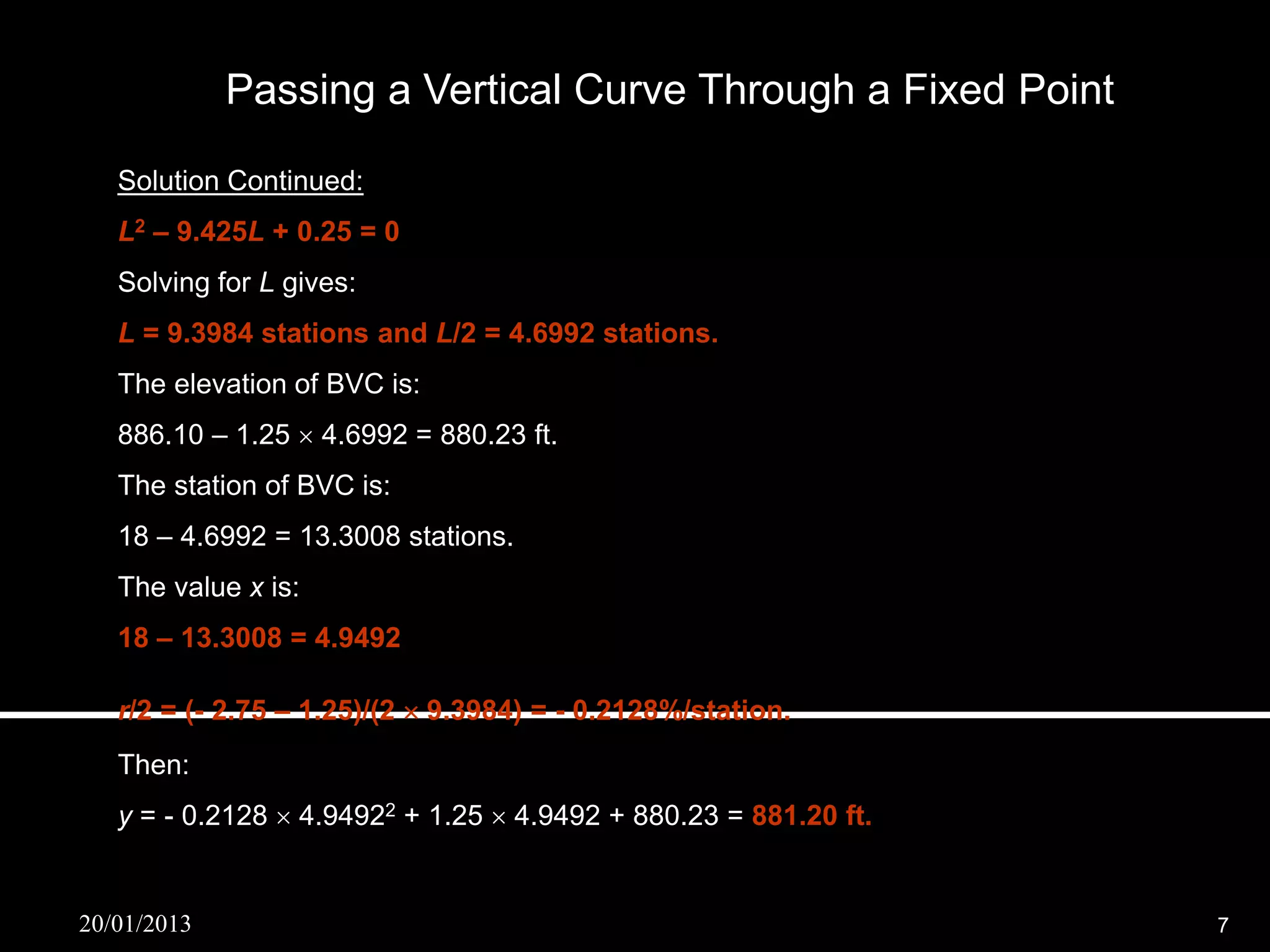
   Solution Continued:
   L2 – 9.425L + 0.25 = 0
   Solving for L gives:
   L = 9.3984 stations and L/2 = 4.6992 stations.
   The elevation of BVC is:
   886.10 – 1.25  4.6992 = 880.23 ft.
   The station of BVC is:
   18 – 4.6992 = 13.3008 stations.
   The value x is:
   18 – 13.3008 = 4.9492

   r/2 = (- 2.75 – 1.25)/(2  9.3984) = - 0.2128%/station.
   Then:
   y = - 0.2128  4.94922 + 1.25  4.9492 + 880.23 = 881.20 ft.


20/01/2013                                                        7
Unequal Tangent Vertical Curve

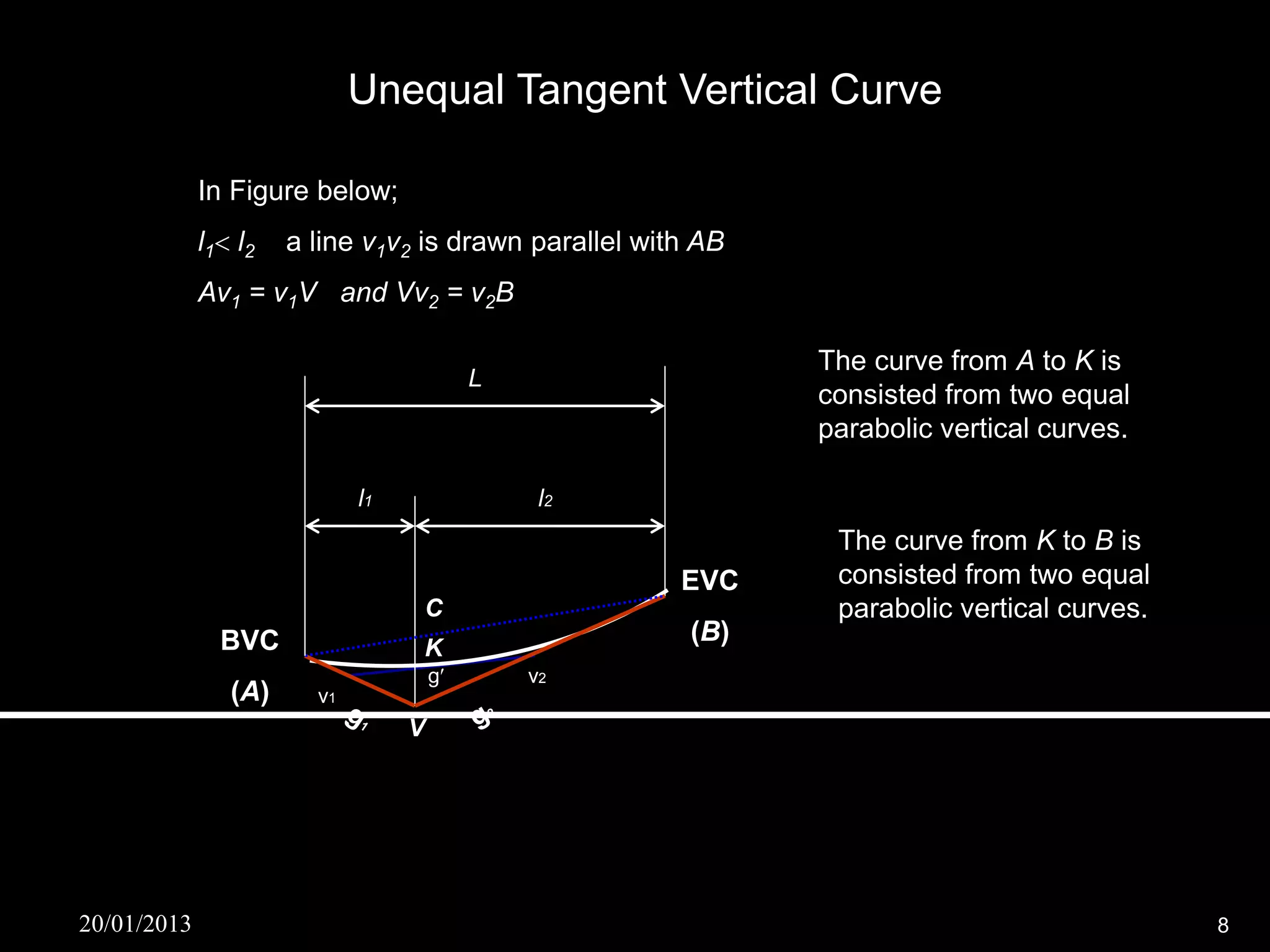
             In Figure below;
             l1 l2   a line v1v2 is drawn parallel with AB
             Av1 = v1V and Vv2 = v2B

                                                              The curve from A to K is
                                           L
                                                              consisted from two equal
                                                              parabolic vertical curves.

                             l1                 l2
                                                               The curve from K to B is
                                                       EVC     consisted from two equal
                                      C                        parabolic vertical curves.
               BVC                                      (B)
                                      K
                                      g       v2
                (A)     v1
                                  V


20/01/2013                                                                                  8
Unequal Tangent Vertical Curve

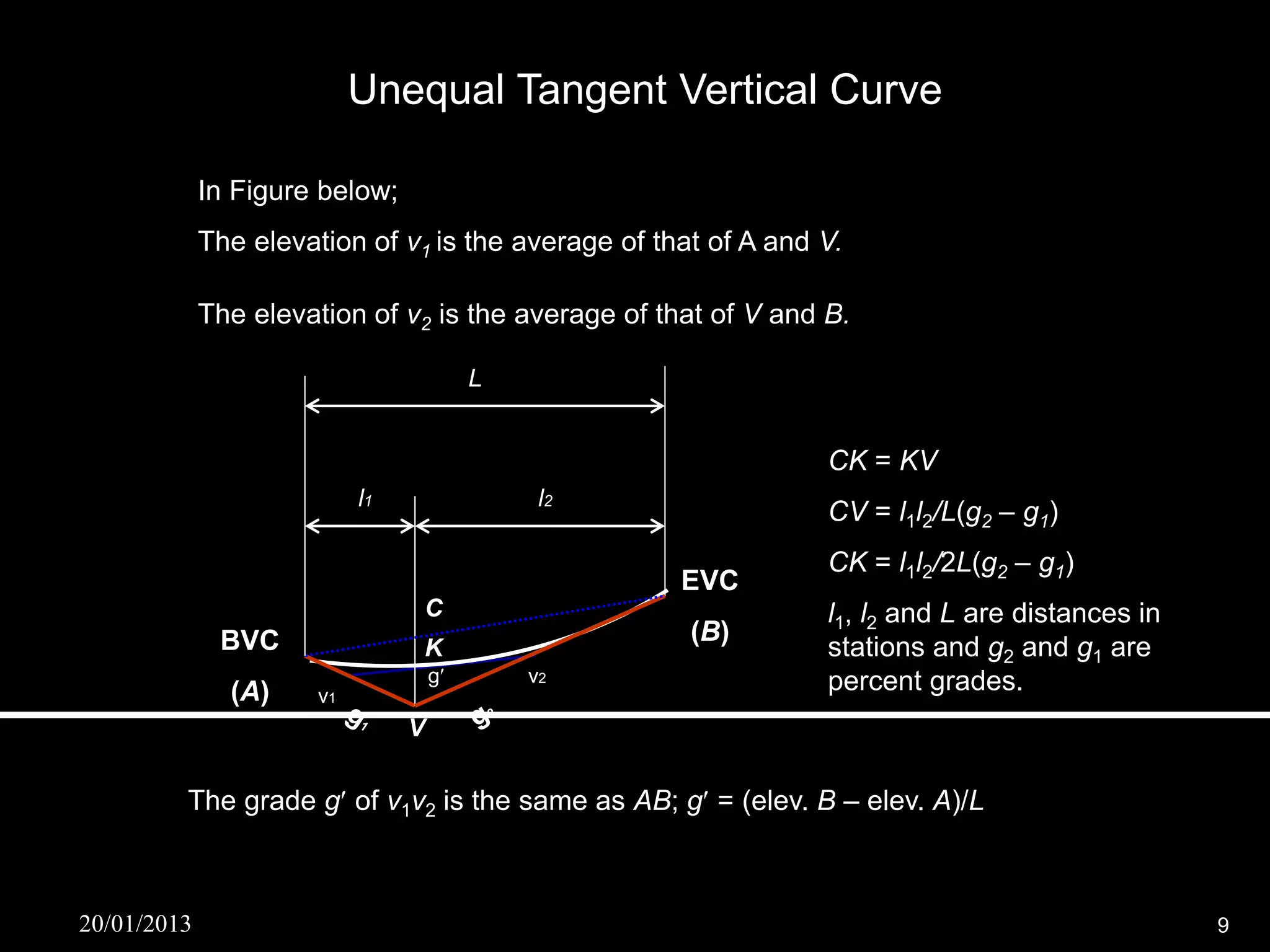
             In Figure below;
             The elevation of v1 is the average of that of A and V.

             The elevation of v2 is the average of that of V and B.

                                          L


                                                                 CK = KV
                            l1                 l2
                                                                 CV = l1l2/L(g2 – g1)
                                                                 CK = l1l2/2L(g2 – g1)
                                                     EVC
                                     C                           l1, l2 and L are distances in
              BVC                                     (B)
                                     K                           stations and g2 and g1 are
                                     g       v2                 percent grades.
               (A)     v1
                                 V

         The grade g of v1v2 is the same as AB; g = (elev. B – elev. A)/L


20/01/2013                                                                                       9
Unequal Tangent Vertical Curve
             Problem:
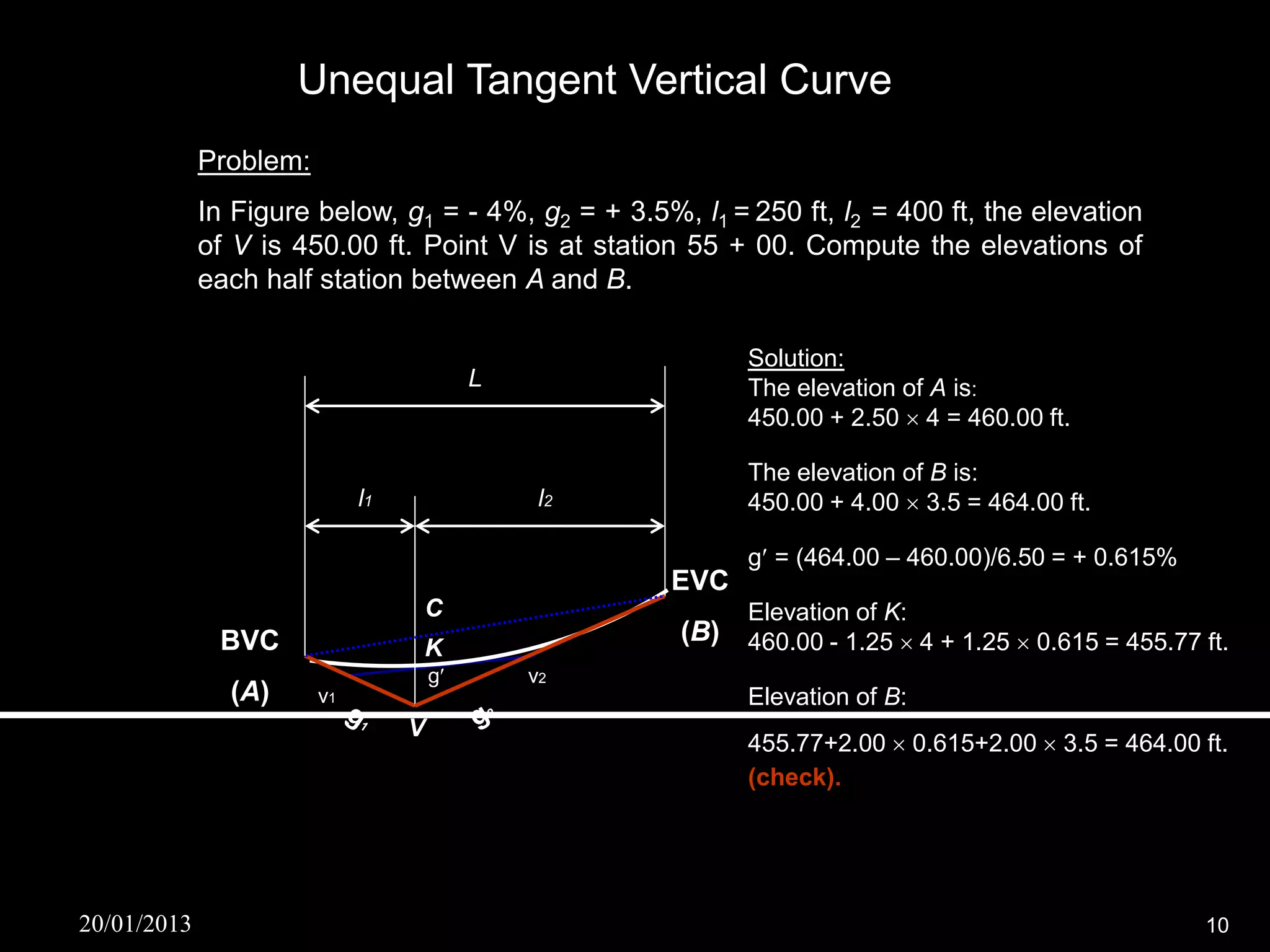
             In Figure below, g1 = - 4%, g2 = + 3.5%, l1 = 250 ft, l2 = 400 ft, the elevation
             of V is 450.00 ft. Point V is at station 55 + 00. Compute the elevations of
             each half station between A and B.

                                                           Solution:
                                           L               The elevation of A is:
                                                           450.00 + 2.50  4 = 460.00 ft.

                                                           The elevation of B is:
                             l1                 l2         450.00 + 4.00  3.5 = 464.00 ft.

                                                           g = (464.00 – 460.00)/6.50 = + 0.615%
                                                     EVC
                                      C                    Elevation of K:
              BVC                                    (B)   460.00 - 1.25  4 + 1.25  0.615 = 455.77 ft.
                                      K
                                      g       v2
               (A)      v1                                 Elevation of B:
                                  V
                                                           455.77+2.00  0.615+2.00  3.5 = 464.00 ft.
                                                           (check).


20/01/2013                                                                                           10
Unequal Tangent Vertical Curve

        Solution Continued:
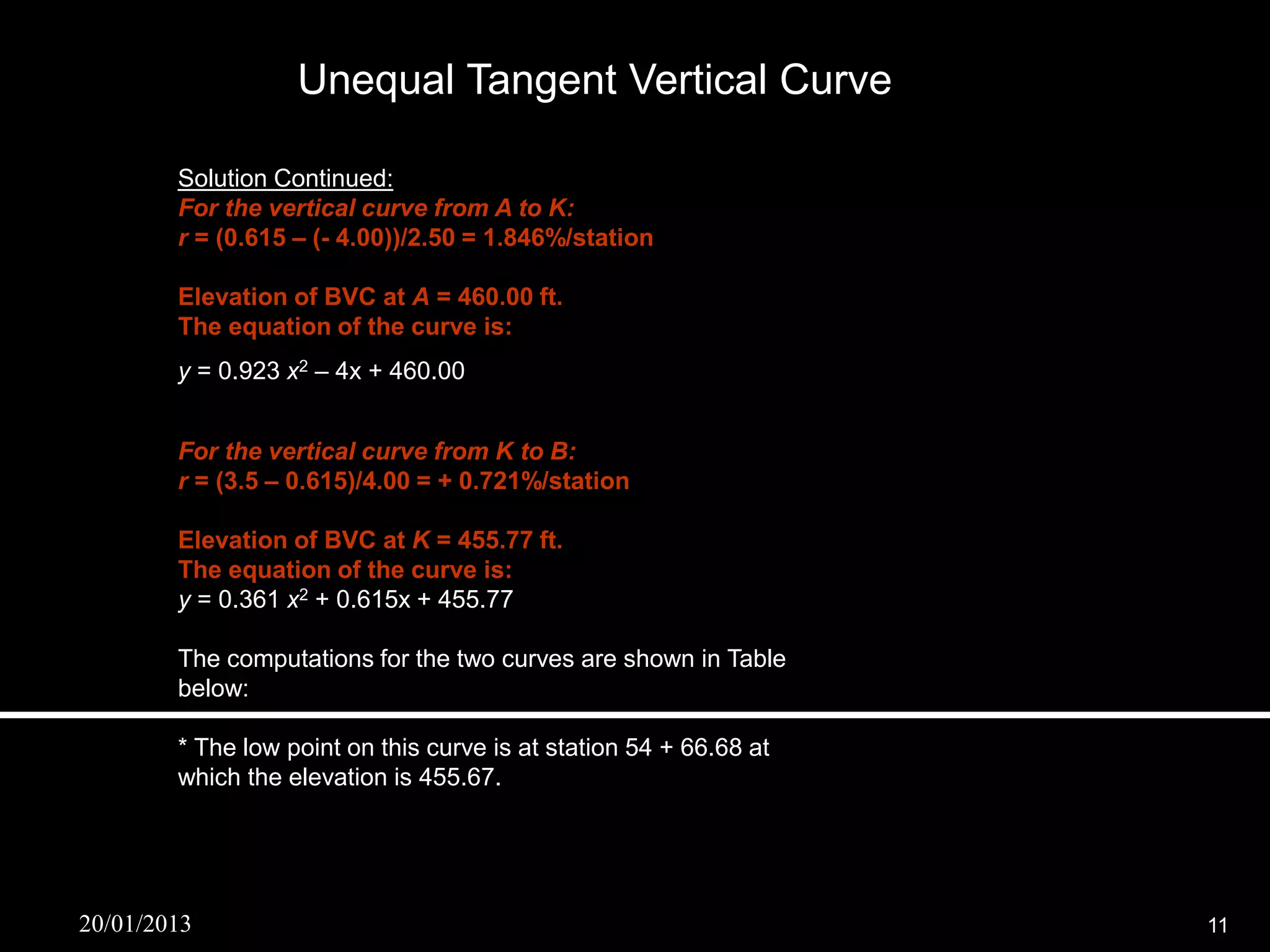
        For the vertical curve from A to K:
        r = (0.615 – (- 4.00))/2.50 = 1.846%/station

        Elevation of BVC at A = 460.00 ft.
        The equation of the curve is:
        y = 0.923 x2 – 4x + 460.00


        For the vertical curve from K to B:
        r = (3.5 – 0.615)/4.00 = + 0.721%/station

        Elevation of BVC at K = 455.77 ft.
        The equation of the curve is:
        y = 0.361 x2 + 0.615x + 455.77

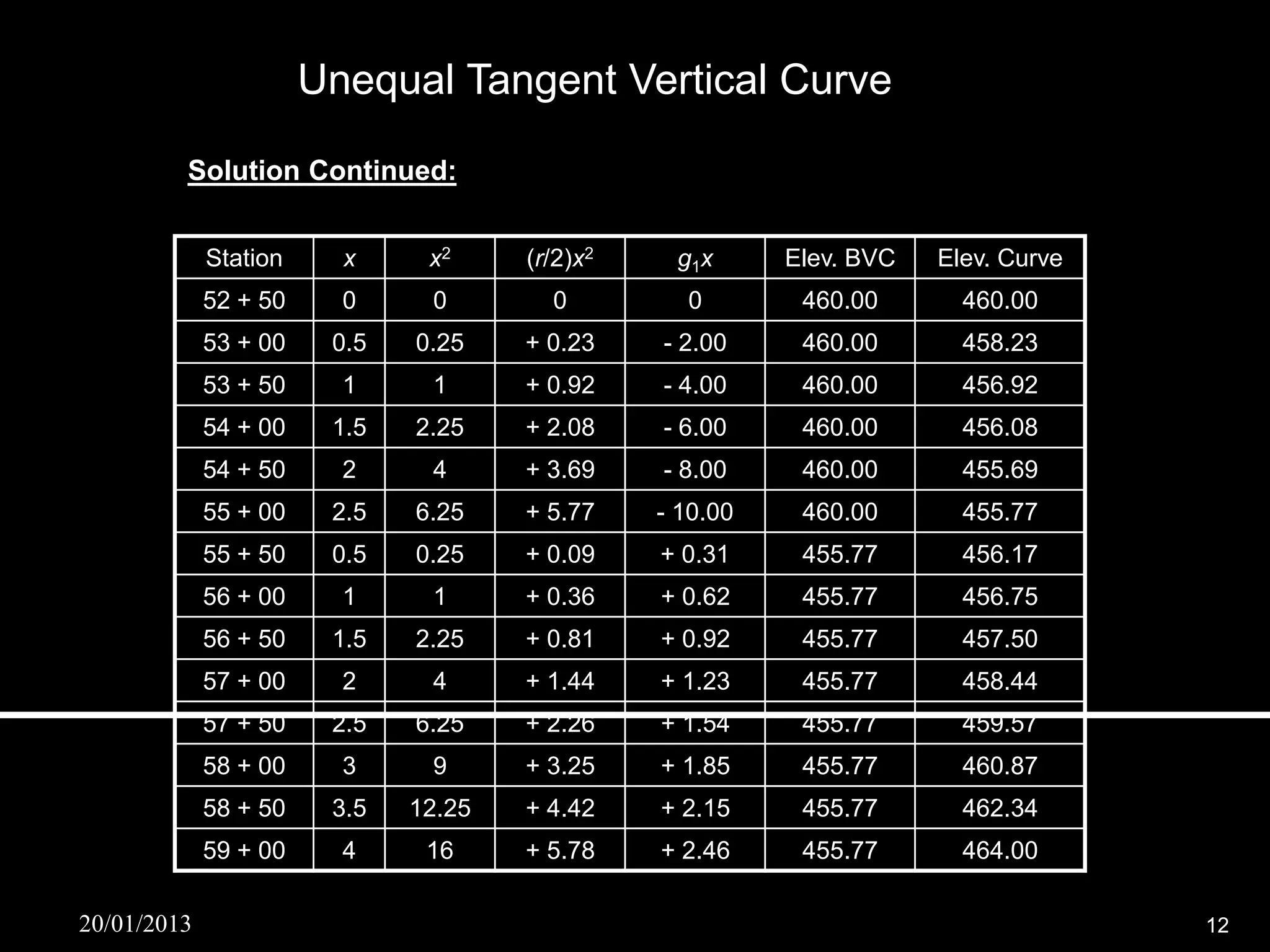
        The computations for the two curves are shown in Table
        below:

        * The low point on this curve is at station 54 + 66.68 at
        which the elevation is 455.67.


20/01/2013                                                          11
Unequal Tangent Vertical Curve

         Solution Continued:


             Station     x     x2     (r/2)x2    g1x      Elev. BVC   Elev. Curve
             52 + 50     0     0        0         0        460.00       460.00
             53 + 00    0.5   0.25    + 0.23    - 2.00     460.00       458.23
             53 + 50     1     1      + 0.92    - 4.00     460.00       456.92
             54 + 00    1.5   2.25    + 2.08    - 6.00     460.00       456.08
             54 + 50     2     4      + 3.69    - 8.00     460.00       455.69
             55 + 00    2.5   6.25    + 5.77    - 10.00    460.00       455.77
             55 + 50    0.5   0.25    + 0.09    + 0.31     455.77       456.17
             56 + 00     1     1      + 0.36    + 0.62     455.77       456.75
             56 + 50    1.5   2.25    + 0.81    + 0.92     455.77       457.50
             57 + 00     2     4      + 1.44    + 1.23     455.77       458.44
             57 + 50    2.5   6.25    + 2.26    + 1.54     455.77       459.57
             58 + 00     3     9      + 3.25    + 1.85     455.77       460.87
             58 + 50    3.5   12.25   + 4.42    + 2.15     455.77       462.34
             59 + 00     4     16     + 5.78    + 2.46     455.77       464.00

20/01/2013                                                                          12
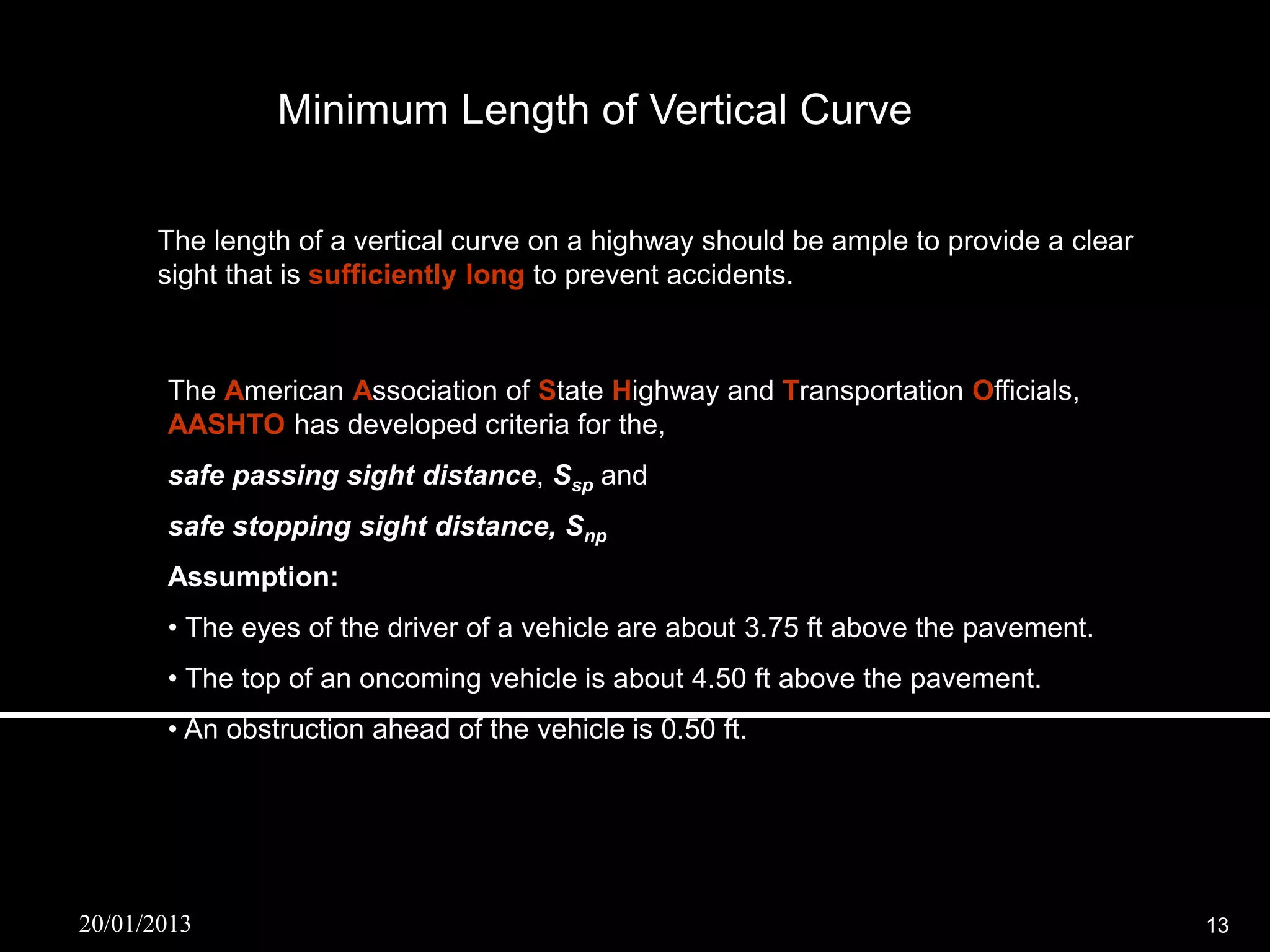
Minimum Length of Vertical Curve

      The length of a vertical curve on a highway should be ample to provide a clear
      sight that is sufficiently long to prevent accidents.


       The American Association of State Highway and Transportation Officials,
       AASHTO has developed criteria for the,
       safe passing sight distance, Ssp and
       safe stopping sight distance, Snp
       Assumption:
       • The eyes of the driver of a vehicle are about 3.75 ft above the pavement.
       • The top of an oncoming vehicle is about 4.50 ft above the pavement.
       • An obstruction ahead of the vehicle is 0.50 ft.


20/01/2013                                                                             13
Minimum Length of Vertical Curve

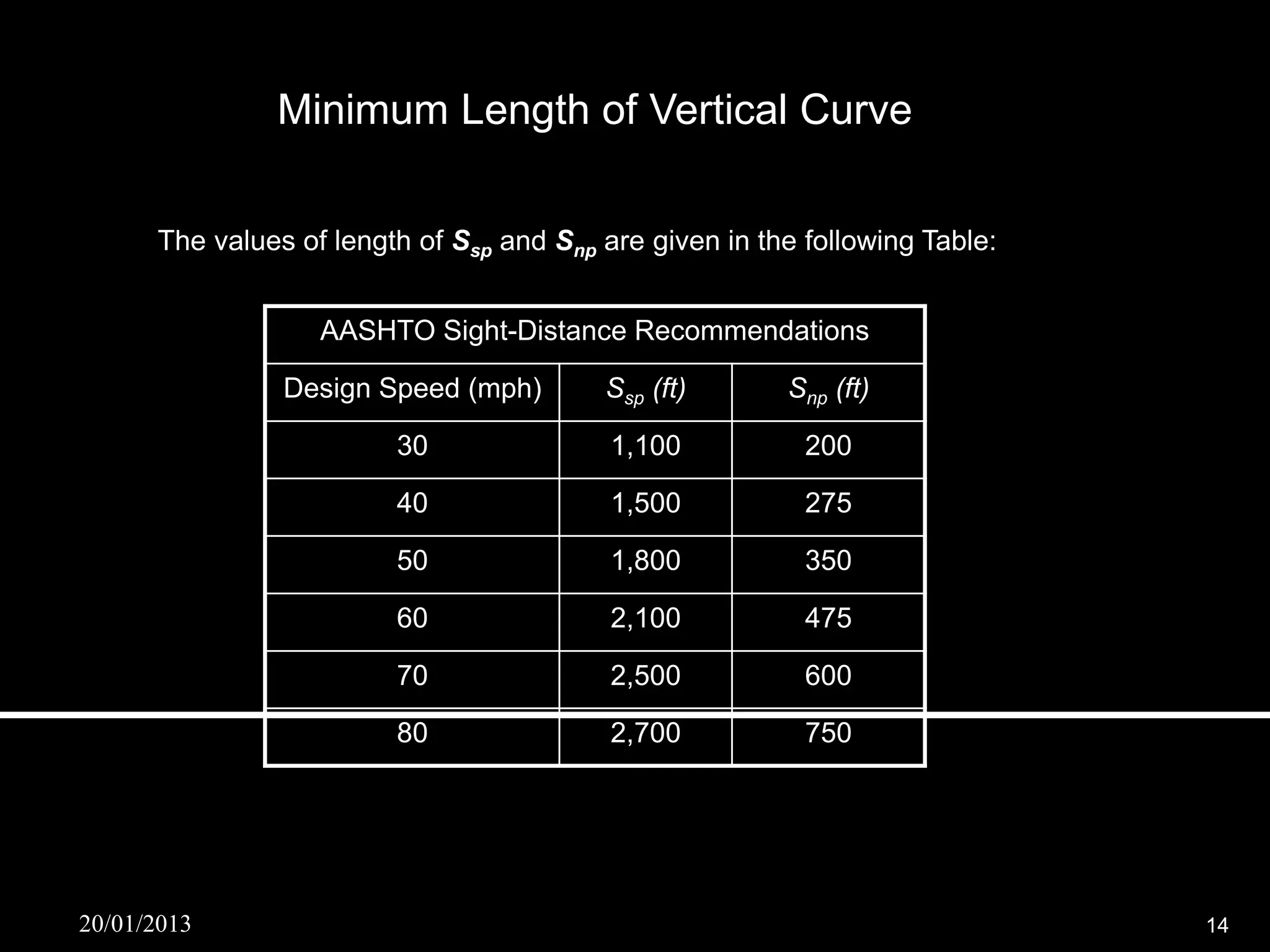
      The values of length of Ssp and Snp are given in the following Table:


                   AASHTO Sight-Distance Recommendations

                Design Speed (mph)        Ssp (ft)       Snp (ft)

                         30                1,100           200

                         40                1,500           275

                         50                1,800           350

                         60                2,100           475

                         70                2,500           600

                         80                2,700           750


20/01/2013                                                                    14
Minimum Length of Vertical Curve

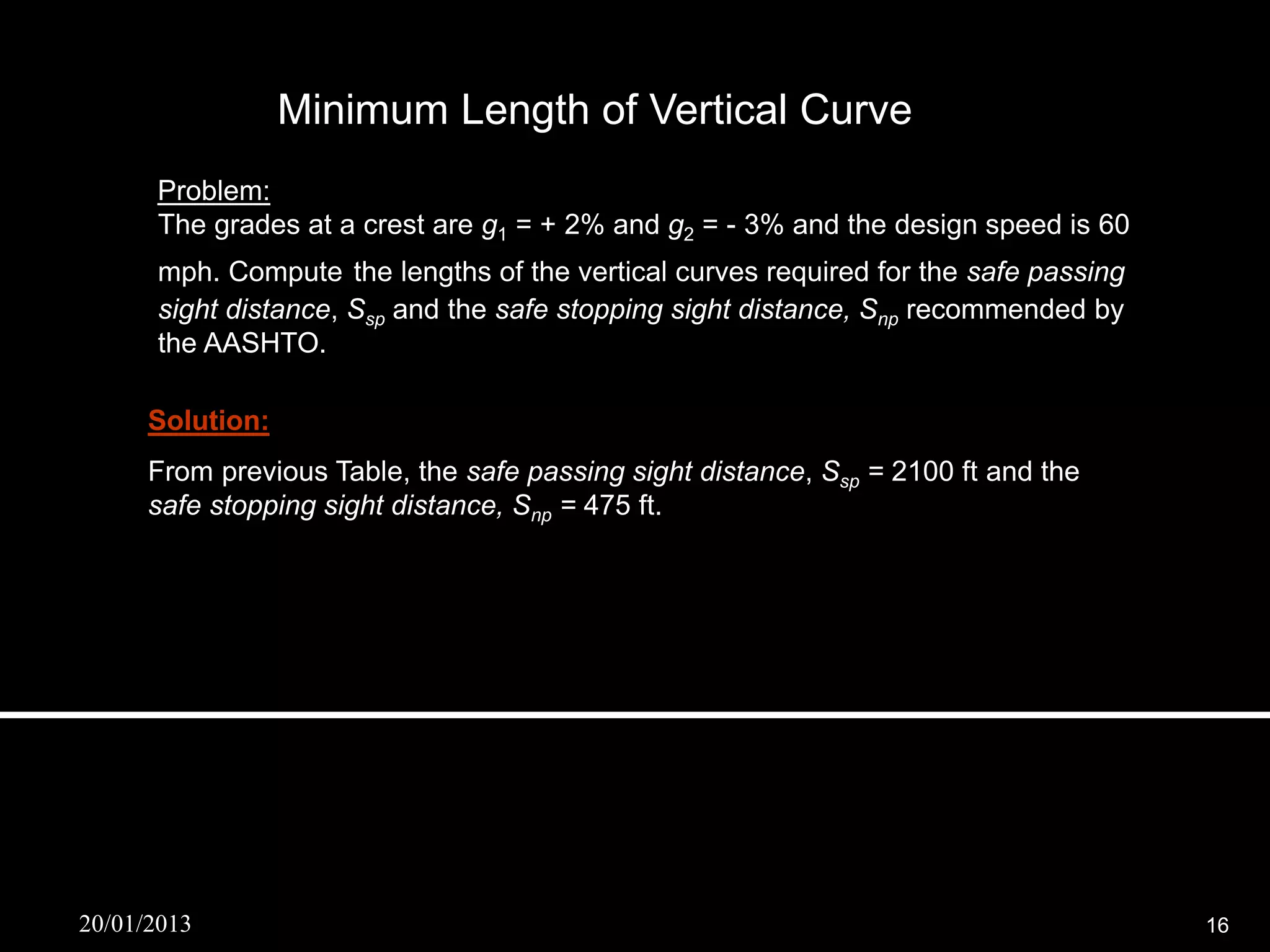
      The values of minimum length of a vertical curve are given here
      without proof:

       a ) If , S sp  L
             S sp ( g1  g 2 )
                 2

       L
                     33

       b) If , S sp  L
                          33
       L  2 S sp 
                       g1  g 2


       a ) If , S np  L
             S np ( g1  g 2 )
                 2

       L
                     14.0

       b) If , S np  L
                        14.0
       L  2 S np 
                       g1  g 2


20/01/2013                                                              15
Minimum Length of Vertical Curve
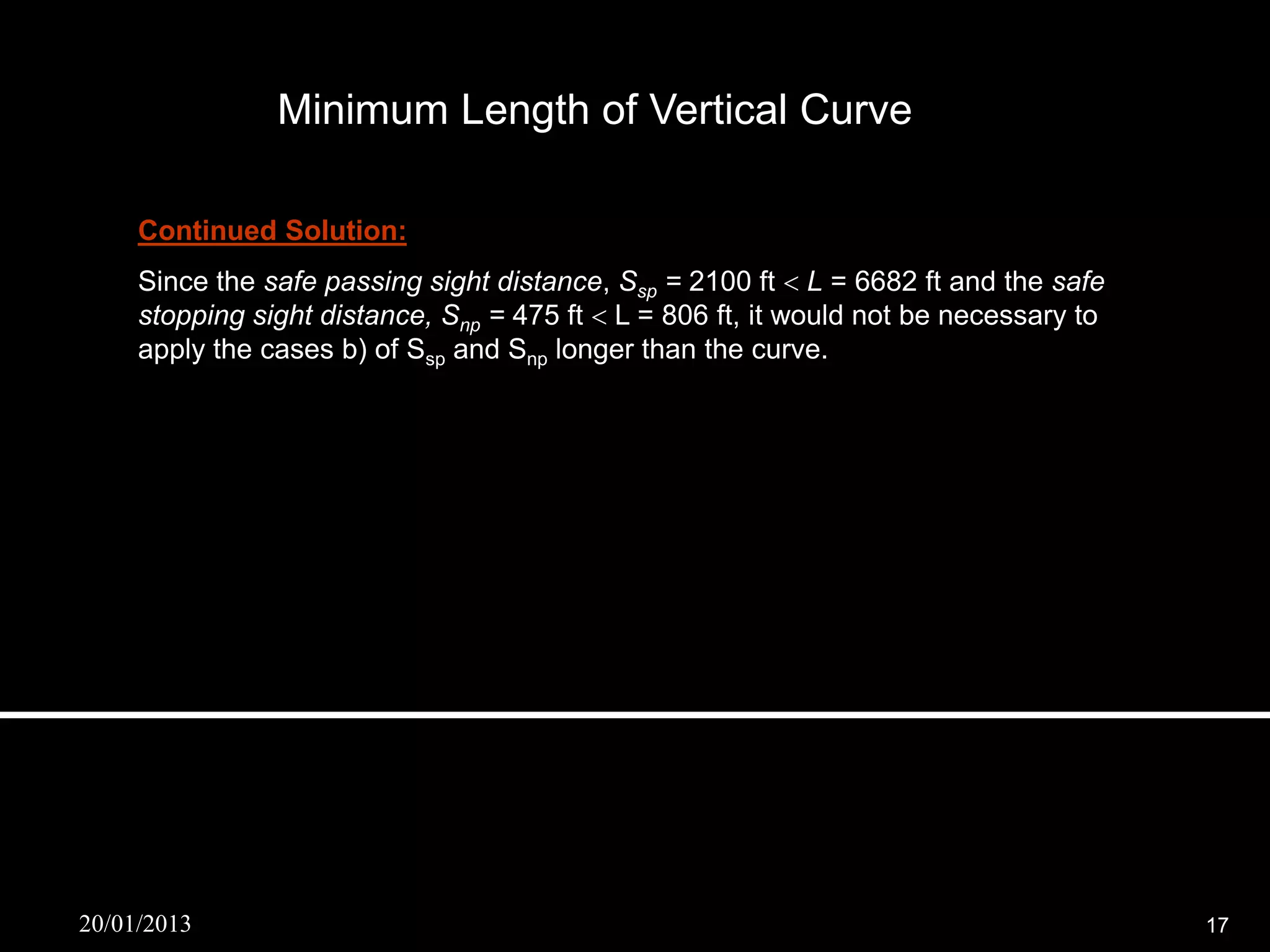
      Problem:
      The grades at a crest are g1 = + 2% and g2 = - 3% and the design speed is 60
      mph. Compute the lengths of the vertical curves required for the safe passing
      sight distance, Ssp and the safe stopping sight distance, Snp recommended by
      the AASHTO.

      Solution:
      From previous Table, the safe passing sight distance, Ssp = 2100 ft and the
      safe stopping sight distance, Snp = 475 ft.

       If , S sp  L
             S sp ( g1  g 2 )
                2
                                   2100 2  0.05
      L                                         6682 ft
                    33                  33

      If , S np  L
             S np ( g1  g 2 )
                2
                                   475 2  0.05
      L                                        806 ft
                    14.0              14.0


20/01/2013                                                                            16
Minimum Length of Vertical Curve

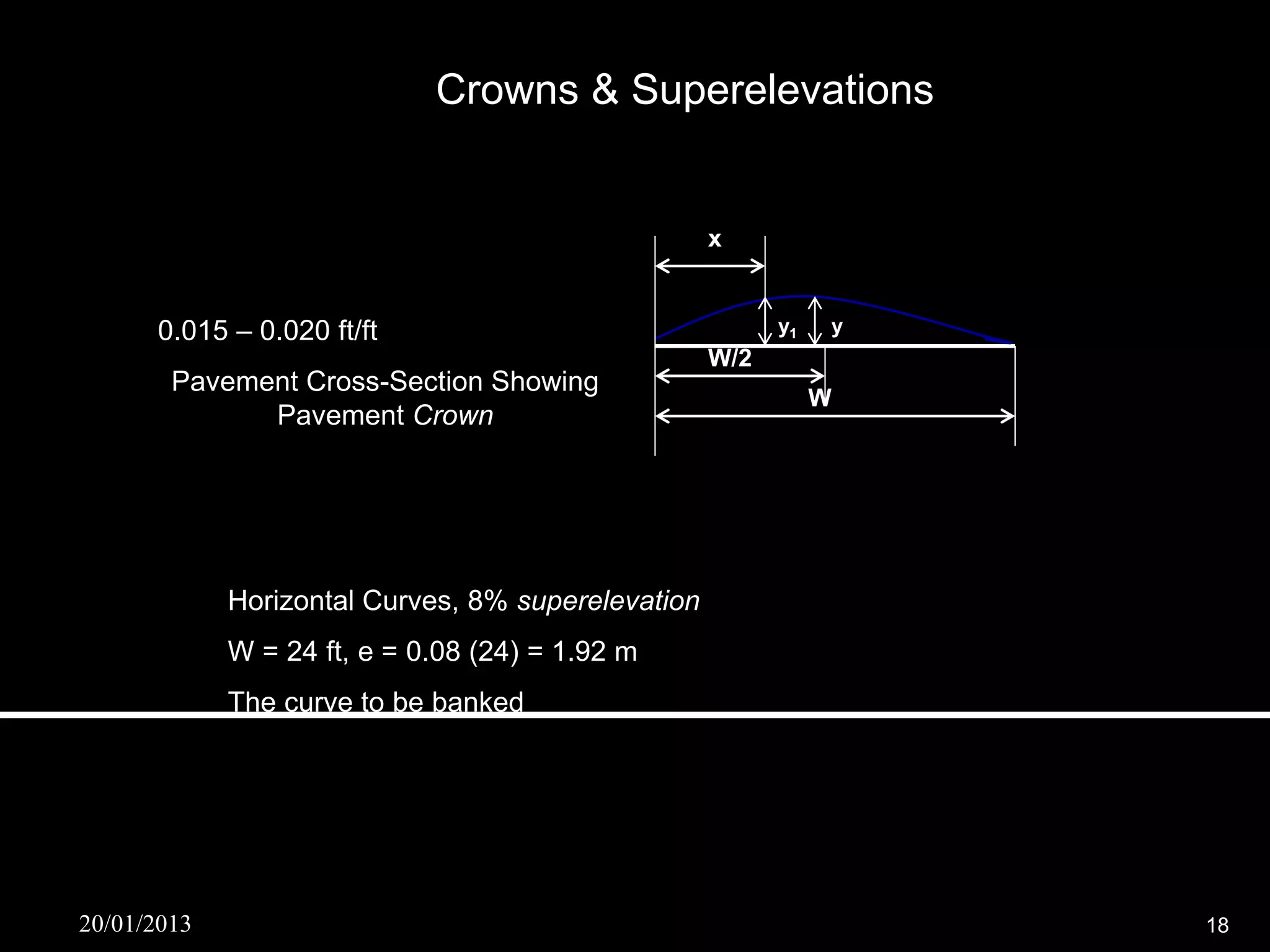
     Continued Solution:
     Since the safe passing sight distance, Ssp = 2100 ft  L = 6682 ft and the safe
     stopping sight distance, Snp = 475 ft  L = 806 ft, it would not be necessary to
     apply the cases b) of Ssp and Snp longer than the curve.


20/01/2013                                                                              17
Crowns & Superelevations


                                                    x


      0.015 – 0.020 ft/ft                                 y1   y
                                                    W/2
        Pavement Cross-Section Showing
                                                               W
              Pavement Crown


             Horizontal Curves, 8% superelevation
             W = 24 ft, e = 0.08 (24) = 1.92 m
             The curve to be banked


20/01/2013                                                         18
Crowns & Superelevations

             • Design Speed of the highway
             • Side Friction

             Climate and Area Classification (Urban/Rural)
             Snow (7% - 8%)
             10% - 12% the highest for gravel roads with cross drainage
             Urban streets (4% - 6%)


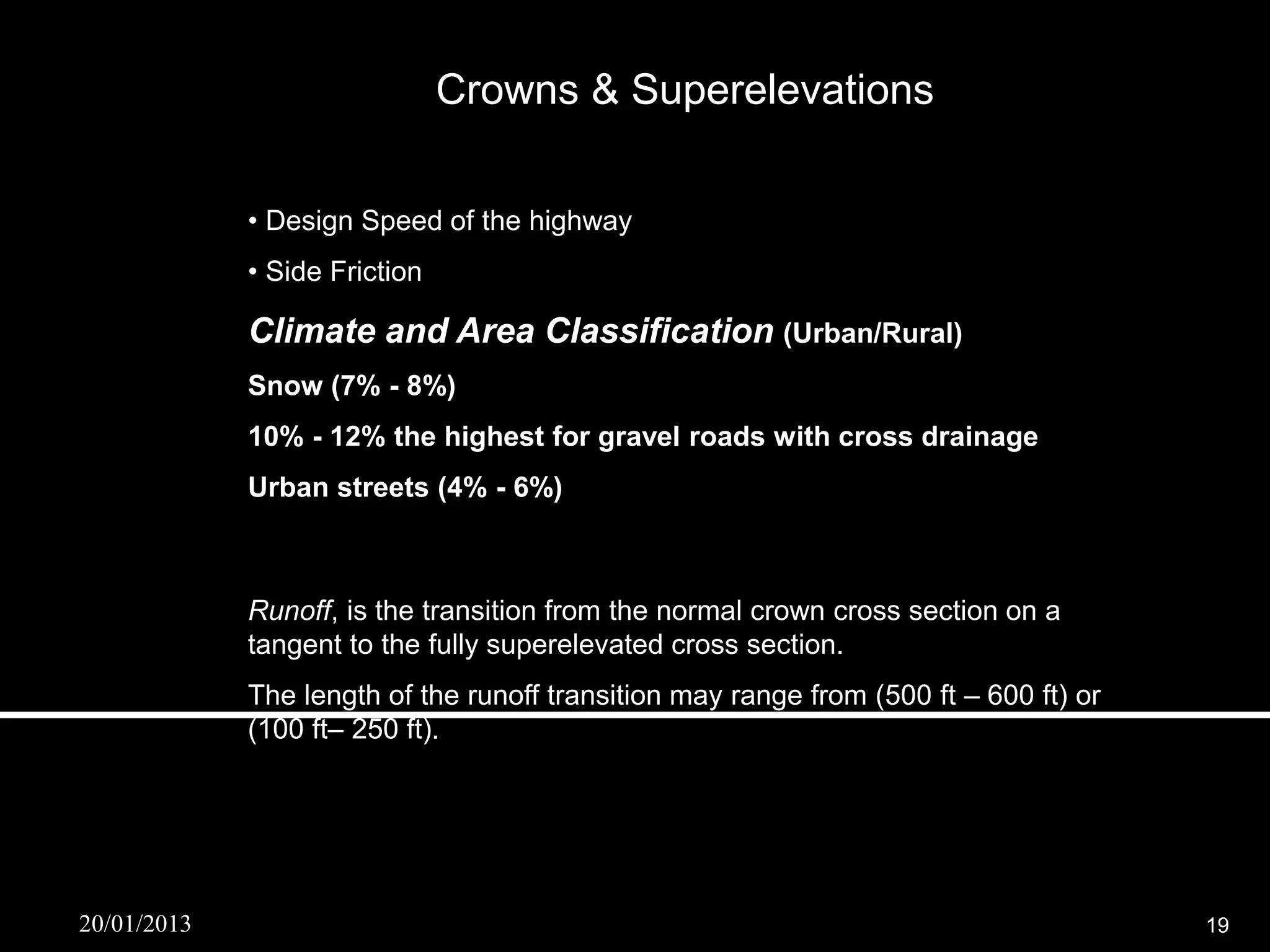
             Runoff, is the transition from the normal crown cross section on a
             tangent to the fully superelevated cross section.
             The length of the runoff transition may range from (500 ft – 600 ft) or
             (100 ft– 250 ft).


20/01/2013                                                                             19
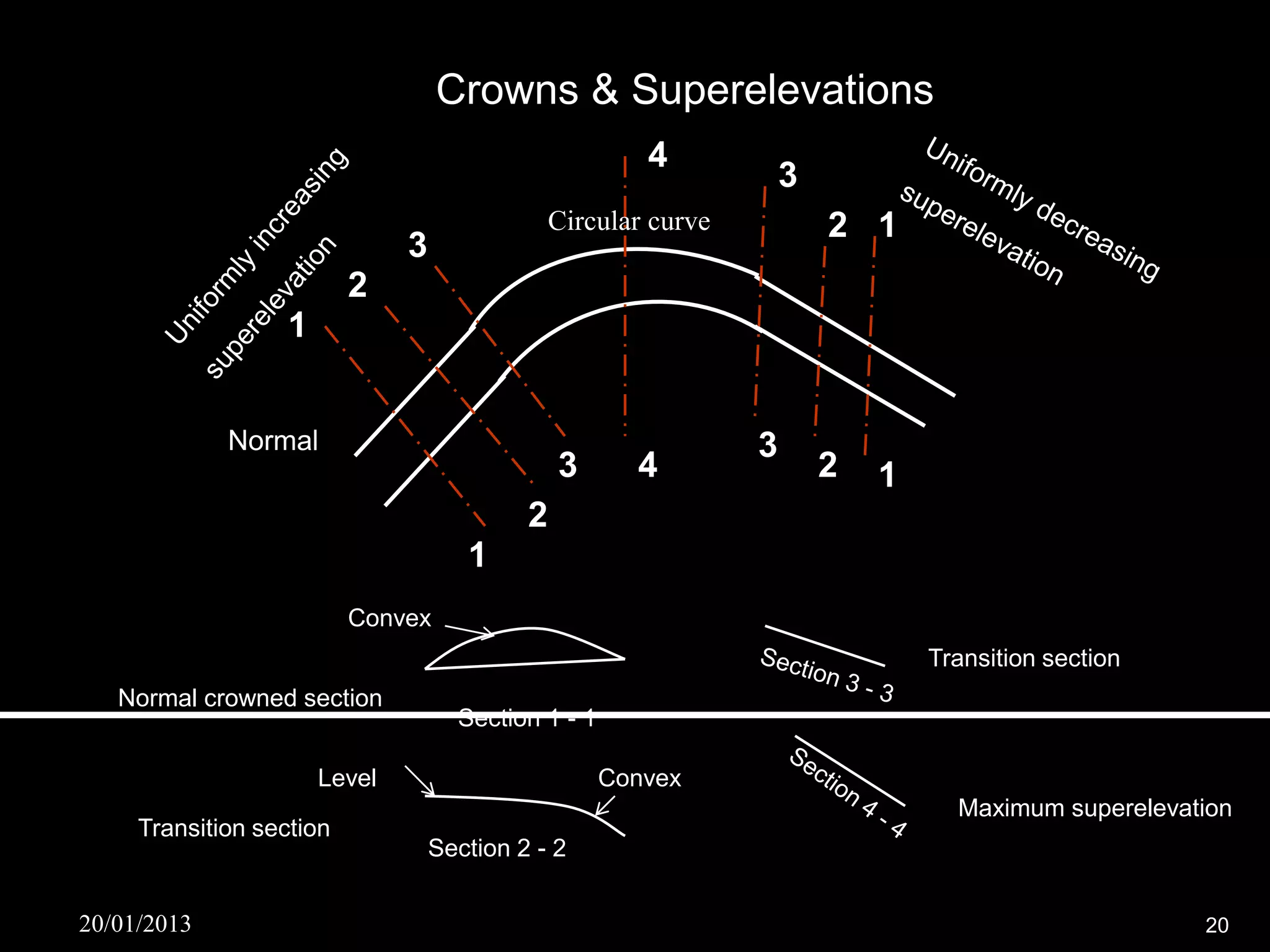
Crowns & Superelevations
                                                        4
                                                                     3
                                                Circular curve           2 1
                               3
                          2
                   1


             Normal                                              3
                                                3      4                 2   1
                                            2
                                      1
                          Convex
                                                                                 Transition section
   Normal crowned section
                                     Section 1 - 1

                       Level                         Convex
                                                                                   Maximum superelevation
     Transition section
                                   Section 2 - 2


20/01/2013                                                                                            20

Vertical Curves (Part 2)

  • 1.
  • 2.
    General Equation ofParabola Equal Tangent Vertical Curves y  a x2  b x  c y  a x 2  g1 x  (elevation of BVC ) A 2a  r L r 2 y x  g1 x  (elevation of BVC ) 2 r is the rate of change of grade per station. 20/01/2013 2
  • 3.
    Design of aVertical Curve A vertical curve design convex/concave means determining; • Radius of curvature R, • Central angle subtended by circular curve , which is the intersection angle of the two lines of alignments 1 and 2. • Length of the circular curve L. Curves Radii R (m) Design Speed Road Km/hr Classification Concave Convex 120 Highway 5,000 15,000 100 1st Order 3,000 10,000 80 2nd Order 2,000 5,000 60 3rd Order 1,500 3,000 40 4th Order 1,200 2,000 20/01/2013 3
  • 4.
    Design of aVertical Curve Problem: Design a concave vertical curve appropriate for connecting two lines of alignment 1 and 2 of 1st order road, their grades are g1 = - 2% and g2 = +3%. The elevation of intersection point V is 390.55 m. 1 R 2  V Solution: As the road is of 1st order, the design speed = 100 km/hr match R = 3,000.00 m. See previous Table. As the grades of the two lines of alignment 1 and 2 are very small,  = (g2 – g1)% = (+ 3 – (- 2))% = 0.05 rad. The curve length, L = R  = 150.00 m. 20/01/2013 4
  • 5.
    Passing a VerticalCurve Through a Fixed Point Problem: Using the grades, intersection station and elevation given in Figure below, it is required to the vertical curve to pass through station 18 + 25 at an elevation of 881.20 ft. What should be the new length of the curve? 18 + 00 V g1 = + 1.25% 886.10 ft g2 = - 2.75% 15 + 00 BVC 21 + 00 300 ft EVC 600 ft 20/01/2013 5
  • 6.
    Passing a VerticalCurve Through a Fixed Point Solution: The curve must be lengthened. The new value of L must be computed and a new value for r results. r 2 y x  g1 x  (elevation of BVC ) 2 r A g  g1  2.75  1.25   2  2 2L 2L 2L L x   0.25 2 gL elevation of BVC  886.10  1 2 r 2 y x  g1 x  (elevation of BVC ) 2  2.75  1.25 L L 1.25L 881.21  [ (  0.25) 2 ]  [1.25(  0.25)]  [886.10  ] 2L 2 2 2 L2  9.425L  0.25  0 20/01/2013 6
  • 7.
    Passing a VerticalCurve Through a Fixed Point Solution Continued: L2 – 9.425L + 0.25 = 0 Solving for L gives: L = 9.3984 stations and L/2 = 4.6992 stations. The elevation of BVC is: 886.10 – 1.25  4.6992 = 880.23 ft. The station of BVC is: 18 – 4.6992 = 13.3008 stations. The value x is: 18 – 13.3008 = 4.9492 r/2 = (- 2.75 – 1.25)/(2  9.3984) = - 0.2128%/station. Then: y = - 0.2128  4.94922 + 1.25  4.9492 + 880.23 = 881.20 ft. 20/01/2013 7
  • 8.
    Unequal Tangent VerticalCurve In Figure below; l1 l2 a line v1v2 is drawn parallel with AB Av1 = v1V and Vv2 = v2B The curve from A to K is L consisted from two equal parabolic vertical curves. l1 l2 The curve from K to B is EVC consisted from two equal C parabolic vertical curves. BVC (B) K g v2 (A) v1 V 20/01/2013 8
  • 9.
    Unequal Tangent VerticalCurve In Figure below; The elevation of v1 is the average of that of A and V. The elevation of v2 is the average of that of V and B. L CK = KV l1 l2 CV = l1l2/L(g2 – g1) CK = l1l2/2L(g2 – g1) EVC C l1, l2 and L are distances in BVC (B) K stations and g2 and g1 are g v2 percent grades. (A) v1 V The grade g of v1v2 is the same as AB; g = (elev. B – elev. A)/L 20/01/2013 9
  • 10.
    Unequal Tangent VerticalCurve Problem: In Figure below, g1 = - 4%, g2 = + 3.5%, l1 = 250 ft, l2 = 400 ft, the elevation of V is 450.00 ft. Point V is at station 55 + 00. Compute the elevations of each half station between A and B. Solution: L The elevation of A is: 450.00 + 2.50  4 = 460.00 ft. The elevation of B is: l1 l2 450.00 + 4.00  3.5 = 464.00 ft. g = (464.00 – 460.00)/6.50 = + 0.615% EVC C Elevation of K: BVC (B) 460.00 - 1.25  4 + 1.25  0.615 = 455.77 ft. K g v2 (A) v1 Elevation of B: V 455.77+2.00  0.615+2.00  3.5 = 464.00 ft. (check). 20/01/2013 10
  • 11.
    Unequal Tangent VerticalCurve Solution Continued: For the vertical curve from A to K: r = (0.615 – (- 4.00))/2.50 = 1.846%/station Elevation of BVC at A = 460.00 ft. The equation of the curve is: y = 0.923 x2 – 4x + 460.00 For the vertical curve from K to B: r = (3.5 – 0.615)/4.00 = + 0.721%/station Elevation of BVC at K = 455.77 ft. The equation of the curve is: y = 0.361 x2 + 0.615x + 455.77 The computations for the two curves are shown in Table below: * The low point on this curve is at station 54 + 66.68 at which the elevation is 455.67. 20/01/2013 11
  • 12.
    Unequal Tangent VerticalCurve Solution Continued: Station x x2 (r/2)x2 g1x Elev. BVC Elev. Curve 52 + 50 0 0 0 0 460.00 460.00 53 + 00 0.5 0.25 + 0.23 - 2.00 460.00 458.23 53 + 50 1 1 + 0.92 - 4.00 460.00 456.92 54 + 00 1.5 2.25 + 2.08 - 6.00 460.00 456.08 54 + 50 2 4 + 3.69 - 8.00 460.00 455.69 55 + 00 2.5 6.25 + 5.77 - 10.00 460.00 455.77 55 + 50 0.5 0.25 + 0.09 + 0.31 455.77 456.17 56 + 00 1 1 + 0.36 + 0.62 455.77 456.75 56 + 50 1.5 2.25 + 0.81 + 0.92 455.77 457.50 57 + 00 2 4 + 1.44 + 1.23 455.77 458.44 57 + 50 2.5 6.25 + 2.26 + 1.54 455.77 459.57 58 + 00 3 9 + 3.25 + 1.85 455.77 460.87 58 + 50 3.5 12.25 + 4.42 + 2.15 455.77 462.34 59 + 00 4 16 + 5.78 + 2.46 455.77 464.00 20/01/2013 12
  • 13.
    Minimum Length ofVertical Curve The length of a vertical curve on a highway should be ample to provide a clear sight that is sufficiently long to prevent accidents. The American Association of State Highway and Transportation Officials, AASHTO has developed criteria for the, safe passing sight distance, Ssp and safe stopping sight distance, Snp Assumption: • The eyes of the driver of a vehicle are about 3.75 ft above the pavement. • The top of an oncoming vehicle is about 4.50 ft above the pavement. • An obstruction ahead of the vehicle is 0.50 ft. 20/01/2013 13
  • 14.
    Minimum Length ofVertical Curve The values of length of Ssp and Snp are given in the following Table: AASHTO Sight-Distance Recommendations Design Speed (mph) Ssp (ft) Snp (ft) 30 1,100 200 40 1,500 275 50 1,800 350 60 2,100 475 70 2,500 600 80 2,700 750 20/01/2013 14
  • 15.
    Minimum Length ofVertical Curve The values of minimum length of a vertical curve are given here without proof: a ) If , S sp  L S sp ( g1  g 2 ) 2 L 33 b) If , S sp  L 33 L  2 S sp  g1  g 2 a ) If , S np  L S np ( g1  g 2 ) 2 L 14.0 b) If , S np  L 14.0 L  2 S np  g1  g 2 20/01/2013 15
  • 16.
    Minimum Length ofVertical Curve Problem: The grades at a crest are g1 = + 2% and g2 = - 3% and the design speed is 60 mph. Compute the lengths of the vertical curves required for the safe passing sight distance, Ssp and the safe stopping sight distance, Snp recommended by the AASHTO. Solution: From previous Table, the safe passing sight distance, Ssp = 2100 ft and the safe stopping sight distance, Snp = 475 ft. If , S sp  L S sp ( g1  g 2 ) 2 2100 2  0.05 L   6682 ft 33 33 If , S np  L S np ( g1  g 2 ) 2 475 2  0.05 L   806 ft 14.0 14.0 20/01/2013 16
  • 17.
    Minimum Length ofVertical Curve Continued Solution: Since the safe passing sight distance, Ssp = 2100 ft  L = 6682 ft and the safe stopping sight distance, Snp = 475 ft  L = 806 ft, it would not be necessary to apply the cases b) of Ssp and Snp longer than the curve. 20/01/2013 17
  • 18.
    Crowns & Superelevations x 0.015 – 0.020 ft/ft y1 y W/2 Pavement Cross-Section Showing W Pavement Crown Horizontal Curves, 8% superelevation W = 24 ft, e = 0.08 (24) = 1.92 m The curve to be banked 20/01/2013 18
  • 19.
    Crowns & Superelevations • Design Speed of the highway • Side Friction Climate and Area Classification (Urban/Rural) Snow (7% - 8%) 10% - 12% the highest for gravel roads with cross drainage Urban streets (4% - 6%) Runoff, is the transition from the normal crown cross section on a tangent to the fully superelevated cross section. The length of the runoff transition may range from (500 ft – 600 ft) or (100 ft– 250 ft). 20/01/2013 19
  • 20.
    Crowns & Superelevations 4 3 Circular curve 2 1 3 2 1 Normal 3 3 4 2 1 2 1 Convex Transition section Normal crowned section Section 1 - 1 Level Convex Maximum superelevation Transition section Section 2 - 2 20/01/2013 20