CLIL Methodology,  strategy for developing basic competencies for participating in European projects Tri-CLIL Congress , Barcelona 2009 Neus Lorenzo Galés [email_address]
Content  Introduction: initial concepts  (1 min.) .. Reflection:  (7 min.) …..  - Challenges: european citizenship and  glocal   identity - Suggested solutions: Lifelong Learning Programs, CLIL and  Diamond Sys.6 (6-C CLIL) Practical Activity  (4 min.)   …  - Activity - Reflection Page  Continuing: further concepts  (3 min.)
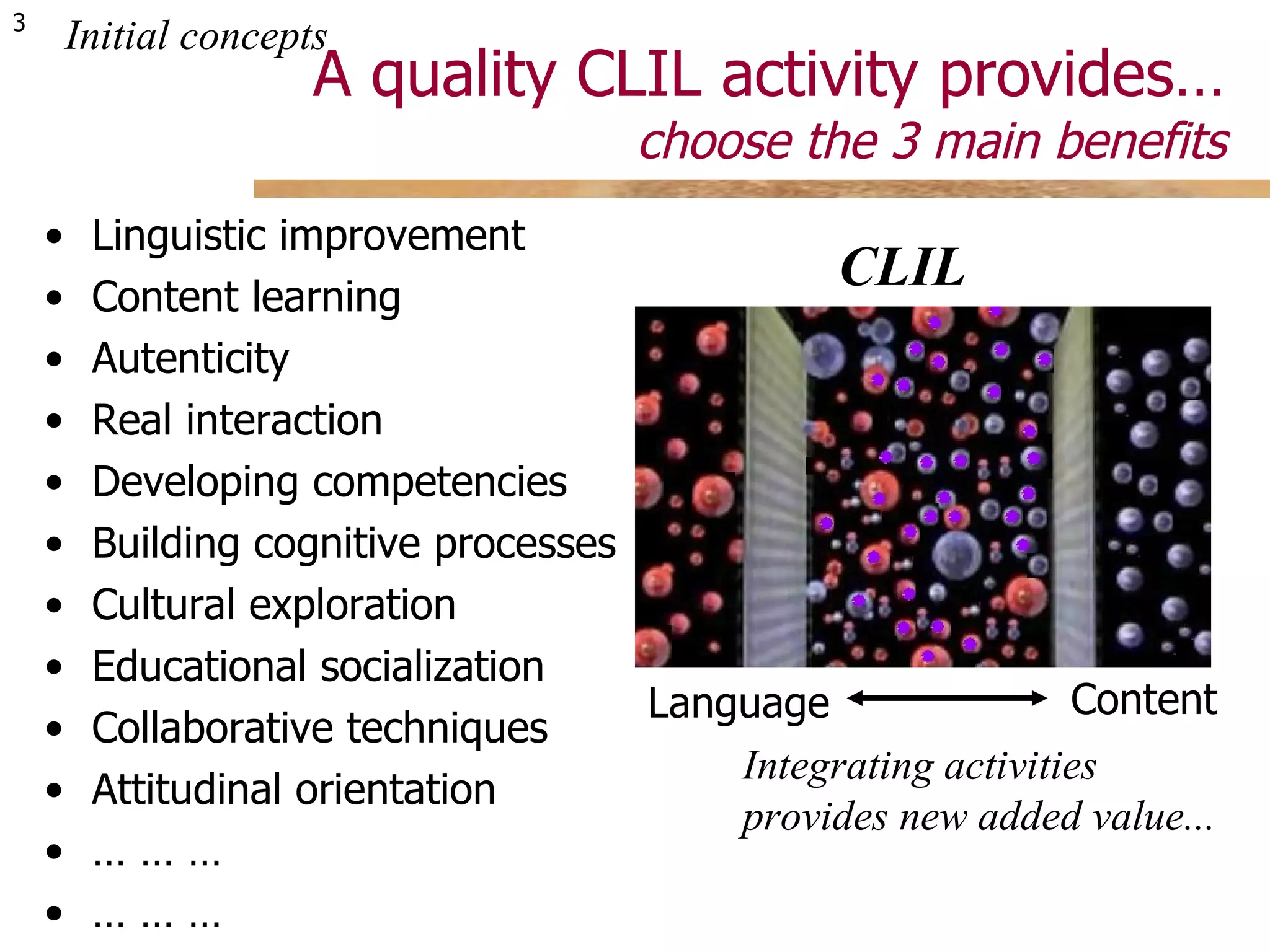
A quality CLIL activity provides… choose the 3 main benefits Linguistic improvement Content learning Autenticity Real interaction Developing competencies Building cognitive processes Cultural exploration  Educational socialization Collaborative techniques Attitudinal orientation … … …  … … … Initial concepts Integrating activities  provides new added value... CLIL Language Content
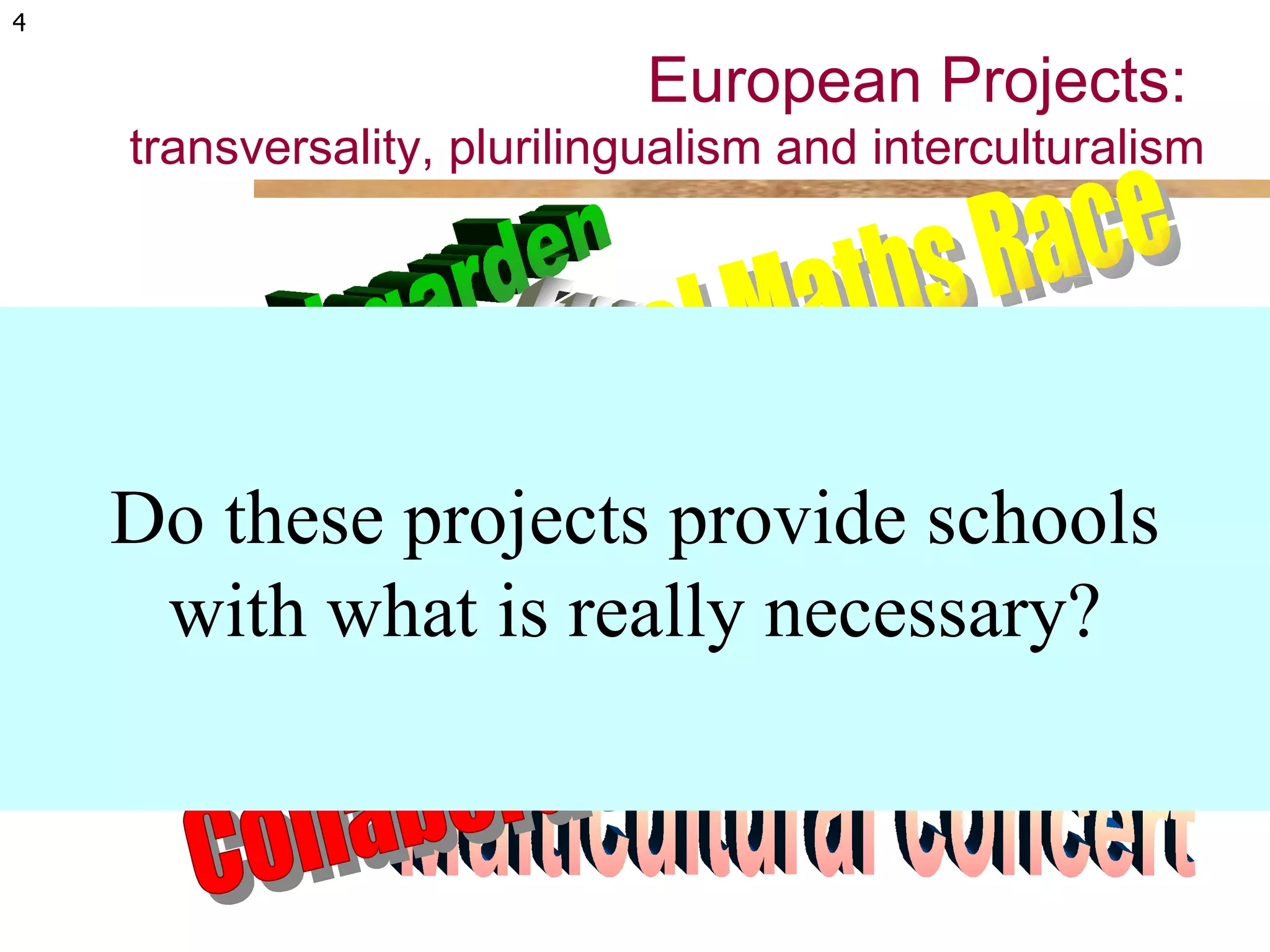
European Projects:  transversality, plurilingualism and interculturalism Virtual garden Simultaneous  Art  Exhibit Multicultural concert Chirldren's intercultural library Collaborative portal European traditions on Webs Virtual Maths Race  Do these projects provide schools with what is really necessary? Radio program in several languages
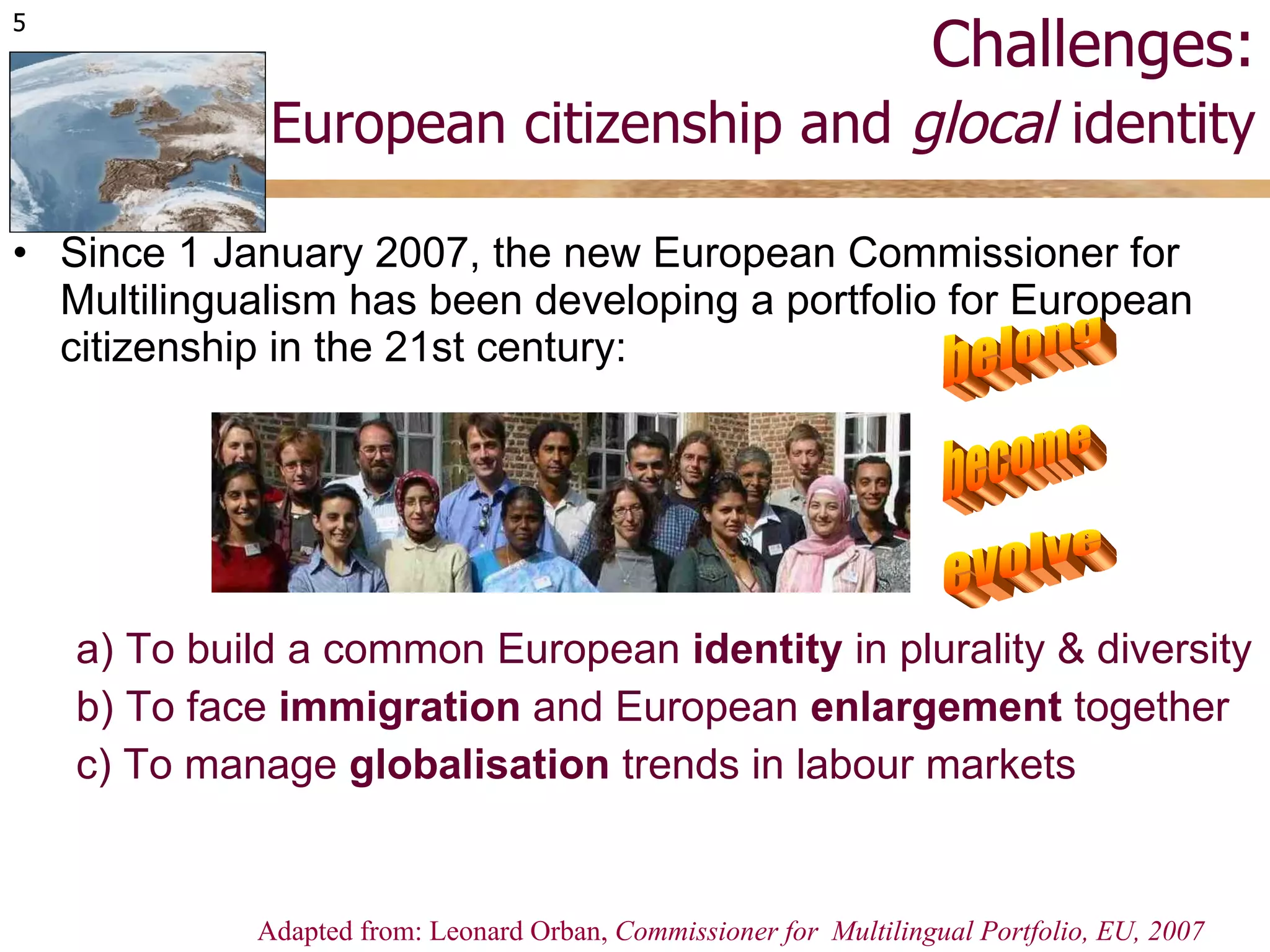
Challenges:   European citizenship and  glocal  identity Since 1 January 2007, the new European Commissioner for Multilingualism has been developing a portfolio for European citizenship in the 21st century: a) To build a common European  identity  in plurality & diversity b) To face  immigration  and European  enlargement  together c) To manage  globalisation  trends in labour markets Adapted from: Leonard Orban,  Commissioner for  Multilingual Portfolio, EU, 2007 belong become evolve
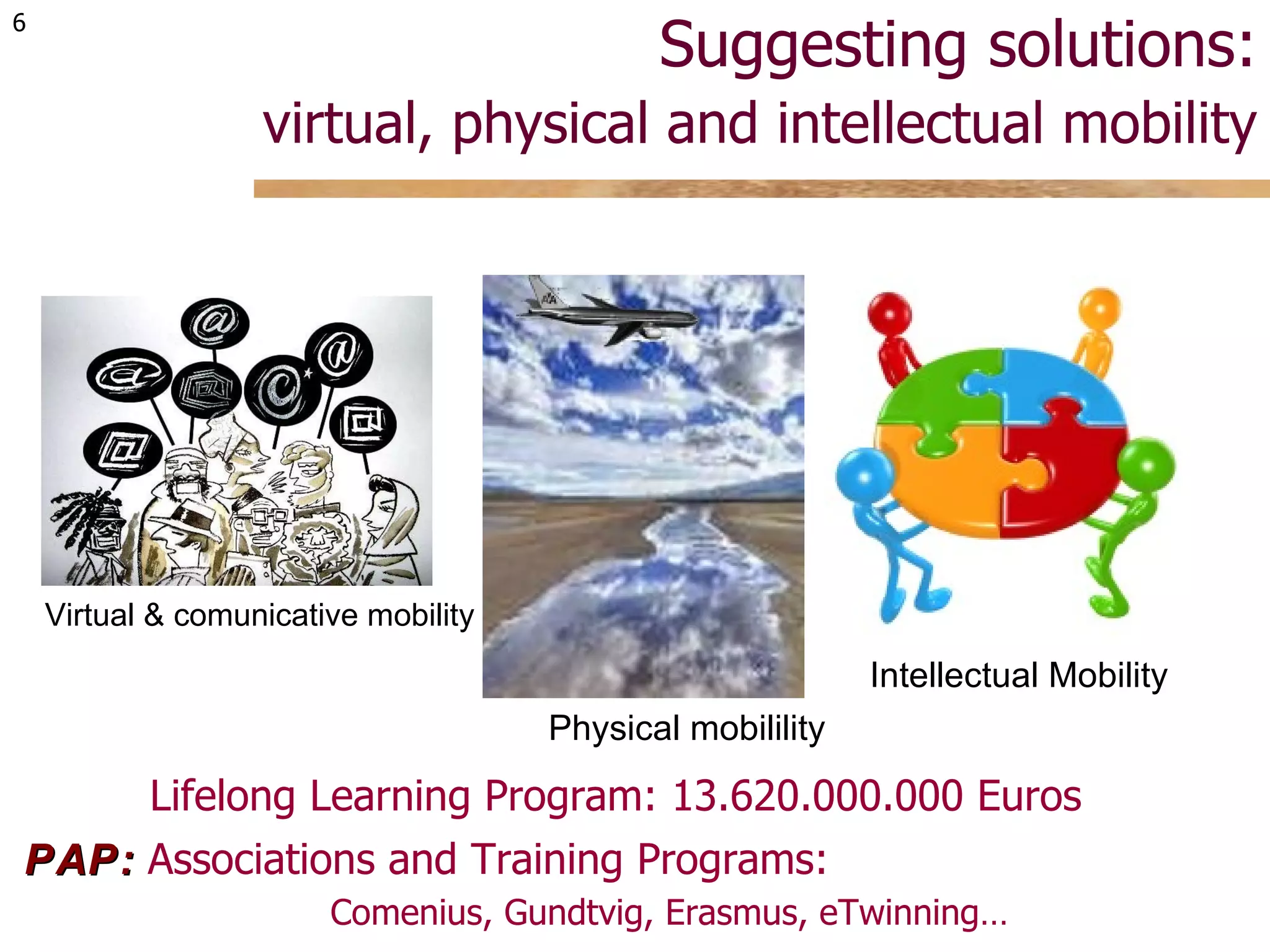
Suggesting solutions:   virtual, physical and intellectual mobility Virtual & comunicative mobility Physical mobilility Intellectual Mobility  PAP:  Associations and Training Programs:    Comenius, Gundtvig, Erasmus, eTwinning… Lifelong Learning Program: 13.620.000.000 Euros
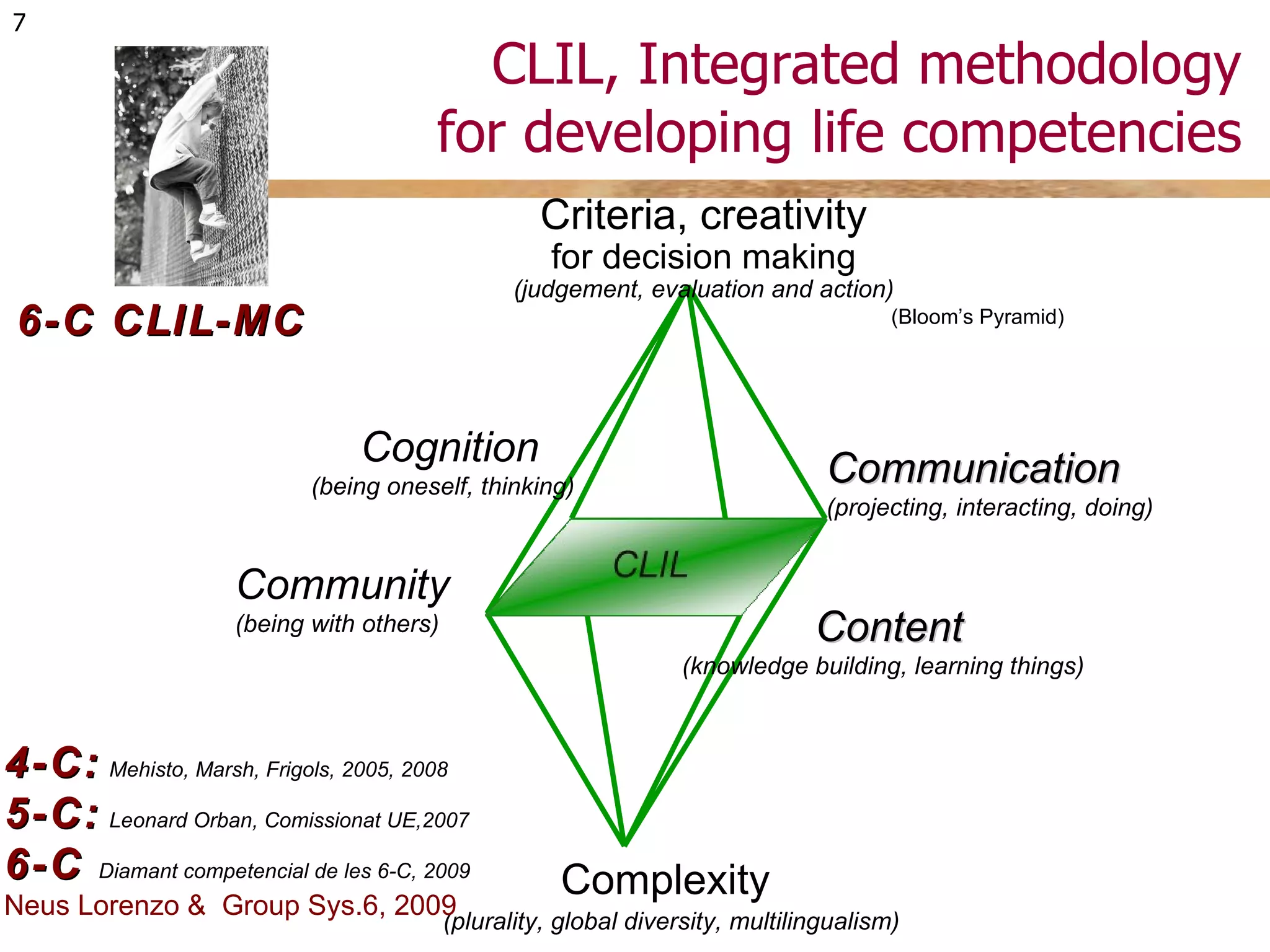
CLIL, Integrated methodology for developing life competencies 4-C:   Mehisto, Marsh, Frigols, 2005, 2008 5-C:   Leonard Orban, Comissionat UE,2007 6-C  Diamant competencial de les 6-C, 2009   Neus Lorenzo &  Group Sys.6, 2009 Criteria, creativity for decision making (judgement, evaluation and action) (Bloom’s Pyramid) Complexity (plurality, global diversity, multilingualism) 6-C CLIL-MC Content (knowledge building, learning things) Communication (projecting, interacting, doing) Community (being with others) Cognition (being oneself, thinking)
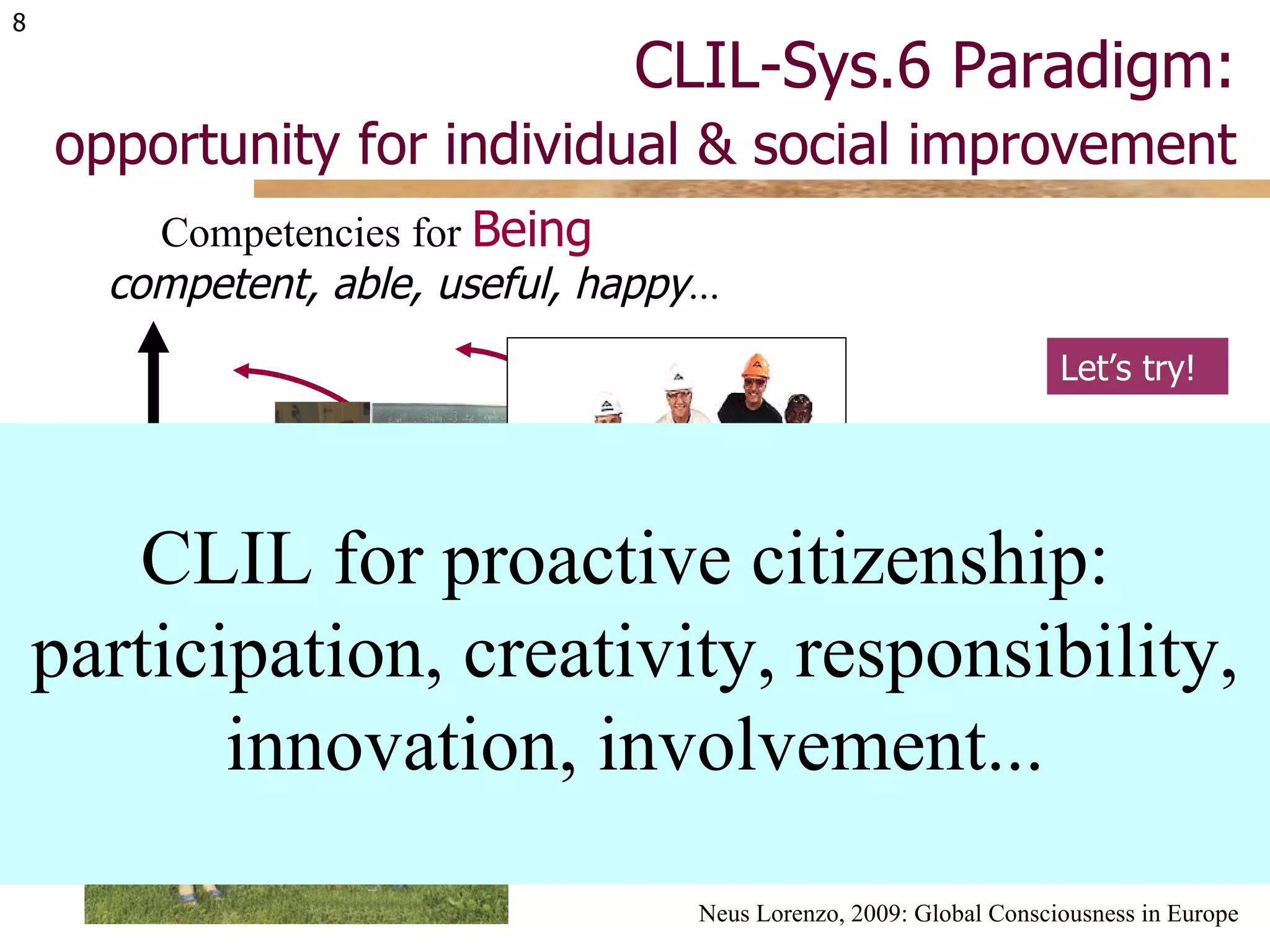
CLIL-Sys.6 Paradigm:   opportunity for individual & social improvement Neus Lorenzo, 2009: Global Consciousness in Europe Let’s try! CLIL for proactive citizenship:  participation, creativity, responsibility, innovation, involvement... transformation sharing learning Competition to  Have things, information, friends ... Competencies for  Being competent, able, useful, happy ...
Doing a European Project using CLIL  a present-day tool for attaining the future   Neus Lorenzo i Galés [email_address] We should cultivate today  the landscape of tomorrow … because only the trees that take root will be able to change the environment. Let’s start now !!!
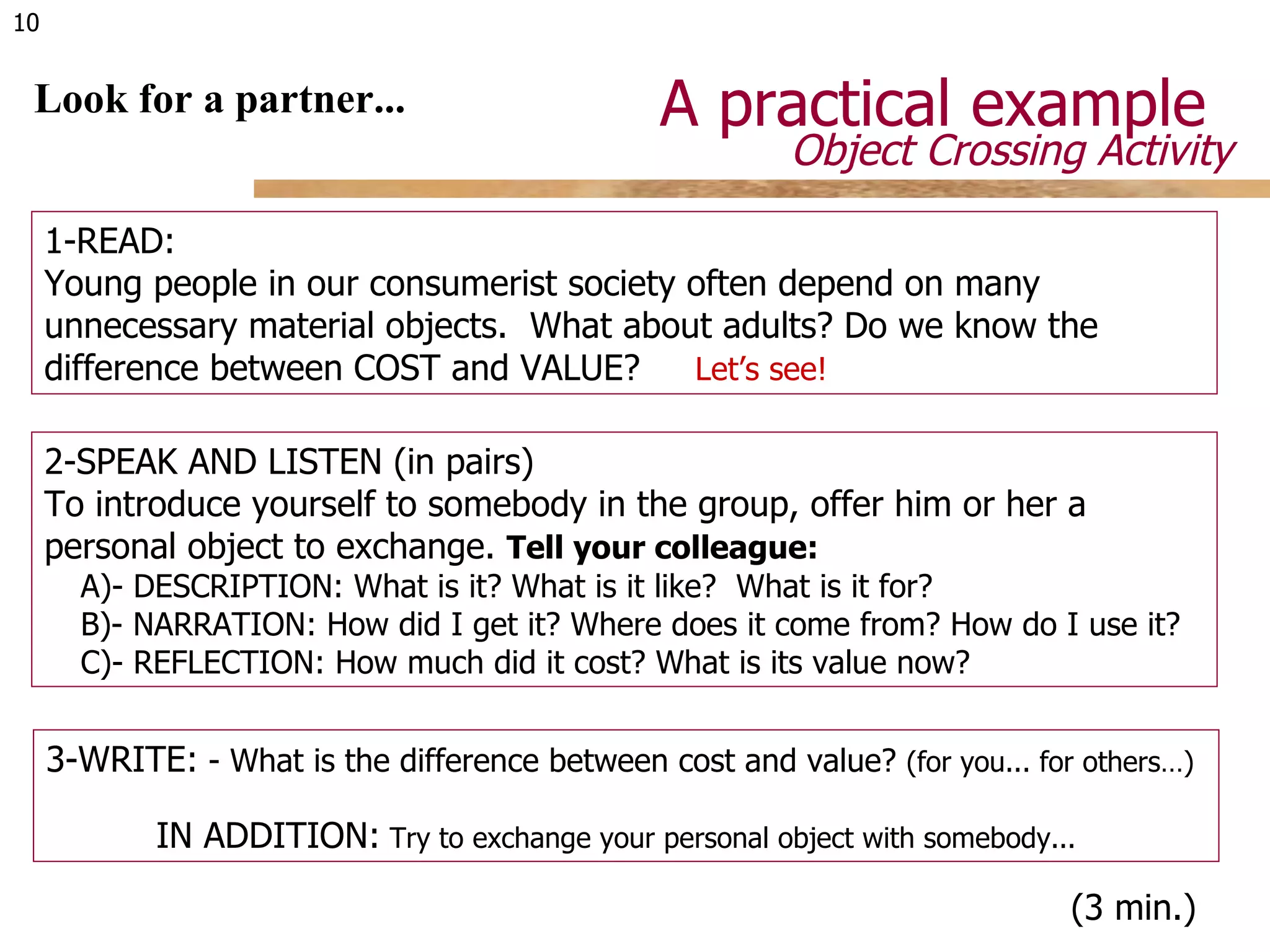
A practical example  Look for a partner... 1-READ: Young people in our consumerist society often depend on many unnecessary material objects.  What about adults?  Do we know the difference between COST and VALUE?  Let’s see! Object Crossing Activity  2-SPEAK AND LISTEN (in pairs) To i ntroduce yourself to somebody in the group, offer him or her a personal object to exchange.  Tell your colleague: A)- DESCRIPTION:  What is it? What is it like?  What is it for?  B)- NARRATION:  How did I get it? Where does it come from? How do I use it? C)- REFLECTION: How much did it cost? What is its value now?  3-WRITE:  - What is the difference between cost and value?  (for you... for others…) IN ADDITION:  Try to exchange your personal object with somebody... (3 min.)
Reflection Page  What language work have we done? -Vocabulary: colours, shapes... -Textual Typology: description, narration… speaking… listening ( skills ) -Grammar (verb tenses…) What learning content can we use ? - Daily life objects and activities, daily routines... - Objects, functions, origins… -Consumption, value and cost concepts, exchange, trade... What intreractive strategies have we used? - Persuasion, conversation, argumentation, buying and selling… What interpersonal and intrapersonal issues do we activate? - Generosity, fairness, property, socialization… What were your feelings when exchanging your object?... An activity with CLIL has an added value:  …  choose 3 main benefits…   Would you change your choice now?
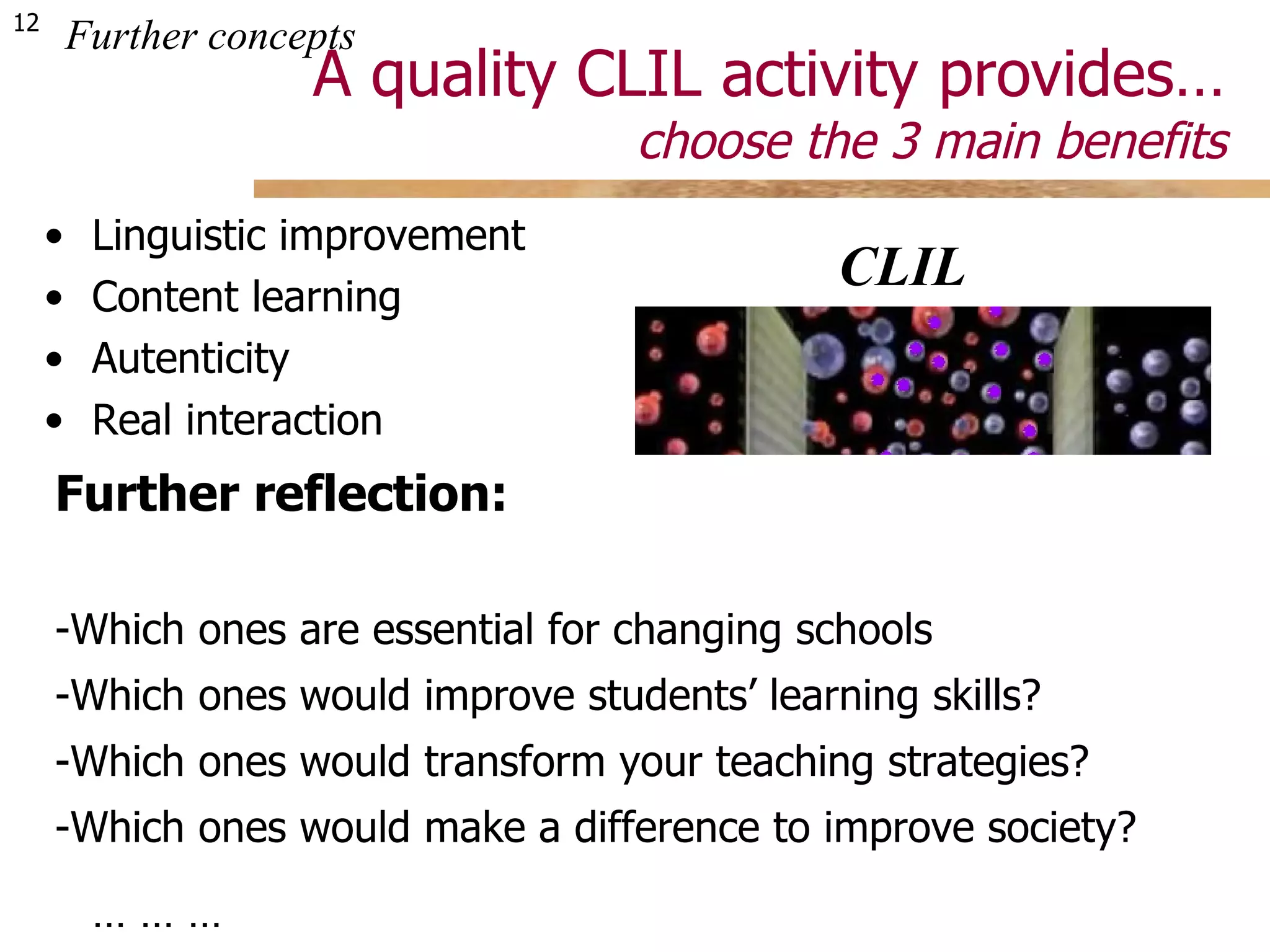
A quality CLIL activity provides… choose the 3 main benefits Linguistic improvement Content learning Autenticity Real interaction Developing competencies Building cognitive processes Cultural exploration  Educational socialization Collaborative techniques Attitudinal orientation  … … …  … … … Further concepts Would you change your choice now? Further reflection: -Which ones are essential for changing schools -Which ones would improve students’ learning skills? -Which ones would transform your teaching strategies? -Which ones would make a difference to improve society? Integrating activities  bring new added values... CLIL Language Content
CLIL Methodology,  strategy for developing competencies for participating in European projects Tri-CLIL Congress , Barcelona 2009 Neus Lorenzo Galés [email_address]
A practicle example  Look for a partner... 1- Young people in our consumerist society often depend on many unnecessary material objects.   --->  How mature are we?   ---> Do we know the difference between COST and VALUE?   How much dependency do we have on personal belongings?  Let’s see! 2- Introduce yourself to somebody in the group and offer him or her a personal object to exchange Tell a colleague -  What is it? What is it like?  What is it for?  -  How did I get it? Where does it come from? How do I use it?  -  How does it make me feel?  Am I able to give it away?   3-Who has gotten rid of the most expensive object? - How much did it cost? What is its value today?  (for you…  for others…)   - What is the difference between cost and value?  (use, personal attachment?)   (6 min.) Object Crossing Activity

Tri Clil 2009 Bcn

  • 1.
    CLIL Methodology, strategy for developing basic competencies for participating in European projects Tri-CLIL Congress , Barcelona 2009 Neus Lorenzo Galés [email_address]
  • 2.
    Content Introduction:initial concepts (1 min.) .. Reflection: (7 min.) ….. - Challenges: european citizenship and glocal identity - Suggested solutions: Lifelong Learning Programs, CLIL and Diamond Sys.6 (6-C CLIL) Practical Activity (4 min.) … - Activity - Reflection Page Continuing: further concepts (3 min.)
  • 3.
    A quality CLILactivity provides… choose the 3 main benefits Linguistic improvement Content learning Autenticity Real interaction Developing competencies Building cognitive processes Cultural exploration Educational socialization Collaborative techniques Attitudinal orientation … … … … … … Initial concepts Integrating activities provides new added value... CLIL Language Content
  • 4.
    European Projects: transversality, plurilingualism and interculturalism Virtual garden Simultaneous Art Exhibit Multicultural concert Chirldren's intercultural library Collaborative portal European traditions on Webs Virtual Maths Race Do these projects provide schools with what is really necessary? Radio program in several languages
  • 5.
    Challenges: European citizenship and glocal identity Since 1 January 2007, the new European Commissioner for Multilingualism has been developing a portfolio for European citizenship in the 21st century: a) To build a common European identity in plurality & diversity b) To face immigration and European enlargement together c) To manage globalisation trends in labour markets Adapted from: Leonard Orban, Commissioner for Multilingual Portfolio, EU, 2007 belong become evolve
  • 6.
    Suggesting solutions: virtual, physical and intellectual mobility Virtual & comunicative mobility Physical mobilility Intellectual Mobility PAP: Associations and Training Programs: Comenius, Gundtvig, Erasmus, eTwinning… Lifelong Learning Program: 13.620.000.000 Euros
  • 7.
    CLIL, Integrated methodologyfor developing life competencies 4-C: Mehisto, Marsh, Frigols, 2005, 2008 5-C: Leonard Orban, Comissionat UE,2007 6-C Diamant competencial de les 6-C, 2009 Neus Lorenzo & Group Sys.6, 2009 Criteria, creativity for decision making (judgement, evaluation and action) (Bloom’s Pyramid) Complexity (plurality, global diversity, multilingualism) 6-C CLIL-MC Content (knowledge building, learning things) Communication (projecting, interacting, doing) Community (being with others) Cognition (being oneself, thinking)
  • 8.
    CLIL-Sys.6 Paradigm: opportunity for individual & social improvement Neus Lorenzo, 2009: Global Consciousness in Europe Let’s try! CLIL for proactive citizenship: participation, creativity, responsibility, innovation, involvement... transformation sharing learning Competition to Have things, information, friends ... Competencies for Being competent, able, useful, happy ...
  • 9.
    Doing a EuropeanProject using CLIL a present-day tool for attaining the future Neus Lorenzo i Galés [email_address] We should cultivate today the landscape of tomorrow … because only the trees that take root will be able to change the environment. Let’s start now !!!
  • 10.
    A practical example Look for a partner... 1-READ: Young people in our consumerist society often depend on many unnecessary material objects. What about adults? Do we know the difference between COST and VALUE? Let’s see! Object Crossing Activity 2-SPEAK AND LISTEN (in pairs) To i ntroduce yourself to somebody in the group, offer him or her a personal object to exchange. Tell your colleague: A)- DESCRIPTION: What is it? What is it like? What is it for? B)- NARRATION: How did I get it? Where does it come from? How do I use it? C)- REFLECTION: How much did it cost? What is its value now? 3-WRITE: - What is the difference between cost and value? (for you... for others…) IN ADDITION: Try to exchange your personal object with somebody... (3 min.)
  • 11.
    Reflection Page What language work have we done? -Vocabulary: colours, shapes... -Textual Typology: description, narration… speaking… listening ( skills ) -Grammar (verb tenses…) What learning content can we use ? - Daily life objects and activities, daily routines... - Objects, functions, origins… -Consumption, value and cost concepts, exchange, trade... What intreractive strategies have we used? - Persuasion, conversation, argumentation, buying and selling… What interpersonal and intrapersonal issues do we activate? - Generosity, fairness, property, socialization… What were your feelings when exchanging your object?... An activity with CLIL has an added value: … choose 3 main benefits… Would you change your choice now?
  • 12.
    A quality CLILactivity provides… choose the 3 main benefits Linguistic improvement Content learning Autenticity Real interaction Developing competencies Building cognitive processes Cultural exploration Educational socialization Collaborative techniques Attitudinal orientation … … … … … … Further concepts Would you change your choice now? Further reflection: -Which ones are essential for changing schools -Which ones would improve students’ learning skills? -Which ones would transform your teaching strategies? -Which ones would make a difference to improve society? Integrating activities bring new added values... CLIL Language Content
  • 13.
    CLIL Methodology, strategy for developing competencies for participating in European projects Tri-CLIL Congress , Barcelona 2009 Neus Lorenzo Galés [email_address]
  • 14.
    A practicle example Look for a partner... 1- Young people in our consumerist society often depend on many unnecessary material objects. ---> How mature are we? ---> Do we know the difference between COST and VALUE? How much dependency do we have on personal belongings? Let’s see! 2- Introduce yourself to somebody in the group and offer him or her a personal object to exchange Tell a colleague - What is it? What is it like? What is it for? - How did I get it? Where does it come from? How do I use it? - How does it make me feel? Am I able to give it away? 3-Who has gotten rid of the most expensive object? - How much did it cost? What is its value today? (for you… for others…) - What is the difference between cost and value? (use, personal attachment?) (6 min.) Object Crossing Activity

Editor's Notes

  • #4 A B C D En grups de 4: (2 min.) TOTS:
  • #13 A B C D En grups de 4: (2 min.) TOTS: