CLIL lesson plan
Information about the class
Class: Year 1(Polimodal) – high elementary
Students’ age: 15/6 years old
Number of students: 35
Tipo de Planificación: (Unidad o Clase): Clase
Unidad Temática: Countries in the Americas.
Clase Nº: 1
Class time: 80 minutes

Aims
    To talk about the general features of a country cohesively.
    To develop writing skills through paragraph build.
    To develop guessing, confirmation, and summarising strategies.


Teaching points

       LEXIS                FUNCTIONS                   STRUCTURE
Anthem, motto,        Introducing                  Generally speaking…
population Density,   Contrasting                  Not only but also
area, currency,       Adding                       What’s more
scenery, domain.                                   Although…
                                                   However,…


Materials: data projector and speakers, photocopies w/activities, blackboard.

Warm-up (5 minutes)

First I will greet the students. I will remind them about the letter we read in the book
about a girl travelling to Canada (Messages, OUP). I will ask them questions like:
Did she go to Ottawa or Montreal?
Did she only stay in a big city?
Did she go alone?
Do you remember what she did in Canada?
Do you know anything about Canada by the way?

After these questions I will tell them that today we’ll talk more about Canada as one
country from North America. I’ll tell them that in future lessons we’ll learn facts
about other countries in the Americas.
Transition: Ok, now let’s focus on some initial facts about Canada.

Development (60 minutes)

Activity 1:
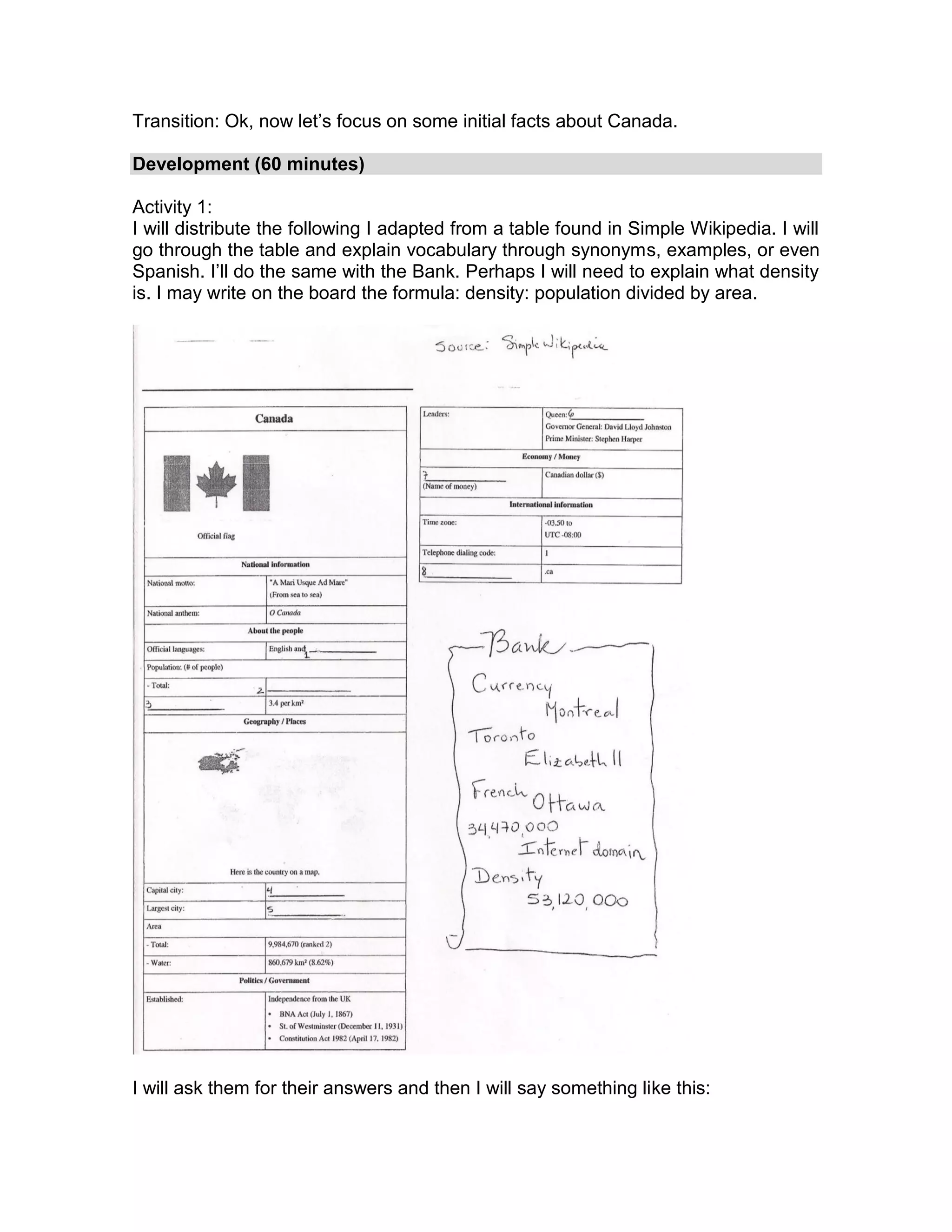
I will distribute the following I adapted from a table found in Simple Wikipedia. I will
go through the table and explain vocabulary through synonyms, examples, or even
Spanish. I’ll do the same with the Bank. Perhaps I will need to explain what density
is. I may write on the board the formula: density: population divided by area.


I will ask them for their answers and then I will say something like this:
So, generally speaking, Canada has a lot from the British. However, they also
have similarities with France. They not only speak English but also French. And
let’s pay attention to their population, area, and density. You see that Canada is a
big country. However, their population is not huge. Although they’re the second
largest country in the world, the population density is low. And look, they’re similar
to the USA. They speak English, too. What’s more, they have Canadian dollar as
their currency.

I will repeat some of the sentences going over the description and as I do I will
write on the board the highlighted words above in any place.

Questions:
Why do you think I used these words?
To show what?
Do I want to sound like a collection of facts? Do I want to say things in order?
Now, look, can we say which of these words ADD information? (I circle them on the
board) Good!
Now, and the others? Do they also add or show contrast? (I underline them)

At this point I will draw a simple table (1 column ADDITION, another column
CONTRAST) and I ask students to come to the board and write those words under
the right column. They will copy this.

Transition: Now, let’s put all this into a paragraph.

Activity 2:
I will hand out copies of the following paragraph. They need to complete the
paragraph with information/words from the Canada table.

Generally speaking, Canada is a country in ____________, its capital is
___________, and its ___________ is the Canadian dollar.
What’s more, the __________ is 34,470,000. However, ___________ is low
because of the vast _______ the country has. Although they are independent from
the UK, _____________ is still one of their leaders. Canadians not only speak
___________ but also ___________.


I will nominate some students to read the paragraph and I will again highlight the
use of the connectors as I did above.

Transition: Excellent! Shall we learn more about Canada? Shall we learn more
about videos promoting tourism?


Activity 3:
I will first tell them that in short videos advertising a country, some aspects are
usually mentioned. I will say that for example we can watch about landscapes,
flora, fauna, or the capital city. Question to students: Any other aspects?
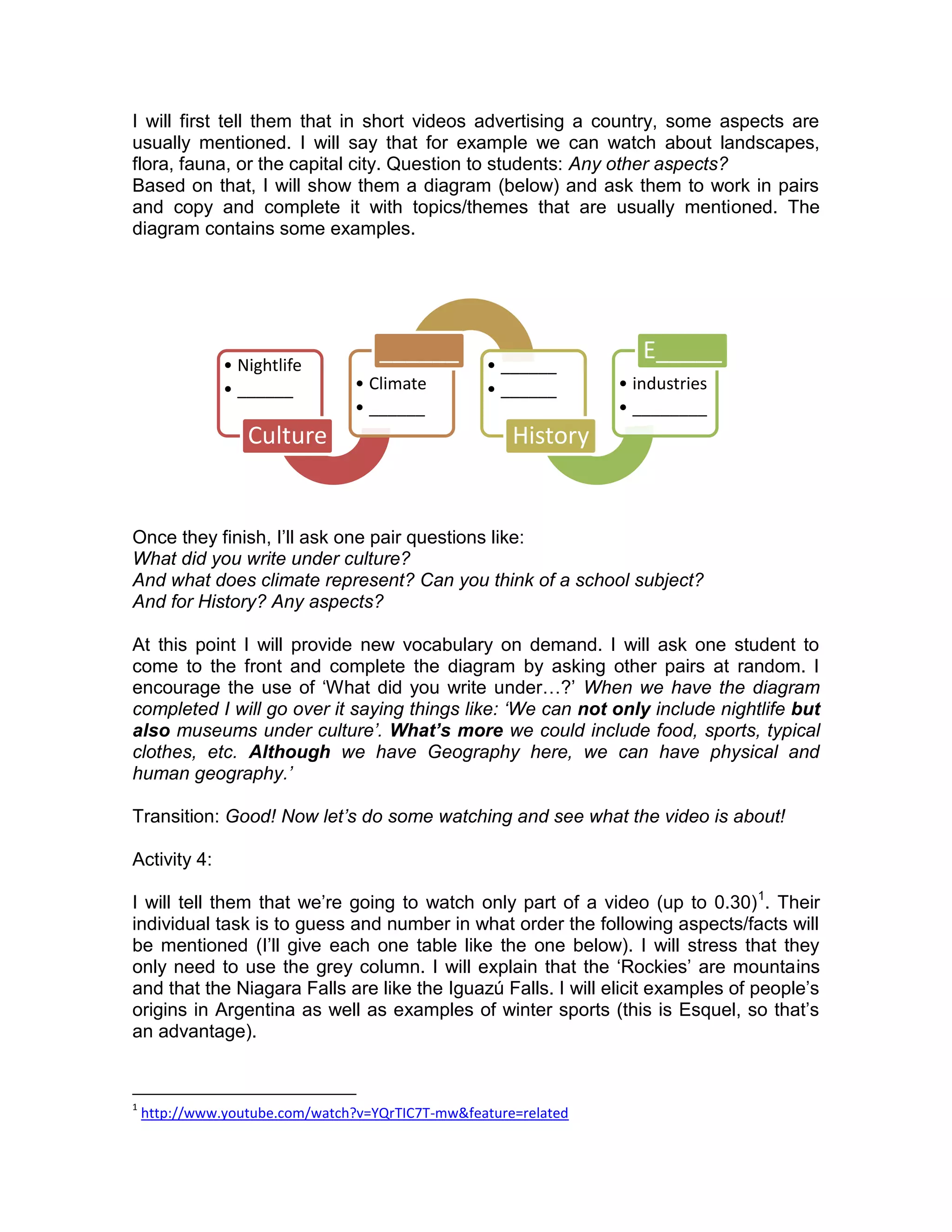
Based on that, I will show them a diagram (below) and ask them to work in pairs
and copy and complete it with topics/themes that are usually mentioned. The
diagram contains some examples.


               • Nightlife
                                    ______        • ______
                                                                    E_____
               • ______          • Climate        • ______       • industries
                                 • ______                        • ________
                  Culture                             History


Once they finish, I’ll ask one pair questions like:
What did you write under culture?
And what does climate represent? Can you think of a school subject?
And for History? Any aspects?

At this point I will provide new vocabulary on demand. I will ask one student to
come to the front and complete the diagram by asking other pairs at random. I
encourage the use of ‘What did you write under…?’ When we have the diagram
completed I will go over it saying things like: ‘We can not only include nightlife but
also museums under culture’. What’s more we could include food, sports, typical
clothes, etc. Although we have Geography here, we can have physical and
human geography.’

Transition: Good! Now let’s do some watching and see what the video is about!

Activity 4:

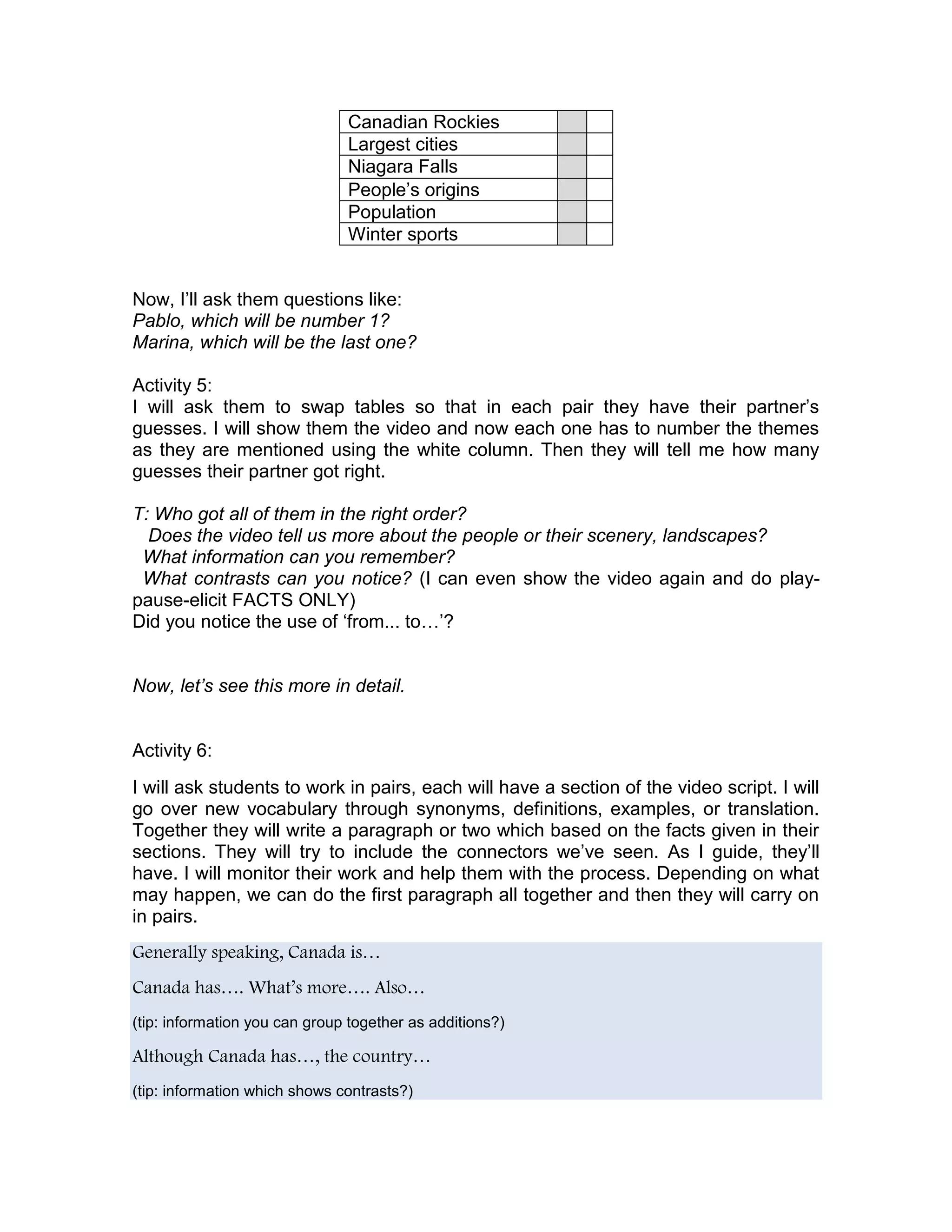
I will tell them that we’re going to watch only part of a video (up to 0.30) 1. Their
individual task is to guess and number in what order the following aspects/facts will
be mentioned (I’ll give each one table like the one below). I will stress that they
only need to use the grey column. I will explain that the ‘Rockies’ are mountains
and that the Niagara Falls are like the Iguazú Falls. I will elicit examples of people’s
origins in Argentina as well as examples of winter sports (this is Esquel, so that’s
an advantage).


1
    http://www.youtube.com/watch?v=YQrTIC7T-mw&feature=related
Canadian Rockies
                               Largest cities
                               Niagara Falls
                               People’s origins
                               Population
                               Winter sports


Now, I’ll ask them questions like:
Pablo, which will be number 1?
Marina, which will be the last one?

Activity 5:
I will ask them to swap tables so that in each pair they have their partner’s
guesses. I will show them the video and now each one has to number the themes
as they are mentioned using the white column. Then they will tell me how many
guesses their partner got right.

T: Who got all of them in the right order?
  Does the video tell us more about the people or their scenery, landscapes?
 What information can you remember?
 What contrasts can you notice? (I can even show the video again and do play-
pause-elicit FACTS ONLY)
Did you notice the use of ‘from... to…’?


Now, let’s see this more in detail.


Activity 6:
I will ask students to work in pairs, each will have a section of the video script. I will
go over new vocabulary through synonyms, definitions, examples, or translation.
Together they will write a paragraph or two which based on the facts given in their
sections. They will try to include the connectors we’ve seen. As I guide, they’ll
have. I will monitor their work and help them with the process. Depending on what
may happen, we can do the first paragraph all together and then they will carry on
in pairs.
Generally speaking, Canada is…
Canada has…. What’s more…. Also…
(tip: information you can group together as additions?)

Although Canada has…, the country…
(tip: information which shows contrasts?)
Closure (10 minutes)
Some pairs will read their productions. I will provide oral feedback through
questions, echoing, and clarification). We will recap facts about Canada through
my prompting. I will congratulate them on their work. I will receive their paragraphs
for correction. They will rewrite them in the following lesson.

Homework

I will assign each group a country from Central America. Each pair will bring
information about their given country from Simple Wikipedia.

Clil lesson plan sample1 module

  • 1.
    CLIL lesson plan Informationabout the class Class: Year 1(Polimodal) – high elementary Students’ age: 15/6 years old Number of students: 35 Tipo de Planificación: (Unidad o Clase): Clase Unidad Temática: Countries in the Americas. Clase Nº: 1 Class time: 80 minutes Aims  To talk about the general features of a country cohesively.  To develop writing skills through paragraph build.  To develop guessing, confirmation, and summarising strategies. Teaching points LEXIS FUNCTIONS STRUCTURE Anthem, motto, Introducing Generally speaking… population Density, Contrasting Not only but also area, currency, Adding What’s more scenery, domain. Although… However,… Materials: data projector and speakers, photocopies w/activities, blackboard. Warm-up (5 minutes) First I will greet the students. I will remind them about the letter we read in the book about a girl travelling to Canada (Messages, OUP). I will ask them questions like: Did she go to Ottawa or Montreal? Did she only stay in a big city? Did she go alone? Do you remember what she did in Canada? Do you know anything about Canada by the way? After these questions I will tell them that today we’ll talk more about Canada as one country from North America. I’ll tell them that in future lessons we’ll learn facts about other countries in the Americas.
  • 2.
    Transition: Ok, nowlet’s focus on some initial facts about Canada. Development (60 minutes) Activity 1: I will distribute the following I adapted from a table found in Simple Wikipedia. I will go through the table and explain vocabulary through synonyms, examples, or even Spanish. I’ll do the same with the Bank. Perhaps I will need to explain what density is. I may write on the board the formula: density: population divided by area. I will ask them for their answers and then I will say something like this:
  • 3.
    So, generally speaking,Canada has a lot from the British. However, they also have similarities with France. They not only speak English but also French. And let’s pay attention to their population, area, and density. You see that Canada is a big country. However, their population is not huge. Although they’re the second largest country in the world, the population density is low. And look, they’re similar to the USA. They speak English, too. What’s more, they have Canadian dollar as their currency. I will repeat some of the sentences going over the description and as I do I will write on the board the highlighted words above in any place. Questions: Why do you think I used these words? To show what? Do I want to sound like a collection of facts? Do I want to say things in order? Now, look, can we say which of these words ADD information? (I circle them on the board) Good! Now, and the others? Do they also add or show contrast? (I underline them) At this point I will draw a simple table (1 column ADDITION, another column CONTRAST) and I ask students to come to the board and write those words under the right column. They will copy this. Transition: Now, let’s put all this into a paragraph. Activity 2: I will hand out copies of the following paragraph. They need to complete the paragraph with information/words from the Canada table. Generally speaking, Canada is a country in ____________, its capital is ___________, and its ___________ is the Canadian dollar. What’s more, the __________ is 34,470,000. However, ___________ is low because of the vast _______ the country has. Although they are independent from the UK, _____________ is still one of their leaders. Canadians not only speak ___________ but also ___________. I will nominate some students to read the paragraph and I will again highlight the use of the connectors as I did above. Transition: Excellent! Shall we learn more about Canada? Shall we learn more about videos promoting tourism? Activity 3:
  • 4.
    I will firsttell them that in short videos advertising a country, some aspects are usually mentioned. I will say that for example we can watch about landscapes, flora, fauna, or the capital city. Question to students: Any other aspects? Based on that, I will show them a diagram (below) and ask them to work in pairs and copy and complete it with topics/themes that are usually mentioned. The diagram contains some examples. • Nightlife ______ • ______ E_____ • ______ • Climate • ______ • industries • ______ • ________ Culture History Once they finish, I’ll ask one pair questions like: What did you write under culture? And what does climate represent? Can you think of a school subject? And for History? Any aspects? At this point I will provide new vocabulary on demand. I will ask one student to come to the front and complete the diagram by asking other pairs at random. I encourage the use of ‘What did you write under…?’ When we have the diagram completed I will go over it saying things like: ‘We can not only include nightlife but also museums under culture’. What’s more we could include food, sports, typical clothes, etc. Although we have Geography here, we can have physical and human geography.’ Transition: Good! Now let’s do some watching and see what the video is about! Activity 4: I will tell them that we’re going to watch only part of a video (up to 0.30) 1. Their individual task is to guess and number in what order the following aspects/facts will be mentioned (I’ll give each one table like the one below). I will stress that they only need to use the grey column. I will explain that the ‘Rockies’ are mountains and that the Niagara Falls are like the Iguazú Falls. I will elicit examples of people’s origins in Argentina as well as examples of winter sports (this is Esquel, so that’s an advantage). 1 http://www.youtube.com/watch?v=YQrTIC7T-mw&feature=related
  • 5.
    Canadian Rockies Largest cities Niagara Falls People’s origins Population Winter sports Now, I’ll ask them questions like: Pablo, which will be number 1? Marina, which will be the last one? Activity 5: I will ask them to swap tables so that in each pair they have their partner’s guesses. I will show them the video and now each one has to number the themes as they are mentioned using the white column. Then they will tell me how many guesses their partner got right. T: Who got all of them in the right order? Does the video tell us more about the people or their scenery, landscapes? What information can you remember? What contrasts can you notice? (I can even show the video again and do play- pause-elicit FACTS ONLY) Did you notice the use of ‘from... to…’? Now, let’s see this more in detail. Activity 6: I will ask students to work in pairs, each will have a section of the video script. I will go over new vocabulary through synonyms, definitions, examples, or translation. Together they will write a paragraph or two which based on the facts given in their sections. They will try to include the connectors we’ve seen. As I guide, they’ll have. I will monitor their work and help them with the process. Depending on what may happen, we can do the first paragraph all together and then they will carry on in pairs. Generally speaking, Canada is… Canada has…. What’s more…. Also… (tip: information you can group together as additions?) Although Canada has…, the country… (tip: information which shows contrasts?)
  • 6.
    Closure (10 minutes) Somepairs will read their productions. I will provide oral feedback through questions, echoing, and clarification). We will recap facts about Canada through my prompting. I will congratulate them on their work. I will receive their paragraphs for correction. They will rewrite them in the following lesson. Homework I will assign each group a country from Central America. Each pair will bring information about their given country from Simple Wikipedia.