CLIL and cultural diversity:

        a winning combination
                  Vicky Saumell


 Barranquilla, Colombia
October 5th and 6th, 2012
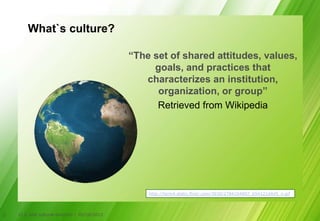
What`s culture?

                                               “The set of shared attitudes, values,
                                                    goals, and practices that
                                                  characterizes an institution,
                                                     organization, or group”
                                                     Retrieved from Wikipedia


                                                   http://farm4.static.flickr.com/3030/2784104897_054121d4d5_o.gif


3   CLIL and cultural diversity l 05/10/2012
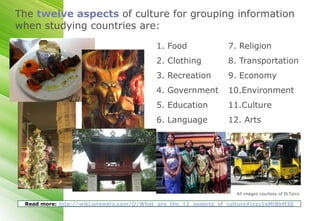
The twelve aspects of culture for grouping information
when studying countries are:

                                          1. Food                7. Religion
                                          2. Clothing            8. Transportation
                                          3. Recreation          9. Economy
                                          4. Government          10.Environment
                                          5. Education           11.Culture
                                          6. Language            12. Arts


                                                                   All images courtesy of ELTpics

 Read more: http://wiki.answers.com/Q/What_are_the_12_aspects_of_culture#ixzz1gMtBkM36
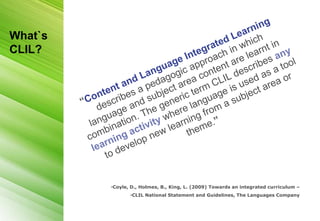
What`s
CLIL?


         •Coyle, D., Holmes, B., King, L. (2009) Towards an integrated curriculum –
                •CLIL National Statement and Guidelines, The Languages Company
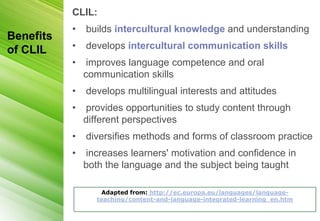
CLIL:
           •   builds intercultural knowledge and understanding
Benefits
of CLIL    •   develops intercultural communication skills
           •    improves language competence and oral
               communication skills
           •   develops multilingual interests and attitudes
           •   provides opportunities to study content through
               different perspectives
           •   diversifies methods and forms of classroom practice
           •   increases learners' motivation and confidence in
               both the language and the subject being taught

                    Adapted from: http://ec.europa.eu/languages/language-
                  teaching/content-and-language-integrated-learning_en.htm
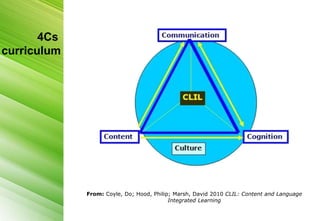
4Cs
curriculum


             From: Coyle, Do; Hood, Philip; Marsh, David 2010 CLIL: Content and Language
                                          Integrated Learning
“Curriculum models for CLIL can vary in
CLIL
types     length from a single unit comprising a sequence
           of 2-3 lessons to a more sustained experience
             through modules lasting half a term or more.
           Some schools are developing bilingual sections
           where subjects are taught through the medium
              of another language for extensive periods.”


        •Coyle, D., Holmes, B., King, L. (2009) Towards an integrated curriculum –
           •CLIL National Statement and Guidelines, The Languages Company
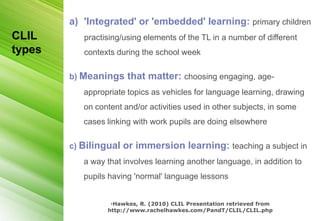
a) 'Integrated' or 'embedded' learning: primary children
CLIL       practising/using elements of the TL in a number of different
types      contexts during the school week

        b) Meanings that matter: choosing engaging, age-
           appropriate topics as vehicles for language learning, drawing
           on content and/or activities used in other subjects, in some
           cases linking with work pupils are doing elsewhere

        c) Bilingual or immersion learning: teaching a subject in
           a way that involves learning another language, in addition to
           pupils having 'normal' language lessons


                  •Hawkes, R. (2010) CLIL Presentation retrieved from
                 http://www.rachelhawkes.com/PandT/CLIL/CLIL.php
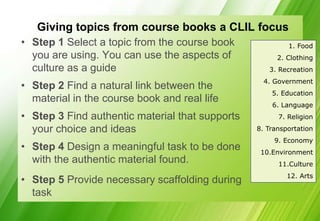
Giving topics from course books a CLIL focus
• Step 1 Select a topic from the course book              1. Food
  you are using. You can use the aspects of            2. Clothing
  culture as a guide                                3. Recreation
                                                   4. Government
• Step 2 Find a natural link between the
                                                     5. Education
  material in the course book and real life
                                                     6. Language
• Step 3 Find authentic material that supports         7. Religion

  your choice and ideas                          8. Transportation
                                                      9. Economy
• Step 4 Design a meaningful task to be done      10.Environment
  with the authentic material found.                   11.Culture
                                                          12. Arts
• Step 5 Provide necessary scaffolding during
  task
Food around the world


                   Step 2
                • What people eat
                around the world
                • Healthy and unhealthy
                food and habits
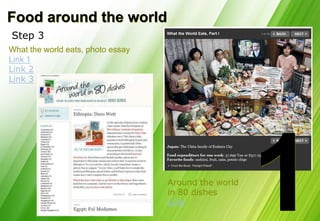
Food around the world
Step 3
What the world eats, photo essay
Link 1
Link 2
Link 3


                                   Around the world
                                   in 80 dishes
                                   Link
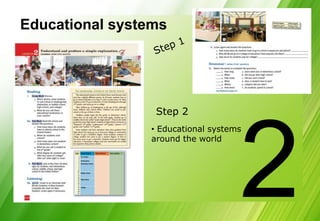
Educational systems


                 Step 2
                • Educational systems
                around the world
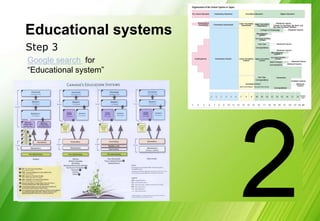
Educational systems
Step 3
Google search for
“Educational system”
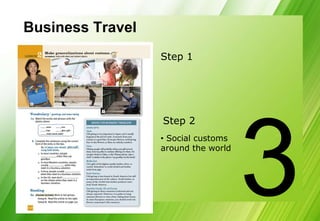
Business Travel
                  Step 1


                  Step 2
                  • Social customs
                  around the world
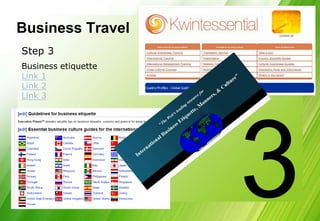
Business Travel
Step 3
Business etiquette
Link 1
Link 2
Link 3
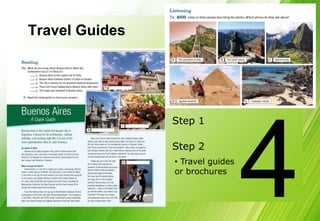
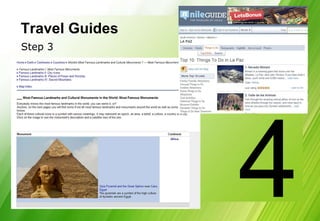
Travel Guides


                Step 1

                Step 2
                • Travel guides
                or brochures
Travel Guides
Step 3
Design a meaningful task to be done
Step 4           with the authentic material found.

Suggestions
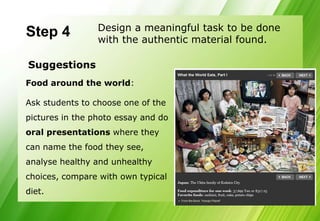
Food around the world:

Ask students to choose one of the
pictures in the photo essay and do
oral presentations where they
can name the food they see,
analyse healthy and unhealthy
choices, compare with own typical
diet.
Design a meaningful task to be done
            Step 4                         with the authentic material found.
          Suggestions

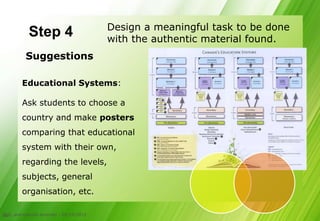
         Educational Systems:

         Ask students to choose a
         country and make posters
         comparing that educational
         system with their own,
         regarding the levels,
         subjects, general
         organisation, etc.

CLIL and cultural diversity - 05/10/2012
20
Design a meaningful task to be done
         Step 4                                     with the authentic material found.
           Suggestions

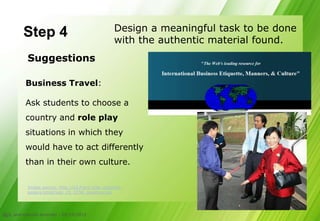
          Business Travel:

          Ask students to choose a
          country and role play
          situations in which they
          would have to act differently
          than in their own culture.

           Image source: http://s3.frank.itlab.us/photo-
           essays/small/sep_25_2358_greeting.jpg


CLIL and cultural diversity - 05/10/2012
21
Design a meaningful task to be done
            Step 4                         with the authentic material found.
            Suggestions

         Travel Guides:

         Ask students to choose a
         country or their own country
         (in multicultural settings) and
         design a travel brochure
         with the main sights and
         landmarks


CLIL and cultural diversity - 05/10/2012
22
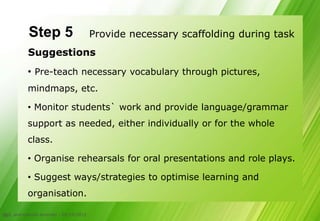
Step 5                         Provide necessary scaffolding during task
            Suggestions
           • Pre-teach necessary vocabulary through pictures,
           mindmaps, etc.

           • Monitor students` work and provide language/grammar
           support as needed, either individually or for the whole
           class.

           • Organise rehearsals for oral presentations and role plays.

           • Suggest ways/strategies to optimise learning and
           organisation.

CLIL and cultural diversity - 05/10/2012
23
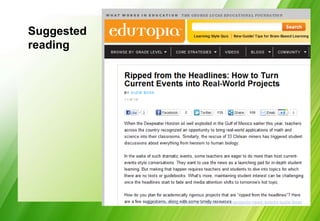
Suggested
reading


            http://www.edutopia.org/blog/real-world-projects-news-events-suzie-boss
Thank you

  My contact details
  E-mail: saumell.vicky@gmail.com
  Website: http://vickysaumell.blogspot.com/
  Twitter: @vickysaumell

References:
• Coyle, D., Holmes, B., King, L. (2009) Towards an integrated curriculum – CLIL
National Statement and Guidelines, The Languages Company
• Coyle, D., Hood, P., Marsh, D. (2010) CLIL: Content and Language Integrated
Learning
• Hawkes, R. (2010) CLIL Presentation retrieved from
http://www.rachelhawkes.com/PandT/CLIL/CLIL.php

CLIL and cultural diversity

  • 1.
    CLIL and culturaldiversity: a winning combination Vicky Saumell Barranquilla, Colombia October 5th and 6th, 2012
  • 2.
    What`s culture? “The set of shared attitudes, values, goals, and practices that characterizes an institution, organization, or group” Retrieved from Wikipedia http://farm4.static.flickr.com/3030/2784104897_054121d4d5_o.gif 3 CLIL and cultural diversity l 05/10/2012
  • 3.
    The twelve aspectsof culture for grouping information when studying countries are: 1. Food 7. Religion 2. Clothing 8. Transportation 3. Recreation 9. Economy 4. Government 10.Environment 5. Education 11.Culture 6. Language 12. Arts All images courtesy of ELTpics Read more: http://wiki.answers.com/Q/What_are_the_12_aspects_of_culture#ixzz1gMtBkM36
  • 4.
    What`s CLIL? •Coyle, D., Holmes, B., King, L. (2009) Towards an integrated curriculum – •CLIL National Statement and Guidelines, The Languages Company
  • 5.
    CLIL: • builds intercultural knowledge and understanding Benefits of CLIL • develops intercultural communication skills • improves language competence and oral communication skills • develops multilingual interests and attitudes • provides opportunities to study content through different perspectives • diversifies methods and forms of classroom practice • increases learners' motivation and confidence in both the language and the subject being taught Adapted from: http://ec.europa.eu/languages/language- teaching/content-and-language-integrated-learning_en.htm
  • 6.
    4Cs curriculum From: Coyle, Do; Hood, Philip; Marsh, David 2010 CLIL: Content and Language Integrated Learning
  • 7.
    “Curriculum models forCLIL can vary in CLIL types length from a single unit comprising a sequence of 2-3 lessons to a more sustained experience through modules lasting half a term or more. Some schools are developing bilingual sections where subjects are taught through the medium of another language for extensive periods.” •Coyle, D., Holmes, B., King, L. (2009) Towards an integrated curriculum – •CLIL National Statement and Guidelines, The Languages Company
  • 8.
    a) 'Integrated' or'embedded' learning: primary children CLIL practising/using elements of the TL in a number of different types contexts during the school week b) Meanings that matter: choosing engaging, age- appropriate topics as vehicles for language learning, drawing on content and/or activities used in other subjects, in some cases linking with work pupils are doing elsewhere c) Bilingual or immersion learning: teaching a subject in a way that involves learning another language, in addition to pupils having 'normal' language lessons •Hawkes, R. (2010) CLIL Presentation retrieved from http://www.rachelhawkes.com/PandT/CLIL/CLIL.php
  • 9.
    Giving topics fromcourse books a CLIL focus • Step 1 Select a topic from the course book 1. Food you are using. You can use the aspects of 2. Clothing culture as a guide 3. Recreation 4. Government • Step 2 Find a natural link between the 5. Education material in the course book and real life 6. Language • Step 3 Find authentic material that supports 7. Religion your choice and ideas 8. Transportation 9. Economy • Step 4 Design a meaningful task to be done 10.Environment with the authentic material found. 11.Culture 12. Arts • Step 5 Provide necessary scaffolding during task
  • 10.
    Food around theworld Step 2 • What people eat around the world • Healthy and unhealthy food and habits
  • 11.
    Food around theworld Step 3 What the world eats, photo essay Link 1 Link 2 Link 3 Around the world in 80 dishes Link
  • 12.
    Educational systems Step 2 • Educational systems around the world
  • 13.
    Educational systems Step 3 Googlesearch for “Educational system”
  • 14.
    Business Travel Step 1 Step 2 • Social customs around the world
  • 15.
    Business Travel Step 3 Businessetiquette Link 1 Link 2 Link 3
  • 16.
    Travel Guides Step 1 Step 2 • Travel guides or brochures
  • 17.
  • 18.
    Design a meaningfultask to be done Step 4 with the authentic material found. Suggestions Food around the world: Ask students to choose one of the pictures in the photo essay and do oral presentations where they can name the food they see, analyse healthy and unhealthy choices, compare with own typical diet.
  • 19.
    Design a meaningfultask to be done Step 4 with the authentic material found. Suggestions Educational Systems: Ask students to choose a country and make posters comparing that educational system with their own, regarding the levels, subjects, general organisation, etc. CLIL and cultural diversity - 05/10/2012 20
  • 20.
    Design a meaningfultask to be done Step 4 with the authentic material found. Suggestions Business Travel: Ask students to choose a country and role play situations in which they would have to act differently than in their own culture. Image source: http://s3.frank.itlab.us/photo- essays/small/sep_25_2358_greeting.jpg CLIL and cultural diversity - 05/10/2012 21
  • 21.
    Design a meaningfultask to be done Step 4 with the authentic material found. Suggestions Travel Guides: Ask students to choose a country or their own country (in multicultural settings) and design a travel brochure with the main sights and landmarks CLIL and cultural diversity - 05/10/2012 22
  • 22.
    Step 5 Provide necessary scaffolding during task Suggestions • Pre-teach necessary vocabulary through pictures, mindmaps, etc. • Monitor students` work and provide language/grammar support as needed, either individually or for the whole class. • Organise rehearsals for oral presentations and role plays. • Suggest ways/strategies to optimise learning and organisation. CLIL and cultural diversity - 05/10/2012 23
  • 23.
    Suggested reading http://www.edutopia.org/blog/real-world-projects-news-events-suzie-boss
  • 24.
    Thank you My contact details E-mail: saumell.vicky@gmail.com Website: http://vickysaumell.blogspot.com/ Twitter: @vickysaumell References: • Coyle, D., Holmes, B., King, L. (2009) Towards an integrated curriculum – CLIL National Statement and Guidelines, The Languages Company • Coyle, D., Hood, P., Marsh, D. (2010) CLIL: Content and Language Integrated Learning • Hawkes, R. (2010) CLIL Presentation retrieved from http://www.rachelhawkes.com/PandT/CLIL/CLIL.php