El model català d’aprenentatge  de llengües estrangeres Berga, 26 Juny 2009 Neus Lorenzo Galés [email_address] L’ús de les tecnologies    i la seva aplicació als programes    de cooperació internacional
The Catalan model  of language teaching and learning  Berga, 26 June 2009 Neus Lorenzo Galés [email_address] Use and application of  ICT  at International Collaborative Projects
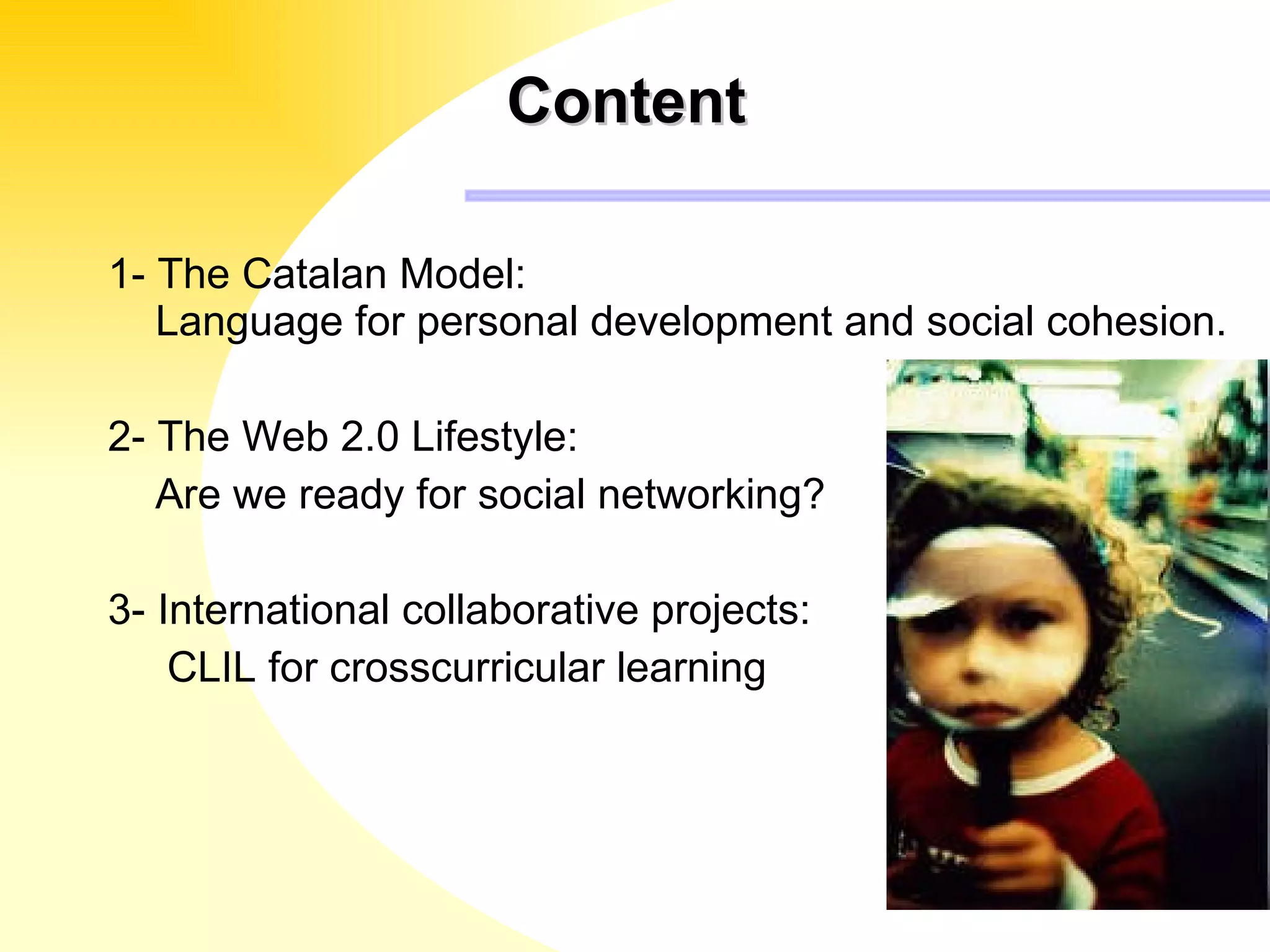
Content  1- The Catalan Model:  Language for personal development and social cohesion. 2- The Web 2.0 Lifestyle: Are we ready for social networking?  3- International collaborative projects: CLIL for crosscurricular learning
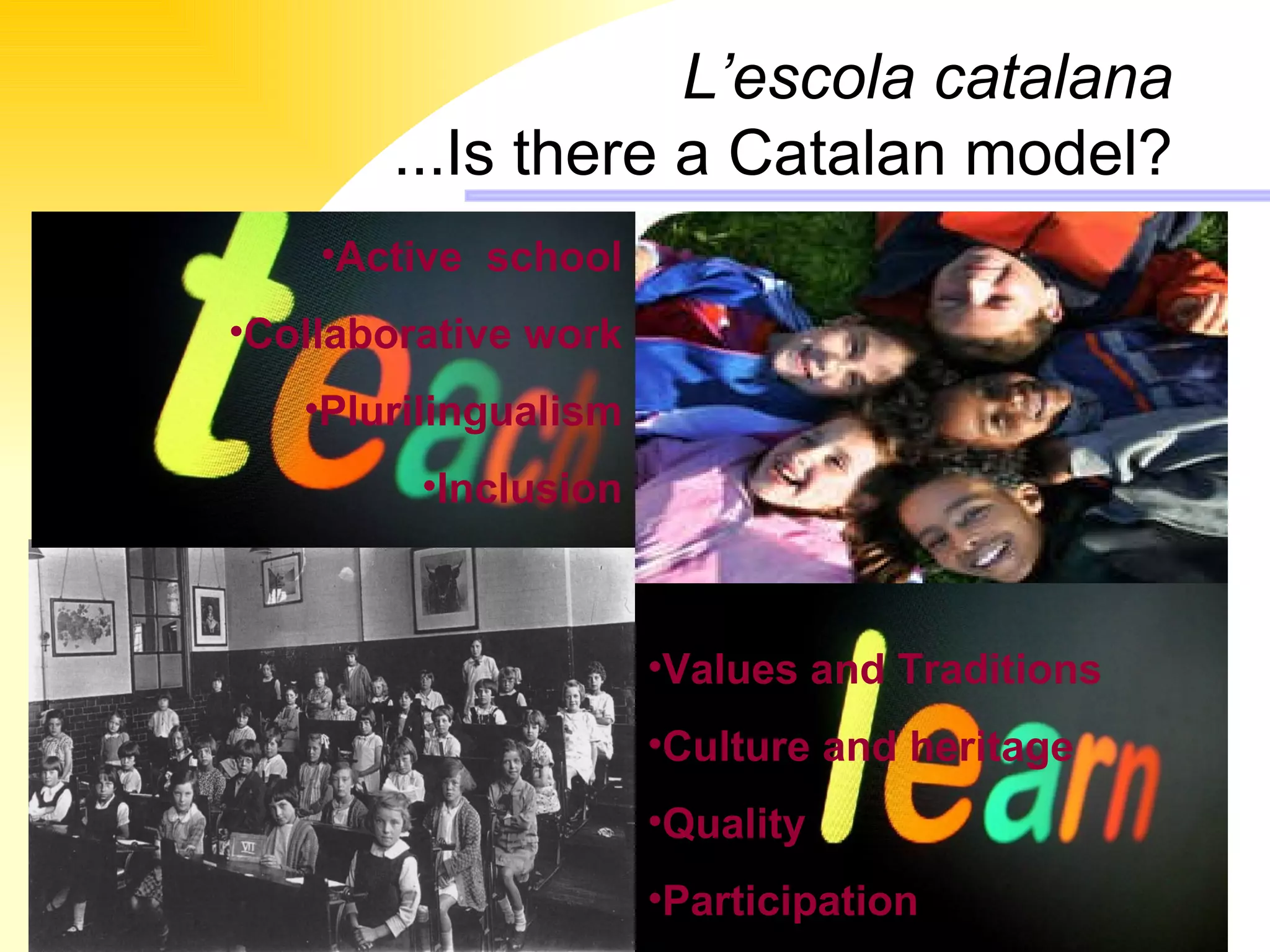
L’escola catalana ...Is there a Catalan model? Active  school Collaborative work Plurilingualism Inclusion Values and Traditions Culture and heritage Quality Participation
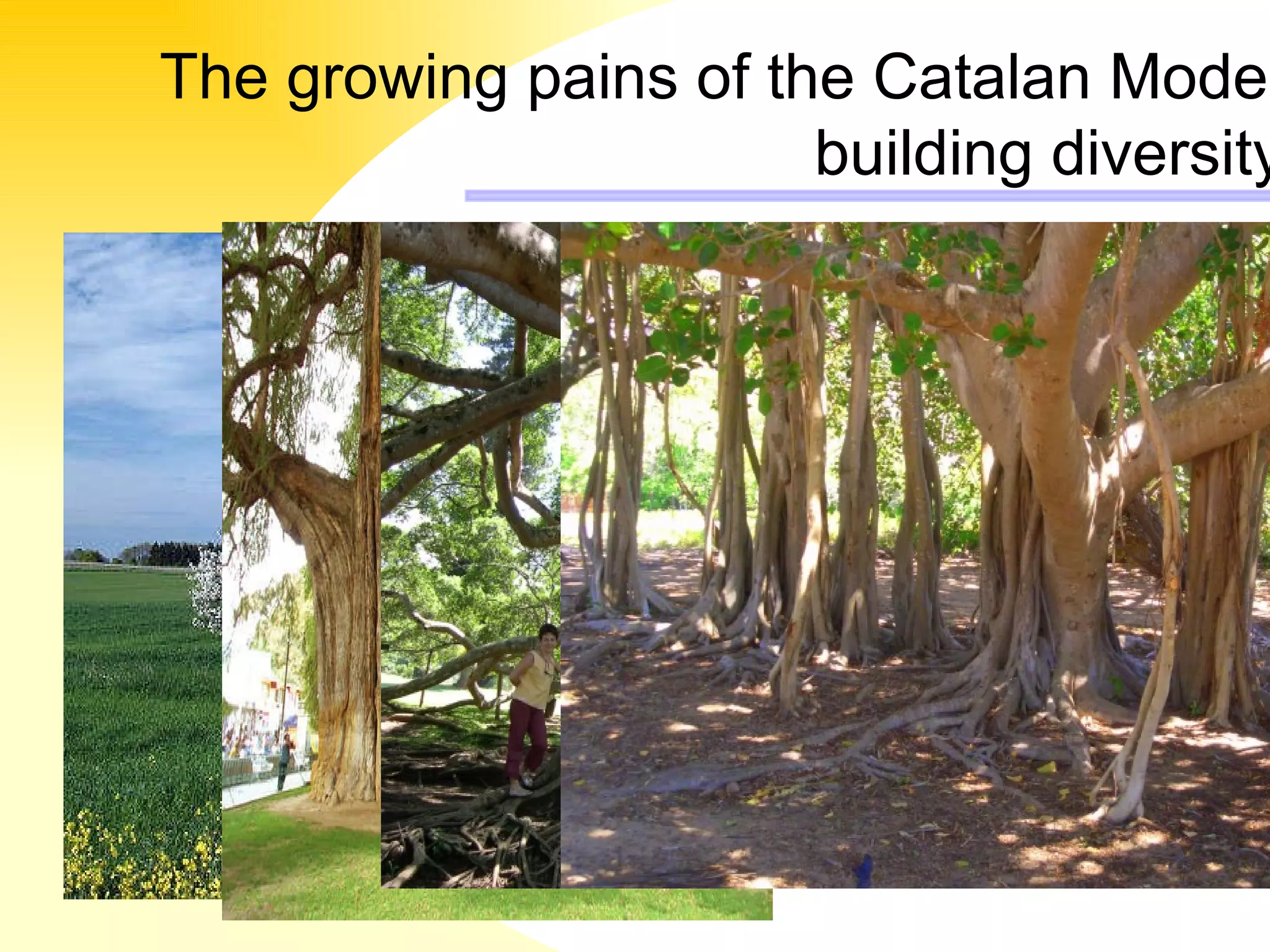
The growing pains of the Catalan Model, building diversity
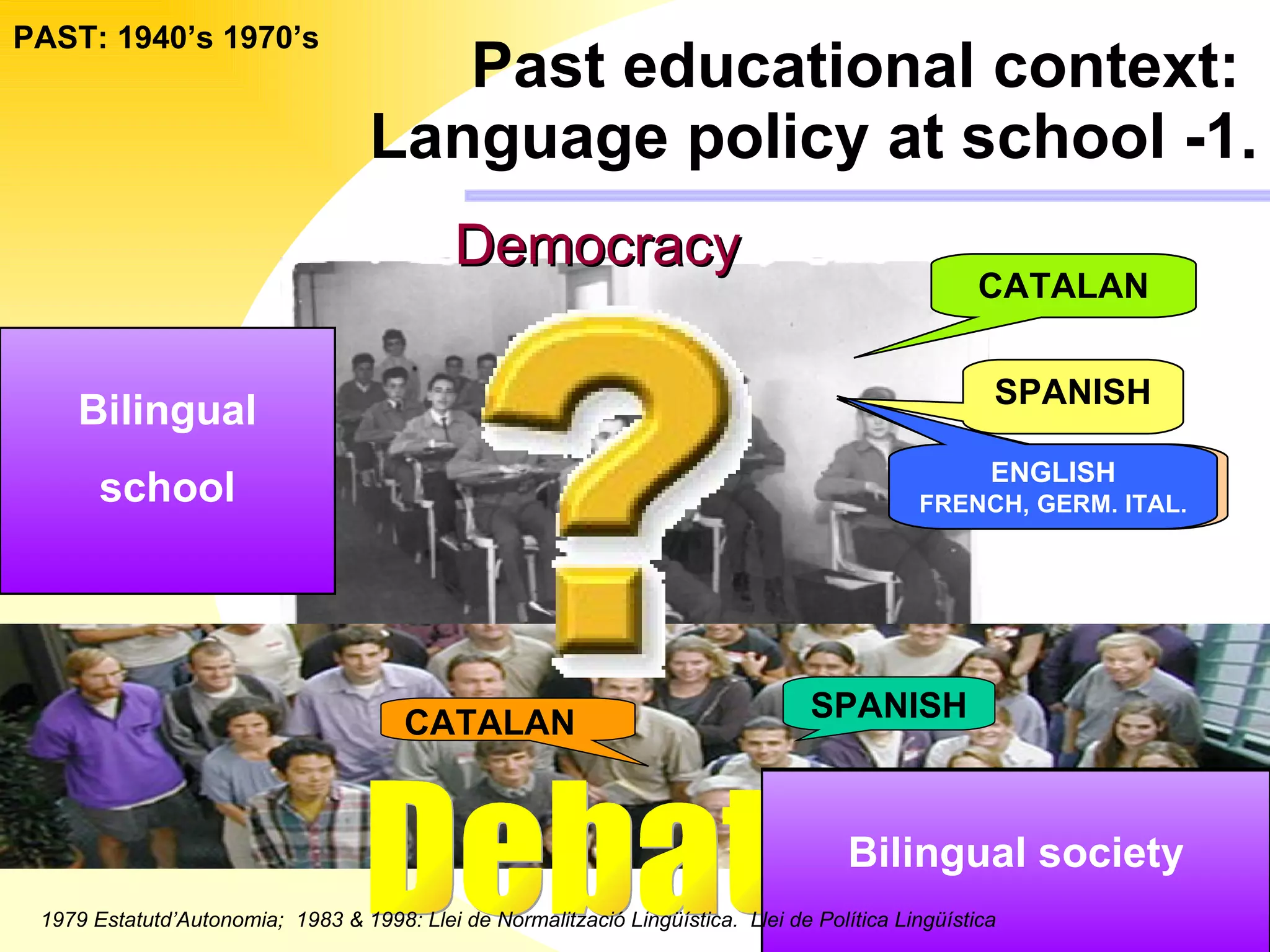
Past educational context:   Language policy at school -1. PAST: 1940’s 1970’s SPANISH Latin - Greek- French ( School subjects) CATALAN ENGLISH FRENCH, GERM. ITAL. 1979 Estatutd’Autonomia;  1983 & 1998: Llei de Normalització Lingüística.  Llei de Política Lingüística Bilingual society Monolingual school SPANISH CATALAN Debate Democracy Bilingual school Bilingual society
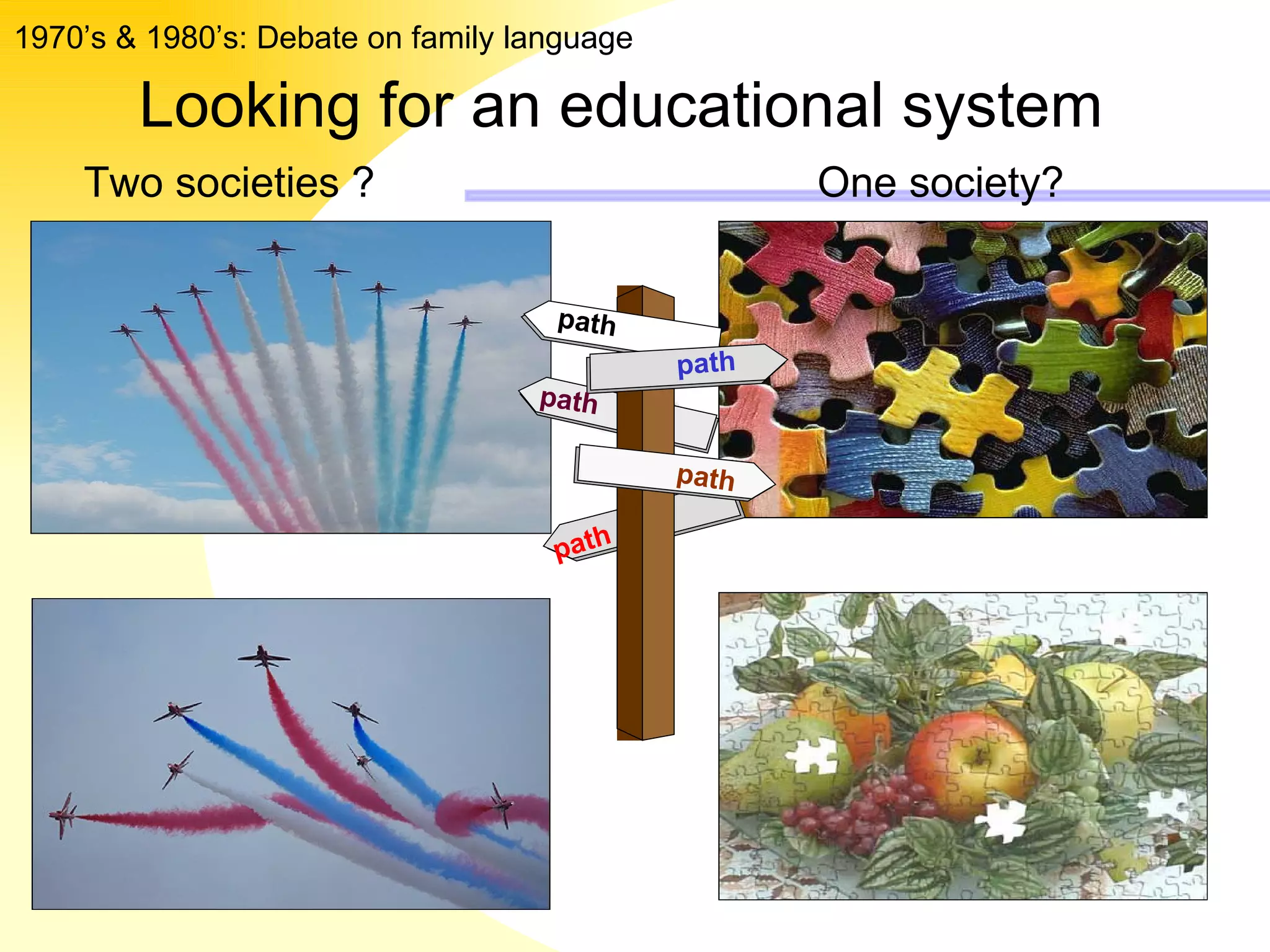
Two societies ? One society? Looking for an educational system   1970’s & 1980’s: Debate on family language path path path path path
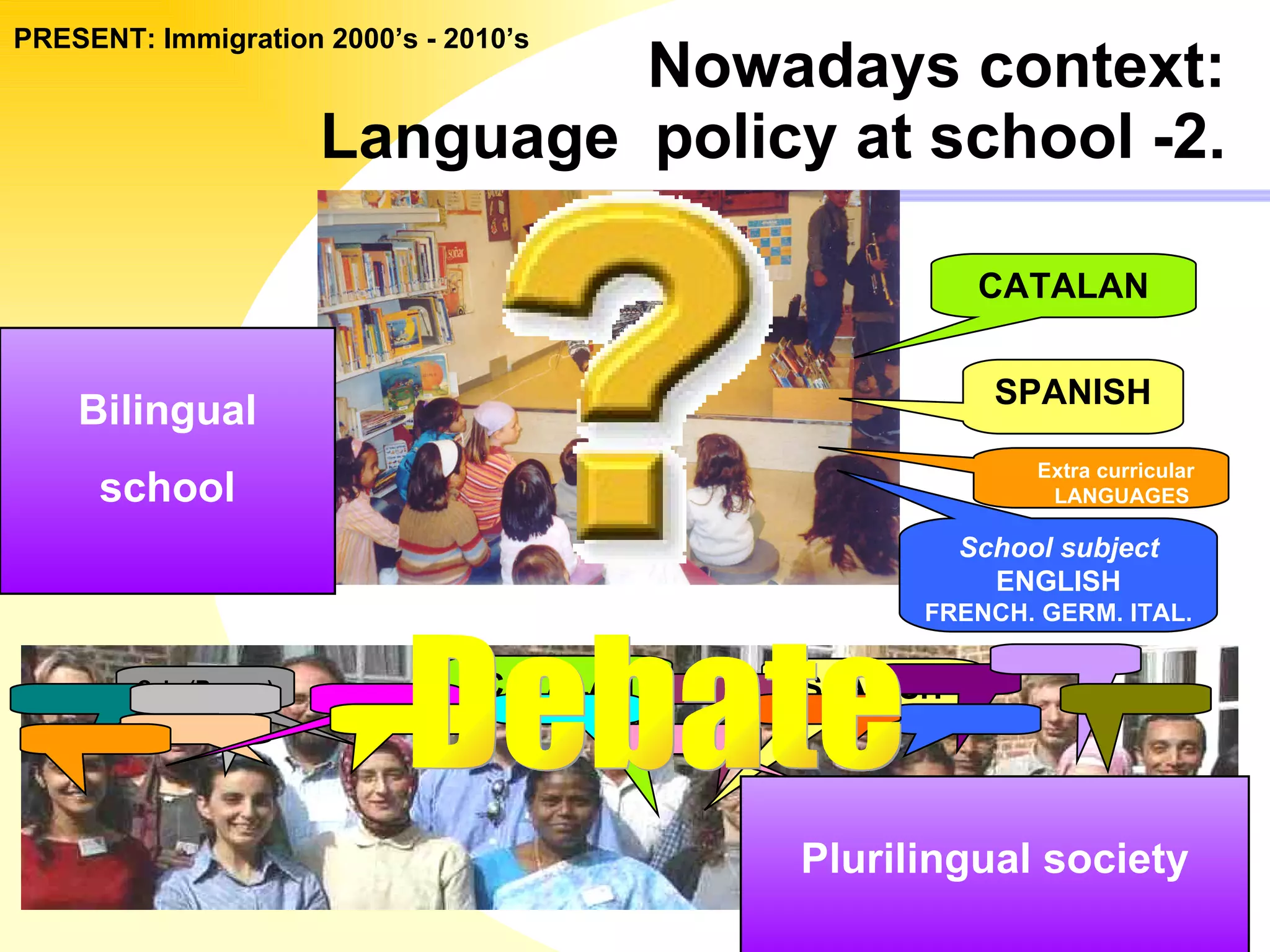
Nowadays context: Language  policy at school -2. PRESENT: Immigration 2000’s - 2010’s Bilingual school Extra curricular  LANGUAGES SPANISH CATALAN School subject ENGLISH FRENCH. GERM. ITAL. CATALAN SPANISH Calo (Roman) Plurilingual society Debate
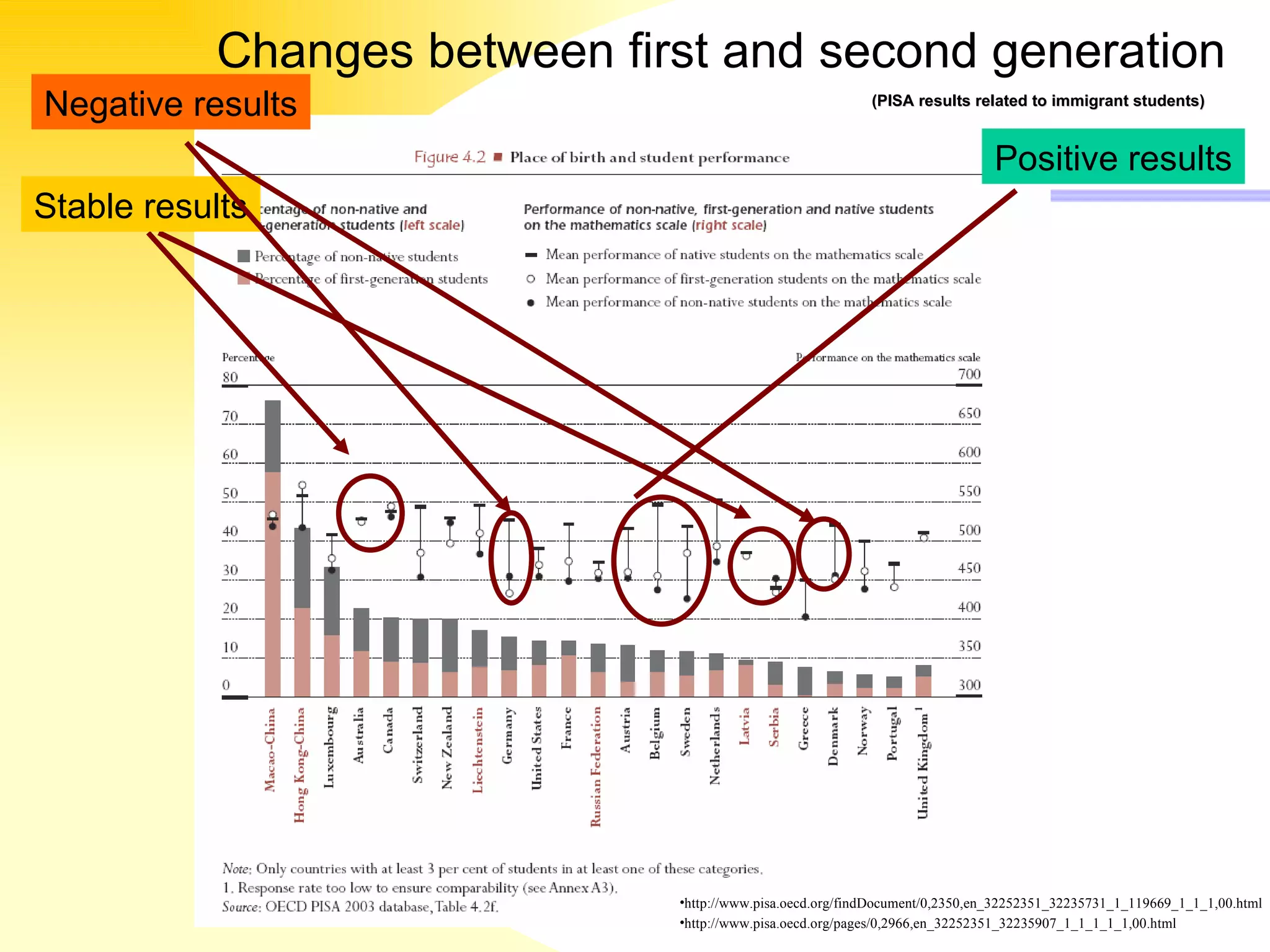
(PISA results related to immigrant students) Changes between first and second generation http://www.pisa.oecd.org/findDocument/0,2350,en_32252351_32235731_1_119669_1_1_1,00.html http://www.pisa.oecd.org/pages/0,2966,en_32252351_32235907_1_1_1_1_1,00.html Stable results Positive results Negative results
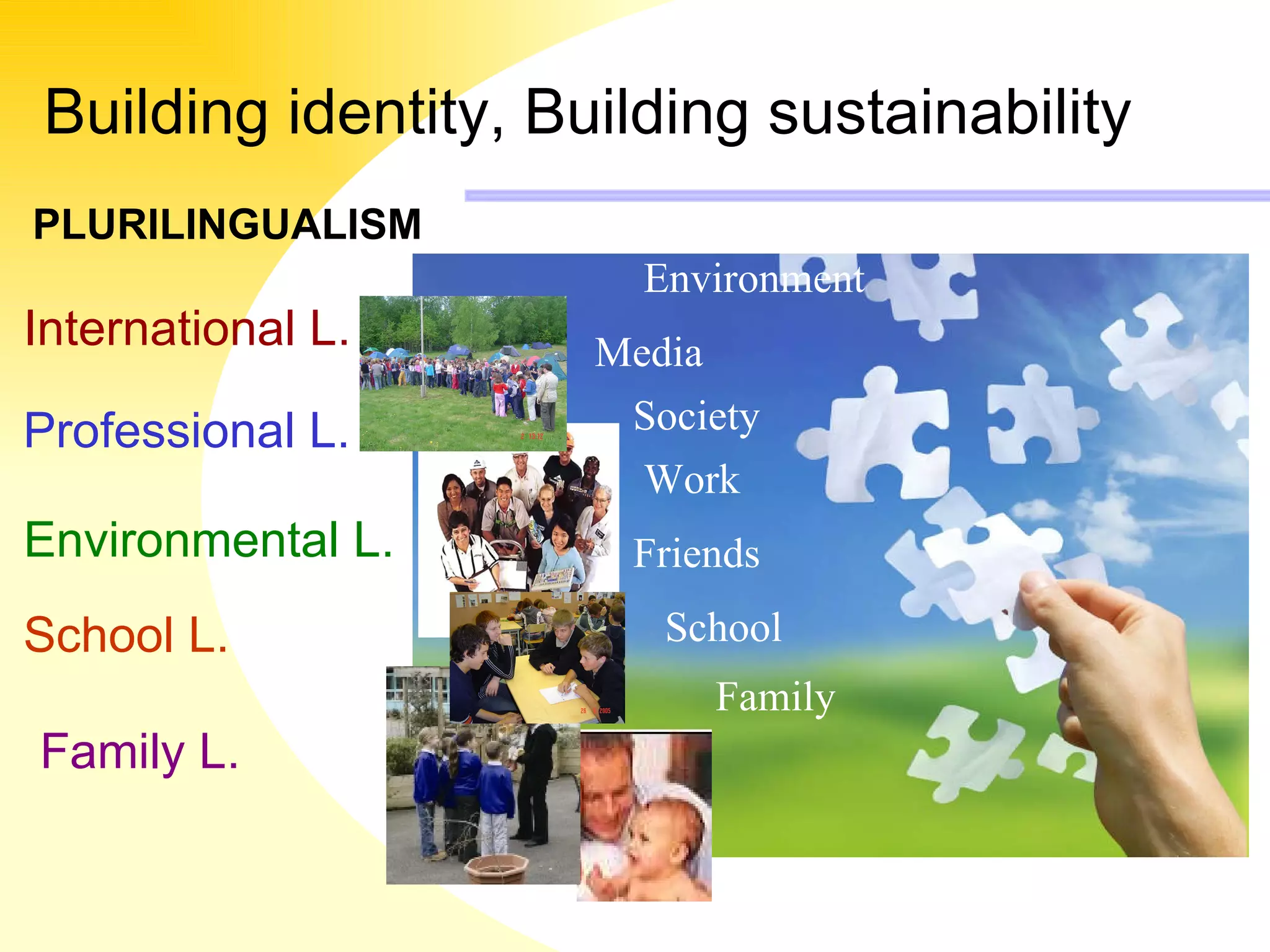
Building identity, Building sustainability PLURILINGUALISM Family School Friends Work Society Media Environment Family L. Environmental L. School L. Professional L. International L.
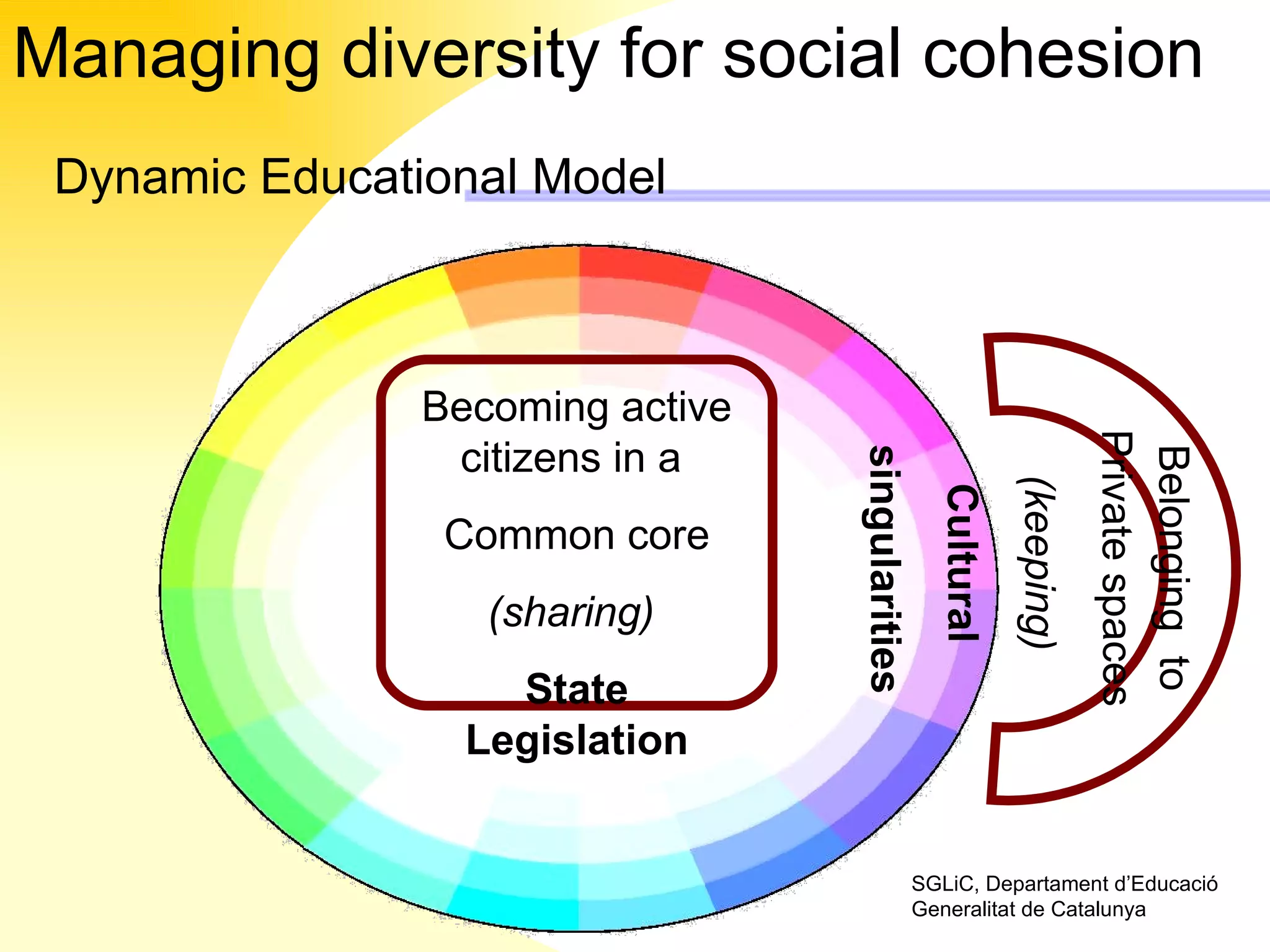
Becoming active citizens in a  Common core (sharing)   State Legislation Belonging  to Private spaces (keeping)   Cultural  singularities Dynamic Educational Model Managing diversity for social cohesion SGLiC, Departament d’Educació Generalitat de Catalunya
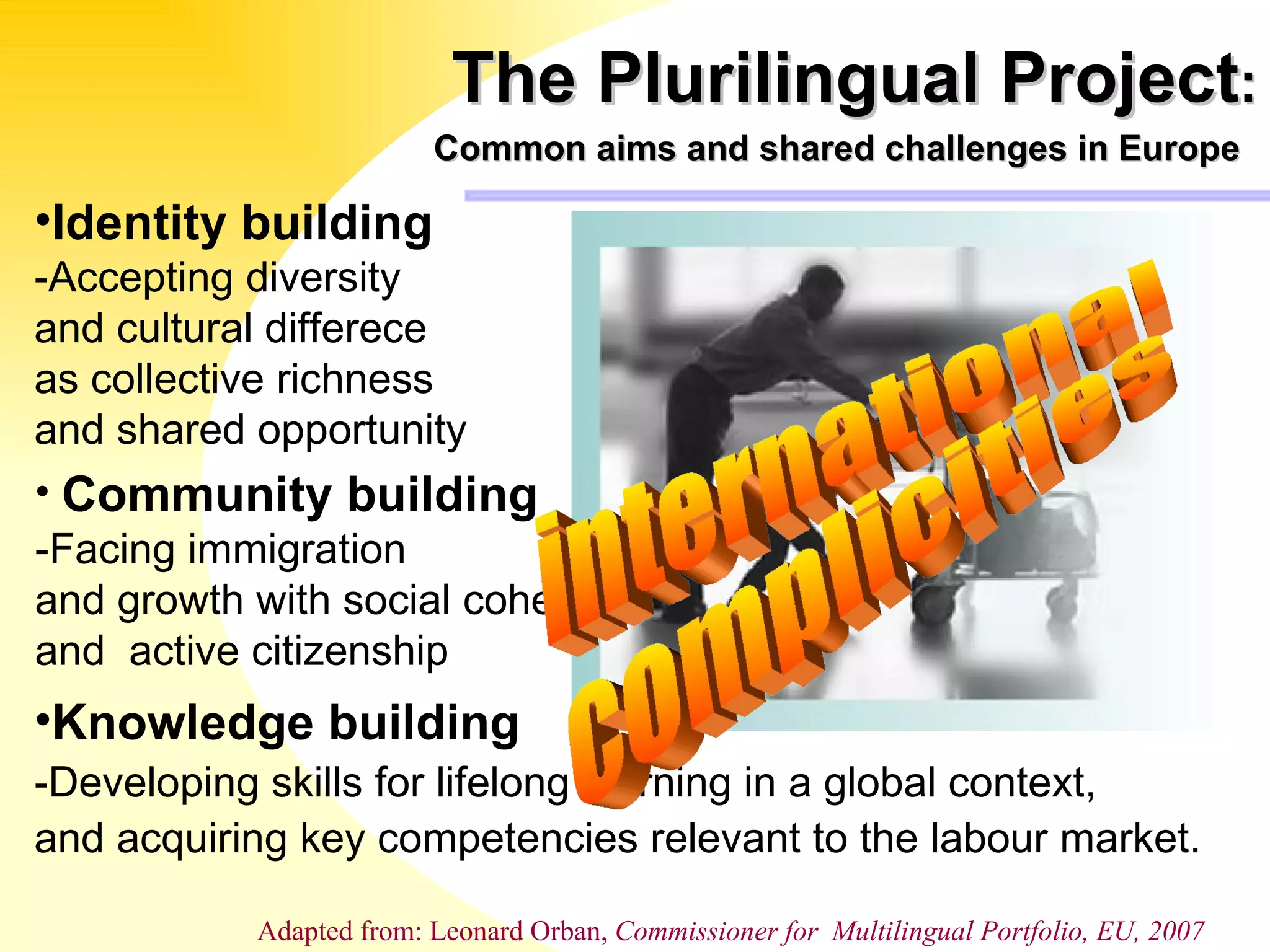
The Plurilingual Project :   Common aims and shared challenges in Europe   Identity building -Accepting diversity  and cultural differece  as collective richness and shared opportunity Community building -Facing immigration  and growth with social cohesion and  active citizenship Knowledge building -Developing skills for lifelong learning in a global context, and acquiring key competencies relevant to the labour market. Adapted from: Leonard Orban, Comissionate for  Multilingual Portfolio,  EU international complicities Adapted from: Leonard Orban,  Commissioner for  Multilingual Portfolio, EU, 2007
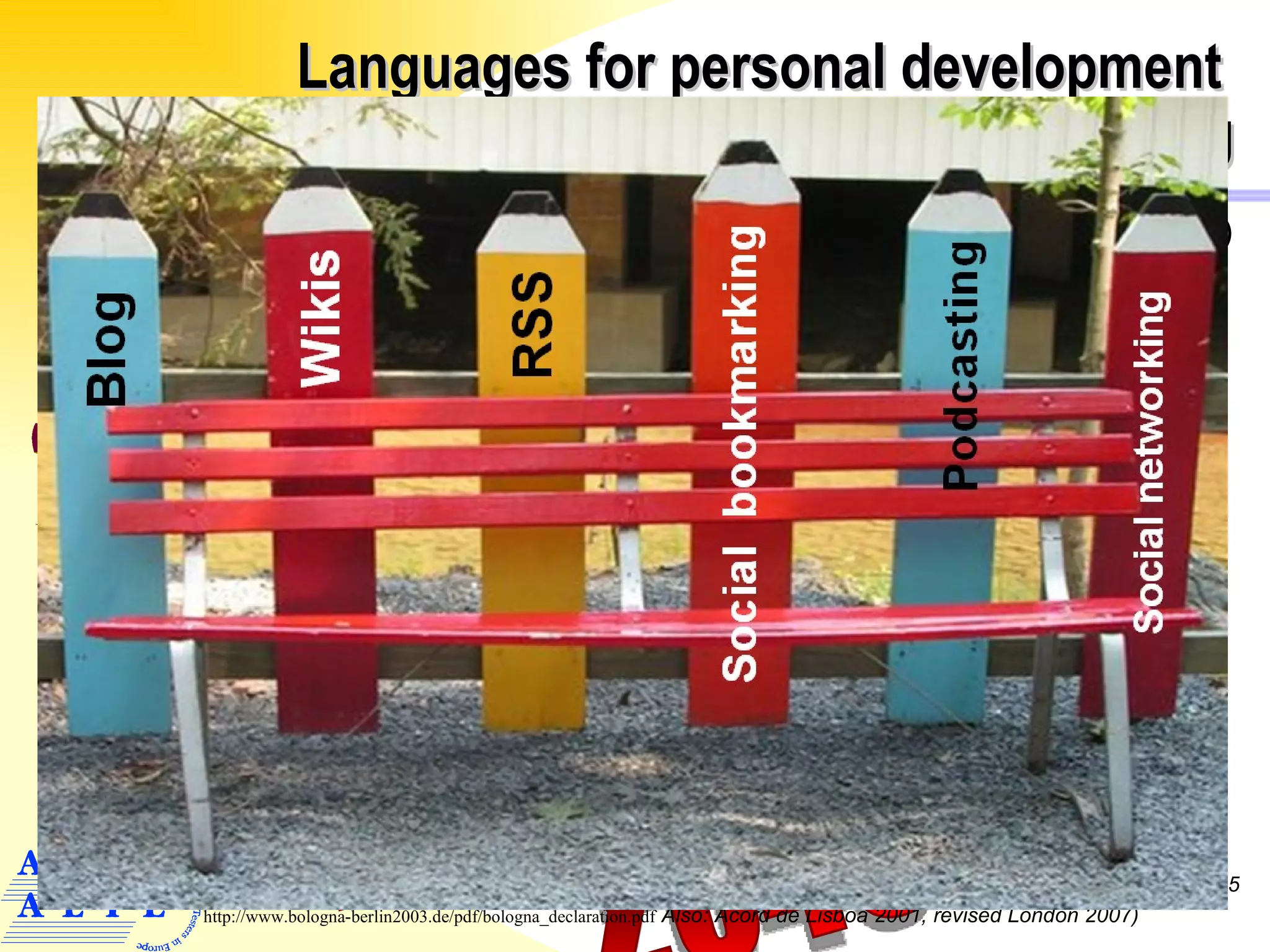
Languages for personal development   Lifelong learning Creating European identity and citizenship ( plurality, diversity  ) Lifelong learning (flexible curricula ) ICT tools & e-learning for knowledge building Academic convergence ( comparable degrees ) European Plurality ( mother tongue +2 ) Dead line: 2010 ____ 2015 ____ 2045 ? Market access ( relevant to the labour market  ) 29 països   : Joint declaration European Ministers of Education  ( Terry Mitchell, promoter of  EHEA: European Higher European Area, Bologna 1999,  Berlin 2003, Bergen 2005 http://www.bologna-berlin2003.de/pdf/bologna_declaration.pdf  Also: Acord de Lisboa 2001, revised London 2007) Europe of Knowledge
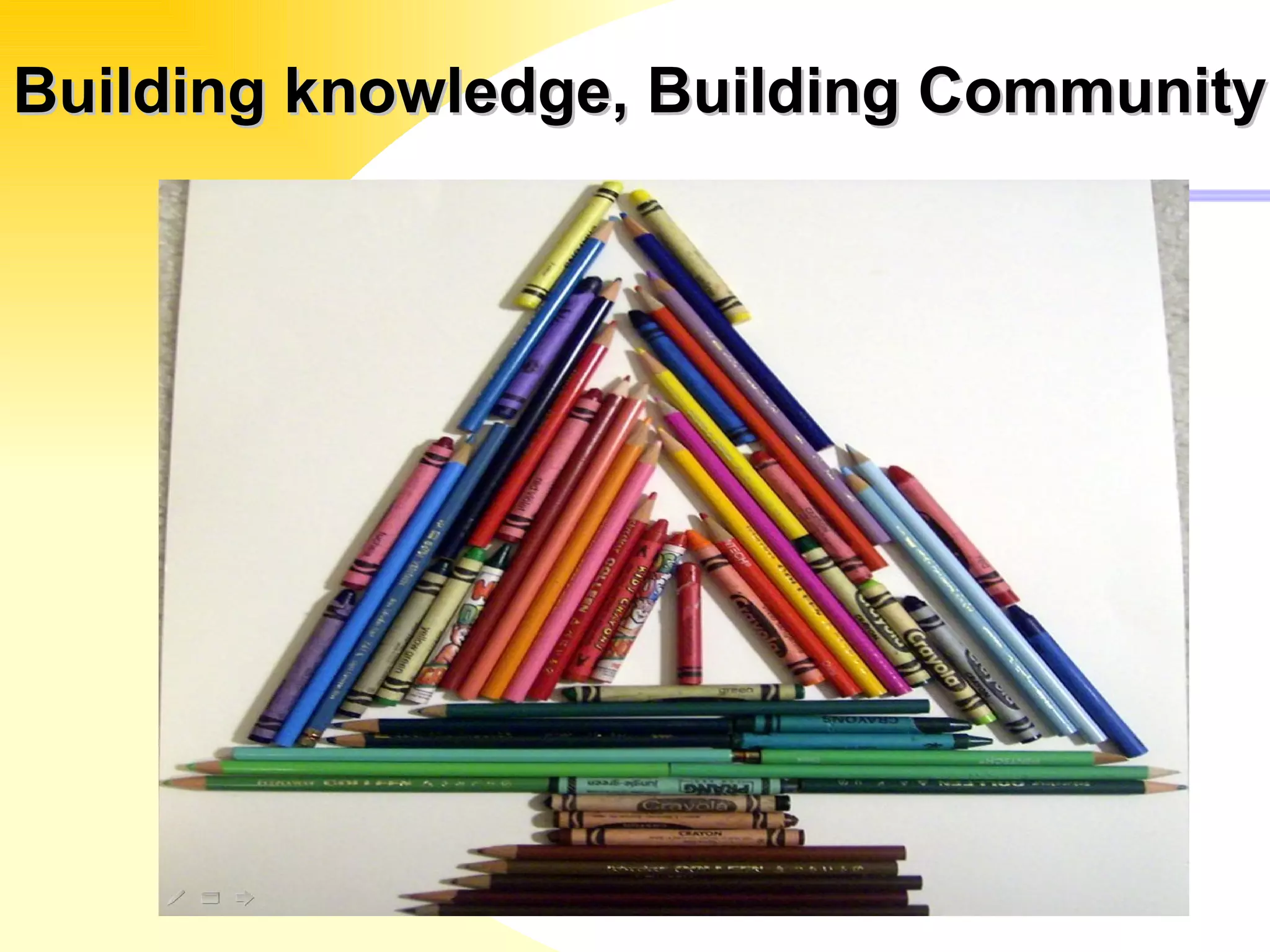
Building knowledge, Building Community
 
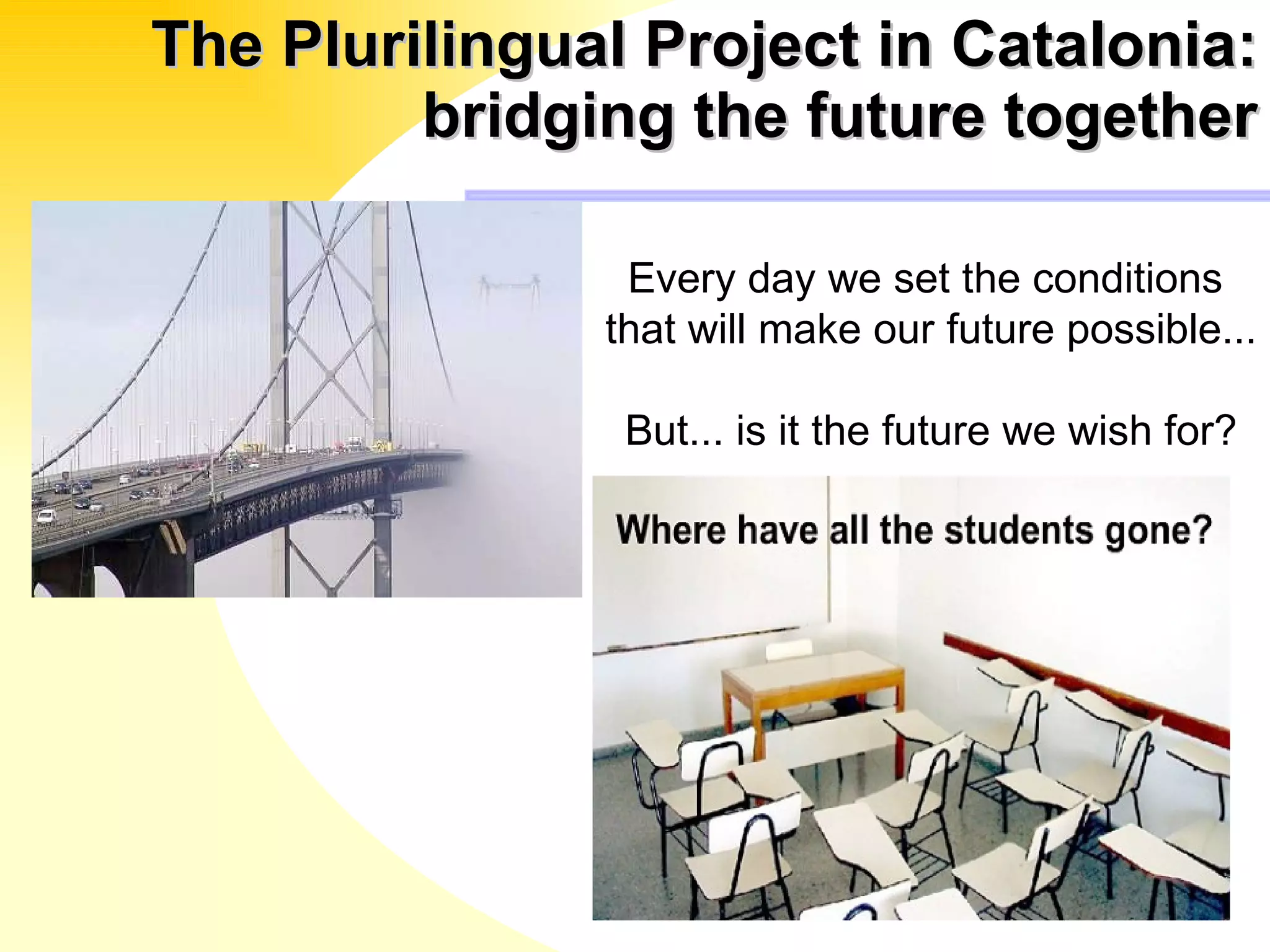
The Plurilingual Project in Catalonia: bridging the future together Every day we set the conditions  that will make our future possible... But... is it the future we wish for?
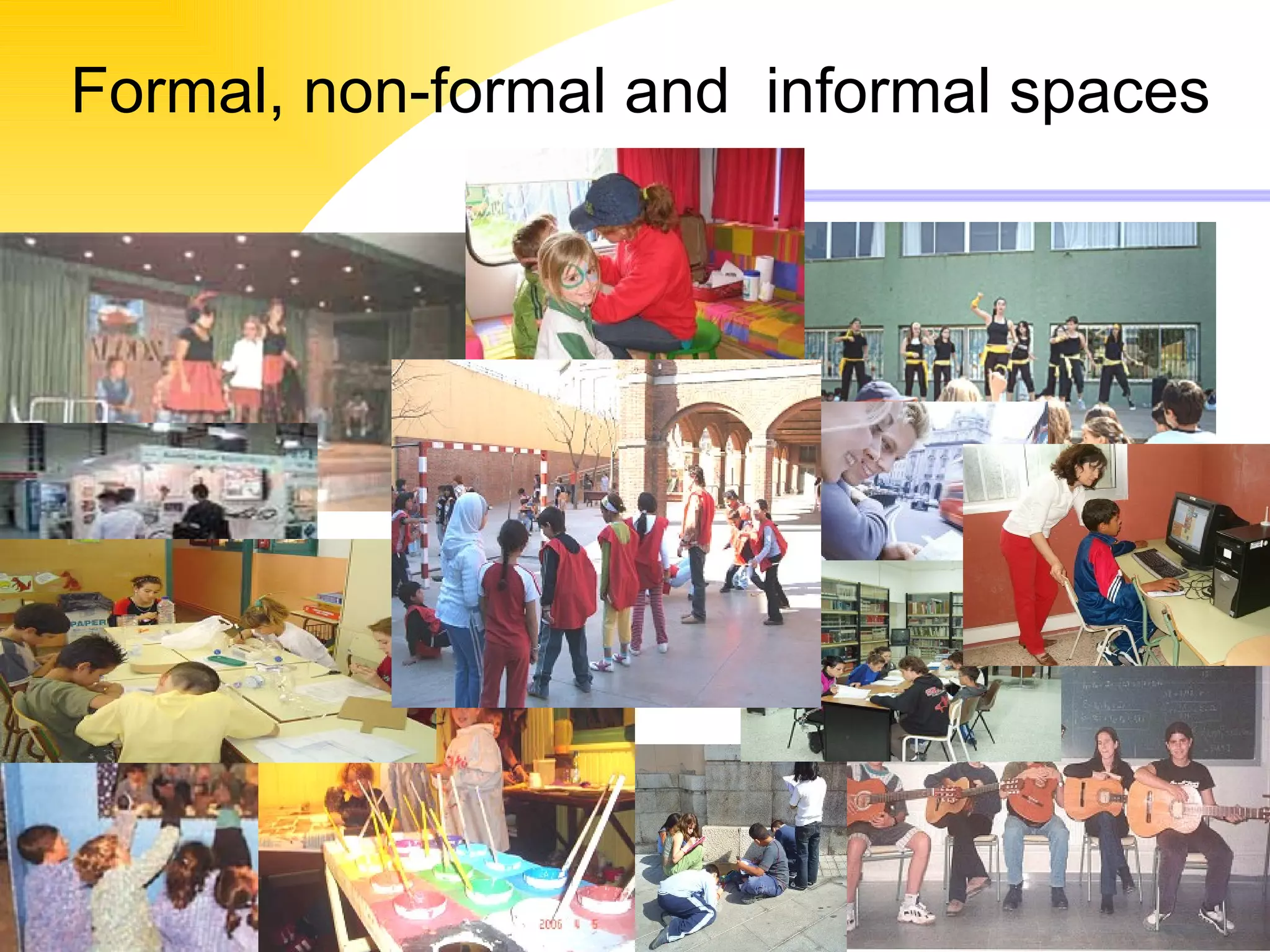
Formal, non-formal and  informal spaces
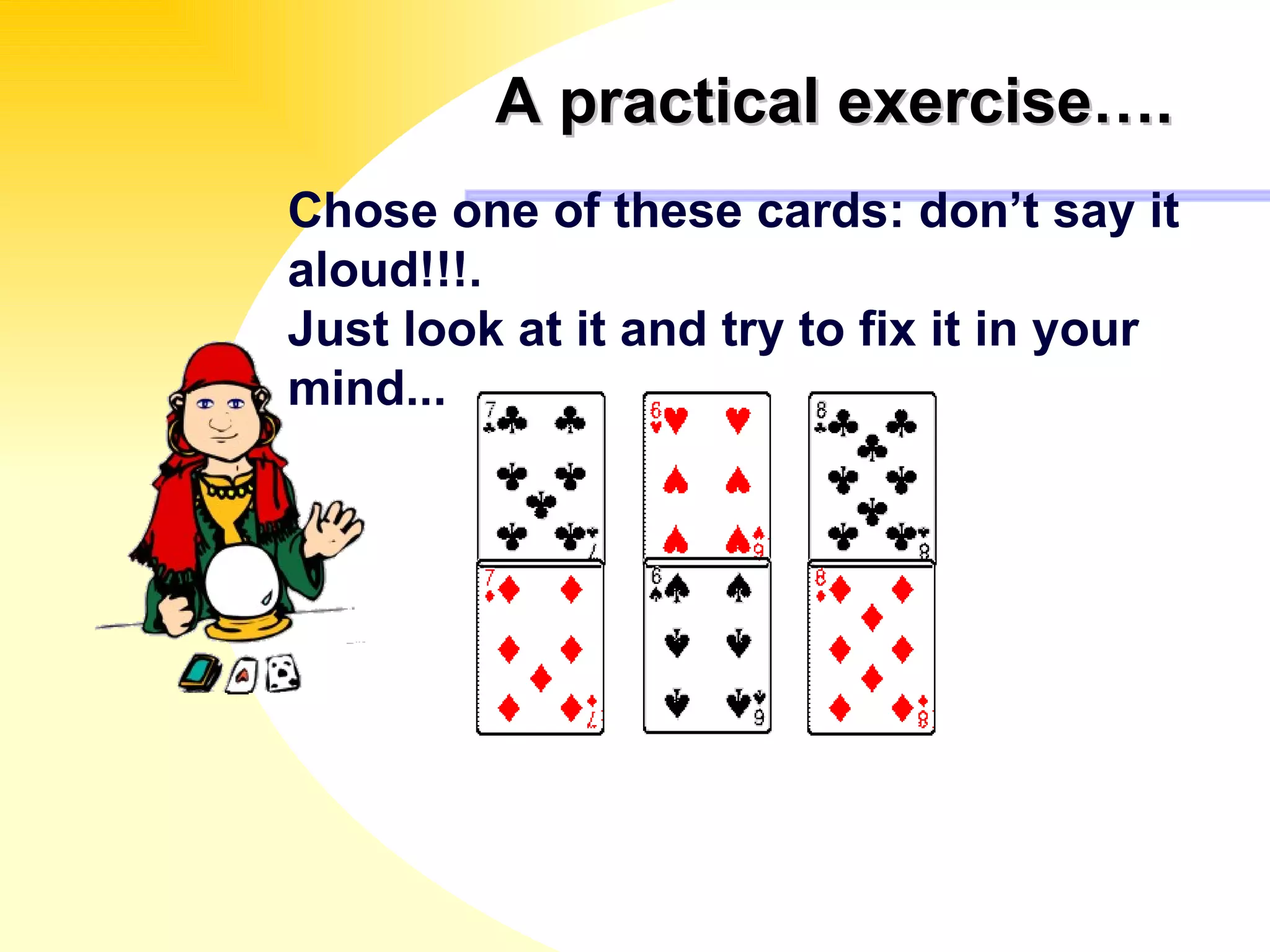
A practical exercise …. Chose one of these cards: don’t say it aloud!!!. Just look at it and try to fix it in your mind...
A practical exercise... Think of your card for 10 second  without saying it to anybody...
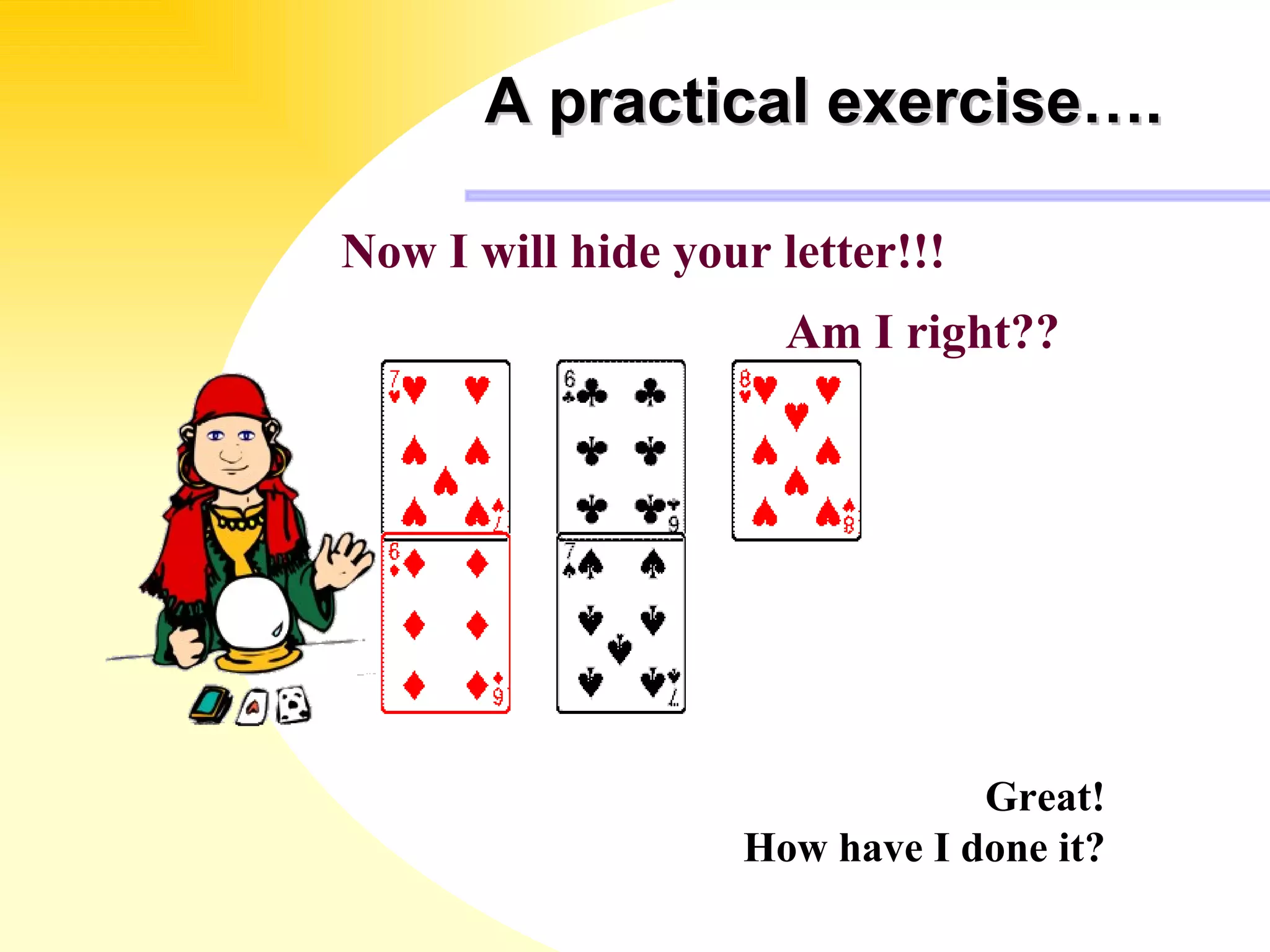
A practical exercise…. Now I will hide your letter!!!  Great! How have I done it? Am I right??
And what is happening now?... People here have started an informal “emergent”  network to get information from the group... Teamwork and networking strategies become natural and useful  when a group is focused on  solving the same problem and sharing aims,  trying to find out new ideas,  thinking aloud, and processing verbally.
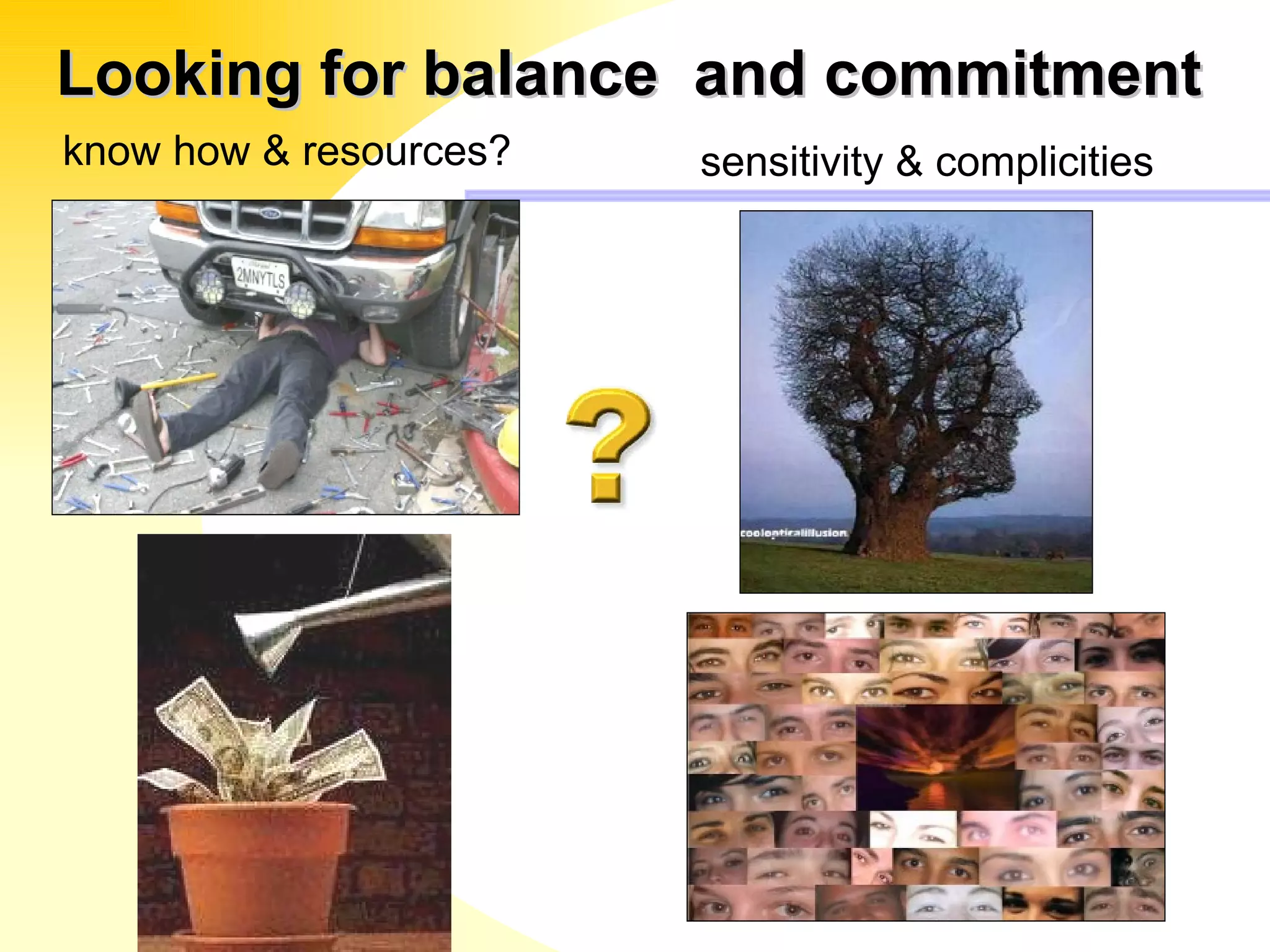
know how & resources? sensitivity & complicities Looking for balance  and commitment
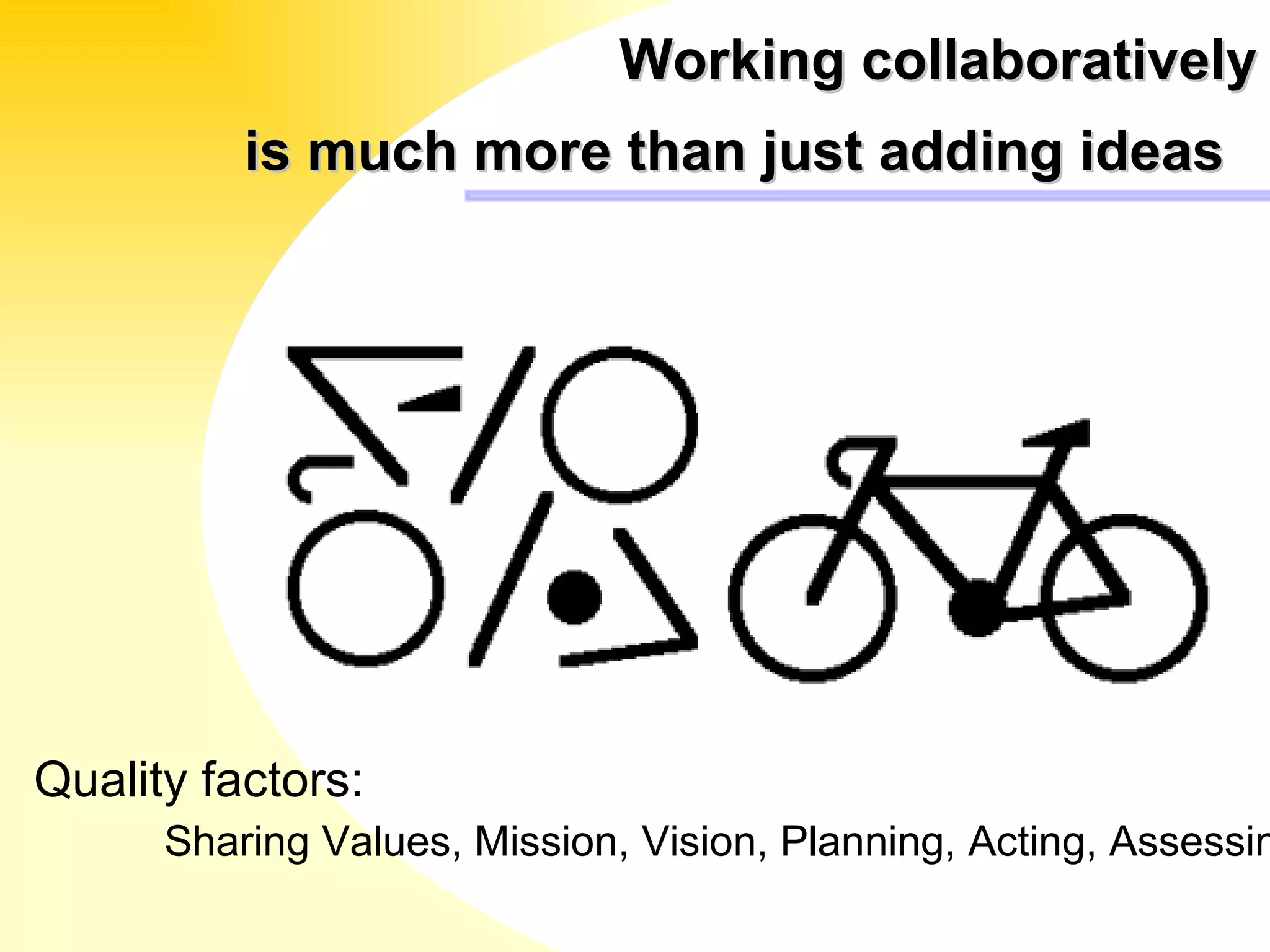
Working collaboratively  is much more than just adding ideas  Quality factors: Sharing Values, Mission, Vision, Planning, Acting, Assessing
 
Moodle http://moodle.vaniercollege.qc.ca/
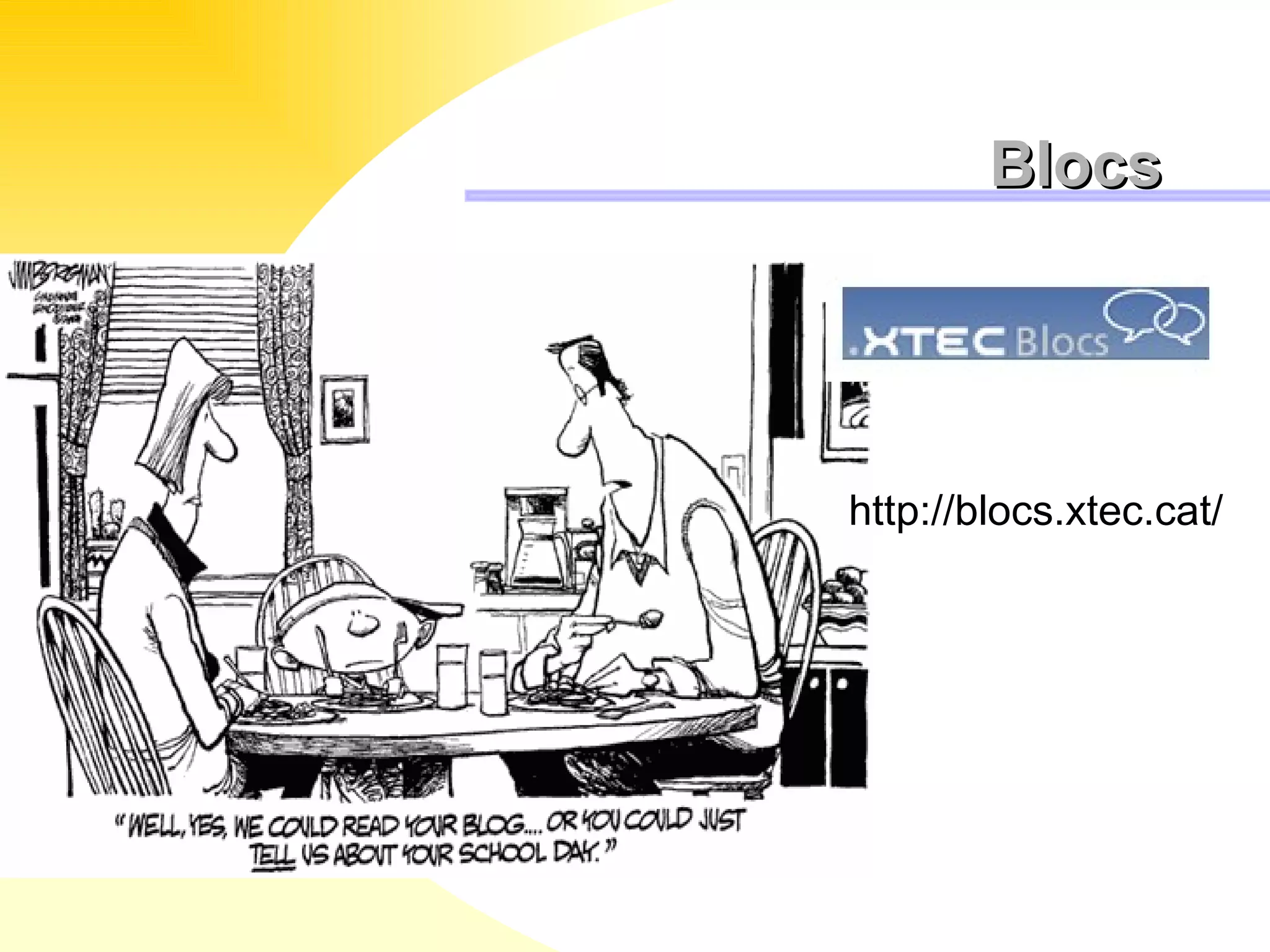
Blocs http://blocs.xtec.cat/
Wikis http://www.wikispaces.com
Video http://youtube.com
Podcasting http://clickcaster.com
 
Sequences Negotiation Information gathering Data process Outcomes Feedback
European Projects:  transversality, plurilingualism and interculturalism Virtual garden Simultaneous  Art  Exhibit Multicultural concert Chirldren's intercultural library Collaborative portal European traditions on Webs Virtual Maths Race  What do these projects  provide schools with? Radio program in several languages
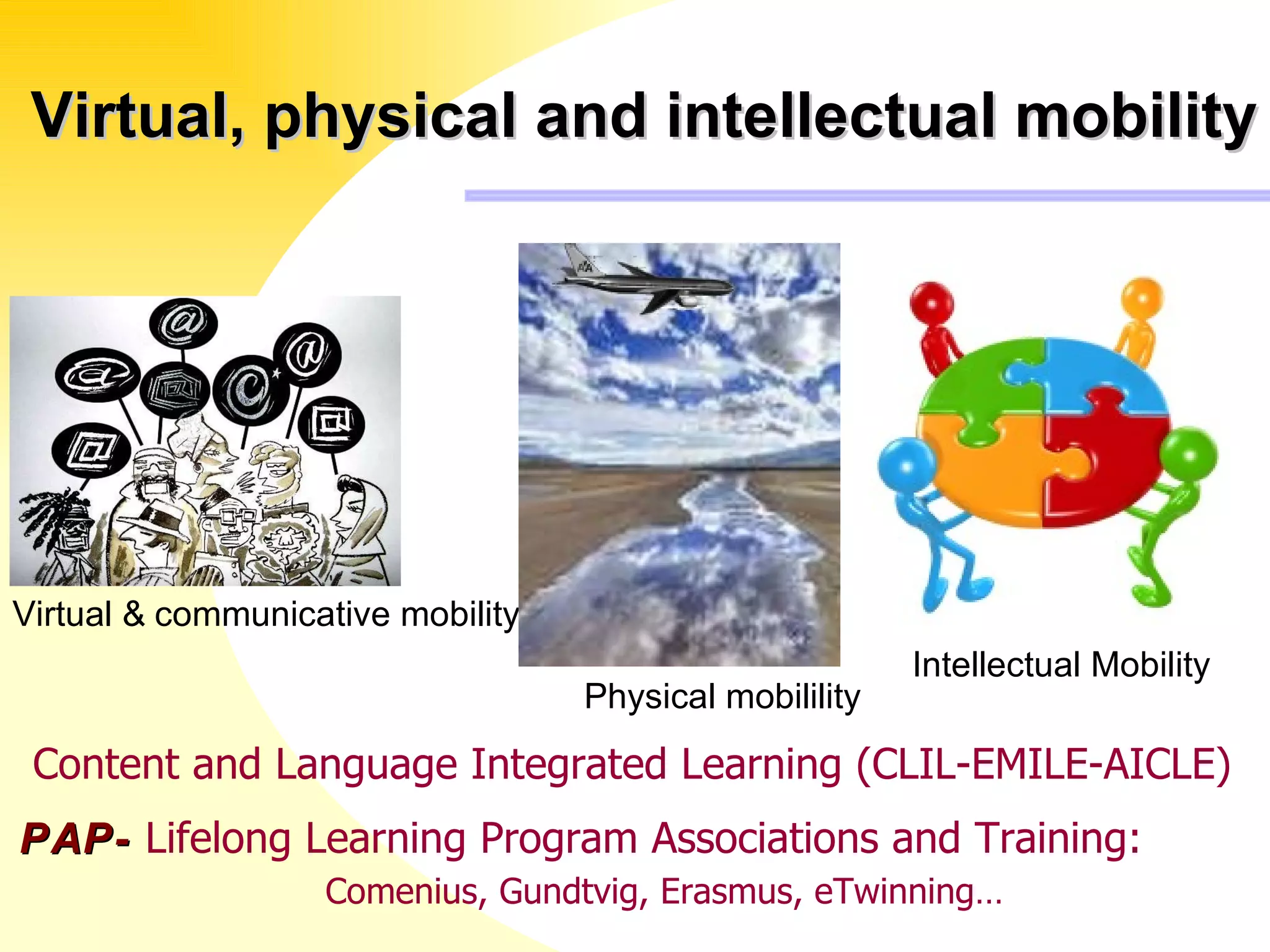
  Virtual, physical and intellectual mobility PAP-  Lifelong Learning Program Associations and Training:    Comenius, Gundtvig, Erasmus, eTwinning… Content and Language Integrated Learning (CLIL-EMILE-AICLE) Virtual &   communicative mobility Physical mobilility Intellectual Mobility
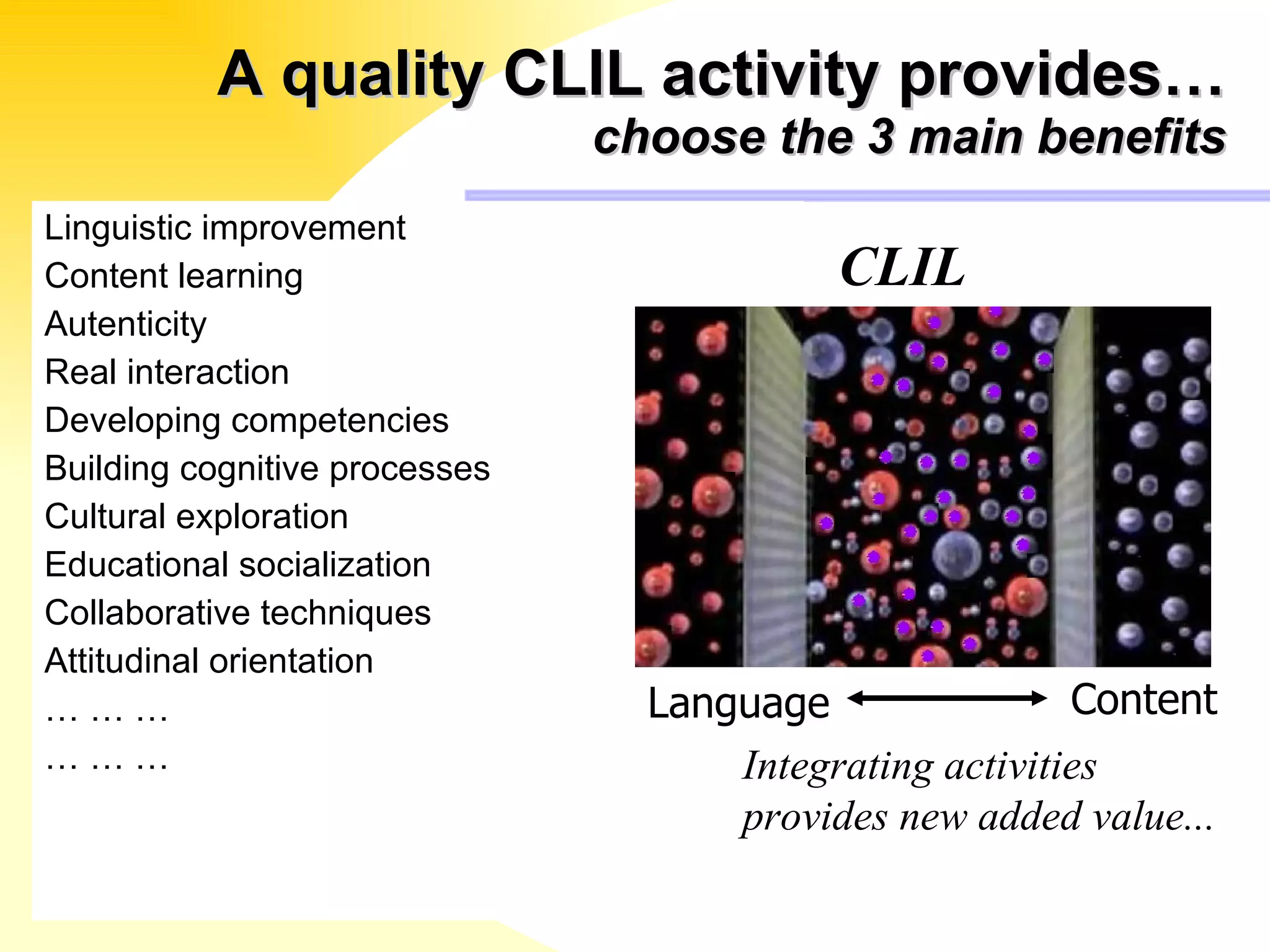
A quality CLIL activity provides… choose the 3 main benefits Linguistic improvement Content learning Autenticity Real interaction Developing competencies Building cognitive processes Cultural exploration  Educational socialization Collaborative techniques Attitudinal orientation … … …  … … … Integrating activities  provides new added value... CLIL Language Content
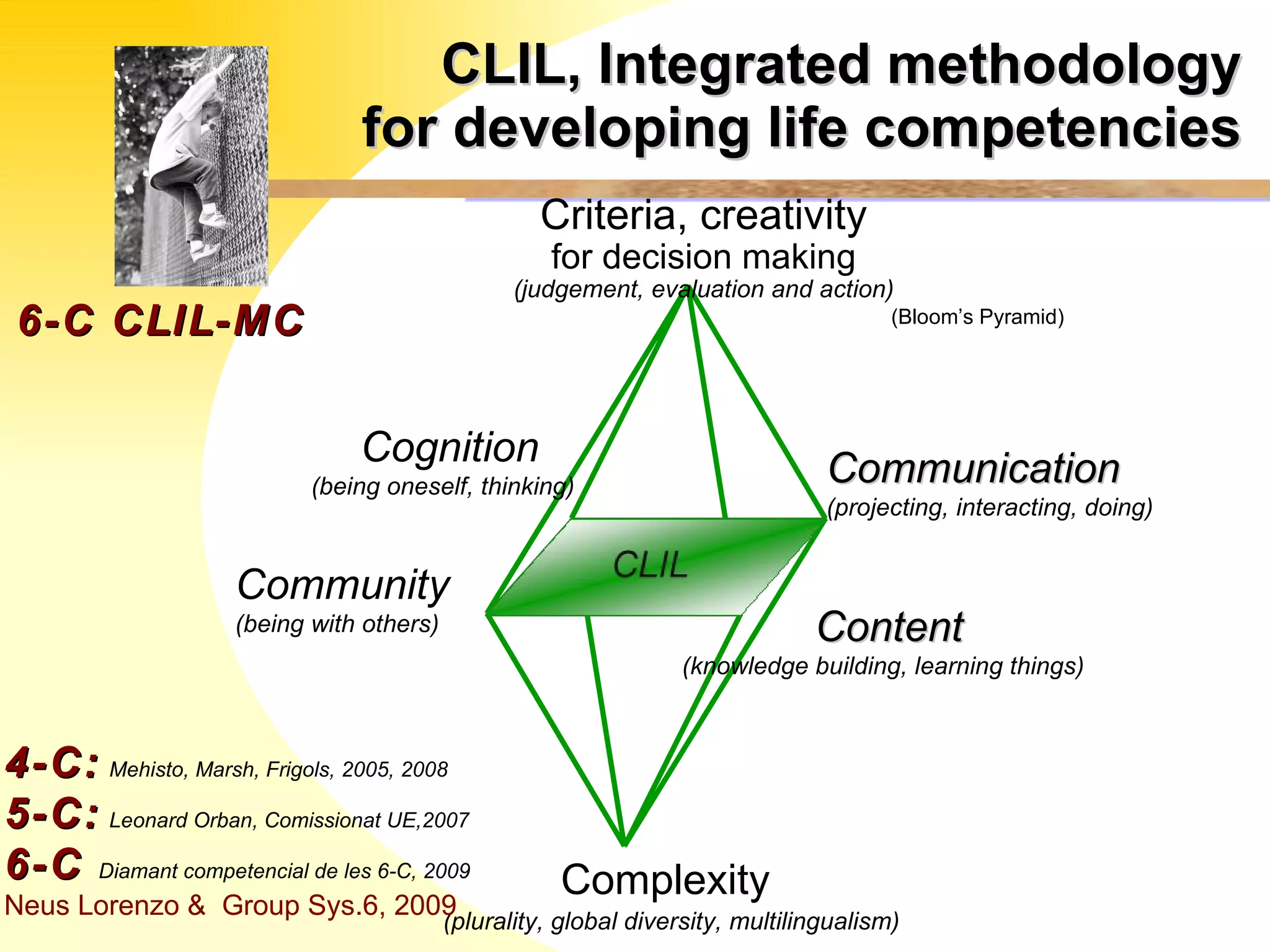
CLIL, Integrated methodology for developing life competencies 4-C:   Mehisto, Marsh, Frigols, 2005, 2008 5-C:   Leonard Orban, Comissionat UE,2007 6-C  Diamant competencial de les 6-C, 2009   Neus Lorenzo &  Group Sys.6, 2009 Criteria, creativity for decision making (judgement, evaluation and action) (Bloom’s Pyramid) Complexity (plurality, global diversity, multilingualism) 6-C CLIL-MC Content (knowledge building, learning things) Communication (projecting, interacting, doing) Community (being with others) Cognition (being oneself, thinking)
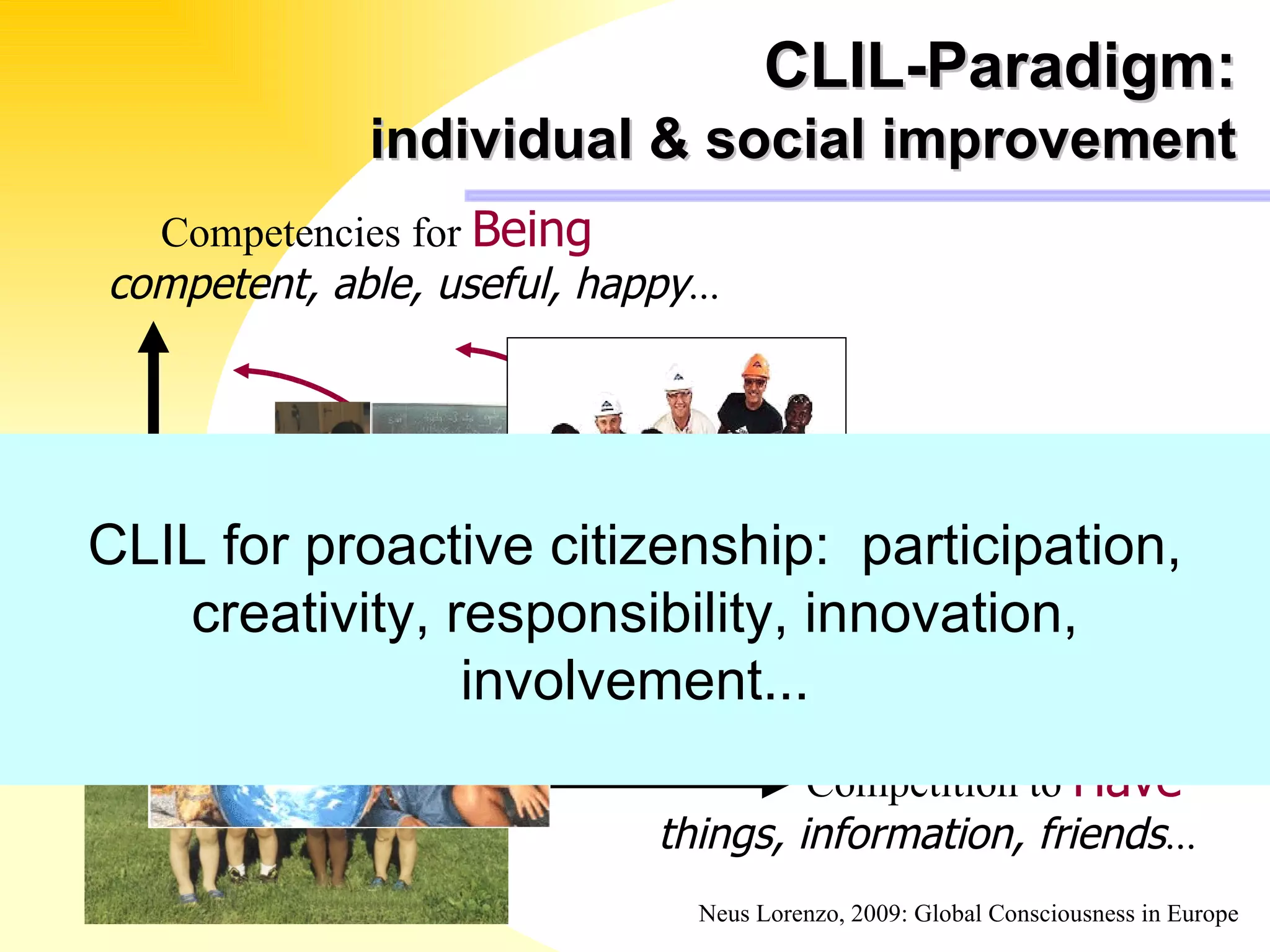
CLIL-Paradigm:   individual & social improvement Neus Lorenzo, 2009: Global Consciousness in Europe CLIL for proactive citizenship:  participation, creativity, responsibility, innovation, involvement... transformation sharing learning Competition to  Have things, information, friends ... Competencies for  Being competent, able, useful, happy ...
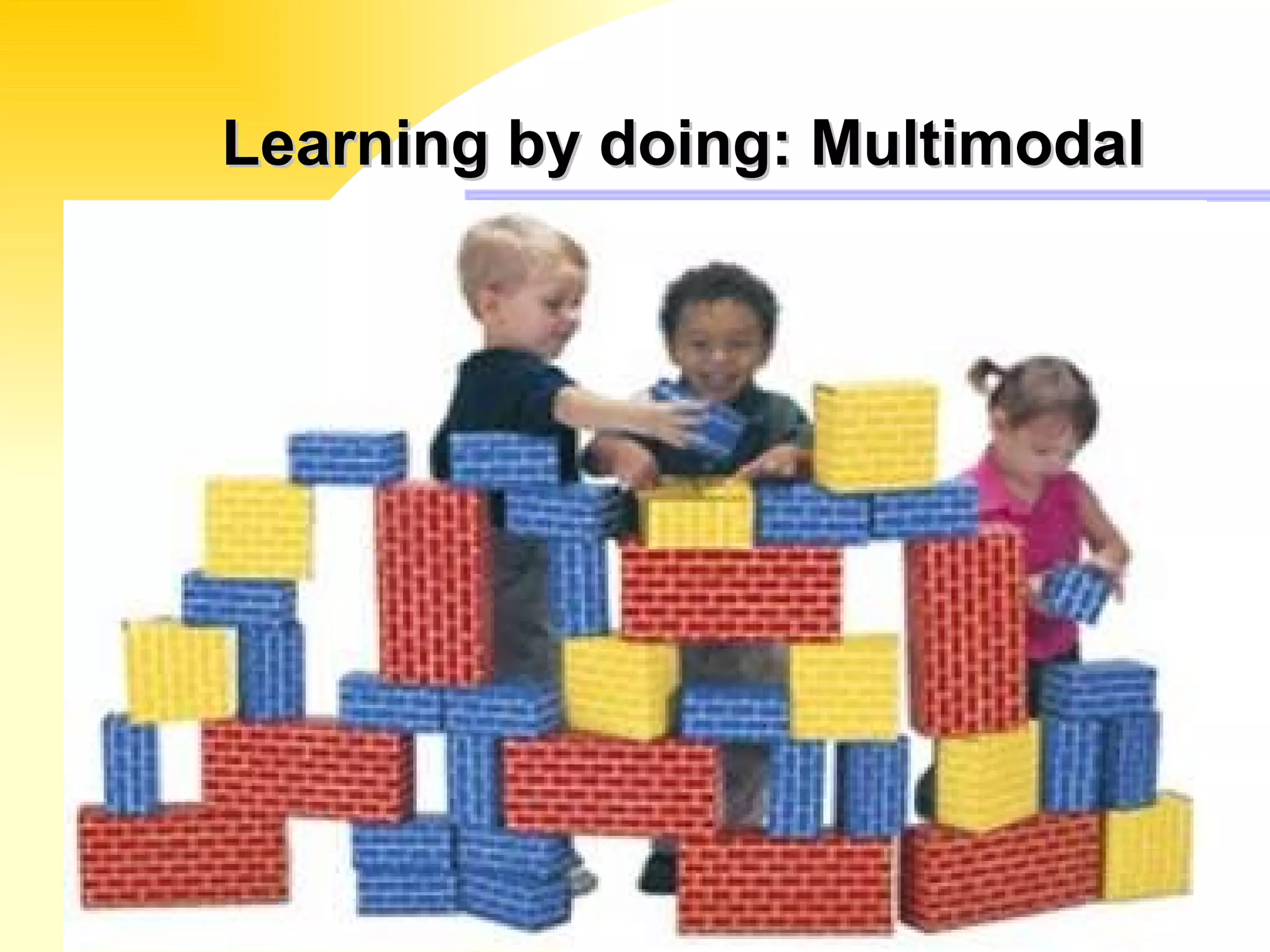
Learning by doing: Multimodal
Teamwork... Network... Teamnets. Kowledge society
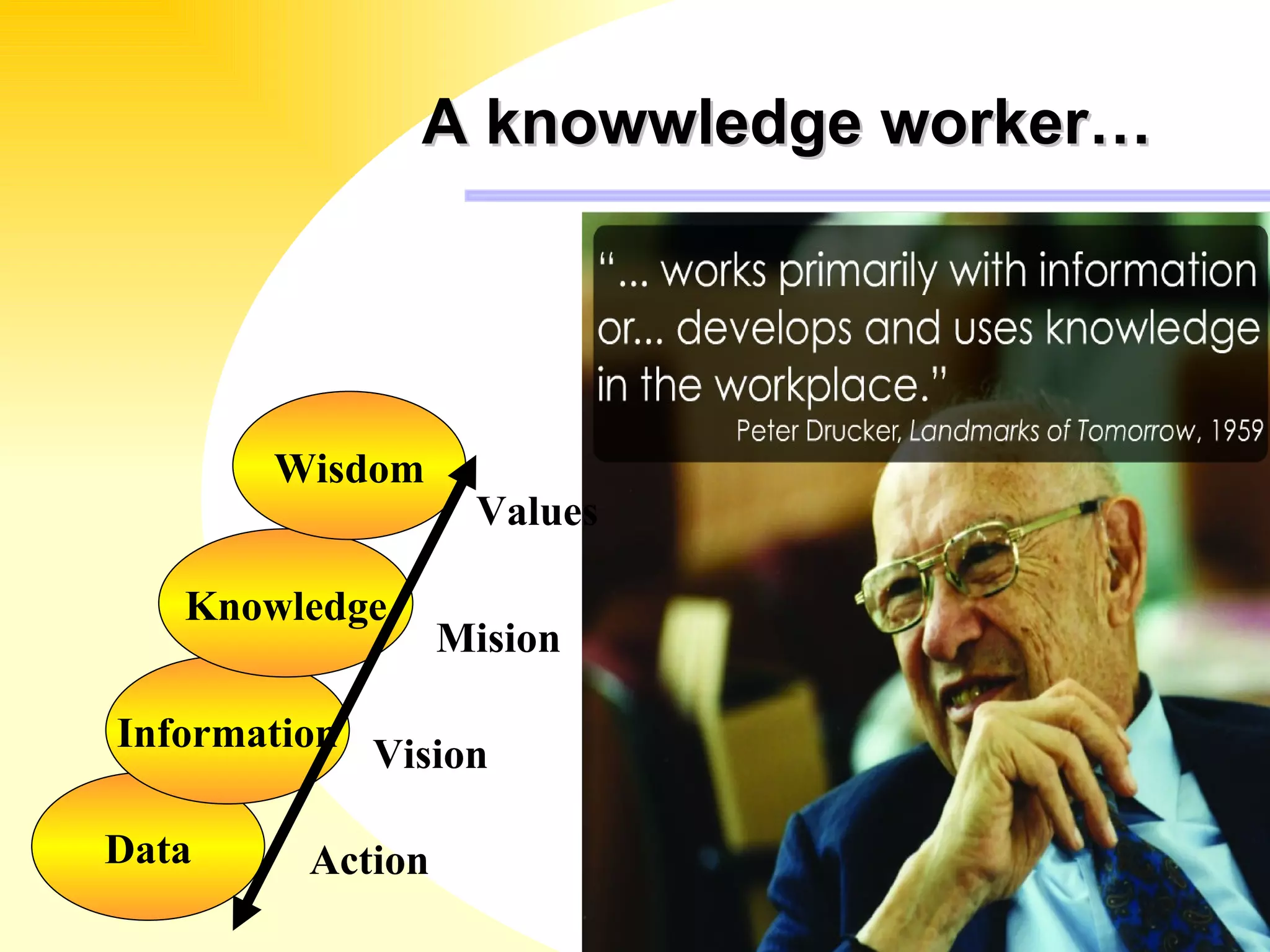
A knowwledge worker… Data Information Knowledge Wisdom Action Vision Mision Values
Strategies for good practices Network requires...   To have specific and defined aims To share commitments and follow collective rules To learn about the context and the territory  To use emotional strategies and easy relationship To delegate in colleagues when necessary To count on a good opperational (technical) team To share information and evidence with users To alternate functions and tasks when needed.
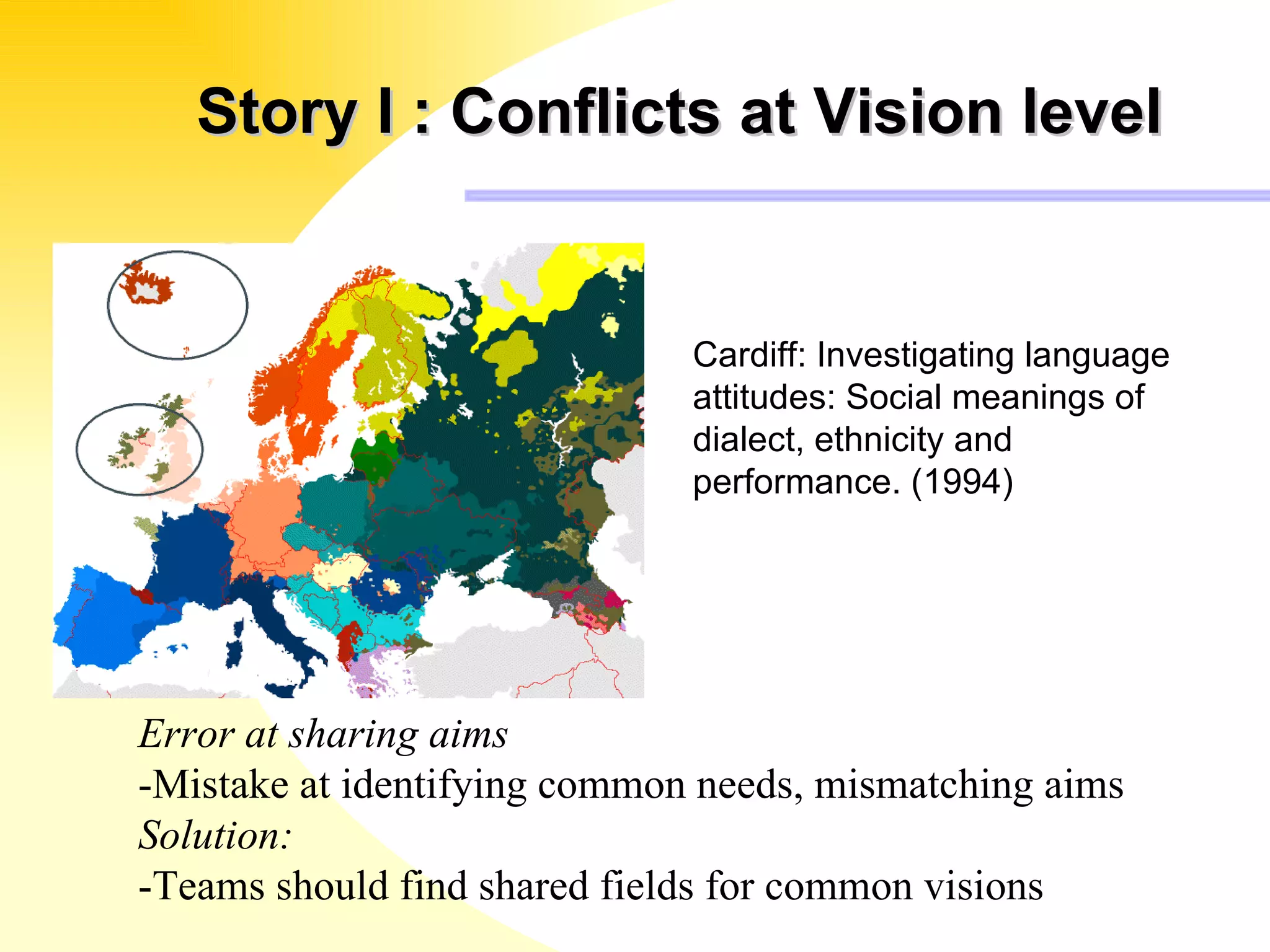
Story I : Conflicts at Vision level Error at sharing aims -Mistake at identifying common needs, mismatching aims Solution: -Teams should find shared fields for common visions Cardiff: Investigating language attitudes: Social meanings of dialect, ethnicity and performance. (1994)
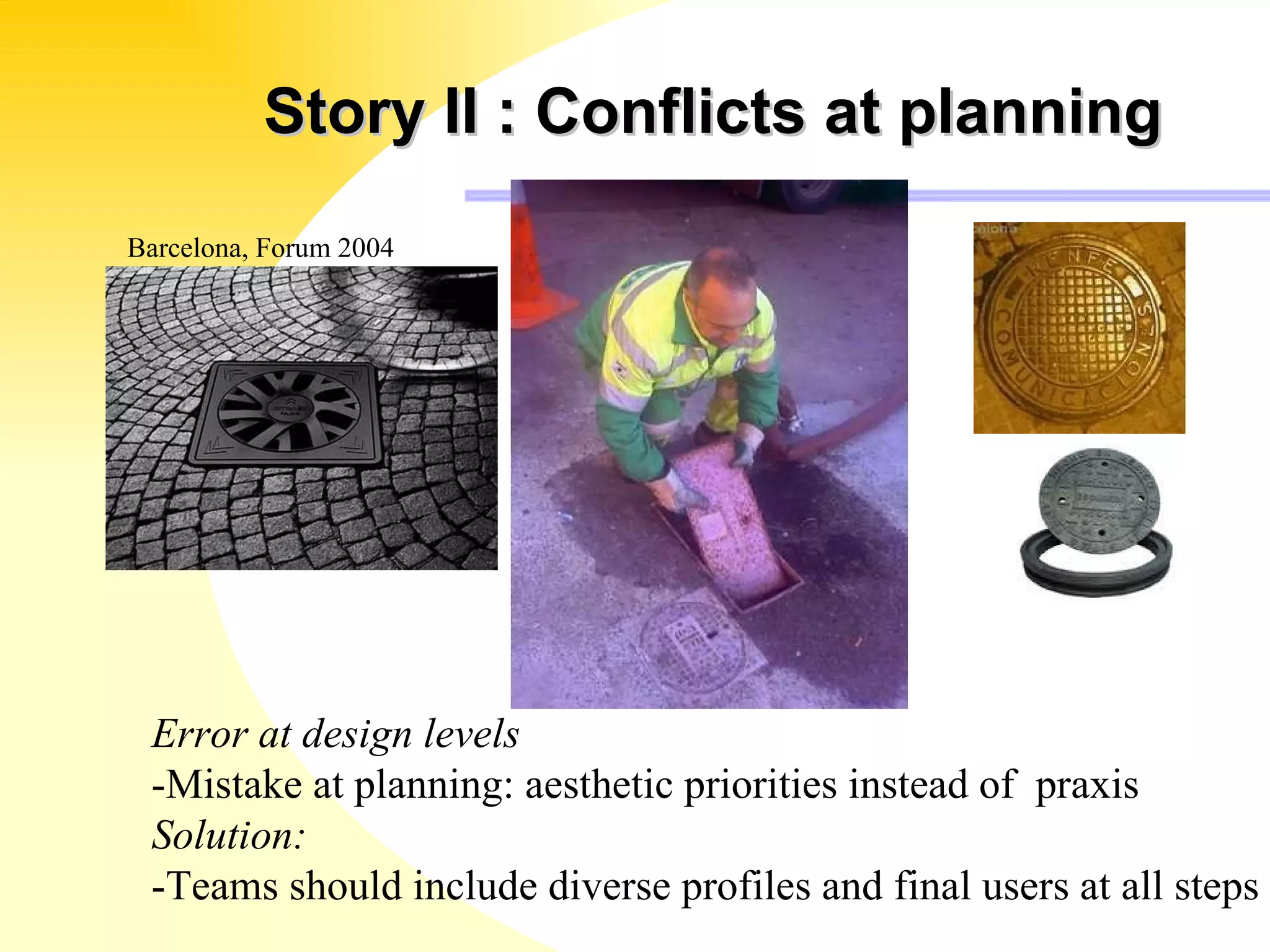
Story II : Conflicts at planning Error at design levels -Mistake at planning: aesthetic priorities instead of  praxis Solution: -Teams should include diverse profiles and final users at all steps Barcelona, Forum 2004
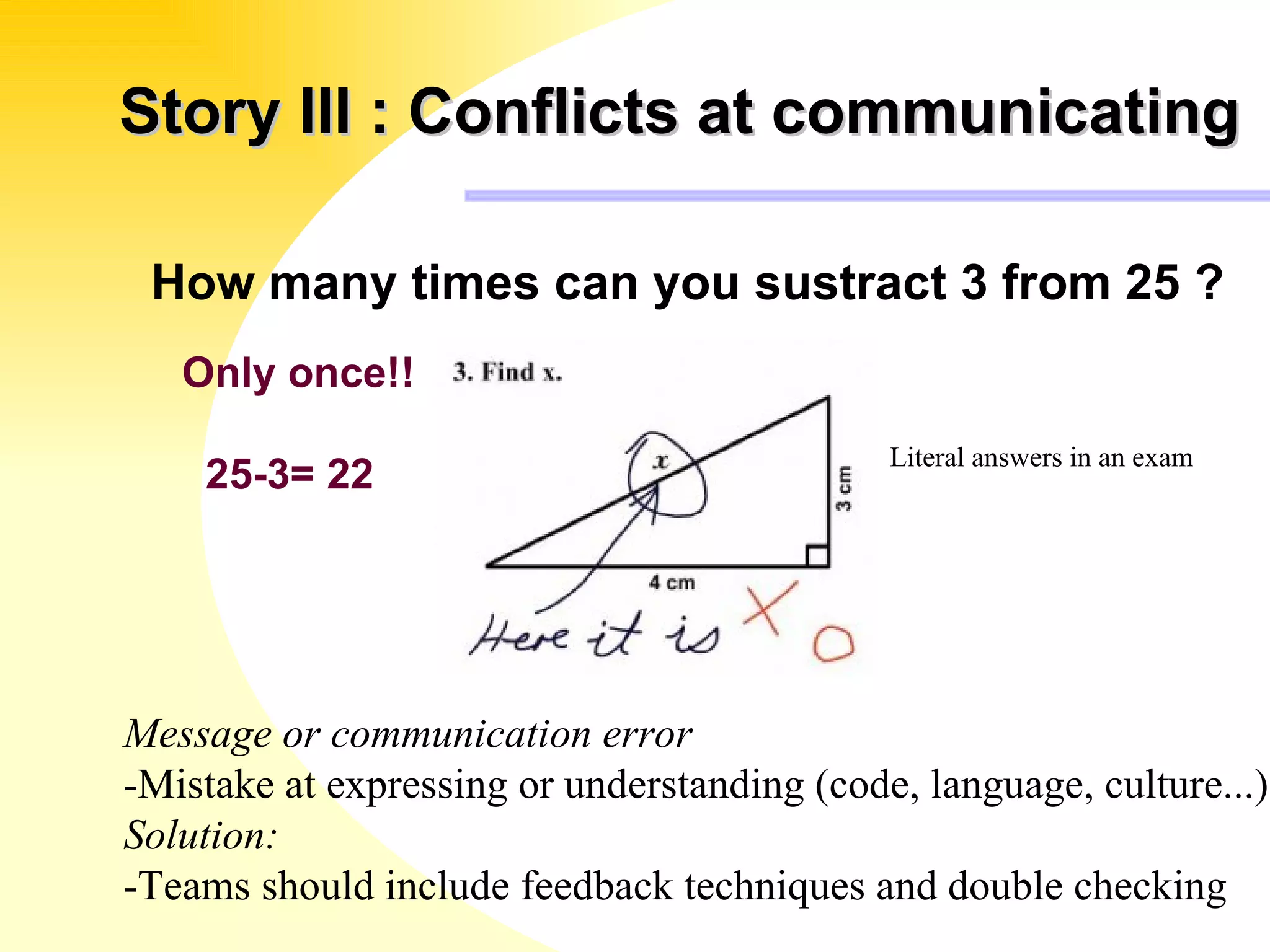
Story III : Conflicts at communicating  Message or communication error -Mistake at expressing or understanding (code, language, culture...) Solution: -Teams should include feedback techniques and double checking How many times can you sustract 3 from 25 ? Only once!! 25-3= 22 Literal answers in an exam
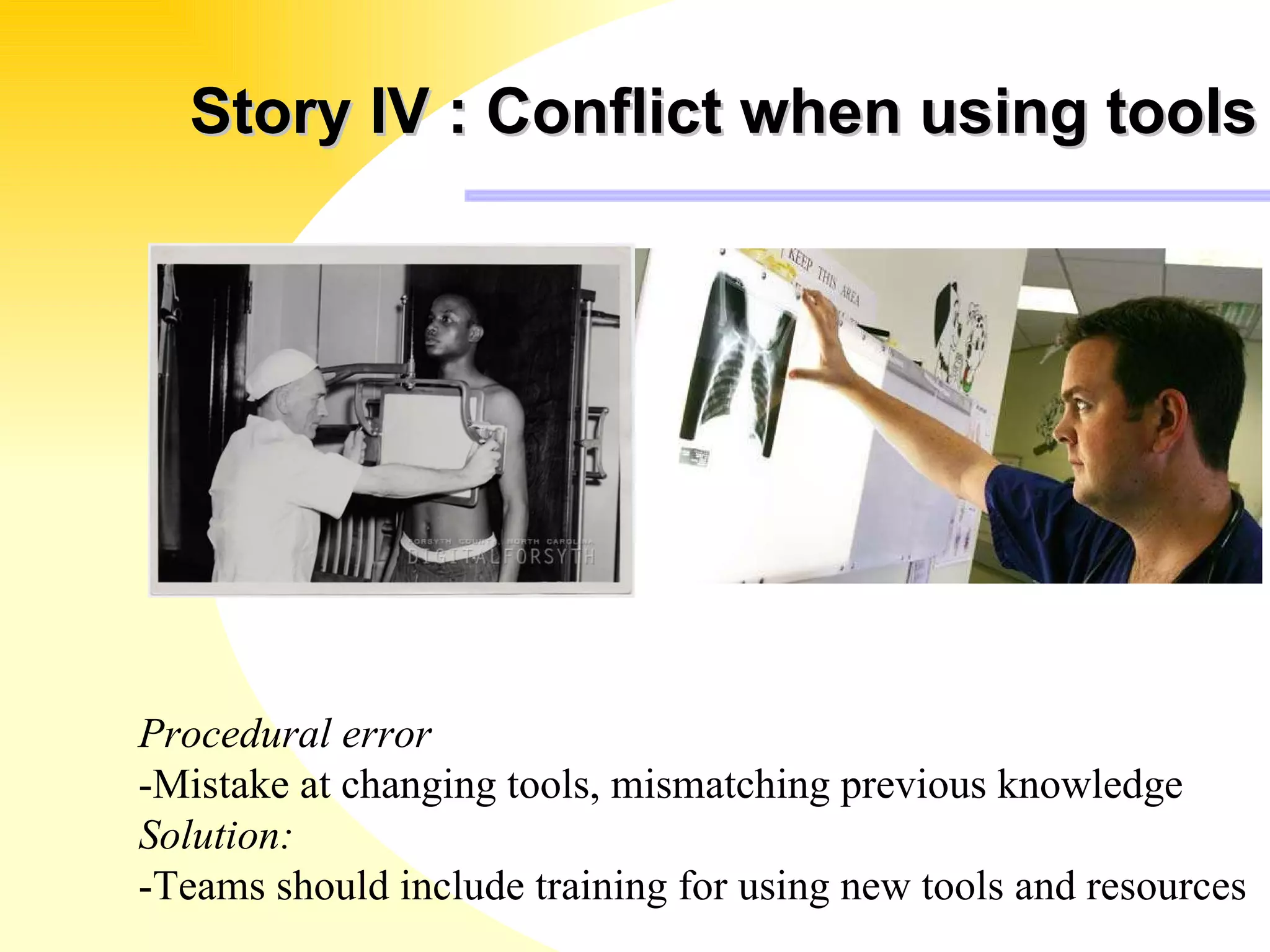
Story IV : Conflict when using tools Procedural error -Mistake at changing tools, mismatching previous knowledge Solution: -Teams should include training for using new tools and resources
Doing  European Projects using CLIL and ICT:  tools for attaining the future   Neus Lorenzo i Galés [email_address] We should cultivate today  the landscape of tomorrow … because only the trees that take root will be able to change the environment. Let’s start now !!!
The Catalan model  of language teaching and learning  Berga, 26 Juny 2009 Neus Lorenzo Galés [email_address] Use and application of  ICT  at International Collaborative Projects

Catalan Model for Language Learning in Plurilingual contexts

  • 1.
    El model catalàd’aprenentatge de llengües estrangeres Berga, 26 Juny 2009 Neus Lorenzo Galés [email_address] L’ús de les tecnologies i la seva aplicació als programes de cooperació internacional
  • 2.
    The Catalan model of language teaching and learning Berga, 26 June 2009 Neus Lorenzo Galés [email_address] Use and application of ICT at International Collaborative Projects
  • 3.
    Content 1-The Catalan Model: Language for personal development and social cohesion. 2- The Web 2.0 Lifestyle: Are we ready for social networking? 3- International collaborative projects: CLIL for crosscurricular learning
  • 4.
    L’escola catalana ...Isthere a Catalan model? Active school Collaborative work Plurilingualism Inclusion Values and Traditions Culture and heritage Quality Participation
  • 5.
    The growing painsof the Catalan Model, building diversity
  • 6.
    Past educational context: Language policy at school -1. PAST: 1940’s 1970’s SPANISH Latin - Greek- French ( School subjects) CATALAN ENGLISH FRENCH, GERM. ITAL. 1979 Estatutd’Autonomia; 1983 & 1998: Llei de Normalització Lingüística. Llei de Política Lingüística Bilingual society Monolingual school SPANISH CATALAN Debate Democracy Bilingual school Bilingual society
  • 7.
    Two societies ?One society? Looking for an educational system 1970’s & 1980’s: Debate on family language path path path path path
  • 8.
    Nowadays context: Language policy at school -2. PRESENT: Immigration 2000’s - 2010’s Bilingual school Extra curricular LANGUAGES SPANISH CATALAN School subject ENGLISH FRENCH. GERM. ITAL. CATALAN SPANISH Calo (Roman) Plurilingual society Debate
  • 9.
    (PISA results relatedto immigrant students) Changes between first and second generation http://www.pisa.oecd.org/findDocument/0,2350,en_32252351_32235731_1_119669_1_1_1,00.html http://www.pisa.oecd.org/pages/0,2966,en_32252351_32235907_1_1_1_1_1,00.html Stable results Positive results Negative results
  • 10.
    Building identity, Buildingsustainability PLURILINGUALISM Family School Friends Work Society Media Environment Family L. Environmental L. School L. Professional L. International L.
  • 11.
    Becoming active citizensin a Common core (sharing) State Legislation Belonging to Private spaces (keeping) Cultural singularities Dynamic Educational Model Managing diversity for social cohesion SGLiC, Departament d’Educació Generalitat de Catalunya
  • 12.
    The Plurilingual Project: Common aims and shared challenges in Europe Identity building -Accepting diversity and cultural differece as collective richness and shared opportunity Community building -Facing immigration and growth with social cohesion and active citizenship Knowledge building -Developing skills for lifelong learning in a global context, and acquiring key competencies relevant to the labour market. Adapted from: Leonard Orban, Comissionate for Multilingual Portfolio, EU international complicities Adapted from: Leonard Orban, Commissioner for Multilingual Portfolio, EU, 2007
  • 13.
    Languages for personaldevelopment Lifelong learning Creating European identity and citizenship ( plurality, diversity ) Lifelong learning (flexible curricula ) ICT tools & e-learning for knowledge building Academic convergence ( comparable degrees ) European Plurality ( mother tongue +2 ) Dead line: 2010 ____ 2015 ____ 2045 ? Market access ( relevant to the labour market ) 29 països : Joint declaration European Ministers of Education ( Terry Mitchell, promoter of EHEA: European Higher European Area, Bologna 1999, Berlin 2003, Bergen 2005 http://www.bologna-berlin2003.de/pdf/bologna_declaration.pdf Also: Acord de Lisboa 2001, revised London 2007) Europe of Knowledge
  • 14.
  • 15.
  • 16.
    The Plurilingual Projectin Catalonia: bridging the future together Every day we set the conditions that will make our future possible... But... is it the future we wish for?
  • 17.
    Formal, non-formal and informal spaces
  • 18.
    A practical exercise…. Chose one of these cards: don’t say it aloud!!!. Just look at it and try to fix it in your mind...
  • 19.
    A practical exercise...Think of your card for 10 second without saying it to anybody...
  • 20.
    A practical exercise….Now I will hide your letter!!! Great! How have I done it? Am I right??
  • 21.
    And what ishappening now?... People here have started an informal “emergent” network to get information from the group... Teamwork and networking strategies become natural and useful when a group is focused on solving the same problem and sharing aims, trying to find out new ideas, thinking aloud, and processing verbally.
  • 22.
    know how &resources? sensitivity & complicities Looking for balance and commitment
  • 23.
    Working collaboratively is much more than just adding ideas Quality factors: Sharing Values, Mission, Vision, Planning, Acting, Assessing
  • 24.
  • 25.
  • 26.
  • 27.
  • 28.
  • 29.
  • 30.
  • 31.
    Sequences Negotiation Informationgathering Data process Outcomes Feedback
  • 32.
    European Projects: transversality, plurilingualism and interculturalism Virtual garden Simultaneous Art Exhibit Multicultural concert Chirldren's intercultural library Collaborative portal European traditions on Webs Virtual Maths Race What do these projects provide schools with? Radio program in several languages
  • 33.
    Virtual,physical and intellectual mobility PAP- Lifelong Learning Program Associations and Training: Comenius, Gundtvig, Erasmus, eTwinning… Content and Language Integrated Learning (CLIL-EMILE-AICLE) Virtual & communicative mobility Physical mobilility Intellectual Mobility
  • 34.
    A quality CLILactivity provides… choose the 3 main benefits Linguistic improvement Content learning Autenticity Real interaction Developing competencies Building cognitive processes Cultural exploration Educational socialization Collaborative techniques Attitudinal orientation … … … … … … Integrating activities provides new added value... CLIL Language Content
  • 35.
    CLIL, Integrated methodologyfor developing life competencies 4-C: Mehisto, Marsh, Frigols, 2005, 2008 5-C: Leonard Orban, Comissionat UE,2007 6-C Diamant competencial de les 6-C, 2009 Neus Lorenzo & Group Sys.6, 2009 Criteria, creativity for decision making (judgement, evaluation and action) (Bloom’s Pyramid) Complexity (plurality, global diversity, multilingualism) 6-C CLIL-MC Content (knowledge building, learning things) Communication (projecting, interacting, doing) Community (being with others) Cognition (being oneself, thinking)
  • 36.
    CLIL-Paradigm: individual & social improvement Neus Lorenzo, 2009: Global Consciousness in Europe CLIL for proactive citizenship: participation, creativity, responsibility, innovation, involvement... transformation sharing learning Competition to Have things, information, friends ... Competencies for Being competent, able, useful, happy ...
  • 37.
  • 38.
  • 39.
    A knowwledge worker…Data Information Knowledge Wisdom Action Vision Mision Values
  • 40.
    Strategies for goodpractices Network requires... To have specific and defined aims To share commitments and follow collective rules To learn about the context and the territory To use emotional strategies and easy relationship To delegate in colleagues when necessary To count on a good opperational (technical) team To share information and evidence with users To alternate functions and tasks when needed.
  • 41.
    Story I :Conflicts at Vision level Error at sharing aims -Mistake at identifying common needs, mismatching aims Solution: -Teams should find shared fields for common visions Cardiff: Investigating language attitudes: Social meanings of dialect, ethnicity and performance. (1994)
  • 42.
    Story II :Conflicts at planning Error at design levels -Mistake at planning: aesthetic priorities instead of praxis Solution: -Teams should include diverse profiles and final users at all steps Barcelona, Forum 2004
  • 43.
    Story III :Conflicts at communicating Message or communication error -Mistake at expressing or understanding (code, language, culture...) Solution: -Teams should include feedback techniques and double checking How many times can you sustract 3 from 25 ? Only once!! 25-3= 22 Literal answers in an exam
  • 44.
    Story IV :Conflict when using tools Procedural error -Mistake at changing tools, mismatching previous knowledge Solution: -Teams should include training for using new tools and resources
  • 45.
    Doing EuropeanProjects using CLIL and ICT: tools for attaining the future Neus Lorenzo i Galés [email_address] We should cultivate today the landscape of tomorrow … because only the trees that take root will be able to change the environment. Let’s start now !!!
  • 46.
    The Catalan model of language teaching and learning Berga, 26 Juny 2009 Neus Lorenzo Galés [email_address] Use and application of ICT at International Collaborative Projects

Editor's Notes

  • #14 ALTE : ‘Association of Language Testers in Europe’ ALTE fou fundada al 1990, després d’una reunió preliminar a Catalunya al 1989. Originalment fou una idea de la Universitat de Salamanca i la University of Cambridge Examination Syndicate Hi havia 8 membres fundadors. Ara hi ha 20 membres de ple dret i 8 membres associats, que representen 24 llengües. Tots els membres de ple dret de l’ALTE són institucions i organitzacions educatives, com ara ministeris i conselleries, universitats i instituts de recerca o altres organitzacions no lucratives. Membres Basc /Govern Basc Català /Generalitat de Catalunya Danès /Consorci d’Avaluació de Llengua Danesa Holandès /CITOgroep /Certificaat Nederlands als Vreemde Taal (CNaVT ) Anglès /University of Cambridge ESOL Finlandès /Universitat de Jyväskylä Francès /Alliance Française/ Centre international d’études pédagogiques Alemany/Goethe-InstitutInter Nationes /WBTWeiterbildungs Testsyteme GmbH Conferències de l’ALTE : Krakow 21st-23rd April 2004 Bilbao November 10-12 th 2004 Berlin May 19 th -21 st 2005 (major public ALTE event on language testing) Cardiff November 2005
  • #35 A B C D En grups de 4: (2 min.) TOTS: