Exercise: Indexing of the electron diffraction patterns Louisa Meshi
Formation of electron diffraction and HRTEM image
Ewald sphere construction: Bragg’s conditions are satisfied when the Ewald sphere cuts a reciprocal lattice point specified  by the indices of the reflecting plane. sin  =  =  = g/2 1/  1/  1/d hkl  * 1/2 =  /2d hkl Bragg’s law g hkl O P hkl Origin of the reciprocal lattice 2  specimen 1/  Points of reciprocal lattice (hkl) plane
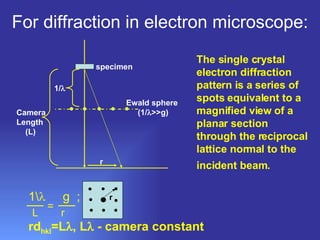
For diffraction in electron microscope: The single crystal electron diffraction pattern is a series of spots equivalent to a magnified view of a planar section through the reciprocal lattice normal to the incident beam .  specimen Ewald sphere (1/  >>g) 1/  Camera Length (L) r L  r  = 1\    g  ; rd hkl =L  , L   - camera constant r
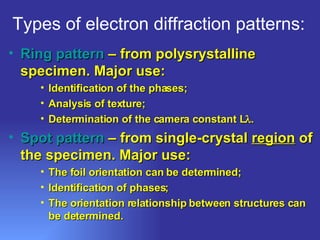
Types of electron diffraction patterns: Ring pattern  – from polysrystalline specimen. Major use: Identification of the phases; Analysis of texture; Determination of the camera constant L  . Spot pattern  – from single-crystal  region  of the specimen. Major use:  The foil orientation can be determined; Identification of phases; The orientation relationship between structures can be determined.
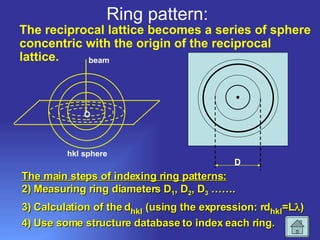
Ring pattern: The reciprocal lattice becomes a series of sphere concentric with the origin of the reciprocal lattice.  The main steps of indexing ring patterns: Measuring ring diameters D 1 , D 2 , D 3  ……. Calculation of the d hkl  (using the expression: rd hkl =L  ) Use some structure database to index each ring. beam O hkl sphere D
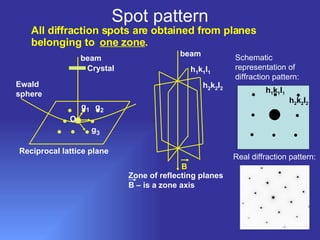
Spot pattern All diffraction spots are obtained from planes belonging to  one zone . O g 1 g 2 g 3 Crystal beam Ewald sphere Reciprocal lattice plane h 1 k 1 l 1 h 2 k 2 l 2 beam Zone of reflecting planes B – is a zone axis B Schematic representation of diffraction pattern: Real diffraction pattern: h 1 k 1 l 1 h 2 k 2 l 2
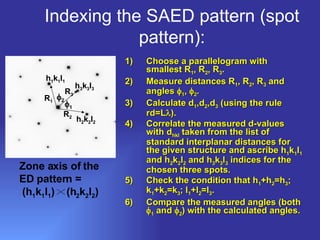
Indexing the SAED pattern (spot pattern): Choose a parallelogram with smallest R 1 , R 2 , R 3 . Measure distances R 1 , R 2 , R 3  and angles   1 ,   2 . Calculate d 1 ,d 2 ,d 3  (using the rule rd=L  ). Correlate the measured d-values with d hkl  taken from the list of standard interplanar distances for the given structure and ascribe h 1 k 1 l 1  and h 2 k 2 l 2  and h 3 k 3 l 3  indices for the chosen three spots. Check the condition that h 1 +h 2 =h 3 ; k 1 +k 2 =k 3 ; l 1 +l 2 =l 3 . Compare the measured angles (both   1  and   2 ) with the calculated angles.  h 1 k 1 l 1 h 2 k 2 l 2 h 3 k 3 l 3  1  2 R 3 R 1 R 2 Zone axis of the ED pattern = (h 1 k 1 l 1 )  (h 2 k 2 l 2 )
Practice time: In the tutorial of the school you will find three electron diffraction patterns. These patterns are taken from Cu and Al. (Crystallographic data and L   of the microscope - are given).  Index the SAED patterns and calculate the Zone Axis (ZA).

Thuc tap ve phan tich TEM

  • 1.
    Exercise: Indexing ofthe electron diffraction patterns Louisa Meshi
  • 2.
    Formation of electrondiffraction and HRTEM image
  • 3.
    Ewald sphere construction:Bragg’s conditions are satisfied when the Ewald sphere cuts a reciprocal lattice point specified by the indices of the reflecting plane. sin  = = = g/2 1/  1/  1/d hkl * 1/2 =  /2d hkl Bragg’s law g hkl O P hkl Origin of the reciprocal lattice 2  specimen 1/  Points of reciprocal lattice (hkl) plane
  • 4.
    For diffraction inelectron microscope: The single crystal electron diffraction pattern is a series of spots equivalent to a magnified view of a planar section through the reciprocal lattice normal to the incident beam . specimen Ewald sphere (1/  >>g) 1/  Camera Length (L) r L r = 1\  g ; rd hkl =L  , L  - camera constant r
  • 5.
    Types of electrondiffraction patterns: Ring pattern – from polysrystalline specimen. Major use: Identification of the phases; Analysis of texture; Determination of the camera constant L  . Spot pattern – from single-crystal region of the specimen. Major use: The foil orientation can be determined; Identification of phases; The orientation relationship between structures can be determined.
  • 6.
    Ring pattern: Thereciprocal lattice becomes a series of sphere concentric with the origin of the reciprocal lattice. The main steps of indexing ring patterns: Measuring ring diameters D 1 , D 2 , D 3 ……. Calculation of the d hkl (using the expression: rd hkl =L  ) Use some structure database to index each ring. beam O hkl sphere D
  • 7.
    Spot pattern Alldiffraction spots are obtained from planes belonging to one zone . O g 1 g 2 g 3 Crystal beam Ewald sphere Reciprocal lattice plane h 1 k 1 l 1 h 2 k 2 l 2 beam Zone of reflecting planes B – is a zone axis B Schematic representation of diffraction pattern: Real diffraction pattern: h 1 k 1 l 1 h 2 k 2 l 2
  • 8.
    Indexing the SAEDpattern (spot pattern): Choose a parallelogram with smallest R 1 , R 2 , R 3 . Measure distances R 1 , R 2 , R 3 and angles  1 ,  2 . Calculate d 1 ,d 2 ,d 3 (using the rule rd=L  ). Correlate the measured d-values with d hkl taken from the list of standard interplanar distances for the given structure and ascribe h 1 k 1 l 1 and h 2 k 2 l 2 and h 3 k 3 l 3 indices for the chosen three spots. Check the condition that h 1 +h 2 =h 3 ; k 1 +k 2 =k 3 ; l 1 +l 2 =l 3 . Compare the measured angles (both  1 and  2 ) with the calculated angles. h 1 k 1 l 1 h 2 k 2 l 2 h 3 k 3 l 3  1  2 R 3 R 1 R 2 Zone axis of the ED pattern = (h 1 k 1 l 1 ) (h 2 k 2 l 2 )
  • 9.
    Practice time: Inthe tutorial of the school you will find three electron diffraction patterns. These patterns are taken from Cu and Al. (Crystallographic data and L  of the microscope - are given). Index the SAED patterns and calculate the Zone Axis (ZA).