How does a jet engine
      work?


     By Kelvin Lam
Engine
• “A machine that converts energy into
  motion, either linear or circular.”
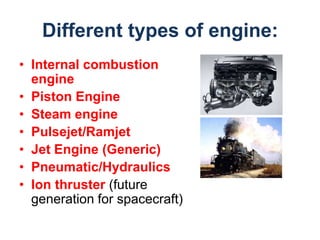
Different types of engine:
• Internal combustion
  engine
• Piston Engine
• Steam engine
• Pulsejet/Ramjet
• Jet Engine (Generic)
• Pneumatic/Hydraulics
• Ion thruster (future
  generation for spacecraft)
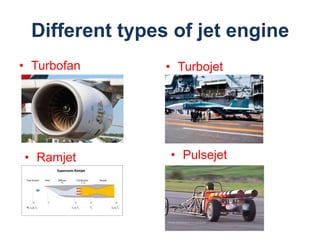
Different types of jet engine
• Turbofan      • Turbojet


• Ramjet        • Pulsejet
Compressible fluid
•   Fluids are compressible substance.
•   Examples includes:
•   Liquid
•   Air

• The jet engine make use of this property to
  generate thrust.
Revision of forces
• A resultant force is a sum of all forces
  acting on an object.
• Force comes with action and reaction pair.
  This is Newton’s Third Law of Motion
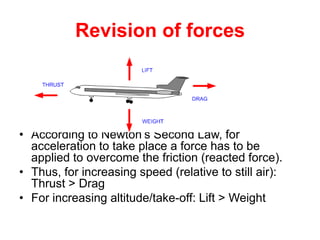
• There are mainly four basic force acting on
  an aircraft while it is cruising.
Revision of forces


• According to Newton’s Second Law, for
  acceleration to take place a force has to be
  applied to overcome the friction (reacted force).
• Thus, for increasing speed (relative to still air):
  Thrust > Drag
• For increasing altitude/take-off: Lift > Weight
Revision of forces
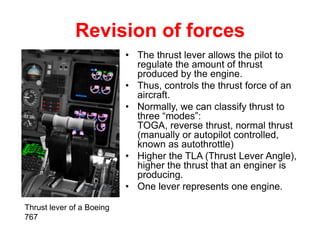
                           • The thrust lever allows the pilot to
                             regulate the amount of thrust
                             produced by the engine.
                           • Thus, controls the thrust force of an
                             aircraft.
                           • Normally, we can classify thrust to
                             three “modes”:
                             TOGA, reverse thrust, normal thrust
                             (manually or autopilot controlled,
                             known as autothrottle)
                           • Higher the TLA (Thrust Lever Angle),
                             higher the thrust that an enginer is
                             producing.
                           • One lever represents one engine.

Thrust lever of a Boeing
767
Structure of a turbofan engine
Stages of propulsion
• SUCK
The air is dragged into the central part of
  the engine by big fan blades.
• SQEEZE
Air is compressed in the compressor using
  specially aligned “mini-blades”.
Stages of propulsion
• BANG
Fuel is injected into the combustion
  chamber. The air ignites it, causing an
  explosion in the chamber as it rapidly
  expands.
• BLOW
The expansion of gas causes the air flow
  quickly from high pressure to low
  pressure.
Engine state
• Steady state: Wheras the
  variable/conditions are maintained
  throughout in the system.
• Transcient state: Wheras the variable are
  changed and adjusted.
Temperature of airflow
• Low-pressure stage:
Using Boyle’s Law, as air is compressed,
  temperature rises. The temperature
  reaches around 500K.
• High-pressure stage:
Again with the same principal, air is
  heated to around 1300-1500K
Temperature of airflow
• Combustion stage
Fuel is mixed with oxygen contained in air.
  The exothermic reaction heats it to around
  3200K.
• Exhaust
Air propelled from the engine can reach at
  least 3000K.
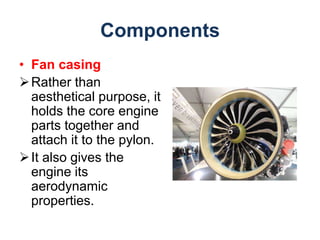
Components
• Fan casing
 Rather than
  aesthetical purpose, it
  holds the core engine
  parts together and
  attach it to the pylon.
 It also gives the
  engine its
  aerodynamic
  properties.
Components
• Gearbox and shafts
The purpose for the shafts are to drive the
  fan blade at the intake using the propelled
  force in the exhaust.
“The two sides”
• Dry-side                  • Wet-side
• “Water and electricity    • It holds the hydraulics
  don’t mix!”                 and the fuel supply of
• It holds the electrical     the engine.
  systems of the
  engine.
Dry side
• Components include
• FADEC (or EEC): Full
  authority Digital Engine
  Control
• Electrical generator
• Ignition (Motor that
  generates bleed air)
• Wires carrying
  information and signals    The “dry-side” of the Trent 900 fitted
                             on Airbus 380.
  back to the flight deck
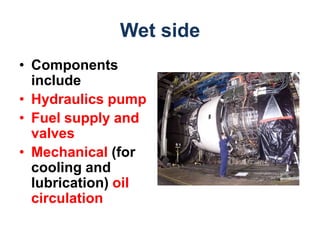
Wet side
• Components
  include
• Hydraulics pump
• Fuel supply and
  valves
• Mechanical (for
  cooling and
  lubrication) oil
  circulation
How pilot starts an engine
• In smaller aircrafts, starter motor is used to
  force air into the combustion chamber.
• In larger airliners, starter motor cannot
  generate enough air flow to move a big fan
  blade.
How pilot starts an engine
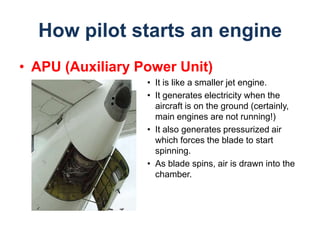
• APU (Auxiliary Power Unit)
                  • It is like a smaller jet engine.
                  • It generates electricity when the
                    aircraft is on the ground (certainly,
                    main engines are not running!)
                  • It also generates pressurized air
                    which forces the blade to start
                    spinning.
                  • As blade spins, air is drawn into the
                    chamber.
How pilot starts an engine
• Fuel pump
As air is drawn into
  the engine, fuel is
  pumped and
  injected into the
  chamber.
How pilot starts an engine
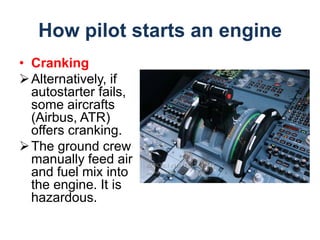
• Cranking
 Alternatively, if
  autostarter fails,
  some aircrafts
  (Airbus, ATR)
  offers cranking.
 The ground crew
  manually feed air
  and fuel mix into
  the engine. It is
  hazardous.
• In cranking mode, air is bled into the
  engine bleed valve.
• FADEC is isolated.
• The bleed air will spin the HP turbine.
Difference
• Turbofan                 • Turbojet
 High-bypass ratio         Low-bypass ratio
 Usually huge              Aero-dynamically
 Used for subsonic          designed so it is small
  flights                   Used for supersonic
 Very fuel efficient at     flights
  high altitudes            Fuel-hungry
Difference
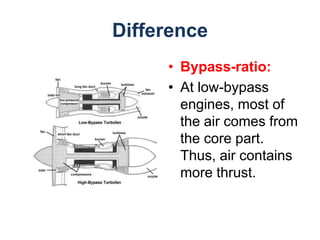
     • Bypass-ratio:
     • At low-bypass
       engines, most of
       the air comes from
       the core part.
       Thus, air contains
       more thrust.
Interesting applications
• ThrustSSC
• The world’s fastest
  land vehicle.
• Achieved a speed
  of 1228km/h (Mach
  1.02)
• Powered by Rolls-
  Royce Spey
  engines
Interesting applications
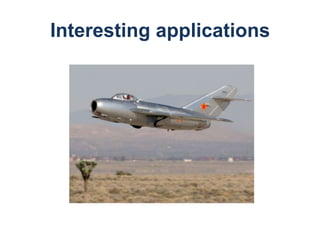
• Road deicing
• Somewhere in
  Russia,
  governments make
  use of remaining
  MiG-15 fighter
  engines to de-ice
  Siberian roads
Interesting applications
Questions?

How does a jet engine work

  • 1.
    How does ajet engine work? By Kelvin Lam
  • 2.
    Engine • “A machinethat converts energy into motion, either linear or circular.”
  • 3.
    Different types ofengine: • Internal combustion engine • Piston Engine • Steam engine • Pulsejet/Ramjet • Jet Engine (Generic) • Pneumatic/Hydraulics • Ion thruster (future generation for spacecraft)
  • 4.
    Different types ofjet engine • Turbofan • Turbojet • Ramjet • Pulsejet
  • 5.
    Compressible fluid • Fluids are compressible substance. • Examples includes: • Liquid • Air • The jet engine make use of this property to generate thrust.
  • 6.
    Revision of forces •A resultant force is a sum of all forces acting on an object. • Force comes with action and reaction pair. This is Newton’s Third Law of Motion • There are mainly four basic force acting on an aircraft while it is cruising.
  • 7.
    Revision of forces •According to Newton’s Second Law, for acceleration to take place a force has to be applied to overcome the friction (reacted force). • Thus, for increasing speed (relative to still air): Thrust > Drag • For increasing altitude/take-off: Lift > Weight
  • 8.
    Revision of forces • The thrust lever allows the pilot to regulate the amount of thrust produced by the engine. • Thus, controls the thrust force of an aircraft. • Normally, we can classify thrust to three “modes”: TOGA, reverse thrust, normal thrust (manually or autopilot controlled, known as autothrottle) • Higher the TLA (Thrust Lever Angle), higher the thrust that an enginer is producing. • One lever represents one engine. Thrust lever of a Boeing 767
  • 9.
    Structure of aturbofan engine
  • 10.
    Stages of propulsion •SUCK The air is dragged into the central part of the engine by big fan blades. • SQEEZE Air is compressed in the compressor using specially aligned “mini-blades”.
  • 11.
    Stages of propulsion •BANG Fuel is injected into the combustion chamber. The air ignites it, causing an explosion in the chamber as it rapidly expands. • BLOW The expansion of gas causes the air flow quickly from high pressure to low pressure.
  • 12.
    Engine state • Steadystate: Wheras the variable/conditions are maintained throughout in the system. • Transcient state: Wheras the variable are changed and adjusted.
  • 13.
    Temperature of airflow •Low-pressure stage: Using Boyle’s Law, as air is compressed, temperature rises. The temperature reaches around 500K. • High-pressure stage: Again with the same principal, air is heated to around 1300-1500K
  • 14.
    Temperature of airflow •Combustion stage Fuel is mixed with oxygen contained in air. The exothermic reaction heats it to around 3200K. • Exhaust Air propelled from the engine can reach at least 3000K.
  • 15.
    Components • Fan casing Rather than aesthetical purpose, it holds the core engine parts together and attach it to the pylon.  It also gives the engine its aerodynamic properties.
  • 16.
    Components • Gearbox andshafts The purpose for the shafts are to drive the fan blade at the intake using the propelled force in the exhaust.
  • 17.
    “The two sides” •Dry-side • Wet-side • “Water and electricity • It holds the hydraulics don’t mix!” and the fuel supply of • It holds the electrical the engine. systems of the engine.
  • 18.
    Dry side • Componentsinclude • FADEC (or EEC): Full authority Digital Engine Control • Electrical generator • Ignition (Motor that generates bleed air) • Wires carrying information and signals The “dry-side” of the Trent 900 fitted on Airbus 380. back to the flight deck
  • 19.
    Wet side • Components include • Hydraulics pump • Fuel supply and valves • Mechanical (for cooling and lubrication) oil circulation
  • 20.
    How pilot startsan engine • In smaller aircrafts, starter motor is used to force air into the combustion chamber. • In larger airliners, starter motor cannot generate enough air flow to move a big fan blade.
  • 21.
    How pilot startsan engine • APU (Auxiliary Power Unit) • It is like a smaller jet engine. • It generates electricity when the aircraft is on the ground (certainly, main engines are not running!) • It also generates pressurized air which forces the blade to start spinning. • As blade spins, air is drawn into the chamber.
  • 22.
    How pilot startsan engine • Fuel pump As air is drawn into the engine, fuel is pumped and injected into the chamber.
  • 23.
    How pilot startsan engine • Cranking  Alternatively, if autostarter fails, some aircrafts (Airbus, ATR) offers cranking.  The ground crew manually feed air and fuel mix into the engine. It is hazardous.
  • 24.
    • In crankingmode, air is bled into the engine bleed valve. • FADEC is isolated. • The bleed air will spin the HP turbine.
  • 25.
    Difference • Turbofan • Turbojet  High-bypass ratio  Low-bypass ratio  Usually huge  Aero-dynamically  Used for subsonic designed so it is small flights  Used for supersonic  Very fuel efficient at flights high altitudes  Fuel-hungry
  • 26.
    Difference • Bypass-ratio: • At low-bypass engines, most of the air comes from the core part. Thus, air contains more thrust.
  • 27.
    Interesting applications • ThrustSSC •The world’s fastest land vehicle. • Achieved a speed of 1228km/h (Mach 1.02) • Powered by Rolls- Royce Spey engines
  • 28.
    Interesting applications • Roaddeicing • Somewhere in Russia, governments make use of remaining MiG-15 fighter engines to de-ice Siberian roads
  • 29.
  • 30.