SCALP DEFECTS
-By Dr.Onkar Kulkarni
Moderator : Dr.P.U.F.Baba
EXTENT OF SCALP
 Anteriorly : supraorbital rims
 Posteriorly : the nuchal line.
 Laterally: from the frontal process of the zygoma to
the prominence of the mastoid process.
LAYERS
 S is skin
 C is subcutaneous tissue
 A is aponeurotic layer
 L is loose areolar tissue
 P is pericranium
IMPORTANT POINTS OF GALEA
 Connective tissue septa within the subcutaneous layer connect firmly to
the underlying musculoaponeurotic layer
 Galea aponeurotica : musculoaponeurotic layer that extends from the
frontalis muscles anteriorly to the occipitalis
Laterally the galea continues as the temporoparietal fascia.
 Galea is highly vascularized
 Subgaleal fascia : loose areolar layer beneath the galea
- thin over the vertex
- thicker in the temporoparietal region.
- richly vascularized and can be elevated as an
independent layer
PERICRANIUM
 periosteal layer of the calvaria.
 Thick collagenous layer with a rich blood supply
 Firmly attached to the skull in the region of the sutures.
 Pericranial flaps
TEMPOROPARIETAL REGION
 four distinct fascial layers
 Superficial temporal fascia:
most superficial layer
This layer is a direct extension of the
galea
closely applied to the overlying skin
 Deep to the superficial temporal fascia is the subgaleal fascia.
 Contained within this easily dissected layer are the superficial temporal
artery and the frontal branch of the facial nerve.
 Under the subgaleal fascia is the superficial temporal fat pad.
Numerous large perforating veins course through this layer
 Temporal fat pad : continuous with the buccal fat pad of the midface.
DEEP TEMPORAL FASCIA.
 Beneath the superficial temporal fat pad
 thick fascial layer surrounding the temporalis.
 Superiorly deep temporal fascia fuses with the pericranium.
 Inferiorly, it splits into two layers at the level of the frontozygomatic
suture.
 The superficial portion of the deep temporal fascia attaches to the
lateral border of the zygomatic arch.
 The deep layer fuses with the medial aspect of the arch
 Reflection of the superficial portion of the deep temporal fascia : Protects
facial nerve branches from injury.
 Temporalis Blood Supply : two deep temporal branches of the internal
maxillary artery: the middle and deep temporal
BLOOD SUPPLY OF SCALP
Internal carotid External carotid
Supraorbital Superficial temporal
Supratrochlear Posterior Auricular
Occipital
NERVE SUPPLY MOTOR
Muscle Nerve supply
Frontalis Frontal br. Of Facial
Occipitalis Posterior auricular
Temporalis Posterior and Anterior branches of
Deep temporal Nerve
{branch of Trigeminal N }
SENSORY NERVE SUPPLY
Supratrochlear Medial forhead
Supraorbital
Superficial
Deep
Central forhead
Remaining Frontoparietal
region
Zygomaticotemporal of
Maxillary division of
Trigeminal N
Skin lateral to temporal crest
Auriculotemporal of Trigeminal
N Lateral scalp
Greater and lesser occipital N Posterior scalp
CAUSES OF SCALP DEFECTS
 Trauma
 Burns
 Neoplastic
 Dermatological conditions
 Congenital
FACTORS CONSIDERED FOR SCALP DEFECTS
 Location
 Structures involved & exposed
 Sorrounding tissue
 Wound size
 Contour
 Previous treatment taken
 Hairline
SECONDARY INTENTION
 the defect is less than 1 cm in diameter and without bone
exposure.
NPWT
 Can help to reduce size, make healthy granulation tissue over the floor
 Molnar et al
the use of the NPWT in conjunction with skin grafts for full-thickness
lesions of the scalp.
They combined decortication of the outer surface of the skull with
immediate skin grafting in four patients with successful graft take.
PRIMARY CLOSURE
 If <3 cm
 Galea scoring :- method of decreasing tension on wound margins
 avoid injury to major vessel
1 mm gain in each incision, keep 1 cm gap
 Obtain meticulous hemostasis following galeotomy to prevent hematoma
 Chances of distal flap vascular
compromise
TISSUE EXPANSION
 Rapid intraop Tissue expansion and
closure :
3-4 cycles of inflation and deflation of the
expander for 3–5 minutes are performed.
STAGED TISSUE EXPANSION TECHNIQUES
 subcutaneous or subgaleal position
 Expansion begins at 2 weeks following placement.
 The device is expanded on a weekly or biweekly basis until the tissue
requirements of the defect are met.
 Expansion should be continued until the expanded flap is approximately
20% larger than the size of the defect
 tissue expansion produces a delay phenomenon
 Defects up to 50% of the scalp can be reconstructed.
 decreased hair follicle density.
 Austad advocates against tissue expansion in acute injuries because
of the risk of contamination and implant exposure.
 Disadvantage : 2 stage procedure
 Complications :
 Hematoma
 implant exposure
 infection
 flap necrosis
 Alopecia
 wide scars.
 Pressure from the expander can deform the cranial vault.
SKIN GRAFTING
 prerequisite for skin grafting
 adequately vascularized wound bed.
 Preservation of the cranial periosteum or the underlying subcutaneous
tissue of the scalp
 Drill holes upto diploic spaces and NPWT F/B interval STSG
 Crane principle
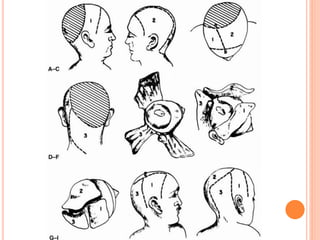
LOCAL FLAPS
 Rotation flap
 Transposition flap
 Gillies tripod flap
 Juri flap
 Orticochea flap
 Bipedicled flap
 Temporoparietal flap
 Frontooccipital flap
 O to T , Y to T flap
 Cervical fascial advancement flap
ROTATION FLAP
TRANSPOSITION FLAP
 Based on principle of triangulating the defect
 Right angled triangle made
 Donor site Covered with STSG
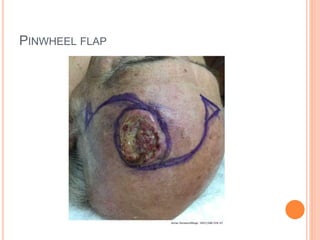
PINWHEEL FLAP
PIN WHEEL FLAP
ORTICOCHEA FLAP
 two anterior ones that are placed in the front part of the defect and a
transverse flap that is placed in the back.
 The posterior transverse flap is situated at the nape of the neck and has its
pedicle located in the retroauricular region.
 This pedicle should be placed on the side opposite the raw surface to be
reconstructed.
 When a large scalp flap is rotated, the dissection should be
subgaleal
 Temptation to revise the dog-ear should be resisted . It will
flatten with time
JURI FLAP - TEMPOROPARIETO- OCCIPITAL FLAP
If defect size <25 cm length as this flap can be taken upto 25 cm
Based on Parietal br . Of STA
Delay needed
TEMPORO-PARIETO-OCCIPITO-PARIETAL FLAP
 If more than 25 cm of flap is needed in length
 Upto 30-32 cm length possible

BIPEDICLED FLAP
FRONTALIS MYOCUTANEOUS FLAP
OCCIPITAL ARTERY BASED VY ADVANCEMENT FLAP
GALEAL FLAP
 Based on STA
 galeal flap is commonly based on a named scalp vessel or combination of
vessels.
 Flap length can often cross the midline
 Can be elevated with frontalis muscle of the forehead to reconstruct the
anterior cranial base.
 Can be taken with bone [vascularized cranial bone for reconstruction about
the orbit and facial skeleton ]
 Subgaleal areolar tissue can be raised with the underlying periosteum as a
turnover flap to provide vascularized coverage for denuded calvaria
DEEP TEMPORAL FASCIA FLAP
 The temporalis fascia is a direct lateral extension of the scalp
periosteum.
 This structure obtains its blood supply from the middle temporal
artery, a branch of the superficial temporal artery.
 Thus, a composite flap of superficial temporal fascia and
temporalis fascia can be isolated on the same vascular leash.
TEMPORALIS MUSCLE
 Origin : the temporalis fossa
 It passes under the
zygomatic arch
 Insertion :coronoid process
of the mandible.
 Blood Supply : DTA
 Always need grafting for
cover
COMPONENT SEPERATION
 Galeal frontalis flaps
 Osteogaleal flaps
 Temporoparietal fascial flaps
REGIONAL FLAP
 Trapezius flap : type 2
 For occipital defects
 blood supply :- transverse cervical
dorsal scapular
occipital arteries
 Pattern :
 Transverse flap : upper fibres [A/w shoulder drop]
Vertical flap : middle and lower fibres
8-10 cm donor defect can be closed primarily
LD FLAP [PEDICLED /FREE]
 By passage of the muscle through the axilla,
defects in the orbit and temporal bone can be
repaired.
OTHER REGIONAL FLAPS
 Splenius capitis for occiput
 Pectoralis major flap for mastoid and temporal region
FREE TISSUE TRANSFER
 LD [Flap of choice for large defects]
 RFF
 ALT
 Omental Flap with STSG
 Free temporo-occipital scalp flap for free hair
baring tissue transfer
CHECKLIST
I. Named vessel included?
II. Native hairline preserved ?
III. Mode of injury?
IV. Inherent inelasticity of galea and mobile parietal and
occipital region [neck]
V. Donor site : less sensitive cosmetically?

Scalp defects

  • 1.
    SCALP DEFECTS -By Dr.OnkarKulkarni Moderator : Dr.P.U.F.Baba
  • 2.
    EXTENT OF SCALP Anteriorly : supraorbital rims  Posteriorly : the nuchal line.  Laterally: from the frontal process of the zygoma to the prominence of the mastoid process.
  • 3.
    LAYERS  S isskin  C is subcutaneous tissue  A is aponeurotic layer  L is loose areolar tissue  P is pericranium
  • 4.
    IMPORTANT POINTS OFGALEA  Connective tissue septa within the subcutaneous layer connect firmly to the underlying musculoaponeurotic layer  Galea aponeurotica : musculoaponeurotic layer that extends from the frontalis muscles anteriorly to the occipitalis Laterally the galea continues as the temporoparietal fascia.  Galea is highly vascularized  Subgaleal fascia : loose areolar layer beneath the galea - thin over the vertex - thicker in the temporoparietal region. - richly vascularized and can be elevated as an independent layer
  • 5.
    PERICRANIUM  periosteal layerof the calvaria.  Thick collagenous layer with a rich blood supply  Firmly attached to the skull in the region of the sutures.  Pericranial flaps
  • 6.
    TEMPOROPARIETAL REGION  fourdistinct fascial layers  Superficial temporal fascia: most superficial layer This layer is a direct extension of the galea closely applied to the overlying skin
  • 7.
     Deep tothe superficial temporal fascia is the subgaleal fascia.  Contained within this easily dissected layer are the superficial temporal artery and the frontal branch of the facial nerve.  Under the subgaleal fascia is the superficial temporal fat pad. Numerous large perforating veins course through this layer  Temporal fat pad : continuous with the buccal fat pad of the midface.
  • 8.
    DEEP TEMPORAL FASCIA. Beneath the superficial temporal fat pad  thick fascial layer surrounding the temporalis.  Superiorly deep temporal fascia fuses with the pericranium.  Inferiorly, it splits into two layers at the level of the frontozygomatic suture.  The superficial portion of the deep temporal fascia attaches to the lateral border of the zygomatic arch.  The deep layer fuses with the medial aspect of the arch
  • 9.
     Reflection ofthe superficial portion of the deep temporal fascia : Protects facial nerve branches from injury.  Temporalis Blood Supply : two deep temporal branches of the internal maxillary artery: the middle and deep temporal
  • 10.
    BLOOD SUPPLY OFSCALP Internal carotid External carotid Supraorbital Superficial temporal Supratrochlear Posterior Auricular Occipital
  • 11.
    NERVE SUPPLY MOTOR MuscleNerve supply Frontalis Frontal br. Of Facial Occipitalis Posterior auricular Temporalis Posterior and Anterior branches of Deep temporal Nerve {branch of Trigeminal N }
  • 12.
    SENSORY NERVE SUPPLY SupratrochlearMedial forhead Supraorbital Superficial Deep Central forhead Remaining Frontoparietal region Zygomaticotemporal of Maxillary division of Trigeminal N Skin lateral to temporal crest Auriculotemporal of Trigeminal N Lateral scalp Greater and lesser occipital N Posterior scalp
  • 13.
    CAUSES OF SCALPDEFECTS  Trauma  Burns  Neoplastic  Dermatological conditions  Congenital
  • 14.
    FACTORS CONSIDERED FORSCALP DEFECTS  Location  Structures involved & exposed  Sorrounding tissue  Wound size  Contour  Previous treatment taken  Hairline
  • 15.
    SECONDARY INTENTION  thedefect is less than 1 cm in diameter and without bone exposure.
  • 16.
    NPWT  Can helpto reduce size, make healthy granulation tissue over the floor  Molnar et al the use of the NPWT in conjunction with skin grafts for full-thickness lesions of the scalp. They combined decortication of the outer surface of the skull with immediate skin grafting in four patients with successful graft take.
  • 17.
    PRIMARY CLOSURE  If<3 cm  Galea scoring :- method of decreasing tension on wound margins  avoid injury to major vessel 1 mm gain in each incision, keep 1 cm gap  Obtain meticulous hemostasis following galeotomy to prevent hematoma  Chances of distal flap vascular compromise
  • 18.
    TISSUE EXPANSION  Rapidintraop Tissue expansion and closure : 3-4 cycles of inflation and deflation of the expander for 3–5 minutes are performed.
  • 19.
    STAGED TISSUE EXPANSIONTECHNIQUES  subcutaneous or subgaleal position  Expansion begins at 2 weeks following placement.  The device is expanded on a weekly or biweekly basis until the tissue requirements of the defect are met.  Expansion should be continued until the expanded flap is approximately 20% larger than the size of the defect  tissue expansion produces a delay phenomenon  Defects up to 50% of the scalp can be reconstructed.  decreased hair follicle density.
  • 20.
     Austad advocatesagainst tissue expansion in acute injuries because of the risk of contamination and implant exposure.  Disadvantage : 2 stage procedure  Complications :  Hematoma  implant exposure  infection  flap necrosis  Alopecia  wide scars.  Pressure from the expander can deform the cranial vault.
  • 21.
    SKIN GRAFTING  prerequisitefor skin grafting  adequately vascularized wound bed.  Preservation of the cranial periosteum or the underlying subcutaneous tissue of the scalp  Drill holes upto diploic spaces and NPWT F/B interval STSG  Crane principle
  • 22.
    LOCAL FLAPS  Rotationflap  Transposition flap  Gillies tripod flap  Juri flap  Orticochea flap  Bipedicled flap  Temporoparietal flap  Frontooccipital flap  O to T , Y to T flap  Cervical fascial advancement flap
  • 23.
  • 24.
    TRANSPOSITION FLAP  Basedon principle of triangulating the defect  Right angled triangle made  Donor site Covered with STSG
  • 25.
  • 26.
  • 27.
    ORTICOCHEA FLAP  twoanterior ones that are placed in the front part of the defect and a transverse flap that is placed in the back.  The posterior transverse flap is situated at the nape of the neck and has its pedicle located in the retroauricular region.  This pedicle should be placed on the side opposite the raw surface to be reconstructed.
  • 30.
     When alarge scalp flap is rotated, the dissection should be subgaleal  Temptation to revise the dog-ear should be resisted . It will flatten with time
  • 31.
    JURI FLAP -TEMPOROPARIETO- OCCIPITAL FLAP If defect size <25 cm length as this flap can be taken upto 25 cm Based on Parietal br . Of STA Delay needed
  • 32.
    TEMPORO-PARIETO-OCCIPITO-PARIETAL FLAP  Ifmore than 25 cm of flap is needed in length  Upto 30-32 cm length possible 
  • 33.
  • 34.
  • 35.
    OCCIPITAL ARTERY BASEDVY ADVANCEMENT FLAP
  • 36.
    GALEAL FLAP  Basedon STA  galeal flap is commonly based on a named scalp vessel or combination of vessels.  Flap length can often cross the midline  Can be elevated with frontalis muscle of the forehead to reconstruct the anterior cranial base.  Can be taken with bone [vascularized cranial bone for reconstruction about the orbit and facial skeleton ]  Subgaleal areolar tissue can be raised with the underlying periosteum as a turnover flap to provide vascularized coverage for denuded calvaria
  • 37.
    DEEP TEMPORAL FASCIAFLAP  The temporalis fascia is a direct lateral extension of the scalp periosteum.  This structure obtains its blood supply from the middle temporal artery, a branch of the superficial temporal artery.  Thus, a composite flap of superficial temporal fascia and temporalis fascia can be isolated on the same vascular leash.
  • 39.
    TEMPORALIS MUSCLE  Origin: the temporalis fossa  It passes under the zygomatic arch  Insertion :coronoid process of the mandible.  Blood Supply : DTA  Always need grafting for cover
  • 40.
    COMPONENT SEPERATION  Galealfrontalis flaps  Osteogaleal flaps  Temporoparietal fascial flaps
  • 41.
    REGIONAL FLAP  Trapeziusflap : type 2  For occipital defects  blood supply :- transverse cervical dorsal scapular occipital arteries  Pattern :  Transverse flap : upper fibres [A/w shoulder drop] Vertical flap : middle and lower fibres 8-10 cm donor defect can be closed primarily
  • 45.
    LD FLAP [PEDICLED/FREE]  By passage of the muscle through the axilla, defects in the orbit and temporal bone can be repaired.
  • 46.
    OTHER REGIONAL FLAPS Splenius capitis for occiput  Pectoralis major flap for mastoid and temporal region
  • 47.
    FREE TISSUE TRANSFER LD [Flap of choice for large defects]  RFF  ALT  Omental Flap with STSG  Free temporo-occipital scalp flap for free hair baring tissue transfer
  • 48.
    CHECKLIST I. Named vesselincluded? II. Native hairline preserved ? III. Mode of injury? IV. Inherent inelasticity of galea and mobile parietal and occipital region [neck] V. Donor site : less sensitive cosmetically?