WOUND HEALING  MBBS, Resident Plastic surgery, HMC, Peshawar ansoor Khan M
Complex & dynamic process of restoring cellular structures & tissue layers
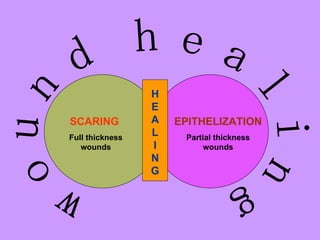
SCARING   Full thickness wounds EPITHELIZATION Partial thickness wounds HEALING w o u n d  h e a l i n g
Phases of wound healing
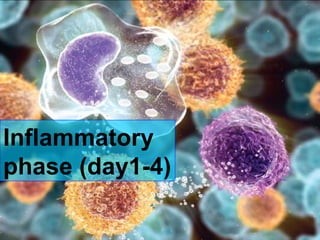
Inflammatory phase (day1-4)
Limit blood loss Debridement Sealing the wound
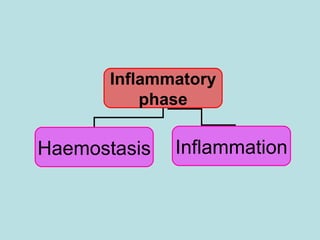
Inflammatory phase Haemostasis Inflammation
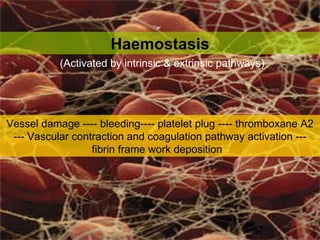
Vessel damage ---- bleeding---- platelet plug ---- thromboxane A2 --- Vascular contraction and coagulation pathway activation --- fibrin frame work deposition  Haemostasis (Activated by intrinsic & extrinsic pathways)
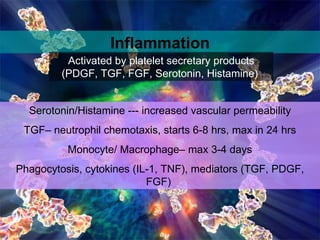
Inflammation Serotonin/Histamine --- increased vascular permeability TGF– neutrophil chemotaxis, starts 6-8 hrs, max in 24 hrs Monocyte/ Macrophage– max 3-4 days Phagocytosis, cytokines (IL-1, TNF), mediators (TGF, PDGF, FGF)  Activated by platelet secretary products (PDGF, TGF, FGF, Serotonin, Histamine)
Proliferative Phase (day 4-21)
Filling wound gap with granulation tissue
EVENTS Fibroplasia, angiogenesis, contraction,  re-epithelization
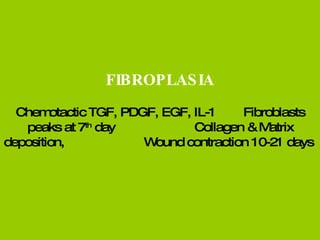
FIBROPLASIA Chemotactic TGF, PDGF, EGF, IL-1  Fibroblasts peaks at 7 th  day  Collagen & Matrix deposition,  Wound contraction 10-21 days
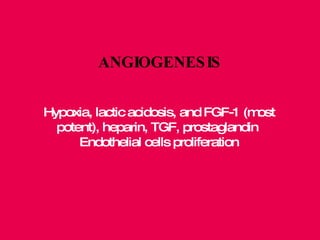
ANGIOGENESIS Hypoxia, lactic acidosis, and FGF-1 (most potent), heparin, TGF, prostaglandin  Endothelial cells proliferation
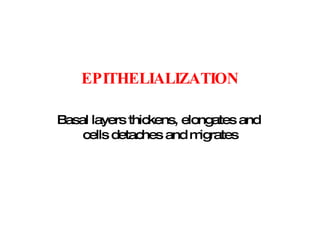
EPITHELIALIZATION Basal layers thickens, elongates and  cells detaches and migrates
Tailoring the way reality lives Phase  (day 21-2years)
S hrinkage  L oss of oedema  S trength  S care contraction
EVENTS Regression of vessels & granulation tissue Wound contraction Collagen remodelling (replacing collagen III with I) Maximum strength at the 12 week
WOUND CONTRACTION Begin in the proliferative phase (4-5 th  day) Continues throughout the healing process Maximum 10-21 day Brings edges close at a rate of 0.6-0.75mm/day Depends on the laxity of the skin
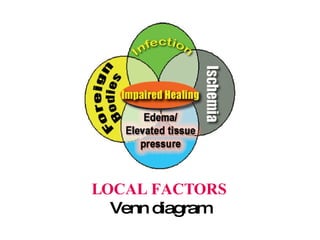
LOCAL FACTORS Venn diagram
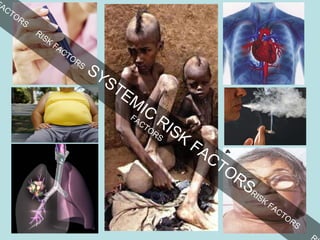
RISK FACTORS  RISK FACTORS  SYSTEMIC RISK FACTORS RISK FACTORS  RISK FACTORS
ISCHEMIA Wound healing is a highly energy dependant process
Sugar is the main fuel for wound healing ISCHEMIA
So it take a rich blood supply to heal a wound ISCHEMIA
Initial response  neo-vascularization  Persistent ischemia results  in apoptosis  “ ”
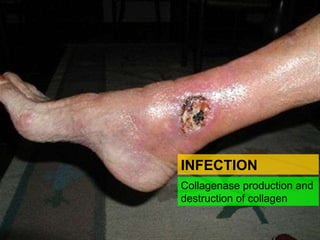
INFECTION Collagenase production and destruction of collagen
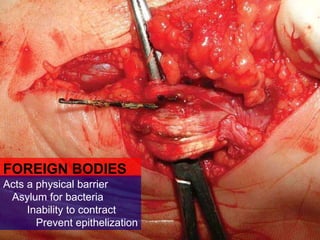
FOREIGN BODIES Acts a physical barrier  Asylum for bacteria  Inability to contract  Prevent epithelization
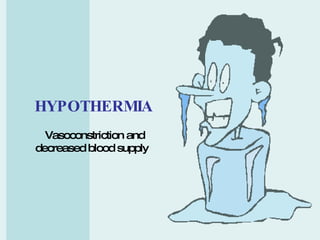
HYPOTHERMIA Vasoconstriction and decreased blood supply
PAIN Adrenaline surge causing vasoconstriction
Keep the wounds  wet ,  warm  and  comfortable   “ ”
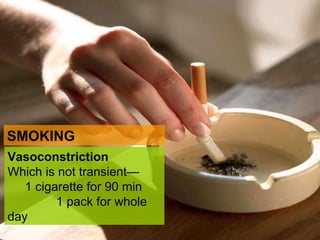
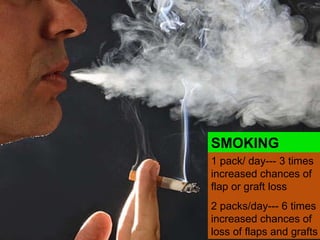
SMOKING Vasoconstriction Which is not transient—  1 cigarette for 90 min  1 pack for whole day
SMOKING Carboxihemoglobin---  O2 carrying capacity.  Subcutaneous PO2
1 pack/ day--- 3 times increased chances of flap or graft loss 2 packs/day--- 6 times increased chances of loss of flaps and grafts  SMOKING

 
STEROIDS Lysosomal stabalization--- impaired phagocytosis Impairment of chemotaxis of microphages Fibroblast genome inhibition--- decreased collagen, decreased strength and increased dehiscence
HEALING SLOWS DOWN WITH AGING
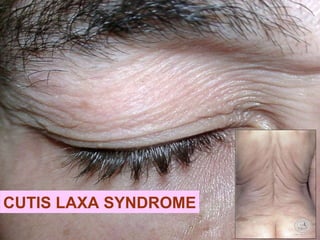
CUTIS LAXA SYNDROME
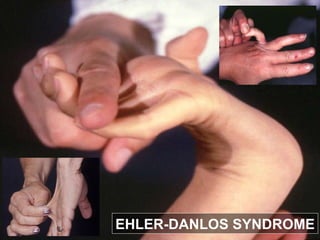
EHLER-DANLOS SYNDROME
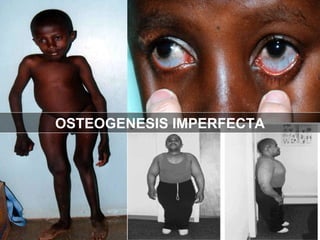
OSTEOGENESIS IMPERFECTA
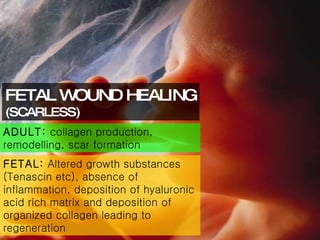
FETAL WOUND HEALING (SCARLESS) ADULT:  collagen production, remodelling, scar formation FETAL:  Altered growth substances (Tenascin etc), absence of inflammation, deposition of hyaluronic acid rich matrix and deposition of organized collagen leading to regeneration
 

Wound healing