Tree Representation in
MapReduce World
IPL weekly-seminar
Yu Liu@NII
2011-11-22
Distributed File System of MapReduce
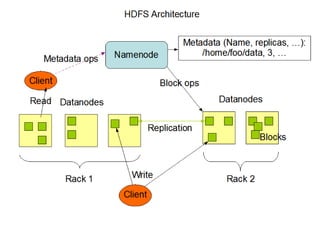
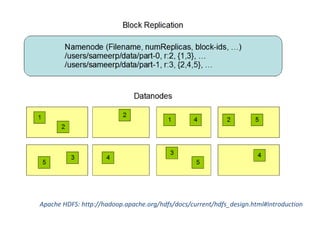
• A GFS/HDFS cluster consists of a single master
(namenode) and multiple chunkservers (datanodes)
and is accessed by multiple clients.
• The master maintains all filesystem metadata.
• Clients interact with the master for metadata
operations, but all data-bearing communication goes
directly to the datanodes
Distributed File System of MapReduce
• Architecture of GFS/HDFS
– Files are divided into fixed-size chunks
– Each chunk is identified by an immutable and
globally unique 64 bit integer (chunk handle)
– Each chunk is replicated on multiple chunkservers
– Chunks of a file are placed as balance as possable
in the cluster.
(The Google File System, SOSP03)
Apache HDFS: http://hadoop.apache.org/hdfs/docs/current/hdfs_design.html#Introduction
Inputs and Outputs of MapReduce
• The MapReduce framework operates exclusively on
<key, value> pairs.
• Each pair is called a record.
• Applications specify the input/output locations and
supply map and reduce functions and other job
parameters, comprise the job configuration. The job
client then submits the job to framework.
Tree Data Structure inside MapReduce
• Currently, GFS/HDFS prefers flat data
structures/ files, files such as xml is not
supported.
• We already know how to represent a file
which contains a large list in HDFS (EuroPar
2011)
• Tree representation is still a problem.
How to Represent a Tree in
MapReduce
• If we can represent the tree by an list , and if :
When this list is split into arbitrary continues sublists,
each split of the list represents a sub tree
After any tree contracting operations on each sub tree,
concated sublists can still get a tree
Then such a list is what we want.
Tree Representation: Balanced
Parenthesis
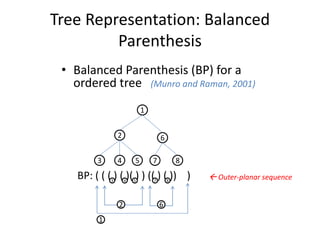
• Balanced Parenthesis (BP) for a
ordered tree (Munro and Raman, 2001)
BP: ( ( ( ) ( )( ) ) (( ) ( )) )
1
2 6
73 4 5 8
1
2 6
3 4 5 7 8
 Outer-planar sequence
BP Can Be A Solution
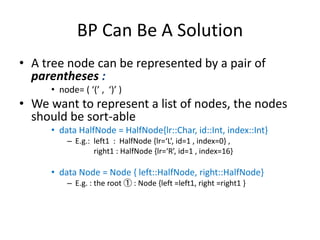
• A tree node can be represented by a pair of
parentheses :
• node= ( ‘(’ , ‘)’ )
• We want to represent a list of nodes, the nodes
should be sort-able
• data HalfNode = HalfNode{lr::Char, id::Int, index::Int}
– E.g.: left1 : HalfNode {lr=‘L’, id=1 , index=0} ,
right1 : HalfNode {lr=‘R’, id=1 , index=16}
• data Node = Node { left::HalfNode, right::HalfNode}
– E.g. : the root ① : Node {left =left1, right =right1 }
Parenthesis / HalfNode
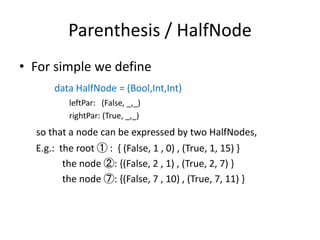
• For simple we define
data HalfNode = (Bool,Int,Int)
leftPar: (False, _,_)
rightPar: (True, _,_)
so that a node can be expressed by two HalfNodes,
E.g.: the root ① : { (False, 1 , 0) , (True, 1, 15) }
the node ②: {(False, 2 , 1) , (True, 2, 7) }
the node ⑦: {(False, 7 , 10) , (True, 7, 11) }
Comparable HalfNode
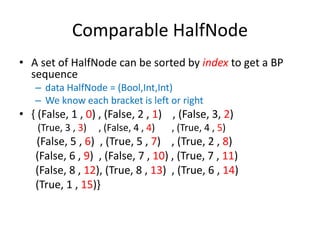
• A set of HalfNode can be sorted by index to get a BP
sequence
– data HalfNode = (Bool,Int,Int)
– We know each bracket is left or right
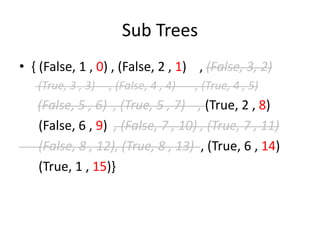
• { (False, 1 , 0) , (False, 2 , 1) , (False, 3, 2)
(True, 3 , 3) , (False, 4 , 4) , (True, 4 , 5)
(False, 5 , 6) , (True, 5 , 7) , (True, 2 , 8)
(False, 6 , 9) , (False, 7 , 10) , (True, 7 , 11)
(False, 8 , 12), (True, 8 , 13) , (True, 6 , 14)
(True, 1 , 15)}
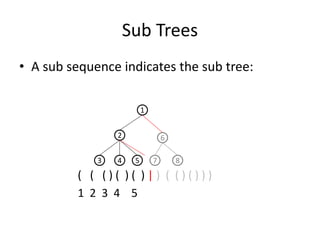
Sub Trees
• A sub sequence indicates the sub tree:
( ( ( ) ( ) ( ) | ) ( ( ) ( ) ) )
1 2 3 4 5
1
2 6
73 4 5 8
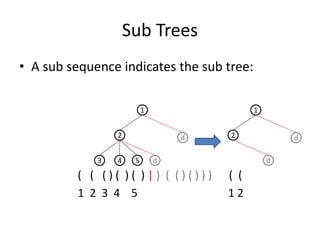
Sub Trees
• A sub sequence indicates the sub tree:
( ( ( ) ( ) ( ) | ) ( ( ) ( ) ) ) ( (
1 2 3 4 5 1 2
1
2 d
d3 4 5
1
2 d
d
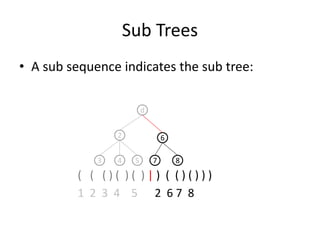
Sub Trees
• A sub sequence indicates the sub tree:
( ( ( ) ( ) ( ) | ) ( ( ) ( ) ) )
1 2 3 4 5 2 6 7 8
d
2 6
73 4 5 8
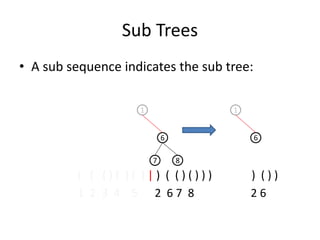
Sub Trees
• A sub sequence indicates the sub tree:
( ( ( ) ( ) ( ) | ) ( ( ) ( ) ) ) ) ( ) )
1 2 3 4 5 2 6 7 8 2 6
1
6
7 8
1
6
Bottom-up Tree contraction
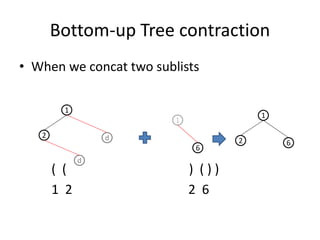
• When we concat two sublists
( ( ) ( ) )
1 2 2 6
1
2 d
d
1
6
1
2 6
Sub Trees
• { (False, 1 , 0) , (False, 2 , 1) , (False, 3, 2)
(True, 3 , 3) , (False, 4 , 4) , (True, 4 , 5)
(False, 5 , 6) , (True, 5 , 7) , (True, 2 , 8)
(False, 6 , 9) , (False, 7 , 10) , (True, 7 , 11)
(False, 8 , 12), (True, 8 , 13) , (True, 6 , 14)
(True, 1 , 15)}
Splitting and Grouping
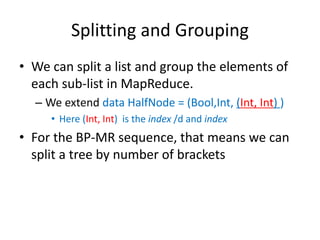
• We can split a list and group the elements of
each sub-list in MapReduce.
– We extend data HalfNode = (Bool,Int, (Int, Int) )
• Here (Int, Int) is the index /d and index
• For the BP-MR sequence, that means we can
split a tree by number of brackets
Practical Data
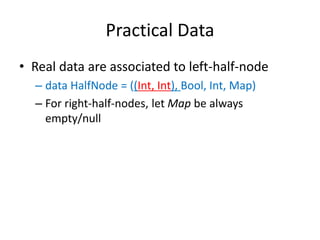
• Real data are associated to left-half-node
– data HalfNode = ((Int, Int), Bool, Int, Map)
– For right-half-nodes, let Map be always
empty/null
Bottom-up Build a Tree
• A list a items as input
• Make a sparse list of “leaf”:
E.g.: [ ((0,100),False, 100, data1), ((0,101), True, 100,
null) , ( (0, 200), False, 200, data2), ( (0, 201), True, 200,
data2) .. ]
( 100) (200) (300) (400) ….
• Insert parents
( ( 100) (200) ) ( (300) (400) )….
50 250
Examples
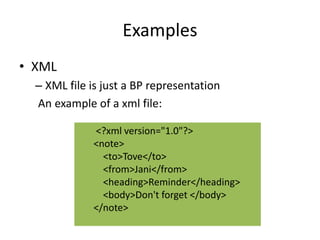
• XML
– XML file is just a BP representation
An example of a xml file:
<?xml version="1.0"?>
<note>
<to>Tove</to>
<from>Jani</from>
<heading>Reminder</heading>
<body>Don't forget </body>
</note>
Examples
• XML file can be easily transformed to BP-MR
– Operation:
• query
– by xpath
– By id / index
• Parallel parsing ?
Hieratical Clustering
• This work is not finished
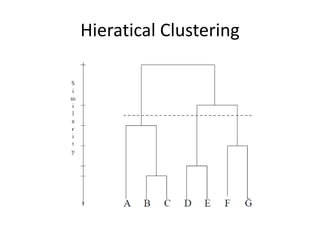
• Usually, clustering algorithms are related to
two categories: hierarchical and partitioning
• The more popular hierarchical agglomerative
clustering (HAC) algorithms use a bottom-up
approach to merge items into a hierarchy of
clusters.
Hieratical Clustering
• The Average-link is one of the most popular
algorithms for hieratical clustering
• Average link: The distance between any two
clusters is the average distance between each
pair of points such that each pair has a point
in both clusters
GTA Algorithm for Hieratical Clustering
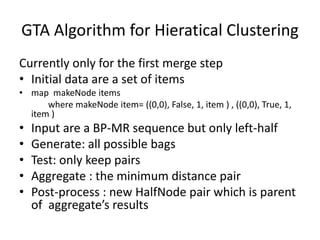
Currently only for the first merge step
• Initial data are a set of items
• map makeNode items
where makeNode item= ((0,0), False, 1, item ) , ((0,0), True, 1,
item )
• Input are a BP-MR sequence but only left-half
• Generate: all possible bags
• Test: only keep pairs
• Aggregate : the minimum distance pair
• Post-process : new HalfNode pair which is parent
of aggregate’s results
Problems
• Hard to do insertion
– Appending to the tail is easy but insertion into
other place is difficult
• Parallel generate BP-MR sequences
– Ideas: first generate skeletons of a tree
Skeletons of a Tree
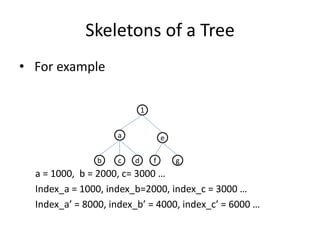
• For example
a = 1000, b = 2000, c= 3000 …
Index_a = 1000, index_b=2000, index_c = 3000 …
Index_a’ = 8000, index_b’ = 4000, index_c’ = 6000 …
1
a e
fb c d g
End
• Thanks
Tree representation  in map reduce world

Tree representation in map reduce world

  • 1.
    Tree Representation in MapReduceWorld IPL weekly-seminar Yu Liu@NII 2011-11-22
  • 2.
    Distributed File Systemof MapReduce • A GFS/HDFS cluster consists of a single master (namenode) and multiple chunkservers (datanodes) and is accessed by multiple clients. • The master maintains all filesystem metadata. • Clients interact with the master for metadata operations, but all data-bearing communication goes directly to the datanodes
  • 4.
    Distributed File Systemof MapReduce • Architecture of GFS/HDFS – Files are divided into fixed-size chunks – Each chunk is identified by an immutable and globally unique 64 bit integer (chunk handle) – Each chunk is replicated on multiple chunkservers – Chunks of a file are placed as balance as possable in the cluster. (The Google File System, SOSP03)
  • 5.
  • 6.
    Inputs and Outputsof MapReduce • The MapReduce framework operates exclusively on <key, value> pairs. • Each pair is called a record. • Applications specify the input/output locations and supply map and reduce functions and other job parameters, comprise the job configuration. The job client then submits the job to framework.
  • 7.
    Tree Data Structureinside MapReduce • Currently, GFS/HDFS prefers flat data structures/ files, files such as xml is not supported. • We already know how to represent a file which contains a large list in HDFS (EuroPar 2011) • Tree representation is still a problem.
  • 8.
    How to Representa Tree in MapReduce • If we can represent the tree by an list , and if : When this list is split into arbitrary continues sublists, each split of the list represents a sub tree After any tree contracting operations on each sub tree, concated sublists can still get a tree Then such a list is what we want.
  • 9.
    Tree Representation: Balanced Parenthesis •Balanced Parenthesis (BP) for a ordered tree (Munro and Raman, 2001) BP: ( ( ( ) ( )( ) ) (( ) ( )) ) 1 2 6 73 4 5 8 1 2 6 3 4 5 7 8  Outer-planar sequence
  • 10.
    BP Can BeA Solution • A tree node can be represented by a pair of parentheses : • node= ( ‘(’ , ‘)’ ) • We want to represent a list of nodes, the nodes should be sort-able • data HalfNode = HalfNode{lr::Char, id::Int, index::Int} – E.g.: left1 : HalfNode {lr=‘L’, id=1 , index=0} , right1 : HalfNode {lr=‘R’, id=1 , index=16} • data Node = Node { left::HalfNode, right::HalfNode} – E.g. : the root ① : Node {left =left1, right =right1 }
  • 11.
    Parenthesis / HalfNode •For simple we define data HalfNode = (Bool,Int,Int) leftPar: (False, _,_) rightPar: (True, _,_) so that a node can be expressed by two HalfNodes, E.g.: the root ① : { (False, 1 , 0) , (True, 1, 15) } the node ②: {(False, 2 , 1) , (True, 2, 7) } the node ⑦: {(False, 7 , 10) , (True, 7, 11) }
  • 12.
    Comparable HalfNode • Aset of HalfNode can be sorted by index to get a BP sequence – data HalfNode = (Bool,Int,Int) – We know each bracket is left or right • { (False, 1 , 0) , (False, 2 , 1) , (False, 3, 2) (True, 3 , 3) , (False, 4 , 4) , (True, 4 , 5) (False, 5 , 6) , (True, 5 , 7) , (True, 2 , 8) (False, 6 , 9) , (False, 7 , 10) , (True, 7 , 11) (False, 8 , 12), (True, 8 , 13) , (True, 6 , 14) (True, 1 , 15)}
  • 13.
    Sub Trees • Asub sequence indicates the sub tree: ( ( ( ) ( ) ( ) | ) ( ( ) ( ) ) ) 1 2 3 4 5 1 2 6 73 4 5 8
  • 14.
    Sub Trees • Asub sequence indicates the sub tree: ( ( ( ) ( ) ( ) | ) ( ( ) ( ) ) ) ( ( 1 2 3 4 5 1 2 1 2 d d3 4 5 1 2 d d
  • 15.
    Sub Trees • Asub sequence indicates the sub tree: ( ( ( ) ( ) ( ) | ) ( ( ) ( ) ) ) 1 2 3 4 5 2 6 7 8 d 2 6 73 4 5 8
  • 16.
    Sub Trees • Asub sequence indicates the sub tree: ( ( ( ) ( ) ( ) | ) ( ( ) ( ) ) ) ) ( ) ) 1 2 3 4 5 2 6 7 8 2 6 1 6 7 8 1 6
  • 17.
    Bottom-up Tree contraction •When we concat two sublists ( ( ) ( ) ) 1 2 2 6 1 2 d d 1 6 1 2 6
  • 18.
    Sub Trees • {(False, 1 , 0) , (False, 2 , 1) , (False, 3, 2) (True, 3 , 3) , (False, 4 , 4) , (True, 4 , 5) (False, 5 , 6) , (True, 5 , 7) , (True, 2 , 8) (False, 6 , 9) , (False, 7 , 10) , (True, 7 , 11) (False, 8 , 12), (True, 8 , 13) , (True, 6 , 14) (True, 1 , 15)}
  • 19.
    Splitting and Grouping •We can split a list and group the elements of each sub-list in MapReduce. – We extend data HalfNode = (Bool,Int, (Int, Int) ) • Here (Int, Int) is the index /d and index • For the BP-MR sequence, that means we can split a tree by number of brackets
  • 20.
    Practical Data • Realdata are associated to left-half-node – data HalfNode = ((Int, Int), Bool, Int, Map) – For right-half-nodes, let Map be always empty/null
  • 21.
    Bottom-up Build aTree • A list a items as input • Make a sparse list of “leaf”: E.g.: [ ((0,100),False, 100, data1), ((0,101), True, 100, null) , ( (0, 200), False, 200, data2), ( (0, 201), True, 200, data2) .. ] ( 100) (200) (300) (400) …. • Insert parents ( ( 100) (200) ) ( (300) (400) )…. 50 250
  • 22.
    Examples • XML – XMLfile is just a BP representation An example of a xml file: <?xml version="1.0"?> <note> <to>Tove</to> <from>Jani</from> <heading>Reminder</heading> <body>Don't forget </body> </note>
  • 23.
    Examples • XML filecan be easily transformed to BP-MR – Operation: • query – by xpath – By id / index • Parallel parsing ?
  • 24.
    Hieratical Clustering • Thiswork is not finished • Usually, clustering algorithms are related to two categories: hierarchical and partitioning • The more popular hierarchical agglomerative clustering (HAC) algorithms use a bottom-up approach to merge items into a hierarchy of clusters.
  • 25.
  • 26.
    Hieratical Clustering • TheAverage-link is one of the most popular algorithms for hieratical clustering • Average link: The distance between any two clusters is the average distance between each pair of points such that each pair has a point in both clusters
  • 27.
    GTA Algorithm forHieratical Clustering Currently only for the first merge step • Initial data are a set of items • map makeNode items where makeNode item= ((0,0), False, 1, item ) , ((0,0), True, 1, item ) • Input are a BP-MR sequence but only left-half • Generate: all possible bags • Test: only keep pairs • Aggregate : the minimum distance pair • Post-process : new HalfNode pair which is parent of aggregate’s results
  • 28.
    Problems • Hard todo insertion – Appending to the tail is easy but insertion into other place is difficult • Parallel generate BP-MR sequences – Ideas: first generate skeletons of a tree
  • 29.
    Skeletons of aTree • For example a = 1000, b = 2000, c= 3000 … Index_a = 1000, index_b=2000, index_c = 3000 … Index_a’ = 8000, index_b’ = 4000, index_c’ = 6000 … 1 a e fb c d g
  • 30.