R Programming
Sakthi Dasan Sekar
http://shakthydoss.com 1
Apply functions
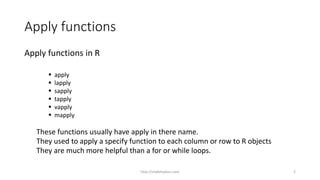
Apply functions in R
 apply
 lapply
 sapply
 tapply
 vapply
 mapply
These functions usually have apply in there name.
They used to apply a specify function to each column or row to R objects
They are much more helpful than a for or while loops.
http://shakthydoss.com 2
Apply functions
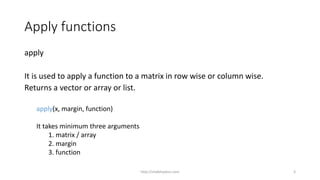
apply
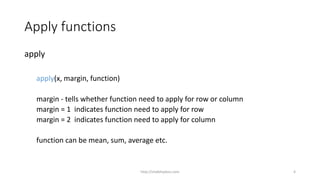
It is used to apply a function to a matrix in row wise or column wise.
Returns a vector or array or list.
apply(x, margin, function)
It takes minimum three arguments
1. matrix / array
2. margin
3. function
http://shakthydoss.com 3
Apply functions
apply
apply(x, margin, function)
margin - tells whether function need to apply for row or column
margin = 1 indicates function need to apply for row
margin = 2 indicates function need to apply for column
function can be mean, sum, average etc.
http://shakthydoss.com 4
Apply functions
apply
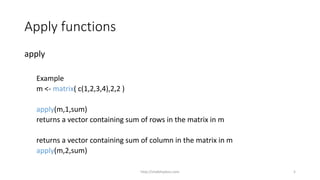
Example
m <- matrix( c(1,2,3,4),2,2 )
apply(m,1,sum)
returns a vector containing sum of rows in the matrix in m
returns a vector containing sum of column in the matrix in m
apply(m,2,sum)
http://shakthydoss.com 5
Apply functions
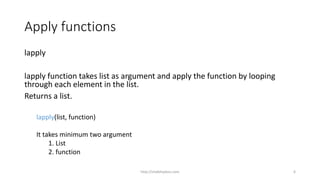
lapply
lapply function takes list as argument and apply the function by looping
through each element in the list.
Returns a list.
lapply(list, function)
It takes minimum two argument
1. List
2. function
http://shakthydoss.com 6
Apply functions
lapply
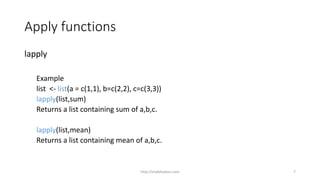
Example
list <- list(a = c(1,1), b=c(2,2), c=c(3,3))
lapply(list,sum)
Returns a list containing sum of a,b,c.
lapply(list,mean)
Returns a list containing mean of a,b,c.
http://shakthydoss.com 7
Apply functions
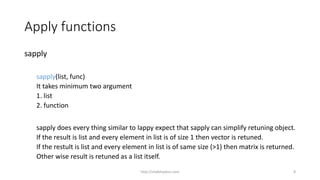
sapply
sapply(list, func)
It takes minimum two argument
1. list
2. function
sapply does every thing similar to lappy expect that sapply can simplify retuning object.
If the result is list and every element in list is of size 1 then vector is retuned.
If the restult is list and every element in list is of same size (>1) then matrix is returned.
Other wise result is retuned as a list itself.
http://shakthydoss.com 8
Apply functions
sapply
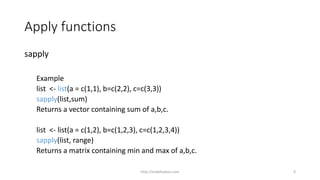
Example
list <- list(a = c(1,1), b=c(2,2), c=c(3,3))
sapply(list,sum)
Returns a vector containing sum of a,b,c.
list <- list(a = c(1,2), b=c(1,2,3), c=c(1,2,3,4))
sapply(list, range)
Returns a matrix containing min and max of a,b,c.
http://shakthydoss.com 9
Apply functions
tapply
tapply works on vector, It apply the function by grouping factors inside
the vector.
tapply(x, factor, fun)
It takes minimum three arguments
1. vector
2. factor of vector
3. function
http://shakthydoss.com 10
Apply functions
tapply
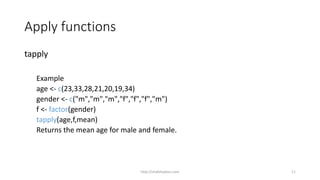
Example
age <- c(23,33,28,21,20,19,34)
gender <- c("m","m","m","f","f","f","m")
f <- factor(gender)
tapply(age,f,mean)
Returns the mean age for male and female.
http://shakthydoss.com 11
Apply functions
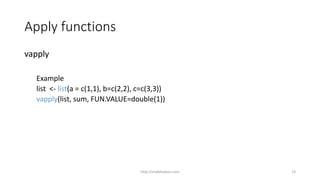
vapply
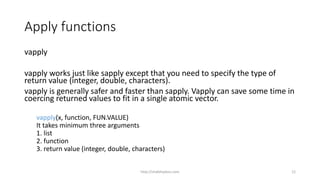
vapply works just like sapply except that you need to specify the type of
return value (integer, double, characters).
vapply is generally safer and faster than sapply. Vapply can save some time in
coercing returned values to fit in a single atomic vector.
vapply(x, function, FUN.VALUE)
It takes minimum three arguments
1. list
2. function
3. return value (integer, double, characters)
http://shakthydoss.com 12
Apply functions
vapply
Example
list <- list(a = c(1,1), b=c(2,2), c=c(3,3))
vapply(list, sum, FUN.VALUE=double(1))
http://shakthydoss.com 13
Apply functions
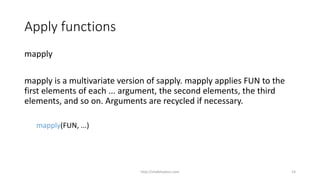
mapply
mapply is a multivariate version of sapply. mapply applies FUN to the
first elements of each ... argument, the second elements, the third
elements, and so on. Arguments are recycled if necessary.
mapply(FUN, ...)
http://shakthydoss.com 14
Apply functions
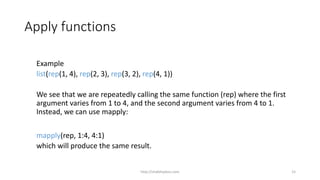
Example
list(rep(1, 4), rep(2, 3), rep(3, 2), rep(4, 1))
We see that we are repeatedly calling the same function (rep) where the first
argument varies from 1 to 4, and the second argument varies from 4 to 1.
Instead, we can use mapply:
mapply(rep, 1:4, 4:1)
which will produce the same result.
http://shakthydoss.com 15
dplyr package
dplyr overview
dplyr is a powerful R-package to transform and summarize tabular data with
rows and columns.
By constraining your options, it simplifies how you can think about common
data manipulation tasks.
It provides simple “verbs”, functions that correspond to the most common data
manipulation tasks, to help you translate those thoughts into code.
It uses efficient data storage backends, so you spend less time waiting for the
computer.
http://shakthydoss.com 16
dplyr package
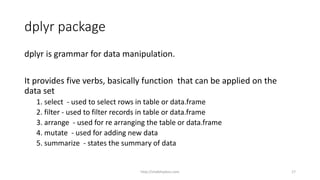
dplyr is grammar for data manipulation.
It provides five verbs, basically function that can be applied on the
data set
1. select - used to select rows in table or data.frame
2. filter - used to filter records in table or data.frame
3. arrange - used for re arranging the table or data.frame
4. mutate - used for adding new data
5. summarize - states the summary of data
http://shakthydoss.com 17
dplyr package
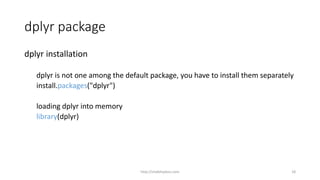
dplyr installation
dplyr is not one among the default package, you have to install them separately
install.packages("dplyr")
loading dplyr into memory
library(dplyr)
http://shakthydoss.com 18
dplyr package
dplyr - Select
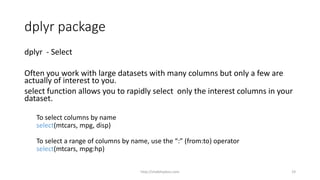
Often you work with large datasets with many columns but only a few are
actually of interest to you.
select function allows you to rapidly select only the interest columns in your
dataset.
To select columns by name
select(mtcars, mpg, disp)
To select a range of columns by name, use the “:” (from:to) operator
select(mtcars, mpg:hp)
http://shakthydoss.com 19
dplyr package
dplyr - Select
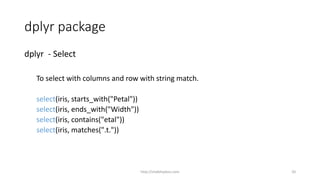
To select with columns and row with string match.
select(iris, starts_with("Petal"))
select(iris, ends_with("Width"))
select(iris, contains("etal"))
select(iris, matches(".t."))
http://shakthydoss.com 20
dplyr package
dplyr - Select
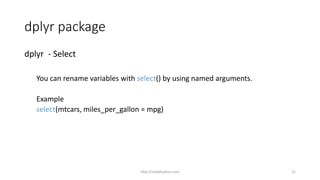
You can rename variables with select() by using named arguments.
Example
select(mtcars, miles_per_gallon = mpg)
http://shakthydoss.com 21
dplyr package
dplyr - filter
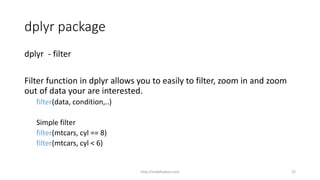
Filter function in dplyr allows you to easily to filter, zoom in and zoom
out of data your are interested.
filter(data, condition,..)
Simple filter
filter(mtcars, cyl == 8)
filter(mtcars, cyl < 6)
http://shakthydoss.com 22
dplyr package
dplyr - filter
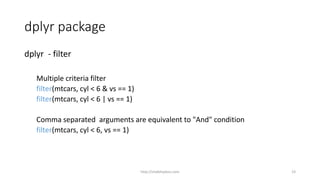
Multiple criteria filter
filter(mtcars, cyl < 6 & vs == 1)
filter(mtcars, cyl < 6 | vs == 1)
Comma separated arguments are equivalent to "And" condition
filter(mtcars, cyl < 6, vs == 1)
http://shakthydoss.com 23
dplyr package
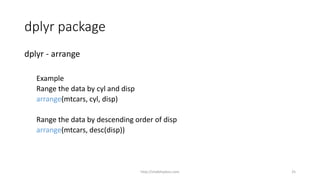
dplyr - arrange
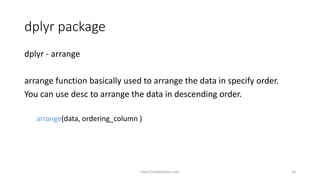
arrange function basically used to arrange the data in specify order.
You can use desc to arrange the data in descending order.
arrange(data, ordering_column )
http://shakthydoss.com 24
dplyr package
dplyr - arrange
Example
Range the data by cyl and disp
arrange(mtcars, cyl, disp)
Range the data by descending order of disp
arrange(mtcars, desc(disp))
http://shakthydoss.com 25
dplyr package
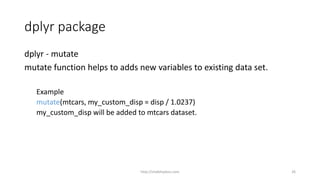
dplyr - mutate
mutate function helps to adds new variables to existing data set.
Example
mutate(mtcars, my_custom_disp = disp / 1.0237)
my_custom_disp will be added to mtcars dataset.
http://shakthydoss.com 26
dplyr package
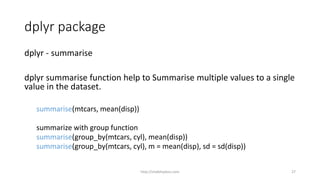
dplyr - summarise
dplyr summarise function help to Summarise multiple values to a single
value in the dataset.
summarise(mtcars, mean(disp))
summarize with group function
summarise(group_by(mtcars, cyl), mean(disp))
summarise(group_by(mtcars, cyl), m = mean(disp), sd = sd(disp))
http://shakthydoss.com 27
dplyr package
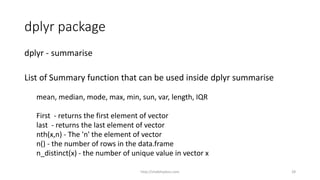
dplyr - summarise
List of Summary function that can be used inside dplyr summarise
mean, median, mode, max, min, sun, var, length, IQR
First - returns the first element of vector
last - returns the last element of vector
nth(x,n) - The 'n' the element of vector
n() - the number of rows in the data.frame
n_distinct(x) - the number of unique value in vector x
http://shakthydoss.com 28
DPLYR & APPLY FUNCTION
Knowledge Check
http://shakthydoss.com 29
DPLYR & APPLY FUNCTION
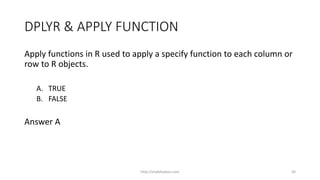
Apply functions in R used to apply a specify function to each column or
row to R objects.
A. TRUE
B. FALSE
Answer A
http://shakthydoss.com 30
DPLYR & APPLY FUNCTION
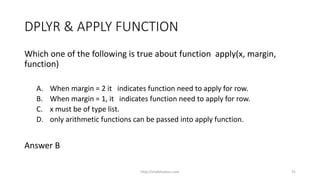
Which one of the following is true about function apply(x, margin,
function)
A. When margin = 2 it indicates function need to apply for row.
B. When margin = 1, it indicates function need to apply for row.
C. x must be of type list.
D. only arithmetic functions can be passed into apply function.
Answer B
http://shakthydoss.com 31
DPLYR & APPLY FUNCTION
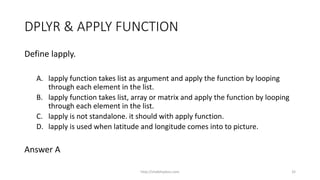
Define lapply.
A. lapply function takes list as argument and apply the function by looping
through each element in the list.
B. lapply function takes list, array or matrix and apply the function by looping
through each element in the list.
C. lapply is not standalone. it should with apply function.
D. lapply is used when latitude and longitude comes into to picture.
Answer A
http://shakthydoss.com 32
DPLYR & APPLY FUNCTION
dplyr is a powerful R-package to transform and summarize tabular data
with rows and columns. It also refered as grammar for data
manipulation.
A. TRUE
B. FALSE
Answer A
http://shakthydoss.com 33
DPLYR & APPLY FUNCTION
How do you rearrange the order of column in data set using dplyr
functions.
A. order_data(data, ordering_column)
B. sort_data(data,ordering_column)
C. dplyr(data,ordering_column)
D. arrange(data, ordering_column)
Answer D
http://shakthydoss.com 34

4 R Tutorial DPLYR Apply Function

  • 1.
    R Programming Sakthi DasanSekar http://shakthydoss.com 1
  • 2.
    Apply functions Apply functionsin R  apply  lapply  sapply  tapply  vapply  mapply These functions usually have apply in there name. They used to apply a specify function to each column or row to R objects They are much more helpful than a for or while loops. http://shakthydoss.com 2
  • 3.
    Apply functions apply It isused to apply a function to a matrix in row wise or column wise. Returns a vector or array or list. apply(x, margin, function) It takes minimum three arguments 1. matrix / array 2. margin 3. function http://shakthydoss.com 3
  • 4.
    Apply functions apply apply(x, margin,function) margin - tells whether function need to apply for row or column margin = 1 indicates function need to apply for row margin = 2 indicates function need to apply for column function can be mean, sum, average etc. http://shakthydoss.com 4
  • 5.
    Apply functions apply Example m <-matrix( c(1,2,3,4),2,2 ) apply(m,1,sum) returns a vector containing sum of rows in the matrix in m returns a vector containing sum of column in the matrix in m apply(m,2,sum) http://shakthydoss.com 5
  • 6.
    Apply functions lapply lapply functiontakes list as argument and apply the function by looping through each element in the list. Returns a list. lapply(list, function) It takes minimum two argument 1. List 2. function http://shakthydoss.com 6
  • 7.
    Apply functions lapply Example list <-list(a = c(1,1), b=c(2,2), c=c(3,3)) lapply(list,sum) Returns a list containing sum of a,b,c. lapply(list,mean) Returns a list containing mean of a,b,c. http://shakthydoss.com 7
  • 8.
    Apply functions sapply sapply(list, func) Ittakes minimum two argument 1. list 2. function sapply does every thing similar to lappy expect that sapply can simplify retuning object. If the result is list and every element in list is of size 1 then vector is retuned. If the restult is list and every element in list is of same size (>1) then matrix is returned. Other wise result is retuned as a list itself. http://shakthydoss.com 8
  • 9.
    Apply functions sapply Example list <-list(a = c(1,1), b=c(2,2), c=c(3,3)) sapply(list,sum) Returns a vector containing sum of a,b,c. list <- list(a = c(1,2), b=c(1,2,3), c=c(1,2,3,4)) sapply(list, range) Returns a matrix containing min and max of a,b,c. http://shakthydoss.com 9
  • 10.
    Apply functions tapply tapply workson vector, It apply the function by grouping factors inside the vector. tapply(x, factor, fun) It takes minimum three arguments 1. vector 2. factor of vector 3. function http://shakthydoss.com 10
  • 11.
    Apply functions tapply Example age <-c(23,33,28,21,20,19,34) gender <- c("m","m","m","f","f","f","m") f <- factor(gender) tapply(age,f,mean) Returns the mean age for male and female. http://shakthydoss.com 11
  • 12.
    Apply functions vapply vapply worksjust like sapply except that you need to specify the type of return value (integer, double, characters). vapply is generally safer and faster than sapply. Vapply can save some time in coercing returned values to fit in a single atomic vector. vapply(x, function, FUN.VALUE) It takes minimum three arguments 1. list 2. function 3. return value (integer, double, characters) http://shakthydoss.com 12
  • 13.
    Apply functions vapply Example list <-list(a = c(1,1), b=c(2,2), c=c(3,3)) vapply(list, sum, FUN.VALUE=double(1)) http://shakthydoss.com 13
  • 14.
    Apply functions mapply mapply isa multivariate version of sapply. mapply applies FUN to the first elements of each ... argument, the second elements, the third elements, and so on. Arguments are recycled if necessary. mapply(FUN, ...) http://shakthydoss.com 14
  • 15.
    Apply functions Example list(rep(1, 4),rep(2, 3), rep(3, 2), rep(4, 1)) We see that we are repeatedly calling the same function (rep) where the first argument varies from 1 to 4, and the second argument varies from 4 to 1. Instead, we can use mapply: mapply(rep, 1:4, 4:1) which will produce the same result. http://shakthydoss.com 15
  • 16.
    dplyr package dplyr overview dplyris a powerful R-package to transform and summarize tabular data with rows and columns. By constraining your options, it simplifies how you can think about common data manipulation tasks. It provides simple “verbs”, functions that correspond to the most common data manipulation tasks, to help you translate those thoughts into code. It uses efficient data storage backends, so you spend less time waiting for the computer. http://shakthydoss.com 16
  • 17.
    dplyr package dplyr isgrammar for data manipulation. It provides five verbs, basically function that can be applied on the data set 1. select - used to select rows in table or data.frame 2. filter - used to filter records in table or data.frame 3. arrange - used for re arranging the table or data.frame 4. mutate - used for adding new data 5. summarize - states the summary of data http://shakthydoss.com 17
  • 18.
    dplyr package dplyr installation dplyris not one among the default package, you have to install them separately install.packages("dplyr") loading dplyr into memory library(dplyr) http://shakthydoss.com 18
  • 19.
    dplyr package dplyr -Select Often you work with large datasets with many columns but only a few are actually of interest to you. select function allows you to rapidly select only the interest columns in your dataset. To select columns by name select(mtcars, mpg, disp) To select a range of columns by name, use the “:” (from:to) operator select(mtcars, mpg:hp) http://shakthydoss.com 19
  • 20.
    dplyr package dplyr -Select To select with columns and row with string match. select(iris, starts_with("Petal")) select(iris, ends_with("Width")) select(iris, contains("etal")) select(iris, matches(".t.")) http://shakthydoss.com 20
  • 21.
    dplyr package dplyr -Select You can rename variables with select() by using named arguments. Example select(mtcars, miles_per_gallon = mpg) http://shakthydoss.com 21
  • 22.
    dplyr package dplyr -filter Filter function in dplyr allows you to easily to filter, zoom in and zoom out of data your are interested. filter(data, condition,..) Simple filter filter(mtcars, cyl == 8) filter(mtcars, cyl < 6) http://shakthydoss.com 22
  • 23.
    dplyr package dplyr -filter Multiple criteria filter filter(mtcars, cyl < 6 & vs == 1) filter(mtcars, cyl < 6 | vs == 1) Comma separated arguments are equivalent to "And" condition filter(mtcars, cyl < 6, vs == 1) http://shakthydoss.com 23
  • 24.
    dplyr package dplyr -arrange arrange function basically used to arrange the data in specify order. You can use desc to arrange the data in descending order. arrange(data, ordering_column ) http://shakthydoss.com 24
  • 25.
    dplyr package dplyr -arrange Example Range the data by cyl and disp arrange(mtcars, cyl, disp) Range the data by descending order of disp arrange(mtcars, desc(disp)) http://shakthydoss.com 25
  • 26.
    dplyr package dplyr -mutate mutate function helps to adds new variables to existing data set. Example mutate(mtcars, my_custom_disp = disp / 1.0237) my_custom_disp will be added to mtcars dataset. http://shakthydoss.com 26
  • 27.
    dplyr package dplyr -summarise dplyr summarise function help to Summarise multiple values to a single value in the dataset. summarise(mtcars, mean(disp)) summarize with group function summarise(group_by(mtcars, cyl), mean(disp)) summarise(group_by(mtcars, cyl), m = mean(disp), sd = sd(disp)) http://shakthydoss.com 27
  • 28.
    dplyr package dplyr -summarise List of Summary function that can be used inside dplyr summarise mean, median, mode, max, min, sun, var, length, IQR First - returns the first element of vector last - returns the last element of vector nth(x,n) - The 'n' the element of vector n() - the number of rows in the data.frame n_distinct(x) - the number of unique value in vector x http://shakthydoss.com 28
  • 29.
    DPLYR & APPLYFUNCTION Knowledge Check http://shakthydoss.com 29
  • 30.
    DPLYR & APPLYFUNCTION Apply functions in R used to apply a specify function to each column or row to R objects. A. TRUE B. FALSE Answer A http://shakthydoss.com 30
  • 31.
    DPLYR & APPLYFUNCTION Which one of the following is true about function apply(x, margin, function) A. When margin = 2 it indicates function need to apply for row. B. When margin = 1, it indicates function need to apply for row. C. x must be of type list. D. only arithmetic functions can be passed into apply function. Answer B http://shakthydoss.com 31
  • 32.
    DPLYR & APPLYFUNCTION Define lapply. A. lapply function takes list as argument and apply the function by looping through each element in the list. B. lapply function takes list, array or matrix and apply the function by looping through each element in the list. C. lapply is not standalone. it should with apply function. D. lapply is used when latitude and longitude comes into to picture. Answer A http://shakthydoss.com 32
  • 33.
    DPLYR & APPLYFUNCTION dplyr is a powerful R-package to transform and summarize tabular data with rows and columns. It also refered as grammar for data manipulation. A. TRUE B. FALSE Answer A http://shakthydoss.com 33
  • 34.
    DPLYR & APPLYFUNCTION How do you rearrange the order of column in data set using dplyr functions. A. order_data(data, ordering_column) B. sort_data(data,ordering_column) C. dplyr(data,ordering_column) D. arrange(data, ordering_column) Answer D http://shakthydoss.com 34