A Homomorphism-based Framework for
Systematic Parallel Programming with MapReduce
Yu Liu1, Zhenjiang Hu2
1 The Graduate University for Advanced Studies,Tokyo, Japan
yuliu@nii.ac.jp
2 National Institute of Informatics,Tokyo, Japan
2 hu@nii.ac.jp
Mar. 10th, 2011
Yu Liu1
, Zhenjiang Hu2
A Homomorphism-based Framework for Systematic Parallel Progr
Background
MapReduce
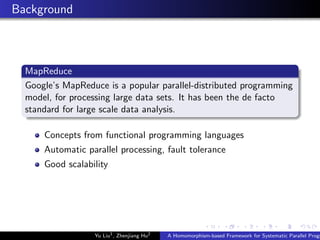
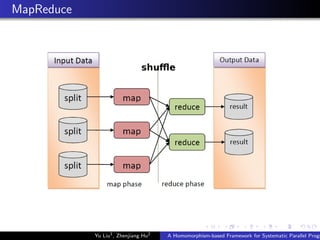
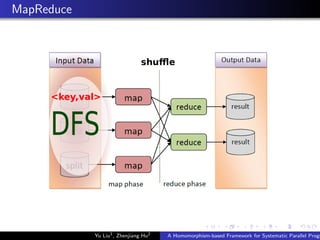
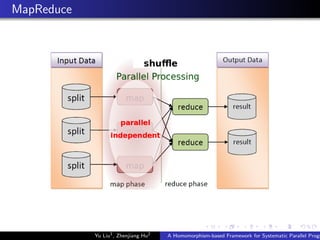
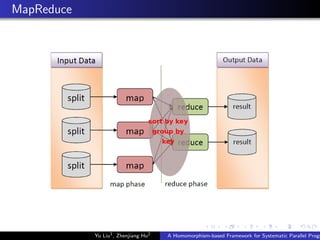
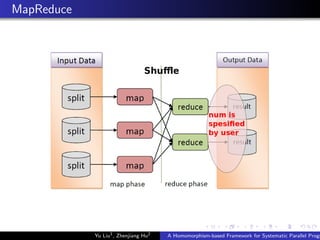
Google’s MapReduce is a popular parallel-distributed programming
model, for processing large data sets. It has been the de facto
standard for large scale data analysis.
Concepts from functional programming languages
Automatic parallel processing, fault tolerance
Good scalability
Yu Liu1
, Zhenjiang Hu2
A Homomorphism-based Framework for Systematic Parallel Progr
MapReduce
Yu Liu1
, Zhenjiang Hu2
A Homomorphism-based Framework for Systematic Parallel Progr
MapReduce
Yu Liu1
, Zhenjiang Hu2
A Homomorphism-based Framework for Systematic Parallel Progr
MapReduce
Yu Liu1
, Zhenjiang Hu2
A Homomorphism-based Framework for Systematic Parallel Progr
MapReduce
Yu Liu1
, Zhenjiang Hu2
A Homomorphism-based Framework for Systematic Parallel Progr
MapReduce
Yu Liu1
, Zhenjiang Hu2
A Homomorphism-based Framework for Systematic Parallel Progr
Programming with MapReduce
A user has to
design a D&C algorithm that fits MapReduce paradigm
map this algorithm to MapReduce.
Yu Liu1
, Zhenjiang Hu2
A Homomorphism-based Framework for Systematic Parallel Progr
Programming with MapReduce
A user has to
design a D&C algorithm that fits MapReduce paradigm
map this algorithm to MapReduce.
Difficulties of programming with MapReduce
How to resolve the constrains on computing order.
How to resolve the data dependency.
Yu Liu1
, Zhenjiang Hu2
A Homomorphism-based Framework for Systematic Parallel Progr
Example
The Maximum Prefix Sum problem
mps [3, −1, 4, −1, −5, 9, 2, −6, 5, −10] = 11
A sequential program for MPS in O(n) time
Yu Liu1
, Zhenjiang Hu2
A Homomorphism-based Framework for Systematic Parallel Progr
Example
The Maximum Prefix Sum problem
mps [3, −1, 4, −1, −5, 9, 2, −6, 5, −10] = 11
Hard to compute MPS with MapReduce
Computation has order.
MPS of sub-lists cannot be conquered directly.
Yu Liu1
, Zhenjiang Hu2
A Homomorphism-based Framework for Systematic Parallel Progr
Questions
Is there a systematic way to resolving such problems with
MapReduce ?
How to handle the problems with district order ?
Yu Liu1
, Zhenjiang Hu2
A Homomorphism-based Framework for Systematic Parallel Progr
Questions
Is there a systematic way to resolving such problems with
MapReduce ?
How to handle the problems with district order ?
How to systematically design the divide-and-conquer
algorithm ?
Yu Liu1
, Zhenjiang Hu2
A Homomorphism-based Framework for Systematic Parallel Progr
Motivation and objective
We propose a systematic approach to automatically generate fully
parallelized and scalable MapReduce programs.
A new framework which provides algorithmic programming
interfaces has been implemented.
Yu Liu1
, Zhenjiang Hu2
A Homomorphism-based Framework for Systematic Parallel Progr
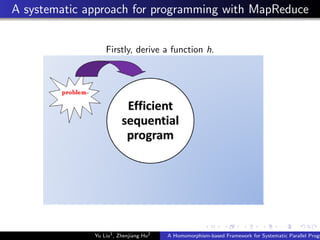
A systematic approach for programming with MapReduce
Firstly, derive a function h.
Yu Liu1
, Zhenjiang Hu2
A Homomorphism-based Framework for Systematic Parallel Progr
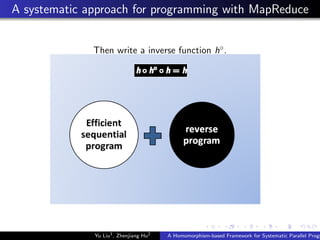
A systematic approach for programming with MapReduce
Then write a inverse function h◦.
Yu Liu1
, Zhenjiang Hu2
A Homomorphism-based Framework for Systematic Parallel Progr
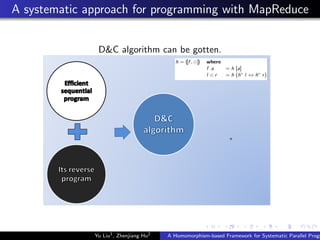
A systematic approach for programming with MapReduce
D&C algorithm can be gotten.
Yu Liu1
, Zhenjiang Hu2
A Homomorphism-based Framework for Systematic Parallel Progr
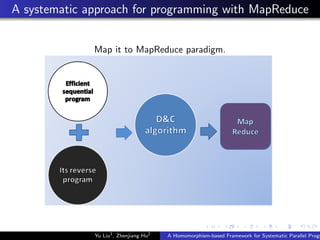
A systematic approach for programming with MapReduce
Map it to MapReduce paradigm.
Yu Liu1
, Zhenjiang Hu2
A Homomorphism-based Framework for Systematic Parallel Progr
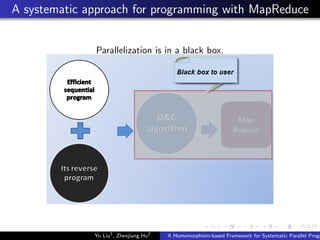
A systematic approach for programming with MapReduce
Parallelization is in a black box.
Yu Liu1
, Zhenjiang Hu2
A Homomorphism-based Framework for Systematic Parallel Progr
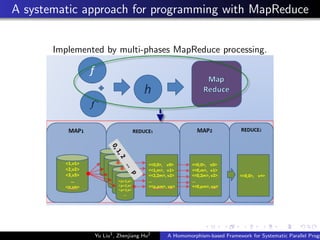
A systematic approach for programming with MapReduce
Implemented by multi-phases MapReduce processing.
Yu Liu1
, Zhenjiang Hu2
A Homomorphism-based Framework for Systematic Parallel Progr
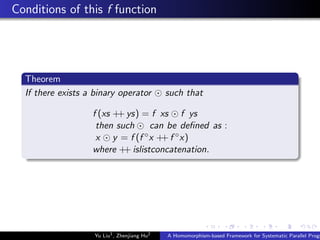
Conditions of this f function
Theorem
If there exists a binary operator such that
f (xs ++ ys) = f xs f ys
then such can be defined as :
x y = f (f ◦x ++ f ◦x)
where ++ islistconcatenation.
Yu Liu1
, Zhenjiang Hu2
A Homomorphism-based Framework for Systematic Parallel Progr
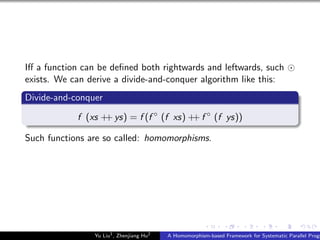
Iff a function can be defined both rightwards and leftwards, such
exists. We can derive a divide-and-conquer algorithm like this:
Divide-and-conquer
f (xs ++ ys) = f (f ◦
(f xs) ++ f ◦
(f ys))
Such functions are so called: homomorphisms.
Yu Liu1
, Zhenjiang Hu2
A Homomorphism-based Framework for Systematic Parallel Progr
Programming Interface
Fold and unfold
fold :: [α] → β
unfold :: β → [α].
The implementation in Java
Yu Liu1
, Zhenjiang Hu2
A Homomorphism-based Framework for Systematic Parallel Progr
A function which computes MPS and its right inverse can be
written as followings:
fold xs = mps sum xs
unfold (m, s) = [m, s − m]
Yu Liu1
, Zhenjiang Hu2
A Homomorphism-based Framework for Systematic Parallel Progr
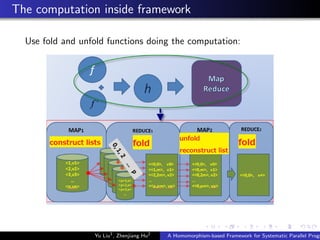
The computation inside framework
Use fold and unfold functions doing the computation:
Yu Liu1
, Zhenjiang Hu2
A Homomorphism-based Framework for Systematic Parallel Progr
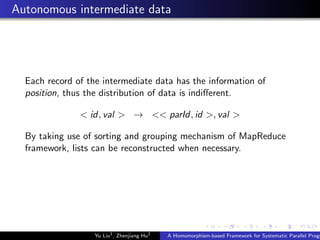
Autonomous intermediate data
Each record of the intermediate data has the information of
position, thus the distribution of data is indifferent.
< id, val > → << parId, id >, val >
By taking use of sorting and grouping mechanism of MapReduce
framework, lists can be reconstructed when necessary.
Yu Liu1
, Zhenjiang Hu2
A Homomorphism-based Framework for Systematic Parallel Progr
A formal definitation
homMR
homMR :: (α → β) → (β → β → β) → {(ID, α)} → β
homMR f (⊕) = getValue ◦ MapReduce mapper2 reducer2
◦ MapReduce mapper1 reducer1
where
mapper1 :: (ID, α) → [((PID, ID), α)]
mapper1 (i, a) = [(pid, i), a))]
where pid = makePid i
reducer1 :: ((PID, ID), [α]) → ((PID, ID), β)
reducer1 ((pid, j), ias) = ((pid, j), hom f (⊕) ias)
Yu Liu1
, Zhenjiang Hu2
A Homomorphism-based Framework for Systematic Parallel Progr
continued
mapper2 :: ((PID, ID), β) → ((PID, ID), β)
mapper2 ((pid, j), b) = ((c0, j), b)
where c0 is a predefined constant pid
reducer2 :: ((PID, ID), [β]) → ((PID, ID), β)
reducer2 ((c0, k), jbs) = ((c0, k), hom f (⊕) jbs)
getValue :: ((PID, ID), β) → β
getValue ((c0, k), c) = c
Where, hom f (⊕) denotes a sequential version of ([f , ⊕]).
Yu Liu1
, Zhenjiang Hu2
A Homomorphism-based Framework for Systematic Parallel Progr
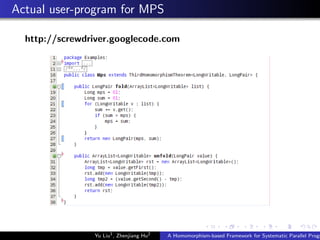
Actual user-program for MPS
http://screwdriver.googlecode.com
Yu Liu1
, Zhenjiang Hu2
A Homomorphism-based Framework for Systematic Parallel Progr
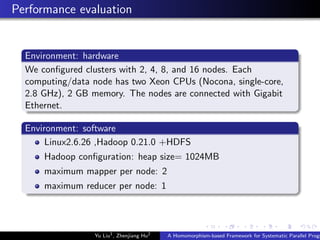
Performance evaluation
Environment: hardware
We configured clusters with 2, 4, 8, and 16 nodes. Each
computing/data node has two Xeon CPUs (Nocona, single-core,
2.8 GHz), 2 GB memory. The nodes are connected with Gigabit
Ethernet.
Environment: software
Linux2.6.26 ,Hadoop 0.21.0 +HDFS
Hadoop configuration: heap size= 1024MB
maximum mapper per node: 2
maximum reducer per node: 1
Yu Liu1
, Zhenjiang Hu2
A Homomorphism-based Framework for Systematic Parallel Progr
Test cases
We implemented several programs for three problems on our
framework and Hadoop:
1 the maximum-prefix-sum problem.
MPS-lh is implemented using our framework’ API.
MPS-mr is implemented by Hadoop API.
2 parallel sum of 64-bit integers
SUM-lh is implemented by our framework’ API.
SUM-mr is implemented by Hadoop API.
3 VAR-lh computes the variance of 32-bit floating-point
numbers;
Yu Liu1
, Zhenjiang Hu2
A Homomorphism-based Framework for Systematic Parallel Progr
Test cases
Test data
100 million 64-bit integers (2.87 GB) for MPS, SUM.
100 million 32-bit floating-point numbers (2.76 GB) for VAR.
Yu Liu1
, Zhenjiang Hu2
A Homomorphism-based Framework for Systematic Parallel Progr
Performance
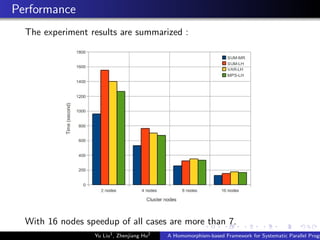
The experiment results are summarized :
With 16 nodes speedup of all cases are more than 7.
Yu Liu1
, Zhenjiang Hu2
A Homomorphism-based Framework for Systematic Parallel Progr
Performance
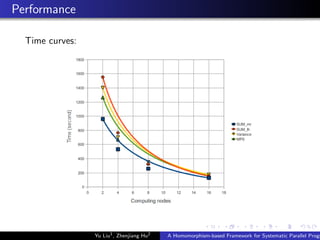
Time curves:
Yu Liu1
, Zhenjiang Hu2
A Homomorphism-based Framework for Systematic Parallel Progr
Concluding remarks
In this research:
Introduced a systematic way of parallel programming on
MapReduce.
Yu Liu1
, Zhenjiang Hu2
A Homomorphism-based Framework for Systematic Parallel Progr
Concluding remarks
In this research:
Introduced a systematic way of parallel programming on
MapReduce.
Developed a framework on top of Hadoop.
Yu Liu1
, Zhenjiang Hu2
A Homomorphism-based Framework for Systematic Parallel Progr
Concluding remarks
In this research:
Introduced a systematic way of parallel programming on
MapReduce.
Developed a framework on top of Hadoop.
Algorithmic programming interfaces let user can focus on the
algebraic properties of problem.
Yu Liu1
, Zhenjiang Hu2
A Homomorphism-based Framework for Systematic Parallel Progr
Concluding remarks
In this research:
Introduced a systematic way of parallel programming on
MapReduce.
Developed a framework on top of Hadoop.
Algorithmic programming interfaces let user can focus on the
algebraic properties of problem.
Details of MapReduce are hidden.
Yu Liu1
, Zhenjiang Hu2
A Homomorphism-based Framework for Systematic Parallel Progr
Concluding remarks
In this research:
Introduced a systematic way of parallel programming on
MapReduce.
Developed a framework on top of Hadoop.
Algorithmic programming interfaces let user can focus on the
algebraic properties of problem.
Details of MapReduce are hidden.
Achieved good scalability and parallelism.
Yu Liu1
, Zhenjiang Hu2
A Homomorphism-based Framework for Systematic Parallel Progr
Concluding remarks
In this research:
Introduced a systematic way of parallel programming on
MapReduce.
Developed a framework on top of Hadoop.
Algorithmic programming interfaces let user can focus on the
algebraic properties of problem.
Details of MapReduce are hidden.
Achieved good scalability and parallelism.
Automatic optimization can be equipped.
Yu Liu1
, Zhenjiang Hu2
A Homomorphism-based Framework for Systematic Parallel Progr
Future work
Decrease the system overhead and do more optimization.
Extend to more complex data structure such as tree and
graph.
Yu Liu1
, Zhenjiang Hu2
A Homomorphism-based Framework for Systematic Parallel Progr
Related work
Parallel programming with list homomorphisms (M.Cole 95)
The Third Homomorphism Theorem(J.Gibbons 96).
Systematic extraction and implementation of
divide-and-conquer parallelism (Gorlatch PLILP96).
Automatic inversion generates divide-and-conquer parallel
programs(Morita et.al., PLDI07).
The third homomorphism theorem on trees: downward &
upward lead to divide-and-conquer (Morihata, POPL09)
Yu Liu1
, Zhenjiang Hu2
A Homomorphism-based Framework for Systematic Parallel Progr
Thank you very much.
Questions?
Yu Liu1
, Zhenjiang Hu2
A Homomorphism-based Framework for Systematic Parallel Progr
List Homomorphism
Function h is said to be a list homomorphism
If there are a function f and an associative operator such that
for any list x and list y
h [a] = f a
h (x ++ y) = h(x) h(y).
Where ++ is the list concatenation.
Instance of a list homomorphism
sum [a] = a
sum (x ++ y) = sum x + sum y.
Yu Liu1
, Zhenjiang Hu2
A Homomorphism-based Framework for Systematic Parallel Progr
Theorem (The Third Homomorphism Theorem (Gibbons,96) )
Let h be a given function and and be binary operators. If the
following two equations hold for any element a and list y
h ([a] ++ y) = a h y
h (y ++ [a]) = h y a
then the function h is a homomorphism.
In fact, for a function h, if we have one of its right inverse h◦ that
satisfies h ◦ h◦ ◦ h = h, then we can obtain the list-homomorphic
definition as follows.
h = ([f , ]) where
f a = h [a]
l r = h (h◦ l ++ h◦ r)
Yu Liu1
, Zhenjiang Hu2
A Homomorphism-based Framework for Systematic Parallel Progr
MapReduce programs can be automatically obtained by
two sequential functions
homomorphism ([f , ⊕])
f :: a → b
⊕ :: b → b → b
(a ⊕ b) ⊕ c = a ⊕ (b ⊕ c).
fold and unfold, that compose leftwards and rightwards functions
fold([a] ++ x) = fold([a] ++ unfold(fold(x)))
fold(x ++ [a]) = fold(unfold(fold(x)) ++ [a]).
Yu Liu1
, Zhenjiang Hu2
A Homomorphism-based Framework for Systematic Parallel Progr
Currently, Screwdriver provides two kinds of programming
interfaces:
Programming interface corresponding to definition of list
homomorphism;
Programming interface corresponding to the 3rd
homomorphism theorem.
Yu Liu1
, Zhenjiang Hu2
A Homomorphism-based Framework for Systematic Parallel Progr
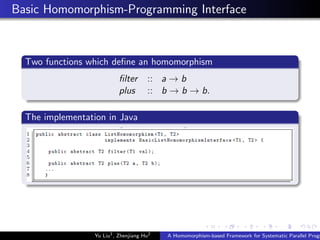
Basic Homomorphism-Programming Interface
Two functions which define an homomorphism
filter :: a → b
plus :: b → b → b.
The implementation in Java
Yu Liu1
, Zhenjiang Hu2
A Homomorphism-based Framework for Systematic Parallel Progr
Programming Interface based on the 3rd homomorphism
theorem
A function and its right inverse
fold :: [a] → b
unfold :: b → [a].
The implementation in Java
Yu Liu1
, Zhenjiang Hu2
A Homomorphism-based Framework for Systematic Parallel Progr
The implementation of Screwdriver : list representation
To implement our programming interface with Hadoop, we need to
consider how to represent lists in a distributed manner.
Input data: index-value pairs
We use integer as the index’s type, the list [a, b, c, d, e] is
represented by {(3, d), (1, b), (2, c), (0, a), (4, e)}.
Yu Liu1
, Zhenjiang Hu2
A Homomorphism-based Framework for Systematic Parallel Progr
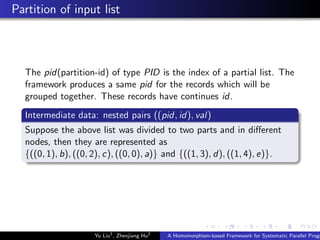
Partition of input list
The pid(partition-id) of type PID is the index of a partial list. The
framework produces a same pid for the records which will be
grouped together. These records have continues id.
Intermediate data: nested pairs ((pid, id), val)
Suppose the above list was divided to two parts and in different
nodes, then they are represented as
{((0, 1), b), ((0, 2), c), ((0, 0), a)} and {((1, 3), d), ((1, 4), e)}.
Yu Liu1
, Zhenjiang Hu2
A Homomorphism-based Framework for Systematic Parallel Progr
Grouping and sorting of intermediate data
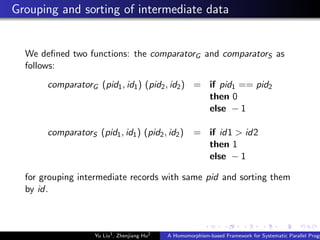
We defined two functions: the comparatorG and comparatorS as
follows:
comparatorG (pid1, id1) (pid2, id2) = if pid1 == pid2
then 0
else − 1
comparatorS (pid1, id1) (pid2, id2) = if id1 > id2
then 1
else − 1
for grouping intermediate records with same pid and sorting them
by id.
Yu Liu1
, Zhenjiang Hu2
A Homomorphism-based Framework for Systematic Parallel Progr
Data partition
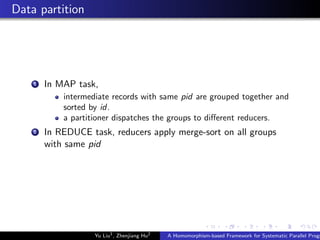
1 In MAP task,
intermediate records with same pid are grouped together and
sorted by id.
a partitioner dispatches the groups to different reducers.
2 In REDUCE task, reducers apply merge-sort on all groups
with same pid
Yu Liu1
, Zhenjiang Hu2
A Homomorphism-based Framework for Systematic Parallel Progr

A Homomorphism-based Framework for Systematic Parallel Programming with MapReduce

  • 1.
    A Homomorphism-based Frameworkfor Systematic Parallel Programming with MapReduce Yu Liu1, Zhenjiang Hu2 1 The Graduate University for Advanced Studies,Tokyo, Japan yuliu@nii.ac.jp 2 National Institute of Informatics,Tokyo, Japan 2 hu@nii.ac.jp Mar. 10th, 2011 Yu Liu1 , Zhenjiang Hu2 A Homomorphism-based Framework for Systematic Parallel Progr
  • 2.
    Background MapReduce Google’s MapReduce isa popular parallel-distributed programming model, for processing large data sets. It has been the de facto standard for large scale data analysis. Concepts from functional programming languages Automatic parallel processing, fault tolerance Good scalability Yu Liu1 , Zhenjiang Hu2 A Homomorphism-based Framework for Systematic Parallel Progr
  • 3.
    MapReduce Yu Liu1 , ZhenjiangHu2 A Homomorphism-based Framework for Systematic Parallel Progr
  • 4.
    MapReduce Yu Liu1 , ZhenjiangHu2 A Homomorphism-based Framework for Systematic Parallel Progr
  • 5.
    MapReduce Yu Liu1 , ZhenjiangHu2 A Homomorphism-based Framework for Systematic Parallel Progr
  • 6.
    MapReduce Yu Liu1 , ZhenjiangHu2 A Homomorphism-based Framework for Systematic Parallel Progr
  • 7.
    MapReduce Yu Liu1 , ZhenjiangHu2 A Homomorphism-based Framework for Systematic Parallel Progr
  • 8.
    Programming with MapReduce Auser has to design a D&C algorithm that fits MapReduce paradigm map this algorithm to MapReduce. Yu Liu1 , Zhenjiang Hu2 A Homomorphism-based Framework for Systematic Parallel Progr
  • 9.
    Programming with MapReduce Auser has to design a D&C algorithm that fits MapReduce paradigm map this algorithm to MapReduce. Difficulties of programming with MapReduce How to resolve the constrains on computing order. How to resolve the data dependency. Yu Liu1 , Zhenjiang Hu2 A Homomorphism-based Framework for Systematic Parallel Progr
  • 10.
    Example The Maximum PrefixSum problem mps [3, −1, 4, −1, −5, 9, 2, −6, 5, −10] = 11 A sequential program for MPS in O(n) time Yu Liu1 , Zhenjiang Hu2 A Homomorphism-based Framework for Systematic Parallel Progr
  • 11.
    Example The Maximum PrefixSum problem mps [3, −1, 4, −1, −5, 9, 2, −6, 5, −10] = 11 Hard to compute MPS with MapReduce Computation has order. MPS of sub-lists cannot be conquered directly. Yu Liu1 , Zhenjiang Hu2 A Homomorphism-based Framework for Systematic Parallel Progr
  • 12.
    Questions Is there asystematic way to resolving such problems with MapReduce ? How to handle the problems with district order ? Yu Liu1 , Zhenjiang Hu2 A Homomorphism-based Framework for Systematic Parallel Progr
  • 13.
    Questions Is there asystematic way to resolving such problems with MapReduce ? How to handle the problems with district order ? How to systematically design the divide-and-conquer algorithm ? Yu Liu1 , Zhenjiang Hu2 A Homomorphism-based Framework for Systematic Parallel Progr
  • 14.
    Motivation and objective Wepropose a systematic approach to automatically generate fully parallelized and scalable MapReduce programs. A new framework which provides algorithmic programming interfaces has been implemented. Yu Liu1 , Zhenjiang Hu2 A Homomorphism-based Framework for Systematic Parallel Progr
  • 15.
    A systematic approachfor programming with MapReduce Firstly, derive a function h. Yu Liu1 , Zhenjiang Hu2 A Homomorphism-based Framework for Systematic Parallel Progr
  • 16.
    A systematic approachfor programming with MapReduce Then write a inverse function h◦. Yu Liu1 , Zhenjiang Hu2 A Homomorphism-based Framework for Systematic Parallel Progr
  • 17.
    A systematic approachfor programming with MapReduce D&C algorithm can be gotten. Yu Liu1 , Zhenjiang Hu2 A Homomorphism-based Framework for Systematic Parallel Progr
  • 18.
    A systematic approachfor programming with MapReduce Map it to MapReduce paradigm. Yu Liu1 , Zhenjiang Hu2 A Homomorphism-based Framework for Systematic Parallel Progr
  • 19.
    A systematic approachfor programming with MapReduce Parallelization is in a black box. Yu Liu1 , Zhenjiang Hu2 A Homomorphism-based Framework for Systematic Parallel Progr
  • 20.
    A systematic approachfor programming with MapReduce Implemented by multi-phases MapReduce processing. Yu Liu1 , Zhenjiang Hu2 A Homomorphism-based Framework for Systematic Parallel Progr
  • 21.
    Conditions of thisf function Theorem If there exists a binary operator such that f (xs ++ ys) = f xs f ys then such can be defined as : x y = f (f ◦x ++ f ◦x) where ++ islistconcatenation. Yu Liu1 , Zhenjiang Hu2 A Homomorphism-based Framework for Systematic Parallel Progr
  • 22.
    Iff a functioncan be defined both rightwards and leftwards, such exists. We can derive a divide-and-conquer algorithm like this: Divide-and-conquer f (xs ++ ys) = f (f ◦ (f xs) ++ f ◦ (f ys)) Such functions are so called: homomorphisms. Yu Liu1 , Zhenjiang Hu2 A Homomorphism-based Framework for Systematic Parallel Progr
  • 23.
    Programming Interface Fold andunfold fold :: [α] → β unfold :: β → [α]. The implementation in Java Yu Liu1 , Zhenjiang Hu2 A Homomorphism-based Framework for Systematic Parallel Progr
  • 24.
    A function whichcomputes MPS and its right inverse can be written as followings: fold xs = mps sum xs unfold (m, s) = [m, s − m] Yu Liu1 , Zhenjiang Hu2 A Homomorphism-based Framework for Systematic Parallel Progr
  • 25.
    The computation insideframework Use fold and unfold functions doing the computation: Yu Liu1 , Zhenjiang Hu2 A Homomorphism-based Framework for Systematic Parallel Progr
  • 26.
    Autonomous intermediate data Eachrecord of the intermediate data has the information of position, thus the distribution of data is indifferent. < id, val > → << parId, id >, val > By taking use of sorting and grouping mechanism of MapReduce framework, lists can be reconstructed when necessary. Yu Liu1 , Zhenjiang Hu2 A Homomorphism-based Framework for Systematic Parallel Progr
  • 27.
    A formal definitation homMR homMR:: (α → β) → (β → β → β) → {(ID, α)} → β homMR f (⊕) = getValue ◦ MapReduce mapper2 reducer2 ◦ MapReduce mapper1 reducer1 where mapper1 :: (ID, α) → [((PID, ID), α)] mapper1 (i, a) = [(pid, i), a))] where pid = makePid i reducer1 :: ((PID, ID), [α]) → ((PID, ID), β) reducer1 ((pid, j), ias) = ((pid, j), hom f (⊕) ias) Yu Liu1 , Zhenjiang Hu2 A Homomorphism-based Framework for Systematic Parallel Progr
  • 28.
    continued mapper2 :: ((PID,ID), β) → ((PID, ID), β) mapper2 ((pid, j), b) = ((c0, j), b) where c0 is a predefined constant pid reducer2 :: ((PID, ID), [β]) → ((PID, ID), β) reducer2 ((c0, k), jbs) = ((c0, k), hom f (⊕) jbs) getValue :: ((PID, ID), β) → β getValue ((c0, k), c) = c Where, hom f (⊕) denotes a sequential version of ([f , ⊕]). Yu Liu1 , Zhenjiang Hu2 A Homomorphism-based Framework for Systematic Parallel Progr
  • 29.
    Actual user-program forMPS http://screwdriver.googlecode.com Yu Liu1 , Zhenjiang Hu2 A Homomorphism-based Framework for Systematic Parallel Progr
  • 30.
    Performance evaluation Environment: hardware Weconfigured clusters with 2, 4, 8, and 16 nodes. Each computing/data node has two Xeon CPUs (Nocona, single-core, 2.8 GHz), 2 GB memory. The nodes are connected with Gigabit Ethernet. Environment: software Linux2.6.26 ,Hadoop 0.21.0 +HDFS Hadoop configuration: heap size= 1024MB maximum mapper per node: 2 maximum reducer per node: 1 Yu Liu1 , Zhenjiang Hu2 A Homomorphism-based Framework for Systematic Parallel Progr
  • 31.
    Test cases We implementedseveral programs for three problems on our framework and Hadoop: 1 the maximum-prefix-sum problem. MPS-lh is implemented using our framework’ API. MPS-mr is implemented by Hadoop API. 2 parallel sum of 64-bit integers SUM-lh is implemented by our framework’ API. SUM-mr is implemented by Hadoop API. 3 VAR-lh computes the variance of 32-bit floating-point numbers; Yu Liu1 , Zhenjiang Hu2 A Homomorphism-based Framework for Systematic Parallel Progr
  • 32.
    Test cases Test data 100million 64-bit integers (2.87 GB) for MPS, SUM. 100 million 32-bit floating-point numbers (2.76 GB) for VAR. Yu Liu1 , Zhenjiang Hu2 A Homomorphism-based Framework for Systematic Parallel Progr
  • 33.
    Performance The experiment resultsare summarized : With 16 nodes speedup of all cases are more than 7. Yu Liu1 , Zhenjiang Hu2 A Homomorphism-based Framework for Systematic Parallel Progr
  • 34.
    Performance Time curves: Yu Liu1 ,Zhenjiang Hu2 A Homomorphism-based Framework for Systematic Parallel Progr
  • 35.
    Concluding remarks In thisresearch: Introduced a systematic way of parallel programming on MapReduce. Yu Liu1 , Zhenjiang Hu2 A Homomorphism-based Framework for Systematic Parallel Progr
  • 36.
    Concluding remarks In thisresearch: Introduced a systematic way of parallel programming on MapReduce. Developed a framework on top of Hadoop. Yu Liu1 , Zhenjiang Hu2 A Homomorphism-based Framework for Systematic Parallel Progr
  • 37.
    Concluding remarks In thisresearch: Introduced a systematic way of parallel programming on MapReduce. Developed a framework on top of Hadoop. Algorithmic programming interfaces let user can focus on the algebraic properties of problem. Yu Liu1 , Zhenjiang Hu2 A Homomorphism-based Framework for Systematic Parallel Progr
  • 38.
    Concluding remarks In thisresearch: Introduced a systematic way of parallel programming on MapReduce. Developed a framework on top of Hadoop. Algorithmic programming interfaces let user can focus on the algebraic properties of problem. Details of MapReduce are hidden. Yu Liu1 , Zhenjiang Hu2 A Homomorphism-based Framework for Systematic Parallel Progr
  • 39.
    Concluding remarks In thisresearch: Introduced a systematic way of parallel programming on MapReduce. Developed a framework on top of Hadoop. Algorithmic programming interfaces let user can focus on the algebraic properties of problem. Details of MapReduce are hidden. Achieved good scalability and parallelism. Yu Liu1 , Zhenjiang Hu2 A Homomorphism-based Framework for Systematic Parallel Progr
  • 40.
    Concluding remarks In thisresearch: Introduced a systematic way of parallel programming on MapReduce. Developed a framework on top of Hadoop. Algorithmic programming interfaces let user can focus on the algebraic properties of problem. Details of MapReduce are hidden. Achieved good scalability and parallelism. Automatic optimization can be equipped. Yu Liu1 , Zhenjiang Hu2 A Homomorphism-based Framework for Systematic Parallel Progr
  • 41.
    Future work Decrease thesystem overhead and do more optimization. Extend to more complex data structure such as tree and graph. Yu Liu1 , Zhenjiang Hu2 A Homomorphism-based Framework for Systematic Parallel Progr
  • 42.
    Related work Parallel programmingwith list homomorphisms (M.Cole 95) The Third Homomorphism Theorem(J.Gibbons 96). Systematic extraction and implementation of divide-and-conquer parallelism (Gorlatch PLILP96). Automatic inversion generates divide-and-conquer parallel programs(Morita et.al., PLDI07). The third homomorphism theorem on trees: downward & upward lead to divide-and-conquer (Morihata, POPL09) Yu Liu1 , Zhenjiang Hu2 A Homomorphism-based Framework for Systematic Parallel Progr
  • 43.
    Thank you verymuch. Questions? Yu Liu1 , Zhenjiang Hu2 A Homomorphism-based Framework for Systematic Parallel Progr
  • 44.
    List Homomorphism Function his said to be a list homomorphism If there are a function f and an associative operator such that for any list x and list y h [a] = f a h (x ++ y) = h(x) h(y). Where ++ is the list concatenation. Instance of a list homomorphism sum [a] = a sum (x ++ y) = sum x + sum y. Yu Liu1 , Zhenjiang Hu2 A Homomorphism-based Framework for Systematic Parallel Progr
  • 45.
    Theorem (The ThirdHomomorphism Theorem (Gibbons,96) ) Let h be a given function and and be binary operators. If the following two equations hold for any element a and list y h ([a] ++ y) = a h y h (y ++ [a]) = h y a then the function h is a homomorphism. In fact, for a function h, if we have one of its right inverse h◦ that satisfies h ◦ h◦ ◦ h = h, then we can obtain the list-homomorphic definition as follows. h = ([f , ]) where f a = h [a] l r = h (h◦ l ++ h◦ r) Yu Liu1 , Zhenjiang Hu2 A Homomorphism-based Framework for Systematic Parallel Progr
  • 46.
    MapReduce programs canbe automatically obtained by two sequential functions homomorphism ([f , ⊕]) f :: a → b ⊕ :: b → b → b (a ⊕ b) ⊕ c = a ⊕ (b ⊕ c). fold and unfold, that compose leftwards and rightwards functions fold([a] ++ x) = fold([a] ++ unfold(fold(x))) fold(x ++ [a]) = fold(unfold(fold(x)) ++ [a]). Yu Liu1 , Zhenjiang Hu2 A Homomorphism-based Framework for Systematic Parallel Progr
  • 47.
    Currently, Screwdriver providestwo kinds of programming interfaces: Programming interface corresponding to definition of list homomorphism; Programming interface corresponding to the 3rd homomorphism theorem. Yu Liu1 , Zhenjiang Hu2 A Homomorphism-based Framework for Systematic Parallel Progr
  • 48.
    Basic Homomorphism-Programming Interface Twofunctions which define an homomorphism filter :: a → b plus :: b → b → b. The implementation in Java Yu Liu1 , Zhenjiang Hu2 A Homomorphism-based Framework for Systematic Parallel Progr
  • 49.
    Programming Interface basedon the 3rd homomorphism theorem A function and its right inverse fold :: [a] → b unfold :: b → [a]. The implementation in Java Yu Liu1 , Zhenjiang Hu2 A Homomorphism-based Framework for Systematic Parallel Progr
  • 50.
    The implementation ofScrewdriver : list representation To implement our programming interface with Hadoop, we need to consider how to represent lists in a distributed manner. Input data: index-value pairs We use integer as the index’s type, the list [a, b, c, d, e] is represented by {(3, d), (1, b), (2, c), (0, a), (4, e)}. Yu Liu1 , Zhenjiang Hu2 A Homomorphism-based Framework for Systematic Parallel Progr
  • 51.
    Partition of inputlist The pid(partition-id) of type PID is the index of a partial list. The framework produces a same pid for the records which will be grouped together. These records have continues id. Intermediate data: nested pairs ((pid, id), val) Suppose the above list was divided to two parts and in different nodes, then they are represented as {((0, 1), b), ((0, 2), c), ((0, 0), a)} and {((1, 3), d), ((1, 4), e)}. Yu Liu1 , Zhenjiang Hu2 A Homomorphism-based Framework for Systematic Parallel Progr
  • 52.
    Grouping and sortingof intermediate data We defined two functions: the comparatorG and comparatorS as follows: comparatorG (pid1, id1) (pid2, id2) = if pid1 == pid2 then 0 else − 1 comparatorS (pid1, id1) (pid2, id2) = if id1 > id2 then 1 else − 1 for grouping intermediate records with same pid and sorting them by id. Yu Liu1 , Zhenjiang Hu2 A Homomorphism-based Framework for Systematic Parallel Progr
  • 53.
    Data partition 1 InMAP task, intermediate records with same pid are grouped together and sorted by id. a partitioner dispatches the groups to different reducers. 2 In REDUCE task, reducers apply merge-sort on all groups with same pid Yu Liu1 , Zhenjiang Hu2 A Homomorphism-based Framework for Systematic Parallel Progr