© 2014 Health Catalyst
www.healthcatalyst.com
Proprietary. Feel free to share but we would appreciate a Health Catalyst citation.
© 2014 Health Catalyst
www.healthcatalyst.comProprietary. Feel free to share but we would appreciate a Health Catalyst citation.
Clinical Data Repository Versus a Data
Warehouse — Which Do You Need?
By Tim Campbell
© 2014 Health Catalyst
www.healthcatalyst.com
Proprietary. Feel free to share but we would appreciate a Health Catalyst citation.
Unlocking the Value of Data
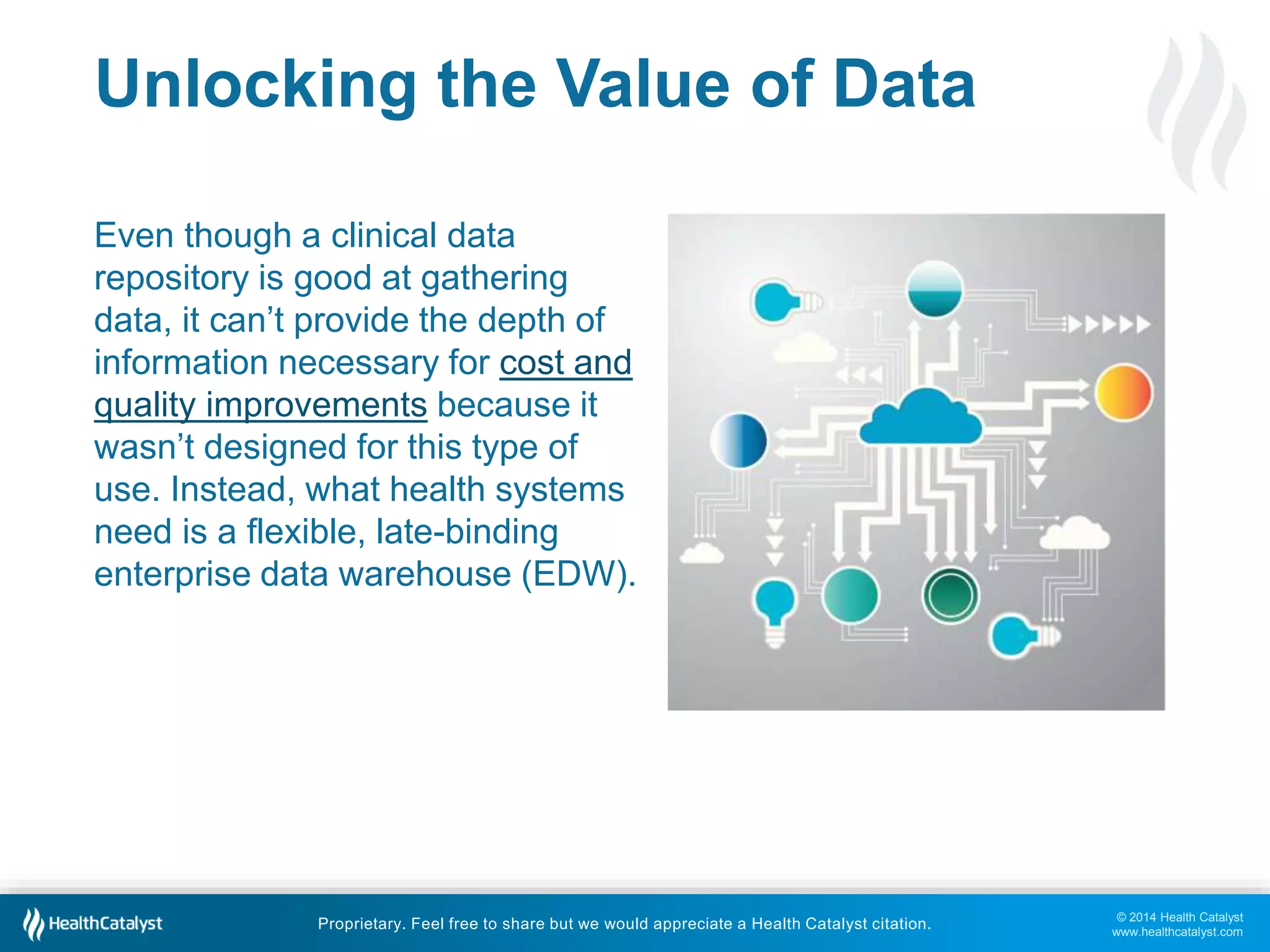
Even though a clinical data
repository is good at gathering
data, it can’t provide the depth of
information necessary for cost and
quality improvements because it
wasn’t designed for this type of
use. Instead, what health systems
need is a flexible, late-binding
enterprise data warehouse (EDW).
© 2014 Health Catalyst
www.healthcatalyst.com
Proprietary. Feel free to share but we would appreciate a Health Catalyst citation.
Clinical Data Repository
A clinical data repository consolidates
data from various clinical sources,
such as an EMR or a lab system, to
provide a full picture of the care a
patient has received.
Some examples of the types of data
found in a clinical data repository
include demo-graphics, lab results,
radiology images, admissions,
transfers, and diagnoses.
© 2014 Health Catalyst
www.healthcatalyst.com
Proprietary. Feel free to share but we would appreciate a Health Catalyst citation.
Clinical Data Repository
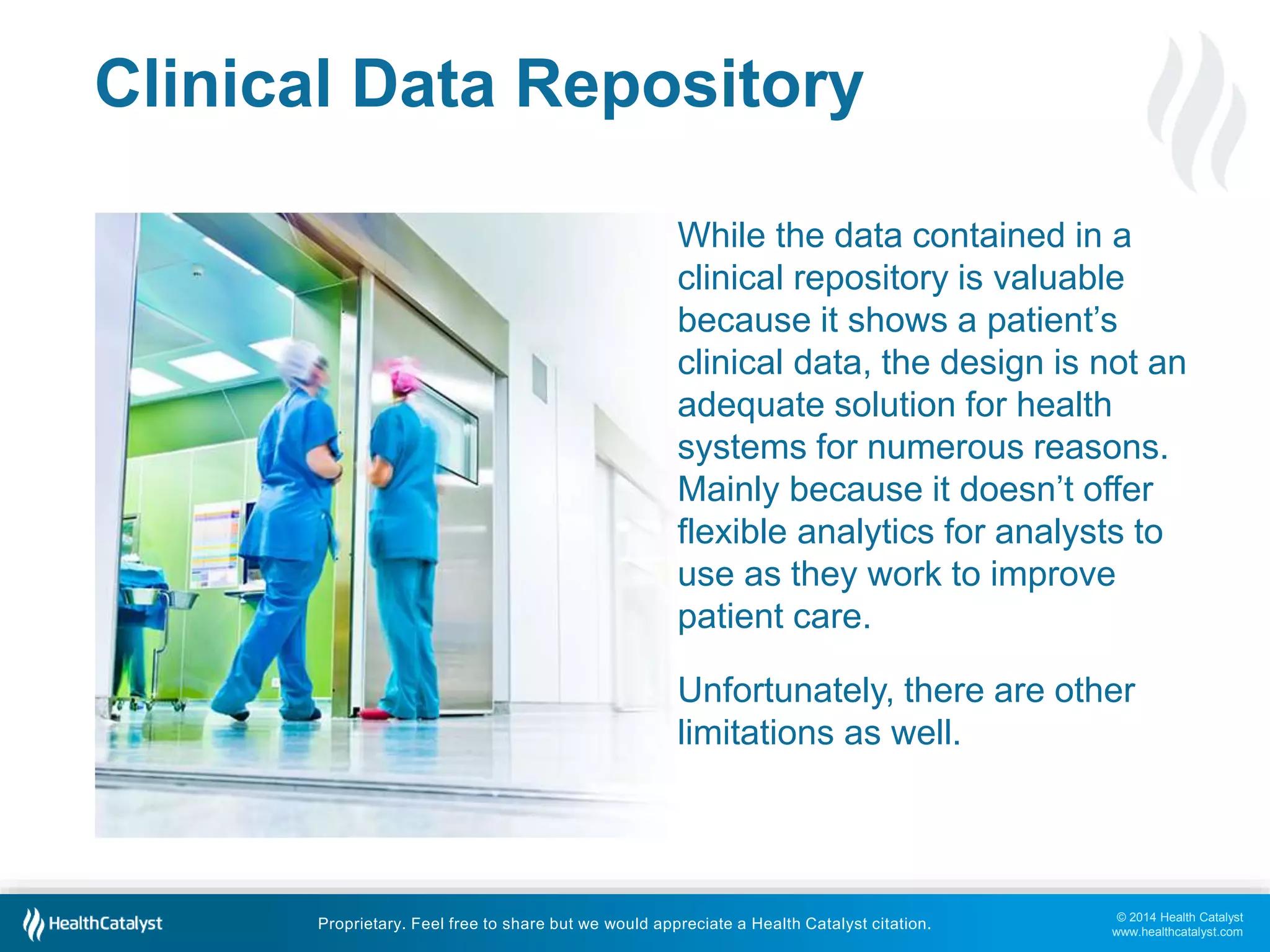
While the data contained in a
clinical repository is valuable
because it shows a patient’s
clinical data, the design is not an
adequate solution for health
systems for numerous reasons.
Mainly because it doesn’t offer
flexible analytics for analysts to
use as they work to improve
patient care.
Unfortunately, there are other
limitations as well.
© 2014 Health Catalyst
www.healthcatalyst.com
Proprietary. Feel free to share but we would appreciate a Health Catalyst citation.
Clinical Data Repository
Clinical data repositories are
inefficient – When clinicians request
many reports all at once the IT team
usually into a report factory rather than
functioning as an experienced
analytics team.
These highly skilled, highly paid IT
employees end up spending their time
tracking down the data, pulling it into
the repository, and spitting out reports.
© 2014 Health Catalyst
www.healthcatalyst.com
Proprietary. Feel free to share but we would appreciate a Health Catalyst citation.
Clinical Data Repository
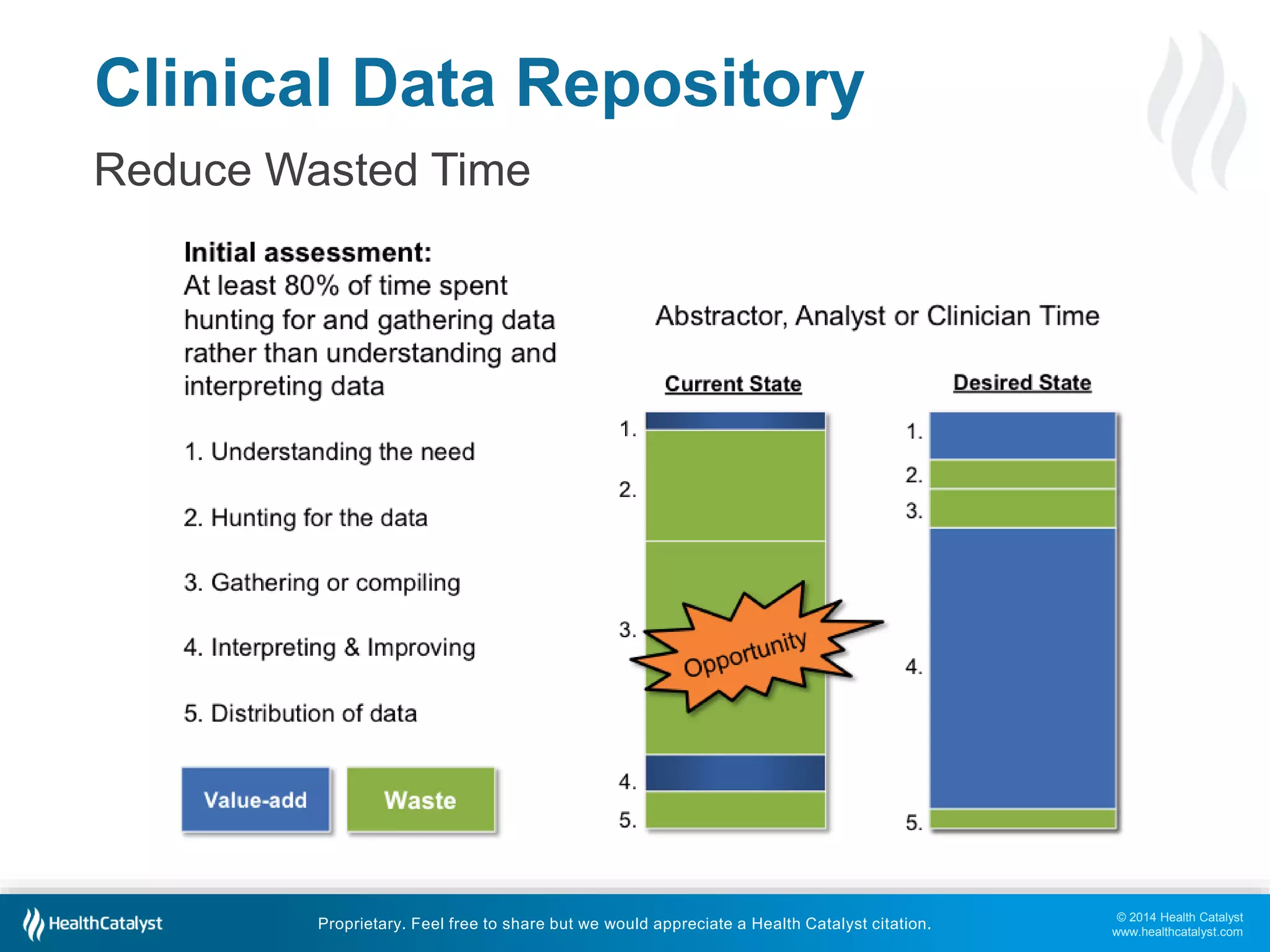
Reduce Wasted Time
© 2014 Health Catalyst
www.healthcatalyst.com
Proprietary. Feel free to share but we would appreciate a Health Catalyst citation.
Clinical Data Repository
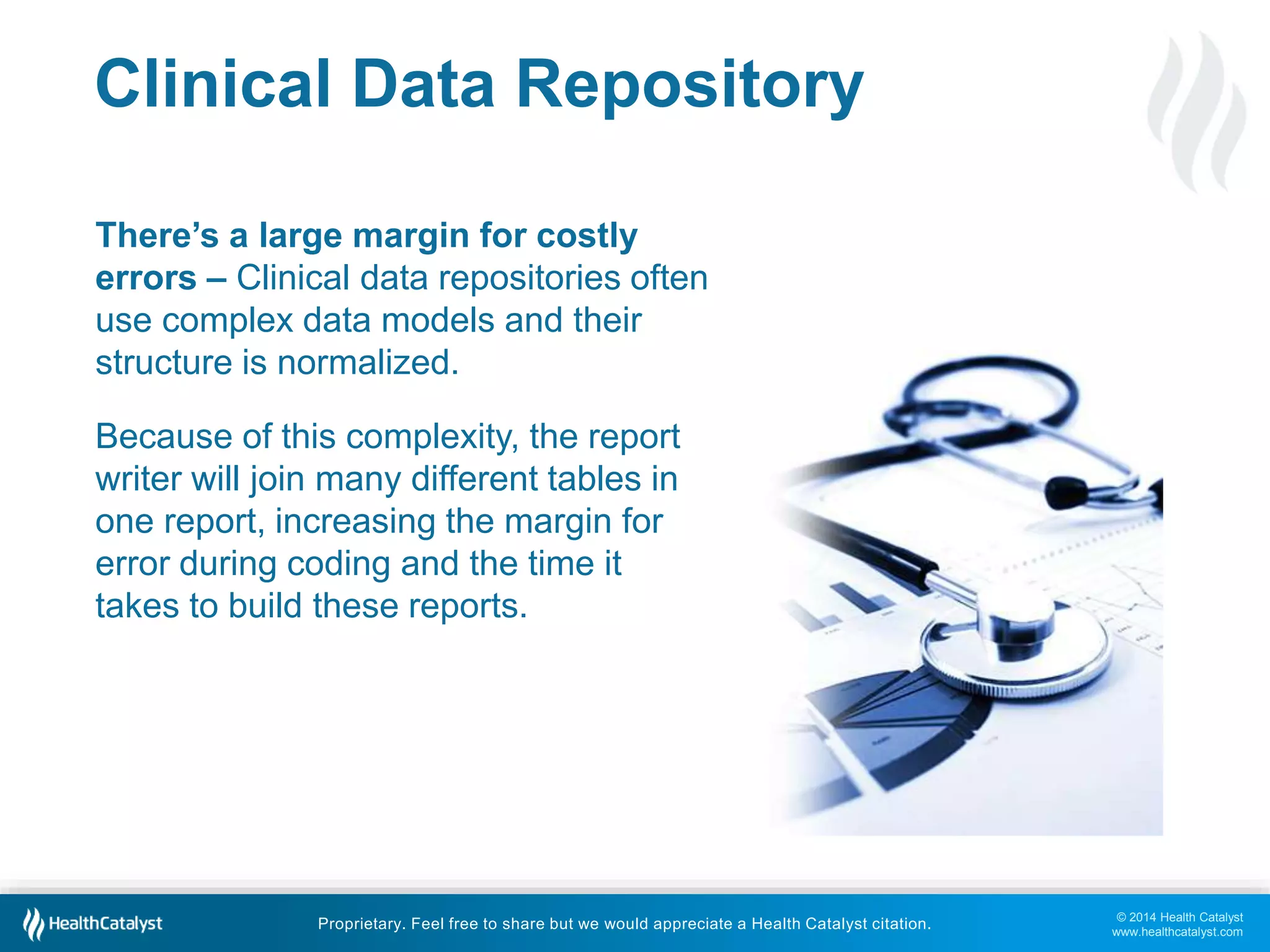
There’s a large margin for costly
errors – Clinical data repositories often
use complex data models and their
structure is normalized.
Because of this complexity, the report
writer will join many different tables in
one report, increasing the margin for
error during coding and the time it
takes to build these reports.
© 2014 Health Catalyst
www.healthcatalyst.com
Proprietary. Feel free to share but we would appreciate a Health Catalyst citation.
Clinical Data Repository
Reports aren’t standardized – When
data is being pulled from clinical data
repositories and then different
visualization tools are used to build
those reports, each report will look and
function differently.
Without a centralized tool for reporting
across the organization, reporting will
continue to have a different look and
feel by department or functional area,
making report reading less efficient.
© 2014 Health Catalyst
www.healthcatalyst.com
Proprietary. Feel free to share but we would appreciate a Health Catalyst citation.
Clinical Data Repository
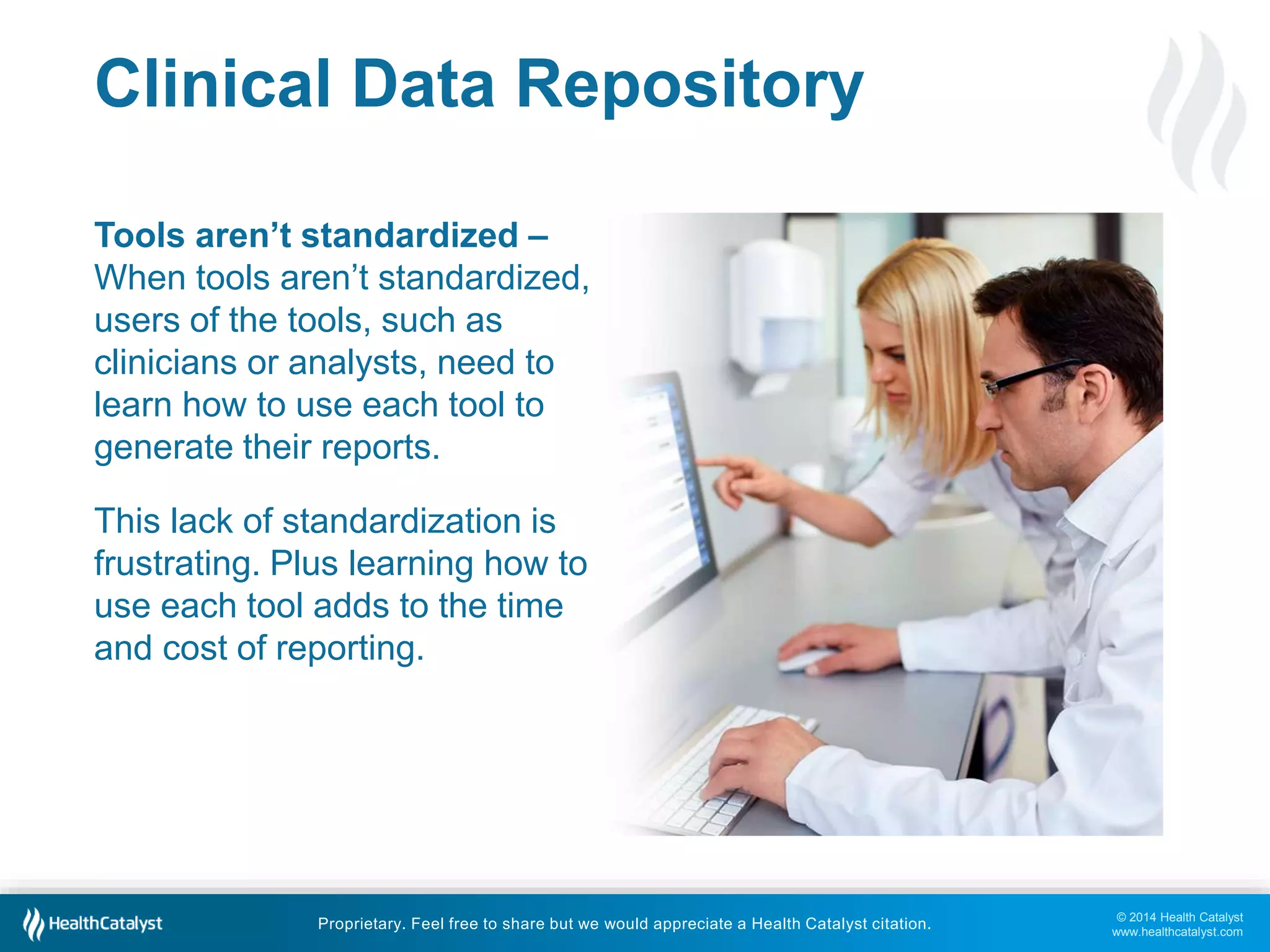
Tools aren’t standardized –
When tools aren’t standardized,
users of the tools, such as
clinicians or analysts, need to
learn how to use each tool to
generate their reports.
This lack of standardization is
frustrating. Plus learning how to
use each tool adds to the time
and cost of reporting.
© 2014 Health Catalyst
www.healthcatalyst.com
Proprietary. Feel free to share but we would appreciate a Health Catalyst citation.
Clinical Data Repository
Data isn’t always secure – With
data spread across many clinical data
repositories, there is no way to audit
who is looking at the data. Even built-
in safeguards within those systems
are limited.
Despite the best intentions and
safeguards the data becomes
extremely vulnerable, exposing the
hospital or health system to needless
risk.
© 2014 Health Catalyst
www.healthcatalyst.com
Proprietary. Feel free to share but we would appreciate a Health Catalyst citation.
Late-Binding™ Enterprise Data
Warehouse
While the patient level care
information the clinical data
repository provides is important,
there’s a better solution that will
provide a single source of truth
across the entire health system:
a Late-Binding™ Data
Warehouse
There are 7 major benefits:
© 2014 Health Catalyst
www.healthcatalyst.com
Proprietary. Feel free to share but we would appreciate a Health Catalyst citation.
Late-Binding™ Enterprise Data
Warehouse
1. Faster time to value – With a
Late-Binding™ Data Warehouse,
you don’t need to wait months or
years to map all of your data.
Instead, you can start small,
pulling in and binding only the
data you need for specific
initiatives. This allows a
much faster time to value and
quickly demonstrates the
benefits.
© 2014 Health Catalyst
www.healthcatalyst.com
Proprietary. Feel free to share but we would appreciate a Health Catalyst citation.
Late-Binding™ Enterprise Data
Warehouse
2. Flexible architecture means
easy adjustments – The flexibility of
a Late-Binding™ Data Warehouse is
critical because healthcare
definitions change rapidly — and
frequently. The architecture makes it
much easier to adjust to changes in
protocols or regulations, new
technologies, and dozens of other
operational and clinical factors.
© 2014 Health Catalyst
www.healthcatalyst.com
Proprietary. Feel free to share but we would appreciate a Health Catalyst citation.
Late-Binding™ Enterprise Data
Warehouse
3. Reduction in waste and
inefficiencies – Instead of analysts
using their precious time to hunt
down data, they are significantly
adding value to the organization.
With a one-stop shop for data and a
place that requires only one login to
get any data in the system, analysts
now have a place to analyze data
so they no longer need to cobble
data together for their reports.
© 2014 Health Catalyst
www.healthcatalyst.com
Proprietary. Feel free to share but we would appreciate a Health Catalyst citation.
Late-Binding™ Enterprise Data
Warehouse
4. Reduced errors means reduced
costs – A Late-Binding™ architecture
decreases the possibility of expensive
errors. When analysts need to perform
data validation to ensure the data in
the reports matches the source data,
they can easily return to the source
system to see what source field and
table that column came from.
© 2014 Health Catalyst
www.healthcatalyst.com
Proprietary. Feel free to share but we would appreciate a Health Catalyst citation.
Late-Binding™ Enterprise Data
Warehouse
5. Reports are standardized –
Late-Binding™ Data Warehouse
look the same across the entire
organization. Once there’s an EDW
team in place, their goal is to treat
every service as a customer and
provide standardized reports with
the same look and feel. This
approach contributes to a more
systematized, unified organization.
© 2014 Health Catalyst
www.healthcatalyst.com
Proprietary. Feel free to share but we would appreciate a Health Catalyst citation.
Late-Binding™ Enterprise Data
Warehouse
6. No more long wait times –
IT departments are usually
overwhelmed with requests. By the
time they’re able to work on a report,
the requirements may have already
changed. With a Late-Binding™ Data
Warehouse, a dedicated, enterprise
team, service lines will have their own
resource who’s role is to work with
them to produce meaningful reports
and make alterations as needs and
wants change.
© 2014 Health Catalyst
www.healthcatalyst.com
Proprietary. Feel free to share but we would appreciate a Health Catalyst citation.
Late-Binding™ Enterprise Data
Warehouse
7. Data is secure – With a Late-
Binding™ Data Warehouse, the
organization has a central, secure
repository for all data. Individual
departments can still maintain their
own repositories — although they
may want to re-think that strategy
after experiencing a full EDW — but
their data is now visible to all
authorized users and the
organization gains far tighter control
over its data.
© 2014 Health Catalyst
www.healthcatalyst.com
Proprietary. Feel free to share but we would appreciate a Health Catalyst citation.
Return on Investment
Heathcare providers employ hundreds
of different technology solutions they’ve
purchased from multiple vendors, with
no way to extract the various data
points into one single source of truth.
A Late-Binding™ Data Warehouse is
able to incorporate all the disparate
data from across the organization
leading to greater insights and a better
return on investment in the short, mid-
and long-term.
© 2014 Health Catalyst
www.healthcatalyst.com
Proprietary. Feel free to share but we would appreciate a Health Catalyst citation.
More on this topic:
Early vs. Late-Binding Approaches to Data Warehousing. Which Is Better for
Healthcare?
Mike Doyle, Vice President
What Is the Best Healthcare Data Warehouse Model? Comparing Enterprise Data
Models, Independent Data Marts, and Late-Binding Solutions
Steve Barlow, Senior Vice President and Co-Founder
Late-Binding vs. EMR-Based Models: Comparing Data Warehouse Methodologies
Eric Just, Vice President, Technology
The Late-Binding™ Data Warehouse White Paper
Dale Sanders, Vice President, Strategy
© 2013 Health Catalyst
www.healthcatalyst.com
Other Clinical Quality Improvement Resources
Click to read additional information at www.healthcatalyst.com
Tim Campbell joined Health Catalyst as a data architect in February of
2011. Previously, he worked for a year-and-a-half as a project manager
for a company that provided point-of-sale software for the fast-food
industry. He has a Bachelor of Arts degree from Saint John’s University
in Collegeville, Minnesota where he majored in business management
and Spanish.

Clinical Data Repository vs. A Data Warehouse - Which Do You Need?

  • 1.
    © 2014 HealthCatalyst www.healthcatalyst.com Proprietary. Feel free to share but we would appreciate a Health Catalyst citation. © 2014 Health Catalyst www.healthcatalyst.comProprietary. Feel free to share but we would appreciate a Health Catalyst citation. Clinical Data Repository Versus a Data Warehouse — Which Do You Need? By Tim Campbell
  • 2.
    © 2014 HealthCatalyst www.healthcatalyst.com Proprietary. Feel free to share but we would appreciate a Health Catalyst citation. Unlocking the Value of Data Even though a clinical data repository is good at gathering data, it can’t provide the depth of information necessary for cost and quality improvements because it wasn’t designed for this type of use. Instead, what health systems need is a flexible, late-binding enterprise data warehouse (EDW).
  • 3.
    © 2014 HealthCatalyst www.healthcatalyst.com Proprietary. Feel free to share but we would appreciate a Health Catalyst citation. Clinical Data Repository A clinical data repository consolidates data from various clinical sources, such as an EMR or a lab system, to provide a full picture of the care a patient has received. Some examples of the types of data found in a clinical data repository include demo-graphics, lab results, radiology images, admissions, transfers, and diagnoses.
  • 4.
    © 2014 HealthCatalyst www.healthcatalyst.com Proprietary. Feel free to share but we would appreciate a Health Catalyst citation. Clinical Data Repository While the data contained in a clinical repository is valuable because it shows a patient’s clinical data, the design is not an adequate solution for health systems for numerous reasons. Mainly because it doesn’t offer flexible analytics for analysts to use as they work to improve patient care. Unfortunately, there are other limitations as well.
  • 5.
    © 2014 HealthCatalyst www.healthcatalyst.com Proprietary. Feel free to share but we would appreciate a Health Catalyst citation. Clinical Data Repository Clinical data repositories are inefficient – When clinicians request many reports all at once the IT team usually into a report factory rather than functioning as an experienced analytics team. These highly skilled, highly paid IT employees end up spending their time tracking down the data, pulling it into the repository, and spitting out reports.
  • 6.
    © 2014 HealthCatalyst www.healthcatalyst.com Proprietary. Feel free to share but we would appreciate a Health Catalyst citation. Clinical Data Repository Reduce Wasted Time
  • 7.
    © 2014 HealthCatalyst www.healthcatalyst.com Proprietary. Feel free to share but we would appreciate a Health Catalyst citation. Clinical Data Repository There’s a large margin for costly errors – Clinical data repositories often use complex data models and their structure is normalized. Because of this complexity, the report writer will join many different tables in one report, increasing the margin for error during coding and the time it takes to build these reports.
  • 8.
    © 2014 HealthCatalyst www.healthcatalyst.com Proprietary. Feel free to share but we would appreciate a Health Catalyst citation. Clinical Data Repository Reports aren’t standardized – When data is being pulled from clinical data repositories and then different visualization tools are used to build those reports, each report will look and function differently. Without a centralized tool for reporting across the organization, reporting will continue to have a different look and feel by department or functional area, making report reading less efficient.
  • 9.
    © 2014 HealthCatalyst www.healthcatalyst.com Proprietary. Feel free to share but we would appreciate a Health Catalyst citation. Clinical Data Repository Tools aren’t standardized – When tools aren’t standardized, users of the tools, such as clinicians or analysts, need to learn how to use each tool to generate their reports. This lack of standardization is frustrating. Plus learning how to use each tool adds to the time and cost of reporting.
  • 10.
    © 2014 HealthCatalyst www.healthcatalyst.com Proprietary. Feel free to share but we would appreciate a Health Catalyst citation. Clinical Data Repository Data isn’t always secure – With data spread across many clinical data repositories, there is no way to audit who is looking at the data. Even built- in safeguards within those systems are limited. Despite the best intentions and safeguards the data becomes extremely vulnerable, exposing the hospital or health system to needless risk.
  • 11.
    © 2014 HealthCatalyst www.healthcatalyst.com Proprietary. Feel free to share but we would appreciate a Health Catalyst citation. Late-Binding™ Enterprise Data Warehouse While the patient level care information the clinical data repository provides is important, there’s a better solution that will provide a single source of truth across the entire health system: a Late-Binding™ Data Warehouse There are 7 major benefits:
  • 12.
    © 2014 HealthCatalyst www.healthcatalyst.com Proprietary. Feel free to share but we would appreciate a Health Catalyst citation. Late-Binding™ Enterprise Data Warehouse 1. Faster time to value – With a Late-Binding™ Data Warehouse, you don’t need to wait months or years to map all of your data. Instead, you can start small, pulling in and binding only the data you need for specific initiatives. This allows a much faster time to value and quickly demonstrates the benefits.
  • 13.
    © 2014 HealthCatalyst www.healthcatalyst.com Proprietary. Feel free to share but we would appreciate a Health Catalyst citation. Late-Binding™ Enterprise Data Warehouse 2. Flexible architecture means easy adjustments – The flexibility of a Late-Binding™ Data Warehouse is critical because healthcare definitions change rapidly — and frequently. The architecture makes it much easier to adjust to changes in protocols or regulations, new technologies, and dozens of other operational and clinical factors.
  • 14.
    © 2014 HealthCatalyst www.healthcatalyst.com Proprietary. Feel free to share but we would appreciate a Health Catalyst citation. Late-Binding™ Enterprise Data Warehouse 3. Reduction in waste and inefficiencies – Instead of analysts using their precious time to hunt down data, they are significantly adding value to the organization. With a one-stop shop for data and a place that requires only one login to get any data in the system, analysts now have a place to analyze data so they no longer need to cobble data together for their reports.
  • 15.
    © 2014 HealthCatalyst www.healthcatalyst.com Proprietary. Feel free to share but we would appreciate a Health Catalyst citation. Late-Binding™ Enterprise Data Warehouse 4. Reduced errors means reduced costs – A Late-Binding™ architecture decreases the possibility of expensive errors. When analysts need to perform data validation to ensure the data in the reports matches the source data, they can easily return to the source system to see what source field and table that column came from.
  • 16.
    © 2014 HealthCatalyst www.healthcatalyst.com Proprietary. Feel free to share but we would appreciate a Health Catalyst citation. Late-Binding™ Enterprise Data Warehouse 5. Reports are standardized – Late-Binding™ Data Warehouse look the same across the entire organization. Once there’s an EDW team in place, their goal is to treat every service as a customer and provide standardized reports with the same look and feel. This approach contributes to a more systematized, unified organization.
  • 17.
    © 2014 HealthCatalyst www.healthcatalyst.com Proprietary. Feel free to share but we would appreciate a Health Catalyst citation. Late-Binding™ Enterprise Data Warehouse 6. No more long wait times – IT departments are usually overwhelmed with requests. By the time they’re able to work on a report, the requirements may have already changed. With a Late-Binding™ Data Warehouse, a dedicated, enterprise team, service lines will have their own resource who’s role is to work with them to produce meaningful reports and make alterations as needs and wants change.
  • 18.
    © 2014 HealthCatalyst www.healthcatalyst.com Proprietary. Feel free to share but we would appreciate a Health Catalyst citation. Late-Binding™ Enterprise Data Warehouse 7. Data is secure – With a Late- Binding™ Data Warehouse, the organization has a central, secure repository for all data. Individual departments can still maintain their own repositories — although they may want to re-think that strategy after experiencing a full EDW — but their data is now visible to all authorized users and the organization gains far tighter control over its data.
  • 19.
    © 2014 HealthCatalyst www.healthcatalyst.com Proprietary. Feel free to share but we would appreciate a Health Catalyst citation. Return on Investment Heathcare providers employ hundreds of different technology solutions they’ve purchased from multiple vendors, with no way to extract the various data points into one single source of truth. A Late-Binding™ Data Warehouse is able to incorporate all the disparate data from across the organization leading to greater insights and a better return on investment in the short, mid- and long-term.
  • 20.
    © 2014 HealthCatalyst www.healthcatalyst.com Proprietary. Feel free to share but we would appreciate a Health Catalyst citation. More on this topic: Early vs. Late-Binding Approaches to Data Warehousing. Which Is Better for Healthcare? Mike Doyle, Vice President What Is the Best Healthcare Data Warehouse Model? Comparing Enterprise Data Models, Independent Data Marts, and Late-Binding Solutions Steve Barlow, Senior Vice President and Co-Founder Late-Binding vs. EMR-Based Models: Comparing Data Warehouse Methodologies Eric Just, Vice President, Technology The Late-Binding™ Data Warehouse White Paper Dale Sanders, Vice President, Strategy
  • 21.
    © 2013 HealthCatalyst www.healthcatalyst.com Other Clinical Quality Improvement Resources Click to read additional information at www.healthcatalyst.com Tim Campbell joined Health Catalyst as a data architect in February of 2011. Previously, he worked for a year-and-a-half as a project manager for a company that provided point-of-sale software for the fast-food industry. He has a Bachelor of Arts degree from Saint John’s University in Collegeville, Minnesota where he majored in business management and Spanish.