Nandini V Patil
Asst.Professor
Godutai Engg. College Kalaburagi
Decision Trees
Introduction
 Decision tree are a simple way to guide one’s
path to a decision.
 Decision may be simple binary Eg. Approve of
loan or complex multi-valued decision Eg.
Sickness diagnosis
 Decision trees are hierarchically branched
structures that helps to come out to the decision
on asking certain questions.
 Good decision tree should short and ask only few
meaningful questions.
 Decision trees are very efficient to use, easy to
explain and their classification accuracy is
competitive with other methods.
Decision tree problem
 Experts will use decision tree or decision rules for
solving problems. Human experts Learns
experiences or data points. Similarly machine can be
trained to learn from the past data points and extract
some knowledge or rules from it.
 Predictive accuracy is based on the correct decision
made.
 The more data available for training the decision tree,
the more accurate its knowledge extraction, then it will
make more accurate decisions.
 The more variables the tree can choose from, the
greater is the accuracy of the decision tree.
 Good decision tree should frugal so that it takes the least
no of questions, thus least amount of effort to get to the
Conti
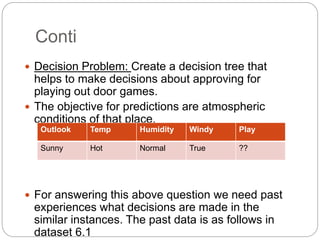
 Decision Problem: Create a decision tree that
helps to make decisions about approving for
playing out door games.
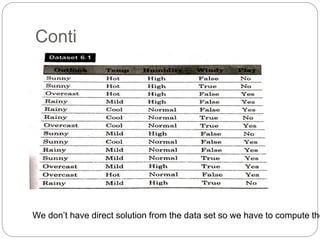
 The objective for predictions are atmospheric
conditions of that place.
 For answering this above question we need past
experiences what decisions are made in the
similar instances. The past data is as follows in
dataset 6.1
Outlook Temp Humidity Windy Play
Sunny Hot Normal True ??
Conti
We don’t have direct solution from the data set so we have to compute the
Decision tree construction
 Decision tree is a hierarchically branched structure.
 Creating a decision is based on asking few simple
questions more important question should be first and
then less important one.
Determining the root node of the tree
 Start the tree constructing by taking an example of
Weather problem for playing.
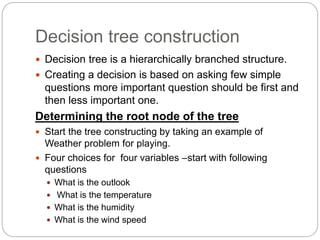
 Four choices for four variables –start with following
questions
 What is the outlook
 What is the temperature
 What is the humidity
 What is the wind speed
Conti
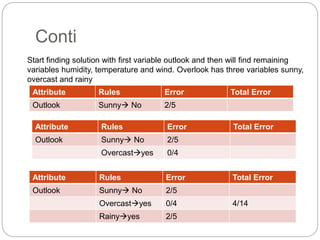
Attribute Rules Error Total Error
Outlook Sunny No 2/5
Attribute Rules Error Total Error
Outlook Sunny No 2/5
Overcastyes 0/4
Attribute Rules Error Total Error
Outlook Sunny No 2/5
Overcastyes 0/4 4/14
Rainyyes 2/5
Start finding solution with first variable outlook and then will find remaining
variables humidity, temperature and wind. Overlook has three variables sunny,
overcast and rainy
Conti
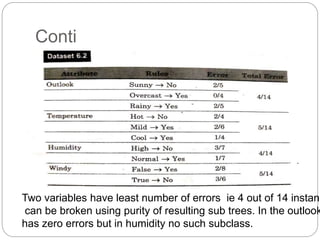
Two variables have least number of errors ie 4 out of 14 instanc
can be broken using purity of resulting sub trees. In the outlook
has zero errors but in humidity no such subclass.
Conti
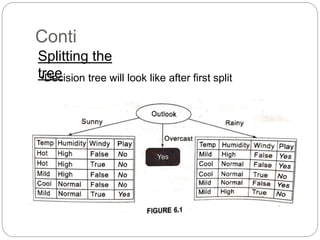
Splitting the
tree•Decision tree will look like after first split
Conti
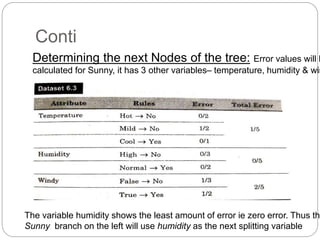
Determining the next Nodes of the tree: Error values will b
calculated for Sunny, it has 3 other variables– temperature, humidity & win
The variable humidity shows the least amount of error ie zero error. Thus the
Sunny branch on the left will use humidity as the next splitting variable
conti
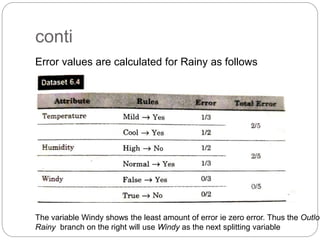
Error values are calculated for Rainy as follows
The variable Windy shows the least amount of error ie zero error. Thus the Outloo
Rainy branch on the right will use Windy as the next splitting variable
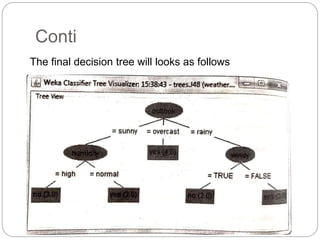
Conti
The final decision tree will looks as follows
conti
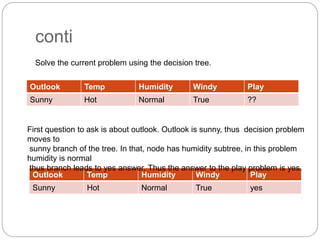
Outlook Temp Humidity Windy Play
Sunny Hot Normal True ??
Outlook Temp Humidity Windy Play
Sunny Hot Normal True yes
Solve the current problem using the decision tree.
First question to ask is about outlook. Outlook is sunny, thus decision problem
moves to
sunny branch of the tree. In that, node has humidity subtree, in this problem
humidity is normal
thus branch leads to yes answer. Thus the answer to the play problem is yes.
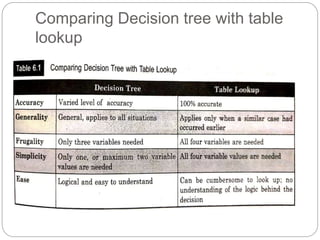
Comparing Decision tree with table
lookup
Lessons from constructing trees
 Final decision tree has zero errors in mapping to the
prior data ie predictive accuracy of tree should be
100%.
 Algorithm should select the minimum no of variables
which are important to solve the problem.
 Tree is almost symmetric with all branches of almost
similar lengths.
 It may possible to increase predictive accuracy by
making more sub-trees & making the tree longer.
 Perfect fitting tree has the danger of over-fitting the
data, thus capturing all the random variations in the
data.
 There will be single best tree for this data, however
two or more equally efficient decision tree of similar
length with similar predictive accuracy for the same
dataset.
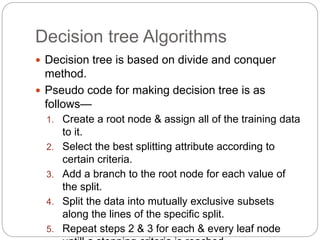
Decision tree Algorithms
 Decision tree is based on divide and conquer
method.
 Pseudo code for making decision tree is as
follows—
1. Create a root node & assign all of the training data
to it.
2. Select the best splitting attribute according to
certain criteria.
3. Add a branch to the root node for each value of
the split.
4. Split the data into mutually exclusive subsets
along the lines of the specific split.
5. Repeat steps 2 & 3 for each & every leaf node
Decision tree key elements
 Splitting criteria—
 Which variable to use for the first split? How should one determine the most
important variable for the first branch & subsequently for each subtree?
 Ans: Algorithms use different measures like least error, information gain,Gini’s coefficient.
 What values to use for the split? If the variables have continuous values such
as for age or blood pressure, what value-ranges should be used to make bins.
 How many branches should be allowed for each node? There could be binary
trees, with just two branches at each node. Or there could be more branches
allowed.
 Stopping criteria – When to stop building the tree? Two major ways–
a) When certain depth of the branches has been reached & tree becomes
unreachable after that.
b)When the error level at any node is within predefined tolerable levels.
 Pruning– Act of reducing the size of decision trees by removing sectins of
the tree that provide little value. The decision tree could be trimmed to make
it more balanced, more general &more easily usable. Two approaches in
pruning
 Prepruning
 Postpruning.
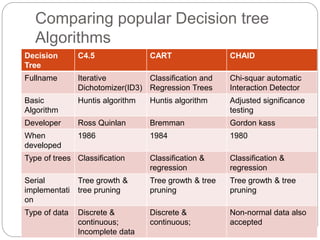
Comparing popular Decision tree
Algorithms
Decision
Tree
C4.5 CART CHAID
Fullname Iterative
Dichotomizer(ID3)
Classification and
Regression Trees
Chi-squar automatic
Interaction Detector
Basic
Algorithm
Huntis algorithm Huntis algorithm Adjusted significance
testing
Developer Ross Quinlan Bremman Gordon kass
When
developed
1986 1984 1980
Type of trees Classification Classification &
regression
Classification &
regression
Serial
implementati
on
Tree growth &
tree pruning
Tree growth & tree
pruning
Tree growth & tree
pruning
Type of data Discrete &
continuous;
Incomplete data
Discrete &
continuous;
Non-normal data also
accepted
Conti
Decision
Tree
C4.5 CART CHAID
Type of splits Multi-way Binary splits only;
clever surrogate
splits to reduce tree
depth
Multiway splits
as default
Splitting
criteria
Information gain Gini’s coefficient,&
other
Chi-square test
Pruning
criteria
Clever bottom-
up technique
avoid over-fitting
Remove weakest
links first
Trees can
become very
large
Implementati
on
Publically
available
Publically available
In most packages
Popular in
market research
for segmentation

Decision trees

  • 1.
    Nandini V Patil Asst.Professor GodutaiEngg. College Kalaburagi Decision Trees
  • 2.
    Introduction  Decision treeare a simple way to guide one’s path to a decision.  Decision may be simple binary Eg. Approve of loan or complex multi-valued decision Eg. Sickness diagnosis  Decision trees are hierarchically branched structures that helps to come out to the decision on asking certain questions.  Good decision tree should short and ask only few meaningful questions.  Decision trees are very efficient to use, easy to explain and their classification accuracy is competitive with other methods.
  • 3.
    Decision tree problem Experts will use decision tree or decision rules for solving problems. Human experts Learns experiences or data points. Similarly machine can be trained to learn from the past data points and extract some knowledge or rules from it.  Predictive accuracy is based on the correct decision made.  The more data available for training the decision tree, the more accurate its knowledge extraction, then it will make more accurate decisions.  The more variables the tree can choose from, the greater is the accuracy of the decision tree.  Good decision tree should frugal so that it takes the least no of questions, thus least amount of effort to get to the
  • 4.
    Conti  Decision Problem:Create a decision tree that helps to make decisions about approving for playing out door games.  The objective for predictions are atmospheric conditions of that place.  For answering this above question we need past experiences what decisions are made in the similar instances. The past data is as follows in dataset 6.1 Outlook Temp Humidity Windy Play Sunny Hot Normal True ??
  • 5.
    Conti We don’t havedirect solution from the data set so we have to compute the
  • 6.
    Decision tree construction Decision tree is a hierarchically branched structure.  Creating a decision is based on asking few simple questions more important question should be first and then less important one. Determining the root node of the tree  Start the tree constructing by taking an example of Weather problem for playing.  Four choices for four variables –start with following questions  What is the outlook  What is the temperature  What is the humidity  What is the wind speed
  • 7.
    Conti Attribute Rules ErrorTotal Error Outlook Sunny No 2/5 Attribute Rules Error Total Error Outlook Sunny No 2/5 Overcastyes 0/4 Attribute Rules Error Total Error Outlook Sunny No 2/5 Overcastyes 0/4 4/14 Rainyyes 2/5 Start finding solution with first variable outlook and then will find remaining variables humidity, temperature and wind. Overlook has three variables sunny, overcast and rainy
  • 8.
    Conti Two variables haveleast number of errors ie 4 out of 14 instanc can be broken using purity of resulting sub trees. In the outlook has zero errors but in humidity no such subclass.
  • 9.
    Conti Splitting the tree•Decision treewill look like after first split
  • 10.
    Conti Determining the nextNodes of the tree: Error values will b calculated for Sunny, it has 3 other variables– temperature, humidity & win The variable humidity shows the least amount of error ie zero error. Thus the Sunny branch on the left will use humidity as the next splitting variable
  • 11.
    conti Error values arecalculated for Rainy as follows The variable Windy shows the least amount of error ie zero error. Thus the Outloo Rainy branch on the right will use Windy as the next splitting variable
  • 12.
    Conti The final decisiontree will looks as follows
  • 13.
    conti Outlook Temp HumidityWindy Play Sunny Hot Normal True ?? Outlook Temp Humidity Windy Play Sunny Hot Normal True yes Solve the current problem using the decision tree. First question to ask is about outlook. Outlook is sunny, thus decision problem moves to sunny branch of the tree. In that, node has humidity subtree, in this problem humidity is normal thus branch leads to yes answer. Thus the answer to the play problem is yes.
  • 14.
    Comparing Decision treewith table lookup
  • 15.
    Lessons from constructingtrees  Final decision tree has zero errors in mapping to the prior data ie predictive accuracy of tree should be 100%.  Algorithm should select the minimum no of variables which are important to solve the problem.  Tree is almost symmetric with all branches of almost similar lengths.  It may possible to increase predictive accuracy by making more sub-trees & making the tree longer.  Perfect fitting tree has the danger of over-fitting the data, thus capturing all the random variations in the data.  There will be single best tree for this data, however two or more equally efficient decision tree of similar length with similar predictive accuracy for the same dataset.
  • 16.
    Decision tree Algorithms Decision tree is based on divide and conquer method.  Pseudo code for making decision tree is as follows— 1. Create a root node & assign all of the training data to it. 2. Select the best splitting attribute according to certain criteria. 3. Add a branch to the root node for each value of the split. 4. Split the data into mutually exclusive subsets along the lines of the specific split. 5. Repeat steps 2 & 3 for each & every leaf node
  • 17.
    Decision tree keyelements  Splitting criteria—  Which variable to use for the first split? How should one determine the most important variable for the first branch & subsequently for each subtree?  Ans: Algorithms use different measures like least error, information gain,Gini’s coefficient.  What values to use for the split? If the variables have continuous values such as for age or blood pressure, what value-ranges should be used to make bins.  How many branches should be allowed for each node? There could be binary trees, with just two branches at each node. Or there could be more branches allowed.  Stopping criteria – When to stop building the tree? Two major ways– a) When certain depth of the branches has been reached & tree becomes unreachable after that. b)When the error level at any node is within predefined tolerable levels.  Pruning– Act of reducing the size of decision trees by removing sectins of the tree that provide little value. The decision tree could be trimmed to make it more balanced, more general &more easily usable. Two approaches in pruning  Prepruning  Postpruning.
  • 18.
    Comparing popular Decisiontree Algorithms Decision Tree C4.5 CART CHAID Fullname Iterative Dichotomizer(ID3) Classification and Regression Trees Chi-squar automatic Interaction Detector Basic Algorithm Huntis algorithm Huntis algorithm Adjusted significance testing Developer Ross Quinlan Bremman Gordon kass When developed 1986 1984 1980 Type of trees Classification Classification & regression Classification & regression Serial implementati on Tree growth & tree pruning Tree growth & tree pruning Tree growth & tree pruning Type of data Discrete & continuous; Incomplete data Discrete & continuous; Non-normal data also accepted
  • 19.
    Conti Decision Tree C4.5 CART CHAID Typeof splits Multi-way Binary splits only; clever surrogate splits to reduce tree depth Multiway splits as default Splitting criteria Information gain Gini’s coefficient,& other Chi-square test Pruning criteria Clever bottom- up technique avoid over-fitting Remove weakest links first Trees can become very large Implementati on Publically available Publically available In most packages Popular in market research for segmentation