
 Fundamental data storage structures used in
programming.
 Combines advantages of an ordered array and a
linked list.
 Searching as fast as in ordered array.
 Insertion and deletion as fast as in linked list.
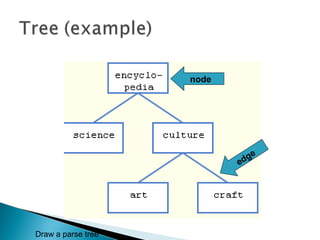
node
edge
Draw a parse tree
 Consists of nodes connected by edges.
 Nodes often represent entities (complex objects)
such as people, car parts etc.
 Edges between the nodes represent the way the
nodes are related.
 Its easy for a program to get from one node to
another if there is a line connecting them.
 The only way to get from node to node is to follow
a path along the edges.
 Path: Traversal from node to node along the edges
results in a sequence called path.
 Root: Node at the top of the tree.
 Parent: Any node, except root has exactly one edge
running upward to another node. The node above it is
called parent.
 Child: Any node may have one or more lines running
downward to other nodes. Nodes below are children.
 Leaf: A node that has no children.
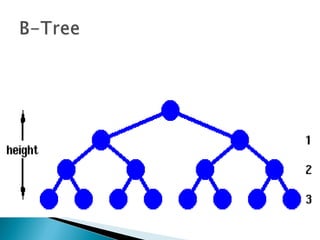
 Subtree: Any node can be considered to be the root of a
subtree, which consists of its children and its children’s
children and so on.
 Visiting: A node is visited when program control
arrives at the node, usually for processing.
 Traversing: To traverse a tree means to visit all
the nodes in some specified order.
 Levels: The level of a particular node refers to
how many generations the node is from the root.
Root is assumed to be level 0.
 Keys: Key value is used to search for the item or
perform other operations on it.
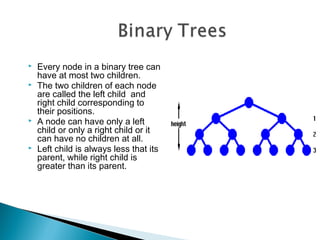
 Every node in a binary tree can
have at most two children.
 The two children of each node
are called the left child and
right child corresponding to
their positions.
 A node can have only a left
child or only a right child or it
can have no children at all.
 Left child is always less that its
parent, while right child is
greater than its parent.
 Some trees can be unbalanced.
 They have most of their nodes on one side of
the root or the other. Individual subtrees may
also be unbalanced.
 Trees become unbalanced because of the order
in which the data items are inserted.
 If the key values are inserted in ascending or
descending order the tree will be unbalanced.
 For search-centric application (Binary tree), an
unbalanced tree must be re-balanced.
 Visiting each node in a specified
order.
 Three simple ways to traverse a tree:
◦ Inorder
◦ Preorder
◦ Postorder
Inorder traversal will cause all the nodes to be visited in
ascending order.
 Steps involved in Inorder traversal (recursion) are:
1. -- Call itself to traverse the node’s left subtree
2. -- Visit the node (e.g. display a key)
3. -- Call itself to traverse the node’s right subtree.
inOrder( node lroot)
{
If (lroot != null) {
inOrder(lroot.leftChild());
System.out.print(lroot.iData + “ “);
inOrder(lroot.rightChild());
}
 Sequence of preorder traversal: e.g. use for infix
parse tree to generate prefix
-- Visit the node
-- Call itself to traverse the node’s left subtree
-- Call itself to traverse the node’s right subtree
 Sequence of postorder traversal: e.g. use for
infix parse tree to generate postfix
-- Call itself to traverse the node’s left subtree
-- Call itself to traverse the node’s right subtree
-- Visit the node.
 To find a node given its key value, start from the
root.
 If the key value is same as the node, then node is
found.
 If key is greater than node, search the right
subtree, else search the left subtree.
 Continue till the node is found or the entire tree is
traversed.
 Time required to find a node depends on how
many levels down it is situated, i.e. O(log N).
 To insert a node we must first find the place to
insert it.
 Follow the path from the root to the appropriate
node, which will be the parent of the new node.
 When this parent is found, the new node is
connected as its left or right child, depending on
whether the new node’s key is less or greater
than that of the parent.
 For the minimum,
◦ go to the left child of the root and keep going to the left
child until you come to a leaf node. This node is the
minimum.
 For the maximum,
◦ go to the right child of the root and keep going to the right
child until you come to a leaf node. This node is the
maximum.
 Start by finding the node you want to delete.
 Then there are three cases to consider:
1. The node to be deleted is a leaf
2. The node to be deleted has one child
3. The node to be deleted has two children
 To delete a leaf node, simply change the
appropriate child field in the node’s parent to point
to null, instead of to the node.
 The node still exists, but is no longer a part of the
tree.
 Because of Java’s garbage collection feature, the
node need not be deleted explicitly.
 The node to be deleted in this case has only two
connections: to its parent and to its only child.
 Connect the child of the node to the node’s
parent, thus cutting off the connection between
the node and its child, and between the node and
its parent.
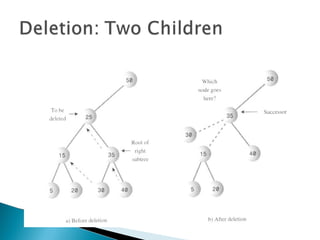
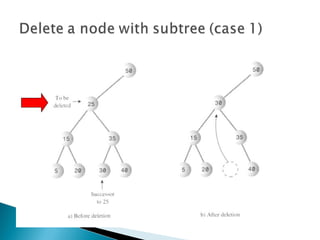
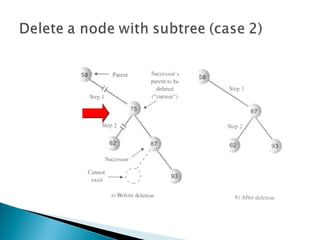
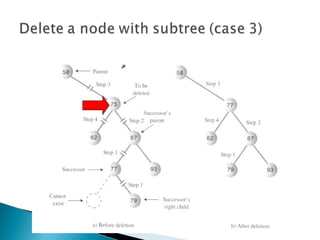
 To delete a node with two children, replace the node
with its inorder successor.
 For each node, the node with the next-highest key (to
the deleted node) in the subtree is called its inorder
successor.
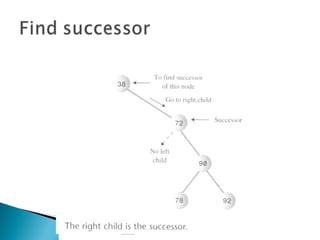
 To find the successor,
◦ start with the original (deleted) node’s right child.
◦ Then go to this node’s left child and then to its left child and so
on, following down the path of left children.
◦ The last left child in this path is the successor of the original node.
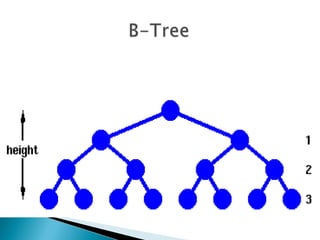
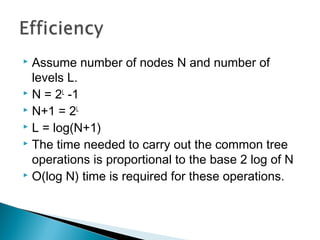
 Assume number of nodes N and number of
levels L.
 N = 2L
-1
 N+1 = 2L
 L = log(N+1)
 The time needed to carry out the common tree
operations is proportional to the base 2 log of N
 O(log N) time is required for these operations.
Tree data structure

Tree data structure

  • 2.
     Fundamental datastorage structures used in programming.  Combines advantages of an ordered array and a linked list.  Searching as fast as in ordered array.  Insertion and deletion as fast as in linked list.
  • 3.
  • 4.
     Consists ofnodes connected by edges.  Nodes often represent entities (complex objects) such as people, car parts etc.  Edges between the nodes represent the way the nodes are related.  Its easy for a program to get from one node to another if there is a line connecting them.  The only way to get from node to node is to follow a path along the edges.
  • 5.
     Path: Traversalfrom node to node along the edges results in a sequence called path.  Root: Node at the top of the tree.  Parent: Any node, except root has exactly one edge running upward to another node. The node above it is called parent.  Child: Any node may have one or more lines running downward to other nodes. Nodes below are children.  Leaf: A node that has no children.  Subtree: Any node can be considered to be the root of a subtree, which consists of its children and its children’s children and so on.
  • 6.
     Visiting: Anode is visited when program control arrives at the node, usually for processing.  Traversing: To traverse a tree means to visit all the nodes in some specified order.  Levels: The level of a particular node refers to how many generations the node is from the root. Root is assumed to be level 0.  Keys: Key value is used to search for the item or perform other operations on it.
  • 8.
     Every nodein a binary tree can have at most two children.  The two children of each node are called the left child and right child corresponding to their positions.  A node can have only a left child or only a right child or it can have no children at all.  Left child is always less that its parent, while right child is greater than its parent.
  • 9.
     Some treescan be unbalanced.  They have most of their nodes on one side of the root or the other. Individual subtrees may also be unbalanced.  Trees become unbalanced because of the order in which the data items are inserted.  If the key values are inserted in ascending or descending order the tree will be unbalanced.  For search-centric application (Binary tree), an unbalanced tree must be re-balanced.
  • 10.
     Visiting eachnode in a specified order.  Three simple ways to traverse a tree: ◦ Inorder ◦ Preorder ◦ Postorder
  • 11.
    Inorder traversal willcause all the nodes to be visited in ascending order.  Steps involved in Inorder traversal (recursion) are: 1. -- Call itself to traverse the node’s left subtree 2. -- Visit the node (e.g. display a key) 3. -- Call itself to traverse the node’s right subtree. inOrder( node lroot) { If (lroot != null) { inOrder(lroot.leftChild()); System.out.print(lroot.iData + “ “); inOrder(lroot.rightChild()); }
  • 12.
     Sequence ofpreorder traversal: e.g. use for infix parse tree to generate prefix -- Visit the node -- Call itself to traverse the node’s left subtree -- Call itself to traverse the node’s right subtree  Sequence of postorder traversal: e.g. use for infix parse tree to generate postfix -- Call itself to traverse the node’s left subtree -- Call itself to traverse the node’s right subtree -- Visit the node.
  • 13.
     To finda node given its key value, start from the root.  If the key value is same as the node, then node is found.  If key is greater than node, search the right subtree, else search the left subtree.  Continue till the node is found or the entire tree is traversed.  Time required to find a node depends on how many levels down it is situated, i.e. O(log N).
  • 14.
     To inserta node we must first find the place to insert it.  Follow the path from the root to the appropriate node, which will be the parent of the new node.  When this parent is found, the new node is connected as its left or right child, depending on whether the new node’s key is less or greater than that of the parent.
  • 15.
     For theminimum, ◦ go to the left child of the root and keep going to the left child until you come to a leaf node. This node is the minimum.  For the maximum, ◦ go to the right child of the root and keep going to the right child until you come to a leaf node. This node is the maximum.
  • 16.
     Start byfinding the node you want to delete.  Then there are three cases to consider: 1. The node to be deleted is a leaf 2. The node to be deleted has one child 3. The node to be deleted has two children
  • 17.
     To deletea leaf node, simply change the appropriate child field in the node’s parent to point to null, instead of to the node.  The node still exists, but is no longer a part of the tree.  Because of Java’s garbage collection feature, the node need not be deleted explicitly.
  • 18.
     The nodeto be deleted in this case has only two connections: to its parent and to its only child.  Connect the child of the node to the node’s parent, thus cutting off the connection between the node and its child, and between the node and its parent.
  • 20.
     To deletea node with two children, replace the node with its inorder successor.  For each node, the node with the next-highest key (to the deleted node) in the subtree is called its inorder successor.  To find the successor, ◦ start with the original (deleted) node’s right child. ◦ Then go to this node’s left child and then to its left child and so on, following down the path of left children. ◦ The last left child in this path is the successor of the original node.
  • 26.
     Assume numberof nodes N and number of levels L.  N = 2L -1  N+1 = 2L  L = log(N+1)  The time needed to carry out the common tree operations is proportional to the base 2 log of N  O(log N) time is required for these operations.