Chapter 6 
Tree
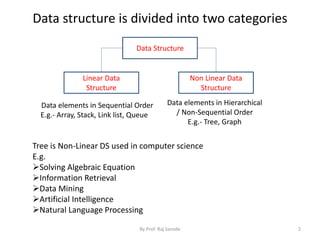
Data structure is divided into two categories 
By Prof. Raj Sarode 2 
Linear Data 
Structure 
Non Linear Data 
Structure 
Data Structure 
Data elements in Sequential Order 
E.g.- Array, Stack, Link list, Queue 
Data elements in Hierarchical 
/ Non-Sequential Order 
E.g.- Tree, Graph 
Tree is Non-Linear DS used in computer science 
E.g. 
Solving Algebraic Equation 
Information Retrieval 
Data Mining 
Artificial Intelligence 
Natural Language Processing
Tree 
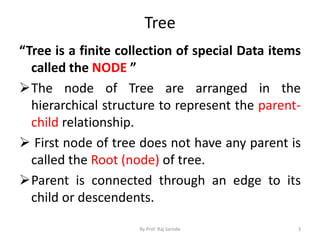
“Tree is a finite collection of special Data items 
called the NODE ” 
The node of Tree are arranged in the 
hierarchical structure to represent the parent-child 
relationship. 
 First node of tree does not have any parent is 
called the Root (node) of tree. 
Parent is connected through an edge to its 
child or descendents. 
By Prof. Raj Sarode 3
By Prof. Raj Sarode 4 
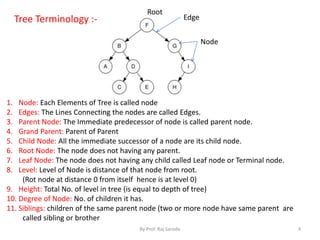
Tree Terminology :- 
Node 
Root 
Edge 
1. Node: Each Elements of Tree is called node 
2. Edges: The Lines Connecting the nodes are called Edges. 
3. Parent Node: The Immediate predecessor of node is called parent node. 
4. Grand Parent: Parent of Parent 
5. Child Node: All the immediate successor of a node are its child node. 
6. Root Node: The node does not having any parent. 
7. Leaf Node: The node does not having any child called Leaf node or Terminal node. 
8. Level: Level of Node is distance of that node from root. 
(Rot node at distance 0 from itself hence is at level 0) 
9. Height: Total No. of level in tree (is equal to depth of tree) 
10. Degree of Node: No. of children it has. 
11. Siblings: children of the same parent node (two or more node have same parent are 
called sibling or brother
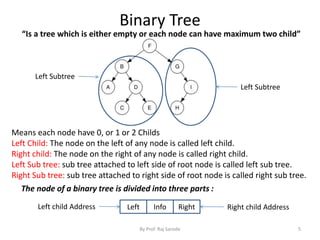
Binary Tree 
“Is a tree which is either empty or each node can have maximum two child” 
Means each node have 0, or 1 or 2 Childs 
Left Child: The node on the left of any node is called left child. 
Right child: The node on the right of any node is called right child. 
Left Sub tree: sub tree attached to left side of root node is called left sub tree. 
Right Sub tree: sub tree attached to right side of root node is called right sub tree. 
By Prof. Raj Sarode 5 
Left Subtree 
Left Subtree 
The node of a binary tree is divided into three parts : 
Left child Address Left Info Right Right child Address
Classification of Binary Tree 
By Prof. Raj Sarode 6 
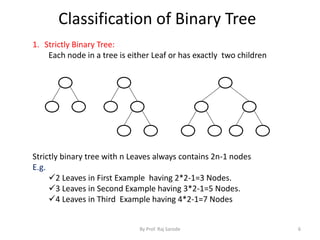
1. Strictly Binary Tree: 
Each node in a tree is either Leaf or has exactly two children 
Strictly binary tree with n Leaves always contains 2n-1 nodes 
E.g. 
2 Leaves in First Example having 2*2-1=3 Nodes. 
3 Leaves in Second Example having 3*2-1=5 Nodes. 
4 Leaves in Third Example having 4*2-1=7 Nodes
Classification of Binary Tree 
By Prof. Raj Sarode 7 
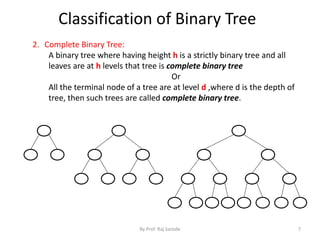
2. Complete Binary Tree: 
A binary tree where having height h is a strictly binary tree and all 
leaves are at h levels that tree is complete binary tree 
Or 
All the terminal node of a tree are at level d ,where d is the depth of 
tree, then such trees are called complete binary tree.
Classification of Binary Tree 
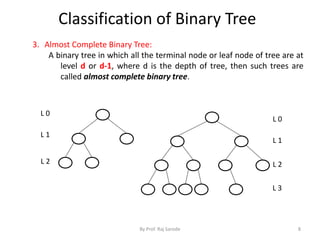
3. Almost Complete Binary Tree: 
A binary tree in which all the terminal node or leaf node of tree are at 
level d or d-1, where d is the depth of tree, then such trees are 
called almost complete binary tree. 
L 0 
L 1 
L 2 
L 3 
By Prof. Raj Sarode 8 
L 0 
L 1 
L 2
Classification of Binary Tree 
By Prof. Raj Sarode 9 
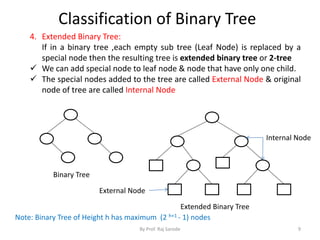
4. Extended Binary Tree: 
If in a binary tree ,each empty sub tree (Leaf Node) is replaced by a 
special node then the resulting tree is extended binary tree or 2-tree 
 We can add special node to leaf node & node that have only one child. 
 The special nodes added to the tree are called External Node & original 
node of tree are called Internal Node 
External Node 
Internal Node 
Binary Tree 
Extended Binary Tree 
Note: Binary Tree of Height h has maximum (2 h+1 - 1) nodes
Representation of Tree 
1. Sequential Representation using array 
 Tree is store in single array 
 Number are assigned to each node from leftmost to rightmost node. 
 Root node always assign no. 1 
 Left Child is placed at position [2 * K] (k is position of root) 
 Right Child is placed at position [2 * K + 1] 
 Size of array is Depends on Depth of tree i.e. 2 d+1 
By Prof. Raj Sarode 10 
A 
B C 
D E F G 
H I 
1 
2 3 
4 5 6 7 
8 9 
Root (A) =1 
L Child = [2*k]= 2 * 1 =2 (B) 
R child = [2 * K + 1] = 2 * 1 + 1 = 3 (C) 
Root(B)=2 
L Child = [2*k]= 2 * 2 =4 (D) 
R child = [2 * K + 1] = 2 * 2 + 1 = 5 (E) 
Note: If root is placed at 0th position then 
L Child = [2 * k + 1 ] 
R child = [2 * K + 2 ]
Representation of Tree 
2. Linked Representation using array 
 Tree is store in single array 
Structure of Node 
Struct mode 
{ 
Int Left; 
Int Info; 
Int Right; 
}; 
Node Tree[10]; 
1 
2 3 
B C 
6 7 
By Prof. Raj Sarode 11 
A 
4 5 
D E 
Tree [ 1] . Info = A 
Tree [ 1 ] . Left = 2 
Tree [ 1 ] . Right = 3 
F G 
2 A 3 
E.g.
Representation of Tree 
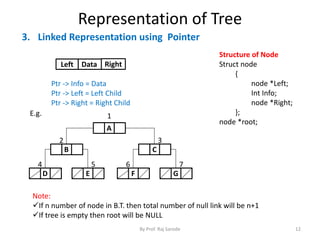
3. Linked Representation using Pointer 
Structure of Node 
Struct node 
{ 
node *Left; 
Int Info; 
node *Right; 
}; 
node *root; 
2 3 
6 7 
By Prof. Raj Sarode 12 
Ptr -> Info = Data 
Ptr -> Left = Left Child 
Ptr -> Right = Right Child 
1 
A 
B C 
4 5 
D E 
F G 
Left Data Right 
E.g. 
Note: 
If n number of node in B.T. then total number of null link will be n+1 
If tree is empty then root will be NULL
Binary Search Tree 
A binary Search Tree is special kind if tree that satisfied 
the following conditions. 
1. The data elements of left sub tree are smaller than 
the root of the tree. 
2. The data elements of right sub tree are greater than 
or equal to the root of the tree. 
3. The left sub tree and right sub tree are also the 
binary search trees, i.e. they must also follow the 
above two rules. 
By Prof. Raj Sarode 13
Operation on Binary Search Tree 
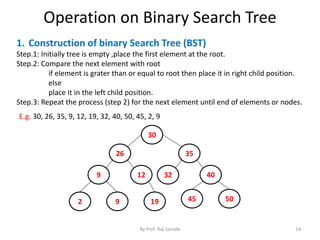
1. Construction of binary Search Tree (BST) 
Step.1: Initially tree is empty ,place the first element at the root. 
Step.2: Compare the next element with root 
if element is grater than or equal to root then place it in right child position. 
else 
place it in the left child position. 
Step.3: Repeat the process (step 2) for the next element until end of elements or nodes. 
E.g. 30, 26, 35, 9, 12, 19, 32, 40, 50, 45, 2, 9 
30 
26 35 
9 12 32 40 
2 9 19 45 50 
By Prof. Raj Sarode 14
Operation on Binary Search Tree 
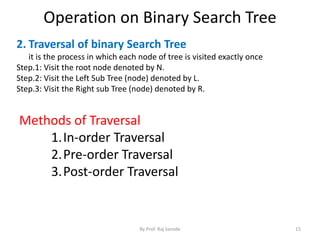
2. Traversal of binary Search Tree 
it is the process in which each node of tree is visited exactly once 
Step.1: Visit the root node denoted by N. 
Step.2: Visit the Left Sub Tree (node) denoted by L. 
Step.3: Visit the Right sub Tree (node) denoted by R. 
Methods of Traversal 
1.In-order Traversal 
2.Pre-order Traversal 
3.Post-order Traversal 
By Prof. Raj Sarode 15
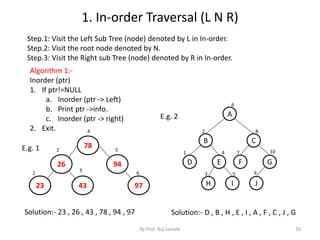
1. In-order Traversal (L N R) 
Step.1: Visit the Left Sub Tree (node) denoted by L in In-order. 
Step.2: Visit the root node denoted by N. 
Step.3: Visit the Right sub Tree (node) denoted by R in In-order. 
Algorithm 1:- 
Inorder (ptr) 
1. If ptr!=NULL 
6 
By Prof. Raj Sarode 16 
a. Inorder (ptr -> Left) 
b. Print ptr ->info. 
c. Inorder (ptr -> right) 
2. Exit. 
78 
26 94 
23 43 97 
Solution:- 23 , 26 , 43 , 78 , 94 , 97 
A 
B C 
D E F G 
H I J 
Solution:- D , B , H , E , I , A , F , C , J , G 
E.g. 1 
E.g. 2 
1 
2 
3 
4 
5 
6 
1 
2 
3 
4 
5 
7 
8 
9 
10
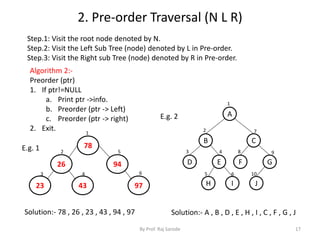
2. Pre-order Traversal (N L R) 
Step.1: Visit the root node denoted by N. 
Step.2: Visit the Left Sub Tree (node) denoted by L in Pre-order. 
Step.3: Visit the Right sub Tree (node) denoted by R in Pre-order. 
Algorithm 2:- 
Preorder (ptr) 
1. If ptr!=NULL 
By Prof. Raj Sarode 17 
a. Print ptr ->info. 
b. Preorder (ptr -> Left) 
c. Preorder (ptr -> right) 
2. Exit. 
78 
26 94 
23 43 97 
Solution:- 78 , 26 , 23 , 43 , 94 , 97 
A 
B C 
D E F G 
H I J 
Solution:- A , B , D , E , H , I , C , F , G , J 
E.g. 1 
E.g. 2 
1 
2 
3 4 
5 
6 
1 
2 
3 4 
5 6 
7 
8 9 
10
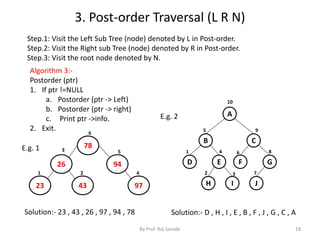
3. Post-order Traversal (L R N) 
Step.1: Visit the Left Sub Tree (node) denoted by L in Post-order. 
Step.2: Visit the Right sub Tree (node) denoted by R in Post-order. 
Step.3: Visit the root node denoted by N. 
Algorithm 3:- 
Postorder (ptr) 
1. If ptr !=NULL 
4 
5 
By Prof. Raj Sarode 18 
a. Postorder (ptr -> Left) 
b. Postorder (ptr -> right) 
c. Print ptr ->info. 
2. Exit. 
78 
3 
26 94 
23 43 97 
Solution:- 23 , 43 , 26 , 97 , 94 , 78 
A 
B C 
D E F G 
H I J 
Solution:- D , H , I , E , B , F , J , G , C , A 
E.g. 1 
E.g. 2 
1 2 
4 
5 
6 
1 
2 3 
6 
7 
8 
9 
10
Thank You 
By Prof. Raj Sarode 19

Tree

  • 1.
  • 2.
    Data structure isdivided into two categories By Prof. Raj Sarode 2 Linear Data Structure Non Linear Data Structure Data Structure Data elements in Sequential Order E.g.- Array, Stack, Link list, Queue Data elements in Hierarchical / Non-Sequential Order E.g.- Tree, Graph Tree is Non-Linear DS used in computer science E.g. Solving Algebraic Equation Information Retrieval Data Mining Artificial Intelligence Natural Language Processing
  • 3.
    Tree “Tree isa finite collection of special Data items called the NODE ” The node of Tree are arranged in the hierarchical structure to represent the parent-child relationship.  First node of tree does not have any parent is called the Root (node) of tree. Parent is connected through an edge to its child or descendents. By Prof. Raj Sarode 3
  • 4.
    By Prof. RajSarode 4 Tree Terminology :- Node Root Edge 1. Node: Each Elements of Tree is called node 2. Edges: The Lines Connecting the nodes are called Edges. 3. Parent Node: The Immediate predecessor of node is called parent node. 4. Grand Parent: Parent of Parent 5. Child Node: All the immediate successor of a node are its child node. 6. Root Node: The node does not having any parent. 7. Leaf Node: The node does not having any child called Leaf node or Terminal node. 8. Level: Level of Node is distance of that node from root. (Rot node at distance 0 from itself hence is at level 0) 9. Height: Total No. of level in tree (is equal to depth of tree) 10. Degree of Node: No. of children it has. 11. Siblings: children of the same parent node (two or more node have same parent are called sibling or brother
  • 5.
    Binary Tree “Isa tree which is either empty or each node can have maximum two child” Means each node have 0, or 1 or 2 Childs Left Child: The node on the left of any node is called left child. Right child: The node on the right of any node is called right child. Left Sub tree: sub tree attached to left side of root node is called left sub tree. Right Sub tree: sub tree attached to right side of root node is called right sub tree. By Prof. Raj Sarode 5 Left Subtree Left Subtree The node of a binary tree is divided into three parts : Left child Address Left Info Right Right child Address
  • 6.
    Classification of BinaryTree By Prof. Raj Sarode 6 1. Strictly Binary Tree: Each node in a tree is either Leaf or has exactly two children Strictly binary tree with n Leaves always contains 2n-1 nodes E.g. 2 Leaves in First Example having 2*2-1=3 Nodes. 3 Leaves in Second Example having 3*2-1=5 Nodes. 4 Leaves in Third Example having 4*2-1=7 Nodes
  • 7.
    Classification of BinaryTree By Prof. Raj Sarode 7 2. Complete Binary Tree: A binary tree where having height h is a strictly binary tree and all leaves are at h levels that tree is complete binary tree Or All the terminal node of a tree are at level d ,where d is the depth of tree, then such trees are called complete binary tree.
  • 8.
    Classification of BinaryTree 3. Almost Complete Binary Tree: A binary tree in which all the terminal node or leaf node of tree are at level d or d-1, where d is the depth of tree, then such trees are called almost complete binary tree. L 0 L 1 L 2 L 3 By Prof. Raj Sarode 8 L 0 L 1 L 2
  • 9.
    Classification of BinaryTree By Prof. Raj Sarode 9 4. Extended Binary Tree: If in a binary tree ,each empty sub tree (Leaf Node) is replaced by a special node then the resulting tree is extended binary tree or 2-tree  We can add special node to leaf node & node that have only one child.  The special nodes added to the tree are called External Node & original node of tree are called Internal Node External Node Internal Node Binary Tree Extended Binary Tree Note: Binary Tree of Height h has maximum (2 h+1 - 1) nodes
  • 10.
    Representation of Tree 1. Sequential Representation using array  Tree is store in single array  Number are assigned to each node from leftmost to rightmost node.  Root node always assign no. 1  Left Child is placed at position [2 * K] (k is position of root)  Right Child is placed at position [2 * K + 1]  Size of array is Depends on Depth of tree i.e. 2 d+1 By Prof. Raj Sarode 10 A B C D E F G H I 1 2 3 4 5 6 7 8 9 Root (A) =1 L Child = [2*k]= 2 * 1 =2 (B) R child = [2 * K + 1] = 2 * 1 + 1 = 3 (C) Root(B)=2 L Child = [2*k]= 2 * 2 =4 (D) R child = [2 * K + 1] = 2 * 2 + 1 = 5 (E) Note: If root is placed at 0th position then L Child = [2 * k + 1 ] R child = [2 * K + 2 ]
  • 11.
    Representation of Tree 2. Linked Representation using array  Tree is store in single array Structure of Node Struct mode { Int Left; Int Info; Int Right; }; Node Tree[10]; 1 2 3 B C 6 7 By Prof. Raj Sarode 11 A 4 5 D E Tree [ 1] . Info = A Tree [ 1 ] . Left = 2 Tree [ 1 ] . Right = 3 F G 2 A 3 E.g.
  • 12.
    Representation of Tree 3. Linked Representation using Pointer Structure of Node Struct node { node *Left; Int Info; node *Right; }; node *root; 2 3 6 7 By Prof. Raj Sarode 12 Ptr -> Info = Data Ptr -> Left = Left Child Ptr -> Right = Right Child 1 A B C 4 5 D E F G Left Data Right E.g. Note: If n number of node in B.T. then total number of null link will be n+1 If tree is empty then root will be NULL
  • 13.
    Binary Search Tree A binary Search Tree is special kind if tree that satisfied the following conditions. 1. The data elements of left sub tree are smaller than the root of the tree. 2. The data elements of right sub tree are greater than or equal to the root of the tree. 3. The left sub tree and right sub tree are also the binary search trees, i.e. they must also follow the above two rules. By Prof. Raj Sarode 13
  • 14.
    Operation on BinarySearch Tree 1. Construction of binary Search Tree (BST) Step.1: Initially tree is empty ,place the first element at the root. Step.2: Compare the next element with root if element is grater than or equal to root then place it in right child position. else place it in the left child position. Step.3: Repeat the process (step 2) for the next element until end of elements or nodes. E.g. 30, 26, 35, 9, 12, 19, 32, 40, 50, 45, 2, 9 30 26 35 9 12 32 40 2 9 19 45 50 By Prof. Raj Sarode 14
  • 15.
    Operation on BinarySearch Tree 2. Traversal of binary Search Tree it is the process in which each node of tree is visited exactly once Step.1: Visit the root node denoted by N. Step.2: Visit the Left Sub Tree (node) denoted by L. Step.3: Visit the Right sub Tree (node) denoted by R. Methods of Traversal 1.In-order Traversal 2.Pre-order Traversal 3.Post-order Traversal By Prof. Raj Sarode 15
  • 16.
    1. In-order Traversal(L N R) Step.1: Visit the Left Sub Tree (node) denoted by L in In-order. Step.2: Visit the root node denoted by N. Step.3: Visit the Right sub Tree (node) denoted by R in In-order. Algorithm 1:- Inorder (ptr) 1. If ptr!=NULL 6 By Prof. Raj Sarode 16 a. Inorder (ptr -> Left) b. Print ptr ->info. c. Inorder (ptr -> right) 2. Exit. 78 26 94 23 43 97 Solution:- 23 , 26 , 43 , 78 , 94 , 97 A B C D E F G H I J Solution:- D , B , H , E , I , A , F , C , J , G E.g. 1 E.g. 2 1 2 3 4 5 6 1 2 3 4 5 7 8 9 10
  • 17.
    2. Pre-order Traversal(N L R) Step.1: Visit the root node denoted by N. Step.2: Visit the Left Sub Tree (node) denoted by L in Pre-order. Step.3: Visit the Right sub Tree (node) denoted by R in Pre-order. Algorithm 2:- Preorder (ptr) 1. If ptr!=NULL By Prof. Raj Sarode 17 a. Print ptr ->info. b. Preorder (ptr -> Left) c. Preorder (ptr -> right) 2. Exit. 78 26 94 23 43 97 Solution:- 78 , 26 , 23 , 43 , 94 , 97 A B C D E F G H I J Solution:- A , B , D , E , H , I , C , F , G , J E.g. 1 E.g. 2 1 2 3 4 5 6 1 2 3 4 5 6 7 8 9 10
  • 18.
    3. Post-order Traversal(L R N) Step.1: Visit the Left Sub Tree (node) denoted by L in Post-order. Step.2: Visit the Right sub Tree (node) denoted by R in Post-order. Step.3: Visit the root node denoted by N. Algorithm 3:- Postorder (ptr) 1. If ptr !=NULL 4 5 By Prof. Raj Sarode 18 a. Postorder (ptr -> Left) b. Postorder (ptr -> right) c. Print ptr ->info. 2. Exit. 78 3 26 94 23 43 97 Solution:- 23 , 43 , 26 , 97 , 94 , 78 A B C D E F G H I J Solution:- D , H , I , E , B , F , J , G , C , A E.g. 1 E.g. 2 1 2 4 5 6 1 2 3 6 7 8 9 10
  • 19.
    Thank You ByProf. Raj Sarode 19