TREES
Trees
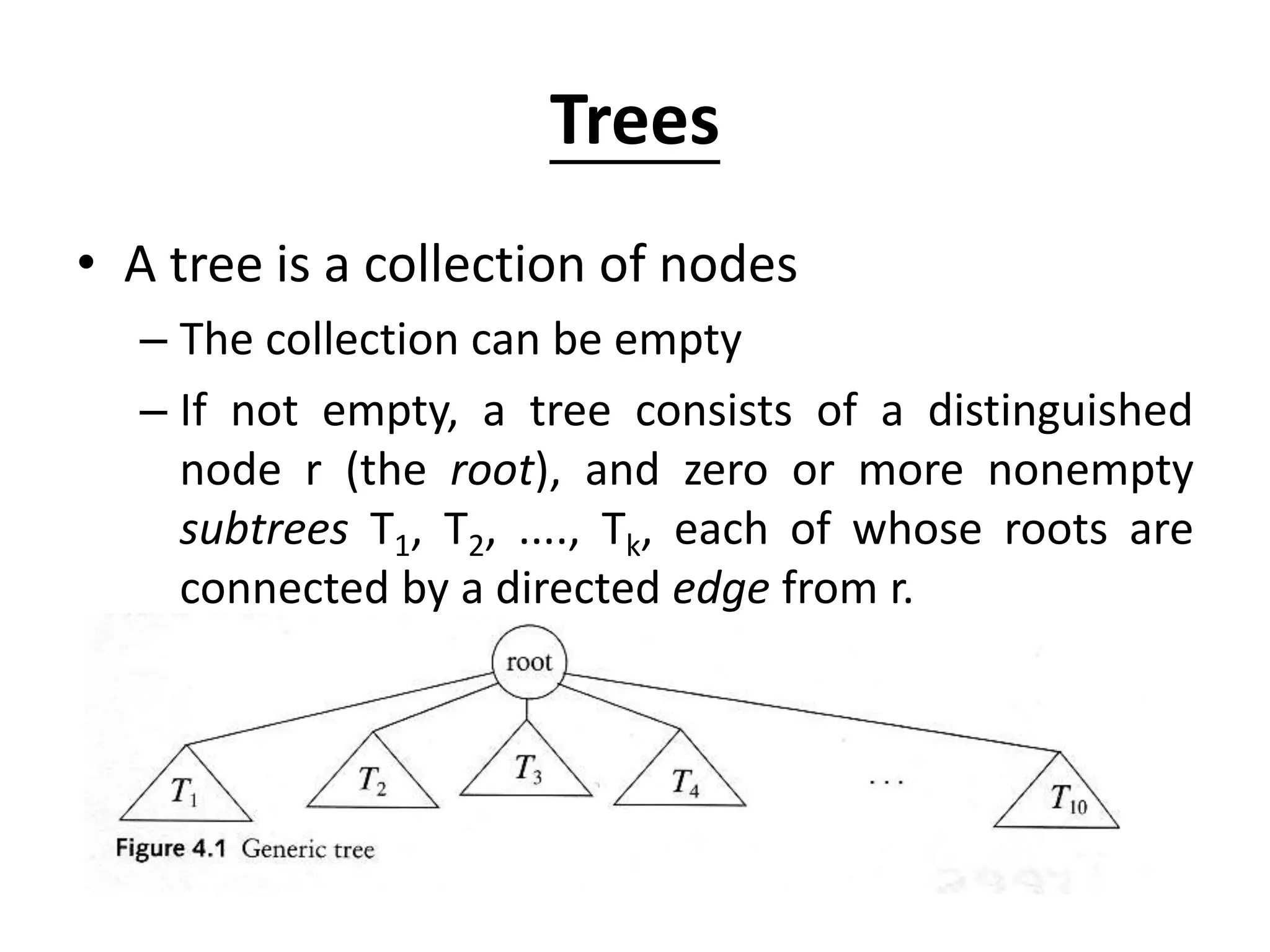
• A tree is a collection of nodes
– The collection can be empty
– If not empty, a tree consists of a distinguished
node r (the root), and zero or more nonempty
subtrees T1, T2, ...., Tk, each of whose roots are
connected by a directed edge from r.
Terminologies
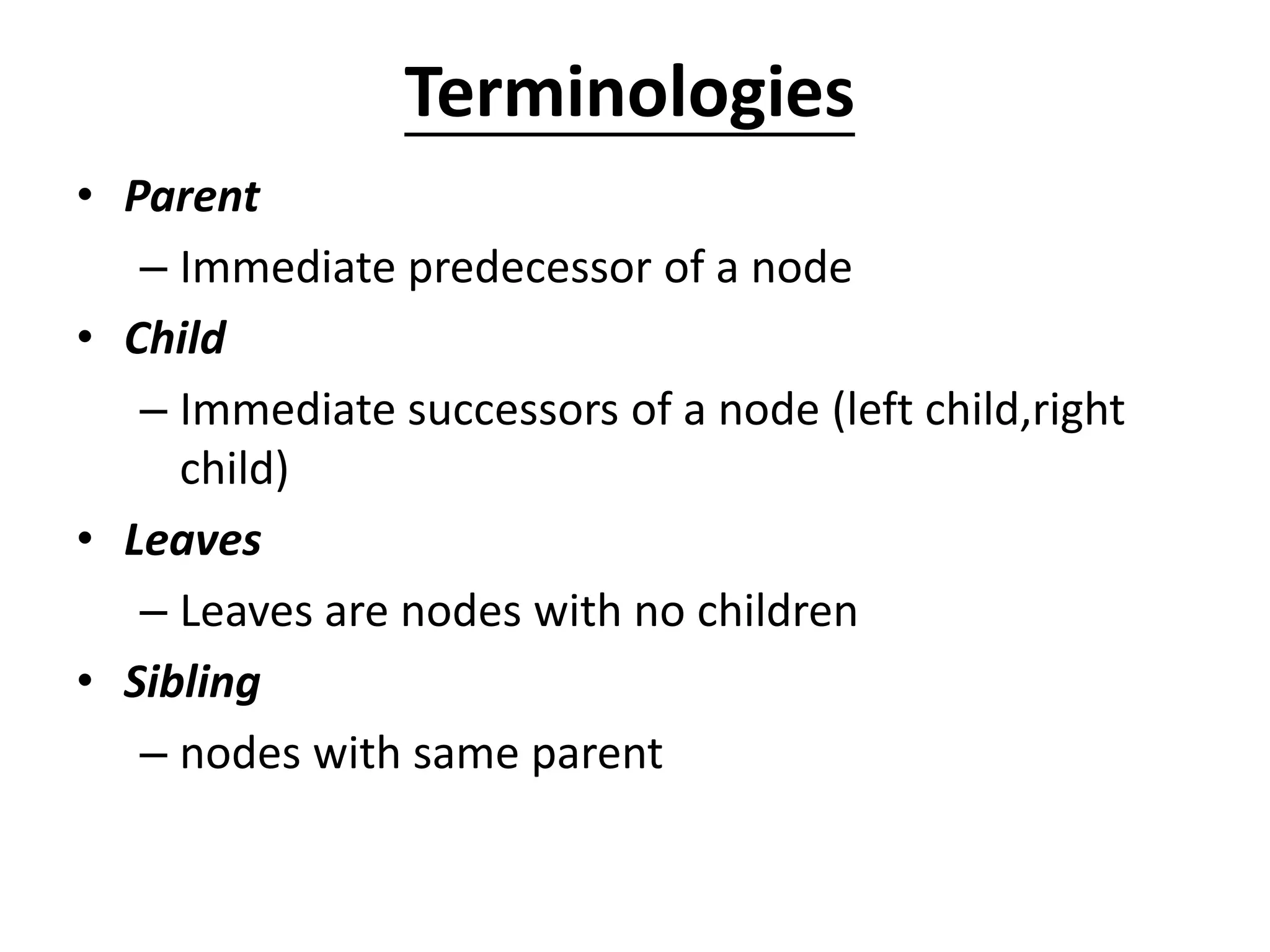
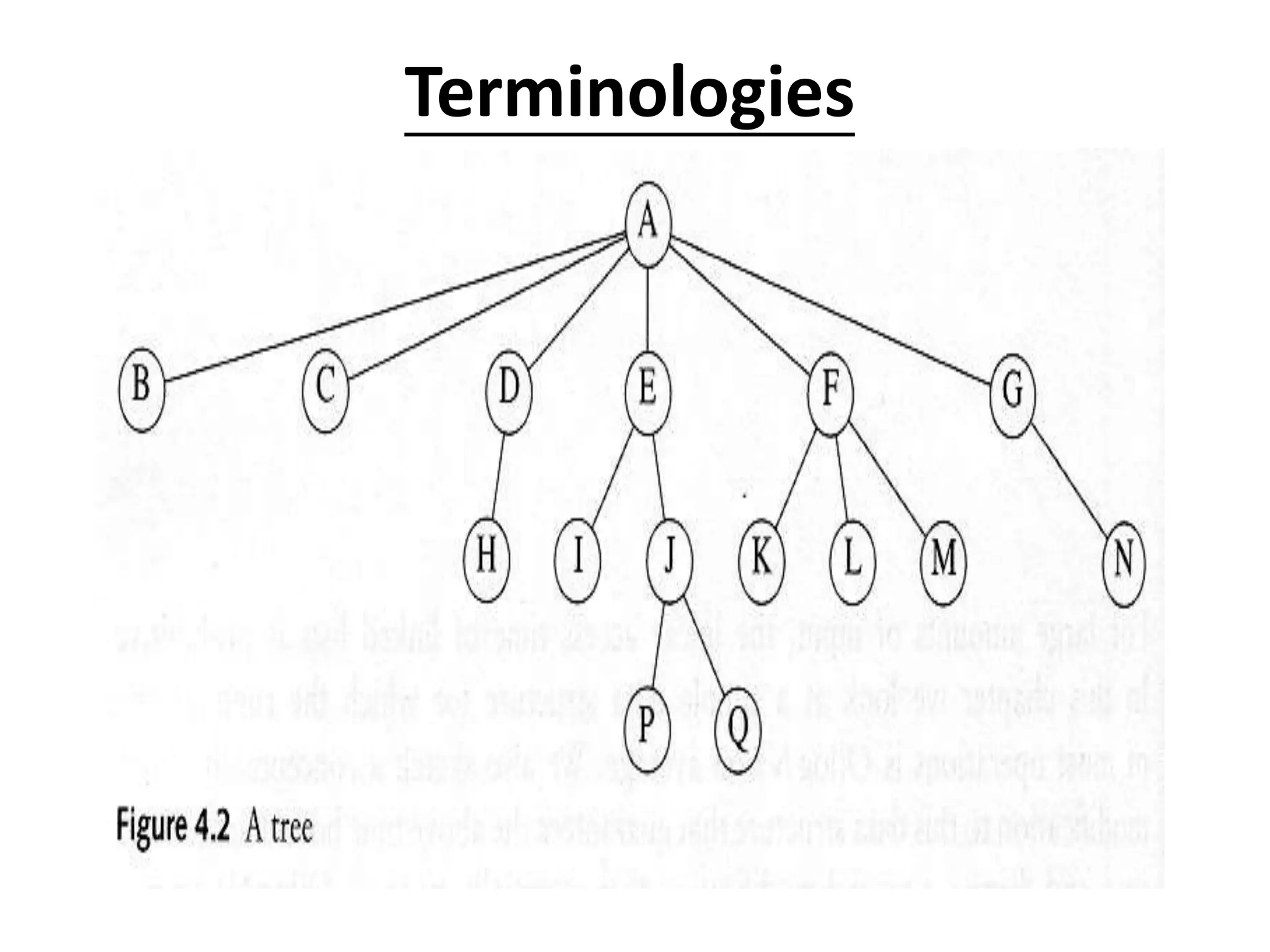
• Parent
– Immediate predecessor of a node
• Child
– Immediate successors of a node (left child,right
child)
• Leaves
– Leaves are nodes with no children
• Sibling
– nodes with same parent
Terminologies
• Level
– Rank in the hierarchy
• Length of a path
– number of edges on the path
• Height of a node(Depth )
– max no of nodes in a path starting from the
root node to a leaf node.
• Degree
– Max no of children that is possible for a node
• Ancestor and descendant
– If there is a path from n1 to n2
– n1 is an ancestor of n2, n2 is a descendant of
n1
– Proper ancestor and proper descendant
Terminologies
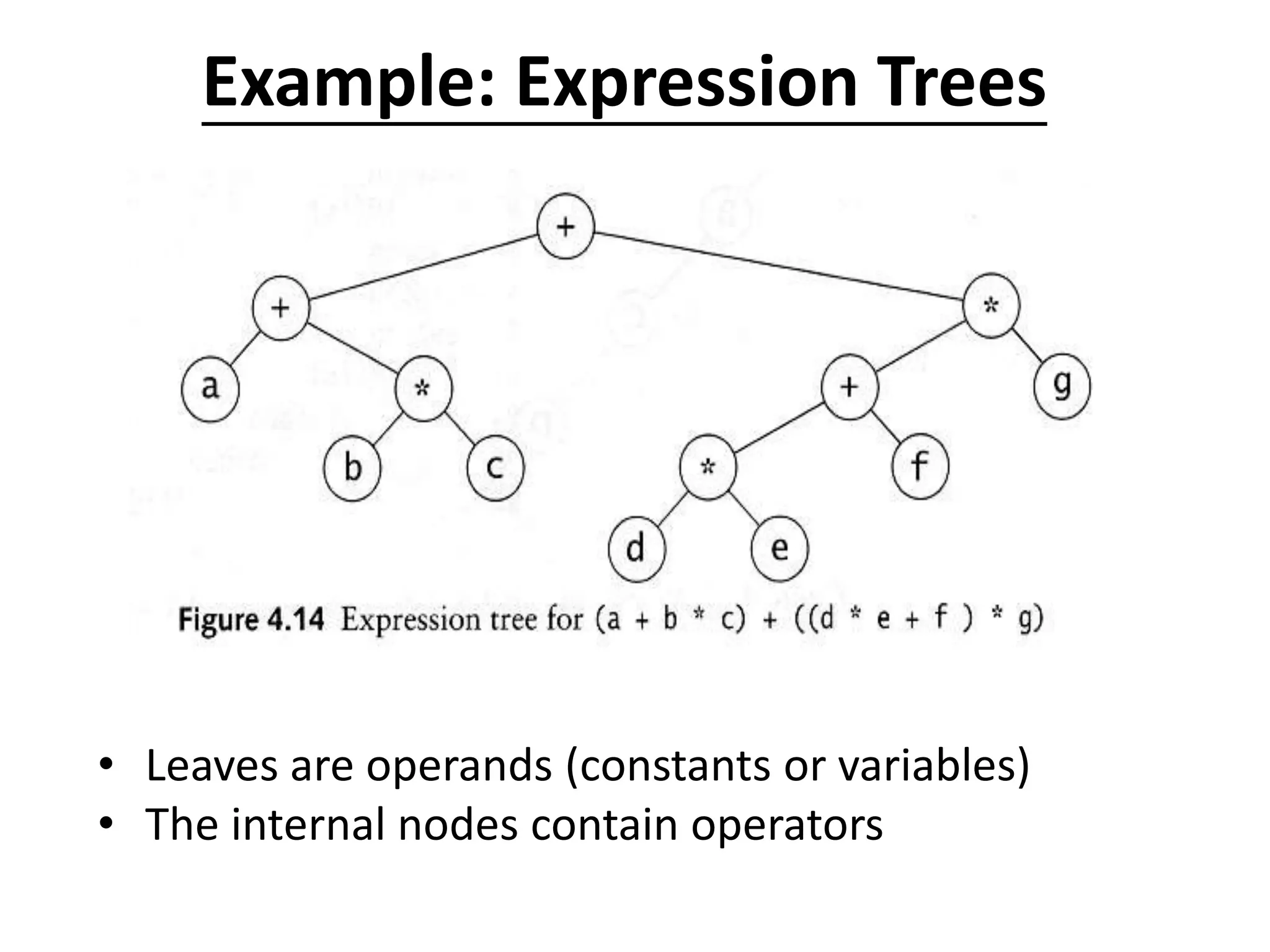
Example: Expression Trees
• Leaves are operands (constants or variables)
• The internal nodes contain operators
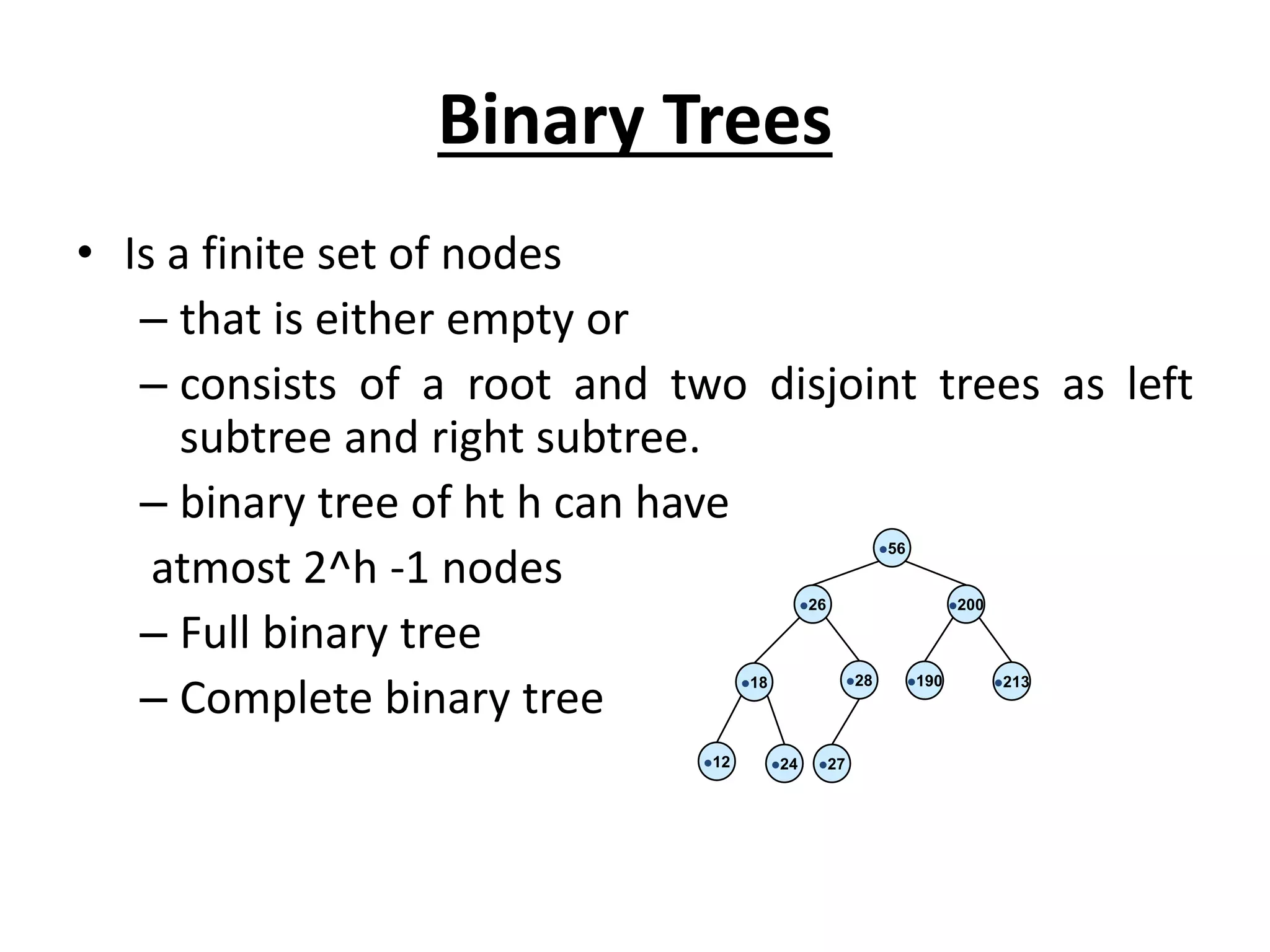
Binary Trees
• Is a finite set of nodes
– that is either empty or
– consists of a root and two disjoint trees as left
subtree and right subtree.
– binary tree of ht h can have
atmost 2^h -1 nodes
– Full binary tree
– Complete binary tree
56
26 200
18 28 190 213
12 24 27
Binary Tree Representation
• Linear Representation
– Parent (i)=[i/2]
– Lchild (i)= 2 * i
– Rchild(i)=(2*i) +1
• Linked Representation
– three fields
• leftchild
• data
• rightchild
Tree Traversal
• Used to print out the data in a tree in a certain
order
• Pre-order traversal
• Post-order traversal
• In-order traversal
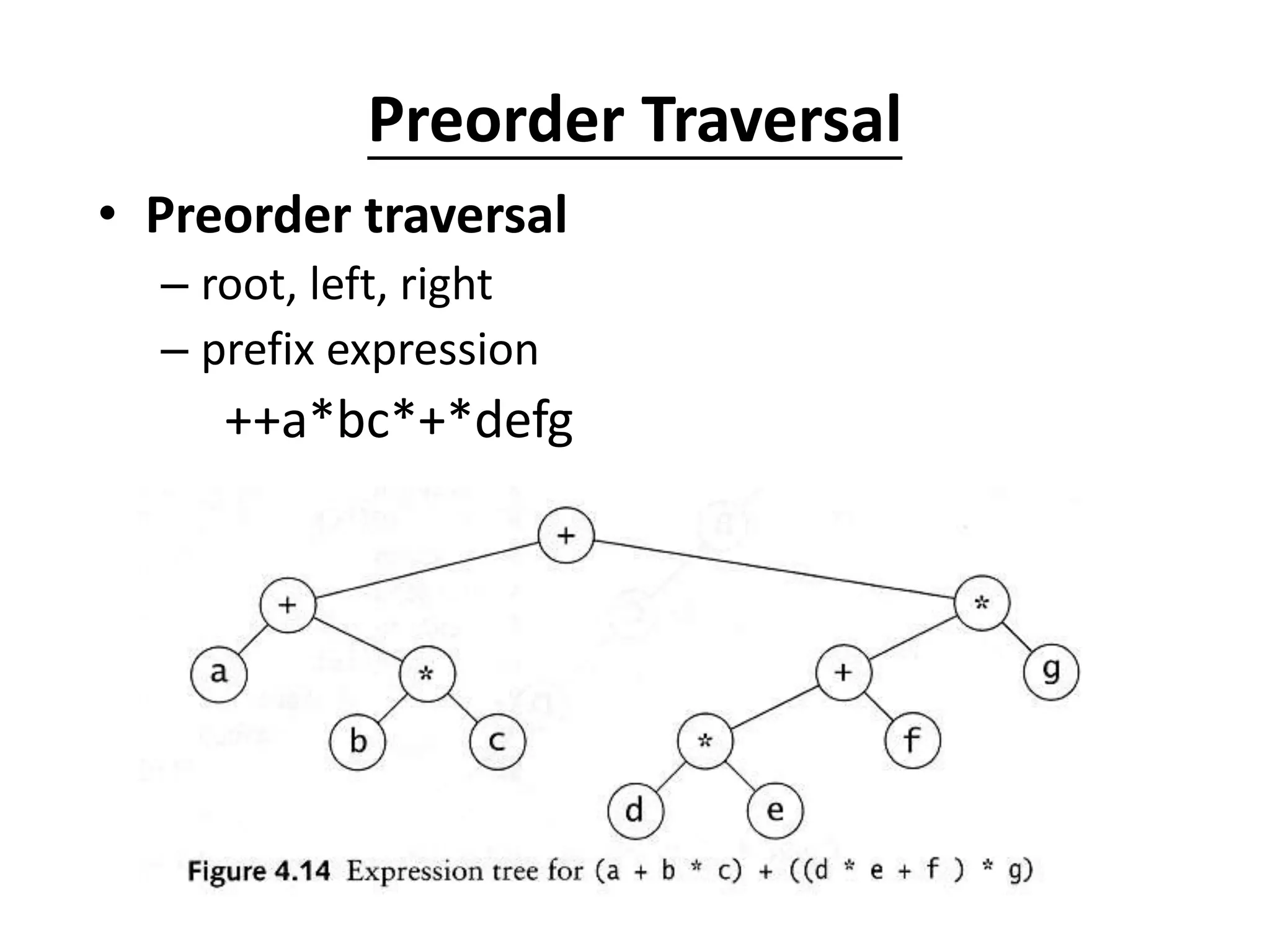
Preorder Traversal
• Preorder traversal
– root, left, right
– prefix expression
++a*bc*+*defg
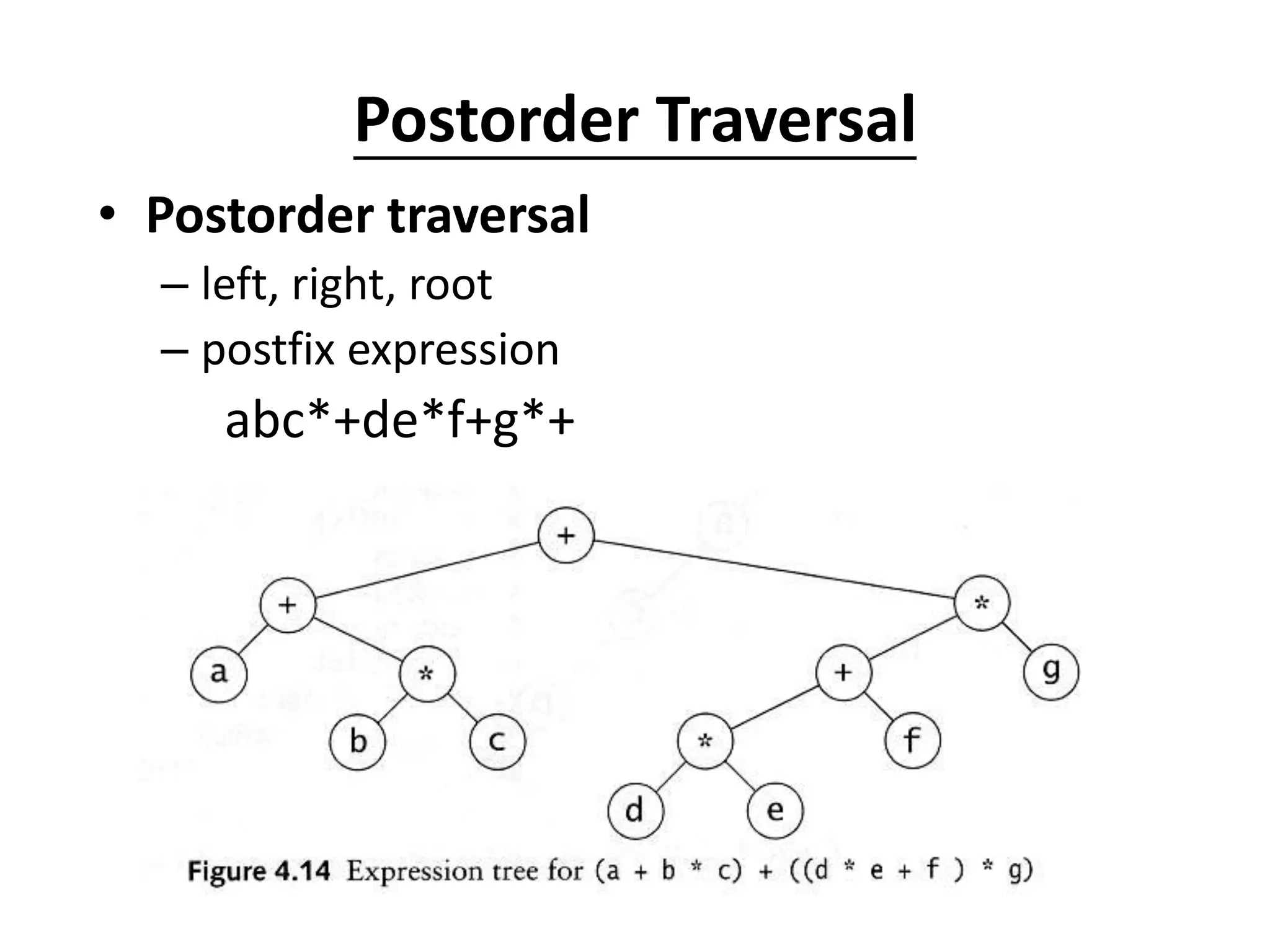
Postorder Traversal
• Postorder traversal
– left, right, root
– postfix expression
abc*+de*f+g*+
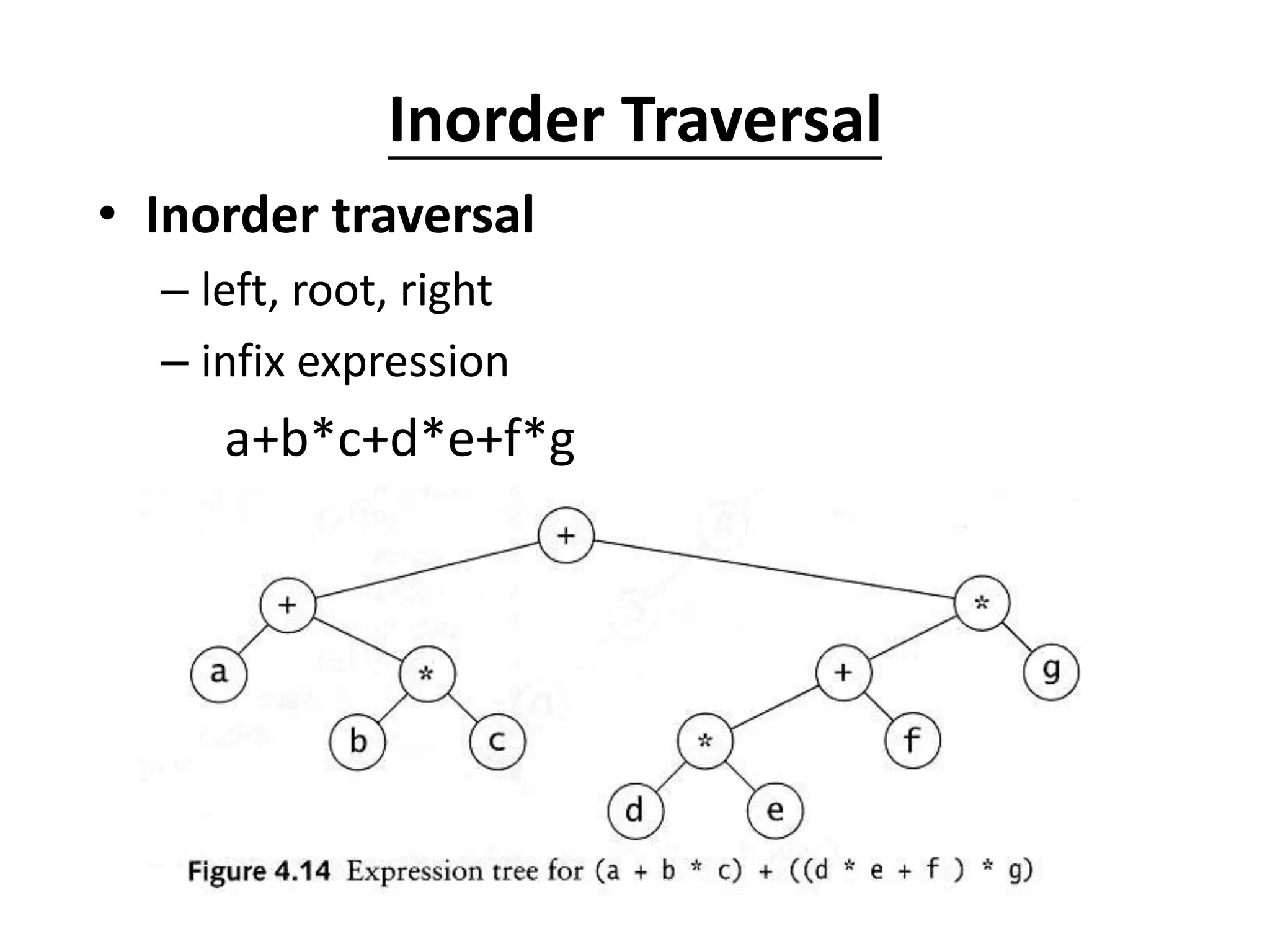
Inorder Traversal
• Inorder traversal
– left, root, right
– infix expression
a+b*c+d*e+f*g
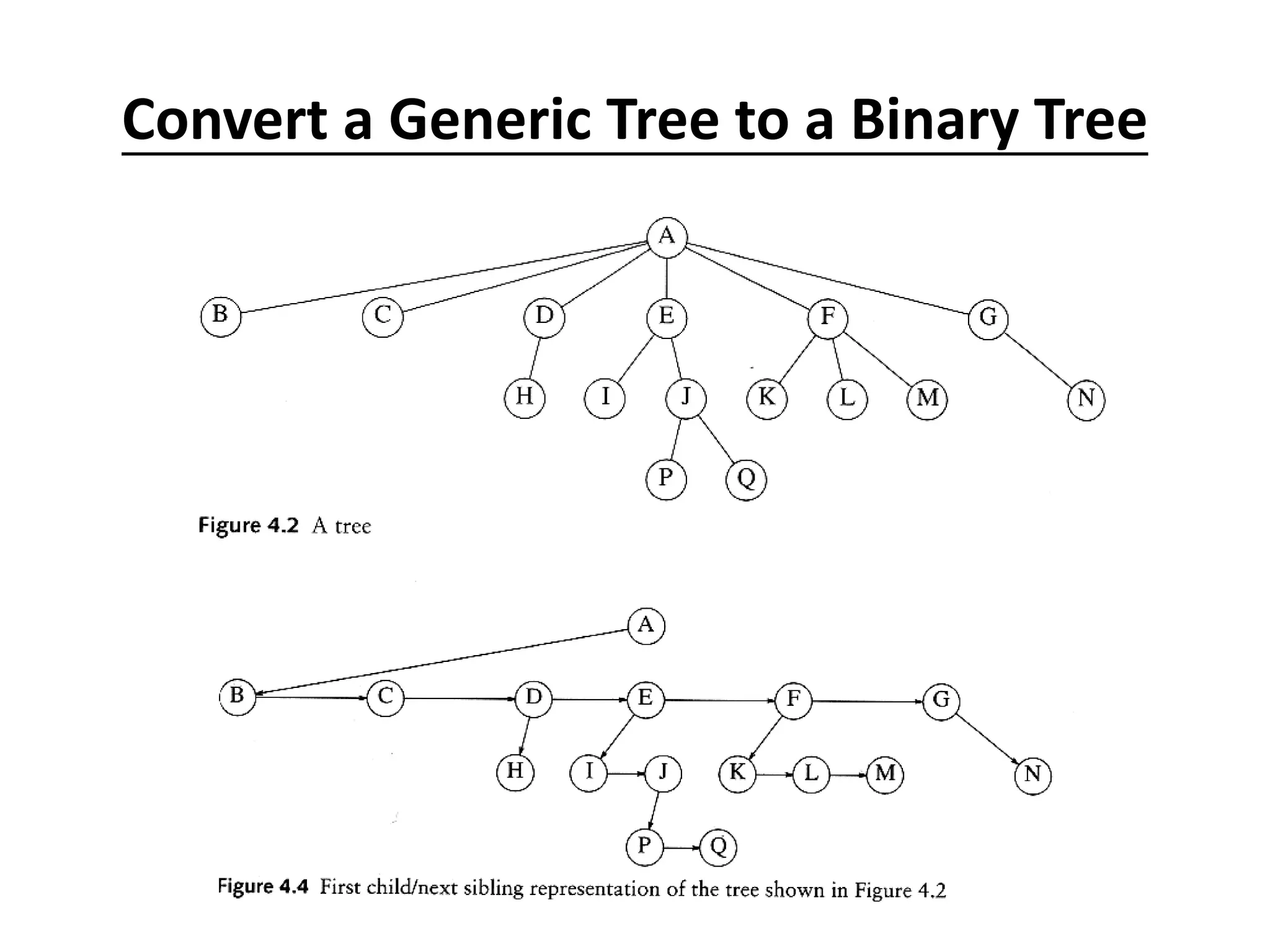
Convert a Generic Tree to a Binary Tree
Binary Search Trees
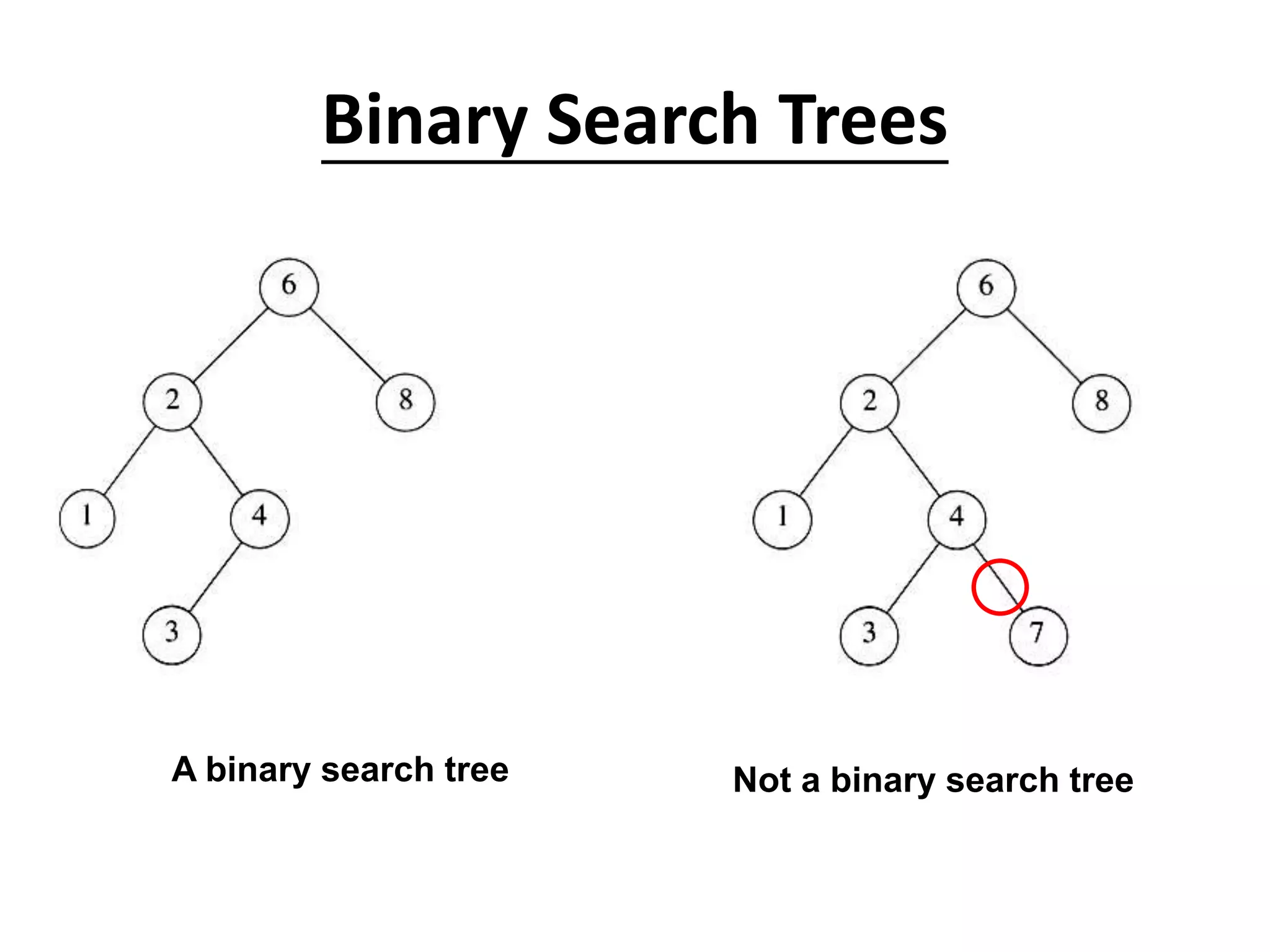
• Binary search tree
– Every node has a unique key.
– The keys in a nonempty left subtree are smaller
than the key in the root .
– The keys in a nonempty right subtree are
greater than the key in the root .
– The left and right subtrees are also binary
search trees.
BST – Representation
• Represented by a linked data structure of nodes.
• root(T) points to the root of tree T.
• Each node contains fields:
– key
– left – pointer to left child: root of left subtree.
– right – pointer to right child : root of right subtree.
– p – pointer to parent. p[root[T]] = NIL (optional).
Binary Search Tree Property
• Stored keys must satisfy
the binary search tree
property.
–  y in left subtree of
x, then key[y] 
key[x].
–  y in right subtree
of x, then key[y] 
key[x].
56
26 200
18 28 190 213
12 24 27
Binary Search Trees
A binary search tree Not a binary search tree
Binary Search Trees
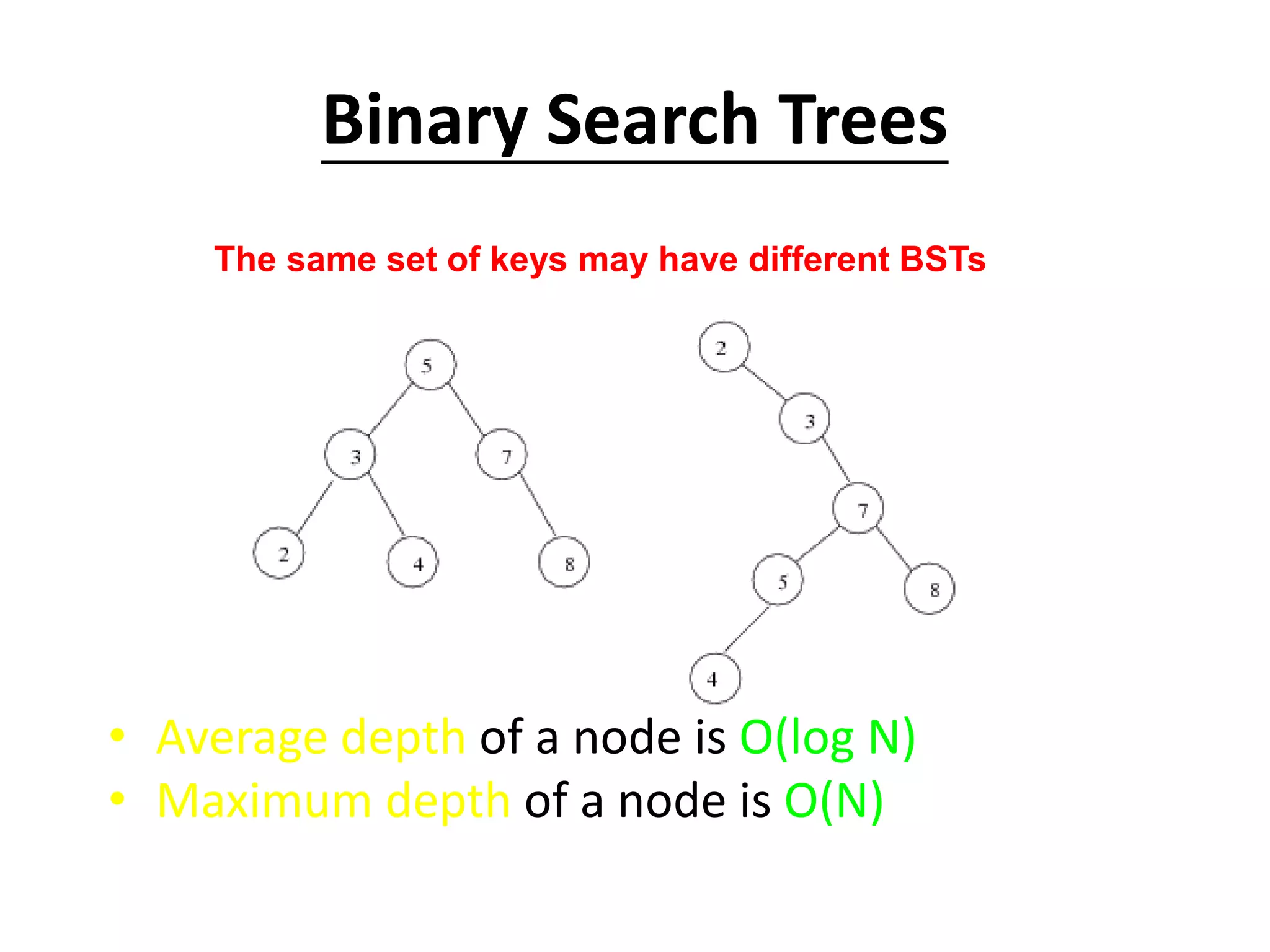
• Average depth of a node is O(log N)
• Maximum depth of a node is O(N)
The same set of keys may have different BSTs
Querying a Binary Search Tree
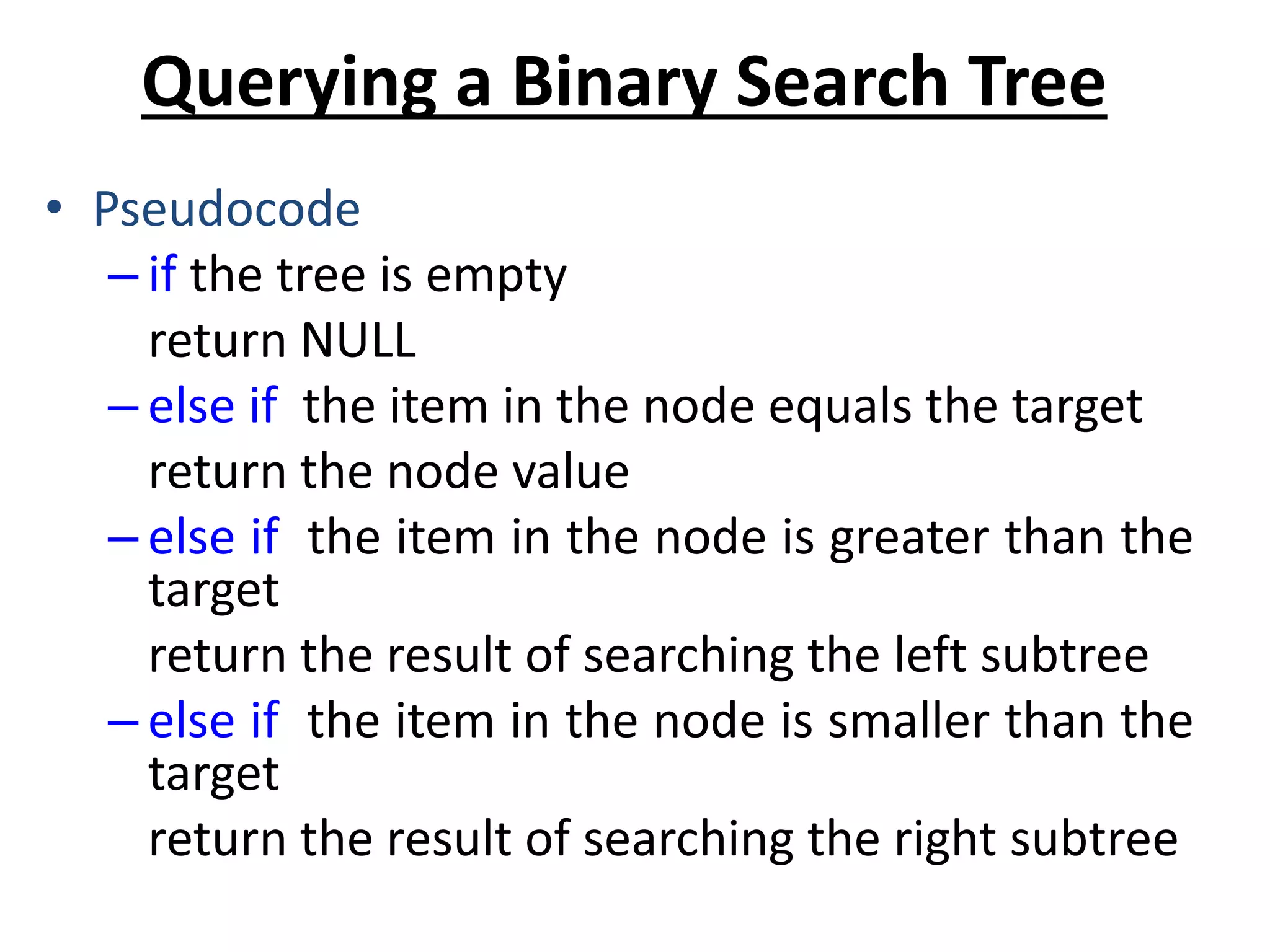
• Pseudocode
– if the tree is empty
return NULL
– else if the item in the node equals the target
return the node value
– else if the item in the node is greater than the
target
return the result of searching the left subtree
– else if the item in the node is smaller than the
target
return the result of searching the right subtree
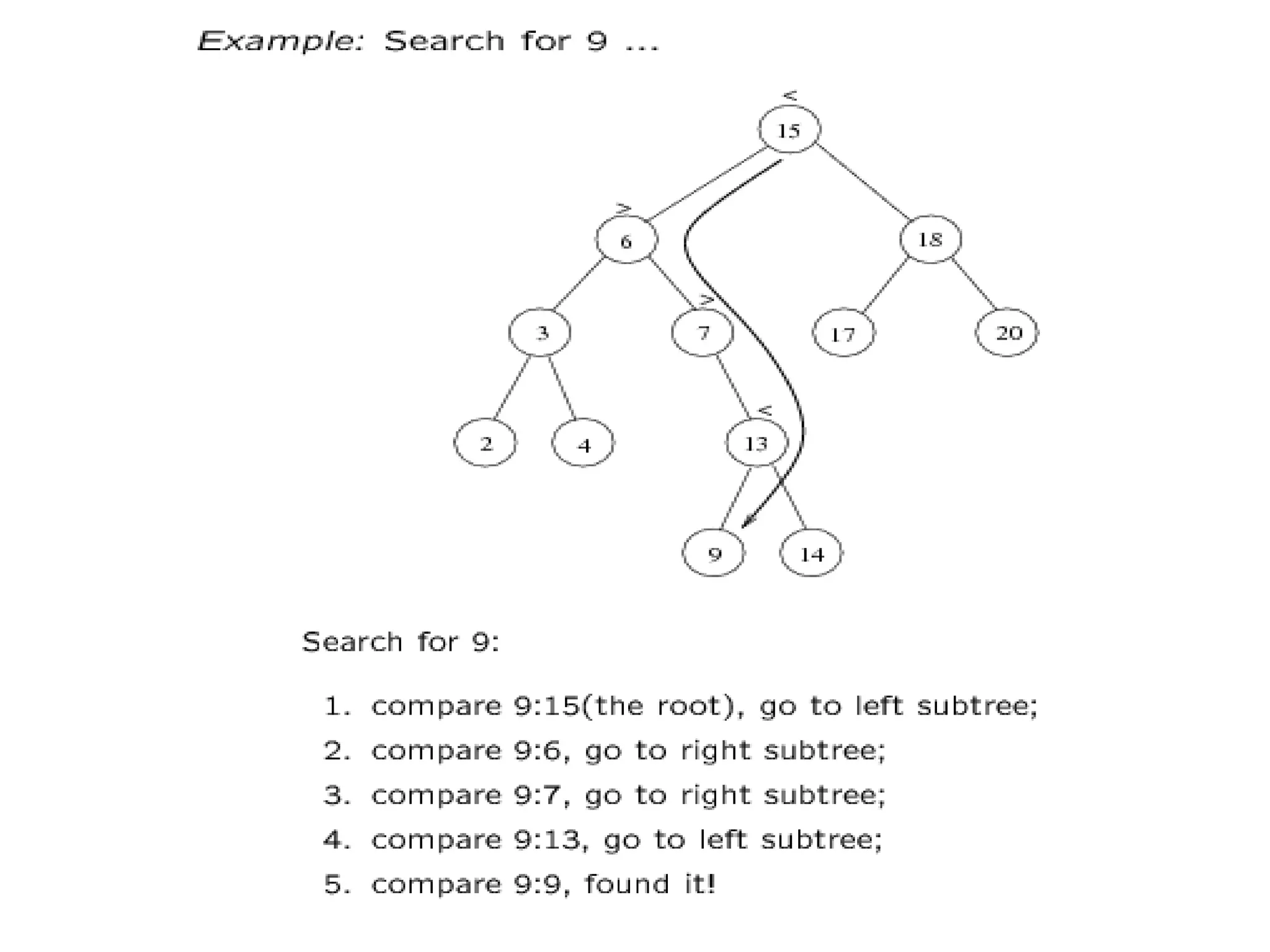
Tree Search
Tree-Search(x, k)
1. if x = NIL or k = key[x]
2. then return x
3. if k < key[x]
4. then return Tree-Search(left[x], k)
5. else return Tree-Search(right[x], k)
Running time: O(h)
56
26 200
18 28 190 213
12 24 27
Iterative Tree Search
Iterative-Tree-Search(x, k)
1. while x  NIL and k  key[x]
2. do if k < key[x]
3. then x  left[x]
4. else x  right[x]
5. return x
The iterative tree search is more efficient on most computers.
The recursive tree search is more straightforward.
56
26 200
18 28 190 213
12 24 27
Querying a Binary Search Tree
• All dynamic-set search operations can be supported in
O(h) time.
• h = (lg n) for a balanced binary tree (and for an
average tree built by adding nodes in random order.)
• h = (n) for an unbalanced tree that resembles a
linear chain of n nodes in the worst case.
Finding Min & Max
Tree-Minimum(x) Tree-Maximum(x)
1. while left[x]  NIL 1. while right[x]  NIL
2. do x  left[x] 2. do x  right[x]
3. return x 3. return x
The binary-search-tree property guarantees that:
» The minimum is located at the left-most node.
» The maximum is located at the right-most node.
Predecessor and Successor
• Successor of node x is the node y such that key[y] is the
smallest key greater than key[x].
• The successor of the largest key is NIL.
• Two cases:
– If node x has a non-empty right subtree, then x’s successor is
the minimum in the right subtree of x.
– If node x has an empty right subtree, then:
• As long as we move to the left up the tree (move up
through right children), we are visiting smaller keys.
• x’s successor y is the node that x is the predecessor of (x is
the maximum in y’s left subtree).
• In other words, x’s successor y, is the lowest ancestor of x
whose left child is also an ancestor of x.
Pseudo-code for Successor
Tree-Successor(x)
1. if right[x]  NIL
2. then return Tree-Minimum(right[x])
3. y  p[x]
4. while y  NIL and x = right[y]
5. do x  y
6. y  p[y]
7. return y
Code for predecessor is symmetric.
Running time: O(h)
56
26 200
18 28 190 213
12 24 27
27
Predecessor
Def: predecessor (x ) = y, such that key [y] is the
biggest key < key [x]
E.g.: predecessor (15) =
predecessor (9) =
predecessor (7) =
Case 1: left (x) is non empty
predecessor (x ) = the maximum in left (x)
Case 2: left (x) is empty
go up the tree until the current node is a right child:
predecessor (x ) is the parent of the current node
if you cannot go further (and you reached the root):
x is the smallest element
3
2 4
6
7
13
15
18
17 20
9
13
7
6 x
y
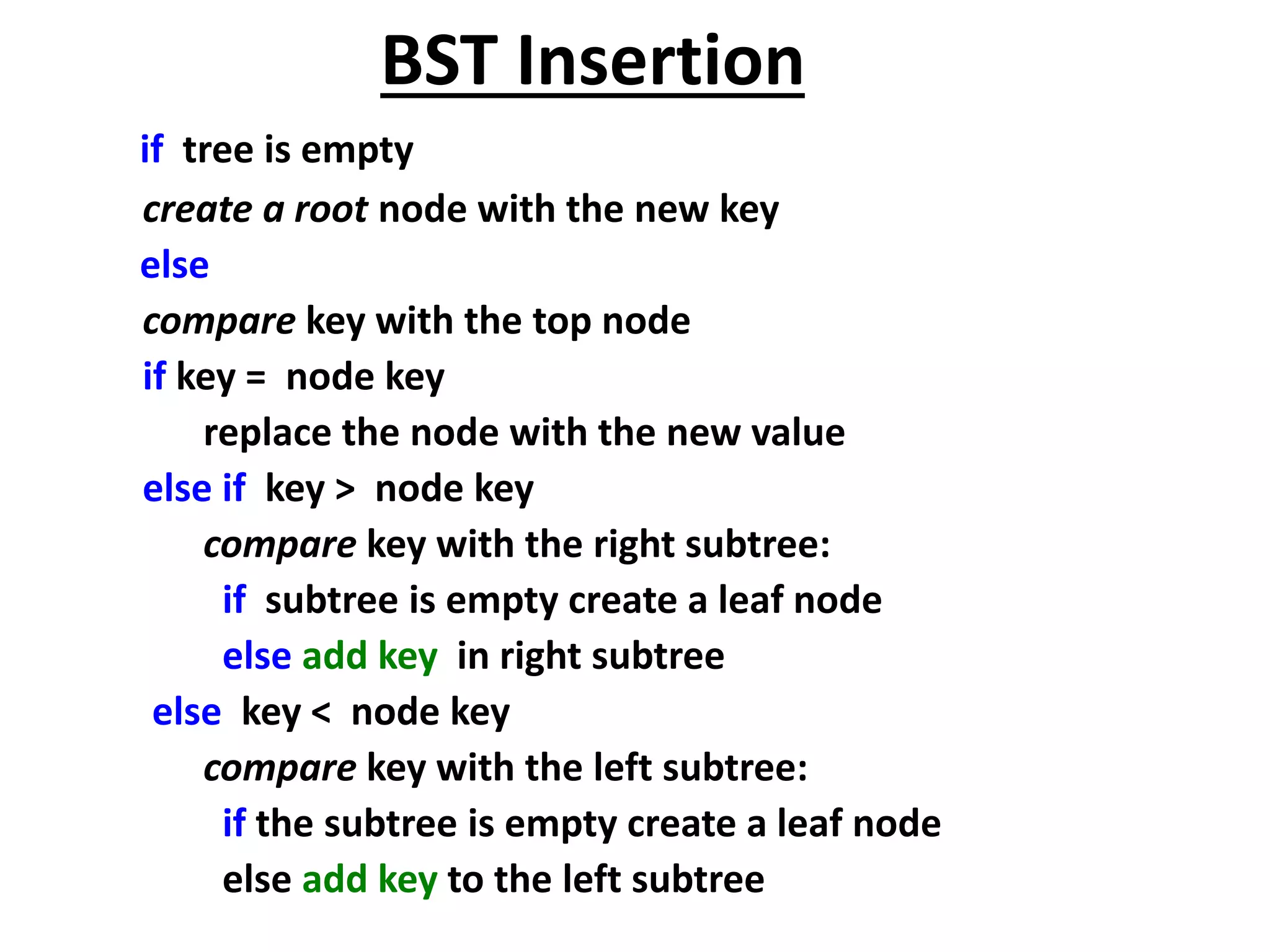
if tree is empty
create a root node with the new key
else
compare key with the top node
if key = node key
replace the node with the new value
else if key > node key
compare key with the right subtree:
if subtree is empty create a leaf node
else add key in right subtree
else key < node key
compare key with the left subtree:
if the subtree is empty create a leaf node
else add key to the left subtree
BST Insertion
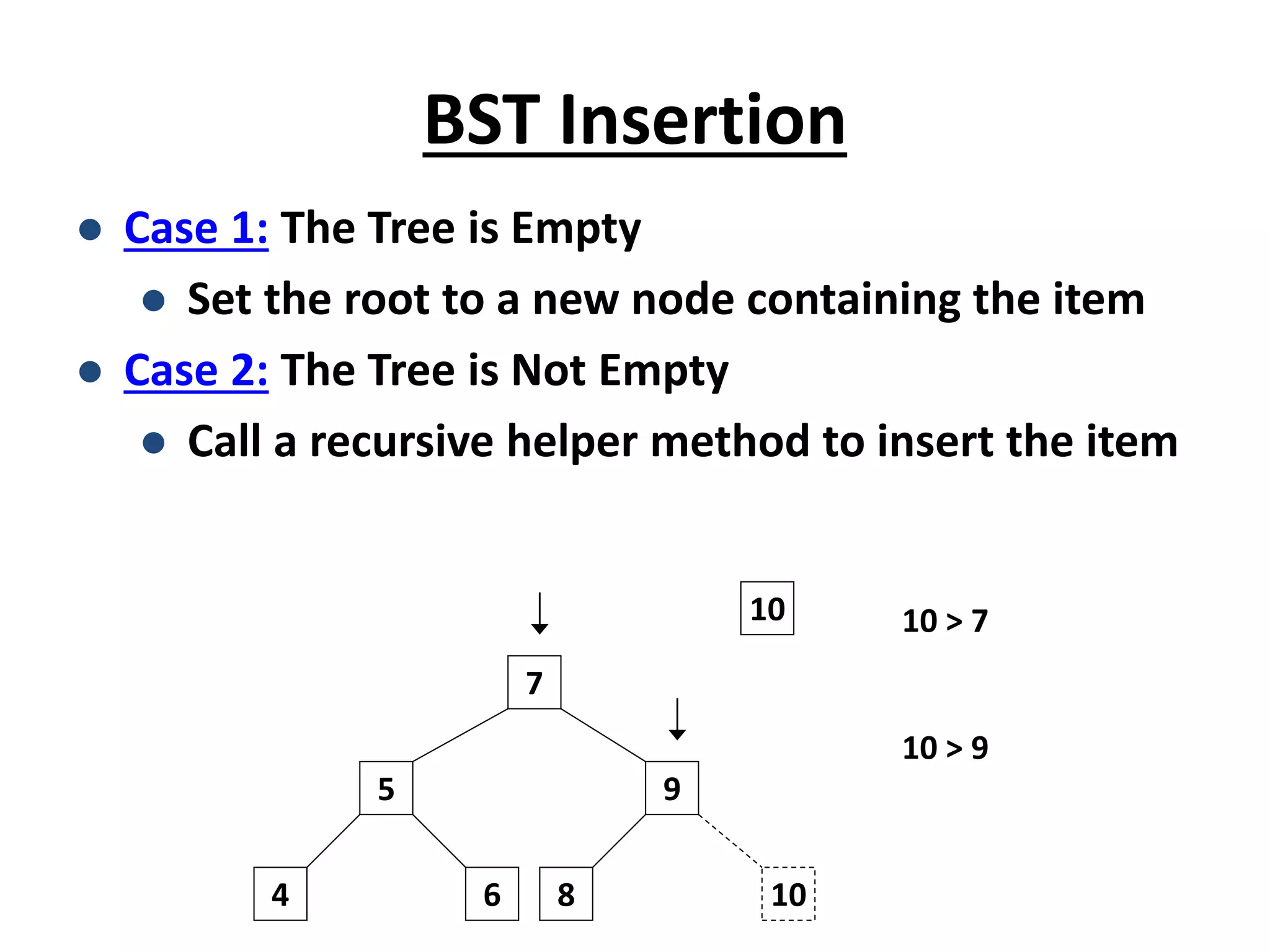
9
7
5
4 6 8
 Case 1: The Tree is Empty
 Set the root to a new node containing the item
 Case 2: The Tree is Not Empty
 Call a recursive helper method to insert the item
10 10 > 7
10 > 9
10
BST Insertion
BST Insertion – Pseudocode
Tree-Insert(T, z)
y  NIL
x  root[T]
while x  NIL
do y  x
if key[z] < key[x]
then x  left[x]
else x  right[x]
p[z]  y
if y = NIL
then root[t]  z
else if key[z] < key[y]
then left[y]  z
else right[y]  z
• Ensure the binary-
search-tree property
holds after change.
• Insertion is easier than
deletion.
56
26 200
18 28 190 213
12 24 27
Analysis of Insertion
• Initialization: O(1)
• While loop in lines 3-7
searches for place to
insert z, maintaining
parent y.
This takes O(h) time.
• Lines 8-13 insert the
value: O(1)
 TOTAL: O(h) time to
insert a node.
Tree-Insert(T, z)
1. y  NIL
2. x  root[T]
3. while x  NIL
4. do y  x
5. if key[z] < key[x]
6. then x  left[x]
7. else x  right[x]
8. p[z]  y
9. if y = NIL
10. then root[t]  z
11. else if key[z] < key[y]
12. then left[y]  z
13. else right[y]  z
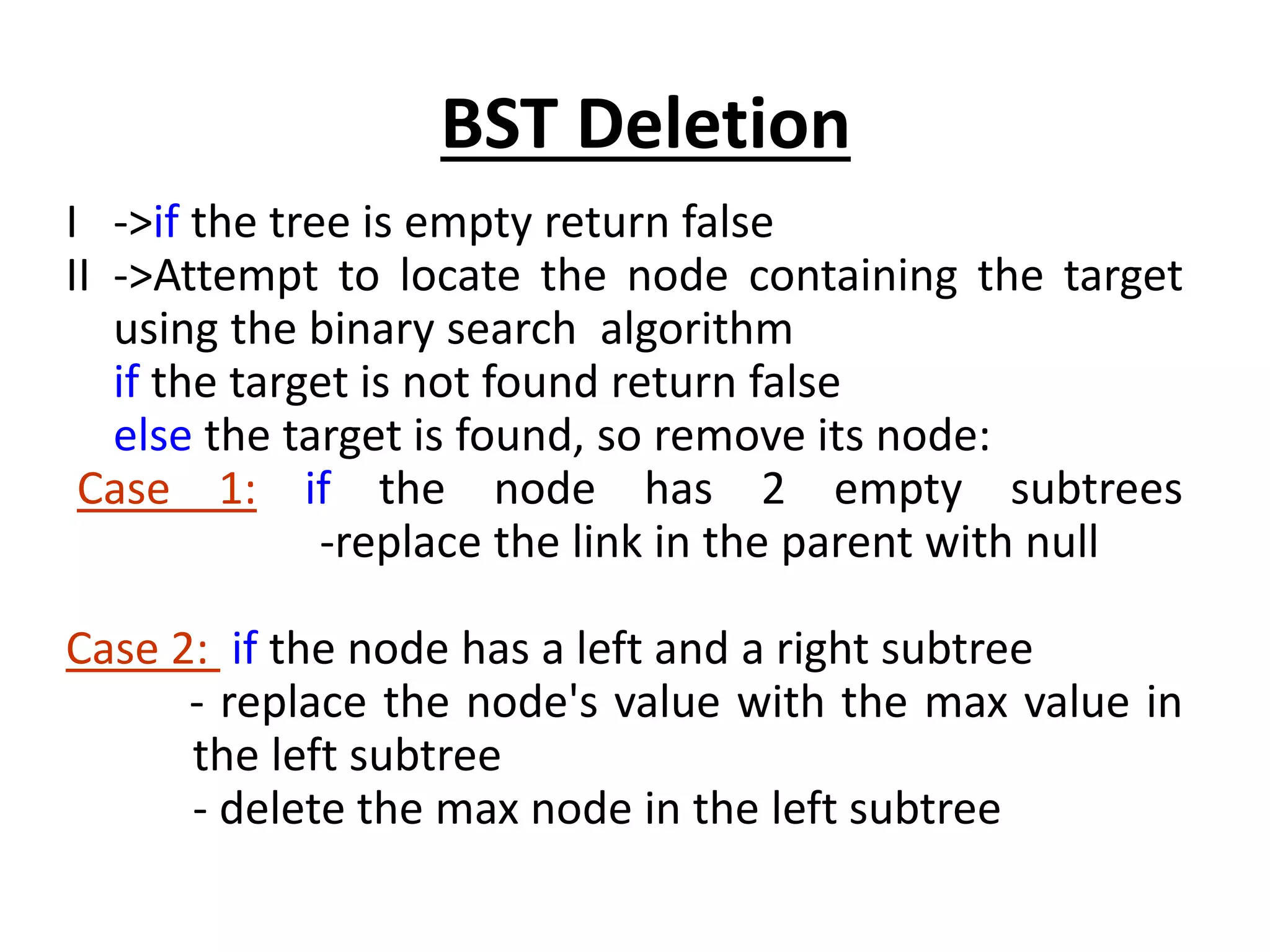
I ->if the tree is empty return false
II ->Attempt to locate the node containing the target
using the binary search algorithm
if the target is not found return false
else the target is found, so remove its node:
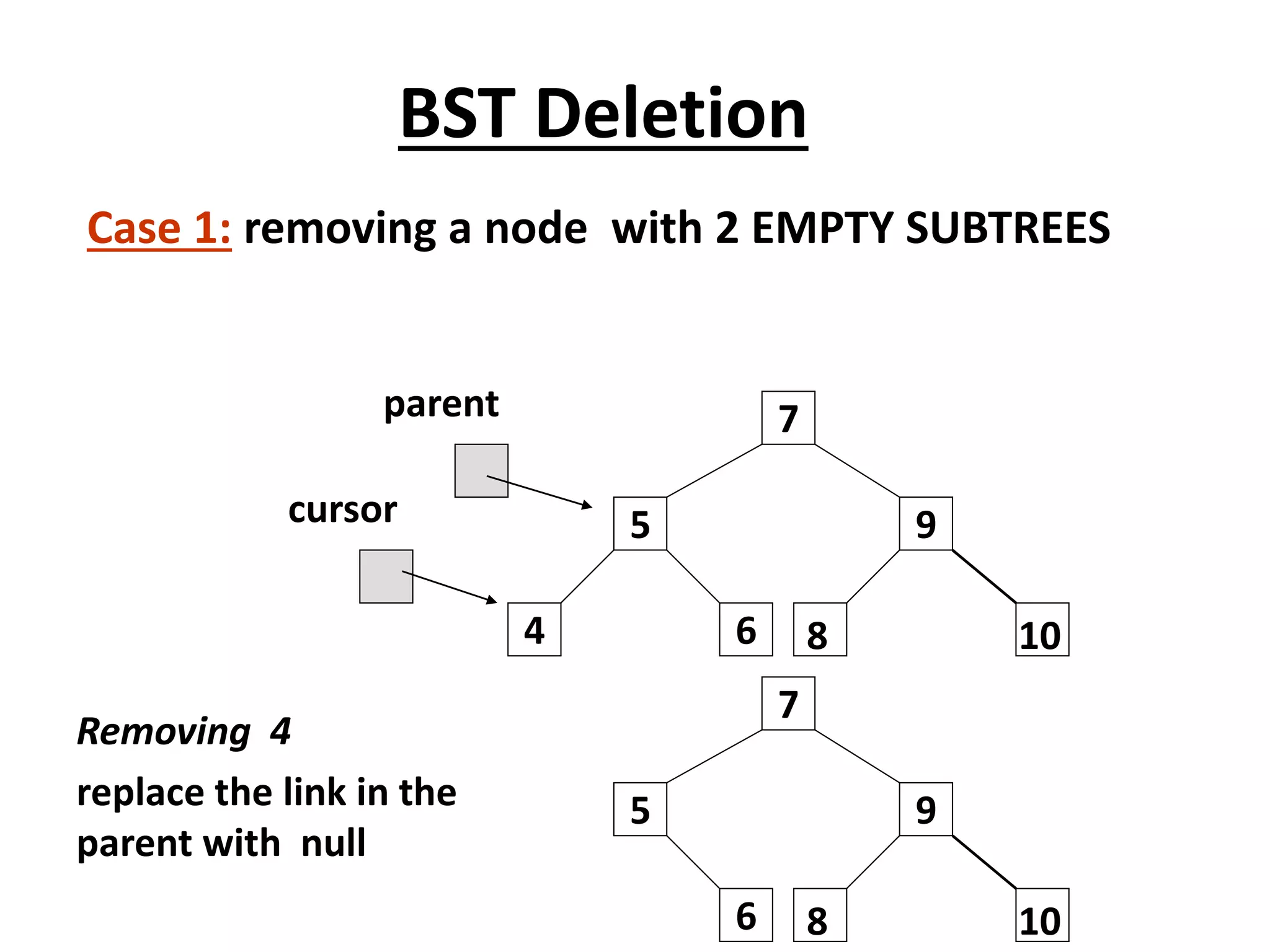
Case 1: if the node has 2 empty subtrees
-replace the link in the parent with null
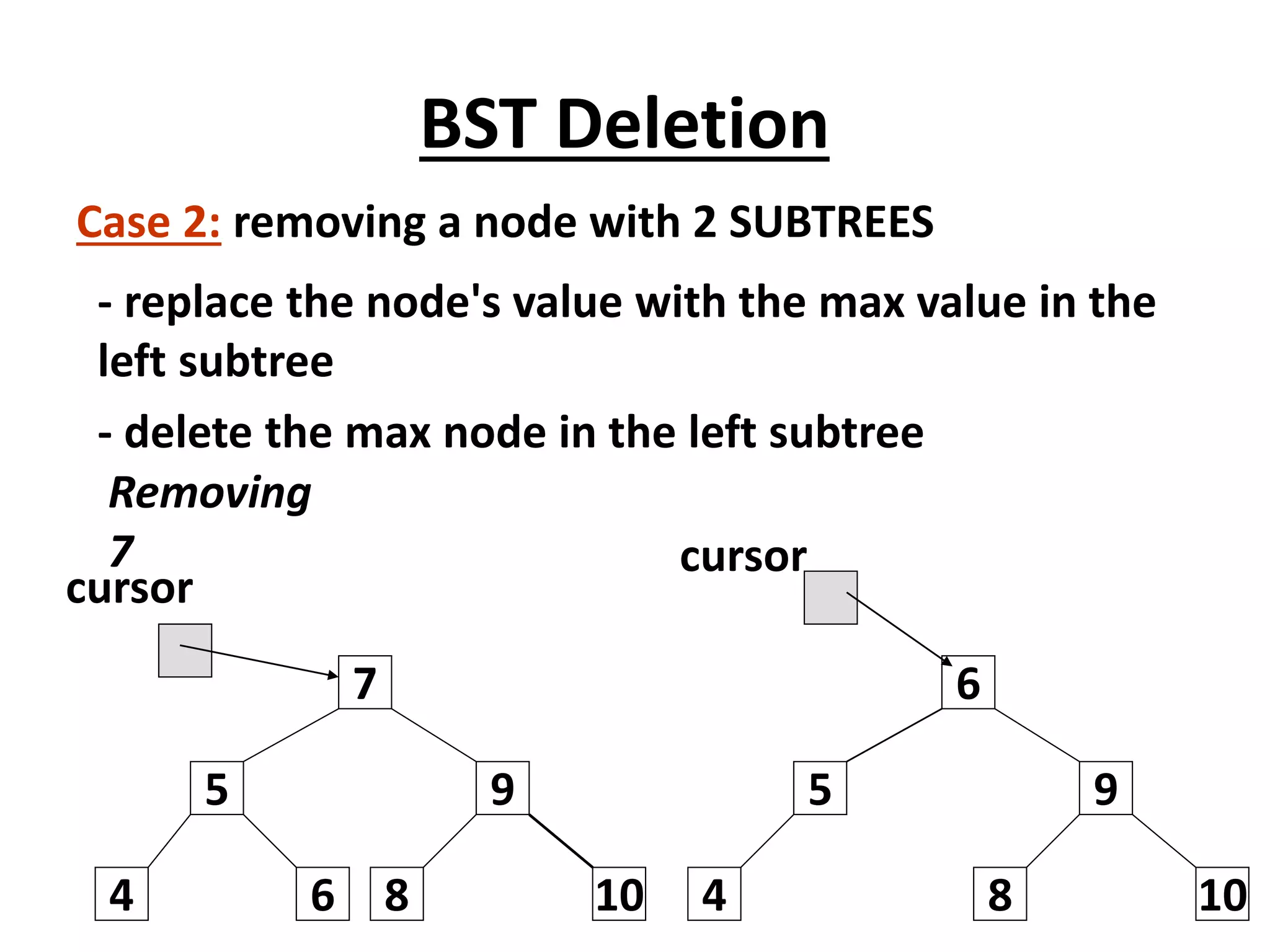
Case 2: if the node has a left and a right subtree
- replace the node's value with the max value in
the left subtree
- delete the max node in the left subtree
BST Deletion
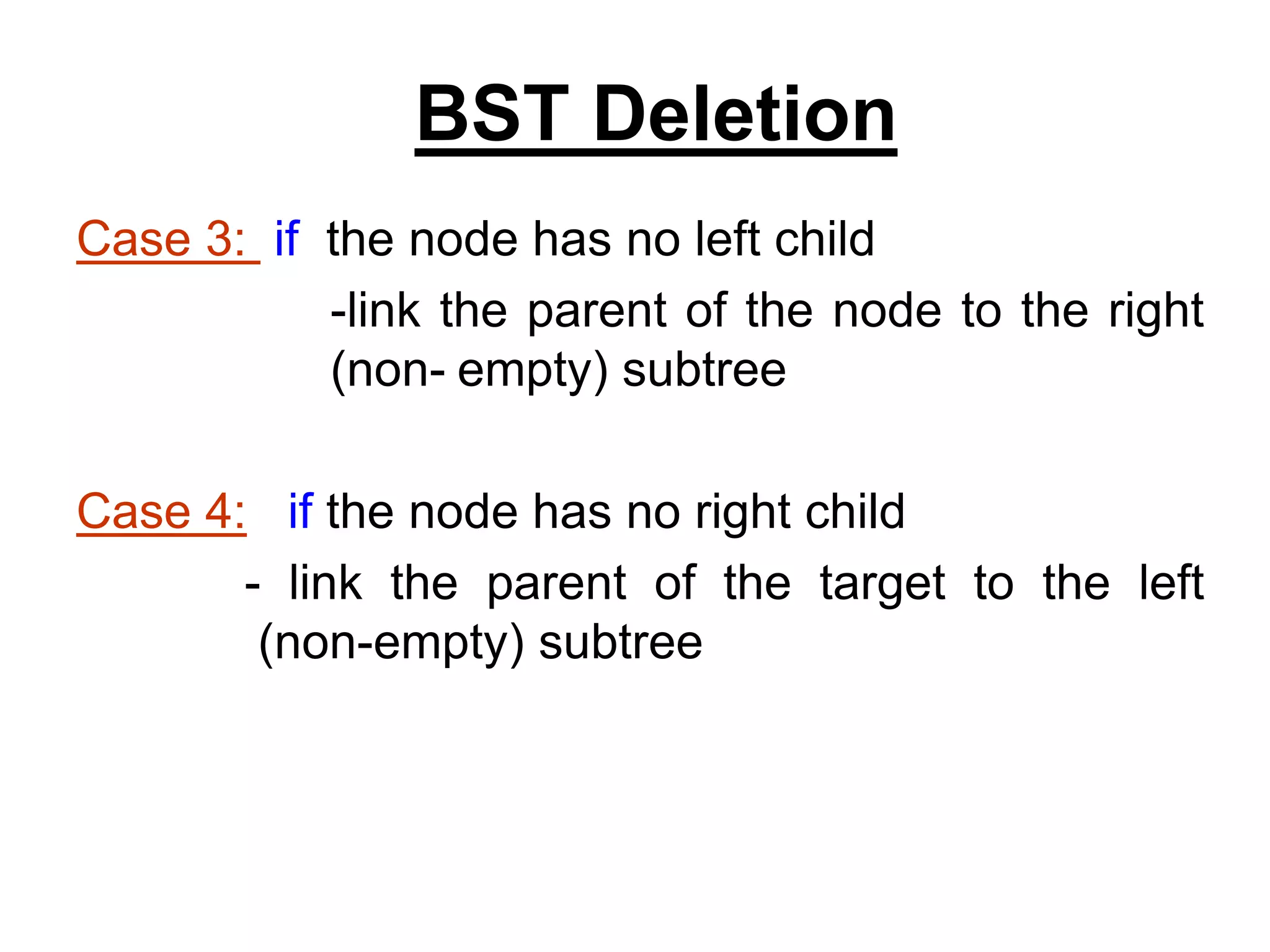
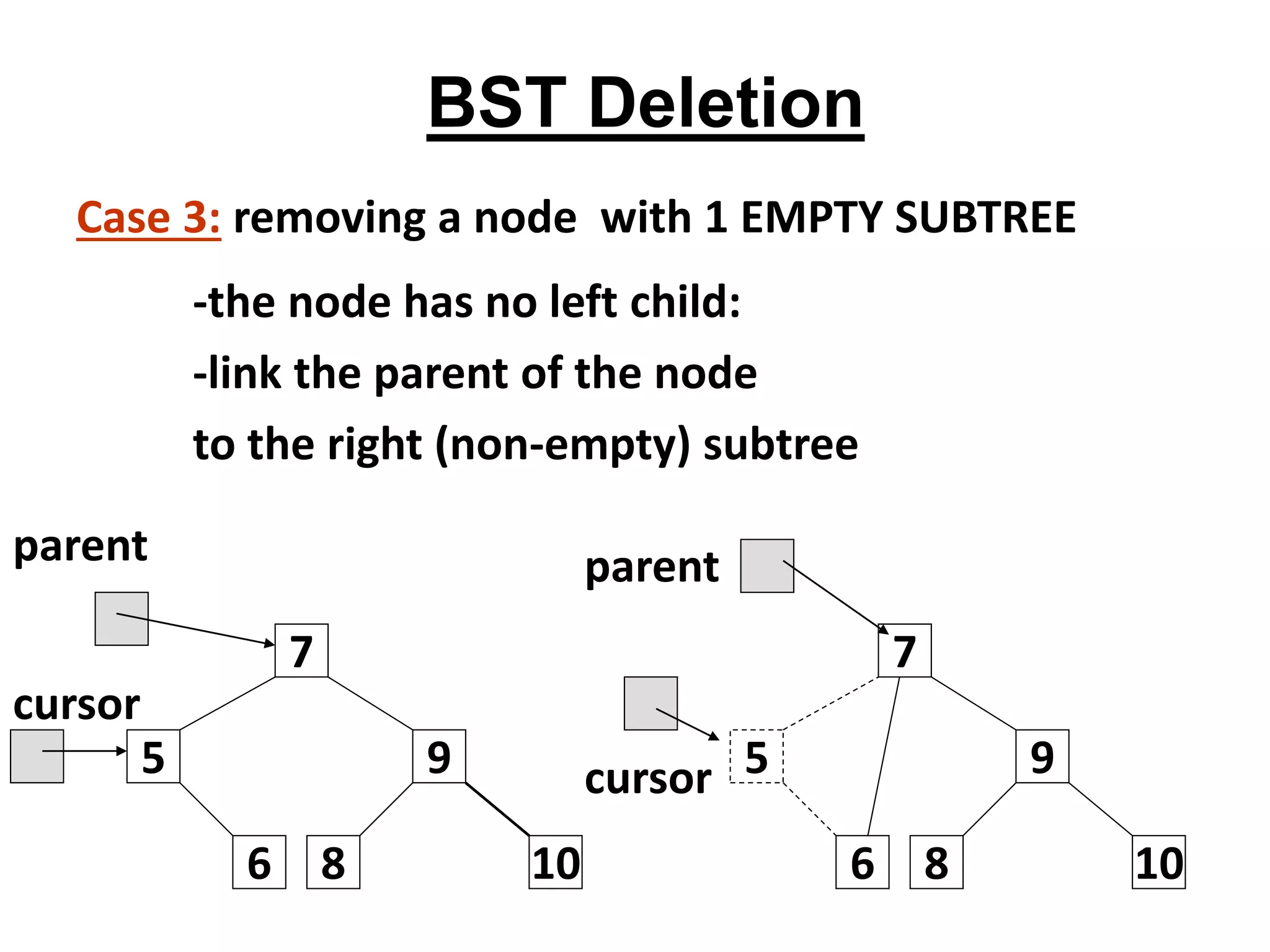
Case 3: if the node has no left child
-link the parent of the node to the right
(non- empty) subtree
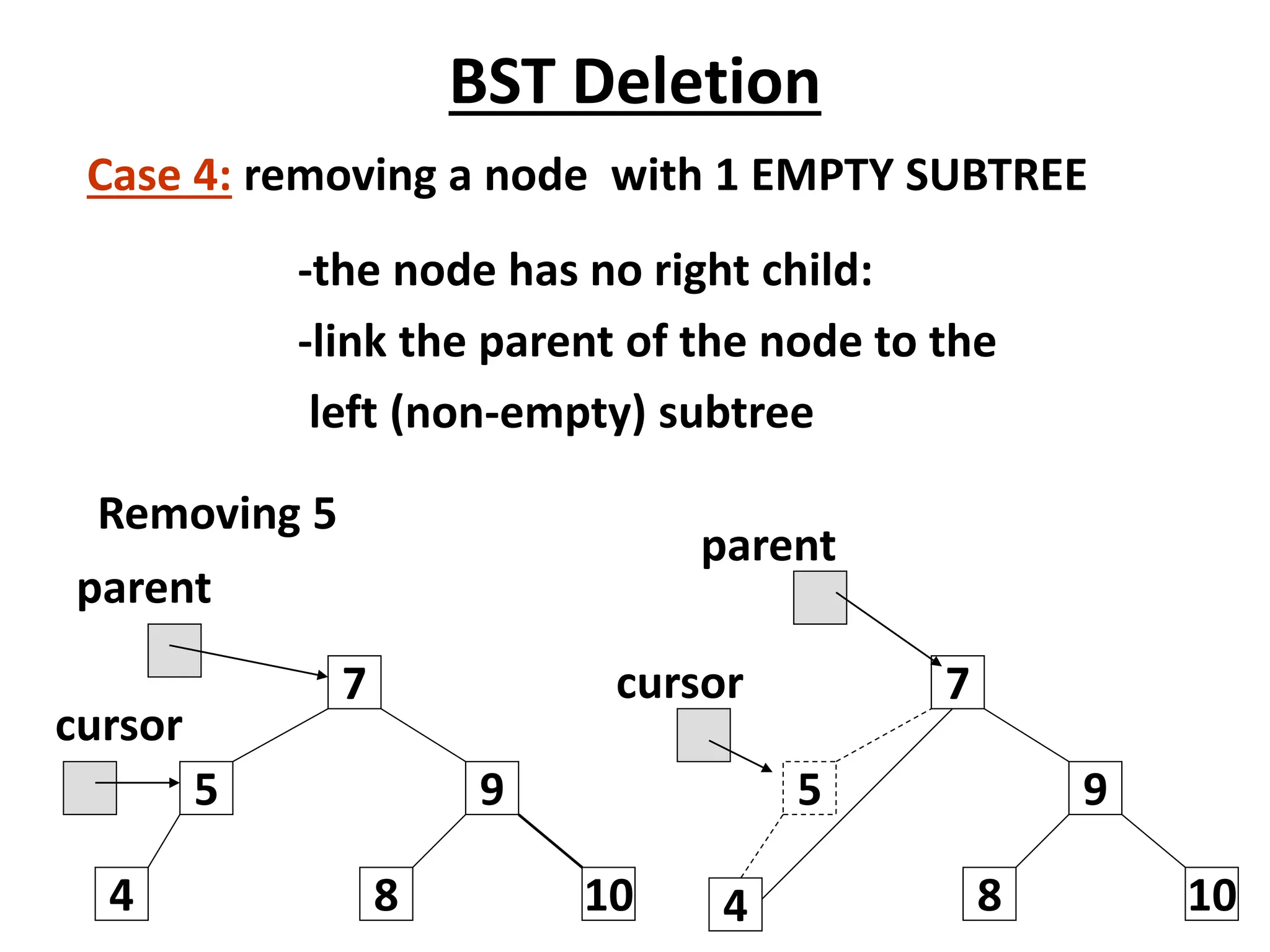
Case 4: if the node has no right child
- link the parent of the target to the left
(non-empty) subtree
BST Deletion
9
7
5
6
4 8 10
9
7
5
6 8 10
Case 1: removing a node with 2 EMPTY SUBTREES
parent
cursor
BST Deletion
Removing 4
replace the link in the
parent with null
Case 2: removing a node with 2 SUBTREES
9
7
5
6 8 10
9
6
5
8 10
cursor
cursor
- replace the node's value with the max value in the
left subtree
- delete the max node in the left subtree
4
4
Removing
7
BST Deletion
9
7
5
6 8 10
9
7
5
6 8 10
cursor
cursor
parent
parent
-the node has no left child:
-link the parent of the node
to the right (non-empty) subtree
Case 3: removing a node with 1 EMPTY SUBTREE
BST Deletion
9
7
5
8 10
9
7
5
8 10
cursor
cursor
parent
parent
-the node has no right child:
-link the parent of the node to the
left (non-empty) subtree
Case 4: removing a node with 1 EMPTY SUBTREE
Removing 5
4 4
BST Deletion
Deletion – Pseudocode
TREE-DELETE(T, z)
1. if left[z] = NIL or right[z] = NIL
2. then y ← z
3. else y ← TREE-SUCCESSOR(z)
4. if left[y]  NIL
5. then x ← left[y]
6. else x ← right[y]
7. if x  NIL
8. then p[x] ← p[y]
z has one child
z has 2 children
15
16
20
18 23
6
5
12
3
7
10 13
y
x
Deletion – Pseudocode
TREE-DELETE(T, z)
9. if p[y] = NIL
10. then root[T] ← x
11. else if y = left[p[y]]
12. then left[p[y]] ← x
13. else right[p[y]] ← x
14. if y  z
15. then key[z] ← key[y]
16. copy y’s satellite data into z
17. return y
15
16
20
18 23
6
5
12
3
7
10 13
y
x
Running time: O(h)

Binary Search Tree

  • 1.
  • 2.
    Trees • A treeis a collection of nodes – The collection can be empty – If not empty, a tree consists of a distinguished node r (the root), and zero or more nonempty subtrees T1, T2, ...., Tk, each of whose roots are connected by a directed edge from r.
  • 3.
    Terminologies • Parent – Immediatepredecessor of a node • Child – Immediate successors of a node (left child,right child) • Leaves – Leaves are nodes with no children • Sibling – nodes with same parent
  • 4.
    Terminologies • Level – Rankin the hierarchy • Length of a path – number of edges on the path • Height of a node(Depth ) – max no of nodes in a path starting from the root node to a leaf node. • Degree – Max no of children that is possible for a node • Ancestor and descendant – If there is a path from n1 to n2 – n1 is an ancestor of n2, n2 is a descendant of n1 – Proper ancestor and proper descendant
  • 5.
  • 6.
    Example: Expression Trees •Leaves are operands (constants or variables) • The internal nodes contain operators
  • 7.
    Binary Trees • Isa finite set of nodes – that is either empty or – consists of a root and two disjoint trees as left subtree and right subtree. – binary tree of ht h can have atmost 2^h -1 nodes – Full binary tree – Complete binary tree 56 26 200 18 28 190 213 12 24 27
  • 8.
    Binary Tree Representation •Linear Representation – Parent (i)=[i/2] – Lchild (i)= 2 * i – Rchild(i)=(2*i) +1 • Linked Representation – three fields • leftchild • data • rightchild
  • 9.
    Tree Traversal • Usedto print out the data in a tree in a certain order • Pre-order traversal • Post-order traversal • In-order traversal
  • 10.
    Preorder Traversal • Preordertraversal – root, left, right – prefix expression ++a*bc*+*defg
  • 11.
    Postorder Traversal • Postordertraversal – left, right, root – postfix expression abc*+de*f+g*+
  • 12.
    Inorder Traversal • Inordertraversal – left, root, right – infix expression a+b*c+d*e+f*g
  • 13.
    Convert a GenericTree to a Binary Tree
  • 14.
    Binary Search Trees •Binary search tree – Every node has a unique key. – The keys in a nonempty left subtree are smaller than the key in the root . – The keys in a nonempty right subtree are greater than the key in the root . – The left and right subtrees are also binary search trees.
  • 15.
    BST – Representation •Represented by a linked data structure of nodes. • root(T) points to the root of tree T. • Each node contains fields: – key – left – pointer to left child: root of left subtree. – right – pointer to right child : root of right subtree. – p – pointer to parent. p[root[T]] = NIL (optional).
  • 16.
    Binary Search TreeProperty • Stored keys must satisfy the binary search tree property. –  y in left subtree of x, then key[y]  key[x]. –  y in right subtree of x, then key[y]  key[x]. 56 26 200 18 28 190 213 12 24 27
  • 17.
    Binary Search Trees Abinary search tree Not a binary search tree
  • 18.
    Binary Search Trees •Average depth of a node is O(log N) • Maximum depth of a node is O(N) The same set of keys may have different BSTs
  • 19.
    Querying a BinarySearch Tree • Pseudocode – if the tree is empty return NULL – else if the item in the node equals the target return the node value – else if the item in the node is greater than the target return the result of searching the left subtree – else if the item in the node is smaller than the target return the result of searching the right subtree
  • 20.
    Tree Search Tree-Search(x, k) 1.if x = NIL or k = key[x] 2. then return x 3. if k < key[x] 4. then return Tree-Search(left[x], k) 5. else return Tree-Search(right[x], k) Running time: O(h) 56 26 200 18 28 190 213 12 24 27
  • 21.
    Iterative Tree Search Iterative-Tree-Search(x,k) 1. while x  NIL and k  key[x] 2. do if k < key[x] 3. then x  left[x] 4. else x  right[x] 5. return x The iterative tree search is more efficient on most computers. The recursive tree search is more straightforward. 56 26 200 18 28 190 213 12 24 27
  • 23.
    Querying a BinarySearch Tree • All dynamic-set search operations can be supported in O(h) time. • h = (lg n) for a balanced binary tree (and for an average tree built by adding nodes in random order.) • h = (n) for an unbalanced tree that resembles a linear chain of n nodes in the worst case.
  • 24.
    Finding Min &Max Tree-Minimum(x) Tree-Maximum(x) 1. while left[x]  NIL 1. while right[x]  NIL 2. do x  left[x] 2. do x  right[x] 3. return x 3. return x The binary-search-tree property guarantees that: » The minimum is located at the left-most node. » The maximum is located at the right-most node.
  • 25.
    Predecessor and Successor •Successor of node x is the node y such that key[y] is the smallest key greater than key[x]. • The successor of the largest key is NIL. • Two cases: – If node x has a non-empty right subtree, then x’s successor is the minimum in the right subtree of x. – If node x has an empty right subtree, then: • As long as we move to the left up the tree (move up through right children), we are visiting smaller keys. • x’s successor y is the node that x is the predecessor of (x is the maximum in y’s left subtree). • In other words, x’s successor y, is the lowest ancestor of x whose left child is also an ancestor of x.
  • 26.
    Pseudo-code for Successor Tree-Successor(x) 1.if right[x]  NIL 2. then return Tree-Minimum(right[x]) 3. y  p[x] 4. while y  NIL and x = right[y] 5. do x  y 6. y  p[y] 7. return y Code for predecessor is symmetric. Running time: O(h) 56 26 200 18 28 190 213 12 24 27
  • 27.
    27 Predecessor Def: predecessor (x) = y, such that key [y] is the biggest key < key [x] E.g.: predecessor (15) = predecessor (9) = predecessor (7) = Case 1: left (x) is non empty predecessor (x ) = the maximum in left (x) Case 2: left (x) is empty go up the tree until the current node is a right child: predecessor (x ) is the parent of the current node if you cannot go further (and you reached the root): x is the smallest element 3 2 4 6 7 13 15 18 17 20 9 13 7 6 x y
  • 28.
    if tree isempty create a root node with the new key else compare key with the top node if key = node key replace the node with the new value else if key > node key compare key with the right subtree: if subtree is empty create a leaf node else add key in right subtree else key < node key compare key with the left subtree: if the subtree is empty create a leaf node else add key to the left subtree BST Insertion
  • 29.
    9 7 5 4 6 8 Case 1: The Tree is Empty  Set the root to a new node containing the item  Case 2: The Tree is Not Empty  Call a recursive helper method to insert the item 10 10 > 7 10 > 9 10 BST Insertion
  • 30.
    BST Insertion –Pseudocode Tree-Insert(T, z) y  NIL x  root[T] while x  NIL do y  x if key[z] < key[x] then x  left[x] else x  right[x] p[z]  y if y = NIL then root[t]  z else if key[z] < key[y] then left[y]  z else right[y]  z • Ensure the binary- search-tree property holds after change. • Insertion is easier than deletion. 56 26 200 18 28 190 213 12 24 27
  • 31.
    Analysis of Insertion •Initialization: O(1) • While loop in lines 3-7 searches for place to insert z, maintaining parent y. This takes O(h) time. • Lines 8-13 insert the value: O(1)  TOTAL: O(h) time to insert a node. Tree-Insert(T, z) 1. y  NIL 2. x  root[T] 3. while x  NIL 4. do y  x 5. if key[z] < key[x] 6. then x  left[x] 7. else x  right[x] 8. p[z]  y 9. if y = NIL 10. then root[t]  z 11. else if key[z] < key[y] 12. then left[y]  z 13. else right[y]  z
  • 32.
    I ->if thetree is empty return false II ->Attempt to locate the node containing the target using the binary search algorithm if the target is not found return false else the target is found, so remove its node: Case 1: if the node has 2 empty subtrees -replace the link in the parent with null Case 2: if the node has a left and a right subtree - replace the node's value with the max value in the left subtree - delete the max node in the left subtree BST Deletion
  • 33.
    Case 3: ifthe node has no left child -link the parent of the node to the right (non- empty) subtree Case 4: if the node has no right child - link the parent of the target to the left (non-empty) subtree BST Deletion
  • 34.
    9 7 5 6 4 8 10 9 7 5 68 10 Case 1: removing a node with 2 EMPTY SUBTREES parent cursor BST Deletion Removing 4 replace the link in the parent with null
  • 35.
    Case 2: removinga node with 2 SUBTREES 9 7 5 6 8 10 9 6 5 8 10 cursor cursor - replace the node's value with the max value in the left subtree - delete the max node in the left subtree 4 4 Removing 7 BST Deletion
  • 36.
    9 7 5 6 8 10 9 7 5 68 10 cursor cursor parent parent -the node has no left child: -link the parent of the node to the right (non-empty) subtree Case 3: removing a node with 1 EMPTY SUBTREE BST Deletion
  • 37.
    9 7 5 8 10 9 7 5 8 10 cursor cursor parent parent -thenode has no right child: -link the parent of the node to the left (non-empty) subtree Case 4: removing a node with 1 EMPTY SUBTREE Removing 5 4 4 BST Deletion
  • 38.
    Deletion – Pseudocode TREE-DELETE(T,z) 1. if left[z] = NIL or right[z] = NIL 2. then y ← z 3. else y ← TREE-SUCCESSOR(z) 4. if left[y]  NIL 5. then x ← left[y] 6. else x ← right[y] 7. if x  NIL 8. then p[x] ← p[y] z has one child z has 2 children 15 16 20 18 23 6 5 12 3 7 10 13 y x
  • 39.
    Deletion – Pseudocode TREE-DELETE(T,z) 9. if p[y] = NIL 10. then root[T] ← x 11. else if y = left[p[y]] 12. then left[p[y]] ← x 13. else right[p[y]] ← x 14. if y  z 15. then key[z] ← key[y] 16. copy y’s satellite data into z 17. return y 15 16 20 18 23 6 5 12 3 7 10 13 y x Running time: O(h)