ADITYA KUMAR
BARN1AR14002
ITMU.SOAD
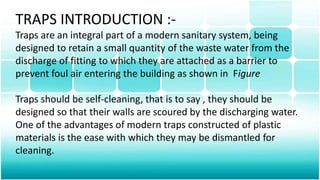
TRAPS INTRODUCTION :-
Traps are an integral part of a modern sanitary system, being
designed to retain a small quantity of the waste water from the
discharge of fitting to which they are attached as a barrier to
prevent foul air entering the building as shown in Figure
Traps should be self-cleaning, that is to say , they should be
designed so that their walls are scoured by the discharging water.
One of the advantages of modern traps constructed of plastic
materials is the ease with which they may be dismantled for
cleaning.
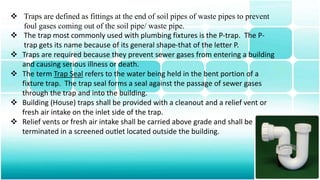
 Traps are defined as fittings at the end of soil pipes of waste pipes to prevent
foul gases coming out of the soil pipe/ waste pipe.
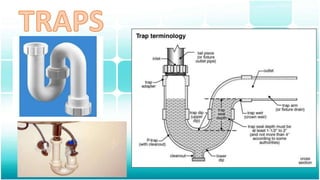
 The trap most commonly used with plumbing fixtures is the P-trap. The P-
trap gets its name because of its general shape-that of the letter P.
 Traps are required because they prevent sewer gases from entering a building
and causing serious illness or death.
 The term Trap Seal refers to the water being held in the bent portion of a
fixture trap. The trap seal forms a seal against the passage of sewer gases
through the trap and into the building.
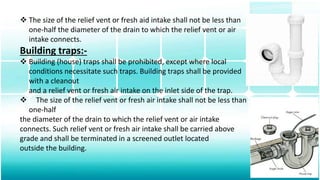
 Building (House) traps shall be provided with a cleanout and a relief vent or
fresh air intake on the inlet side of the trap.
 Relief vents or fresh air intake shall be carried above grade and shall be
terminated in a screened outlet located outside the building.
 The size of the relief vent or fresh aid intake shall not be less than
one-half the diameter of the drain to which the relief vent or air
intake connects.
Building traps:-
 Building (house) traps shall be prohibited, except where local
conditions necessitate such traps. Building traps shall be provided
with a cleanout
and a relief vent or fresh air intake on the inlet side of the trap.
 The size of the relief vent or fresh air intake shall not be less than
one-half
the diameter of the drain to which the relief vent or air intake
connects. Such relief vent or fresh air intake shall be carried above
grade and shall be terminated in a screened outlet located
outside the building.
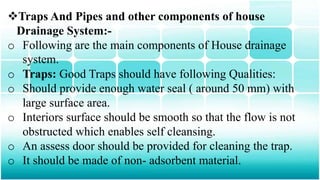
Traps And Pipes and other components of house
Drainage System:-
o Following are the main components of House drainage
system.
o Traps: Good Traps should have following Qualities:
o Should provide enough water seal ( around 50 mm) with
large surface area.
o Interiors surface should be smooth so that the flow is not
obstructed which enables self cleansing.
o An assess door should be provided for cleaning the trap.
o It should be made of non- adsorbent material.
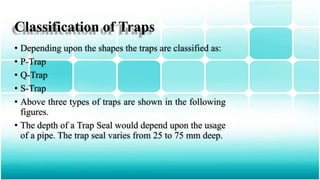
Classification of Traps
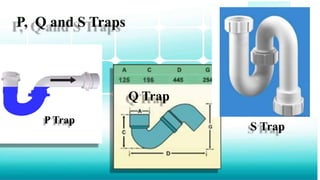
• Depending upon the shapes the traps are classified as:
• P-Trap
• Q-Trap
• S-Trap
• Above three types of traps are shown in the following
figures.
• The depth of a Trap Seal would depend upon the usage
of a pipe. The trap seal varies from 25 to 75 mm deep.
P, Q and S Traps
P Trap
Q Trap
S Trap
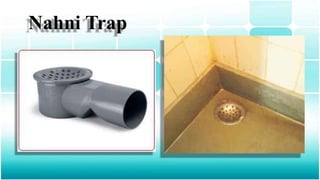
Nahni Trap
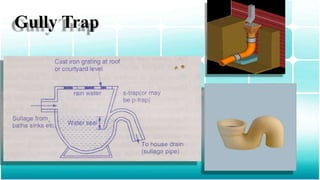
Gully Trap
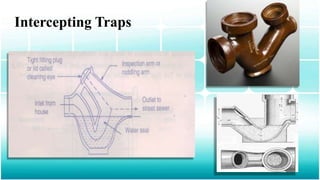
Intercepting Traps
Advantage of Intercepting
Traps
•Foul Gases of larger municipal sewers are
prevented from entering house drainage system.
•Harmful pathogens are not entered in house
drains.
•Well designed and contructed interceptors can
quickly remove foul matter of house drain to
muncipal sewers.
Loss of Trap Seals
caused
• Evaporation
• Capillary action
• Momentum
• Leakage
• Wavering out
• Compression or back
pressure
• Induced siphonage
• Self siphonage
If a trap seal loss,
smells from the
sanitary appliances
would enter the
building. Therefore
the water seal in the
trap must be
maintained under all
circumstances.
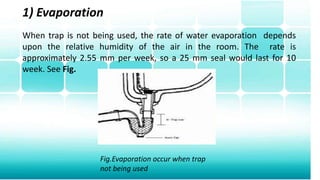
1) Evaporation
When trap is not being used, the rate of water evaporation depends
upon the relative humidity of the air in the room. The rate is
approximately 2.55 mm per week, so a 25 mm seal would last for 10
week. See Fig.
Fig.Evaporation occur when trap
not being used
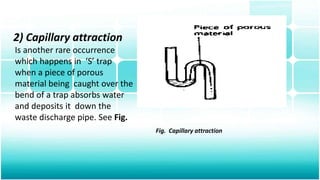
2) Capillary attraction
Is another rare occurrence
which happens in ‘S’ trap
when a piece of porous
material being caught over the
bend of a trap absorbs water
and deposits it down the
waste discharge pipe. See Fig.
Fig. Capillary attraction
3) Momentum
This is caused by a sudden
discharge of water from a
bucket. Due to velocity water
is discharged and it shoots
around the trap bend and
goes down the waste pipe,
leaving no seal.
4) Leakage
It is caused by a fault in the
trap or plumbing installation
and water on the floor would
be apparent.
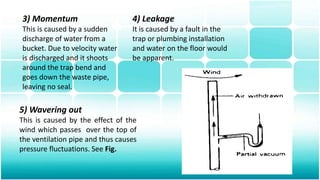
5) Wavering out
This is caused by the effect of the
wind which passes over the top of
the ventilation pipe and thus causes
pressure fluctuations. See Fig.
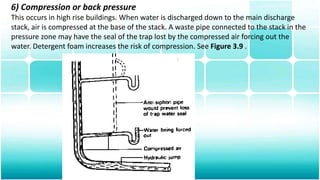
6) Compression or back pressure
This occurs in high rise buildings. When water is discharged down to the main discharge
stack, air is compressed at the base of the stack. A waste pipe connected to the stack in the
pressure zone may have the seal of the trap lost by the compressed air forcing out the
water. Detergent foam increases the risk of compression. See Figure 3.9 .
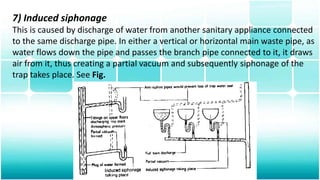
7) Induced siphonage
This is caused by discharge of water from another sanitary appliance connected
to the same discharge pipe. In either a vertical or horizontal main waste pipe, as
water flows down the pipe and passes the branch pipe connected to it, it draws
air from it, thus creating a partial vacuum and subsequently siphonage of the
trap takes place. See Fig.
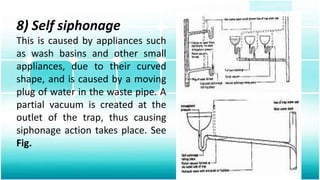
8) Self siphonage
This is caused by appliances such
as wash basins and other small
appliances, due to their curved
shape, and is caused by a moving
plug of water in the waste pipe. A
partial vacuum is created at the
outlet of the trap, thus causing
siphonage action takes place. See
Fig.
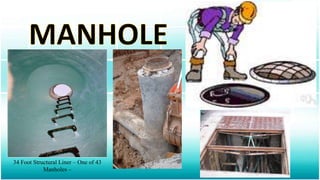
34 Foot Structural Liner – One of 43
Manholes –
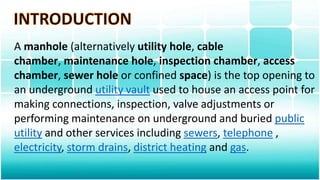
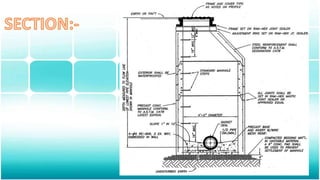
A manhole (alternatively utility hole, cable
chamber, maintenance hole, inspection chamber, access
chamber, sewer hole or confined space) is the top opening to
an underground utility vault used to house an access point for
making connections, inspection, valve adjustments or
performing maintenance on underground and buried public
utility and other services including sewers, telephone ,
electricity, storm drains, district heating and gas.
USES:-
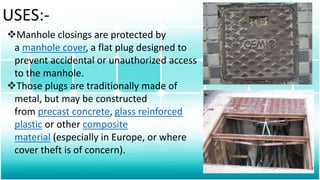
Manhole closings are protected by
a manhole cover, a flat plug designed to
prevent accidental or unauthorized access
to the manhole.
Those plugs are traditionally made of
metal, but may be constructed
from precast concrete, glass reinforced
plastic or other composite
material (especially in Europe, or where
cover theft is of concern).
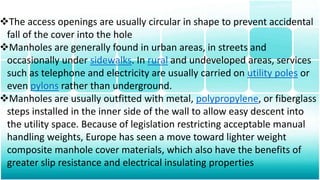
The access openings are usually circular in shape to prevent accidental
fall of the cover into the hole
Manholes are generally found in urban areas, in streets and
occasionally under sidewalks. In rural and undeveloped areas, services
such as telephone and electricity are usually carried on utility poles or
even pylons rather than underground.
Manholes are usually outfitted with metal, polypropylene, or fiberglass
steps installed in the inner side of the wall to allow easy descent into
the utility space. Because of legislation restricting acceptable manual
handling weights, Europe has seen a move toward lighter weight
composite manhole cover materials, which also have the benefits of
greater slip resistance and electrical insulating properties
PRECAUTIONS TO BE TAKEN
WHILE INSTALLING:-
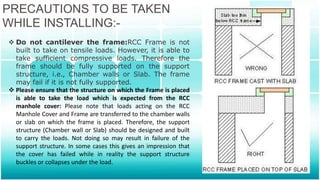
 Do not cantilever the frame:RCC Frame is not
built to take on tensile loads. However, it is able to
take sufficient compressive loads. Therefore the
frame should be fully supported on the support
structure, i.e., Chamber walls or Slab. The frame
may fail if it is not fully supported.
 Please ensure that the structure on which the Frame is placed
is able to take the load which is expected from the RCC
manhole cover: Please note that loads acting on the RCC
Manhole Cover and Frame are transferred to the chamber walls
or slab on which the frame is placed. Therefore, the support
structure (Chamber wall or Slab) should be designed and built
to carry the loads. Not doing so may result in failure of the
support structure. In some cases this gives an impression that
the cover has failed while in reality the support structure
buckles or collapses under the load.
Never make the Frame a part of the Slab: In
some cases the workmen while making
arrangements for the Frame, casts the frame
along with the slab (refer to Figure 1). In doing
so the thickness of the slab on which the frame
is resting is very thin. This will result in failure of
the structure as the slab on which the frames
rests is not able to bear the load expected of the
RCC Cover.
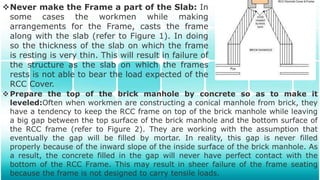
Prepare the top of the brick manhole by concrete so as to make it
leveled:Often when workmen are constructing a conical manhole from brick, they
have a tendency to keep the RCC frame on top of the brick manhole while leaving
a big gap between the top surface of the brick manhole and the bottom surface of
the RCC frame (refer to Figure 2). They are working with the assumption that
eventually the gap will be filled by mortar. In reality, this gap is never filled
properly because of the inward slope of the inside surface of the brick manhole. As
a result, the concrete filled in the gap will never have perfect contact with the
bottom of the RCC Frame. This may result in sheer failure of the frame seating
because the frame is not designed to carry tensile loads.
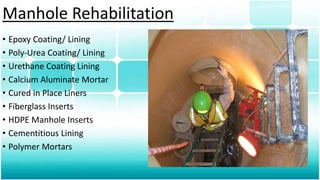
Manhole Rehabilitation:
• Epoxy Coating/ Lining
• Poly-Urea Coating/ Lining
• Urethane Coating Lining
• Calcium Aluminate Mortar
• Cured in Place Liners
• Fiberglass Inserts
• HDPE Manhole Inserts
• Cementitious Lining
• Polymer Mortars
ADVANTAGES:-
EFFECTIVE WASTEWATER TRANSPORTATION AT MINIMUM DEPTH,
MINIMISING THE EXCAVATION FOR THE PIPING SYSTEM
GRAVITY FREE; INDEPENDENT FROM LAND TOPOGRAPHY
LOW COST COMPARED TO A CONVENTIONAL GRAVITY SEWER
PIPE SIZE AND DEPTH REQUIREMENTS ARE REDUCED AND MANY SMALL
PUMPS ARE CHEAPER THAN SOME LARGE –CAPICITY LIFT STATIONS
REQUIRED LITTLE WATER ONLY FOR TRANSPORTING THE EXCRETA
FOULE GASES CANN’T EFFECT THE ENVIRONMENT.
EASILY CARRY SEWER WESTE THTOURH PIPELINE
DISADVANTAGES:-
NEED EXPERT DESIGN, HIGH CAPITAL COSTS
NEEDS A PERMANENT CLINING MANAGEMENT.
A PROPER RECYCLING OF NUTRIENTS AND ENERGY BECOMES
DIFFICULT, BECAUSE ALL KINDS OF WASTERS ARE MIXED
UNSUTIABILITY FOR SELF HELP,REQUIRES SKILLED ENGINNEERS AND
OPERATORS
IT IS STILL A FLUSHING SYSTEM WHICH TRANSPORTED WASTWATER
AWAY . IT THERE IS NO TRETMENT PLANT AND AN UNPROFESSIONAL
DISCHARGE IT CAN CONTIMINATE THE ENVIRONMENT
LEKAGES MAY LEAD TO CONTAMINATIONS
Traps and manhole aditya kumar barn1 ar14002

Traps and manhole aditya kumar barn1 ar14002

  • 1.
  • 3.
    TRAPS INTRODUCTION :- Trapsare an integral part of a modern sanitary system, being designed to retain a small quantity of the waste water from the discharge of fitting to which they are attached as a barrier to prevent foul air entering the building as shown in Figure Traps should be self-cleaning, that is to say , they should be designed so that their walls are scoured by the discharging water. One of the advantages of modern traps constructed of plastic materials is the ease with which they may be dismantled for cleaning.
  • 4.
     Traps aredefined as fittings at the end of soil pipes of waste pipes to prevent foul gases coming out of the soil pipe/ waste pipe.  The trap most commonly used with plumbing fixtures is the P-trap. The P- trap gets its name because of its general shape-that of the letter P.  Traps are required because they prevent sewer gases from entering a building and causing serious illness or death.  The term Trap Seal refers to the water being held in the bent portion of a fixture trap. The trap seal forms a seal against the passage of sewer gases through the trap and into the building.  Building (House) traps shall be provided with a cleanout and a relief vent or fresh air intake on the inlet side of the trap.  Relief vents or fresh air intake shall be carried above grade and shall be terminated in a screened outlet located outside the building.
  • 5.
     The sizeof the relief vent or fresh aid intake shall not be less than one-half the diameter of the drain to which the relief vent or air intake connects. Building traps:-  Building (house) traps shall be prohibited, except where local conditions necessitate such traps. Building traps shall be provided with a cleanout and a relief vent or fresh air intake on the inlet side of the trap.  The size of the relief vent or fresh air intake shall not be less than one-half the diameter of the drain to which the relief vent or air intake connects. Such relief vent or fresh air intake shall be carried above grade and shall be terminated in a screened outlet located outside the building.
  • 6.
    Traps And Pipesand other components of house Drainage System:- o Following are the main components of House drainage system. o Traps: Good Traps should have following Qualities: o Should provide enough water seal ( around 50 mm) with large surface area. o Interiors surface should be smooth so that the flow is not obstructed which enables self cleansing. o An assess door should be provided for cleaning the trap. o It should be made of non- adsorbent material.
  • 7.
    Classification of Traps •Depending upon the shapes the traps are classified as: • P-Trap • Q-Trap • S-Trap • Above three types of traps are shown in the following figures. • The depth of a Trap Seal would depend upon the usage of a pipe. The trap seal varies from 25 to 75 mm deep.
  • 8.
    P, Q andS Traps P Trap Q Trap S Trap
  • 9.
  • 10.
  • 11.
  • 13.
    Advantage of Intercepting Traps •FoulGases of larger municipal sewers are prevented from entering house drainage system. •Harmful pathogens are not entered in house drains. •Well designed and contructed interceptors can quickly remove foul matter of house drain to muncipal sewers.
  • 14.
    Loss of TrapSeals caused • Evaporation • Capillary action • Momentum • Leakage • Wavering out • Compression or back pressure • Induced siphonage • Self siphonage If a trap seal loss, smells from the sanitary appliances would enter the building. Therefore the water seal in the trap must be maintained under all circumstances.
  • 15.
    1) Evaporation When trapis not being used, the rate of water evaporation depends upon the relative humidity of the air in the room. The rate is approximately 2.55 mm per week, so a 25 mm seal would last for 10 week. See Fig. Fig.Evaporation occur when trap not being used
  • 16.
    2) Capillary attraction Isanother rare occurrence which happens in ‘S’ trap when a piece of porous material being caught over the bend of a trap absorbs water and deposits it down the waste discharge pipe. See Fig. Fig. Capillary attraction
  • 17.
    3) Momentum This iscaused by a sudden discharge of water from a bucket. Due to velocity water is discharged and it shoots around the trap bend and goes down the waste pipe, leaving no seal. 4) Leakage It is caused by a fault in the trap or plumbing installation and water on the floor would be apparent. 5) Wavering out This is caused by the effect of the wind which passes over the top of the ventilation pipe and thus causes pressure fluctuations. See Fig.
  • 18.
    6) Compression orback pressure This occurs in high rise buildings. When water is discharged down to the main discharge stack, air is compressed at the base of the stack. A waste pipe connected to the stack in the pressure zone may have the seal of the trap lost by the compressed air forcing out the water. Detergent foam increases the risk of compression. See Figure 3.9 .
  • 19.
    7) Induced siphonage Thisis caused by discharge of water from another sanitary appliance connected to the same discharge pipe. In either a vertical or horizontal main waste pipe, as water flows down the pipe and passes the branch pipe connected to it, it draws air from it, thus creating a partial vacuum and subsequently siphonage of the trap takes place. See Fig.
  • 20.
    8) Self siphonage Thisis caused by appliances such as wash basins and other small appliances, due to their curved shape, and is caused by a moving plug of water in the waste pipe. A partial vacuum is created at the outlet of the trap, thus causing siphonage action takes place. See Fig.
  • 21.
    34 Foot StructuralLiner – One of 43 Manholes –
  • 22.
    A manhole (alternativelyutility hole, cable chamber, maintenance hole, inspection chamber, access chamber, sewer hole or confined space) is the top opening to an underground utility vault used to house an access point for making connections, inspection, valve adjustments or performing maintenance on underground and buried public utility and other services including sewers, telephone , electricity, storm drains, district heating and gas.
  • 23.
    USES:- Manhole closings areprotected by a manhole cover, a flat plug designed to prevent accidental or unauthorized access to the manhole. Those plugs are traditionally made of metal, but may be constructed from precast concrete, glass reinforced plastic or other composite material (especially in Europe, or where cover theft is of concern).
  • 24.
    The access openingsare usually circular in shape to prevent accidental fall of the cover into the hole Manholes are generally found in urban areas, in streets and occasionally under sidewalks. In rural and undeveloped areas, services such as telephone and electricity are usually carried on utility poles or even pylons rather than underground. Manholes are usually outfitted with metal, polypropylene, or fiberglass steps installed in the inner side of the wall to allow easy descent into the utility space. Because of legislation restricting acceptable manual handling weights, Europe has seen a move toward lighter weight composite manhole cover materials, which also have the benefits of greater slip resistance and electrical insulating properties
  • 25.
    PRECAUTIONS TO BETAKEN WHILE INSTALLING:-  Do not cantilever the frame:RCC Frame is not built to take on tensile loads. However, it is able to take sufficient compressive loads. Therefore the frame should be fully supported on the support structure, i.e., Chamber walls or Slab. The frame may fail if it is not fully supported.  Please ensure that the structure on which the Frame is placed is able to take the load which is expected from the RCC manhole cover: Please note that loads acting on the RCC Manhole Cover and Frame are transferred to the chamber walls or slab on which the frame is placed. Therefore, the support structure (Chamber wall or Slab) should be designed and built to carry the loads. Not doing so may result in failure of the support structure. In some cases this gives an impression that the cover has failed while in reality the support structure buckles or collapses under the load.
  • 26.
    Never make theFrame a part of the Slab: In some cases the workmen while making arrangements for the Frame, casts the frame along with the slab (refer to Figure 1). In doing so the thickness of the slab on which the frame is resting is very thin. This will result in failure of the structure as the slab on which the frames rests is not able to bear the load expected of the RCC Cover. Prepare the top of the brick manhole by concrete so as to make it leveled:Often when workmen are constructing a conical manhole from brick, they have a tendency to keep the RCC frame on top of the brick manhole while leaving a big gap between the top surface of the brick manhole and the bottom surface of the RCC frame (refer to Figure 2). They are working with the assumption that eventually the gap will be filled by mortar. In reality, this gap is never filled properly because of the inward slope of the inside surface of the brick manhole. As a result, the concrete filled in the gap will never have perfect contact with the bottom of the RCC Frame. This may result in sheer failure of the frame seating because the frame is not designed to carry tensile loads.
  • 28.
    Manhole Rehabilitation: • EpoxyCoating/ Lining • Poly-Urea Coating/ Lining • Urethane Coating Lining • Calcium Aluminate Mortar • Cured in Place Liners • Fiberglass Inserts • HDPE Manhole Inserts • Cementitious Lining • Polymer Mortars
  • 29.
    ADVANTAGES:- EFFECTIVE WASTEWATER TRANSPORTATIONAT MINIMUM DEPTH, MINIMISING THE EXCAVATION FOR THE PIPING SYSTEM GRAVITY FREE; INDEPENDENT FROM LAND TOPOGRAPHY LOW COST COMPARED TO A CONVENTIONAL GRAVITY SEWER PIPE SIZE AND DEPTH REQUIREMENTS ARE REDUCED AND MANY SMALL PUMPS ARE CHEAPER THAN SOME LARGE –CAPICITY LIFT STATIONS REQUIRED LITTLE WATER ONLY FOR TRANSPORTING THE EXCRETA FOULE GASES CANN’T EFFECT THE ENVIRONMENT. EASILY CARRY SEWER WESTE THTOURH PIPELINE
  • 30.
    DISADVANTAGES:- NEED EXPERT DESIGN,HIGH CAPITAL COSTS NEEDS A PERMANENT CLINING MANAGEMENT. A PROPER RECYCLING OF NUTRIENTS AND ENERGY BECOMES DIFFICULT, BECAUSE ALL KINDS OF WASTERS ARE MIXED UNSUTIABILITY FOR SELF HELP,REQUIRES SKILLED ENGINNEERS AND OPERATORS IT IS STILL A FLUSHING SYSTEM WHICH TRANSPORTED WASTWATER AWAY . IT THERE IS NO TRETMENT PLANT AND AN UNPROFESSIONAL DISCHARGE IT CAN CONTIMINATE THE ENVIRONMENT LEKAGES MAY LEAD TO CONTAMINATIONS