

Abbe
Value/Number
Trisruta Deb
1st year, M.Optom
BV(DU)MC School of Optometry
Lens Properties
The main material properties of spectacle lenses fall into
several categories, including:
• Refractive index
• Specific gravity or density
• Abbe number or V-value*
• UV absorption
• Impact resistance
• Durability
• Reflectance
Introduction
 The Abbe number is optical properties of the material
rather than of its mechanical characteristics.
 The Abbe number is the reciprocal of the dispersive
power of the material and indicates the degree of
transverse chromatic aberration (TCA) which the wearer
will experience.
 It also called as ‘nu’ value
 ABBE value defined after the German Physicist Ernst
Abbe (1840-1905), who defined this useful
measurement of optical quality.
Key Notes
 Lower Abbe value lenses will have the higher
Chromatic Aberration at periphery of the lens & vice-
versa.
 ABBE value of the human eye is about 45 to 50
To reduce Chromatic aberration in high power
lenses one should prescribe lenses with high ABBE
value.
Cont....
 Chromatic Aberration depends on the 2
properties:
1. Wavelengths of the light rays
2. Refractive Indices of the lens material
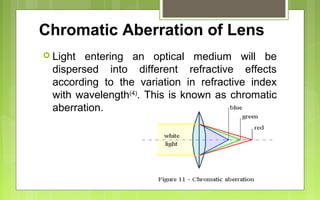
Chromatic Aberration of Lens
 Light entering an optical medium will be
dispersed into different refractive effects
according to the variation in refractive index
with wavelength(4)
. This is known as chromatic
aberration.
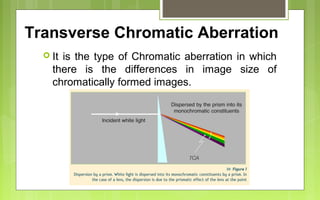
Transverse Chromatic Aberration
 It is the type of Chromatic aberration in which
there is the differences in image size of
chromatically formed images.
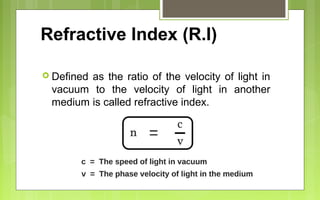
Refractive Index (R.I)
 Defined as the ratio of the velocity of light in
vacuum to the velocity of light in another
medium is called refractive index.
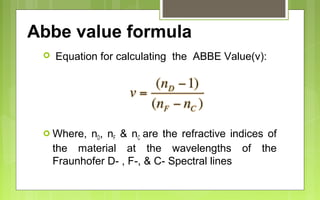
Abbe value formula
 Equation for calculating the ABBE Value(v):
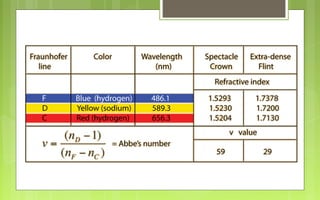
 Where, nD, nF & nC are the refractive indices of
the material at the wavelengths of the
Fraunhofer D- , F-, & C- Spectral lines
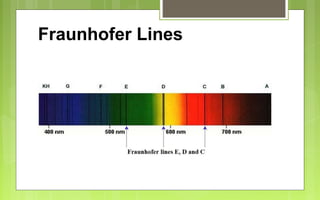
Fraunhofer Lines
We can classifies materials in terms
of their Abbe number as follows:
Low dispersion V ≥ 45 (e.g- Crown=59)
Medium dispersion V ≥ 39 but < 45
High dispersion V < 39 (e.g- high density flint = 29)
Therefore, low dispersion materials almost never give rise
to complaints of coloured fringes or off-axis blur.
Often in optical practice we notice the
complain:
“These lenses are fine when I look through the
centres but vision is blurred when I look through the
edge”
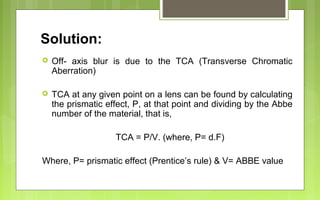
Solution:
 Off- axis blur is due to the TCA (Transverse Chromatic
Aberration)
 TCA at any given point on a lens can be found by calculating
the prismatic effect, P, at that point and dividing by the Abbe
number of the material, that is,
TCA = P/V. (where, P= d.F)
Where, P= prismatic effect (Prentice’s rule) & V= ABBE value
Cont...
It is generally considered that the average
threshold value for TCA is 0.1∆.
 TCA less than 0.1∆ is unlikely to give rise to
complaints.
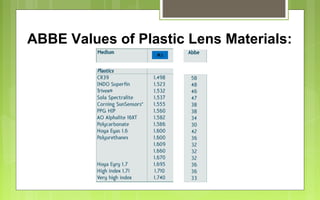
ABBE Values of Plastic Lens Materials:
R.I
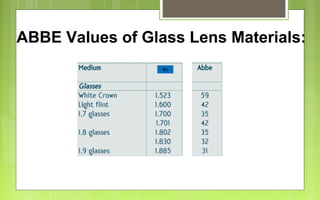
ABBE Values of Glass Lens Materials:
R.I
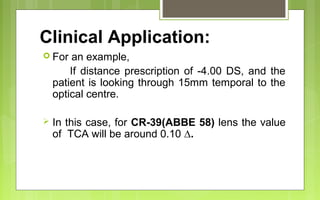
Clinical Application:
 For an example,
If distance prescription of -4.00 DS, and the
patient is looking through 15mm temporal to the
optical centre.
 In this case, for CR-39(ABBE 58) lens the value
of TCA will be around 0.10 ∆.
Cont..
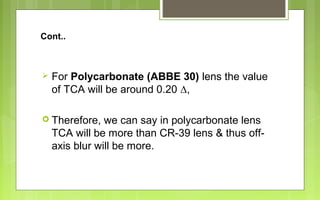
 For Polycarbonate (ABBE 30) lens the value
of TCA will be around 0.20 ∆,
 Therefore, we can say in polycarbonate lens
TCA will be more than CR-39 lens & thus off-
axis blur will be more.
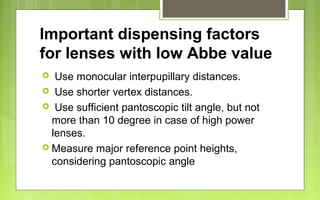
Important dispensing factors
for lenses with low Abbe value
 Use monocular interpupillary distances.
 Use shorter vertex distances.
 Use sufficient pantoscopic tilt angle, but not
more than 10 degree in case of high power
lenses.
 Measure major reference point heights,
considering pantoscopic angle
References:
 System for Opthalmic Dispensing, 2nd
Edition, Irvin M
Borish, O.D, D.O.S, L.L.D, D.Sc.
 Clinical Optics, 2nd
Edition, Troy E. Fannin
 www. pmoptics.com(Pricision Micro Optics)
 Ot Article; CET Continuing Education & Traning, Course
code: C-34968 (Module 2), Course Code: C-12758 (Module 3)
THANK YOU!

Abbe value

  • 1.
    Abbe Value/Number Trisruta Deb 1st year,M.Optom BV(DU)MC School of Optometry
  • 2.
    Lens Properties The mainmaterial properties of spectacle lenses fall into several categories, including: • Refractive index • Specific gravity or density • Abbe number or V-value* • UV absorption • Impact resistance • Durability • Reflectance
  • 3.
    Introduction  The Abbenumber is optical properties of the material rather than of its mechanical characteristics.  The Abbe number is the reciprocal of the dispersive power of the material and indicates the degree of transverse chromatic aberration (TCA) which the wearer will experience.  It also called as ‘nu’ value  ABBE value defined after the German Physicist Ernst Abbe (1840-1905), who defined this useful measurement of optical quality.
  • 4.
    Key Notes  LowerAbbe value lenses will have the higher Chromatic Aberration at periphery of the lens & vice- versa.  ABBE value of the human eye is about 45 to 50 To reduce Chromatic aberration in high power lenses one should prescribe lenses with high ABBE value.
  • 5.
    Cont....  Chromatic Aberrationdepends on the 2 properties: 1. Wavelengths of the light rays 2. Refractive Indices of the lens material
  • 6.
    Chromatic Aberration ofLens  Light entering an optical medium will be dispersed into different refractive effects according to the variation in refractive index with wavelength(4) . This is known as chromatic aberration.
  • 7.
    Transverse Chromatic Aberration It is the type of Chromatic aberration in which there is the differences in image size of chromatically formed images.
  • 8.
    Refractive Index (R.I) Defined as the ratio of the velocity of light in vacuum to the velocity of light in another medium is called refractive index.
  • 9.
    Abbe value formula Equation for calculating the ABBE Value(v):  Where, nD, nF & nC are the refractive indices of the material at the wavelengths of the Fraunhofer D- , F-, & C- Spectral lines
  • 11.
  • 12.
    We can classifiesmaterials in terms of their Abbe number as follows: Low dispersion V ≥ 45 (e.g- Crown=59) Medium dispersion V ≥ 39 but < 45 High dispersion V < 39 (e.g- high density flint = 29) Therefore, low dispersion materials almost never give rise to complaints of coloured fringes or off-axis blur.
  • 13.
    Often in opticalpractice we notice the complain: “These lenses are fine when I look through the centres but vision is blurred when I look through the edge”
  • 14.
    Solution:  Off- axisblur is due to the TCA (Transverse Chromatic Aberration)  TCA at any given point on a lens can be found by calculating the prismatic effect, P, at that point and dividing by the Abbe number of the material, that is, TCA = P/V. (where, P= d.F) Where, P= prismatic effect (Prentice’s rule) & V= ABBE value
  • 15.
    Cont... It is generallyconsidered that the average threshold value for TCA is 0.1∆.  TCA less than 0.1∆ is unlikely to give rise to complaints.
  • 16.
    ABBE Values ofPlastic Lens Materials: R.I
  • 17.
    ABBE Values ofGlass Lens Materials: R.I
  • 18.
    Clinical Application:  Foran example, If distance prescription of -4.00 DS, and the patient is looking through 15mm temporal to the optical centre.  In this case, for CR-39(ABBE 58) lens the value of TCA will be around 0.10 ∆.
  • 19.
    Cont..  For Polycarbonate(ABBE 30) lens the value of TCA will be around 0.20 ∆,  Therefore, we can say in polycarbonate lens TCA will be more than CR-39 lens & thus off- axis blur will be more.
  • 20.
    Important dispensing factors forlenses with low Abbe value  Use monocular interpupillary distances.  Use shorter vertex distances.  Use sufficient pantoscopic tilt angle, but not more than 10 degree in case of high power lenses.  Measure major reference point heights, considering pantoscopic angle
  • 21.
    References:  System forOpthalmic Dispensing, 2nd Edition, Irvin M Borish, O.D, D.O.S, L.L.D, D.Sc.  Clinical Optics, 2nd Edition, Troy E. Fannin  www. pmoptics.com(Pricision Micro Optics)  Ot Article; CET Continuing Education & Traning, Course code: C-34968 (Module 2), Course Code: C-12758 (Module 3)
  • 22.