Opthalmic and geometric
optics
Prasentation by saroj sah
rama university
kanpur up
Light
 Light is a forms of energy whose interaction with
retina and gives the sensation of sight.
 Nature of light:-
 Light is an electromagnetic waves.
 Light also have Dual nature i,e sometime acts as
wave and sometimes particles.
 The energy of photon diretly proportional to the
frequency of the electromagnetic wave.
 Ie E=hf h is planck’s constant
Properties of light
 Light is transverse in nature
 Light travels in straight line
 It can be detected by human eye
 Light travels at a speed of 3*10 m/s at empty
space
 It is forms of wave motion
 It is not deflected by electric and magnetic
field
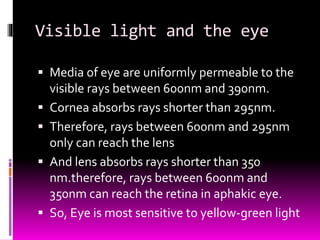
Visible light and the eye
 Media of eye are uniformly permeable to the
visible rays between 600nm and 390nm.
 Cornea absorbs rays shorter than 295nm.
 Therefore, rays between 600nm and 295nm
only can reach the lens
 And lens absorbs rays shorter than 350
nm.therefore, rays between 600nm and
350nm can reach the retina in aphakic eye.
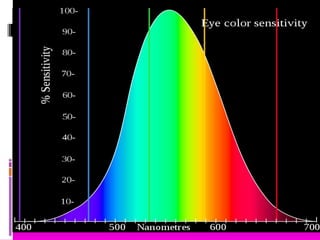
 So, Eye is most sensitive to yellow-green light
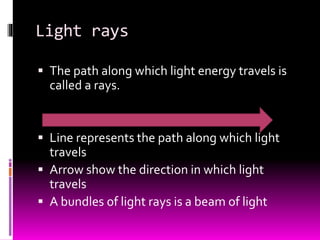
Light rays
 The path along which light energy travels is
called a rays.
 Line represents the path along which light
travels
 Arrow show the direction in which light
travels
 A bundles of light rays is a beam of light
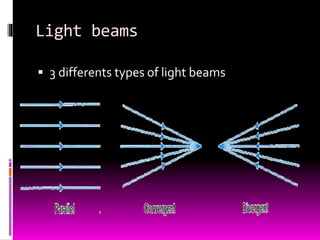
Light beams
 3 differents types of light beams
Two nature of light
 1) wave nature of light
 2) Particles nature of light
 3) Dual nature of light
 Details of nature of light are as
 1) Wave nature of light :-
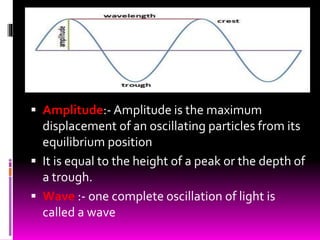
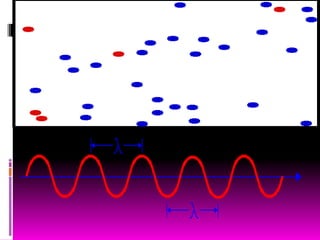
 Wavelength :-Wavelengh of light is defined
as the distance between two symmetrical
parts of the wave motion
 Amplitude:- Amplitude is the maximum
displacement of an oscillating particles from its
equilibrium position
 It is equal to the height of a peak or the depth of
a trough.
 Wave :- one complete oscillation of light is
called a wave
 Speed :- speed is the distance traveled per unit of
time .
 It is scalar quantity
 Energy :- hf ie h is plank’s constant and f is
frequency.
 2) Particle nature :-
 The particle like nature of light is modeled with
photons
 A photon means photo+electron
 It is carrier of electromagnetic energy and
interacts with other particles
 A photon has no mass and no charge
Reflection of light
 Reflection of light is the phenomenon of change in
the path of light rays without any change in the
medium
 The light rays falling on a reflecting surface are
called incident rays
 And those reflected by surface is called reflected
rays
 A line drawn at right angle to the surface is called
normal
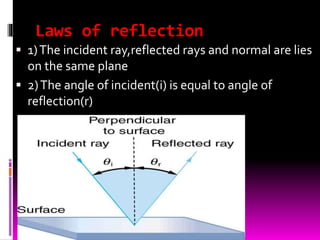
Laws of reflection
 1)The incident ray,reflected rays and normal are lies
on the same plane
 2)The angle of incident(i) is equal to angle of
reflection(r)
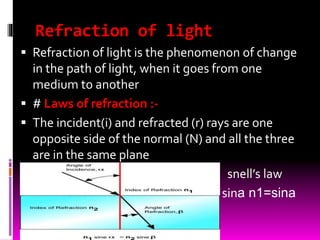
Refraction of light
 Refraction of light is the phenomenon of change
in the path of light, when it goes from one
medium to another
 # Laws of refraction :-
 The incident(i) and refracted (r) rays are one
opposite side of the normal (N) and all the three
are in the same plane
 snell’s law
 sina n1=sina
n2
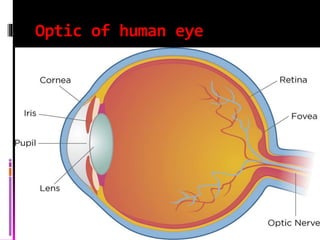
Optic of human eye
Opthalmic and geometric optics

Opthalmic and geometric optics

  • 1.
    Opthalmic and geometric optics Prasentationby saroj sah rama university kanpur up
  • 2.
    Light  Light isa forms of energy whose interaction with retina and gives the sensation of sight.  Nature of light:-  Light is an electromagnetic waves.  Light also have Dual nature i,e sometime acts as wave and sometimes particles.  The energy of photon diretly proportional to the frequency of the electromagnetic wave.  Ie E=hf h is planck’s constant
  • 3.
    Properties of light Light is transverse in nature  Light travels in straight line  It can be detected by human eye  Light travels at a speed of 3*10 m/s at empty space  It is forms of wave motion  It is not deflected by electric and magnetic field
  • 4.
    Visible light andthe eye  Media of eye are uniformly permeable to the visible rays between 600nm and 390nm.  Cornea absorbs rays shorter than 295nm.  Therefore, rays between 600nm and 295nm only can reach the lens  And lens absorbs rays shorter than 350 nm.therefore, rays between 600nm and 350nm can reach the retina in aphakic eye.  So, Eye is most sensitive to yellow-green light
  • 6.
    Light rays  Thepath along which light energy travels is called a rays.  Line represents the path along which light travels  Arrow show the direction in which light travels  A bundles of light rays is a beam of light
  • 7.
    Light beams  3differents types of light beams
  • 8.
    Two nature oflight  1) wave nature of light  2) Particles nature of light  3) Dual nature of light  Details of nature of light are as  1) Wave nature of light :-  Wavelength :-Wavelengh of light is defined as the distance between two symmetrical parts of the wave motion
  • 9.
     Amplitude:- Amplitudeis the maximum displacement of an oscillating particles from its equilibrium position  It is equal to the height of a peak or the depth of a trough.  Wave :- one complete oscillation of light is called a wave
  • 10.
     Speed :-speed is the distance traveled per unit of time .  It is scalar quantity  Energy :- hf ie h is plank’s constant and f is frequency.  2) Particle nature :-  The particle like nature of light is modeled with photons  A photon means photo+electron  It is carrier of electromagnetic energy and interacts with other particles  A photon has no mass and no charge
  • 12.
    Reflection of light Reflection of light is the phenomenon of change in the path of light rays without any change in the medium  The light rays falling on a reflecting surface are called incident rays  And those reflected by surface is called reflected rays  A line drawn at right angle to the surface is called normal
  • 13.
    Laws of reflection 1)The incident ray,reflected rays and normal are lies on the same plane  2)The angle of incident(i) is equal to angle of reflection(r)
  • 14.
    Refraction of light Refraction of light is the phenomenon of change in the path of light, when it goes from one medium to another  # Laws of refraction :-  The incident(i) and refracted (r) rays are one opposite side of the normal (N) and all the three are in the same plane  snell’s law  sina n1=sina n2
  • 15.