Transportation
G. Muniselvi
18UD10
Logistics management
Meaning:
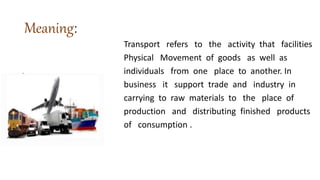
Transport refers to the activity that facilities
Physical Movement of goods as well as
individuals from one place to another. In
business it support trade and industry in
carrying to raw materials to the place of
production and distributing finished products
of consumption .
Types of transportation:
• Railways
• Roadways
• Airways
• waterways
• pipelines.
Railways transportation:
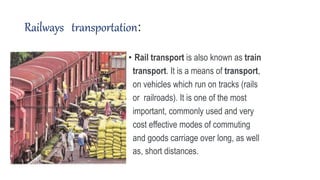
• Rail transport is also known as train
transport. It is a means of transport,
on vehicles which run on tracks (rails
or railroads). It is one of the most
important, commonly used and very
cost effective modes of commuting
and goods carriage over long, as well
as, short distances.
Advantage of railways:
• Faster than shipping.
• Existing railway –system.
• Providing new jobs.
• More Flexible
Disadvantage of railways:
• Service and maintenance.
• unflexible transportway.
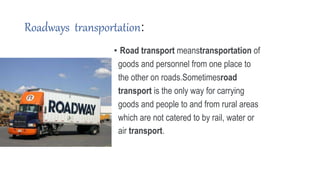
Roadways transportation:
• Road transport meanstransportation of
goods and personnel from one place to
the other on roads.Sometimesroad
transport is the only way for carrying
goods and people to and from rural areas
which are not catered to by rail, water or
air transport.
Advantage of roadways:
• Door to Door Service
• Less Capital Outlay
• Service in Rural Areas
• Flexible Service
Disadvantage of roadways:
• Accidents and Breakdowns
• Slow Speed
• Lack of Organisation and Structur
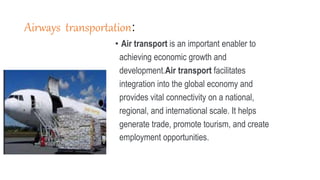
Airways transportation:
• Air transport is an important enabler to
achieving economic growth and
development.Air transport facilitates
integration into the global economy and
provides vital connectivity on a national,
regional, and international scale. It helps
generate trade, promote tourism, and create
employment opportunities.
Advantage of airways:
• High Speed
• Quick Service
• No Infrastructure Investment
• Easy Access
Disadvantage of airways:
• Risky
• Very Costly
• Small Carrying Capacity
• Unreliable
Waterways transportation:
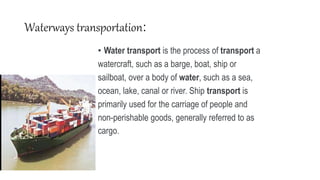
• Water transport is the process of transport a
watercraft, such as a barge, boat, ship or
sailboat, over a body of water, such as a sea,
ocean, lake, canal or river. Ship transport is
primarily used for the carriage of people and
non-perishable goods, generally referred to as
cargo.
Advantage of waterways:
• Cheap
• Less Maintenance Cost
• Useful for Bulky Goods
• Helpful in Defence
Disadvantage of waterways:
• More Risky
• Slow Speed
Pipelines transportation:
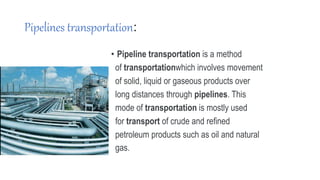
• Pipeline transportation is a method
of transportationwhich involves movement
of solid, liquid or gaseous products over
long distances through pipelines. This
mode of transportation is mostly used
for transport of crude and refined
petroleum products such as oil and natural
gas.
Advantage of pipelines:
• They are ideally suited to transport the liquids and
gases.
• Pipelines can be laid through difficult terrains as
well as under water.
• It involves very low energy consumption.
• It needs very little maintenance.
ADVERTISEMENTS:
• Pipelines arc safe, accident-free and
environmental friendly.
Disadvantage of pipelines:
• It is not flexible, i.e., it can be used only for a few
fixed points.
• Its capacity cannot be increased once it is laid.
ADVERTISEMENTS:
• It is difficult to make security arrangements
for pipelines.
• Underground pipelines cannot be easily repaired and
detection of leakage is also difficult.
Transportation slide

Transportation slide

  • 1.
  • 2.
    Meaning: Transport refers tothe activity that facilities Physical Movement of goods as well as individuals from one place to another. In business it support trade and industry in carrying to raw materials to the place of production and distributing finished products of consumption .
  • 3.
    Types of transportation: •Railways • Roadways • Airways • waterways • pipelines.
  • 4.
    Railways transportation: • Railtransport is also known as train transport. It is a means of transport, on vehicles which run on tracks (rails or railroads). It is one of the most important, commonly used and very cost effective modes of commuting and goods carriage over long, as well as, short distances.
  • 5.
    Advantage of railways: •Faster than shipping. • Existing railway –system. • Providing new jobs. • More Flexible
  • 6.
    Disadvantage of railways: •Service and maintenance. • unflexible transportway.
  • 7.
    Roadways transportation: • Roadtransport meanstransportation of goods and personnel from one place to the other on roads.Sometimesroad transport is the only way for carrying goods and people to and from rural areas which are not catered to by rail, water or air transport.
  • 8.
    Advantage of roadways: •Door to Door Service • Less Capital Outlay • Service in Rural Areas • Flexible Service
  • 9.
    Disadvantage of roadways: •Accidents and Breakdowns • Slow Speed • Lack of Organisation and Structur
  • 10.
    Airways transportation: • Airtransport is an important enabler to achieving economic growth and development.Air transport facilitates integration into the global economy and provides vital connectivity on a national, regional, and international scale. It helps generate trade, promote tourism, and create employment opportunities.
  • 11.
    Advantage of airways: •High Speed • Quick Service • No Infrastructure Investment • Easy Access
  • 12.
    Disadvantage of airways: •Risky • Very Costly • Small Carrying Capacity • Unreliable
  • 13.
    Waterways transportation: • Watertransport is the process of transport a watercraft, such as a barge, boat, ship or sailboat, over a body of water, such as a sea, ocean, lake, canal or river. Ship transport is primarily used for the carriage of people and non-perishable goods, generally referred to as cargo.
  • 14.
    Advantage of waterways: •Cheap • Less Maintenance Cost • Useful for Bulky Goods • Helpful in Defence
  • 15.
    Disadvantage of waterways: •More Risky • Slow Speed
  • 16.
    Pipelines transportation: • Pipelinetransportation is a method of transportationwhich involves movement of solid, liquid or gaseous products over long distances through pipelines. This mode of transportation is mostly used for transport of crude and refined petroleum products such as oil and natural gas.
  • 17.
    Advantage of pipelines: •They are ideally suited to transport the liquids and gases. • Pipelines can be laid through difficult terrains as well as under water. • It involves very low energy consumption. • It needs very little maintenance. ADVERTISEMENTS: • Pipelines arc safe, accident-free and environmental friendly.
  • 18.
    Disadvantage of pipelines: •It is not flexible, i.e., it can be used only for a few fixed points. • Its capacity cannot be increased once it is laid. ADVERTISEMENTS: • It is difficult to make security arrangements for pipelines. • Underground pipelines cannot be easily repaired and detection of leakage is also difficult.