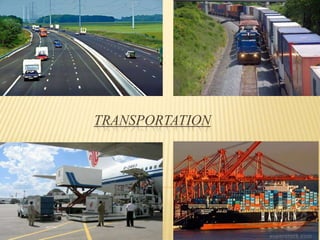
TRANSPORTATION
MEANING AND DEFINITION
“The process of moving an item from point
A to point B.”
“Safe, efficient, reliable, and sustainable
movement of persons and goods over time
and space”
Importance of transportation:
1) Place Utility.
2) Industrial Development.
3) Employment Opportunities.
4) High Standard of Living.
5) Distribution of Perishable Goods.
6)Emergency Transportation
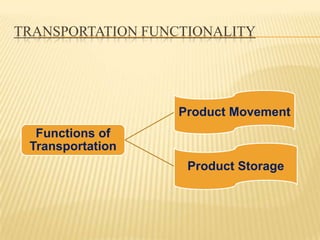
TRANSPORTATION FUNCTIONALITY
Functions of
Transportation
Product Movement
Product Storage
Product Movement
 Temporal:
- Product is locked up during transit, hence inaccessible
- Positive amount of time is spent in transporting material.
- Time is a resource[Temporal Resource] expended in
Transportation .
- During the time product is locked up costs are incurred in
proportion of time.
 Financial:
- Administration costs, Salaries, Maintenance costs are
expended.
 Environmental:
- Fuel costs are high[Creates air pollution, congestion,
Noise pollution.
Product Storage:
It is a temporary storage in stationery vehicle. Product storage
is expensive in transport vehicle. In some situations Product is
done such as:
When the cost of unloading and reloading the product in the
Warehouse is more expensive.
When storage space is limited. Or,
At other times, temporary storage is used due to diversion. This
occurs when an original delivery destination is changed while
the inventory is in transit.
PRINCIPLES OF TRANSPORTATION
Principles of
Transportation
Economy
of Scale
Economy of
Distance
Types of Transportation
1.Road Transport.
2. Rail Transport.
3. Water Transport.
4. Air Transport.
5. Pipeline Transport.
6. Ropeway Transport.
Road Transport:
* Advantages;
1. Door to Door Service.
2. Economical over short distances.
3. Flexibility.
4.Limited Capital Expenditure.
* Disadvantages;
1. Irregular and Unreliable.
2. Unsuitable for Long Distances
3. No Uniformity in Rates.
4. Limited Speed.
5. Affected by Weather.
Rail Transport:
* Advantages;
1. High Speed.
2. Suitable for Long Distances.
3. Bulky Goods.
4. Protection.
5. Large Carrying Capacity.
* Disadvantages;
1. Huge Capital Expenditure.
2. High Overheads.
3. No Door to Door Service.
4. No Competition.
5. Inflexible Mode.
Air Transport:
* Advantages;
1. Flexible.
2. Quick service.
3. Natural Highways.
4. Protection.
5. High Speed.
* Disadvantages;
1. High Cost of Construction and Maintenance.
2. Costliest.
3. Limited Carrying Capacity.
4. International Restrictions.
5. Unsuitable for Bulky Goods.
Water Transport:
* Advantages;
1. Cheapest Mode of Transport.
2. Large Carrying Capacity.
3. Safety.
4. Protection to Goods.
5. Flexibility.
* Disadvantages;
1. Slow.
2. Huge Capital Expenditure.
3. High Cost of Maintenance.
4. No Door to Door Service.
5. Special Packing.
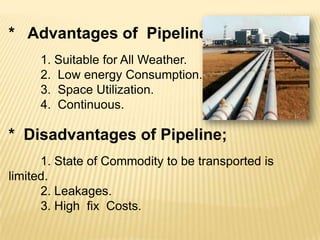
Pipeline Transport:
 Generally liquids like oils,
crude, petroleum products are
transported.
 More than 6350 KM of Pipeline
exits in India.
 Currently 27% of petroleum
products are moved by
pipelines in India.
* Advantages of Pipeline;
1. Suitable for All Weather.
2. Low energy Consumption.
3. Space Utilization.
4. Continuous.
* Disadvantages of Pipeline;
1. State of Commodity to be transported is
limited.
2. Leakages.
3. High fix Costs.
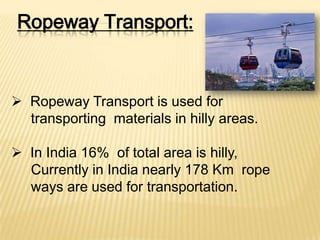
Ropeway Transport:
 Ropeway Transport is used for
transporting materials in hilly areas.
 In India 16% of total area is hilly,
Currently in India nearly 178 Km rope
ways are used for transportation.
* Advantages of Ropeway;
1. Transports Bulk Material over Short
Distance.
2. Lower Capital Costs.
3. Less environmental damage.
* Disadvantages of
Ropeway;
1. Limited Scope.
COST STRUCTURE FOR EACH MODULE:
Mode Fixed Costs Variable Costs
Rail High- Equipments, Terminals
, Tracks ,etc
Low
Road Low-Highway provided by
government
Medium-Fuel , Maintenance, etc
Water Medium-Ships and
Equipment
Low-As capacity is huge
Pipeline Highest-Right of the way ,
construction, Equipment for
control station and Pumping
capacity
Lowest-Insignificant labour costs
Air Low-Aircraft and cargo
handling systems
High- Fuel, labour, Maintenance
COST RATIO OF LOGISTICS ELEMENTS
Inventor
y
Manage
ment
Transpo
rtation
Packagi
ng
Orderin
g
Wareho
using
Cost Ratio 17.5 11 29.5 11.9 5.5 17
0
5
10
15
20
25
30
35
Factors affecting Transportation Costs:
Product Related Factors Market Related Factors
Density Whether the Product is transported
Domestically or
Internationally, Seasonality of
Product Movement
Stow ability Location of Markets, which
determines the distance goods must
be transported
Ease or Difficulty of Handling Nature & extent of government
regulation
Liability Balance or imbalance of Freight
Traffic in to and out of a Market
CONCLUSION:
 Transportation and logistics systems have interdependent
relationships that logistics management needs
transportation to perform its activities and meanwhile, a
successful logistics system could help to improve traffic
environment and transportation development.
 Since transportation contributes the highest cost among the
related elements in logistics systems, the improvement of
transport efficiency could change the overall performance of
a logistics system.
Transportation final ppt hemant n kt colg thane

Transportation final ppt hemant n kt colg thane

  • 1.
  • 2.
    MEANING AND DEFINITION “Theprocess of moving an item from point A to point B.” “Safe, efficient, reliable, and sustainable movement of persons and goods over time and space”
  • 3.
    Importance of transportation: 1)Place Utility. 2) Industrial Development. 3) Employment Opportunities. 4) High Standard of Living. 5) Distribution of Perishable Goods. 6)Emergency Transportation
  • 4.
  • 5.
    Product Movement  Temporal: -Product is locked up during transit, hence inaccessible - Positive amount of time is spent in transporting material. - Time is a resource[Temporal Resource] expended in Transportation . - During the time product is locked up costs are incurred in proportion of time.  Financial: - Administration costs, Salaries, Maintenance costs are expended.  Environmental: - Fuel costs are high[Creates air pollution, congestion, Noise pollution.
  • 6.
    Product Storage: It isa temporary storage in stationery vehicle. Product storage is expensive in transport vehicle. In some situations Product is done such as: When the cost of unloading and reloading the product in the Warehouse is more expensive. When storage space is limited. Or, At other times, temporary storage is used due to diversion. This occurs when an original delivery destination is changed while the inventory is in transit.
  • 7.
    PRINCIPLES OF TRANSPORTATION Principlesof Transportation Economy of Scale Economy of Distance
  • 8.
    Types of Transportation 1.RoadTransport. 2. Rail Transport. 3. Water Transport. 4. Air Transport. 5. Pipeline Transport. 6. Ropeway Transport.
  • 9.
    Road Transport: * Advantages; 1.Door to Door Service. 2. Economical over short distances. 3. Flexibility. 4.Limited Capital Expenditure. * Disadvantages; 1. Irregular and Unreliable. 2. Unsuitable for Long Distances 3. No Uniformity in Rates. 4. Limited Speed. 5. Affected by Weather.
  • 10.
    Rail Transport: * Advantages; 1.High Speed. 2. Suitable for Long Distances. 3. Bulky Goods. 4. Protection. 5. Large Carrying Capacity. * Disadvantages; 1. Huge Capital Expenditure. 2. High Overheads. 3. No Door to Door Service. 4. No Competition. 5. Inflexible Mode.
  • 11.
    Air Transport: * Advantages; 1.Flexible. 2. Quick service. 3. Natural Highways. 4. Protection. 5. High Speed. * Disadvantages; 1. High Cost of Construction and Maintenance. 2. Costliest. 3. Limited Carrying Capacity. 4. International Restrictions. 5. Unsuitable for Bulky Goods.
  • 12.
    Water Transport: * Advantages; 1.Cheapest Mode of Transport. 2. Large Carrying Capacity. 3. Safety. 4. Protection to Goods. 5. Flexibility. * Disadvantages; 1. Slow. 2. Huge Capital Expenditure. 3. High Cost of Maintenance. 4. No Door to Door Service. 5. Special Packing.
  • 13.
    Pipeline Transport:  Generallyliquids like oils, crude, petroleum products are transported.  More than 6350 KM of Pipeline exits in India.  Currently 27% of petroleum products are moved by pipelines in India.
  • 14.
    * Advantages ofPipeline; 1. Suitable for All Weather. 2. Low energy Consumption. 3. Space Utilization. 4. Continuous. * Disadvantages of Pipeline; 1. State of Commodity to be transported is limited. 2. Leakages. 3. High fix Costs.
  • 15.
    Ropeway Transport:  RopewayTransport is used for transporting materials in hilly areas.  In India 16% of total area is hilly, Currently in India nearly 178 Km rope ways are used for transportation.
  • 16.
    * Advantages ofRopeway; 1. Transports Bulk Material over Short Distance. 2. Lower Capital Costs. 3. Less environmental damage. * Disadvantages of Ropeway; 1. Limited Scope.
  • 17.
    COST STRUCTURE FOREACH MODULE: Mode Fixed Costs Variable Costs Rail High- Equipments, Terminals , Tracks ,etc Low Road Low-Highway provided by government Medium-Fuel , Maintenance, etc Water Medium-Ships and Equipment Low-As capacity is huge Pipeline Highest-Right of the way , construction, Equipment for control station and Pumping capacity Lowest-Insignificant labour costs Air Low-Aircraft and cargo handling systems High- Fuel, labour, Maintenance
  • 18.
    COST RATIO OFLOGISTICS ELEMENTS Inventor y Manage ment Transpo rtation Packagi ng Orderin g Wareho using Cost Ratio 17.5 11 29.5 11.9 5.5 17 0 5 10 15 20 25 30 35
  • 19.
    Factors affecting TransportationCosts: Product Related Factors Market Related Factors Density Whether the Product is transported Domestically or Internationally, Seasonality of Product Movement Stow ability Location of Markets, which determines the distance goods must be transported Ease or Difficulty of Handling Nature & extent of government regulation Liability Balance or imbalance of Freight Traffic in to and out of a Market
  • 20.
    CONCLUSION:  Transportation andlogistics systems have interdependent relationships that logistics management needs transportation to perform its activities and meanwhile, a successful logistics system could help to improve traffic environment and transportation development.  Since transportation contributes the highest cost among the related elements in logistics systems, the improvement of transport efficiency could change the overall performance of a logistics system.