TRANSPORTATION
V.Abinash
18UD16
Logistics Management
1. Transportation Meaning:
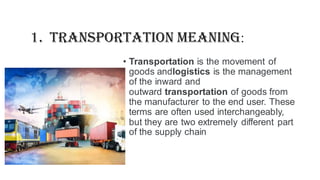
• Transportation is the movement of
goods andlogistics is the management
of the inward and
outward transportation of goods from
the manufacturer to the end user. These
terms are often used interchangeably,
but they are two extremely different part
of the supply chain
Definition:
• In business, at its most basic
level, transportation is simply moving products
and materials from one place to
another.Logistics also includes the packaging
of products for storage and
shipment. Logistics involves both internal and
external distribution networks.
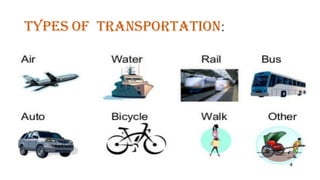
Types Of Transportation:
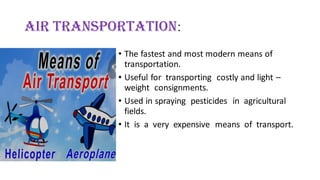
Air Transportation:
• The fastest and most modern means of
transportation.
• Useful for transporting costly and light –
weight consignments.
• Used in spraying pesticides in agricultural
fields.
• It is a very expensive means of transport.
Types Of Air Transportation:
• Aeroplanes.
• Helicopters.
• Hot air balloons.
• Blimps.
• Gliders.
Advantages Of Air Transportation:
• Flexible
• Quick service
• Natural highways
• Protection
• High speed.
Disadvantage Of Air Transportation:
• High cost of construction and
maintenance costliest
• Limited carrying capacity
• International Restrictions
• Unsuitable for Bulky Goods.
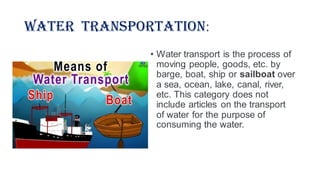
Water Transportation:
• Water transport is the process of
moving people, goods, etc. by
barge, boat, ship or sailboat over
a sea, ocean, lake, canal, river,
etc. This category does not
include articles on the transport
of water for the purpose of
consuming the water.
Types Of Water Transportation:
•Inland Water Transport
•Rivers
•Canals
•Lakes.
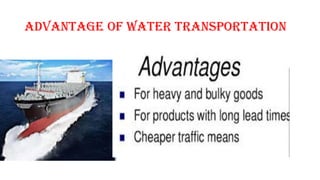
Advantage Of water Transportation
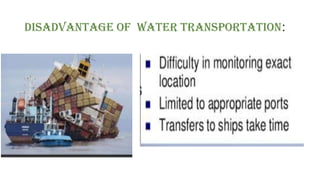
Disadvantage Of Water Transportation:
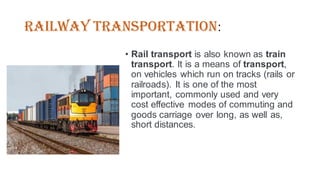
Railway Transportation:
• Rail transport is also known as train
transport. It is a means of transport,
on vehicles which run on tracks (rails or
railroads). It is one of the most
important, commonly used and very
cost effective modes of commuting and
goods carriage over long, as well as,
short distances.
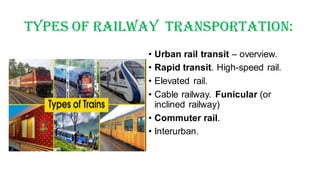
Types Of Railway Transportation:
• Urban rail transit – overview.
• Rapid transit. High-speed rail.
• Elevated rail.
• Cable railway. Funicular (or
inclined railway)
• Commuter rail.
• Interurban.
Advantage Of Water Transportation:
• Faster than shipping
• Exiting railway system
• Providing new jobs
• More flexible
• Envionmental protection.
Disadvantage Of Railway transportation:
• Service and maintenance
• Unflexible transpotway .
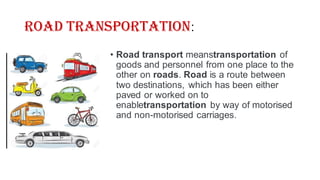
Road Transportation:
• Road transport meanstransportation of
goods and personnel from one place to the
other on roads. Road is a route between
two destinations, which has been either
paved or worked on to
enabletransportation by way of motorised
and non-motorised carriages.
Types of Road Transportation:
• Bus&van
• Car
• Scooty&Bike
• Taxi
• Cycle
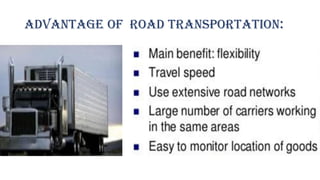
Advantage Of Road Transportation:
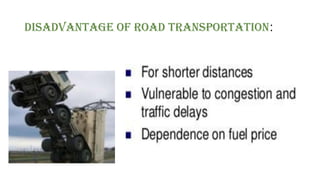
Disadvantage Of Road Transportation:
Reference :
• Google
• Book
TRANSPORTATION

TRANSPORTATION

  • 1.
  • 2.
    1. Transportation Meaning: •Transportation is the movement of goods andlogistics is the management of the inward and outward transportation of goods from the manufacturer to the end user. These terms are often used interchangeably, but they are two extremely different part of the supply chain
  • 3.
    Definition: • In business,at its most basic level, transportation is simply moving products and materials from one place to another.Logistics also includes the packaging of products for storage and shipment. Logistics involves both internal and external distribution networks.
  • 4.
  • 5.
    Air Transportation: • Thefastest and most modern means of transportation. • Useful for transporting costly and light – weight consignments. • Used in spraying pesticides in agricultural fields. • It is a very expensive means of transport.
  • 6.
    Types Of AirTransportation: • Aeroplanes. • Helicopters. • Hot air balloons. • Blimps. • Gliders.
  • 7.
    Advantages Of AirTransportation: • Flexible • Quick service • Natural highways • Protection • High speed.
  • 8.
    Disadvantage Of AirTransportation: • High cost of construction and maintenance costliest • Limited carrying capacity • International Restrictions • Unsuitable for Bulky Goods.
  • 9.
    Water Transportation: • Watertransport is the process of moving people, goods, etc. by barge, boat, ship or sailboat over a sea, ocean, lake, canal, river, etc. This category does not include articles on the transport of water for the purpose of consuming the water.
  • 10.
    Types Of WaterTransportation: •Inland Water Transport •Rivers •Canals •Lakes.
  • 11.
    Advantage Of waterTransportation
  • 12.
    Disadvantage Of WaterTransportation:
  • 13.
    Railway Transportation: • Railtransport is also known as train transport. It is a means of transport, on vehicles which run on tracks (rails or railroads). It is one of the most important, commonly used and very cost effective modes of commuting and goods carriage over long, as well as, short distances.
  • 14.
    Types Of RailwayTransportation: • Urban rail transit – overview. • Rapid transit. High-speed rail. • Elevated rail. • Cable railway. Funicular (or inclined railway) • Commuter rail. • Interurban.
  • 15.
    Advantage Of WaterTransportation: • Faster than shipping • Exiting railway system • Providing new jobs • More flexible • Envionmental protection.
  • 16.
    Disadvantage Of Railwaytransportation: • Service and maintenance • Unflexible transpotway .
  • 17.
    Road Transportation: • Roadtransport meanstransportation of goods and personnel from one place to the other on roads. Road is a route between two destinations, which has been either paved or worked on to enabletransportation by way of motorised and non-motorised carriages.
  • 18.
    Types of RoadTransportation: • Bus&van • Car • Scooty&Bike • Taxi • Cycle
  • 19.
    Advantage Of RoadTransportation:
  • 20.
    Disadvantage Of RoadTransportation:
  • 21.