Mathavan.G
18UD29
3rd B.B.A-C
Transportasion
Logistics meaning:
Logisticsrefers to the overallprocess of managing how resources areacquired,
stored, and transportedto their final destination.… The term is now used widely in
the business sector, particularlyby companies in the manufacturingsectors, to
refer to how resourcesare handledand moved along the supply chain.
The process of coordinatingand moving resources – people, materials, inventory,
and equipment – from one location
Evolution of Transportation
 Logistical evolution means that we can get goods to exactly where
they need to be as well as track the journey. Technology has helped
us to map the most efficient ways of distributing goods. More
thought goes into logistics today than it previously has before. A
popular concept is the seven R's of logistics.
From the beginning of the 1960s until the present year the logistics have
kept on evolving. Logistics can be easily defined as “efficient planning and
implementation of products, services, and information flow from the starting
point (origin) to the endpoint (customers) including transport, storage, and
control”.
Components of Supply chain:
1. Three Components of Supply Chain Management
2. A supply chain features three main components: purchasing,
manufacturing and transportation. You will need to make many
key decisions across these three components from start to finish,
including:
3. Materials to be used for products
4. Production amounts
5. Inventory levels
6. Distribution network configuration
7. Transportation for both receiving and shipping
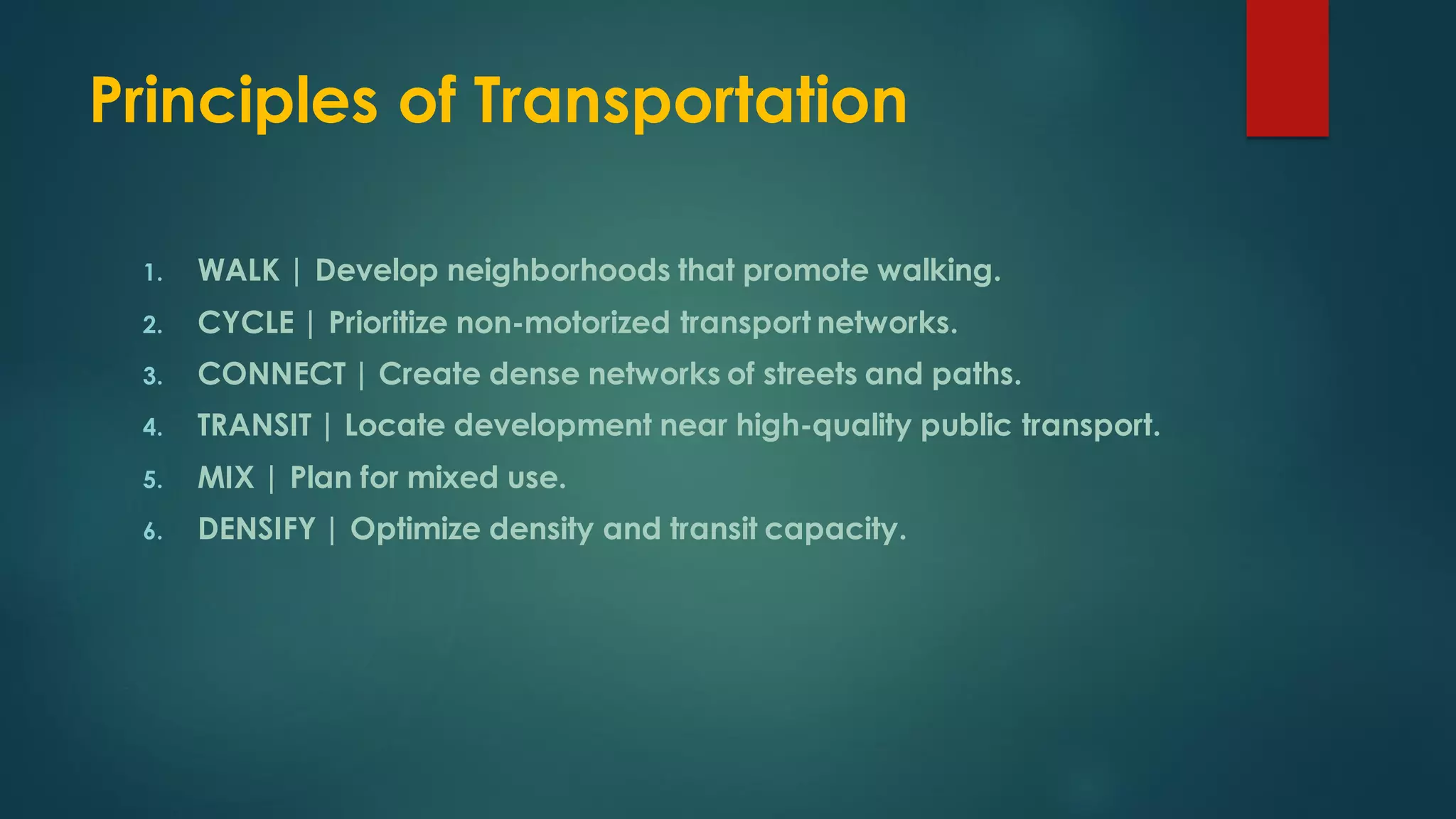
Principles of Transportation
1. WALK | Develop neighborhoods that promote walking.
2. CYCLE | Prioritize non-motorized transport networks.
3. CONNECT | Create dense networks of streets and paths.
4. TRANSIT | Locate development near high-quality public transport.
5. MIX | Plan for mixed use.
6. DENSIFY | Optimize density and transit capacity.
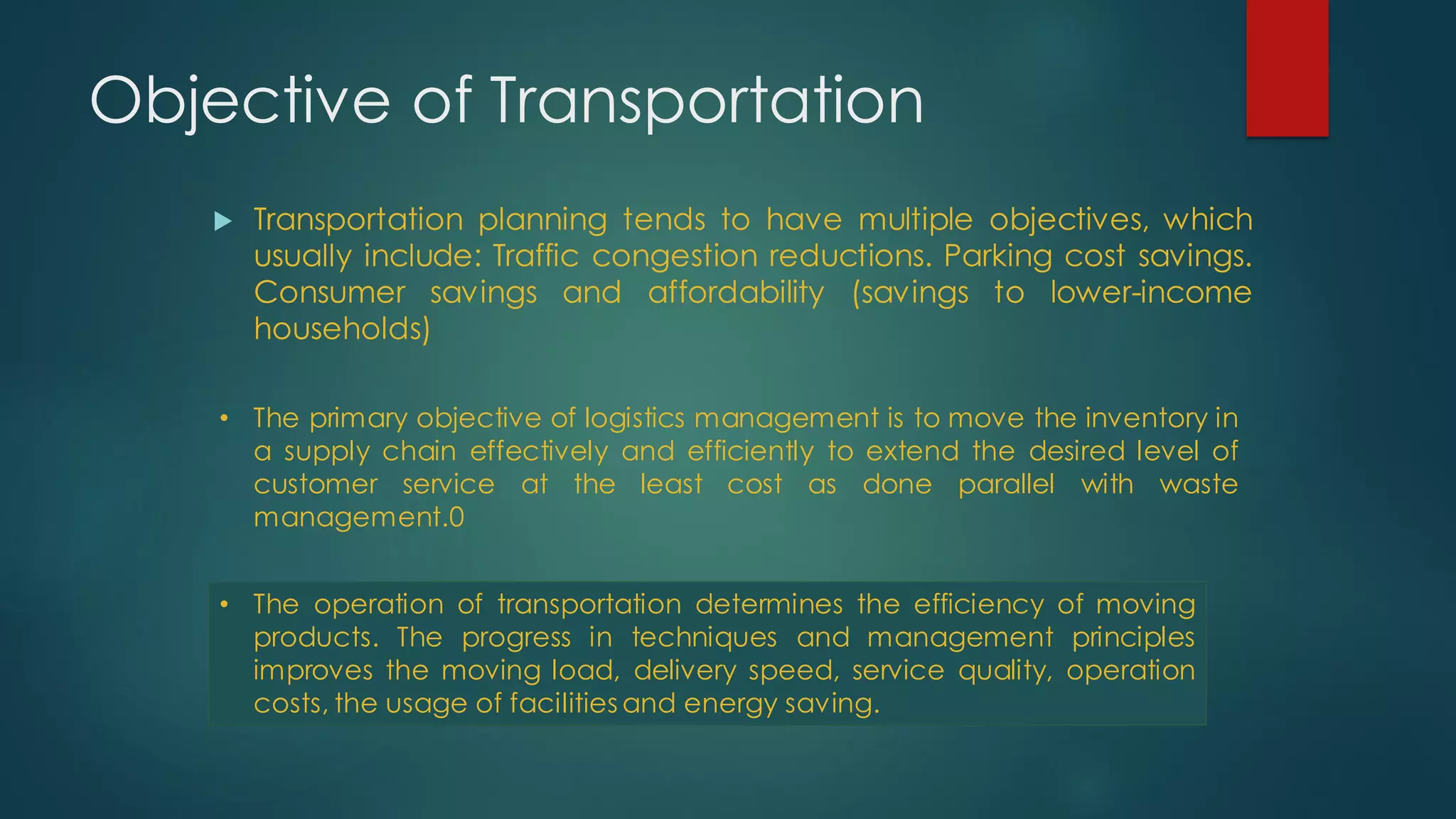
Objective of Transportation
 Transportation planning tends to have multiple objectives, which
usually include: Traffic congestion reductions. Parking cost savings.
Consumer savings and affordability (savings to lower-income
households)
• The primary objective of logistics management is to move the inventory in
a supply chain effectively and efficiently to extend the desired level of
customer service at the least cost as done parallel with waste
management.0
• The operation of transportation determines the efficiency of moving
products. The progress in techniques and management principles
improves the moving load, delivery speed, service quality, operation
costs, the usage of facilities and energy saving.
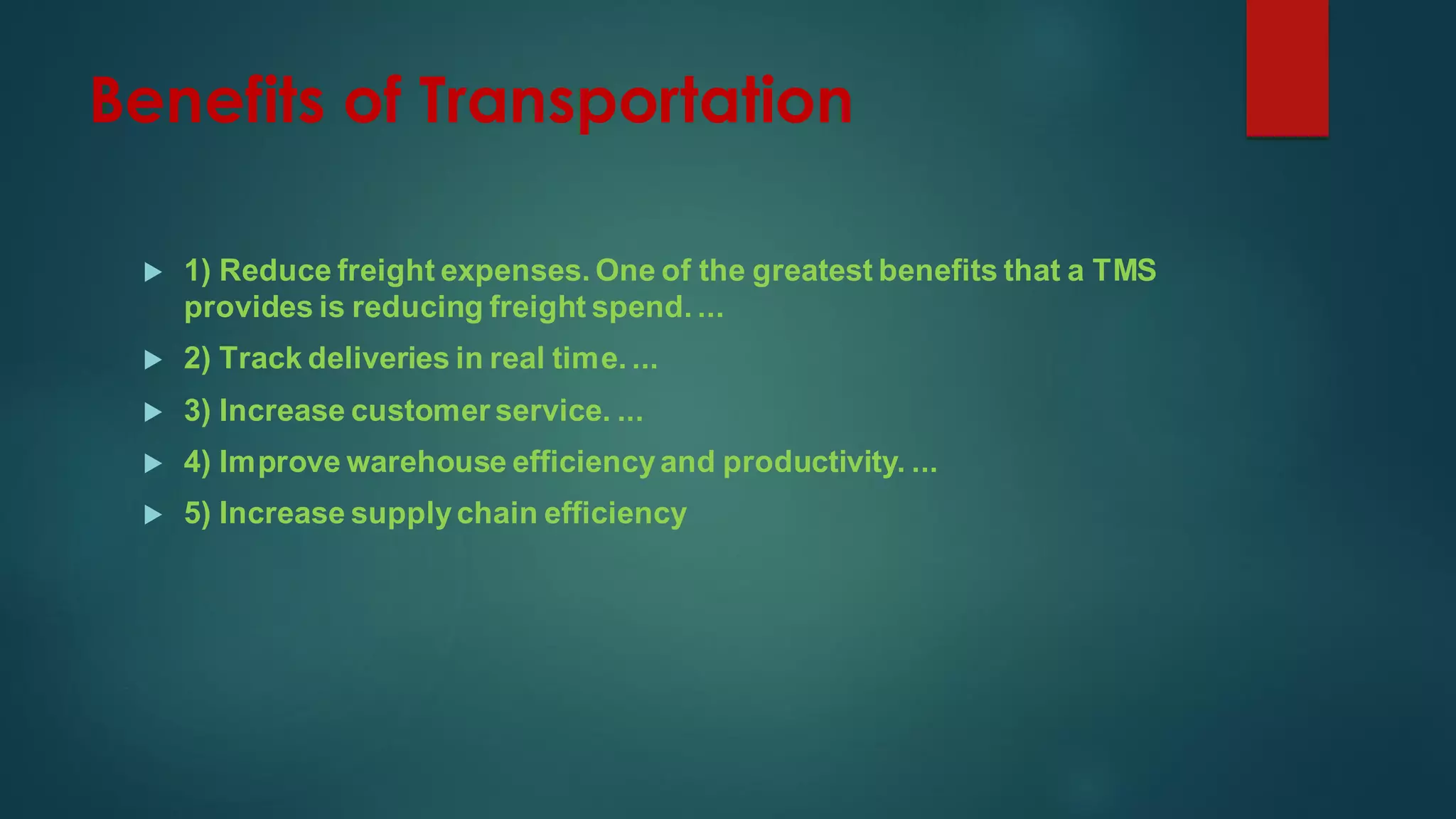
Benefits of Transportation
 1) Reduce freight expenses. One of the greatest benefits that a TMS
provides is reducing freight spend. ...
 2) Track deliveries in real time. ...
 3) Increase customer service. ...
 4) Improve warehouse efficiencyand productivity. ...
 5) Increase supplychain efficiency
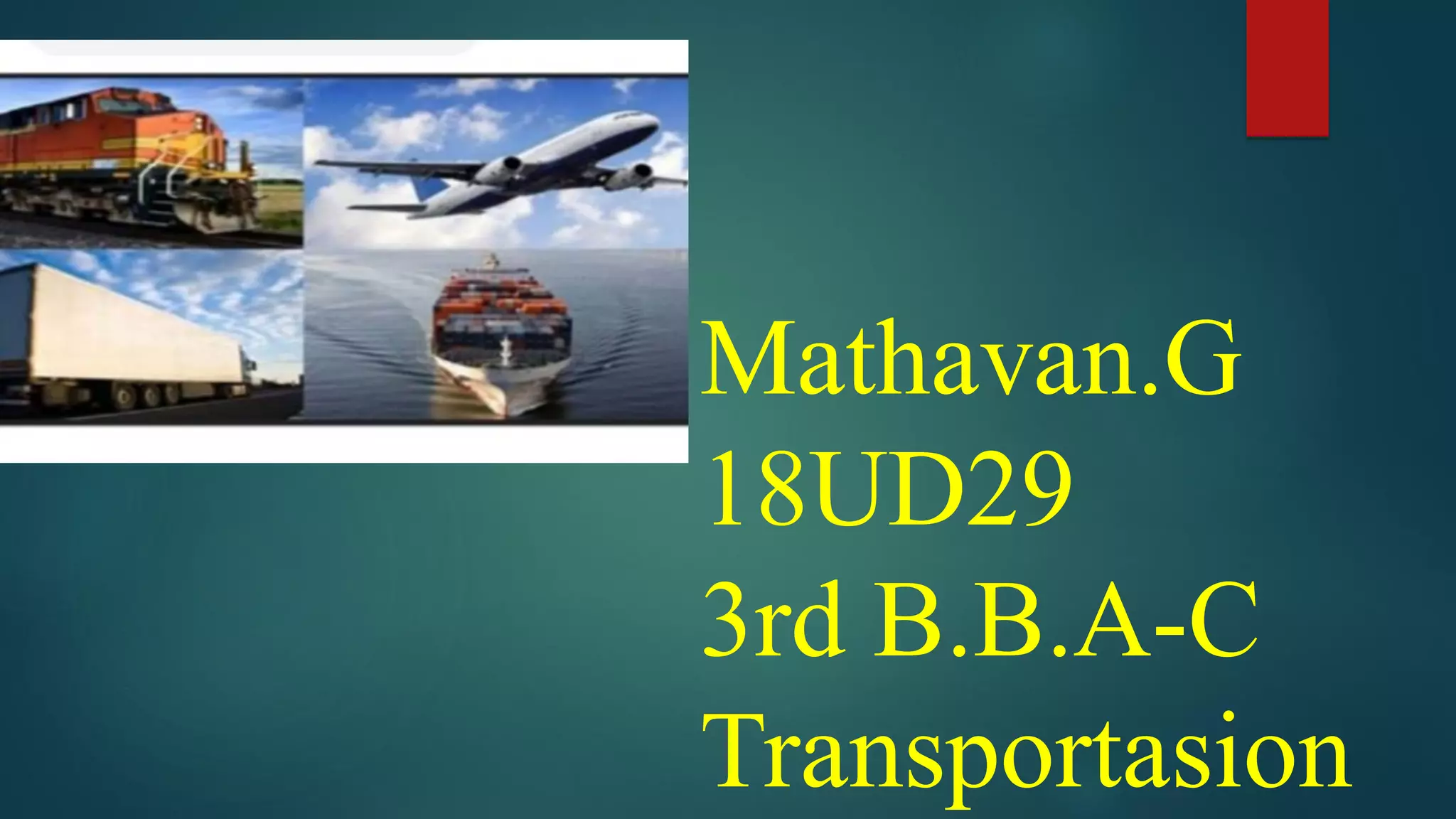
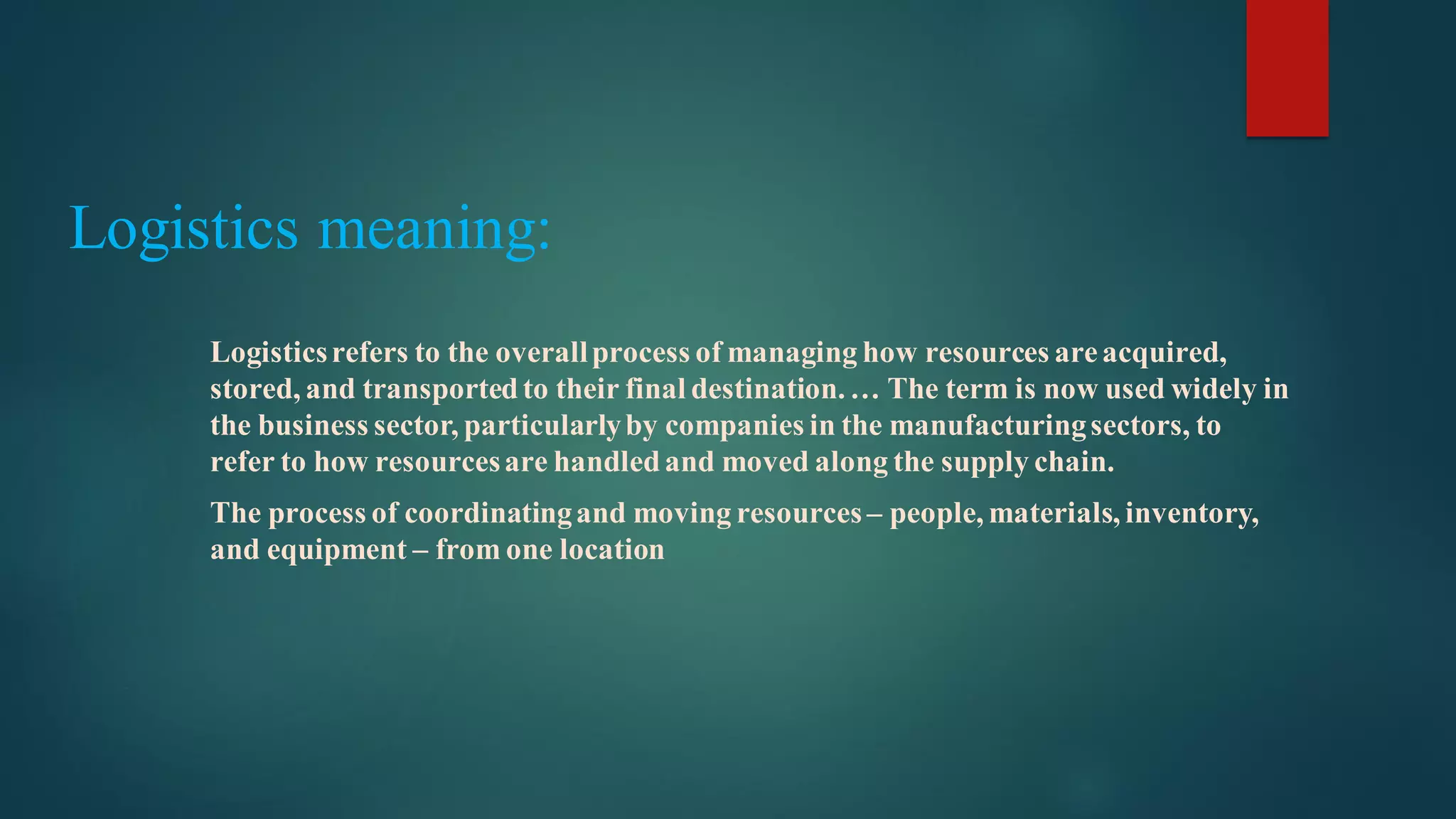
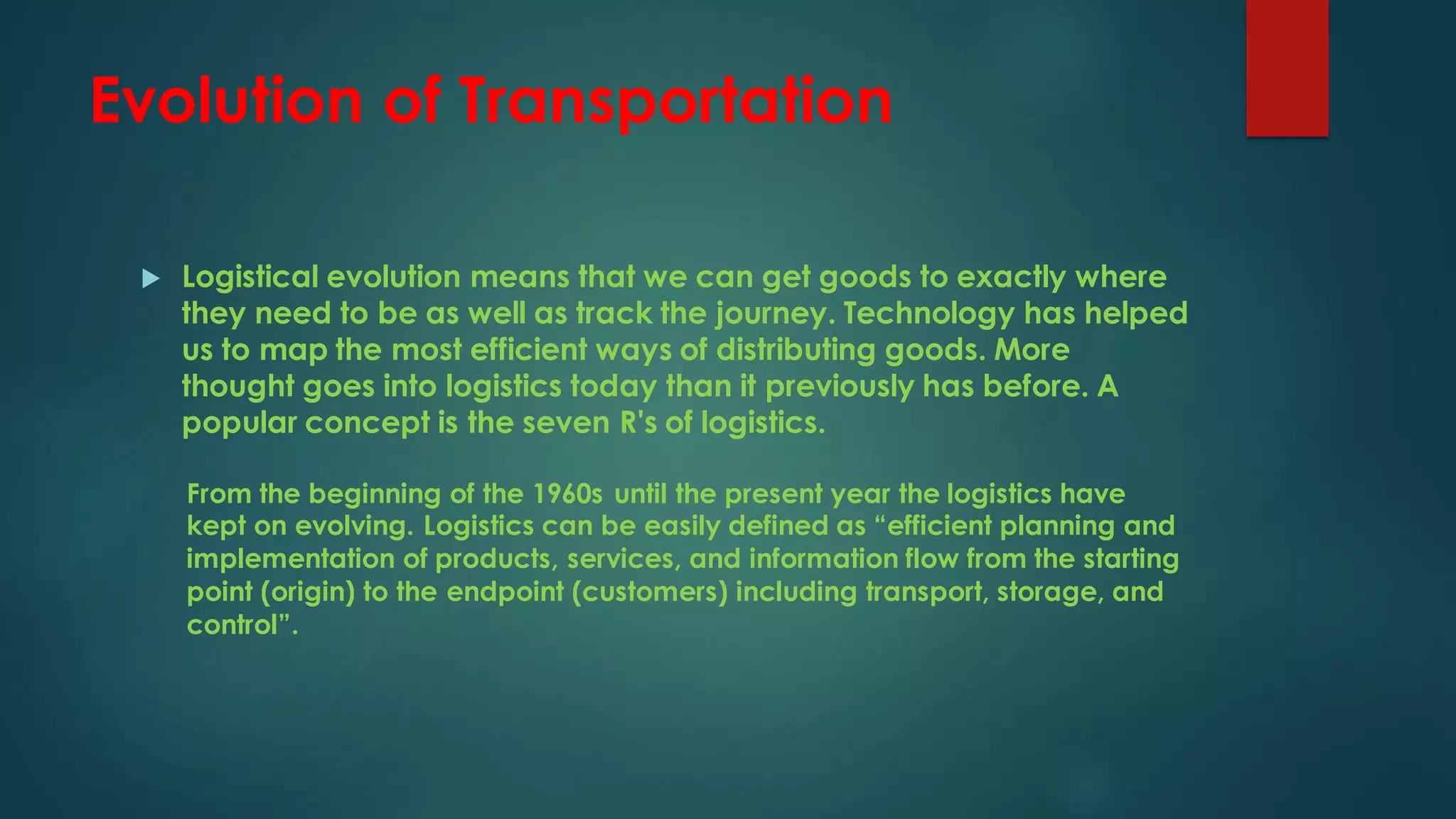
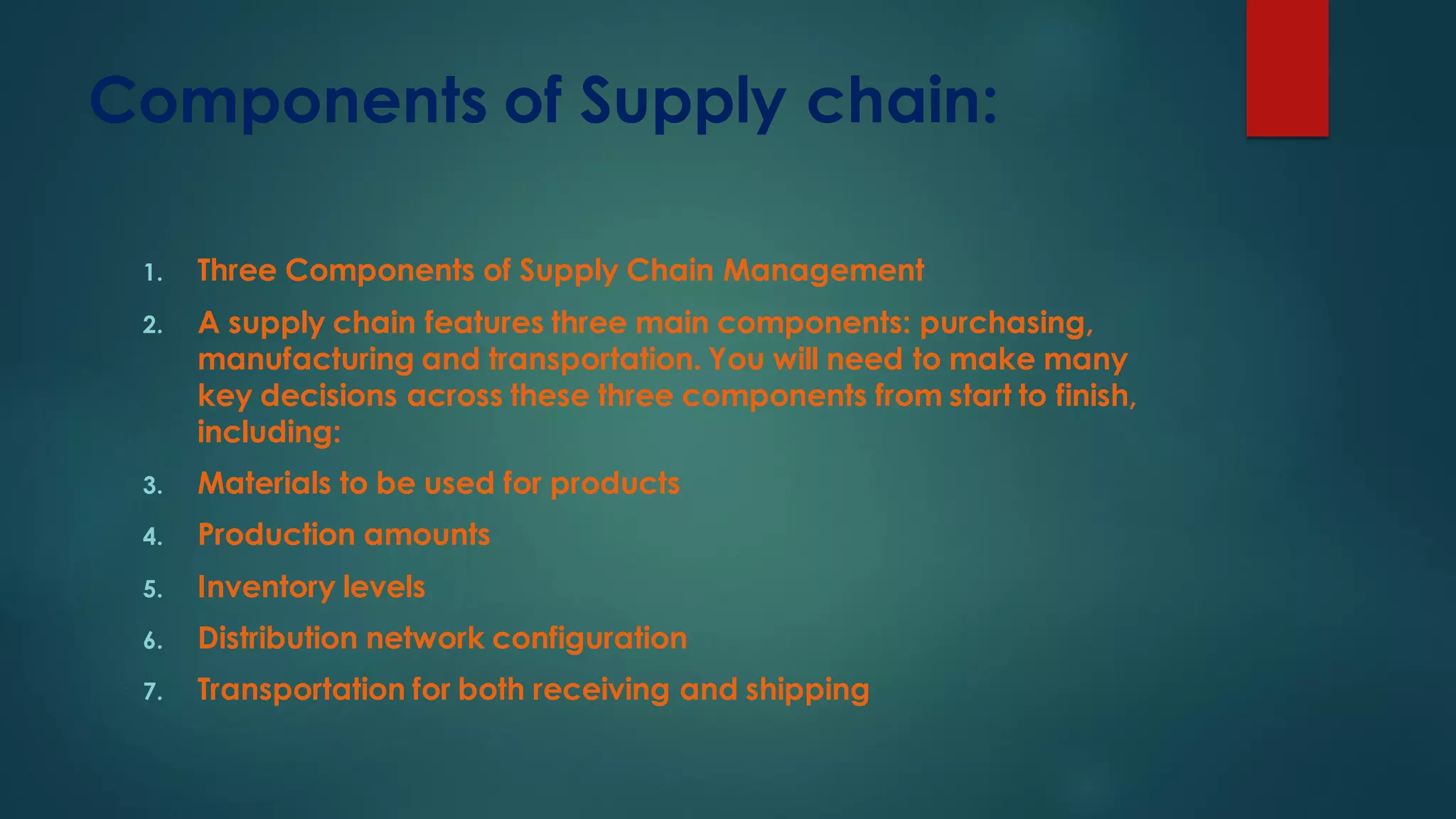
Comparing Logistics Transportation
Methods :
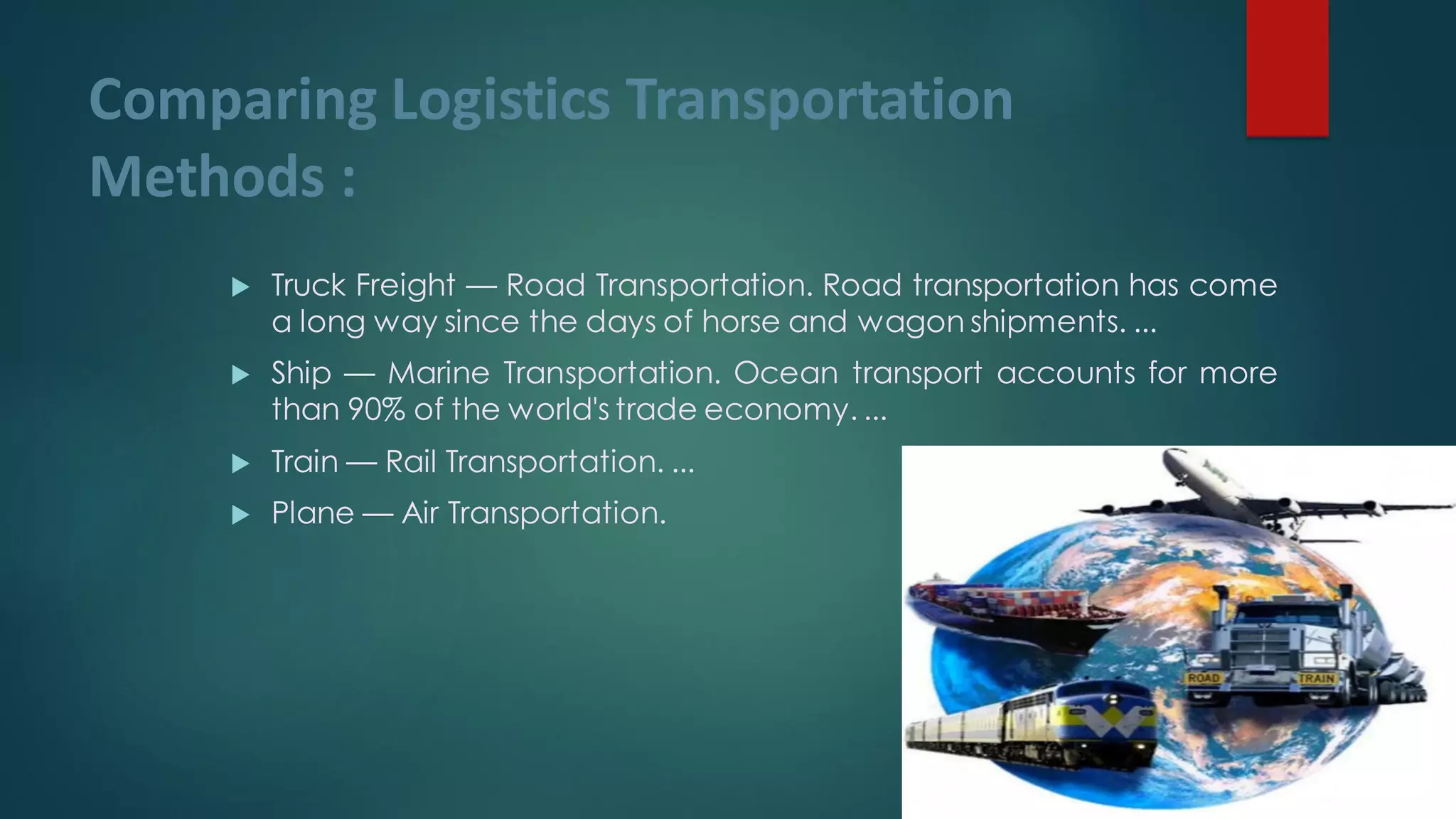
 Truck Freight — Road Transportation. Road transportation has come
a long way since the days of horse and wagon shipments. ...
 Ship — Marine Transportation. Ocean transport accounts for more
than 90% of the world's trade economy. ...
 Train — Rail Transportation. ...
 Plane — Air Transportation.
Meaning of Road of Transportation
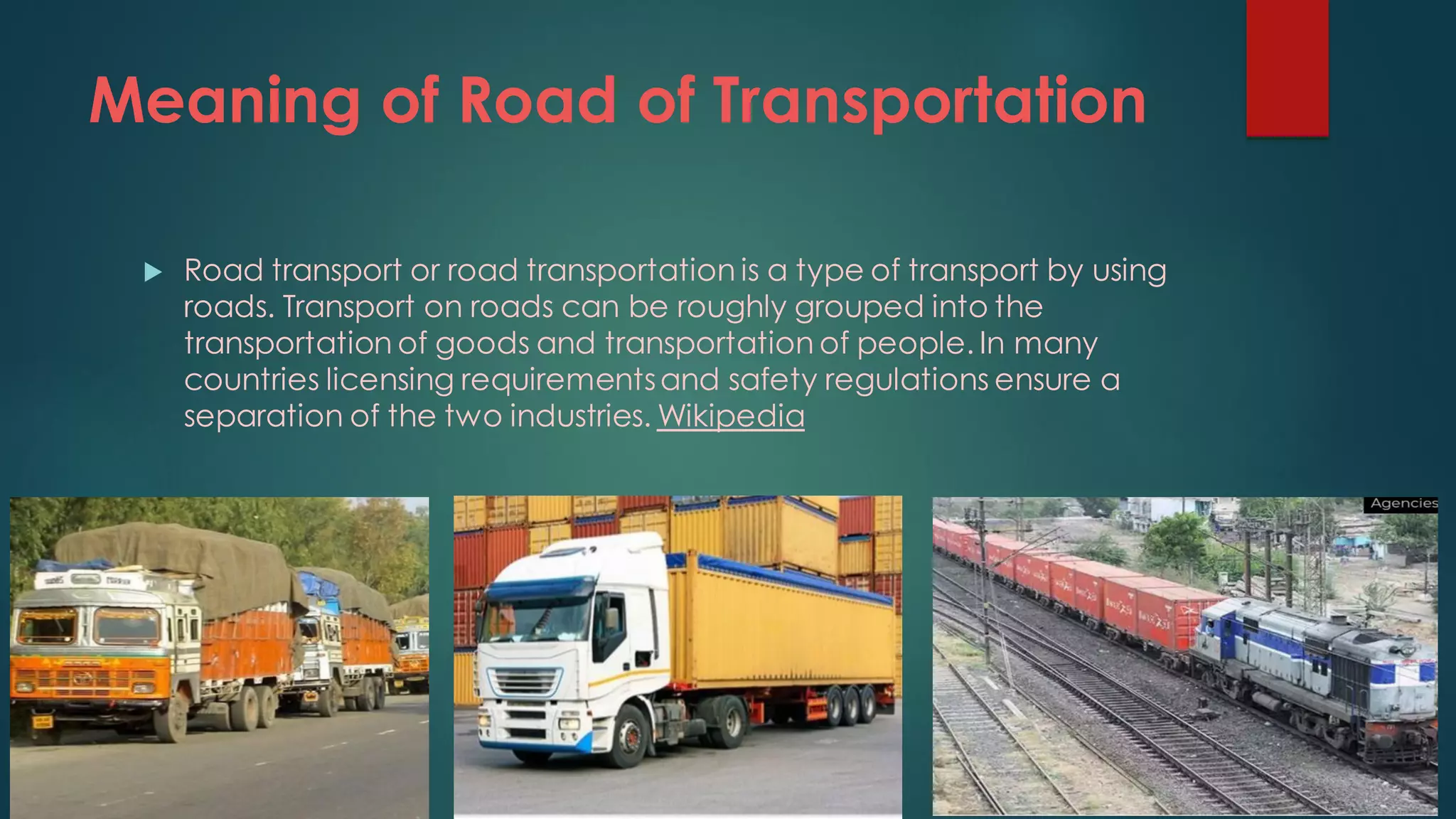
 Road transport or road transportation is a type of transport by using
roads. Transport on roads can be roughly grouped into the
transportation of goods and transportation of people. In many
countries licensing requirementsand safety regulations ensure a
separation of the two industries. Wikipedia
Type of Road of Transportation
 Animal-powered. Land. Rail. Road.
 Motorized Cable Transport. Rail.
 Human-powered. Cable. Land. Rail. Road.
 Water.
 Motorized Land Transport. Rail. Road.
 Pipeline.
 Space.
Advantages of Road transportation
1. Less Capital Outlay:
2. Door to Door Service:
3. Service in Rural Areas:
4. Flexible Service:
5. Suitable for Short Distance:
6. Lesser Risk of Damage in Transit:
7. Saving in Packing Cost:
8. Rapid Speed:
Disadvantages of road of
Transportation:
1. Frequent Accidents: ADVERTISEMENTS: ...
2. Inadequate Roads: Most of the roads are in bad shape and are
inadequate. ...
3. Heavy Taxes: ...
4. Poor Maintenance of Roads: ...
5. Rising Cost of Petrol and Diesel: ...
6. Unsuitable for Long Distances and Bulky Goods:
Meaning of Marine Transportation
 The study of marine transportation explores boat and sea
management.Programs of study in this field prepare students for
careers as mates on large ships, tugs or ferries who assist in routine
operations. Graduates may also work shoreside, in positions in
management or sales.
Type of marine transportation
 Cargo Ships. One of the most common types of sea transport
involves using a cargo ship. ...
 RoRo Ships. Roll-On/Roll-Off (RoRo) ships typically transport vehicles.
...
 Bulk Carriers. Bulk carriers hold an essential spot in the maritime
shipping industry. ...
 Barges.
Advantages of Marine
Transportation:
 Economical. Hands down, the ocean shipping industry offers the most competitive
freight costs to shippers, especially over long distances. ...
 Efficiency. ...
 Oversized, heavy and bulky cargo capability. ...
 Safety. ...
 Environmental friendliness
Disadvantages of Marine
Transportation:
 shipping by sea can be slower than other transport modes and bad
weather can add further delays
 routes and timetables are usually inflexible
 tracking your goods' progress is difficult
 you have to pay port duties and taxes
 further transportation overland will be needed to reach the final
destination
 basic freight rates are subject to fuel and currency surcharges
Meaning of Air Transportation
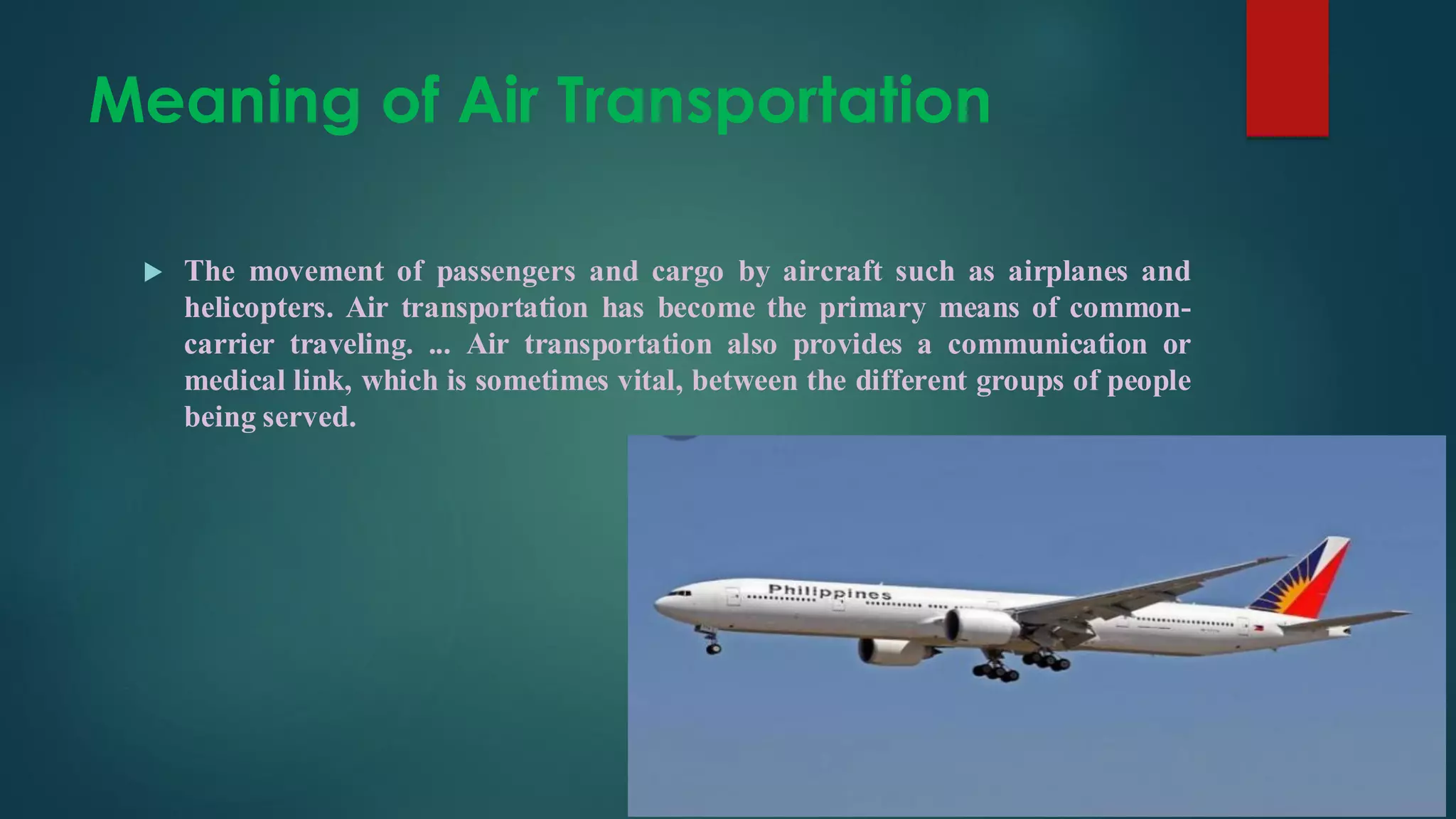
 The movement of passengers and cargo by aircraft such as airplanes and
helicopters. Air transportation has become the primary means of common-
carrier traveling. ... Air transportation also provides a communication or
medical link, which is sometimes vital, between the different groups of people
being served.
Type of Air Transportation:
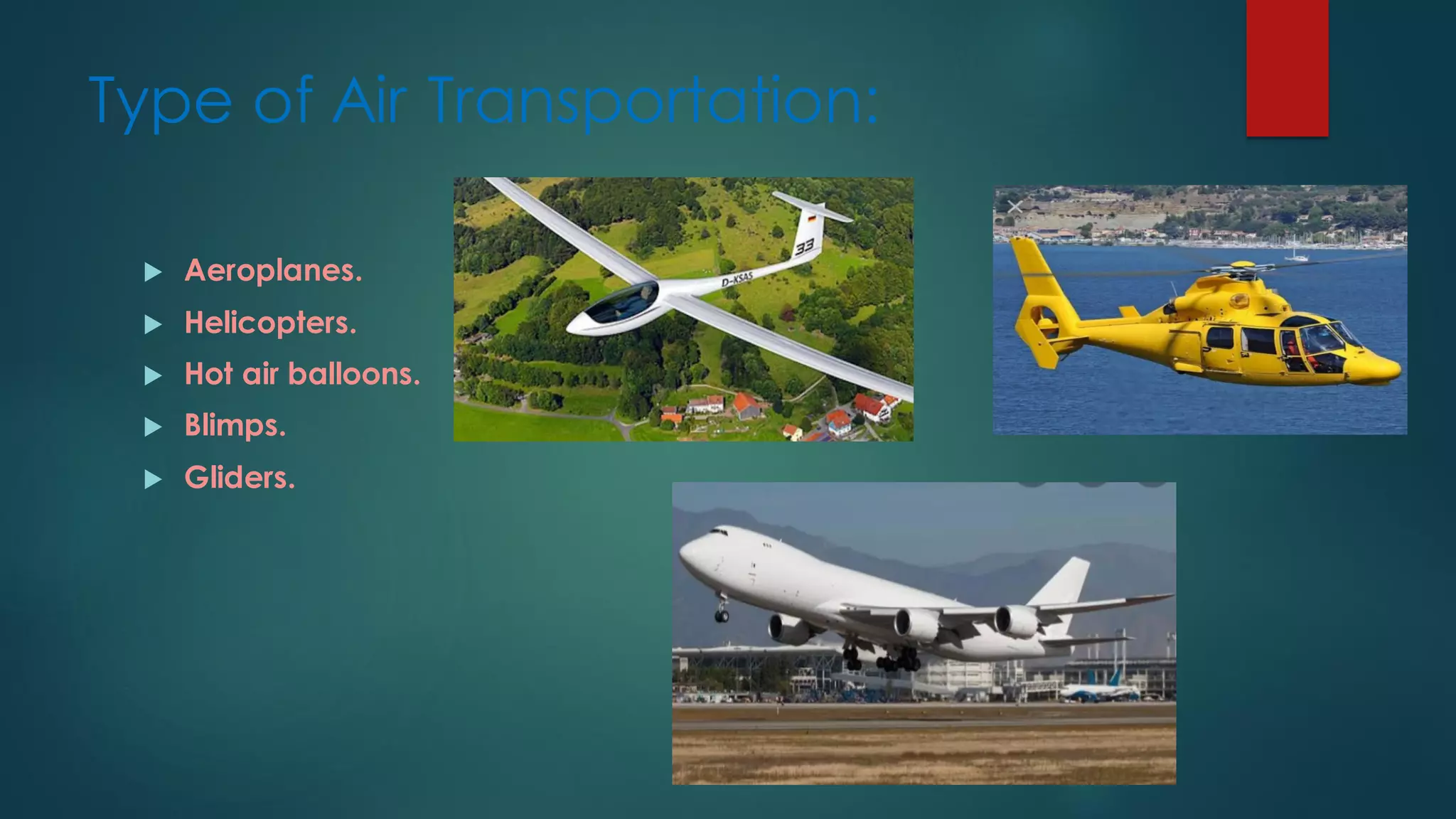
 Aeroplanes.
 Helicopters.
 Hot air balloons.
 Blimps.
 Gliders.
Advantages of Air transportation
1. High Speed: It is the fast speed means of transport. ...
2. Minimum Cost: ...
3. Strategic Importance: ...
4. Easy transport of costly and light goods: ...
5. Free from physical barriers: ...
6. Useful for Agriculture: ...
7. Useful in natural calamities:
Disadvantages of Air transportation
1. Transport subject to traffic delays.
2. Transport subject to breakdown.
3. Goods susceptible to damage through careless driving.
4. Bad weather.
5. Drivingregulations can cause delays.
logistics assignment

logistics assignment

  • 1.
  • 2.
    Logistics meaning: Logisticsrefers tothe overallprocess of managing how resources areacquired, stored, and transportedto their final destination.… The term is now used widely in the business sector, particularlyby companies in the manufacturingsectors, to refer to how resourcesare handledand moved along the supply chain. The process of coordinatingand moving resources – people, materials, inventory, and equipment – from one location
  • 3.
    Evolution of Transportation Logistical evolution means that we can get goods to exactly where they need to be as well as track the journey. Technology has helped us to map the most efficient ways of distributing goods. More thought goes into logistics today than it previously has before. A popular concept is the seven R's of logistics. From the beginning of the 1960s until the present year the logistics have kept on evolving. Logistics can be easily defined as “efficient planning and implementation of products, services, and information flow from the starting point (origin) to the endpoint (customers) including transport, storage, and control”.
  • 4.
    Components of Supplychain: 1. Three Components of Supply Chain Management 2. A supply chain features three main components: purchasing, manufacturing and transportation. You will need to make many key decisions across these three components from start to finish, including: 3. Materials to be used for products 4. Production amounts 5. Inventory levels 6. Distribution network configuration 7. Transportation for both receiving and shipping
  • 5.
    Principles of Transportation 1.WALK | Develop neighborhoods that promote walking. 2. CYCLE | Prioritize non-motorized transport networks. 3. CONNECT | Create dense networks of streets and paths. 4. TRANSIT | Locate development near high-quality public transport. 5. MIX | Plan for mixed use. 6. DENSIFY | Optimize density and transit capacity.
  • 7.
    Objective of Transportation Transportation planning tends to have multiple objectives, which usually include: Traffic congestion reductions. Parking cost savings. Consumer savings and affordability (savings to lower-income households) • The primary objective of logistics management is to move the inventory in a supply chain effectively and efficiently to extend the desired level of customer service at the least cost as done parallel with waste management.0 • The operation of transportation determines the efficiency of moving products. The progress in techniques and management principles improves the moving load, delivery speed, service quality, operation costs, the usage of facilities and energy saving.
  • 8.
    Benefits of Transportation 1) Reduce freight expenses. One of the greatest benefits that a TMS provides is reducing freight spend. ...  2) Track deliveries in real time. ...  3) Increase customer service. ...  4) Improve warehouse efficiencyand productivity. ...  5) Increase supplychain efficiency
  • 9.
    Comparing Logistics Transportation Methods:  Truck Freight — Road Transportation. Road transportation has come a long way since the days of horse and wagon shipments. ...  Ship — Marine Transportation. Ocean transport accounts for more than 90% of the world's trade economy. ...  Train — Rail Transportation. ...  Plane — Air Transportation.
  • 10.
    Meaning of Roadof Transportation  Road transport or road transportation is a type of transport by using roads. Transport on roads can be roughly grouped into the transportation of goods and transportation of people. In many countries licensing requirementsand safety regulations ensure a separation of the two industries. Wikipedia
  • 11.
    Type of Roadof Transportation  Animal-powered. Land. Rail. Road.  Motorized Cable Transport. Rail.  Human-powered. Cable. Land. Rail. Road.  Water.  Motorized Land Transport. Rail. Road.  Pipeline.  Space.
  • 12.
    Advantages of Roadtransportation 1. Less Capital Outlay: 2. Door to Door Service: 3. Service in Rural Areas: 4. Flexible Service: 5. Suitable for Short Distance: 6. Lesser Risk of Damage in Transit: 7. Saving in Packing Cost: 8. Rapid Speed:
  • 13.
    Disadvantages of roadof Transportation: 1. Frequent Accidents: ADVERTISEMENTS: ... 2. Inadequate Roads: Most of the roads are in bad shape and are inadequate. ... 3. Heavy Taxes: ... 4. Poor Maintenance of Roads: ... 5. Rising Cost of Petrol and Diesel: ... 6. Unsuitable for Long Distances and Bulky Goods:
  • 14.
    Meaning of MarineTransportation  The study of marine transportation explores boat and sea management.Programs of study in this field prepare students for careers as mates on large ships, tugs or ferries who assist in routine operations. Graduates may also work shoreside, in positions in management or sales.
  • 15.
    Type of marinetransportation  Cargo Ships. One of the most common types of sea transport involves using a cargo ship. ...  RoRo Ships. Roll-On/Roll-Off (RoRo) ships typically transport vehicles. ...  Bulk Carriers. Bulk carriers hold an essential spot in the maritime shipping industry. ...  Barges.
  • 16.
    Advantages of Marine Transportation: Economical. Hands down, the ocean shipping industry offers the most competitive freight costs to shippers, especially over long distances. ...  Efficiency. ...  Oversized, heavy and bulky cargo capability. ...  Safety. ...  Environmental friendliness
  • 17.
    Disadvantages of Marine Transportation: shipping by sea can be slower than other transport modes and bad weather can add further delays  routes and timetables are usually inflexible  tracking your goods' progress is difficult  you have to pay port duties and taxes  further transportation overland will be needed to reach the final destination  basic freight rates are subject to fuel and currency surcharges
  • 18.
    Meaning of AirTransportation  The movement of passengers and cargo by aircraft such as airplanes and helicopters. Air transportation has become the primary means of common- carrier traveling. ... Air transportation also provides a communication or medical link, which is sometimes vital, between the different groups of people being served.
  • 19.
    Type of AirTransportation:  Aeroplanes.  Helicopters.  Hot air balloons.  Blimps.  Gliders.
  • 20.
    Advantages of Airtransportation 1. High Speed: It is the fast speed means of transport. ... 2. Minimum Cost: ... 3. Strategic Importance: ... 4. Easy transport of costly and light goods: ... 5. Free from physical barriers: ... 6. Useful for Agriculture: ... 7. Useful in natural calamities:
  • 21.
    Disadvantages of Airtransportation 1. Transport subject to traffic delays. 2. Transport subject to breakdown. 3. Goods susceptible to damage through careless driving. 4. Bad weather. 5. Drivingregulations can cause delays.