Sustainable Curitiba 
Jeff, Juliana, Lori and Ryan.
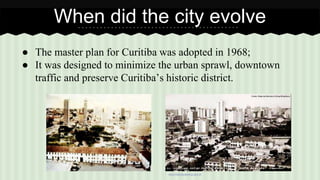
When did the city evolve 
● The master plan for Curitiba was adopted in 1968; 
● It was designed to minimize the urban sprawl, downtown 
traffic and preserve Curitiba’s historic district. 
www.historia.seed.pr.gov.br
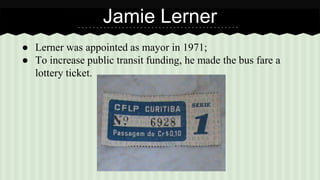
Jamie Lerner 
● Lerner was appointed as mayor in 1971; 
● To increase public transit funding, he made the bus fare a 
lottery ticket.
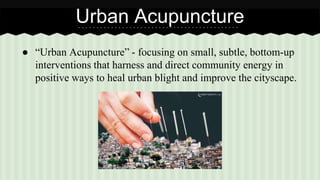
Urban Acupuncture 
● “Urban Acupuncture” - focusing on small, subtle, bottom-up 
interventions that harness and direct community energy in 
positive ways to heal urban blight and improve the cityscape.
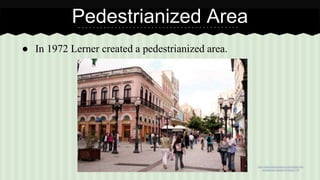
Pedestrianized Area 
● In 1972 Lerner created a pedestrianized area. 
http://www.dailygossip.org/curitiba-the-ecological- 
capital-of-brazil-778
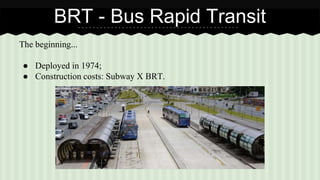
BRT - Bus Rapid Transit 
The beginning... 
● Deployed in 1974; 
● Construction costs: Subway X BRT.
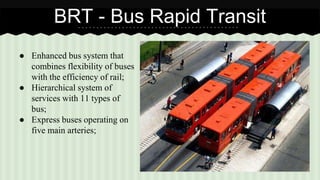
BRT - Bus Rapid Transit 
● Enhanced bus system that 
combines flexibility of buses 
with the efficiency of rail; 
● Hierarchical system of 
services with 11 types of 
bus; 
● Express buses operating on 
five main arteries;
BRT - Bus Rapid Transit 
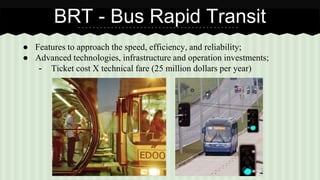
● Features to approach the speed, efficiency, and reliability; 
● Advanced technologies, infrastructure and operation investments; 
- Ticket cost X technical fare (25 million dollars per year)
BRT - Bus Rapid Transit 
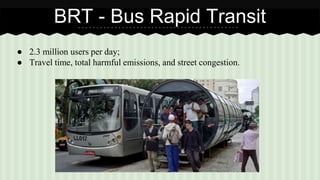
● 2.3 million users per day; 
● Travel time, total harmful emissions, and street congestion.
Road System 
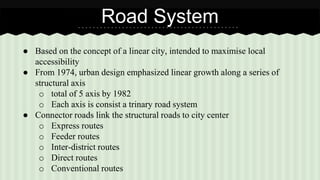
● Based on the concept of a linear city, intended to maximise local 
accessibility 
● From 1974, urban design emphasized linear growth along a series of 
structural axis 
o total of 5 axis by 1982 
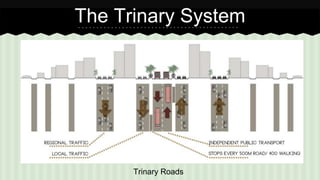
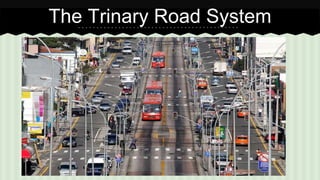
o Each axis is consist a trinary road system 
● Connector roads link the structural roads to city center 
o Express routes 
o Feeder routes 
o Inter-district routes 
o Direct routes 
o Conventional routes
Road System
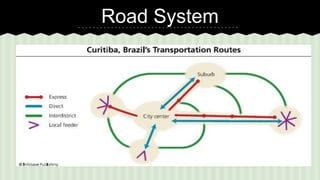
The Trinary System 
The Trinary Roads 
Trinary Roads
The Trinary Road System
Zoning Laws 
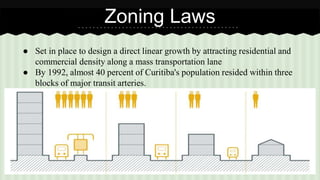
● Set in place to design a direct linear growth by attracting residential and 
commercial density along a mass transportation lane 
● By 1992, almost 40 percent of Curitiba's population resided within three 
blocks of major transit arteries.
The Green Exchange Program 
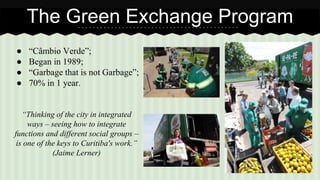
● “Câmbio Verde”; 
● Began in 1989; 
● “Garbage that is not Garbage”; 
● 70% in 1 year. 
“Thinking of the city in integrated 
ways – seeing how to integrate 
functions and different social groups – 
is one of the keys to Curitiba's work.” 
(Jaime Lerner)
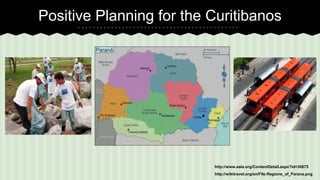
Positive Planning for the Curitibanos 
Some Advantages 
http://www.asla.org/ContentDetail.aspx?id=30875 
http://wikitravel.org/en/File:Regions_of_Parana.png
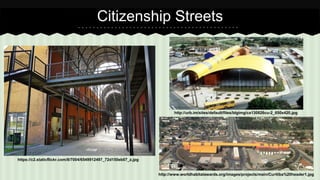
Citizenship Streets 
http://urb.im/sites/default/files/blgimg/ca130826cu-2_650x420.jpg 
http://www.worldhabitatawards.org/images/projects/main/Curitiba%20header1.jpg 
https://c2.staticflickr.com/8/7004/6549912497_72d150eb07_z.jpg
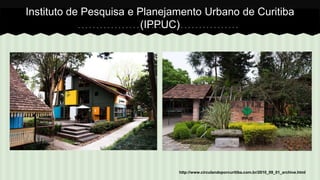
Instituto de Pesquisa e Planejamento Urbano de Curitiba 
(IPPUC) 
http://www.circulandoporcuritiba.com.br/2010_09_01_archive.html
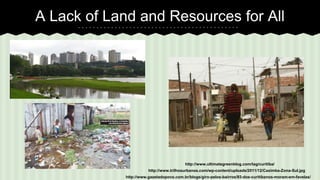
A Lack of Land and Resources for All 
http://www.ultimategreenblog.com/tag/curitiba/ 
http://www.trilhosurbanos.com/wp-content/uploads/2011/12/Caximba-Zona-Sul.jpg 
http://www.gazetadopovo.com.br/blogs/giro-pelos-bairros/93-dos-curitibanos-moram-em-favelas/
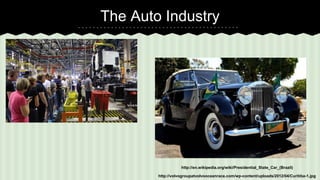
Some Disadvantages The Auto Industry 
http://en.wikipedia.org/wiki/Presidential_State_Car_(Brazil) 
http://volvogroupatvolvooceanrace.com/wp-content/uploads/2012/04/Curitiba-1.jpg
Conclusion 
http://www.curitiba-parana.net/urbanismo.htm

Curitiba 2

  • 1.
    Sustainable Curitiba Jeff,Juliana, Lori and Ryan.
  • 2.
    When did thecity evolve ● The master plan for Curitiba was adopted in 1968; ● It was designed to minimize the urban sprawl, downtown traffic and preserve Curitiba’s historic district. www.historia.seed.pr.gov.br
  • 3.
    Jamie Lerner ●Lerner was appointed as mayor in 1971; ● To increase public transit funding, he made the bus fare a lottery ticket.
  • 4.
    Urban Acupuncture ●“Urban Acupuncture” - focusing on small, subtle, bottom-up interventions that harness and direct community energy in positive ways to heal urban blight and improve the cityscape.
  • 5.
    Pedestrianized Area ●In 1972 Lerner created a pedestrianized area. http://www.dailygossip.org/curitiba-the-ecological- capital-of-brazil-778
  • 6.
    BRT - BusRapid Transit The beginning... ● Deployed in 1974; ● Construction costs: Subway X BRT.
  • 7.
    BRT - BusRapid Transit ● Enhanced bus system that combines flexibility of buses with the efficiency of rail; ● Hierarchical system of services with 11 types of bus; ● Express buses operating on five main arteries;
  • 8.
    BRT - BusRapid Transit ● Features to approach the speed, efficiency, and reliability; ● Advanced technologies, infrastructure and operation investments; - Ticket cost X technical fare (25 million dollars per year)
  • 9.
    BRT - BusRapid Transit ● 2.3 million users per day; ● Travel time, total harmful emissions, and street congestion.
  • 10.
    Road System ●Based on the concept of a linear city, intended to maximise local accessibility ● From 1974, urban design emphasized linear growth along a series of structural axis o total of 5 axis by 1982 o Each axis is consist a trinary road system ● Connector roads link the structural roads to city center o Express routes o Feeder routes o Inter-district routes o Direct routes o Conventional routes
  • 11.
  • 12.
    The Trinary System The Trinary Roads Trinary Roads
  • 13.
  • 14.
    Zoning Laws ●Set in place to design a direct linear growth by attracting residential and commercial density along a mass transportation lane ● By 1992, almost 40 percent of Curitiba's population resided within three blocks of major transit arteries.
  • 15.
    The Green ExchangeProgram ● “Câmbio Verde”; ● Began in 1989; ● “Garbage that is not Garbage”; ● 70% in 1 year. “Thinking of the city in integrated ways – seeing how to integrate functions and different social groups – is one of the keys to Curitiba's work.” (Jaime Lerner)
  • 16.
    Positive Planning forthe Curitibanos Some Advantages http://www.asla.org/ContentDetail.aspx?id=30875 http://wikitravel.org/en/File:Regions_of_Parana.png
  • 17.
    Citizenship Streets http://urb.im/sites/default/files/blgimg/ca130826cu-2_650x420.jpg http://www.worldhabitatawards.org/images/projects/main/Curitiba%20header1.jpg https://c2.staticflickr.com/8/7004/6549912497_72d150eb07_z.jpg
  • 18.
    Instituto de Pesquisae Planejamento Urbano de Curitiba (IPPUC) http://www.circulandoporcuritiba.com.br/2010_09_01_archive.html
  • 19.
    A Lack ofLand and Resources for All http://www.ultimategreenblog.com/tag/curitiba/ http://www.trilhosurbanos.com/wp-content/uploads/2011/12/Caximba-Zona-Sul.jpg http://www.gazetadopovo.com.br/blogs/giro-pelos-bairros/93-dos-curitibanos-moram-em-favelas/
  • 20.
    Some Disadvantages TheAuto Industry http://en.wikipedia.org/wiki/Presidential_State_Car_(Brazil) http://volvogroupatvolvooceanrace.com/wp-content/uploads/2012/04/Curitiba-1.jpg
  • 21.

Editor's Notes

  • #3 “After nearly a century of unchecked growth, the city finally had a plan for development” The picture on the right is 1970 and on the left is 1968
  • #4 During brazil’s military dictatorship and was elected again afterwards Spent 12 years in office
  • #5 He held the belief that in three years any city can improve their city by using these programs. URBAN ACUPUNTURE Building the faith and trust of their citizens, however, required more than just solidarity, it also required good, highly effective action. As Jaime Lerner (in Vaz & Vaz del Bello, 2006) stated it, “We were gaining the support from the population by showing and doing.” Metaphorically, Lerner depicts this process of leveraged demonstrative action as one of urban acupuncture: “I call it urban acupuncture, which is where you focus on key points that increase energy and flow” (Lerner in Young, 2008, p. 1). The idea of urban acupuncture is that while planning takes time, there is also need for immediate, leveraged action that can help jump‐start the process of regeneration within a community. As one interviewee put it, “the whole process of planning takes time and it has to take time. But sometimes you shouldn’t wait. There is some focal point where you can do it fast and you can create a new energy that can help the whole process of planning. It’s not instead of the process of planning, it’s to help it happen.” And in the words of another Urban acupuncture begins with the development of a good idea. A lot of people think participation is just asking or having meetings. This is okay, but you have to have an idea to start. It’s like a game, sometimes it’s the community that starts the game, sometimes it’s the goverment. - See more at: http://www.morethangreen.es/en/curitiba-jaime-lerner/#sthash.OrmA8WeD.dpuf
  • #6 The Pedestrianized area spanning six blocks which was completed in 3 days He had hundreds of kids painting a large rolled sheet to keep the cars out the cars tried to pass through the pedestrian zone, they were faced with hundreds of children busy painting on large rolls of paper, lying on the floor purposely by the mayor. A fun and still is a traditional event on Saturday morning for children of Curitiba, who want to unleash their creativity.
  • #9 Uses metal tokens, while increasing the transfer speed that allows passengers to travel throughout the system for only one fare.
  • #17 Curitiba is capital of region, Parana, which provides opportunities for growth, as well as a concentration of different government offices, giving the metropolitan area access to public leaders such as Jamie Lerner. “Curitibanos” feared sprawl, fewer green spaces and loss of character, and this helped plan more effectively with a focus on sustainability and not planning for cars to travel farther into and out of the city. Lack of funds led to the creation of the BRT, without widening roads, and having to have a more creative and cost effective plan put into place that still kept “curitibanos” values in mind.
  • #18 Recent Economic liberation and transition from a military dictatorship to a multiparty system democracy with gave citizens more direct control over the planning process. They started holding public debates on plans and encouraging the involvement of citizens and the private sectors. It also led to the creation of Citizenship Streets (1995). “Citizenship Streets” are mini-malls of government branch offices placed at or near main bus terminals throughout the city, to provide services to the public. These areas helped decentralize the government and make it more accessible to citizens. Each Citizenship Street houses a regional branch of the various city offices (municipal offices, banking offices, state and federal agencies, and special courts) all in one area. The first Citizenship Street was created in Boqueirão in 1995.
  • #19  Institute for Research and Urban Planning in Curitiba (IPPUC) Creation of the Institute for Research and Urban Planning in Curitiba (IPPUC) in 1965, with Lerner as leader, was able to effectively implement and manage urban development of the region Devised Ideias Forca (Core Ideas Project) - 24 current urban projects, each has its own expert in the field involved
  • #20 Curitiba has many floodplains, which are unsuitable for building on, so they had to build around them, and displace residents in the process. Unchecked growth, there has been a rapid increase in population in the city, and a decrease in the population of the surrounding areas, leading to a shortage of resources. Additionally, a rise in poverty and housing shortages has negatively affected planning for land use in the city and surrounding areas as the population has been increasing in the slums. The government spends its time and resources planning for and launching public projects, but tend to ignore them once they are set in place. They rely on the citizens to be responsible and keep the programs going, which they do not always follow through on, which has made it more difficult to effectively plan out such projects.
  • #21 The Automobile Industry is a key source of wealth for the region. Volvo, Chrysler, Renault, Volkswagen-Audi and New Holland all have factories in Curitiba. Cars are also symbols of status. Although vehicle traffic has decreased over time, “Curitiba [still] has the highest vehicle ownership rate per capita of any Brazilian capital city: [with] 0.63 cars per resident, more than twice the national average of 0.27.” (NextCity)
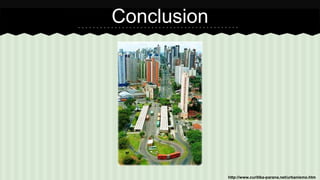
  • #22 This can be changed I just thought this was an important point Today about 1,100 buses make 12,500 trips per day, serving more than 1.3 million passengers per day, 50 times more than 20 years ago. http://www.fta.dot.gov/12351_4391.html You can see the “Results of BRT” in the bottom of the page 41 cities are operating a transportation system based on the Curitiba system, with 46 more in development. With the help of Jamie Lerner, and the backing of governmental agencies, Curitiba has evolved a sustainable approach to planning. It has been, and continues to be, developed with the Curitibanos and their cultural values in mind, although as with any city, there are always obstacles. But, the systems put in place, (such as the BRT, the Green Exchange Program, and Citizenship Streets), have helped to maximize the effectiveness of transportation and land use in achieving planner and policy maker’s overall goals.