
The atom- By Aditya Abeysinghe 1
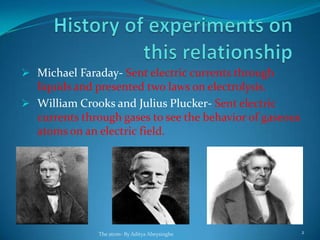
 Michael Faraday- Sent electric currents through
liquids and presented two laws on electrolysis.
 William Crooks and Julius Plucker- Sent electric
currents through gases to see the behavior of gaseous
atoms on an electric field.
The atom- By Aditya Abeysinghe 2
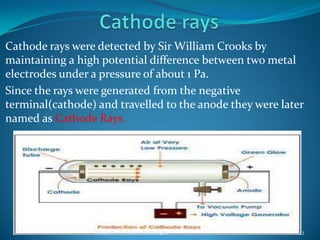
Cathode rays were detected by Sir William Crooks by
maintaining a high potential difference between two metal
electrodes under a pressure of about 1 Pa.
Since the rays were generated from the negative
terminal(cathode) and travelled to the anode they were later
named as Cathode Rays.
The atom- By Aditya Abeysinghe 3
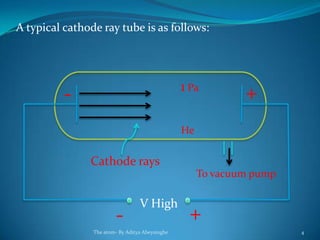
A typical cathode ray tube is as follows:
- +
V High
To vacuum pump
- +
Cathode rays
1 Pa
He
The atom- By Aditya Abeysinghe 4
Many scientist performed experiments to
find how the matter present in cathode rays
behaved. However much of the valuable
results is credited to Sir J.J. Thomson who
also discovered the electron.
Summary of some of his experiments are as
follows:
The atom- By Aditya Abeysinghe 5
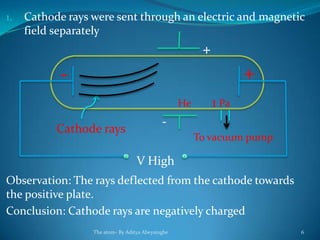
1. Cathode rays were sent through an electric and magnetic
field separately
Observation: The rays deflected from the cathode towards
the positive plate.
Conclusion: Cathode rays are negatively charged
V High
To vacuum pump
- +
Cathode rays
1 PaHe
+
-
The atom- By Aditya Abeysinghe 6
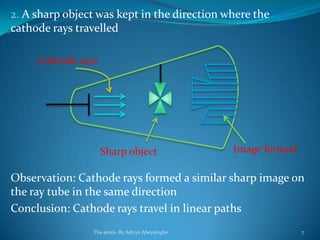
2. A sharp object was kept in the direction where the
cathode rays travelled
Observation: Cathode rays formed a similar sharp image on
the ray tube in the same direction
Conclusion: Cathode rays travel in linear paths
Sharp object Image formed
Cathode rays
The atom- By Aditya Abeysinghe 7
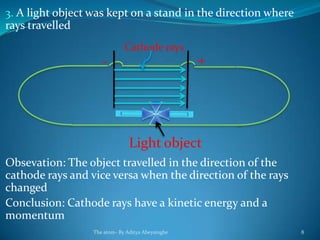
3. A light object was kept on a stand in the direction where
rays travelled
Obsevation: The object travelled in the direction of the
cathode rays and vice versa when the direction of the rays
changed
Conclusion: Cathode rays have a kinetic energy and a
momentum
Cathode rays
- +
Light object
The atom- By Aditya Abeysinghe 8
In addition to these characteristics, cathode rays also
have the capability of transparency through materials
and a capability of ionizing materials.
Thus it is believed that cathode rays consist of a
stream of electrons and it emitted radiation.
Finally scientists named this radiation as
β radiation
Later Louis de Broglie showed that electrons(stream
of cathode rays) act like photons in a dual manner, in
that they act both as waves and as particles.
The atom- By Aditya Abeysinghe 9
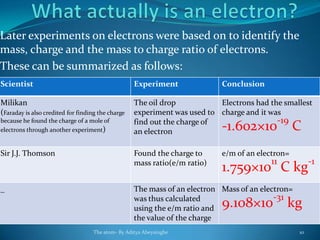
Later experiments on electrons were based on to identify the
mass, charge and the mass to charge ratio of electrons.
These can be summarized as follows:
Scientist Experiment Conclusion
Milikan
(Faraday is also credited for finding the charge
because he found the charge of a mole of
electrons through another experiment)
The oil drop
experiment was used to
find out the charge of
an electron
Electrons had the smallest
charge and it was
-1.602×10⁻¹⁹
C
Sir J.J. Thomson Found the charge to
mass ratio(e/m ratio)
e/m of an electron=
1.759×10¹¹
C kg-1
_ The mass of an electron
was thus calculated
using the e/m ratio and
the value of the charge
Mass of an electron=
9.108×10⁻³¹
kg
The atom- By Aditya Abeysinghe 10
However the charge of an electron was the lowest charge
discovered up to date and the mass of the electron is the
smallest mass found up to date. Thus the electron is
described as the common element that bridges
matter with electricity since any charge or mass of
any other element can be expressed by means of
that of an electron.
However, the mass of an electron is less than 1 a.m.u.(atomic
mass unit). Therefore the relative mass of an electron is
considered zero. Meanwhile the relative charge of an electron
is considered as -1.
The atom- By Aditya Abeysinghe 11
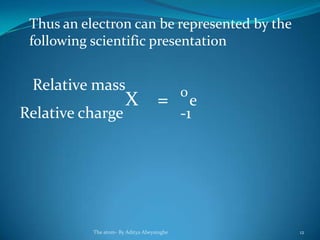
Thus an electron can be represented by the
following scientific presentation
X = e
0
-1
Relative mass
Relative charge
The atom- By Aditya Abeysinghe 12
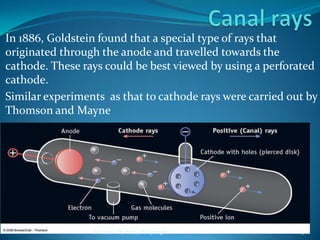
In 1886, Goldstein found that a special type of rays that
originated through the anode and travelled towards the
cathode. These rays could be best viewed by using a perforated
cathode.
Similar experiments as that to cathode rays were carried out by
Thomson and Mayne
The atom- By Aditya Abeysinghe 13
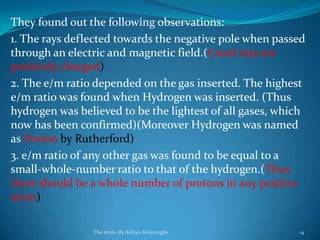
They found out the following observations:
1. The rays deflected towards the negative pole when passed
through an electric and magnetic field.(Canal rays are
positively charged)
2. The e/m ratio depended on the gas inserted. The highest
e/m ratio was found when Hydrogen was inserted. (Thus
hydrogen was believed to be the lightest of all gases, which
now has been confirmed)(Moreover Hydrogen was named
as Proton by Rutherford)
3. e/m ratio of any other gas was found to be equal to a
small-whole-number ratio to that of the hydrogen.(Thus
there should be a whole number of protons in any positive
atom)
The atom- By Aditya Abeysinghe 14
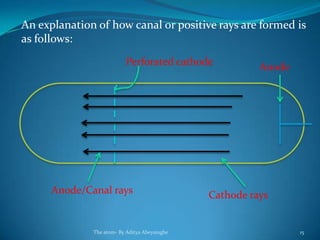
An explanation of how canal or positive rays are formed is
as follows:
Cathode raysAnode/Canal rays
Perforated cathode
Anode
The atom- By Aditya Abeysinghe 15
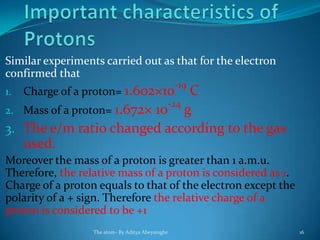
Similar experiments carried out as that for the electron
confirmed that
1. Charge of a proton= 1.602×10⁻¹⁹
C
2. Mass of a proton= 1.672× 10⁻²⁴
g
3. The e/m ratio changed according to the gas
used.
Moreover the mass of a proton is greater than 1 a.m.u.
Therefore, the relative mass of a proton is considered as 1.
Charge of a proton equals to that of the electron except the
polarity of a + sign. Therefore the relative charge of a
proton is considered to be +1
The atom- By Aditya Abeysinghe 16
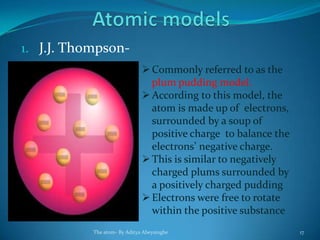
1. J.J. Thompson-
Commonly referred to as the
plum pudding model.
According to this model, the
atom is made up of electrons,
surrounded by a soup of
positive charge to balance the
electrons’ negative charge.
This is similar to negatively
charged plums surrounded by
a positively charged pudding
Electrons were free to rotate
within the positive substance
The atom- By Aditya Abeysinghe 17
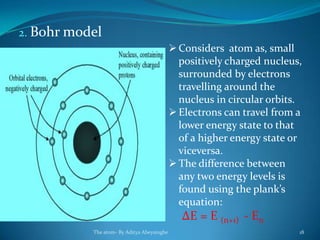
2. Bohr model
Considers atom as, small
positively charged nucleus,
surrounded by electrons
travelling around the
nucleus in circular orbits.
Electrons can travel from a
lower energy state to that
of a higher energy state or
viceversa.
The difference between
any two energy levels is
found using the plank’s
equation:
ΔE = E (n+1) - En
The atom- By Aditya Abeysinghe 18
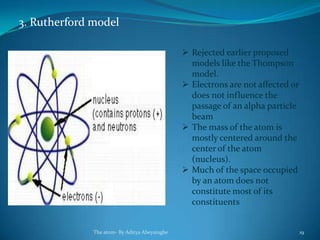
3. Rutherford model
 Rejected earlier proposed
models like the Thompson
model.
 Electrons are not affected or
does not influence the
passage of an alpha particle
beam
 The mass of the atom is
mostly centered around the
center of the atom
(nucleus).
 Much of the space occupied
by an atom does not
constitute most of its
constituents
The atom- By Aditya Abeysinghe 19
For exercises related to the topics you have
seen so far on this presentation, please
visit:
http://www.slideshare.net/
adityaabeysinghe/the-atom-
worksheet
The atom- By Aditya Abeysinghe 20

The relationship between matter and electricity

  • 1.
    The atom- ByAditya Abeysinghe 1
  • 2.
     Michael Faraday-Sent electric currents through liquids and presented two laws on electrolysis.  William Crooks and Julius Plucker- Sent electric currents through gases to see the behavior of gaseous atoms on an electric field. The atom- By Aditya Abeysinghe 2
  • 3.
    Cathode rays weredetected by Sir William Crooks by maintaining a high potential difference between two metal electrodes under a pressure of about 1 Pa. Since the rays were generated from the negative terminal(cathode) and travelled to the anode they were later named as Cathode Rays. The atom- By Aditya Abeysinghe 3
  • 4.
    A typical cathoderay tube is as follows: - + V High To vacuum pump - + Cathode rays 1 Pa He The atom- By Aditya Abeysinghe 4
  • 5.
    Many scientist performedexperiments to find how the matter present in cathode rays behaved. However much of the valuable results is credited to Sir J.J. Thomson who also discovered the electron. Summary of some of his experiments are as follows: The atom- By Aditya Abeysinghe 5
  • 6.
    1. Cathode rayswere sent through an electric and magnetic field separately Observation: The rays deflected from the cathode towards the positive plate. Conclusion: Cathode rays are negatively charged V High To vacuum pump - + Cathode rays 1 PaHe + - The atom- By Aditya Abeysinghe 6
  • 7.
    2. A sharpobject was kept in the direction where the cathode rays travelled Observation: Cathode rays formed a similar sharp image on the ray tube in the same direction Conclusion: Cathode rays travel in linear paths Sharp object Image formed Cathode rays The atom- By Aditya Abeysinghe 7
  • 8.
    3. A lightobject was kept on a stand in the direction where rays travelled Obsevation: The object travelled in the direction of the cathode rays and vice versa when the direction of the rays changed Conclusion: Cathode rays have a kinetic energy and a momentum Cathode rays - + Light object The atom- By Aditya Abeysinghe 8
  • 9.
    In addition tothese characteristics, cathode rays also have the capability of transparency through materials and a capability of ionizing materials. Thus it is believed that cathode rays consist of a stream of electrons and it emitted radiation. Finally scientists named this radiation as β radiation Later Louis de Broglie showed that electrons(stream of cathode rays) act like photons in a dual manner, in that they act both as waves and as particles. The atom- By Aditya Abeysinghe 9
  • 10.
    Later experiments onelectrons were based on to identify the mass, charge and the mass to charge ratio of electrons. These can be summarized as follows: Scientist Experiment Conclusion Milikan (Faraday is also credited for finding the charge because he found the charge of a mole of electrons through another experiment) The oil drop experiment was used to find out the charge of an electron Electrons had the smallest charge and it was -1.602×10⁻¹⁹ C Sir J.J. Thomson Found the charge to mass ratio(e/m ratio) e/m of an electron= 1.759×10¹¹ C kg-1 _ The mass of an electron was thus calculated using the e/m ratio and the value of the charge Mass of an electron= 9.108×10⁻³¹ kg The atom- By Aditya Abeysinghe 10
  • 11.
    However the chargeof an electron was the lowest charge discovered up to date and the mass of the electron is the smallest mass found up to date. Thus the electron is described as the common element that bridges matter with electricity since any charge or mass of any other element can be expressed by means of that of an electron. However, the mass of an electron is less than 1 a.m.u.(atomic mass unit). Therefore the relative mass of an electron is considered zero. Meanwhile the relative charge of an electron is considered as -1. The atom- By Aditya Abeysinghe 11
  • 12.
    Thus an electroncan be represented by the following scientific presentation X = e 0 -1 Relative mass Relative charge The atom- By Aditya Abeysinghe 12
  • 13.
    In 1886, Goldsteinfound that a special type of rays that originated through the anode and travelled towards the cathode. These rays could be best viewed by using a perforated cathode. Similar experiments as that to cathode rays were carried out by Thomson and Mayne The atom- By Aditya Abeysinghe 13
  • 14.
    They found outthe following observations: 1. The rays deflected towards the negative pole when passed through an electric and magnetic field.(Canal rays are positively charged) 2. The e/m ratio depended on the gas inserted. The highest e/m ratio was found when Hydrogen was inserted. (Thus hydrogen was believed to be the lightest of all gases, which now has been confirmed)(Moreover Hydrogen was named as Proton by Rutherford) 3. e/m ratio of any other gas was found to be equal to a small-whole-number ratio to that of the hydrogen.(Thus there should be a whole number of protons in any positive atom) The atom- By Aditya Abeysinghe 14
  • 15.
    An explanation ofhow canal or positive rays are formed is as follows: Cathode raysAnode/Canal rays Perforated cathode Anode The atom- By Aditya Abeysinghe 15
  • 16.
    Similar experiments carriedout as that for the electron confirmed that 1. Charge of a proton= 1.602×10⁻¹⁹ C 2. Mass of a proton= 1.672× 10⁻²⁴ g 3. The e/m ratio changed according to the gas used. Moreover the mass of a proton is greater than 1 a.m.u. Therefore, the relative mass of a proton is considered as 1. Charge of a proton equals to that of the electron except the polarity of a + sign. Therefore the relative charge of a proton is considered to be +1 The atom- By Aditya Abeysinghe 16
  • 17.
    1. J.J. Thompson- Commonlyreferred to as the plum pudding model. According to this model, the atom is made up of electrons, surrounded by a soup of positive charge to balance the electrons’ negative charge. This is similar to negatively charged plums surrounded by a positively charged pudding Electrons were free to rotate within the positive substance The atom- By Aditya Abeysinghe 17
  • 18.
    2. Bohr model Considersatom as, small positively charged nucleus, surrounded by electrons travelling around the nucleus in circular orbits. Electrons can travel from a lower energy state to that of a higher energy state or viceversa. The difference between any two energy levels is found using the plank’s equation: ΔE = E (n+1) - En The atom- By Aditya Abeysinghe 18
  • 19.
    3. Rutherford model Rejected earlier proposed models like the Thompson model.  Electrons are not affected or does not influence the passage of an alpha particle beam  The mass of the atom is mostly centered around the center of the atom (nucleus).  Much of the space occupied by an atom does not constitute most of its constituents The atom- By Aditya Abeysinghe 19
  • 20.
    For exercises relatedto the topics you have seen so far on this presentation, please visit: http://www.slideshare.net/ adityaabeysinghe/the-atom- worksheet The atom- By Aditya Abeysinghe 20