CELL MEMBRANE
TRANSPORT
INTRODUCTION
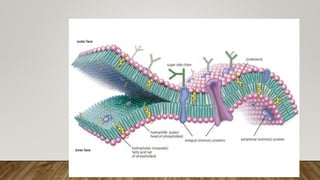
• One of the main functions of the cell membrane is to regulate the passage of a variety of small
molecules across it.
• Biological membranes are semipermeable membranes through certain molecules move freely
across the membranes but the movement of the others is restricted because of size, charge or
solubility.
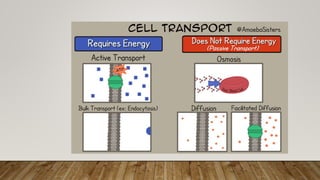
• There are two types of mechanisms :
1. Active Transport.
2. Passive Transport.
• Also, the transport of macromolecules across the plasma membrane is done by endocytosis and
exocytosis.
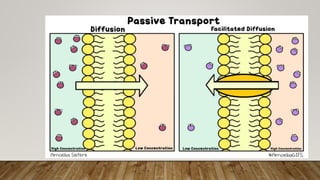
PASSIVE TRANSPORT (DOWNHILL MOVEMENT)
• Transport of substances is along the concentration gradient.
• It does not need energy as the substances move from region of higher concentration
to the region of lower concentration.
• Passive transport is like swimming in the direction of water flow in a river.
• There are different types of passive processes, such as
1. Simple Diffusion
2. Osmosis
3. Facilitated Diffusion
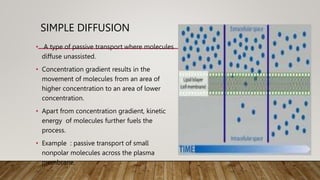
SIMPLE DIFFUSION
• A type of passive transport where molecules
diffuse unassisted.
• Concentration gradient results in the
movement of molecules from an area of
higher concentration to an area of lower
concentration.
• Apart from concentration gradient, kinetic
energy of molecules further fuels the
process.
• Example : passive transport of small
nonpolar molecules across the plasma
membrane.
OSMOSIS
• Osmosis is a specific type of diffusion; it is the passage of water from a
region of high water concentration through a semi-permeable membrane
to a region of low water concentration.
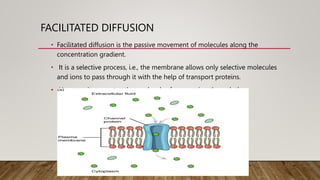
FACILITATED DIFFUSION
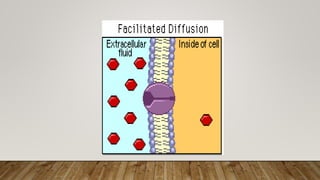
• Facilitated diffusion is the passive movement of molecules along the
concentration gradient.
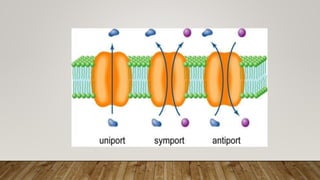
• It is a selective process, i.e., the membrane allows only selective molecules
and ions to pass through it with the help of transport proteins.
• However, it prevents other molecules from passing through the
membrane.
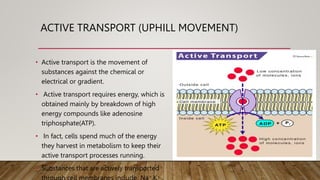
ACTIVE TRANSPORT (UPHILL MOVEMENT)
• Active transport is the movement of
substances against the chemical or
electrical or gradient.
• Active transport requires energy, which is
obtained mainly by breakdown of high
energy compounds like adenosine
triphosphate(ATP).
• In fact, cells spend much of the energy
they harvest in metabolism to keep their
active transport processes running.
• Substances that are actively transported
+ +
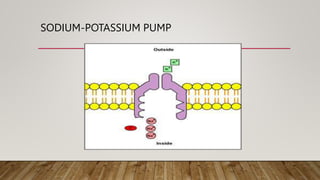
SODIUM-POTASSIUM PUMP
TRANSPORT OF MACROMOLECULES ACROSS
THE PLASMA MEMBRANE
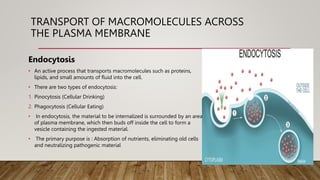
Endocytosis
• An active process that transports macromolecules such as proteins,
lipids, and small amounts of fluid into the cell.
• There are two types of endocytosis:
1. Pinocytosis (Cellular Drinking)
2. Phagocytosis (Cellular Eating)
• In endocytosis, the material to be internalized is surrounded by an area
of plasma membrane, which then buds off inside the cell to form a
vesicle containing the ingested material.
• The primary purpose is : Absorption of nutrients, eliminating old cells
and neutralizing pathogenic material
EXOCYTOSIS
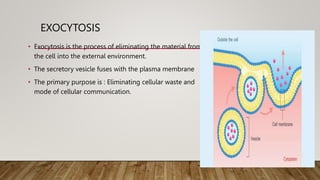
• Exocytosis is the process of eliminating the material from
the cell into the external environment.
• The secretory vesicle fuses with the plasma membrane
• The primary purpose is : Eliminating cellular waste and
mode of cellular communication.
Cell Membrane Transport.pptx

Cell Membrane Transport.pptx

  • 1.
  • 3.
    INTRODUCTION • One ofthe main functions of the cell membrane is to regulate the passage of a variety of small molecules across it. • Biological membranes are semipermeable membranes through certain molecules move freely across the membranes but the movement of the others is restricted because of size, charge or solubility. • There are two types of mechanisms : 1. Active Transport. 2. Passive Transport. • Also, the transport of macromolecules across the plasma membrane is done by endocytosis and exocytosis.
  • 4.
    PASSIVE TRANSPORT (DOWNHILLMOVEMENT) • Transport of substances is along the concentration gradient. • It does not need energy as the substances move from region of higher concentration to the region of lower concentration. • Passive transport is like swimming in the direction of water flow in a river. • There are different types of passive processes, such as 1. Simple Diffusion 2. Osmosis 3. Facilitated Diffusion
  • 5.
    SIMPLE DIFFUSION • Atype of passive transport where molecules diffuse unassisted. • Concentration gradient results in the movement of molecules from an area of higher concentration to an area of lower concentration. • Apart from concentration gradient, kinetic energy of molecules further fuels the process. • Example : passive transport of small nonpolar molecules across the plasma membrane.
  • 6.
    OSMOSIS • Osmosis isa specific type of diffusion; it is the passage of water from a region of high water concentration through a semi-permeable membrane to a region of low water concentration.
  • 7.
    FACILITATED DIFFUSION • Facilitateddiffusion is the passive movement of molecules along the concentration gradient. • It is a selective process, i.e., the membrane allows only selective molecules and ions to pass through it with the help of transport proteins. • However, it prevents other molecules from passing through the membrane.
  • 11.
    ACTIVE TRANSPORT (UPHILLMOVEMENT) • Active transport is the movement of substances against the chemical or electrical or gradient. • Active transport requires energy, which is obtained mainly by breakdown of high energy compounds like adenosine triphosphate(ATP). • In fact, cells spend much of the energy they harvest in metabolism to keep their active transport processes running. • Substances that are actively transported + +
  • 12.
  • 13.
    TRANSPORT OF MACROMOLECULESACROSS THE PLASMA MEMBRANE Endocytosis • An active process that transports macromolecules such as proteins, lipids, and small amounts of fluid into the cell. • There are two types of endocytosis: 1. Pinocytosis (Cellular Drinking) 2. Phagocytosis (Cellular Eating) • In endocytosis, the material to be internalized is surrounded by an area of plasma membrane, which then buds off inside the cell to form a vesicle containing the ingested material. • The primary purpose is : Absorption of nutrients, eliminating old cells and neutralizing pathogenic material
  • 14.
    EXOCYTOSIS • Exocytosis isthe process of eliminating the material from the cell into the external environment. • The secretory vesicle fuses with the plasma membrane • The primary purpose is : Eliminating cellular waste and mode of cellular communication.