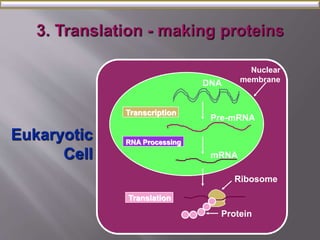
Nuclear 
membrane 
Transcription 
RNA Processing 
Translation 
DNA 
Pre-mRNA 
mRNA 
Ribosome 
Protein 
Eukaryotic 
Cell
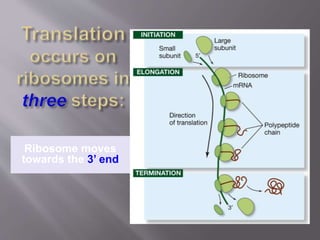
Ribosome moves 
towards the 3’ end
 Three parts: 
1. initiation: start codon (AUG) 
2. elongation: 
3. termination: stop codon (UAG, UAA, UGA) 
 Let’s make a PROTEIN!!!!.
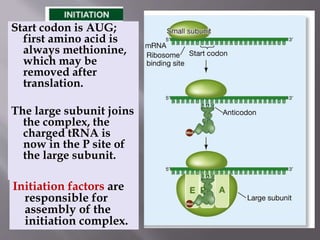
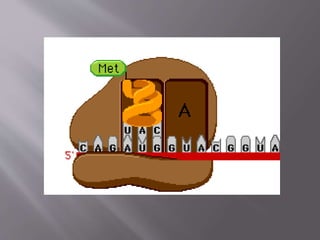
Start codon is AUG; 
first amino acid is 
always methionine, 
which may be 
removed after 
translation. 
The large subunit joins 
the complex, the 
charged tRNA is 
now in the P site of 
the large subunit. 
Initiation factors are 
responsible for 
assembly of the 
initiation complex.
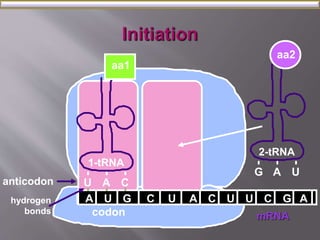
aa2 
2-tRNA 
G 
A U 
aa1 
A U G C U A C U U C G 
mRNA 
A 
1-tRNA 
U A C 
anticodon 
hydrogen 
bonds codon
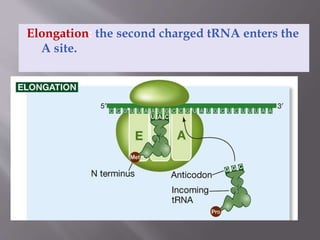
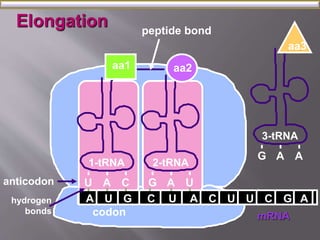
Elongation: the second charged tRNA enters the 
A site.
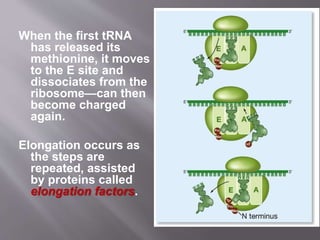
When the first tRNA 
has released its 
methionine, it moves 
to the E site and 
dissociates from the 
ribosome—can then 
become charged 
again. 
Elongation occurs as 
the steps are 
repeated, assisted 
by proteins called 
elongation factors.
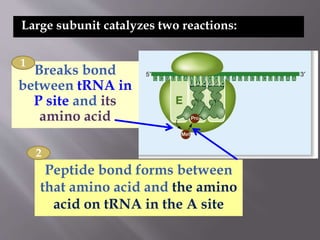
Large subunit catalyzes two reactions: 
Breaks bond 
between tRNA in 
P site and its 
amino acid 
Peptide bond forms between 
that amino acid and the amino 
acid on tRNA in the A site 
1 
2
aa1 aa2 
aa3 
A U G C U A C U U C G 
mRNA 
1-tRNA 2-tRNA 
U A C G 
A U 
A 
anticodon 
hydrogen 
bonds codon 
peptide bond 
3-tRNA 
G A A 
Elongation
aa1 
aa3 
A U G C U A C U U C G 
mRNA 
1-tRNA 
2-tRNA 
U A C 
G 
aa2 
A U 
A 
peptide bond 
3-tRNA 
G A A 
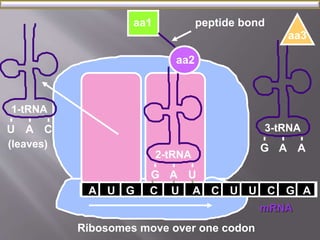
Ribosomes move over one codon 
(leaves)
aa4 
mRNA 
aa1 
aa2 
2-tRNA 
G 
A U 
aa3 
A U G C U A C U U C G 
A 
peptide bonds 
3-tRNA 
G A A 
4-tRNA 
G C U 
A C U
aa4 
mRNA 
2-tRNA 
G 
aa1 
aa2 
A U 
aa3 
A U G C U A C U U C G 
A 
peptide bonds 
3-tRNA 
G A A 
4-tRNA 
G C U 
A C U 
(leaves) 
Ribosomes move over one codon
aa5 
5-tRNA 
mRNA 
aa1 
aa2 
aa3 
aa4 
G C U A C U U C G 
A 
peptide bonds 
3-tRNA 
G A A 
4-tRNA 
G C U 
A C U 
U G A
aa5 
5-tRNA 
mRNA 
aa1 
aa2 
peptide bonds 
aa4 
G C U A C U U C G 
A 
3-tRNA 
G A A 
aa3 
4-tRNA 
G C U 
A C U 
U G A 
Ribosomes move over one codon
Termination: translation ends when a 
stop codon [UAA, UAG, UGA] enters 
the A site.
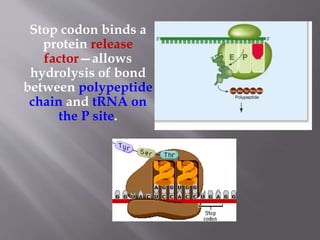
Stop codon binds a 
protein release 
factor—allows 
hydrolysis of bond 
between polypeptide 
chain and tRNA on 
the P site.
aa2 
aa1 
A C A U G U 
mRNA 
U 
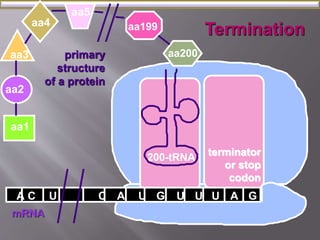
primary 
structure 
of a protein 
aa3 
200-tRNA 
aa4 
Termination 
U A G 
aa5 
C U 
aa200 
aa199 
terminator 
or stop 
codon
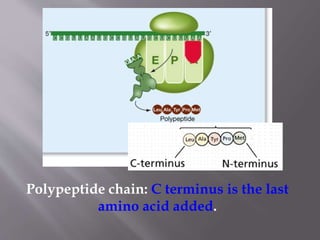
Polypeptide chain: C terminus is the last 
amino acid added.
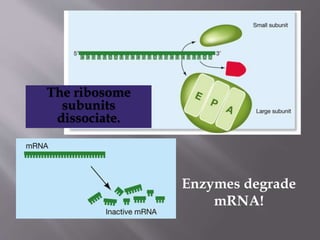
Enzymes degrade 
mRNA! 
The ribosome 
subunits 
dissociate.
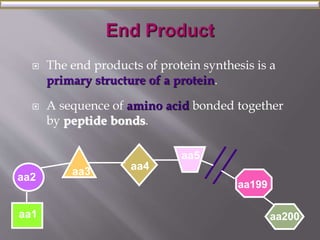
 The end products of protein synthesis is a 
primary structure of a protein. 
 A sequence of amino acid bonded together 
by peptide bonds. 
aa2 
aa1 
aa3 
aa4 
aa5 
aa200 
aa199
 This m-rna can again be translated 
by the same or any other ribosomes 
to form the multiple copies of that 
protein!!!
Translation presntion by me

Translation presntion by me

  • 3.
    Nuclear membrane Transcription RNA Processing Translation DNA Pre-mRNA mRNA Ribosome Protein Eukaryotic Cell
  • 4.
  • 5.
     Three parts: 1. initiation: start codon (AUG) 2. elongation: 3. termination: stop codon (UAG, UAA, UGA)  Let’s make a PROTEIN!!!!.
  • 6.
    Start codon isAUG; first amino acid is always methionine, which may be removed after translation. The large subunit joins the complex, the charged tRNA is now in the P site of the large subunit. Initiation factors are responsible for assembly of the initiation complex.
  • 8.
    aa2 2-tRNA G A U aa1 A U G C U A C U U C G mRNA A 1-tRNA U A C anticodon hydrogen bonds codon
  • 9.
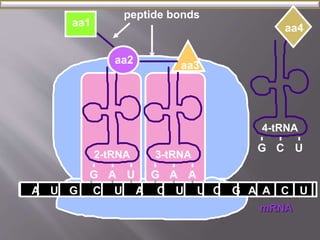
    Elongation: the secondcharged tRNA enters the A site.
  • 10.
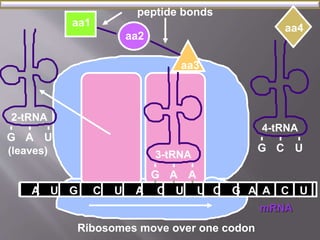
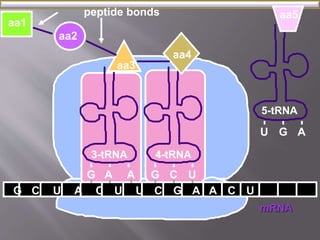
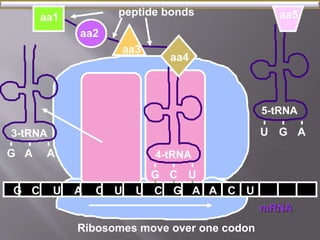
    When the firsttRNA has released its methionine, it moves to the E site and dissociates from the ribosome—can then become charged again. Elongation occurs as the steps are repeated, assisted by proteins called elongation factors.
  • 11.
    Large subunit catalyzestwo reactions: Breaks bond between tRNA in P site and its amino acid Peptide bond forms between that amino acid and the amino acid on tRNA in the A site 1 2
  • 12.
    aa1 aa2 aa3 A U G C U A C U U C G mRNA 1-tRNA 2-tRNA U A C G A U A anticodon hydrogen bonds codon peptide bond 3-tRNA G A A Elongation
  • 13.
    aa1 aa3 AU G C U A C U U C G mRNA 1-tRNA 2-tRNA U A C G aa2 A U A peptide bond 3-tRNA G A A Ribosomes move over one codon (leaves)
  • 14.
    aa4 mRNA aa1 aa2 2-tRNA G A U aa3 A U G C U A C U U C G A peptide bonds 3-tRNA G A A 4-tRNA G C U A C U
  • 15.
    aa4 mRNA 2-tRNA G aa1 aa2 A U aa3 A U G C U A C U U C G A peptide bonds 3-tRNA G A A 4-tRNA G C U A C U (leaves) Ribosomes move over one codon
  • 16.
    aa5 5-tRNA mRNA aa1 aa2 aa3 aa4 G C U A C U U C G A peptide bonds 3-tRNA G A A 4-tRNA G C U A C U U G A
  • 17.
    aa5 5-tRNA mRNA aa1 aa2 peptide bonds aa4 G C U A C U U C G A 3-tRNA G A A aa3 4-tRNA G C U A C U U G A Ribosomes move over one codon
  • 18.
    Termination: translation endswhen a stop codon [UAA, UAG, UGA] enters the A site.
  • 19.
    Stop codon bindsa protein release factor—allows hydrolysis of bond between polypeptide chain and tRNA on the P site.
  • 20.
    aa2 aa1 AC A U G U mRNA U primary structure of a protein aa3 200-tRNA aa4 Termination U A G aa5 C U aa200 aa199 terminator or stop codon
  • 21.
    Polypeptide chain: Cterminus is the last amino acid added.
  • 22.
    Enzymes degrade mRNA! The ribosome subunits dissociate.
  • 23.
     The endproducts of protein synthesis is a primary structure of a protein.  A sequence of amino acid bonded together by peptide bonds. aa2 aa1 aa3 aa4 aa5 aa200 aa199
  • 24.
     This m-rnacan again be translated by the same or any other ribosomes to form the multiple copies of that protein!!!