Eukaryotic Translation
By
Divakaran.P
Msc.Biochemistry & Molecular biology
Pondicherry university.
 Translation is basically a synonym process of protein synthesis.
 It is the process in which the protein is synthesized from the
information contained in a molecule of messenger RNA (mRNA).
 It can defined as “ the process by which the sequence of
nucleotides in a messenger RNA molecule directs the incorporation
of amino acid into protein.”
Introduction
TRANSLATIONAL MACHINERY
 The machinery required for translating the language of messenger RNAs
into the language of proteins is composed of four primary components
mRNAs : Messenger RNA (mRNA) provides an intermediate that carries the
copy of a DNA sequence that represents protein.
tRNAs : tRNA acts as an adaptor between the codons and the amino acids
they specify.
Enzymes : Required for the attachment of amino acids to the correct tRNA
molecule.
Aminoacyl-tRNA Synthetase :Peptidyl Transferase.
Ribosome : It is the macromolecular complex that directs the synthesis of
proteins.
 Translation can be subdivided into several steps :
1. Initiation
2. Elongation
3. Termination
4. Recycling
 Translation initiation in eukaryotes is a highly regulated and complex stage
of gene expression. It requires the action of at least 12 initiation factors,
many of which are known to be the targets of regulatory pathways. Here
review our current understanding of the molecular mechanics of
translation initiation.
eIF-1(and 1A): promotes scanning.
eIF-2: binds tRNAi Met to 40S subunit,
requires GTP which gets hydrolyzed to GDP.
eIF-2B: catalyzes exchange of GTP to GDP on eIF-2
eIF-3: binds to 40S subunit, prevents 60S subunit from binding to it .
eIF-5: stimulates 60S subunit binding to the 40S pre-initiation complex.
eIF-6: binds to 60S subunit, helps prevent 40S subunit from binding to it.
Initiation factors
In the translation mechanism, diverse proteins known as translational factors are
involved converting the information contained in the mRNA into a protein. This event
is commonly divided into three phases: initiation, elongation, and termination.
 The initiation phase has been described as the most regulated in eukaryotic cells,
it can be carried out in two ways:
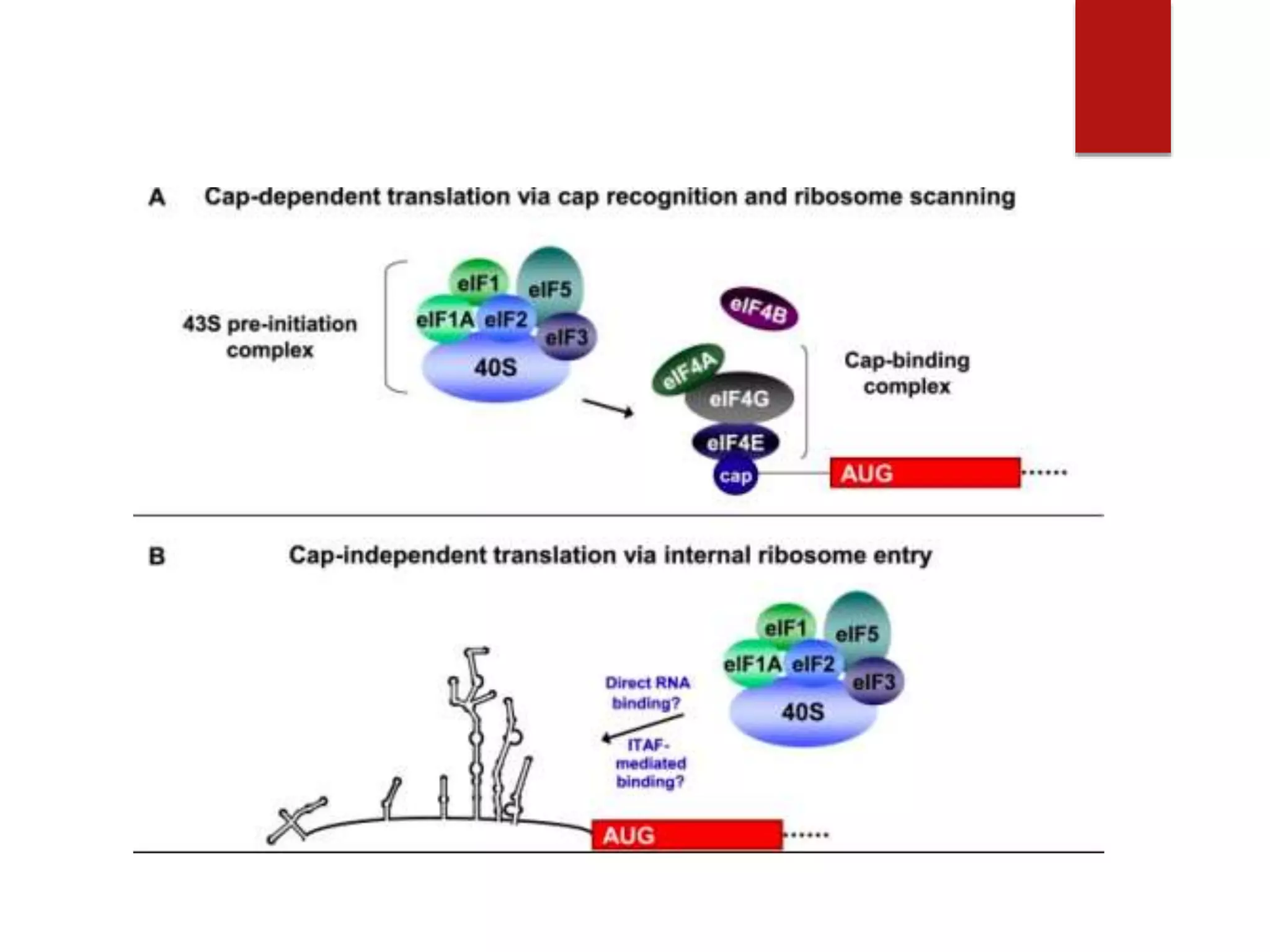
(a)cap-dependent or conventional.
(b)cap-independent or internal ribosome entrysite(IRES).
Translation Mechanism
 Initiation of translation usually involves the interaction of certain key proteins
with a special tag bound to the 5′-end of an mRNA molecule, the 5′ cap.
 The protein factors bind the small ribosomal subunit (also referred to as the
40S subunit), and these initiation factors hold the mRNA in place.
1. Initiation
(i) Cap-dependent initiation, and
(ii) Cap-independent initiation.
 Cap-Dependent Initiation
 The eukaryotic Initiation Factor 3 (eIF3) is associated with the small
ribosomal subunit, and plays a role in keeping the large ribosomal subunit
from prematurely binding.
 The factor eIF3 also interacts with the eIF4F complex which consists of
three other initiation factors [eIF4A, eIF4E and eIF4G].
 The factor eIF4G is a protein which directly associates with both eIF3 and
the other two components.
 The eIF4E is the cap-binding protein. It is the rate-limiting step of cap-
dependent initiation, and is often cleaved from the complex by some viral
proteases to limit the cell’s ability to translate its own transcripts.
 This is lesser known method of translation in eukaryotes. This method of
translation has been recently discovered.
 It has been found to be important in conditions that require the translation of
specific mRNAs.
 It works despite cellular stress or the inability to translate most mRNAs.
Examples of such type of translation are factors responding to apoptosis and
stress-induced responses.
 The best studied example of the cap-independent mode of translation initiation
in eukaryotes is the Internal Ribosome Entry Site (IRES) approach.
 The Cap-Independent Initiation:
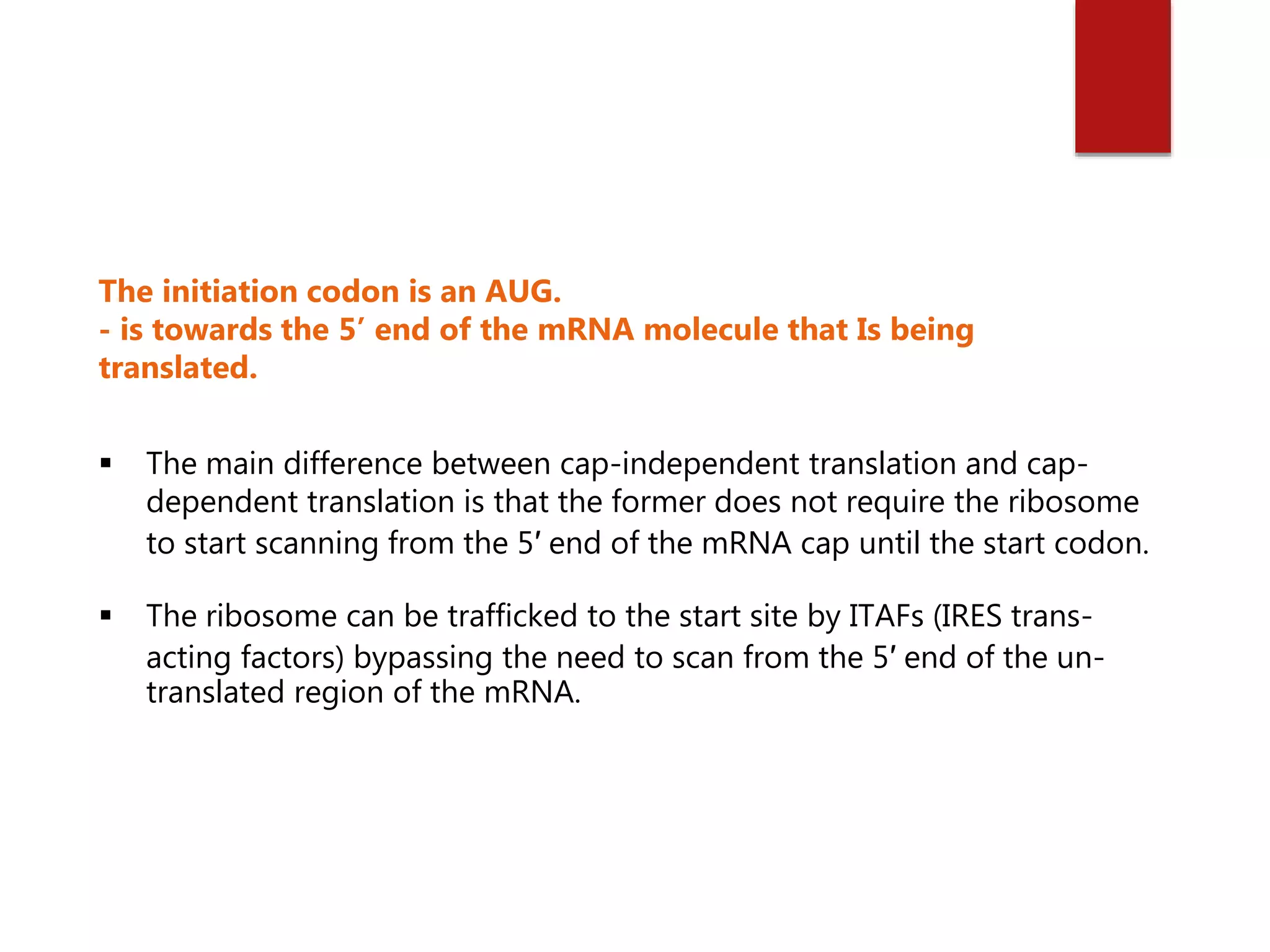
 The main difference between cap-independent translation and cap-
dependent translation is that the former does not require the ribosome
to start scanning from the 5′ end of the mRNA cap until the start codon.
 The ribosome can be trafficked to the start site by ITAFs (IRES trans-
acting factors) bypassing the need to scan from the 5′ end of the un-
translated region of the mRNA.
The initiation codon is an AUG.
- is towards the 5’ end of the mRNA molecule that Is being
translated.
At the start of elongation, the mRNA is bound to the complete two subunit
ribosome..,
- With the initiating tRNA in the P site,
- and the A site is free for binding to the next tRNA.
 The ribosome moves along the mRNA in a 5’ to 3’ direction, in a step-wise
process, recognizing each subsequent codon.
 The peptidyl transferase enzyme then catalyzes the formation of a peptide bond
between.
- the free N terminal of the amino acid at the A site.
- with a free N terminal and the Carboxyl terminal of the second
amino acid connected to its tRNA.
 Translation Elongation
 Elongation is dependent on eukaryotic elongation factors At the end of the
initiation step, the mRNA is positioned so that the next codon can be
translated during the elongation stage of protein synthesis.
 The initiator tRNA occupies the P site in the ribosome; and the A site is ready
to receive an aminoacyl-tRNA. During chain elongation, each additional amino
acid is added to the nascent polypeptide chain in a three-step micro-cycle.
 Elongation
Translational elongation
 The steps in this micro-cycle are,
(i) Positioning the correct aminoacyl-tRNA in the A site of the ribosome;
(ii) Forming the peptide bond and
(iii) Shifting the mRNA by one codon relative to the ribosome.
The translation machinery works relatively slowly compared to the enzyme
that catalyze DNA replication. Proteins are synthesised at a rate of only 18 amino
acid residues per second, whereas bacterial replisomes synthesize DNA at a rate
1,000 nucleotides per second.
This difference in rate reflects, in part, the difference between polymerizing four
types of nucleotides to make nucleic acids and polymerizing 20 types of amino
acids to make proteins. Testing and rejecting incorrect aminoacyl- tRNA
takes time and slows protein synthesis.
During translocation the peptidyl-tRNA remains attached to its codon, but is
transferred from the ribosomal A site to the P site.
 The vacant A site now contains a new codon, and an aminoacyl-tRNA with the
correct anticodon can enter and bind.
 The process repeats until a stop codon is reached.
 Chain Elongation: Translocation
In both prokaryotes and eukaryotes, simultaneous translation occurs.
- New ribosomes may initiate as soon as the previous ribosome has moved away
from the initiation site, creating a polyribosome (polysome).
- An average mRNA might have 8–10 ribosomes attached at a given moment.
 This is the last phase of translation. Termination occurs when one of the
three termination codons moves into the A site. These codons are not
recognized by any tRNAs.
 Termination of elongation is dependent on eukaryotic release factors In
eukaryotes, there is only one release factor that is eRF, which recognizes all
three stop codons [in place of RF1, RF2, or RF3 factors in prokaryotes].
 However, the overall process of termination is similar to that of
prokaryotes.
 Termination
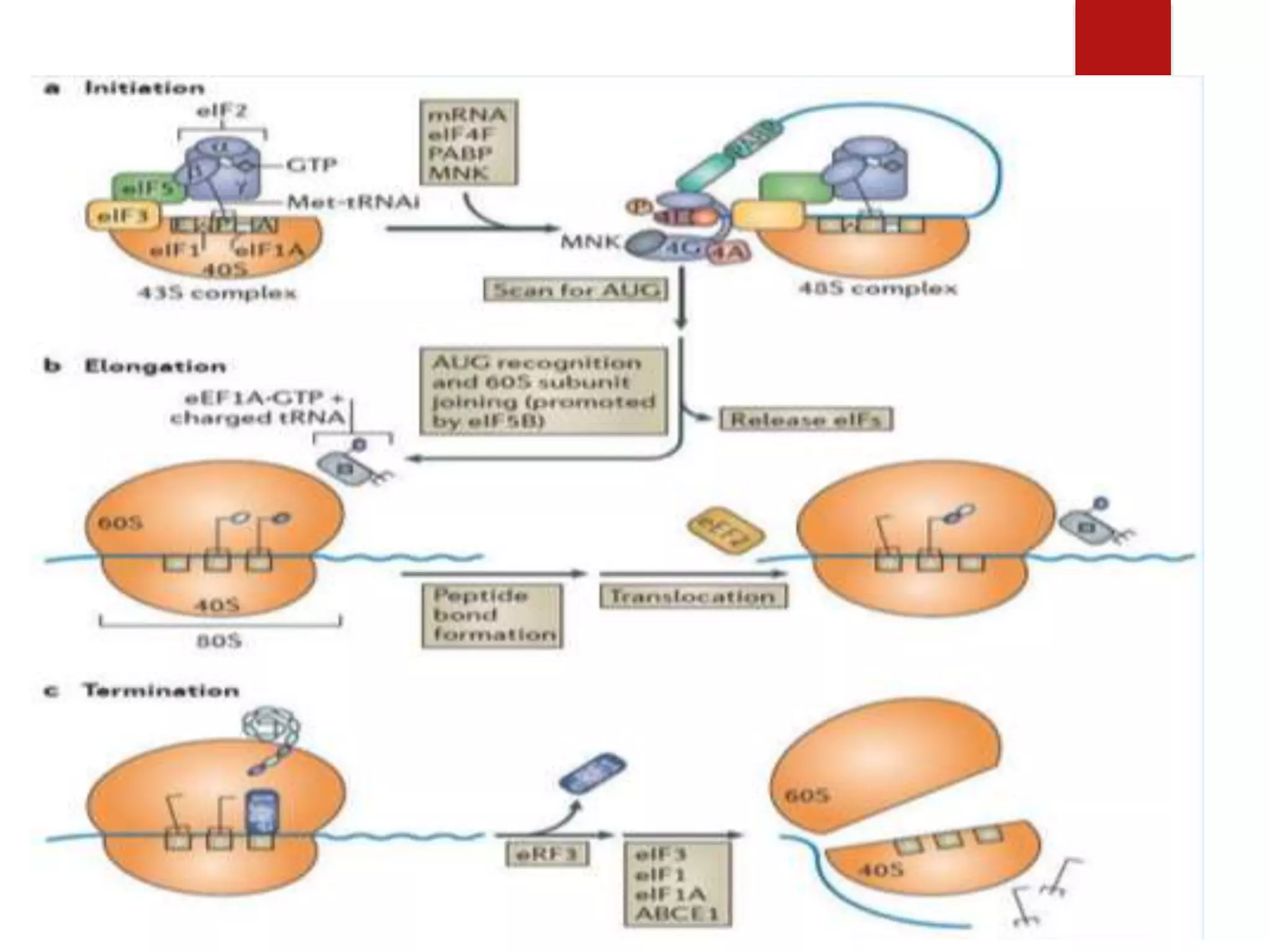
One of the stop or termination signals (UAA, UAG and UGA) terminates
the growing polypeptide.
When the ribosome encounters a stop codon,
- there is no tRNA available to bind to the A site
of the ribosome,
- instead a release factor binds to it.
In eukaryotes, a single release factor- eukaryotic release factor 1 (eRF1)-
recognizes all three stop codons, and eRF3 stimulates the termination
events.
once the release factor binds, the ribosome unit falls apart,
- releasing the large and small subunits,
- the tRNA carrying the polypeptide is also released,
freeing up the polypeptide product.
 After the release of polypeptide and the release factors the ribosome is still
bound to the mRNA and is left with two deacylated tRNA (in the P and E sites).
 To participate in a new round of polypeptide synthesis, these mRNA and the
tRNA must be released and the ribosome must dissociate into small subunit and
large subunit.
 Collectively these events are termed as ribosome recycling
 Ribosomal Recycling
Reference
 http://www.biologydiscussion.com
 Molecular Cell Biology
Book by David Baltimore and Harvey Lodish
 https://www.sciencedirect.com
 Wikipedia.org
Thank you….

Divakaran Molecular level of Eukaryotic translation

  • 1.
    Eukaryotic Translation By Divakaran.P Msc.Biochemistry &Molecular biology Pondicherry university.
  • 2.
     Translation isbasically a synonym process of protein synthesis.  It is the process in which the protein is synthesized from the information contained in a molecule of messenger RNA (mRNA).  It can defined as “ the process by which the sequence of nucleotides in a messenger RNA molecule directs the incorporation of amino acid into protein.” Introduction
  • 4.
    TRANSLATIONAL MACHINERY  Themachinery required for translating the language of messenger RNAs into the language of proteins is composed of four primary components mRNAs : Messenger RNA (mRNA) provides an intermediate that carries the copy of a DNA sequence that represents protein. tRNAs : tRNA acts as an adaptor between the codons and the amino acids they specify. Enzymes : Required for the attachment of amino acids to the correct tRNA molecule. Aminoacyl-tRNA Synthetase :Peptidyl Transferase. Ribosome : It is the macromolecular complex that directs the synthesis of proteins.
  • 5.
     Translation canbe subdivided into several steps : 1. Initiation 2. Elongation 3. Termination 4. Recycling  Translation initiation in eukaryotes is a highly regulated and complex stage of gene expression. It requires the action of at least 12 initiation factors, many of which are known to be the targets of regulatory pathways. Here review our current understanding of the molecular mechanics of translation initiation.
  • 6.
    eIF-1(and 1A): promotesscanning. eIF-2: binds tRNAi Met to 40S subunit, requires GTP which gets hydrolyzed to GDP. eIF-2B: catalyzes exchange of GTP to GDP on eIF-2 eIF-3: binds to 40S subunit, prevents 60S subunit from binding to it . eIF-5: stimulates 60S subunit binding to the 40S pre-initiation complex. eIF-6: binds to 60S subunit, helps prevent 40S subunit from binding to it. Initiation factors
  • 8.
    In the translationmechanism, diverse proteins known as translational factors are involved converting the information contained in the mRNA into a protein. This event is commonly divided into three phases: initiation, elongation, and termination.  The initiation phase has been described as the most regulated in eukaryotic cells, it can be carried out in two ways: (a)cap-dependent or conventional. (b)cap-independent or internal ribosome entrysite(IRES). Translation Mechanism
  • 9.
     Initiation oftranslation usually involves the interaction of certain key proteins with a special tag bound to the 5′-end of an mRNA molecule, the 5′ cap.  The protein factors bind the small ribosomal subunit (also referred to as the 40S subunit), and these initiation factors hold the mRNA in place. 1. Initiation (i) Cap-dependent initiation, and (ii) Cap-independent initiation.  Cap-Dependent Initiation
  • 10.
     The eukaryoticInitiation Factor 3 (eIF3) is associated with the small ribosomal subunit, and plays a role in keeping the large ribosomal subunit from prematurely binding.  The factor eIF3 also interacts with the eIF4F complex which consists of three other initiation factors [eIF4A, eIF4E and eIF4G].  The factor eIF4G is a protein which directly associates with both eIF3 and the other two components.  The eIF4E is the cap-binding protein. It is the rate-limiting step of cap- dependent initiation, and is often cleaved from the complex by some viral proteases to limit the cell’s ability to translate its own transcripts.
  • 12.
     This islesser known method of translation in eukaryotes. This method of translation has been recently discovered.  It has been found to be important in conditions that require the translation of specific mRNAs.  It works despite cellular stress or the inability to translate most mRNAs. Examples of such type of translation are factors responding to apoptosis and stress-induced responses.  The best studied example of the cap-independent mode of translation initiation in eukaryotes is the Internal Ribosome Entry Site (IRES) approach.  The Cap-Independent Initiation:
  • 13.
     The maindifference between cap-independent translation and cap- dependent translation is that the former does not require the ribosome to start scanning from the 5′ end of the mRNA cap until the start codon.  The ribosome can be trafficked to the start site by ITAFs (IRES trans- acting factors) bypassing the need to scan from the 5′ end of the un- translated region of the mRNA. The initiation codon is an AUG. - is towards the 5’ end of the mRNA molecule that Is being translated.
  • 14.
    At the startof elongation, the mRNA is bound to the complete two subunit ribosome.., - With the initiating tRNA in the P site, - and the A site is free for binding to the next tRNA.  The ribosome moves along the mRNA in a 5’ to 3’ direction, in a step-wise process, recognizing each subsequent codon.  The peptidyl transferase enzyme then catalyzes the formation of a peptide bond between. - the free N terminal of the amino acid at the A site. - with a free N terminal and the Carboxyl terminal of the second amino acid connected to its tRNA.  Translation Elongation
  • 15.
     Elongation isdependent on eukaryotic elongation factors At the end of the initiation step, the mRNA is positioned so that the next codon can be translated during the elongation stage of protein synthesis.  The initiator tRNA occupies the P site in the ribosome; and the A site is ready to receive an aminoacyl-tRNA. During chain elongation, each additional amino acid is added to the nascent polypeptide chain in a three-step micro-cycle.  Elongation
  • 16.
  • 17.
     The stepsin this micro-cycle are, (i) Positioning the correct aminoacyl-tRNA in the A site of the ribosome; (ii) Forming the peptide bond and (iii) Shifting the mRNA by one codon relative to the ribosome. The translation machinery works relatively slowly compared to the enzyme that catalyze DNA replication. Proteins are synthesised at a rate of only 18 amino acid residues per second, whereas bacterial replisomes synthesize DNA at a rate 1,000 nucleotides per second. This difference in rate reflects, in part, the difference between polymerizing four types of nucleotides to make nucleic acids and polymerizing 20 types of amino acids to make proteins. Testing and rejecting incorrect aminoacyl- tRNA takes time and slows protein synthesis.
  • 18.
    During translocation thepeptidyl-tRNA remains attached to its codon, but is transferred from the ribosomal A site to the P site.  The vacant A site now contains a new codon, and an aminoacyl-tRNA with the correct anticodon can enter and bind.  The process repeats until a stop codon is reached.  Chain Elongation: Translocation In both prokaryotes and eukaryotes, simultaneous translation occurs. - New ribosomes may initiate as soon as the previous ribosome has moved away from the initiation site, creating a polyribosome (polysome). - An average mRNA might have 8–10 ribosomes attached at a given moment.
  • 20.
     This isthe last phase of translation. Termination occurs when one of the three termination codons moves into the A site. These codons are not recognized by any tRNAs.  Termination of elongation is dependent on eukaryotic release factors In eukaryotes, there is only one release factor that is eRF, which recognizes all three stop codons [in place of RF1, RF2, or RF3 factors in prokaryotes].  However, the overall process of termination is similar to that of prokaryotes.  Termination
  • 21.
    One of thestop or termination signals (UAA, UAG and UGA) terminates the growing polypeptide. When the ribosome encounters a stop codon, - there is no tRNA available to bind to the A site of the ribosome, - instead a release factor binds to it. In eukaryotes, a single release factor- eukaryotic release factor 1 (eRF1)- recognizes all three stop codons, and eRF3 stimulates the termination events. once the release factor binds, the ribosome unit falls apart, - releasing the large and small subunits, - the tRNA carrying the polypeptide is also released, freeing up the polypeptide product.
  • 23.
     After therelease of polypeptide and the release factors the ribosome is still bound to the mRNA and is left with two deacylated tRNA (in the P and E sites).  To participate in a new round of polypeptide synthesis, these mRNA and the tRNA must be released and the ribosome must dissociate into small subunit and large subunit.  Collectively these events are termed as ribosome recycling  Ribosomal Recycling
  • 25.
    Reference  http://www.biologydiscussion.com  MolecularCell Biology Book by David Baltimore and Harvey Lodish  https://www.sciencedirect.com  Wikipedia.org
  • 26.