TOPIC : TRANSLATION
SUBMITTED TO: DR.JAGRITI SHARMA SUBMITTED BY : ANUSHIKA SHARMA
MSC. MICROBIOLOGY
II SEMESTER
SUB T0PIC
 Introduction of Translation
 Component of Translation
 TRANSLATION IN PROKARTOTES
 Initation
 Elongation
 Termination
 TRANSLATION IN EUKARYOTES
 Initation
 Elongation
 Termination
TOPIC TRANSLATION
 REGULATION OF TRANSLATION
 INTRODUCTION
 Mechanism of Regulation of Translation
 Riboswitch Mechanism
 Various other pathway of Regulation of Translational
 Post translational modification:
 INTRODUCTION
 Types of the post translational modification
 Technique to seen post translational modification
 REFERENCES
 TRANSLATION :
 INTRODUCTION :

THE GENETIC INFORMATION CONTAINED WITH THE ORDER OF NUCLEODIDES IN THE MESSENGER RNA
 (MRNA) IS USED TO GENERATE THE LINEAR SEQUENCE OF AMINO ACIDS IN PROTEINS.
 THESE LINEAR OF AMINO ACIDS ARE FURTHER PROCESSED AND , MODIFIED.
 OR TRANSLATIOCHAINSN IS A PROCESS BY WHICH PROTEIN IS SYNTHESIZED AT RIBOSOMAL SITE UPON
 MRNA TEMPLATE. THE BLUE PRINT OF WHICH IS IN DNA CODING.
 IN THIS PREOCESS MRNA IS DECODE TO FORMA PARTICULAR POLYPEPTIDE.
 TRANSLATION PROCESS OCCURS ININ CYTOSOL REQUIRES THE INVOLVMENT OF PROTEINS.
 SYNTHESIS UNIT-RIBOSOME,MRNA,TRNA,AMINO ACIDS, AMINOACYL-RNA SYNTHASE AND
 SEVERAL OTHER PROTEINS.
COMPONENT OF TRANSLATION
 –BINDING SITE FOR FIRST(AMINOACYLATED TRNA.)
 2.P-SITE – BINDING SITE FOR THE (PEPTIDYL TRNA).
 3.E-SITE – BINDING SITE tRNA –STRUCTURE AND AMINO ACID COMPOITION.
 THE RIBOSOMES – THESE ARE MACRO MOLECULAR COMPLEX THAT DIRECT THE SYNTHESIS
OF PROTEINS.
 EACH RIBOSOMES HAVING 2 RIBOSOMAL SUBUNITS (LARGER AND SMALLER).
 RIBOSOMES t-RNA BINDING SIDE ------
 1.A-SITE FOR THE (UNCHANGED TRNA).
 PROKARYOTIC RIBOSOMAL AND COMPONENTS.
 EUKARYOTIC RIBOSMAL AND COMPONENTS.
 FUNCTION OF RIBOSOMAL UNITS.
MRNA AND GENETIC CODE
 FEATURES OF PROKARYOTIC AND EUKARYOTIC MRNA.
 THE GENETIC CODE AND ITS FEATURE.
 WOBBLING AND GENETIC CODE.
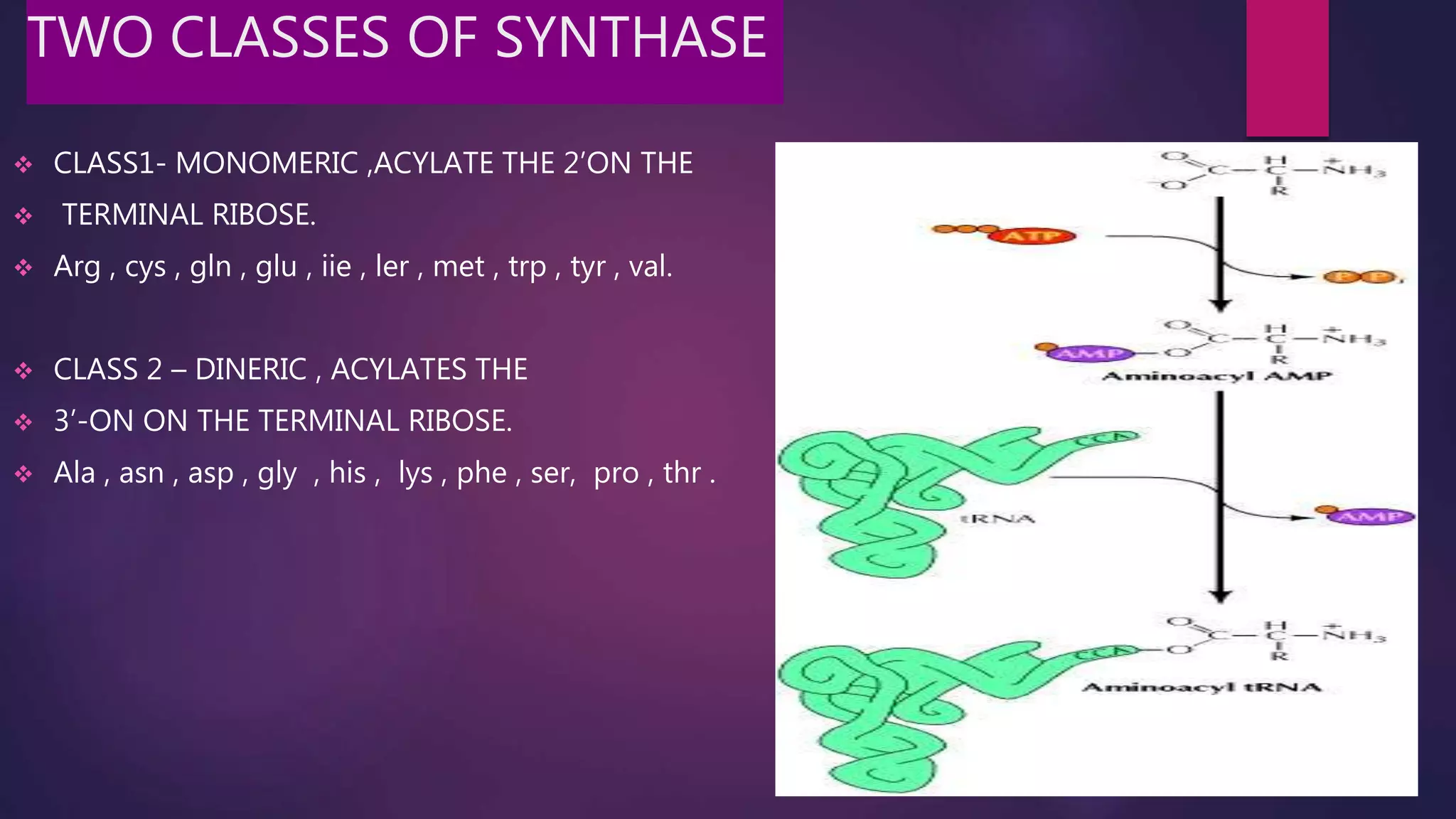
 AMINO ACID ACTIVATION AND TRNA LOADING.
 SPECIFICITY AND TIDELITY OF AMINO ACYLATION REACTION.
 PROTEIN SYNTHESIS IN PROKARYOTES.
 THE INTIATION COMPLEX AND INTIATION FACTORS.
 INTIATION ELONGATION AND TRANSLATION.
 TERMINATION OF TRANSLATION.
 ANTIBIOTICS AND PROKARYOTIC PROTEIN SYNTHESIS.
EUKARYOTIC TRANSLATION
 EUKARYOTIC INTIATION FACTORS AND INTIATION.
 COMPLEX INTIATION , ELONGATION,TERMINATION mg2t IONS ARE ALSO REQUIRED IN
TRANSLATION.
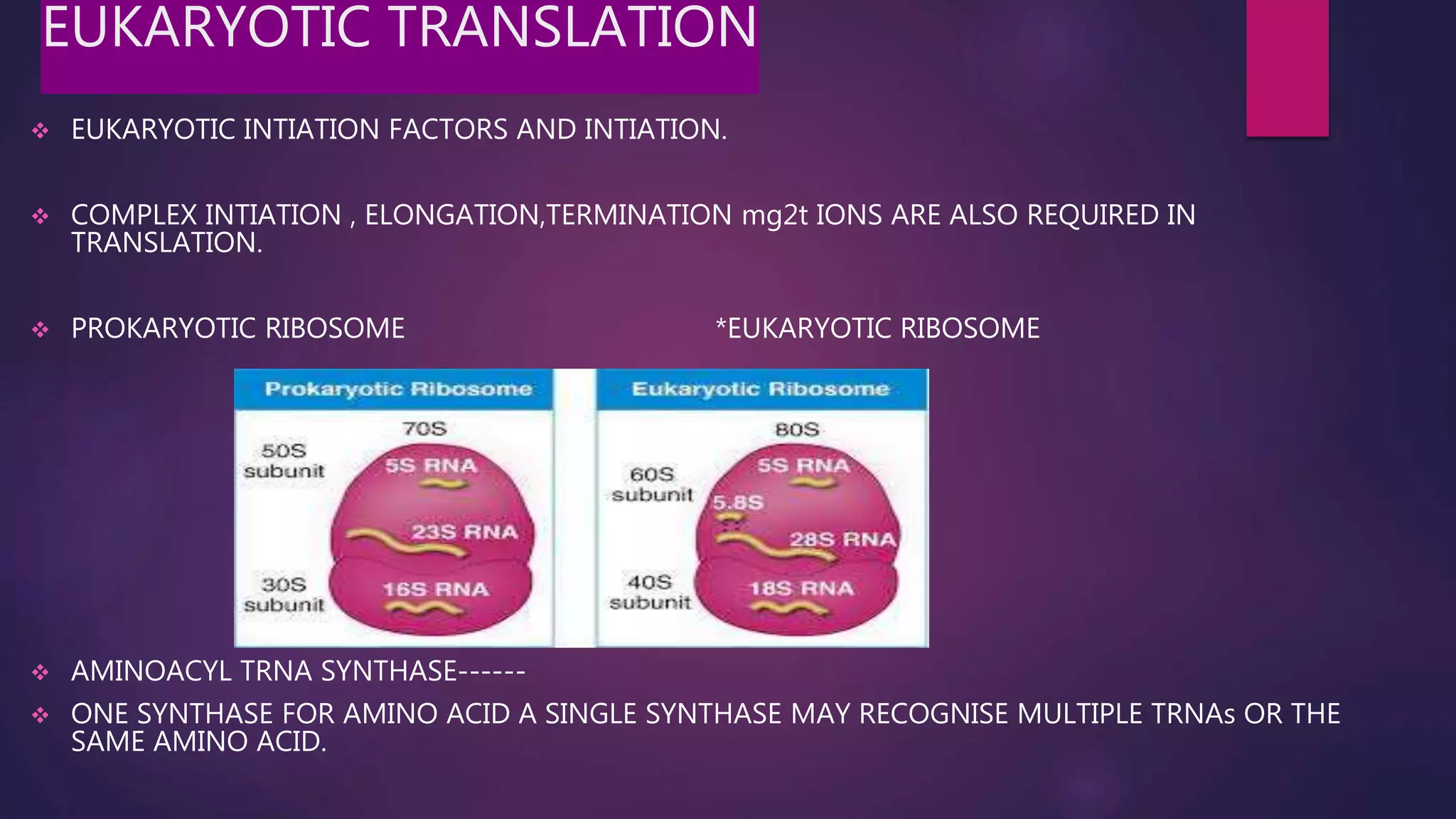
 PROKARYOTIC RIBOSOME *EUKARYOTIC RIBOSOME
 AMINOACYL TRNA SYNTHASE------
 ONE SYNTHASE FOR AMINO ACID A SINGLE SYNTHASE MAY RECOGNISE MULTIPLE TRNAs OR THE
SAME AMINO ACID.
TWO CLASSES OF SYNTHASE
 CLASS1- MONOMERIC ,ACYLATE THE 2’ON THE
 TERMINAL RIBOSE.
 Arg , cys , gln , glu , iie , ler , met , trp , tyr , val.
 CLASS 2 – DINERIC , ACYLATES THE
 3’-ON ON THE TERMINAL RIBOSE.
 Ala , asn , asp , gly , his , lys , phe , ser, pro , thr .
Translation in prokaryotes
 INITIATION
 tRNA CHARGING
 Addition of adenylated amino acid to trna to make it active or charged .
 INITIATION PROCESS:
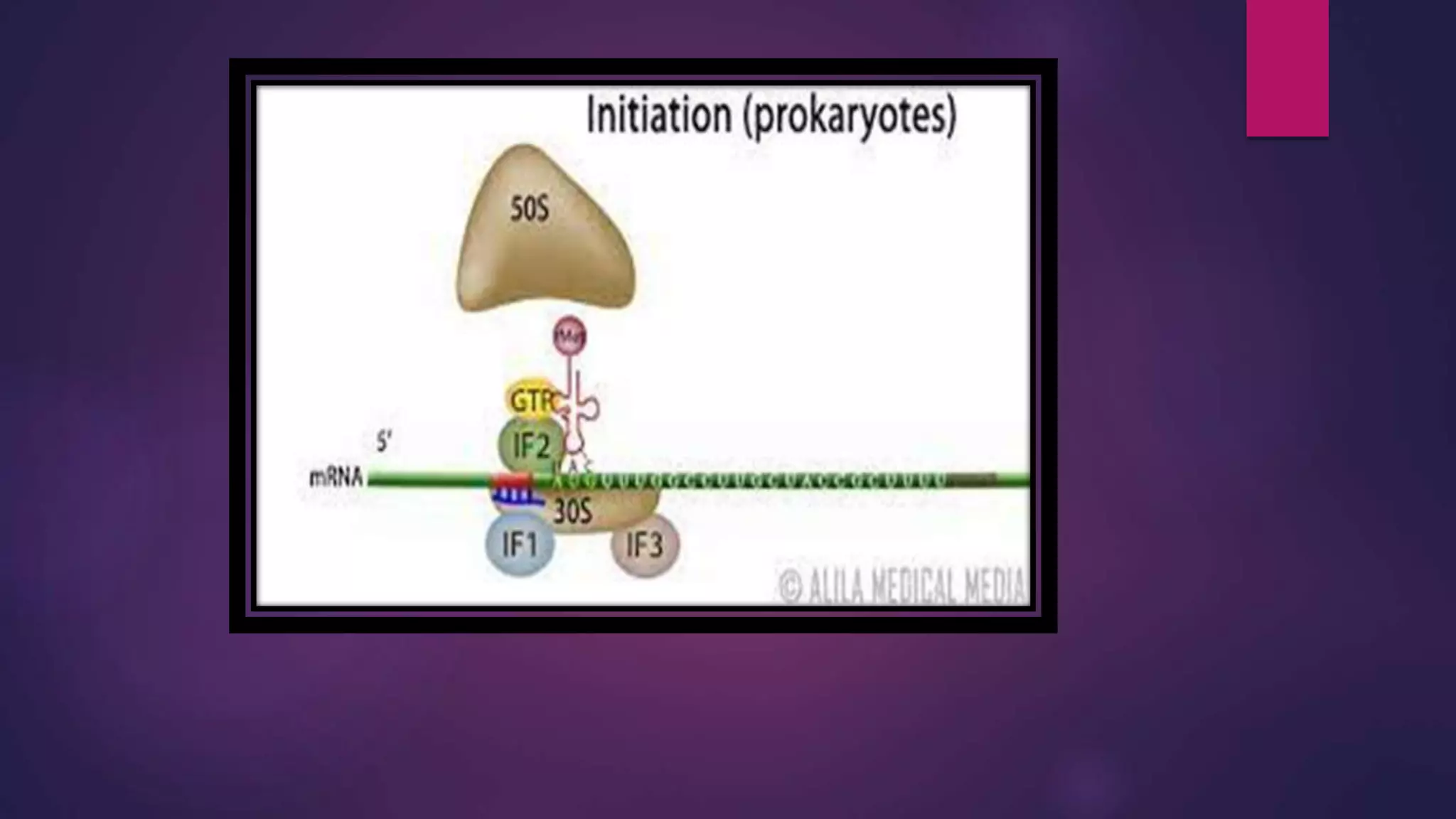
 Initiation require 3 factors known as the initiation factor IF1, IF2 and IF3.
 In prokaryotes ribosome subunit 30S and 50S
 IF3 complex:- It binds to the 30S ribosome small subunit and preventing the larger subunit binding to it
without mRNA.
 IF2 complex:- with GTP and IF1 bind to small subunit of ribosome.
 Anticodon tRNA binds to this assembly by anticodon matching.
 At this stage IF3 is released as its work to keep both subunit apart.
 This is called 30S initiation complex.
 50S subunit can bind to it by displacing its IF1 and IF2 and GTP is hydrolysed to release energy
 this assembly is now called 70S Ribosome initiation complex
 ELONGATION :
 Elongation start after initiation it requires inititation complex and
 certain elongation factor EF .
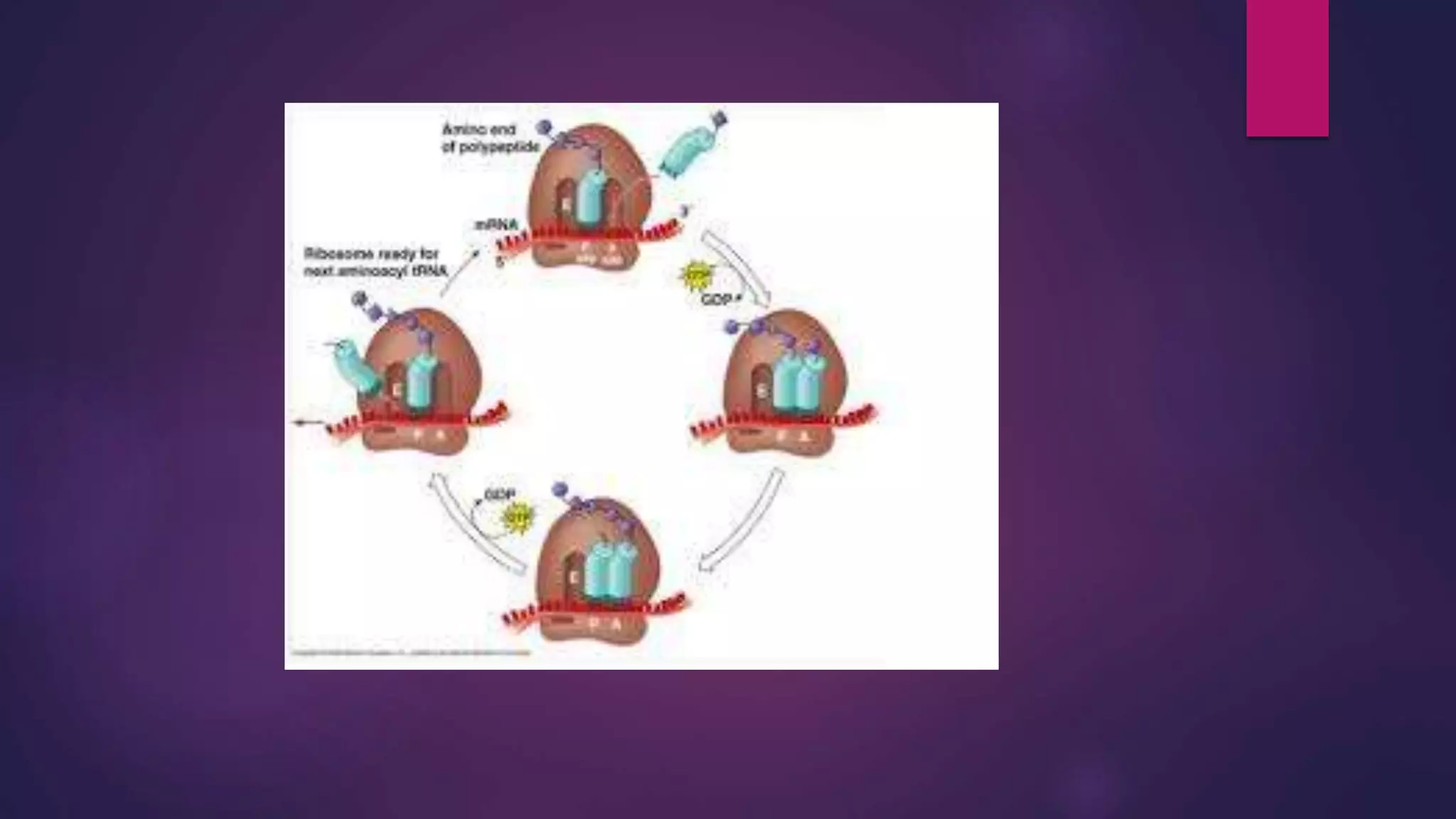
 It mainly involve 3 factors EF-TU and EF-TS and EF-G.
 EF-Tu is required to deliver the amino acid acyl tRNA to A site.
 Energy is required in this process which comes from GTP , So this complex is EF-Tu GDP complex.
 EF-TS is again convert it into EF-TU GTP complex.
 This EF-TU GTP complex is available to bind with fresh amino acyl tRNA and deliver in to ribosome.
 All type of tRNA expect initiated tRNA can bind with EF-Tu GTP complex.
 Then, complex EF-g and GTP binding
 Binding to ribosome and discharge tRNA moves from A to P side.
 Now mRNA from one codon to another that is the elongation is EfG and GDP released and the new
codon is available from vacant site.
Termination:-
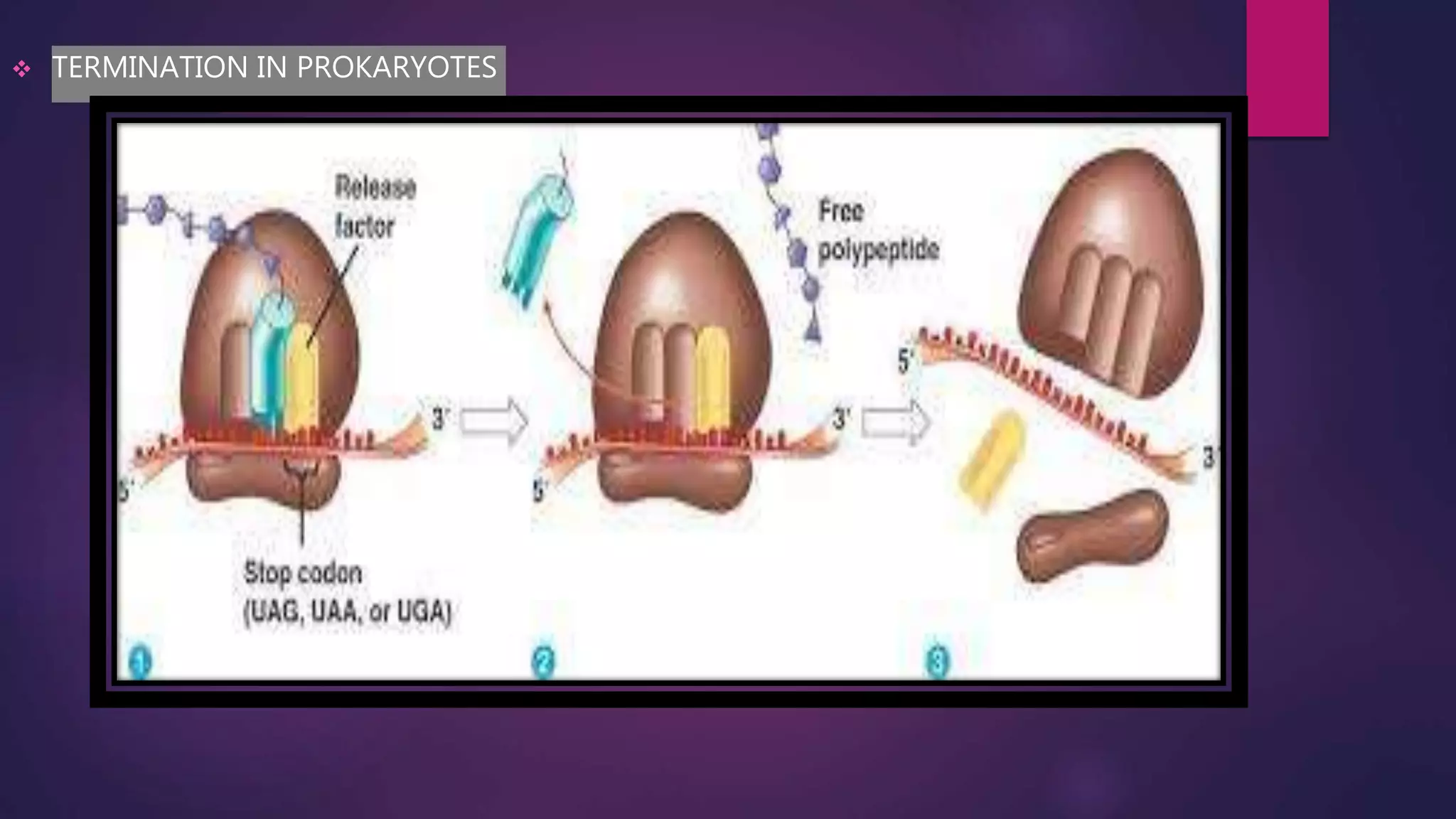
 Termination occur when any stop codon occupies the A site.
 STOP codon – UAA , UAG , UGA.
 Termination factors involved – Rf1 , Rf2 , Rf3 , RRf.
 Rf1 , Rf2 , Rf3 cause the hydrolysis to peptdyl tRNA bond.
 These are called release factors.
 Than , the polypeptide and lost unchanged tRNA is released from P site.
 None of the 70s ribosome dissociated into each submit 5Os and 30s.
 In Prokaryotes transcription and translation are coupled as sometimes translation is started the
other end of the mRNA while it is being So there mRNA while it being synthesized so there is little
or no requirement of Processing.
 TERMINATION IN PROKARYOTES
 Translation in eukaryotes
 Eukaryotic translation occur in Cytoplasm.
 It can be divided into 3 parts:-
 1) Initiation
 2) Elongation
 3) Termination
 1)Initiation
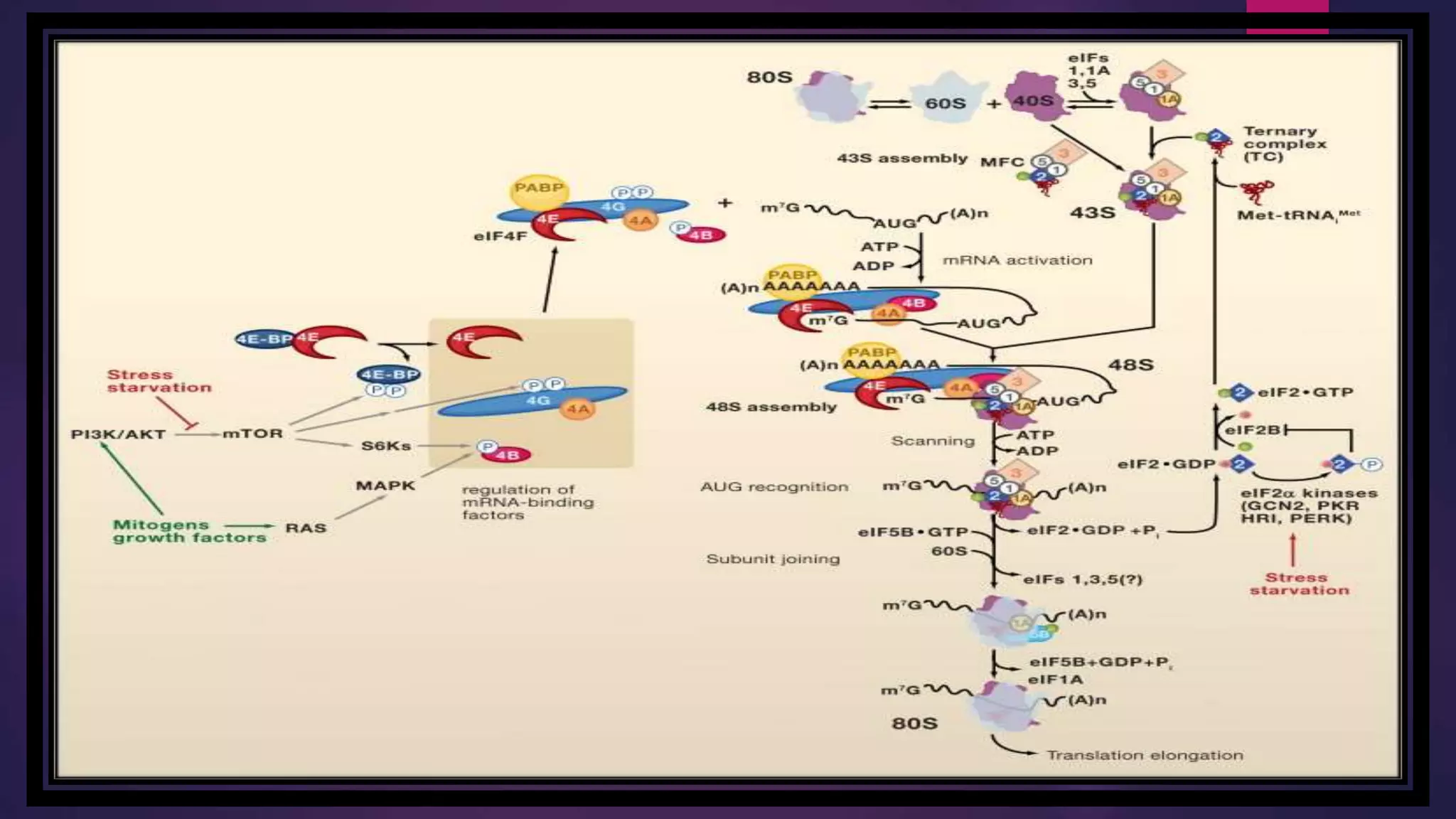
 Initiation is a complex process in case of Eukaryotes as compared to
Prokaryotes.
 Eukaryotes initiation involved to 10 initiation factor Elf.
 These initation factors if are divided into three initiation group that is 43 pre
initiation 48 initiation group and 80S initation group.
 A ternary complex of met tRNA , Elf2 and GTP attached to 40s submit to make
it a 43 pre initiation complex.
 Elf1 and Elf3 stabilize this complex.
 48 Initiation complex:-
The binding of mRNA to 43S initiation complex result into 48S initiation complex.
5’AUG is the initiation codon.
80s Initiation complex:-
48S initiation complex binds to 60S submit to from the 80S initiation complex.
This binding requires energy which comes from hydrolysis of GTP , after the binding 43S Initiation complex is
released.
3) Elongation:-
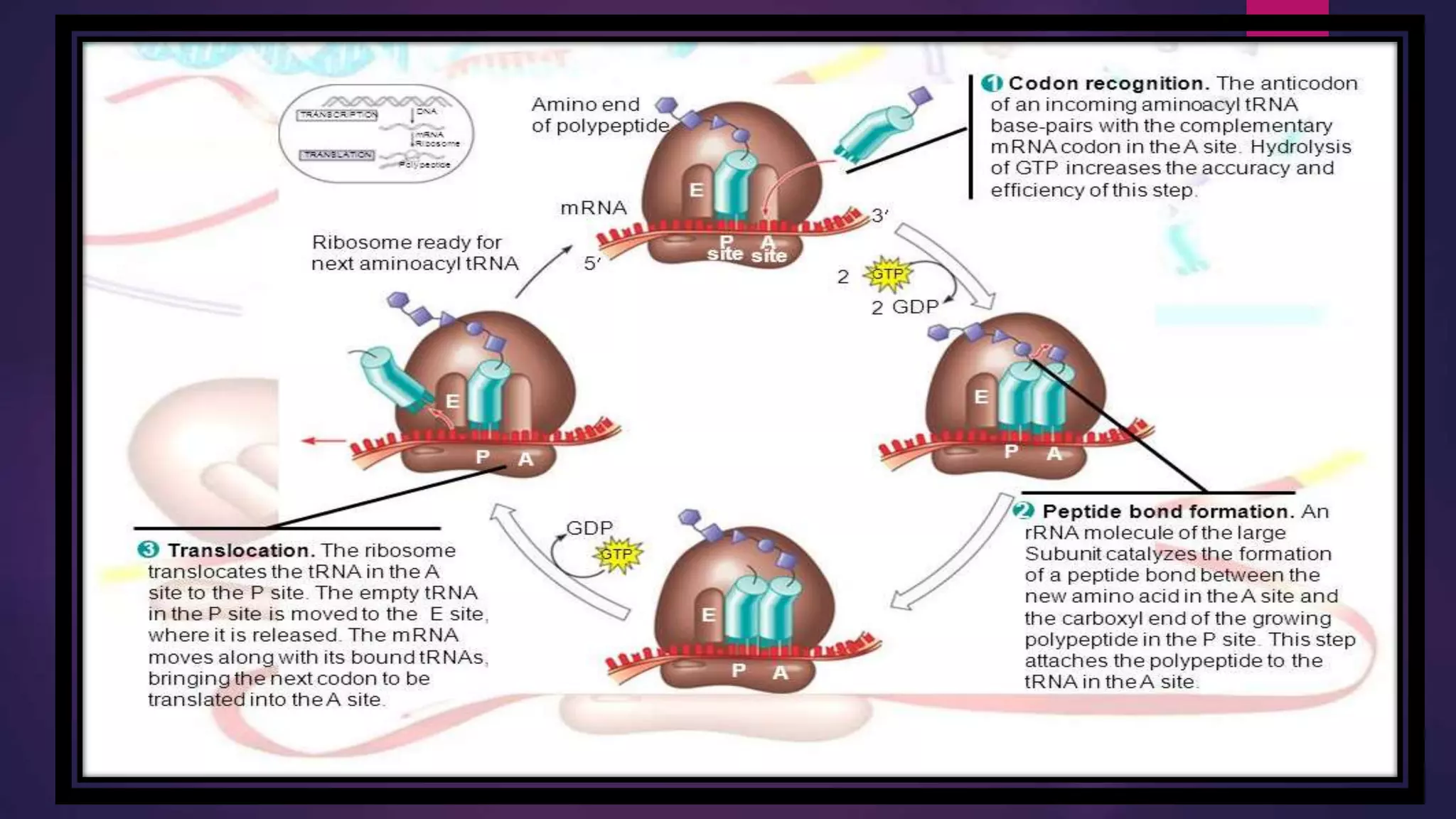
 Elongation is a process in which one by one Amino acid at it as per the anti codon ,
codon matching between tRNA and mRNA.
 Elongation involves certain EF factors.
 Elongation can be divided into 3 sub stages:-
 Binding of amino acid tRNA at A site peptide bond formation and translation
 80s initiation complex has met tRNA with P site and A site is free.
 So another amino acyl tRNA is placed at a A site it require EF 1a and GTP.
 Then New aminoacyl tRNA is places at A site EF 1a and GDP are set free for recycle.
 Second step Peptide bond formation :-
 Peptdyl transferase catalyses the formation peptide bond.
 This result in the attachment of growing polypetide chain to the A site.
 Third step is translation it involve the movement of growing poypeptide chain from p site.
 Translation requires f2 and GTP.
 GTP get hydrolysed and supplies energy to move mRNA.
 Ef 2 and GTP complex are recycled for the translocation.
 TERMINATION:-
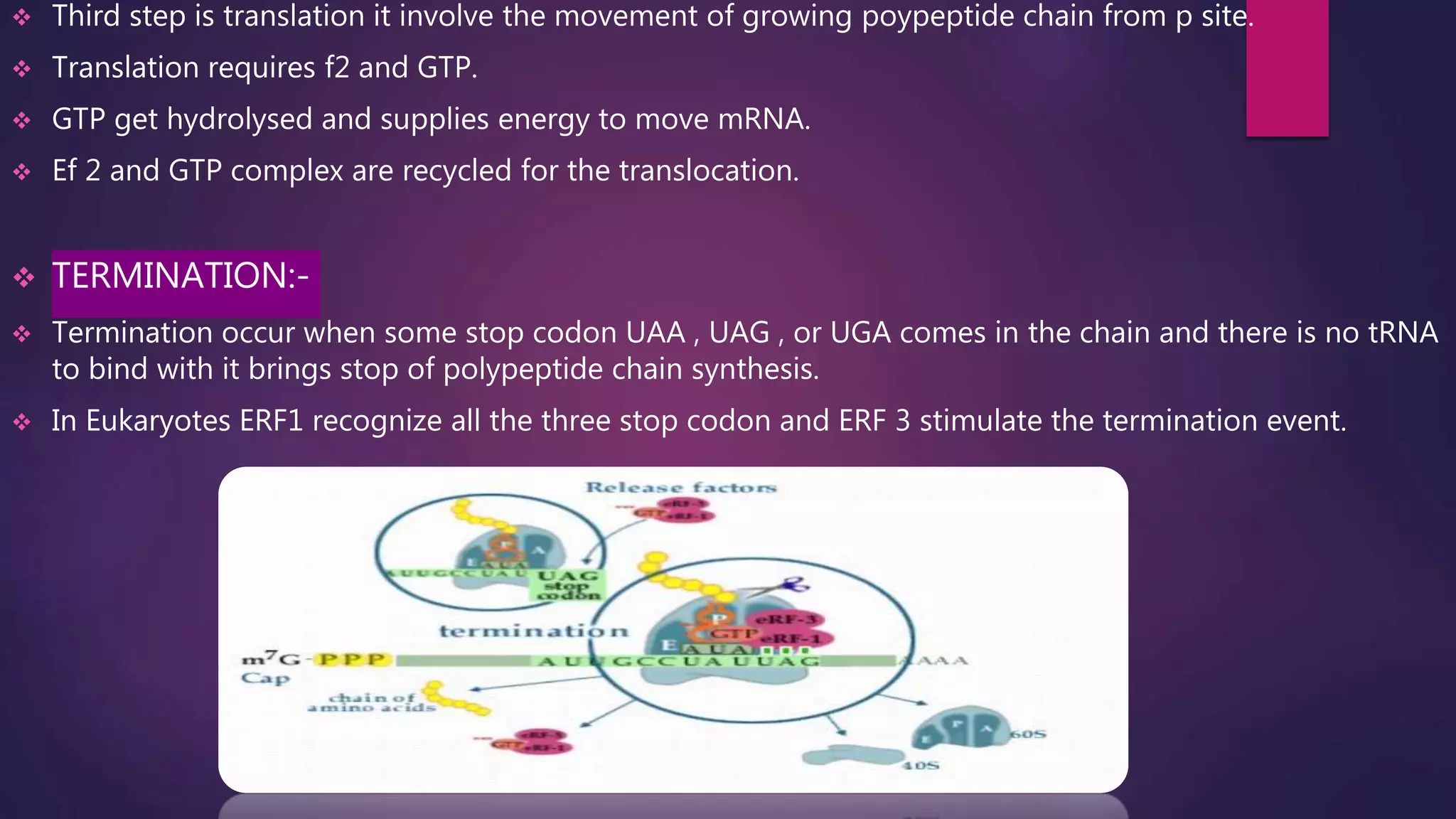
 Termination occur when some stop codon UAA , UAG , or UGA comes in the chain and there is no tRNA
to bind with it brings stop of polypeptide chain synthesis.
 In Eukaryotes ERF1 recognize all the three stop codon and ERF 3 stimulate the termination event.
 REGULATION OF TRANSLATION
 Gene expression is regulated not only on the transcription level but it is also regulated in translation
level.
 One advantage of control of translation over transcription is the ability to respond very rapidly to
external a stimuli.
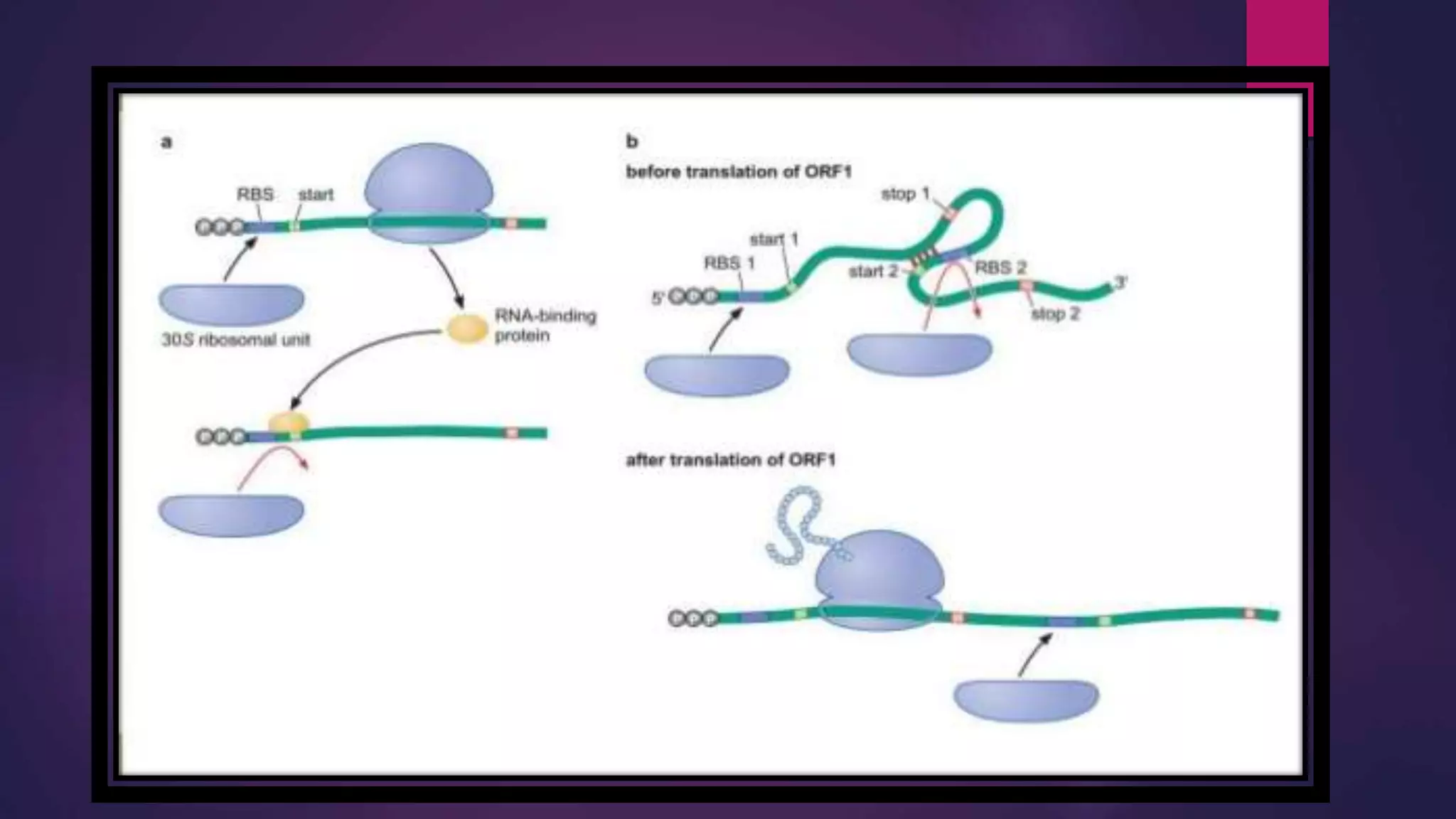
 As with other type of regulation , translation control typically function at the level of Intiation.
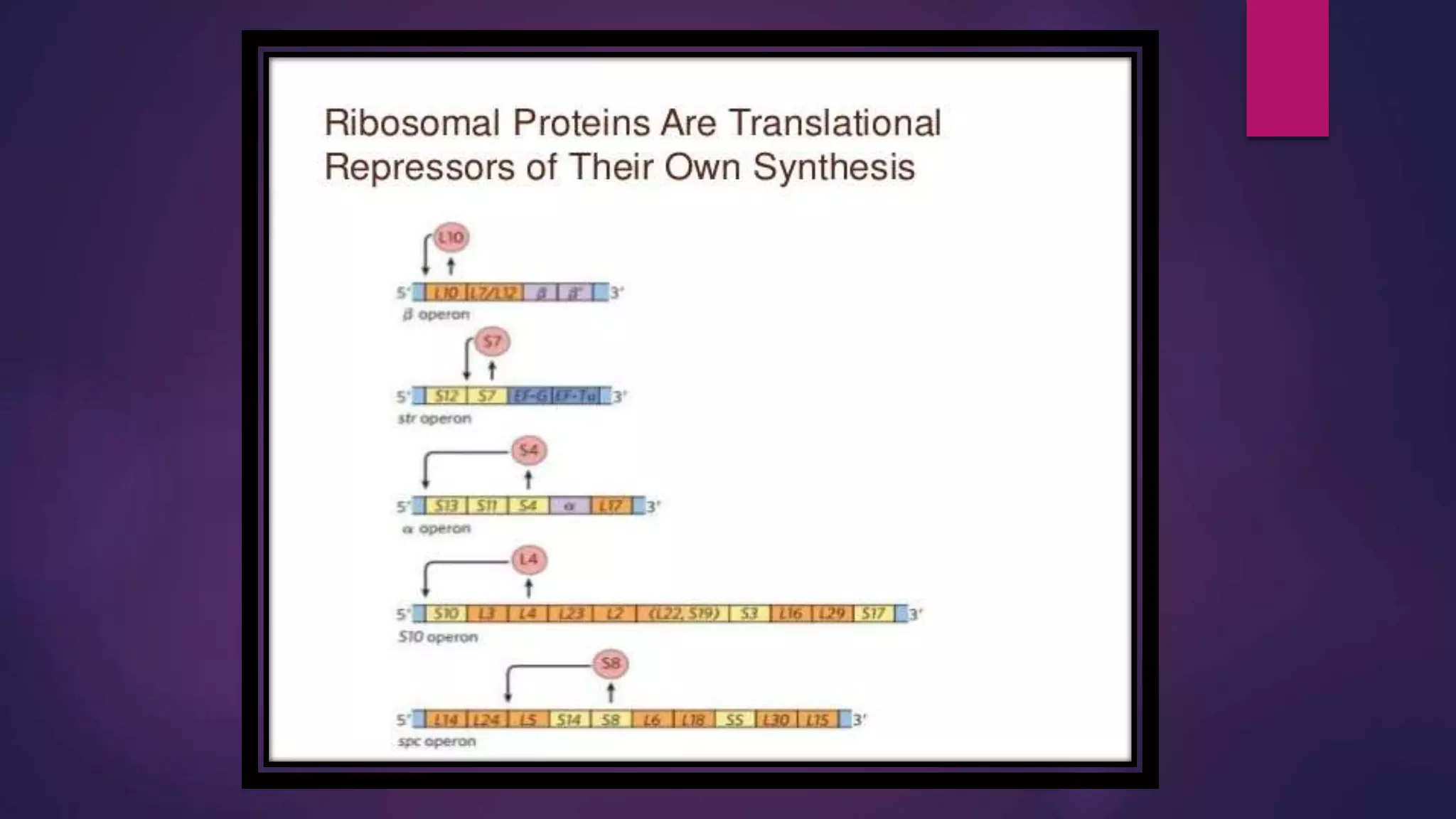
 Protein or RNA binding near the ribosome – Binding Site.
 Negatively Regulates bacterical Translation Initiation .
STRINGENT RESPONSE IN E.COLI
 Binding of an unchanged
tRNA to the A-Site.
 Binding of ReAa to the
30S subunit.
 Synthesis of ppGpp.
Downregulation/inhibition of
Transcription .
 When bacteria are starved of nutrients
Its immideatly shut down transcription
This is called stringent response.
 Total RNA synthesis is reduced to 10%of
Its normal level.
 Usually nucleotides to like ppGpp and
ppGpp accumulate or it inhibit transcription
 Process as there not RNA bind with this nucleotide.
 Riboswitch mechanisms
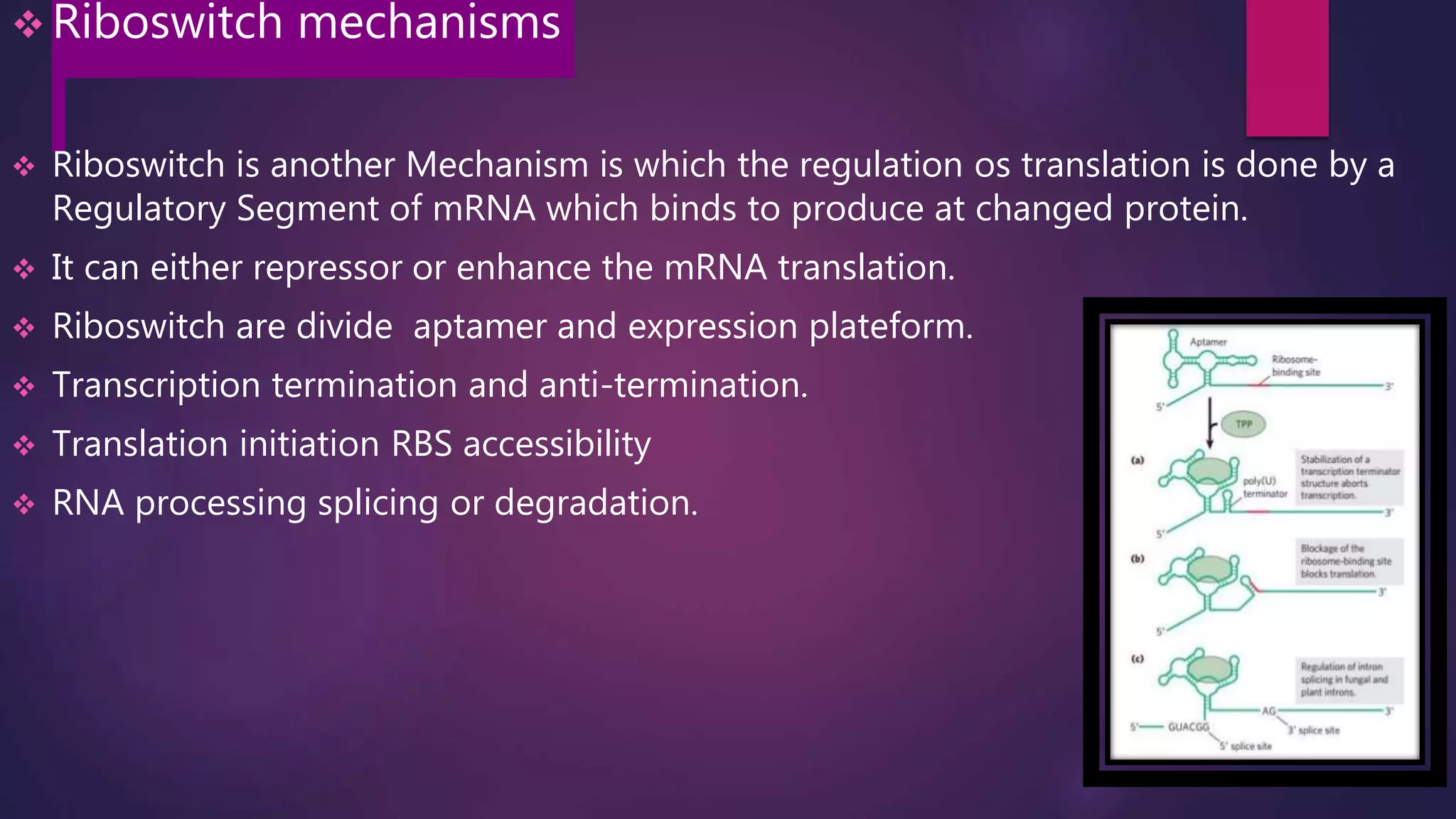
 Riboswitch is another Mechanism is which the regulation os translation is done by a
Regulatory Segment of mRNA which binds to produce at changed protein.
 It can either repressor or enhance the mRNA translation.
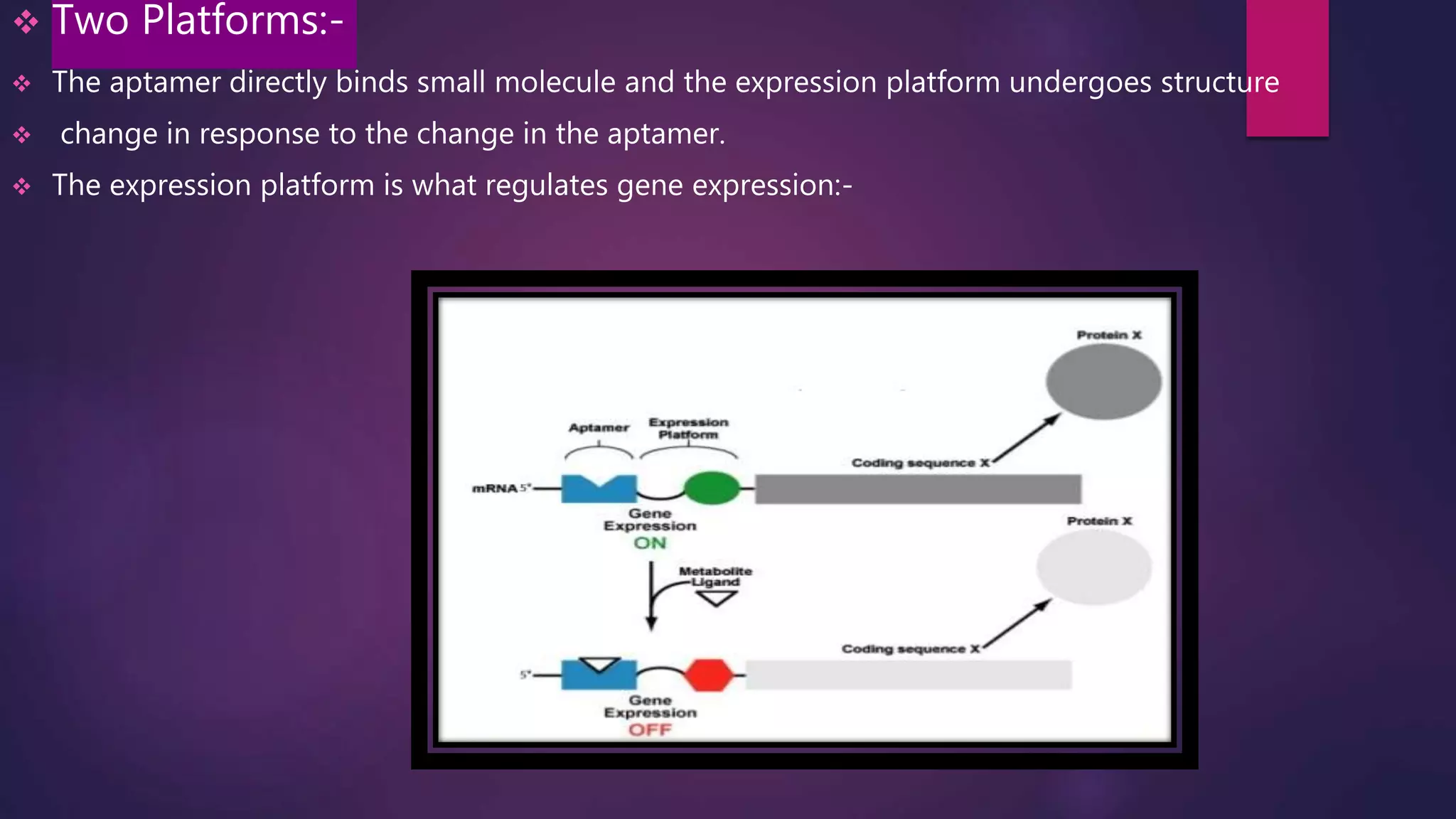
 Riboswitch are divide aptamer and expression plateform.
 Transcription termination and anti-termination.
 Translation initiation RBS accessibility
 RNA processing splicing or degradation.
 Two Platforms:-
 The aptamer directly binds small molecule and the expression platform undergoes structure
 change in response to the change in the aptamer.
 The expression platform is what regulates gene expression:-
 Glucosamione – 6 – Phosphate Riboswitch:-
 RNA Mediated repression

POST TRANSLATIONAL MODIFICATION
 Post translational modification are the chemical modification of protein after its translation.
 TYPES OF POST TRANSLATIONAL MODIFICATION
1.Phosphorylation
2.Glycosylation
3.Ubiqitation
4.S – Nitrosylation
5.Methylation
6.N-acetylation
7.Lipidation
8.Protiolysis
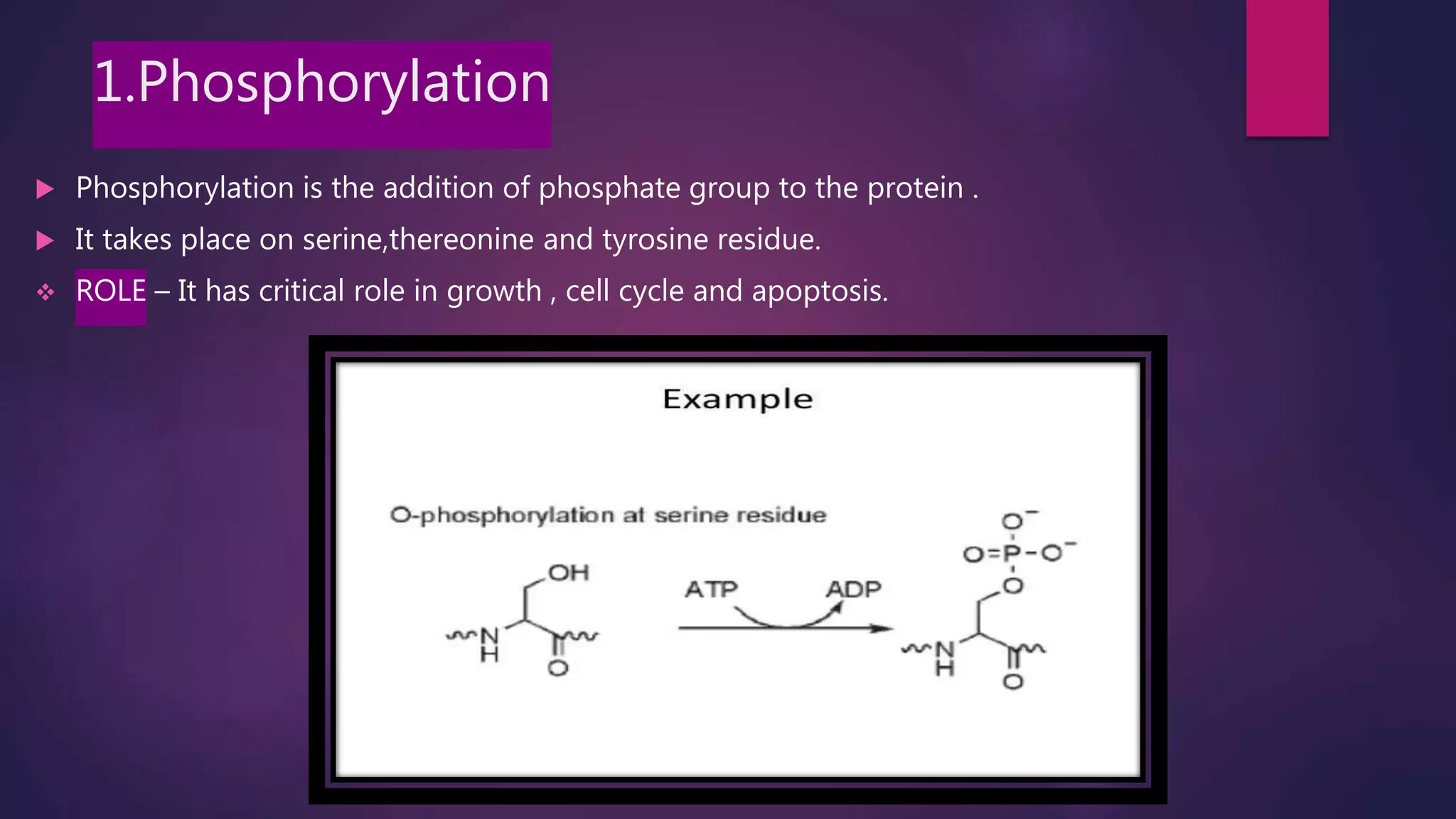
1.Phosphorylation
 Phosphorylation is the addition of phosphate group to the protein .
 It takes place on serine,thereonine and tyrosine residue.
 ROLE – It has critical role in growth , cell cycle and apoptosis.
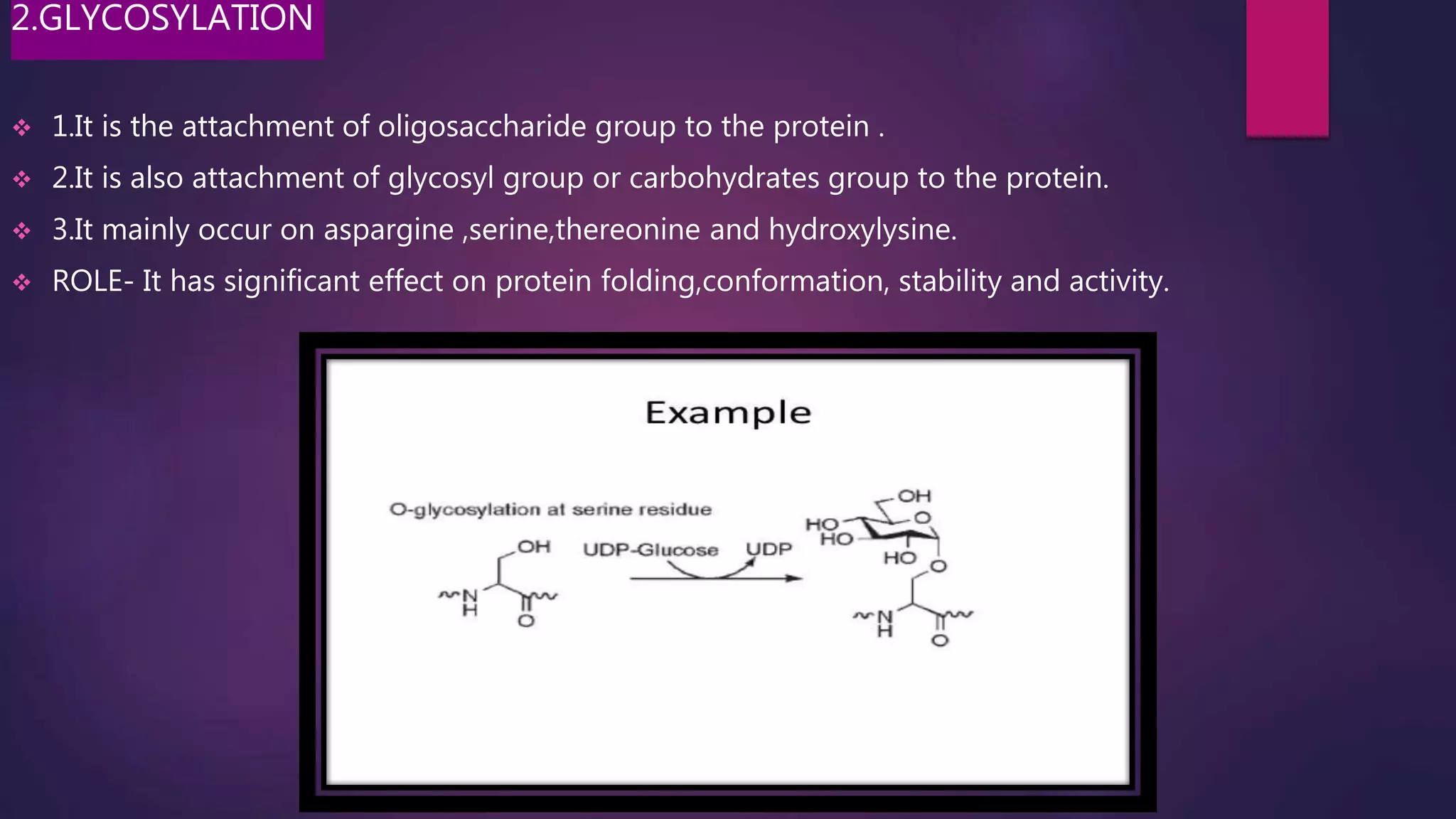
2.GLYCOSYLATION
 1.It is the attachment of oligosaccharide group to the protein .
 2.It is also attachment of glycosyl group or carbohydrates group to the protein.
 3.It mainly occur on aspargine ,serine,thereonine and hydroxylysine.
 ROLE- It has significant effect on protein folding,conformation, stability and activity.
 TYPE OF GLYCANS :
 N - linked glycans : Attachment to nitrogen of aspargine or arginine side chain.
 O – linked glycans : These are attachment to the hydroxy oxygen of serine and thereonine.
 Phosphoglycan are linked through the phosphate group of serine.
 C linked glycans: Are rarer formed .
 Sugar is added to the carbon on tryptophane side chain.
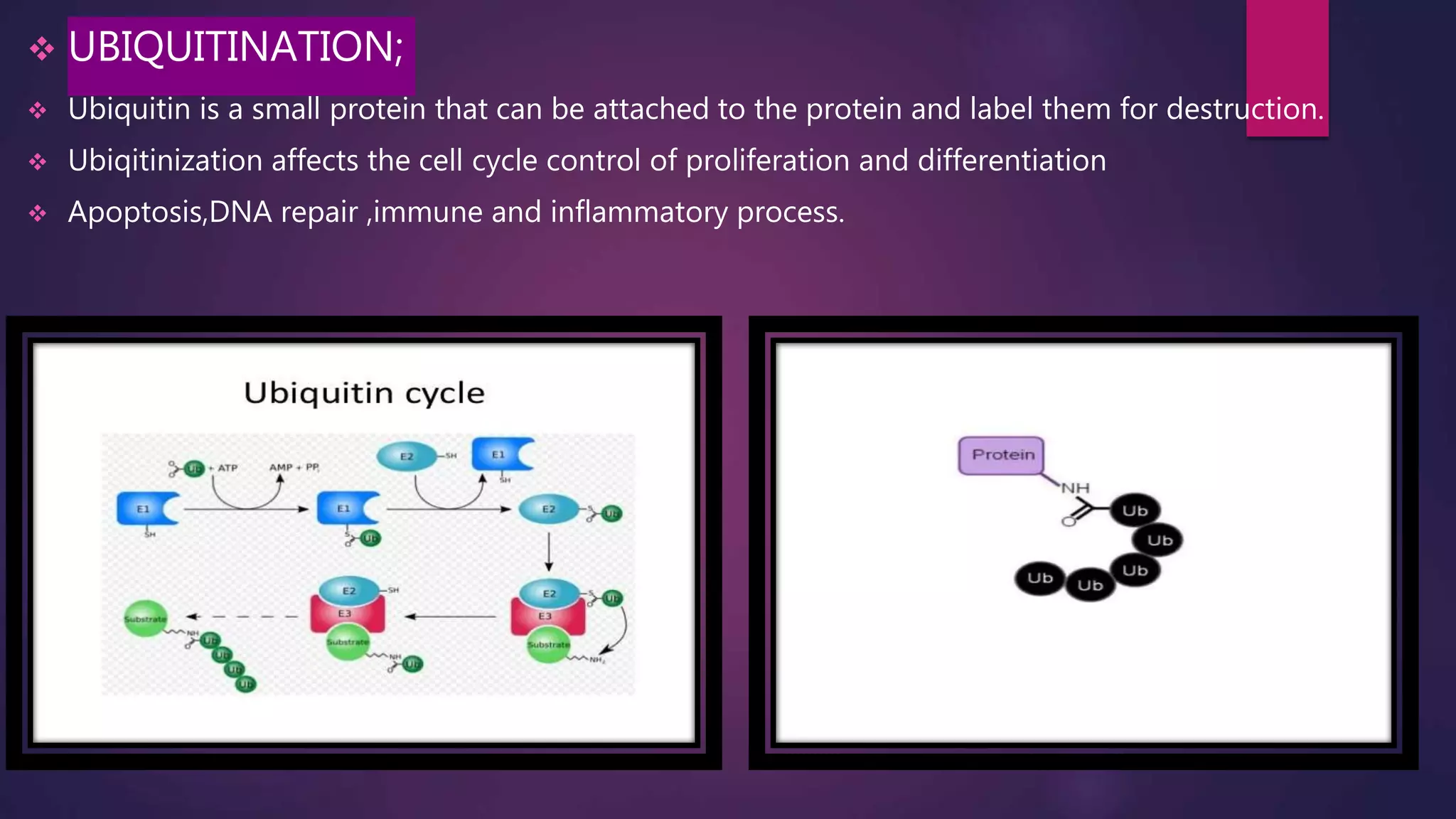
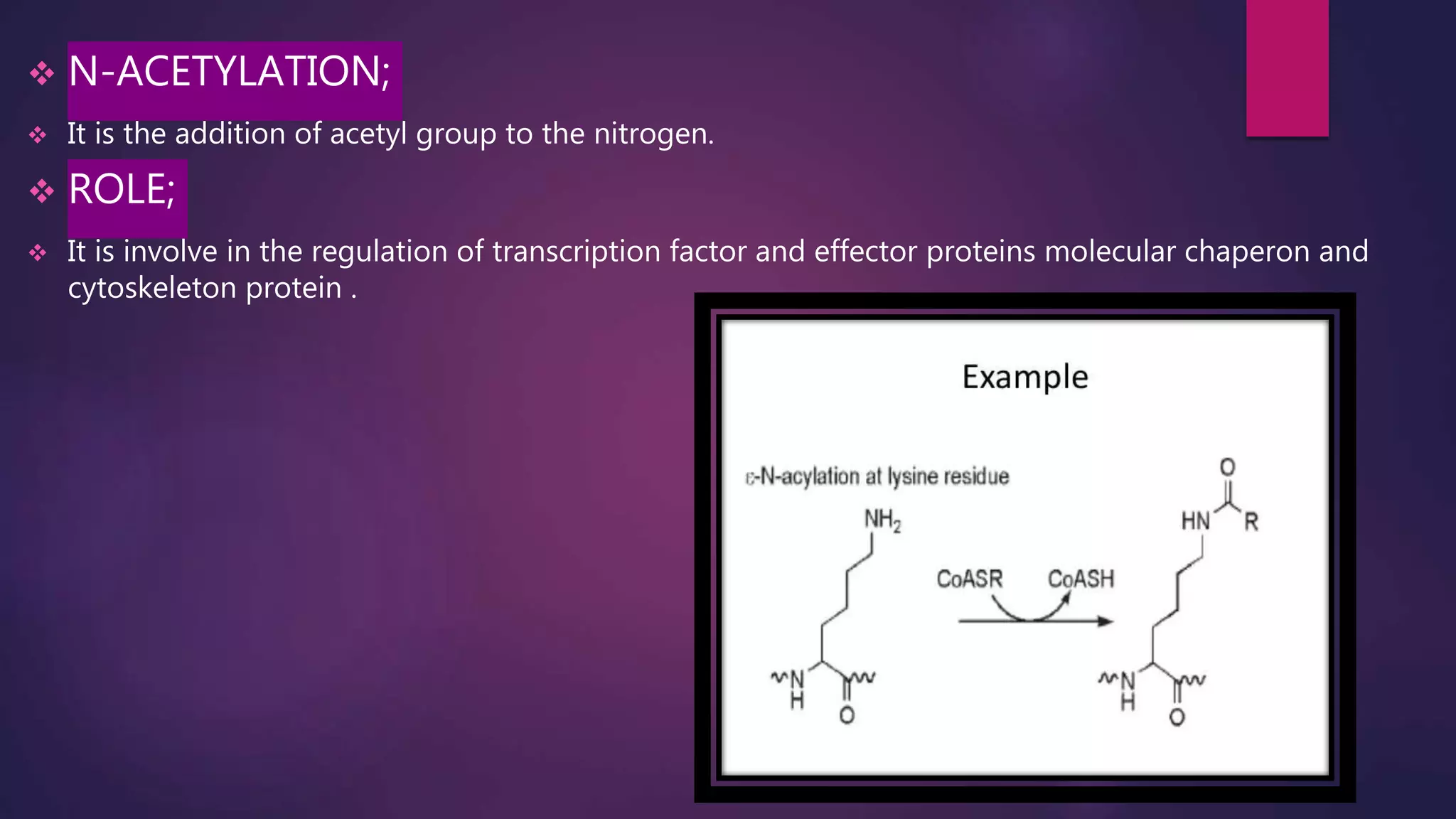
 UBIQUITINATION;
 Ubiquitin is a small protein that can be attached to the protein and label them for destruction.
 Ubiqitinization affects the cell cycle control of proliferation and differentiation
 Apoptosis,DNA repair ,immune and inflammatory process.
 S-nitrosylation
 Nitrosyl group and NO is added to the protein .
 It is used by cell to stabilize protein and regulate gene expression.
ALKYLATION/ METHYLATION
 It is the addition of methyl group of the protein usually with arginine or lysine residue.
 Methyl donar is the adenosylmethonine .
 The enzyme used in the process methyl transferase.
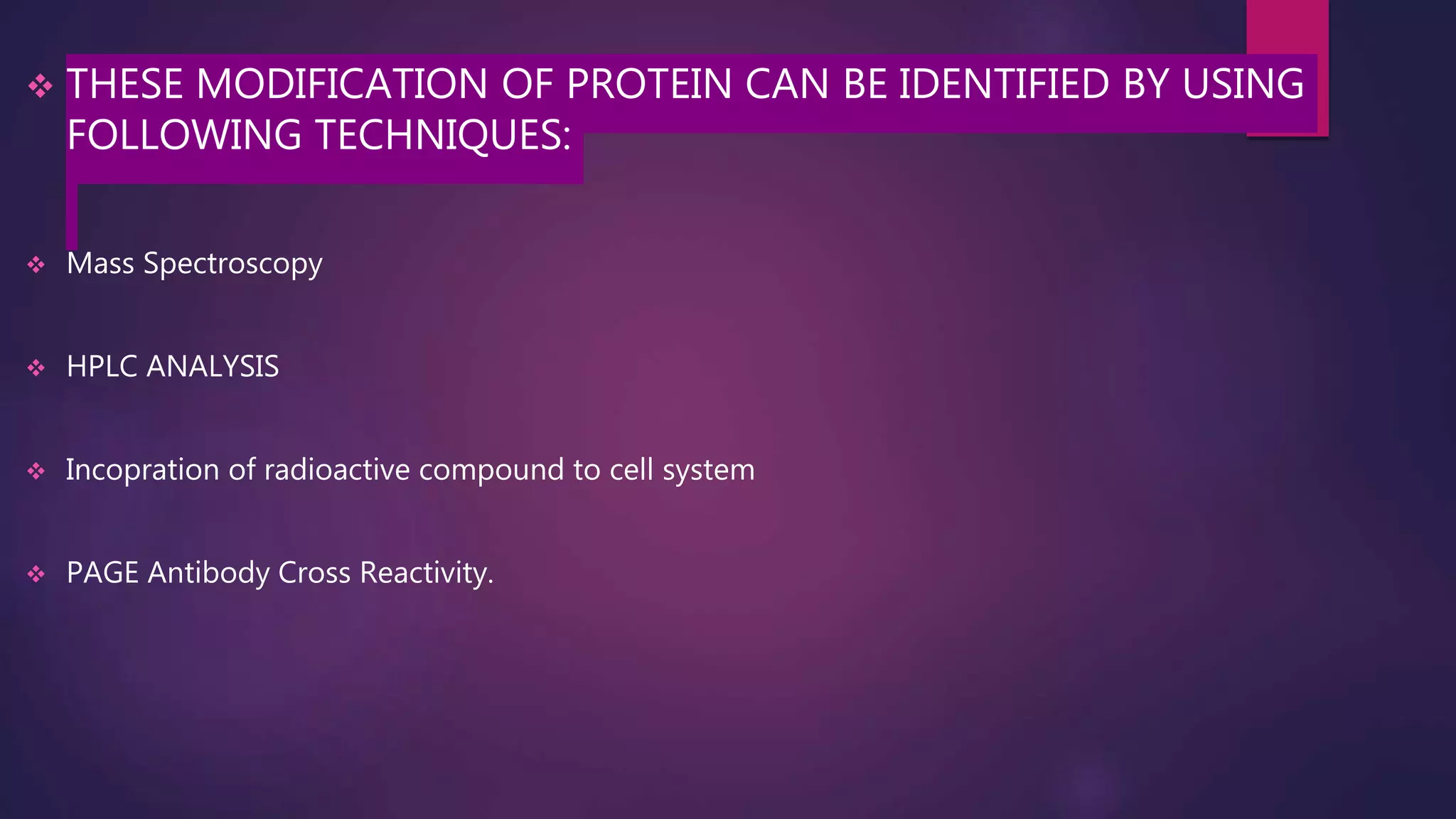
 N-ACETYLATION;
 It is the addition of acetyl group to the nitrogen.
 ROLE;
 It is involve in the regulation of transcription factor and effector proteins molecular chaperon and
cytoskeleton protein .
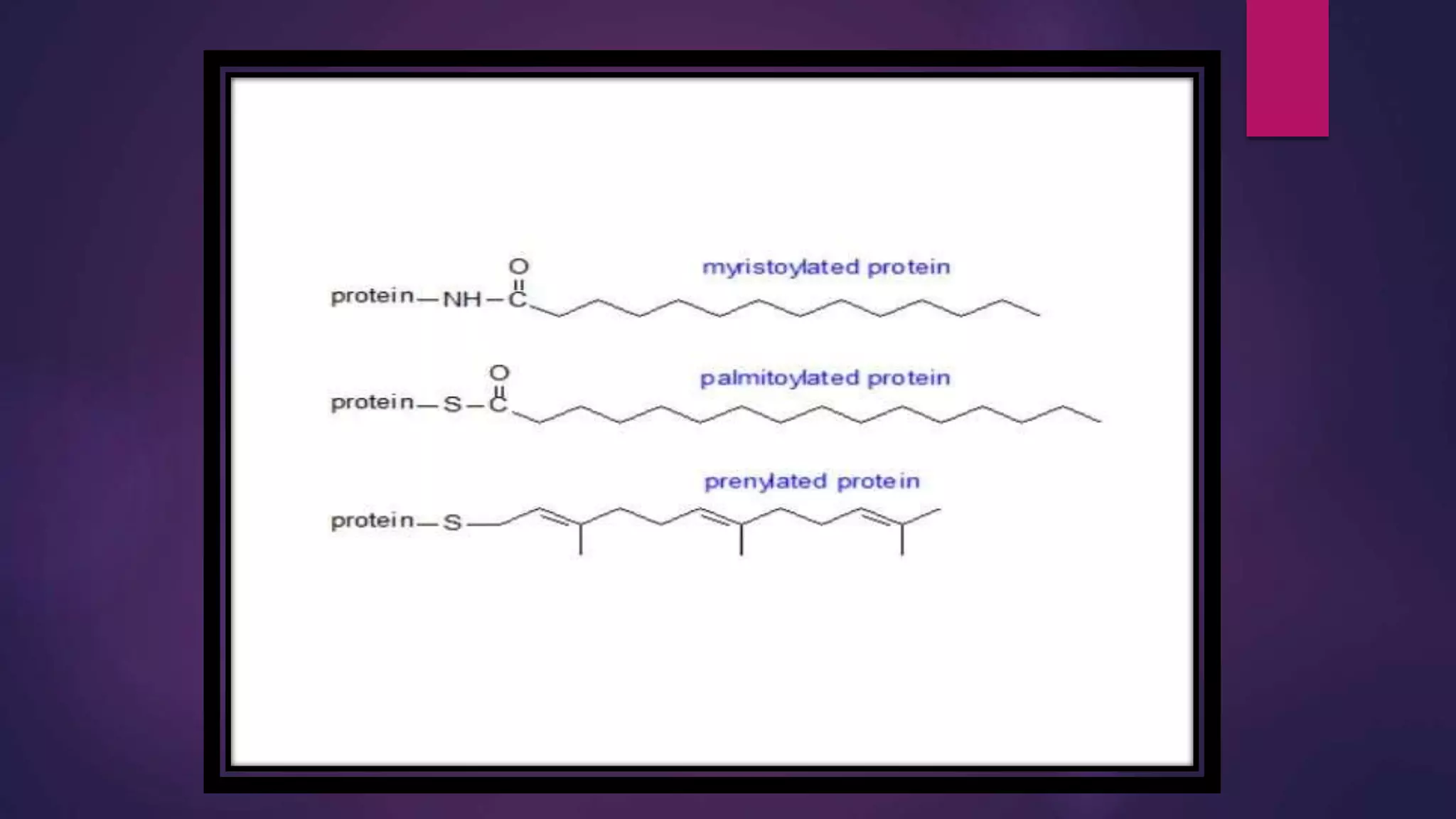
 LIPIDATION
 It is the attachment of lipid group such as fatty acid covalently to the protein.
 Lipidation helps in cellular localization and targeting signals and transfer of signal
 Through membrane protein.
 TYPES OF LIPIDADATION:
 C-terminal glycosylphosphaticinositol (GPI)
 N-terminal myristylation
 S-Palmitolyation
 S-Prenylation
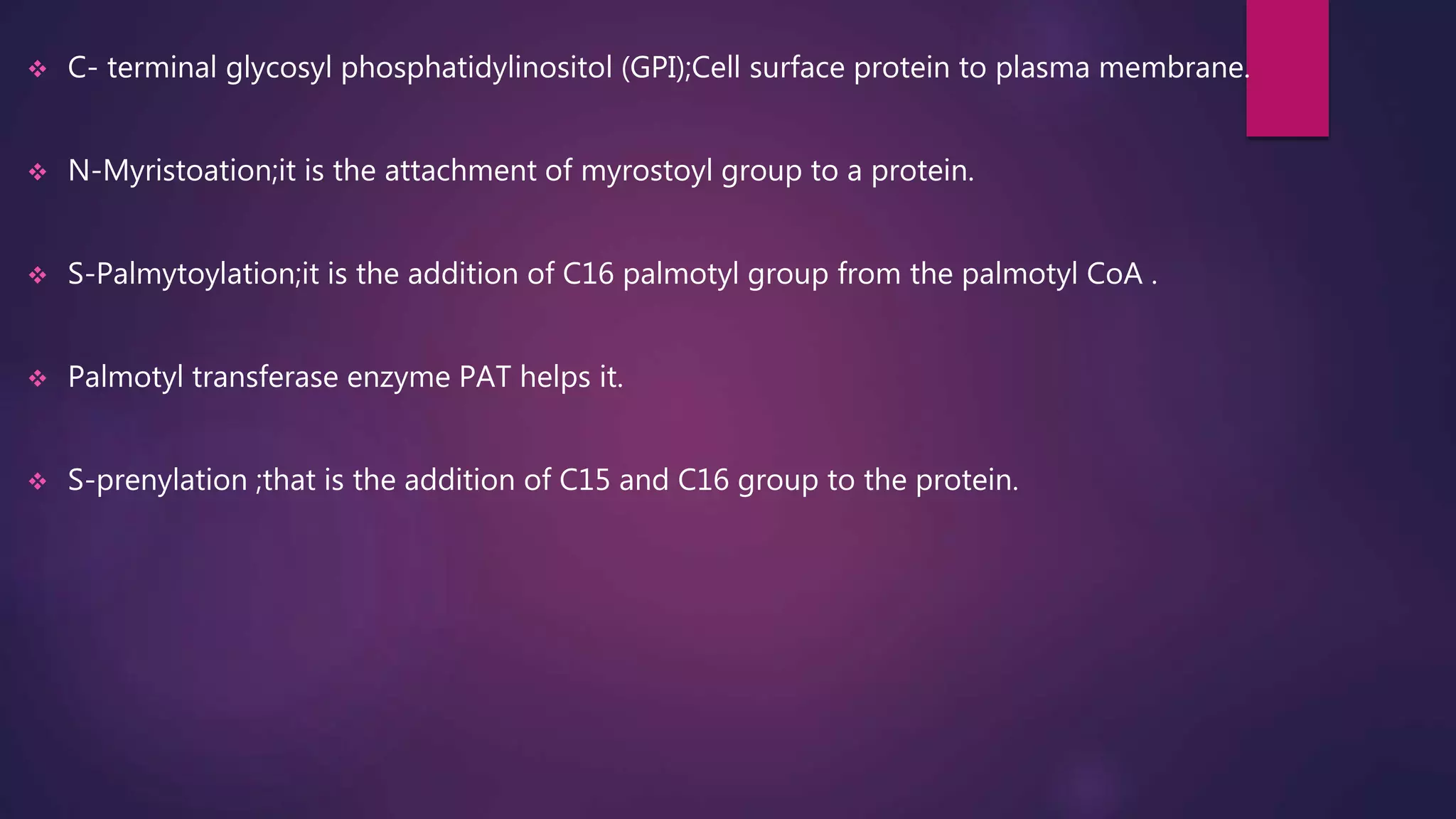
 C- terminal glycosyl phosphatidylinositol (GPI);Cell surface protein to plasma membrane.
 N-Myristoation;it is the attachment of myrostoyl group to a protein.
 S-Palmytoylation;it is the addition of C16 palmotyl group from the palmotyl CoA .
 Palmotyl transferase enzyme PAT helps it.
 S-prenylation ;that is the addition of C15 and C16 group to the protein.
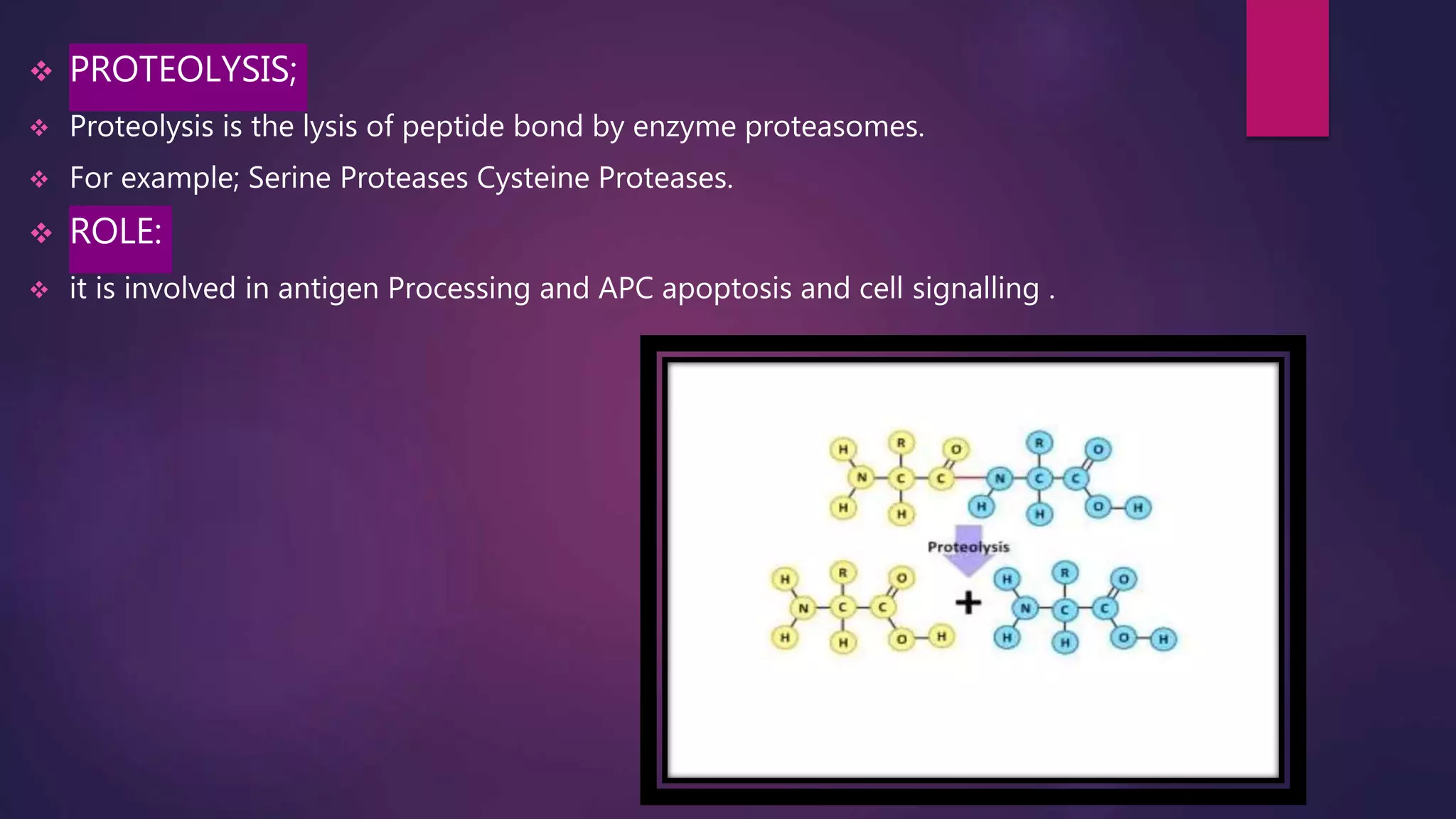
 PROTEOLYSIS;
 Proteolysis is the lysis of peptide bond by enzyme proteasomes.
 For example; Serine Proteases Cysteine Proteases.
 ROLE:
 it is involved in antigen Processing and APC apoptosis and cell signalling .
 THESE MODIFICATION OF PROTEIN CAN BE IDENTIFIED BY USING
FOLLOWING TECHNIQUES:
 Mass Spectroscopy
 HPLC ANALYSIS
 Incopration of radioactive compound to cell system
 PAGE Antibody Cross Reactivity.
 REFERENCES:
 Benjamin lewin (GENE VIII)
 Translation ncbi.com
 Translation .google.com
 Watson molecular Biology Of Gene.

Translation in prokaryotes and eukaryotes

  • 1.
    TOPIC : TRANSLATION SUBMITTEDTO: DR.JAGRITI SHARMA SUBMITTED BY : ANUSHIKA SHARMA MSC. MICROBIOLOGY II SEMESTER
  • 2.
    SUB T0PIC  Introductionof Translation  Component of Translation  TRANSLATION IN PROKARTOTES  Initation  Elongation  Termination  TRANSLATION IN EUKARYOTES  Initation  Elongation  Termination TOPIC TRANSLATION
  • 3.
     REGULATION OFTRANSLATION  INTRODUCTION  Mechanism of Regulation of Translation  Riboswitch Mechanism  Various other pathway of Regulation of Translational  Post translational modification:  INTRODUCTION  Types of the post translational modification  Technique to seen post translational modification  REFERENCES
  • 4.
     TRANSLATION : INTRODUCTION :  THE GENETIC INFORMATION CONTAINED WITH THE ORDER OF NUCLEODIDES IN THE MESSENGER RNA  (MRNA) IS USED TO GENERATE THE LINEAR SEQUENCE OF AMINO ACIDS IN PROTEINS.  THESE LINEAR OF AMINO ACIDS ARE FURTHER PROCESSED AND , MODIFIED.  OR TRANSLATIOCHAINSN IS A PROCESS BY WHICH PROTEIN IS SYNTHESIZED AT RIBOSOMAL SITE UPON  MRNA TEMPLATE. THE BLUE PRINT OF WHICH IS IN DNA CODING.  IN THIS PREOCESS MRNA IS DECODE TO FORMA PARTICULAR POLYPEPTIDE.  TRANSLATION PROCESS OCCURS ININ CYTOSOL REQUIRES THE INVOLVMENT OF PROTEINS.  SYNTHESIS UNIT-RIBOSOME,MRNA,TRNA,AMINO ACIDS, AMINOACYL-RNA SYNTHASE AND  SEVERAL OTHER PROTEINS.
  • 5.
    COMPONENT OF TRANSLATION –BINDING SITE FOR FIRST(AMINOACYLATED TRNA.)  2.P-SITE – BINDING SITE FOR THE (PEPTIDYL TRNA).  3.E-SITE – BINDING SITE tRNA –STRUCTURE AND AMINO ACID COMPOITION.  THE RIBOSOMES – THESE ARE MACRO MOLECULAR COMPLEX THAT DIRECT THE SYNTHESIS OF PROTEINS.  EACH RIBOSOMES HAVING 2 RIBOSOMAL SUBUNITS (LARGER AND SMALLER).  RIBOSOMES t-RNA BINDING SIDE ------  1.A-SITE FOR THE (UNCHANGED TRNA).  PROKARYOTIC RIBOSOMAL AND COMPONENTS.  EUKARYOTIC RIBOSMAL AND COMPONENTS.  FUNCTION OF RIBOSOMAL UNITS.
  • 6.
    MRNA AND GENETICCODE  FEATURES OF PROKARYOTIC AND EUKARYOTIC MRNA.  THE GENETIC CODE AND ITS FEATURE.  WOBBLING AND GENETIC CODE.  AMINO ACID ACTIVATION AND TRNA LOADING.  SPECIFICITY AND TIDELITY OF AMINO ACYLATION REACTION.  PROTEIN SYNTHESIS IN PROKARYOTES.  THE INTIATION COMPLEX AND INTIATION FACTORS.  INTIATION ELONGATION AND TRANSLATION.  TERMINATION OF TRANSLATION.  ANTIBIOTICS AND PROKARYOTIC PROTEIN SYNTHESIS.
  • 7.
    EUKARYOTIC TRANSLATION  EUKARYOTICINTIATION FACTORS AND INTIATION.  COMPLEX INTIATION , ELONGATION,TERMINATION mg2t IONS ARE ALSO REQUIRED IN TRANSLATION.  PROKARYOTIC RIBOSOME *EUKARYOTIC RIBOSOME  AMINOACYL TRNA SYNTHASE------  ONE SYNTHASE FOR AMINO ACID A SINGLE SYNTHASE MAY RECOGNISE MULTIPLE TRNAs OR THE SAME AMINO ACID.
  • 8.
    TWO CLASSES OFSYNTHASE  CLASS1- MONOMERIC ,ACYLATE THE 2’ON THE  TERMINAL RIBOSE.  Arg , cys , gln , glu , iie , ler , met , trp , tyr , val.  CLASS 2 – DINERIC , ACYLATES THE  3’-ON ON THE TERMINAL RIBOSE.  Ala , asn , asp , gly , his , lys , phe , ser, pro , thr .
  • 9.
    Translation in prokaryotes INITIATION  tRNA CHARGING  Addition of adenylated amino acid to trna to make it active or charged .
  • 10.
     INITIATION PROCESS: Initiation require 3 factors known as the initiation factor IF1, IF2 and IF3.  In prokaryotes ribosome subunit 30S and 50S  IF3 complex:- It binds to the 30S ribosome small subunit and preventing the larger subunit binding to it without mRNA.  IF2 complex:- with GTP and IF1 bind to small subunit of ribosome.  Anticodon tRNA binds to this assembly by anticodon matching.  At this stage IF3 is released as its work to keep both subunit apart.  This is called 30S initiation complex.  50S subunit can bind to it by displacing its IF1 and IF2 and GTP is hydrolysed to release energy  this assembly is now called 70S Ribosome initiation complex
  • 12.
     ELONGATION : Elongation start after initiation it requires inititation complex and  certain elongation factor EF .  It mainly involve 3 factors EF-TU and EF-TS and EF-G.  EF-Tu is required to deliver the amino acid acyl tRNA to A site.  Energy is required in this process which comes from GTP , So this complex is EF-Tu GDP complex.  EF-TS is again convert it into EF-TU GTP complex.  This EF-TU GTP complex is available to bind with fresh amino acyl tRNA and deliver in to ribosome.  All type of tRNA expect initiated tRNA can bind with EF-Tu GTP complex.  Then, complex EF-g and GTP binding  Binding to ribosome and discharge tRNA moves from A to P side.  Now mRNA from one codon to another that is the elongation is EfG and GDP released and the new codon is available from vacant site.
  • 14.
    Termination:-  Termination occurwhen any stop codon occupies the A site.  STOP codon – UAA , UAG , UGA.  Termination factors involved – Rf1 , Rf2 , Rf3 , RRf.  Rf1 , Rf2 , Rf3 cause the hydrolysis to peptdyl tRNA bond.  These are called release factors.  Than , the polypeptide and lost unchanged tRNA is released from P site.  None of the 70s ribosome dissociated into each submit 5Os and 30s.  In Prokaryotes transcription and translation are coupled as sometimes translation is started the other end of the mRNA while it is being So there mRNA while it being synthesized so there is little or no requirement of Processing.
  • 15.
     TERMINATION INPROKARYOTES
  • 16.
     Translation ineukaryotes  Eukaryotic translation occur in Cytoplasm.  It can be divided into 3 parts:-  1) Initiation  2) Elongation  3) Termination  1)Initiation  Initiation is a complex process in case of Eukaryotes as compared to Prokaryotes.  Eukaryotes initiation involved to 10 initiation factor Elf.  These initation factors if are divided into three initiation group that is 43 pre initiation 48 initiation group and 80S initation group.  A ternary complex of met tRNA , Elf2 and GTP attached to 40s submit to make it a 43 pre initiation complex.  Elf1 and Elf3 stabilize this complex.
  • 17.
     48 Initiationcomplex:- The binding of mRNA to 43S initiation complex result into 48S initiation complex. 5’AUG is the initiation codon. 80s Initiation complex:- 48S initiation complex binds to 60S submit to from the 80S initiation complex. This binding requires energy which comes from hydrolysis of GTP , after the binding 43S Initiation complex is released.
  • 19.
    3) Elongation:-  Elongationis a process in which one by one Amino acid at it as per the anti codon , codon matching between tRNA and mRNA.  Elongation involves certain EF factors.  Elongation can be divided into 3 sub stages:-  Binding of amino acid tRNA at A site peptide bond formation and translation  80s initiation complex has met tRNA with P site and A site is free.  So another amino acyl tRNA is placed at a A site it require EF 1a and GTP.  Then New aminoacyl tRNA is places at A site EF 1a and GDP are set free for recycle.  Second step Peptide bond formation :-  Peptdyl transferase catalyses the formation peptide bond.  This result in the attachment of growing polypetide chain to the A site.
  • 21.
     Third stepis translation it involve the movement of growing poypeptide chain from p site.  Translation requires f2 and GTP.  GTP get hydrolysed and supplies energy to move mRNA.  Ef 2 and GTP complex are recycled for the translocation.  TERMINATION:-  Termination occur when some stop codon UAA , UAG , or UGA comes in the chain and there is no tRNA to bind with it brings stop of polypeptide chain synthesis.  In Eukaryotes ERF1 recognize all the three stop codon and ERF 3 stimulate the termination event.
  • 22.
     REGULATION OFTRANSLATION  Gene expression is regulated not only on the transcription level but it is also regulated in translation level.  One advantage of control of translation over transcription is the ability to respond very rapidly to external a stimuli.  As with other type of regulation , translation control typically function at the level of Intiation.  Protein or RNA binding near the ribosome – Binding Site.  Negatively Regulates bacterical Translation Initiation .
  • 25.
    STRINGENT RESPONSE INE.COLI  Binding of an unchanged tRNA to the A-Site.  Binding of ReAa to the 30S subunit.  Synthesis of ppGpp. Downregulation/inhibition of Transcription .  When bacteria are starved of nutrients Its immideatly shut down transcription This is called stringent response.  Total RNA synthesis is reduced to 10%of Its normal level.  Usually nucleotides to like ppGpp and ppGpp accumulate or it inhibit transcription  Process as there not RNA bind with this nucleotide.
  • 26.
     Riboswitch mechanisms Riboswitch is another Mechanism is which the regulation os translation is done by a Regulatory Segment of mRNA which binds to produce at changed protein.  It can either repressor or enhance the mRNA translation.  Riboswitch are divide aptamer and expression plateform.  Transcription termination and anti-termination.  Translation initiation RBS accessibility  RNA processing splicing or degradation.
  • 27.
     Two Platforms:- The aptamer directly binds small molecule and the expression platform undergoes structure  change in response to the change in the aptamer.  The expression platform is what regulates gene expression:-
  • 28.
     Glucosamione –6 – Phosphate Riboswitch:-  RNA Mediated repression
  • 29.
     POST TRANSLATIONAL MODIFICATION Post translational modification are the chemical modification of protein after its translation.  TYPES OF POST TRANSLATIONAL MODIFICATION 1.Phosphorylation 2.Glycosylation 3.Ubiqitation 4.S – Nitrosylation 5.Methylation 6.N-acetylation 7.Lipidation 8.Protiolysis
  • 30.
    1.Phosphorylation  Phosphorylation isthe addition of phosphate group to the protein .  It takes place on serine,thereonine and tyrosine residue.  ROLE – It has critical role in growth , cell cycle and apoptosis.
  • 31.
    2.GLYCOSYLATION  1.It isthe attachment of oligosaccharide group to the protein .  2.It is also attachment of glycosyl group or carbohydrates group to the protein.  3.It mainly occur on aspargine ,serine,thereonine and hydroxylysine.  ROLE- It has significant effect on protein folding,conformation, stability and activity.
  • 32.
     TYPE OFGLYCANS :  N - linked glycans : Attachment to nitrogen of aspargine or arginine side chain.  O – linked glycans : These are attachment to the hydroxy oxygen of serine and thereonine.  Phosphoglycan are linked through the phosphate group of serine.  C linked glycans: Are rarer formed .  Sugar is added to the carbon on tryptophane side chain.
  • 33.
     UBIQUITINATION;  Ubiquitinis a small protein that can be attached to the protein and label them for destruction.  Ubiqitinization affects the cell cycle control of proliferation and differentiation  Apoptosis,DNA repair ,immune and inflammatory process.
  • 34.
     S-nitrosylation  Nitrosylgroup and NO is added to the protein .  It is used by cell to stabilize protein and regulate gene expression. ALKYLATION/ METHYLATION  It is the addition of methyl group of the protein usually with arginine or lysine residue.  Methyl donar is the adenosylmethonine .  The enzyme used in the process methyl transferase.
  • 35.
     N-ACETYLATION;  Itis the addition of acetyl group to the nitrogen.  ROLE;  It is involve in the regulation of transcription factor and effector proteins molecular chaperon and cytoskeleton protein .
  • 36.
     LIPIDATION  Itis the attachment of lipid group such as fatty acid covalently to the protein.  Lipidation helps in cellular localization and targeting signals and transfer of signal  Through membrane protein.  TYPES OF LIPIDADATION:  C-terminal glycosylphosphaticinositol (GPI)  N-terminal myristylation  S-Palmitolyation  S-Prenylation
  • 38.
     C- terminalglycosyl phosphatidylinositol (GPI);Cell surface protein to plasma membrane.  N-Myristoation;it is the attachment of myrostoyl group to a protein.  S-Palmytoylation;it is the addition of C16 palmotyl group from the palmotyl CoA .  Palmotyl transferase enzyme PAT helps it.  S-prenylation ;that is the addition of C15 and C16 group to the protein.
  • 39.
     PROTEOLYSIS;  Proteolysisis the lysis of peptide bond by enzyme proteasomes.  For example; Serine Proteases Cysteine Proteases.  ROLE:  it is involved in antigen Processing and APC apoptosis and cell signalling .
  • 40.
     THESE MODIFICATIONOF PROTEIN CAN BE IDENTIFIED BY USING FOLLOWING TECHNIQUES:  Mass Spectroscopy  HPLC ANALYSIS  Incopration of radioactive compound to cell system  PAGE Antibody Cross Reactivity.
  • 41.
     REFERENCES:  Benjaminlewin (GENE VIII)  Translation ncbi.com  Translation .google.com  Watson molecular Biology Of Gene.