A L L Y O U
N E E D T O
K N O W
A B O U T
V E R B S
L E R A T O N O S I P H O
N D W A N D W E
M E A N I N G O F V E R B
A verb is a doing
word.
It describes
actions
It shows
possession
It denotes being
also(The verbs to
be are – is, am
,are, was, were)
Transitive Verb
• Transitive Verb- A verb that requires an
object to complete its meaning, is called
a Transitive Verb.
• Examples
• My mother washes clothes.
• Alice made a doll.
Intransitive Verb
• Intransitive Verb- A verb that doesn't
require an object to complete its
meaning.
• Examples
• The baby slept.
• The girl smiled.
K I N D S O F V E R B S
T R A N S I T I V E V E R B A N D
I N T R A N S I T I V E V E R B
Transitive Verbs
are action verbs
that have an
object to
receive that
action.
I bake some
cookies
I ride the
bicycle
I move the chair
• Intransitive Verbs are action verbs but
unlike Transitive Verbs they do not have
an object receiving the action
• I laugh
• I cry
• The book falls
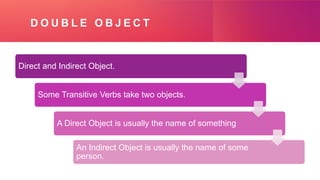
D O U B L E O B J E C T
Direct and Indirect Object.
Some Transitive Verbs take two objects.
A Direct Object is usually the name of something
An Indirect Object is usually the name of some
person.
E X A M P L E S
• Roshan gave his friend a video game.
• She gave a rupee to him
• Danish told us a funny story
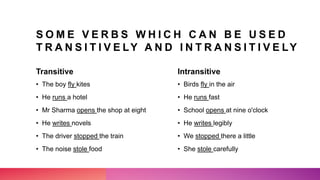
Transitive
• The boy fly kites
• He runs a hotel
• Mr Sharma opens the shop at eight
• He writes novels
• The driver stopped the train
• The noise stole food
Intransitive
• Birds fly in the air
• He runs fast
• School opens at nine o'clock
• He writes legibly
• We stopped there a little
• She stole carefully
S O M E V E R B S W H I C H C A N B E U S E D
T R A N S I T I V E LY A N D I N T R A N S I T I V E LY
V E R B T O B E
• Verb to be ( is, am ,are, was, were ,will,
be, shall be, appear, seem and look)
V E R B S O F
I N C O M P L E T E
P R E D I C T I O N
T H E Y N E E D O T H E R W O R D S O R A P H R A S E T O
C O M P L E T E T H E I R M E A N I N G . I T I S C A L L E D
C O M P L E M E M T .
A
C O M P L E M E N T
C O M P L E T E S
T H E
P R E D I C AT E
E X A M P L E S
The dog is (what?) an animal. ( C)
E X A M P L E S C O N T.
The man
seems (what?)
tired. ©
He became
(what?) a
hero. ©
M A I N P A R T S
O F V E R B
1. The Present Tense
2. The Past Tense
3. The Future Tense.
E X A M P L E S
P R E S E N T
• Emma asks questions all the time.
PA S T
Emma asked questions all the time.
F U T U R E
• Emma will ask questions all the time.
From nouns
Bath – Bathe
Breath – Breathe
Food – Feed
Action – Act
Belief – Believe
Death - Die
From adjectives
 Able – Enable
 Deep – Deepen
 New – Renew
 Active – Act
 Cheerful – Cheer
 Hopeful - Hope
F O R M AT I O N O F V E R B S
V E R B S
S O M E P R E F I X E S A N D
S U F F I X E S C A N A R R A N G E
W O R D S I N T O V E R B S
P R E F I X E S
1. Able - Enable • 2. Courage – Encourage
P R E F I X E S C O N T.
3. JOY – ENJOY 4. DANGER –
ENDANGER
P R E F I X E S
5. List – enlist
6. Light – enlighten
7. Little – be little
Friend – be friend
S U F F I X E S
Broad – broaden
Wide – widen
Fright – frighten
S U F F I X E S
C O N T.
Bright – Brighten
Realise – realise
Critic – criticise
Just - justify
: : :
• Pure – purify
• Test - Testify
Clear - clarify
T Y P E S O F V E R B S
 Action Verbs
 Linking Verbs
 Helping Verbs
A C T I O N V E R B S
• An action verb tells what people or things can do.
• These are some action verbs
• - Play
• Write
• Scream
• Dance
• Pick
A C T I O N V E R B S C O N T.
• Ran
• Coughed
• Swallowed
• Ride
• Awake
L I N K I N G V E R B S
• Am
• Is
• Was
• Were
• Seem
V E R B P H R A S E S
• A phrase is a group of words
• A verb phrase is a verb that has more than one verb in it.
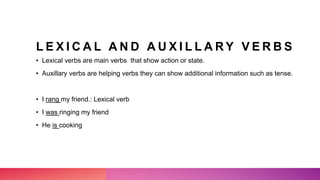
L E X I C A L A N D A U X I L L A R Y V E R B S
• Lexical verbs are main verbs that show action or state.
• Auxillary verbs are helping verbs they can show additional information such as tense.
• I rang my friend.: Lexical verb
• I was ringing my friend
• He is cooking
M A I N V E R B
• Every complete sentence must have a subject and a main verb.
Subject
• The topic of the sentence Who or What
the sentence is about.
• The subject is a noun or pronoun
Main Verb
• The verb in the sentence that shows
what the subject does, or shows what
state the subject is in. Example "Emily
us sad".
E X A M P L E S
R E F E R E N C E S
OHasija, S . ( 2014) All About Verbs. Available at https://www.slideshare.net/swatihasija All
about verbs( Accesssed 17 September 2021).
Soni, P. (2008)Action Verbs A project LA Activity.Available at
https://www.slideshare.net/kakasoni

Repurposed slides

  • 1.
    A L LY O U N E E D T O K N O W A B O U T V E R B S L E R A T O N O S I P H O N D W A N D W E
  • 2.
    M E AN I N G O F V E R B A verb is a doing word. It describes actions It shows possession It denotes being also(The verbs to be are – is, am ,are, was, were)
  • 3.
    Transitive Verb • TransitiveVerb- A verb that requires an object to complete its meaning, is called a Transitive Verb. • Examples • My mother washes clothes. • Alice made a doll. Intransitive Verb • Intransitive Verb- A verb that doesn't require an object to complete its meaning. • Examples • The baby slept. • The girl smiled. K I N D S O F V E R B S
  • 4.
    T R AN S I T I V E V E R B A N D I N T R A N S I T I V E V E R B Transitive Verbs are action verbs that have an object to receive that action. I bake some cookies I ride the bicycle I move the chair • Intransitive Verbs are action verbs but unlike Transitive Verbs they do not have an object receiving the action • I laugh • I cry • The book falls
  • 5.
    D O UB L E O B J E C T Direct and Indirect Object. Some Transitive Verbs take two objects. A Direct Object is usually the name of something An Indirect Object is usually the name of some person.
  • 6.
    E X AM P L E S • Roshan gave his friend a video game. • She gave a rupee to him • Danish told us a funny story
  • 7.
    Transitive • The boyfly kites • He runs a hotel • Mr Sharma opens the shop at eight • He writes novels • The driver stopped the train • The noise stole food Intransitive • Birds fly in the air • He runs fast • School opens at nine o'clock • He writes legibly • We stopped there a little • She stole carefully S O M E V E R B S W H I C H C A N B E U S E D T R A N S I T I V E LY A N D I N T R A N S I T I V E LY
  • 8.
    V E RB T O B E • Verb to be ( is, am ,are, was, were ,will, be, shall be, appear, seem and look)
  • 9.
    V E RB S O F I N C O M P L E T E P R E D I C T I O N T H E Y N E E D O T H E R W O R D S O R A P H R A S E T O C O M P L E T E T H E I R M E A N I N G . I T I S C A L L E D C O M P L E M E M T .
  • 10.
    A C O MP L E M E N T C O M P L E T E S T H E P R E D I C AT E
  • 11.
    E X AM P L E S The dog is (what?) an animal. ( C)
  • 12.
    E X AM P L E S C O N T. The man seems (what?) tired. © He became (what?) a hero. ©
  • 13.
    M A IN P A R T S O F V E R B 1. The Present Tense 2. The Past Tense 3. The Future Tense.
  • 14.
    E X AM P L E S
  • 15.
    P R ES E N T • Emma asks questions all the time.
  • 16.
    PA S T Emmaasked questions all the time.
  • 17.
    F U TU R E • Emma will ask questions all the time.
  • 18.
    From nouns Bath –Bathe Breath – Breathe Food – Feed Action – Act Belief – Believe Death - Die From adjectives  Able – Enable  Deep – Deepen  New – Renew  Active – Act  Cheerful – Cheer  Hopeful - Hope F O R M AT I O N O F V E R B S
  • 19.
    V E RB S S O M E P R E F I X E S A N D S U F F I X E S C A N A R R A N G E W O R D S I N T O V E R B S
  • 20.
    P R EF I X E S 1. Able - Enable • 2. Courage – Encourage
  • 21.
    P R EF I X E S C O N T. 3. JOY – ENJOY 4. DANGER – ENDANGER
  • 22.
    P R EF I X E S 5. List – enlist 6. Light – enlighten 7. Little – be little Friend – be friend
  • 23.
    S U FF I X E S Broad – broaden Wide – widen Fright – frighten
  • 24.
    S U FF I X E S C O N T. Bright – Brighten Realise – realise Critic – criticise Just - justify
  • 25.
    : : : •Pure – purify • Test - Testify Clear - clarify
  • 26.
    T Y PE S O F V E R B S  Action Verbs  Linking Verbs  Helping Verbs
  • 27.
    A C TI O N V E R B S • An action verb tells what people or things can do. • These are some action verbs • - Play • Write • Scream • Dance • Pick
  • 28.
    A C TI O N V E R B S C O N T. • Ran • Coughed • Swallowed • Ride • Awake
  • 29.
    L I NK I N G V E R B S • Am • Is • Was • Were • Seem
  • 30.
    V E RB P H R A S E S • A phrase is a group of words • A verb phrase is a verb that has more than one verb in it.
  • 31.
    L E XI C A L A N D A U X I L L A R Y V E R B S • Lexical verbs are main verbs that show action or state. • Auxillary verbs are helping verbs they can show additional information such as tense. • I rang my friend.: Lexical verb • I was ringing my friend • He is cooking
  • 32.
    M A IN V E R B • Every complete sentence must have a subject and a main verb.
  • 33.
    Subject • The topicof the sentence Who or What the sentence is about. • The subject is a noun or pronoun Main Verb • The verb in the sentence that shows what the subject does, or shows what state the subject is in. Example "Emily us sad". E X A M P L E S
  • 34.
    R E FE R E N C E S OHasija, S . ( 2014) All About Verbs. Available at https://www.slideshare.net/swatihasija All about verbs( Accesssed 17 September 2021). Soni, P. (2008)Action Verbs A project LA Activity.Available at https://www.slideshare.net/kakasoni