SPAG PLC - How to make a difference
in 40 minutes?!
•Spelling- Homophones
•Punctuation- Apostrophes
•Grammar- Sentence
construction
Whole School Literacy
"Every teacher is a teacher of English
because every teacher is a
teacher in English. We cannot give a
lesson in any subject without helping
or neglecting the English of our
pupils."
– George Sampson, (Primary teacher and school
inspector) 1921.
We are not experts!
We get it wrong too!
The 1990s education system did not
have a focus on grammar – we are
generally self-taught as a consequence
of PGCE study.
The study of English Literature is not
focussed necessarily on language,
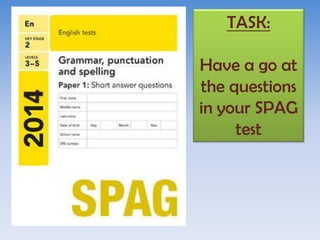
TASK:
Have a go at
the questions
in your SPAG
test
Grammar – where did it come
from?
Grammar is a construct – the rules of grammar were not
created by a god or divine power.
Grammar was developed to teach Latin – a lingua franca
of Western Europe because of the Roman Empire.
‘Grammar’ came from the Greek word for writing
Most of the population in the Middle Ages of England
were illiterate and English was very much a ‘spoken
language’
The printing press made it possible for more people to
read and therefore the rules of grammar enabled a
‘standard’ version of English to be developed.
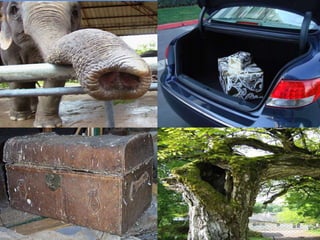
What is this?
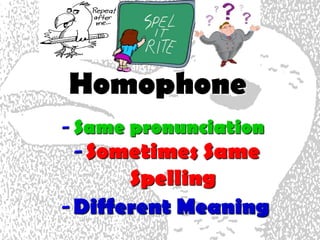
Homophone
- Same pronunciation
- Sometimes Same
Spelling
- Different Meaning
A cross bear
can’t bear to
cross rivers
A cross bear
can’t bear to
cross rivers
A cross bear
can’t bear to
cross rivers
A cross bear
can’t bear to
cross rivers
A cross bear
can’t bear to
cross rivers
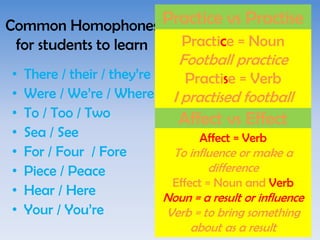
Common Homophones for
students to learn
• There / their / they’re
• Were / We’re / Where
• To / Too / Two
• Sea / See
• For / Four / Fore
• Piece / Peace
• Hear / Here
• Your / You’re
Practice vs
Practise
Affect vs Effect
Common Homophones
for students to learn
• There / their / they’re
• Were / We’re / Where
• To / Too / Two
• Sea / See
• For / Four / Fore
• Piece / Peace
• Hear / Here
• Your / You’re
Practice vs Practise
Affect vs Effect
Practice = Noun
Football practice
Practise = Verb
I practised football
Affect = Verb
To influence or make a
difference
Effect = Noun and Verb
Noun = a result or influence
Verb = to bring something
about as a result
Sentences
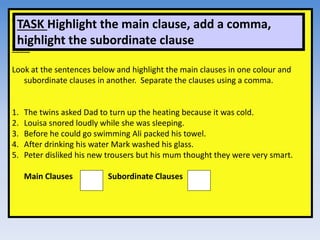
Task:
Look at the sentences below and highlight the main clauses in one colour and
subordinate clauses in another. Separate the clauses using a comma.
1. The twins asked Dad to turn up the heating because it was cold.
2. Louisa snored loudly while she was sleeping.
3. Before he could go swimming Ali packed his towel.
4. After drinking his water Mark washed his glass.
5. Peter disliked his new trousers but his mum thought they were very smart.
Main Clauses Subordinate Clauses
TASK Highlight the main clause, add a comma,
highlight the subordinate clause
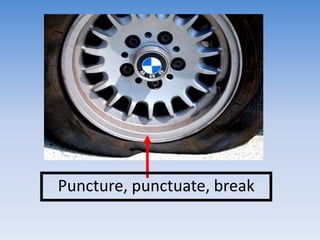
Puncture, punctuate, break
19
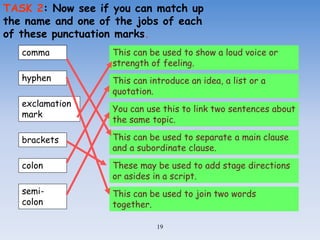
TASK 2: Now see if you can match up
the name and one of the jobs of each
of these punctuation marks.
hyphen
comma
semi-
colon
exclamation
mark
colon
brackets
This can be used to show a loud voice or
strength of feeling.
This can introduce an idea, a list or a
quotation.
This can be used to separate a main clause
and a subordinate clause.
These may be used to add stage directions
or asides in a script.
This can be used to join two words
together.
You can use this to link two sentences about
the same topic.
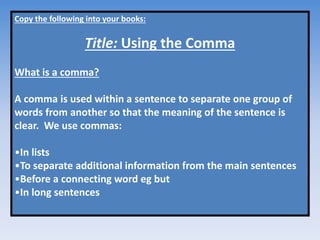
Copy the following into your books:
Title: Using the Comma
What is a comma?
A comma is used within a sentence to separate one group of
words from another so that the meaning of the sentence is
clear. We use commas:
•In lists
•To separate additional information from the main sentences
•Before a connecting word eg but
•In long sentences
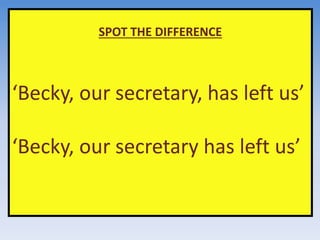
SPOT THE DIFFERENCE
‘Becky, our secretary, has left us’
‘Becky, our secretary has left us’
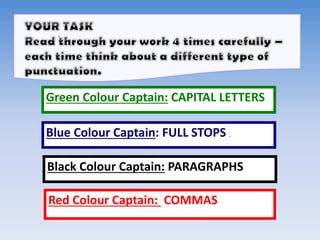
Red Colour Captain: COMMAS
Green Colour Captain: CAPITAL LETTERS
Blue Colour Captain: FULL STOPS .
Black Colour Captain: PARAGRAPHS
Apostrophes
(not apostrophe’s!)
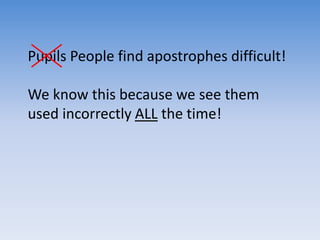
Pupils People find apostrophes difficult!
We know this because we see them
used incorrectly ALL the time!
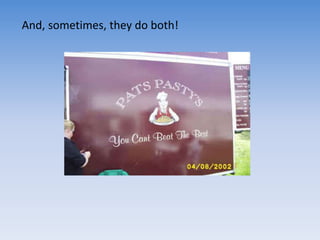
People miss them out when they should use them…
But they also put them in where they shouldn’t…
And, sometimes, they do both!
The
possessive
apostrophe
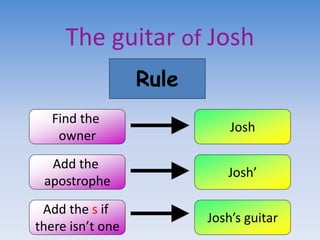
The guitar of Josh
Rule
Find the
owner
Add the
apostrophe
Add the s if
there isn’t one
Josh
Josh’s guitar
Josh’
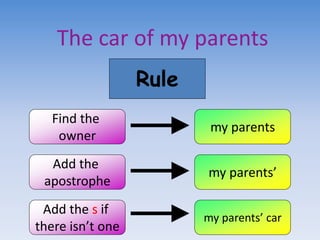
The car of my parents
Rule
Find the
owner
Add the
apostrophe
Add the s if
there isn’t one
my parents
my parents’ car
my parents’
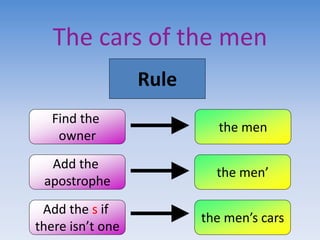
The cars of the men
Rule
Find the
owner
Add the
apostrophe
Add the s if
there isn’t one
the men
the men’s cars
the men’
The
omission
apostrophe
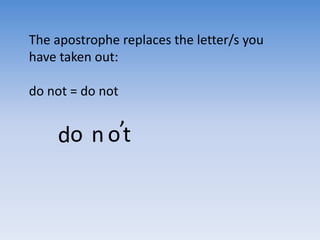
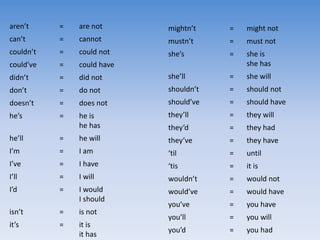
The apostrophe replaces the letter/s you
have taken out:
do not = do not
do n ot
‘
aren’t = are not
can’t = cannot
couldn’t = could not
could’ve = could have
didn’t = did not
don’t = do not
doesn’t = does not
he’s = he is
he has
he’ll = he will
I’m = I am
I’ve = I have
I’ll = I will
I’d = I would
I should
isn’t = is not
it’s = it is
it has
mightn’t = might not
mustn’t = must not
she’s = she is
she has
she’ll = she will
shouldn’t = should not
should’ve = should have
they’ll = they will
they’d = they had
they’ve = they have
‘til = until
‘tis = it is
wouldn’t = would not
would’ve = would have
you’ve = you have
you’ll = you will
you’d = you had
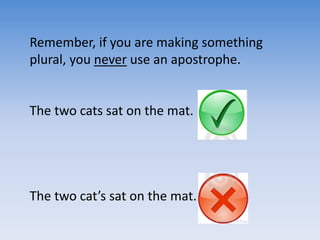
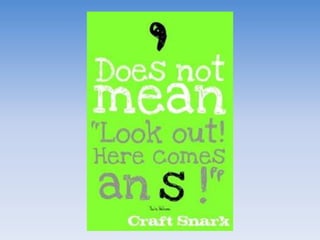
Remember, if you are making something
plural, you never use an apostrophe.
The two cats sat on the mat.
The two cat’s sat on the mat.
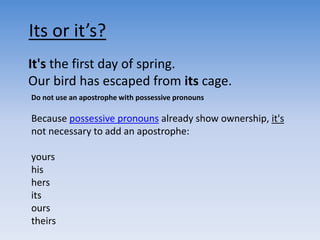
It's the first day of spring.
Our bird has escaped from its cage.
Its or it’s?
Do not use an apostrophe with possessive pronouns
Because possessive pronouns already show ownership, it's
not necessary to add an apostrophe:
yours
his
hers
its
ours
theirs

Spelling, punctuation and grammar

  • 1.
    SPAG PLC -How to make a difference in 40 minutes?! •Spelling- Homophones •Punctuation- Apostrophes •Grammar- Sentence construction
  • 2.
    Whole School Literacy "Everyteacher is a teacher of English because every teacher is a teacher in English. We cannot give a lesson in any subject without helping or neglecting the English of our pupils." – George Sampson, (Primary teacher and school inspector) 1921.
  • 3.
    We are notexperts! We get it wrong too! The 1990s education system did not have a focus on grammar – we are generally self-taught as a consequence of PGCE study. The study of English Literature is not focussed necessarily on language,
  • 4.
    TASK: Have a goat the questions in your SPAG test
  • 5.
    Grammar – wheredid it come from? Grammar is a construct – the rules of grammar were not created by a god or divine power. Grammar was developed to teach Latin – a lingua franca of Western Europe because of the Roman Empire. ‘Grammar’ came from the Greek word for writing Most of the population in the Middle Ages of England were illiterate and English was very much a ‘spoken language’ The printing press made it possible for more people to read and therefore the rules of grammar enabled a ‘standard’ version of English to be developed.
  • 6.
  • 8.
    Homophone - Same pronunciation -Sometimes Same Spelling - Different Meaning
  • 9.
    A cross bear can’tbear to cross rivers A cross bear can’t bear to cross rivers A cross bear can’t bear to cross rivers A cross bear can’t bear to cross rivers A cross bear can’t bear to cross rivers
  • 10.
    Common Homophones for studentsto learn • There / their / they’re • Were / We’re / Where • To / Too / Two • Sea / See • For / Four / Fore • Piece / Peace • Hear / Here • Your / You’re Practice vs Practise Affect vs Effect
  • 11.
    Common Homophones for studentsto learn • There / their / they’re • Were / We’re / Where • To / Too / Two • Sea / See • For / Four / Fore • Piece / Peace • Hear / Here • Your / You’re Practice vs Practise Affect vs Effect Practice = Noun Football practice Practise = Verb I practised football Affect = Verb To influence or make a difference Effect = Noun and Verb Noun = a result or influence Verb = to bring something about as a result
  • 16.
    Sentences Task: Look at thesentences below and highlight the main clauses in one colour and subordinate clauses in another. Separate the clauses using a comma. 1. The twins asked Dad to turn up the heating because it was cold. 2. Louisa snored loudly while she was sleeping. 3. Before he could go swimming Ali packed his towel. 4. After drinking his water Mark washed his glass. 5. Peter disliked his new trousers but his mum thought they were very smart. Main Clauses Subordinate Clauses TASK Highlight the main clause, add a comma, highlight the subordinate clause
  • 18.
  • 19.
    19 TASK 2: Nowsee if you can match up the name and one of the jobs of each of these punctuation marks. hyphen comma semi- colon exclamation mark colon brackets This can be used to show a loud voice or strength of feeling. This can introduce an idea, a list or a quotation. This can be used to separate a main clause and a subordinate clause. These may be used to add stage directions or asides in a script. This can be used to join two words together. You can use this to link two sentences about the same topic.
  • 20.
    Copy the followinginto your books: Title: Using the Comma What is a comma? A comma is used within a sentence to separate one group of words from another so that the meaning of the sentence is clear. We use commas: •In lists •To separate additional information from the main sentences •Before a connecting word eg but •In long sentences
  • 21.
    SPOT THE DIFFERENCE ‘Becky,our secretary, has left us’ ‘Becky, our secretary has left us’
  • 22.
    Red Colour Captain:COMMAS Green Colour Captain: CAPITAL LETTERS Blue Colour Captain: FULL STOPS . Black Colour Captain: PARAGRAPHS
  • 23.
  • 24.
    Pupils People findapostrophes difficult! We know this because we see them used incorrectly ALL the time!
  • 25.
    People miss themout when they should use them…
  • 26.
    But they alsoput them in where they shouldn’t…
  • 27.
  • 28.
  • 29.
    The guitar ofJosh Rule Find the owner Add the apostrophe Add the s if there isn’t one Josh Josh’s guitar Josh’
  • 30.
    The car ofmy parents Rule Find the owner Add the apostrophe Add the s if there isn’t one my parents my parents’ car my parents’
  • 31.
    The cars ofthe men Rule Find the owner Add the apostrophe Add the s if there isn’t one the men the men’s cars the men’
  • 32.
  • 33.
    The apostrophe replacesthe letter/s you have taken out: do not = do not do n ot ‘
  • 34.
    aren’t = arenot can’t = cannot couldn’t = could not could’ve = could have didn’t = did not don’t = do not doesn’t = does not he’s = he is he has he’ll = he will I’m = I am I’ve = I have I’ll = I will I’d = I would I should isn’t = is not it’s = it is it has mightn’t = might not mustn’t = must not she’s = she is she has she’ll = she will shouldn’t = should not should’ve = should have they’ll = they will they’d = they had they’ve = they have ‘til = until ‘tis = it is wouldn’t = would not would’ve = would have you’ve = you have you’ll = you will you’d = you had
  • 35.
    Remember, if youare making something plural, you never use an apostrophe. The two cats sat on the mat. The two cat’s sat on the mat.
  • 37.
    It's the firstday of spring. Our bird has escaped from its cage. Its or it’s? Do not use an apostrophe with possessive pronouns Because possessive pronouns already show ownership, it's not necessary to add an apostrophe: yours his hers its ours theirs