








Monday
  1/28/2013
1. “I Have a Dream”
   speech due today
2. Journal 9
3. Quick Review
4. Transitive and
   Intransitive Verbs
5. Classwork: p 171 (1-18)
Journal 9
Do you ever stop to think
about how lucky you are
to live in a free country?
What goes through your
mind now that you’ve
learned what it was like
for those who weren’t free
a long time ago? What
about those who are still
not free today?
Transitive and Intransitive Verbs
                  Miss Borja
           7th Grade Language Arts
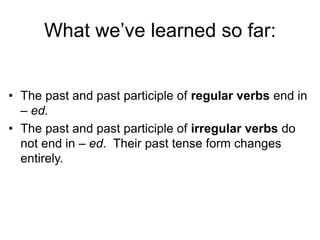
What we’ve learned so far:


• The past and past participle of regular verbs end in
  – ed.
• The past and past participle of irregular verbs do
  not end in – ed. Their past tense form changes
  entirely.
When a verb expresses action, something or
 someone in the predicate “receives” that
                 action.


         Paul hit the ball over the fence.

          The crowd cheered the batter.
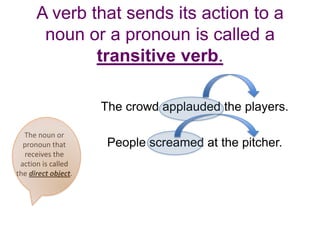
A verb that sends its action to a
       noun or a pronoun is called a
              transitive verb.

                     The crowd applauded the players.

  The noun or
  pronoun that        People screamed at the pitcher.
  receives the
 action is called
the direct object.
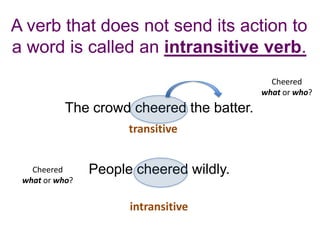
A verb that does not send its action to
a word is called an intransitive verb.
                                             Cheered
                                           what or who?
           The crowd cheered the batter.
                      transitive


   Cheered      People cheered wildly.
 what or who?


                      intransitive
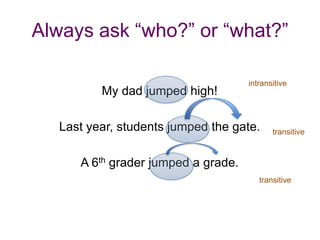
Always ask “who?” or “what?”

                                    intransitive
         My dad jumped high!

  Last year, students jumped the gate.     transitive


     A 6th grader jumped a grade.
                                       transitive
Linking verbs are always intransitive.
     They do not express action.


          The Ravens are the winners.

    They seem triumphant about their victory.

         The team is in first place now.
Let’s Play
Mrs. Bustamante teaches us
         geometry.
We draw circles with a compass
    and also study angles.
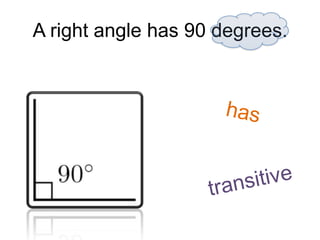
A right angle has 90 degrees.
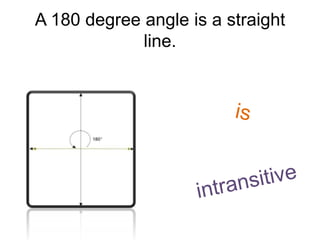
A 180 degree angle is a straight
             line.
Math becomes interesting with Mrs.
    Bustamante for a teacher.
In your notes:
• A transitive verb expresses
  action that is received by a
  noun or pronoun.
• An intransitive verb does not
  have an object that receives
  the action.
• The noun or pronoun that
  receives the action is called
  a direct object.
• Linking verbs are always
  intransitive
• Assignment: p 171 #s 1-18
  Questions and Answers.

Transitive and intransitive verbs

  • 1.
    Monday 1/28/2013 1.“I Have a Dream” speech due today 2. Journal 9 3. Quick Review 4. Transitive and Intransitive Verbs 5. Classwork: p 171 (1-18)
  • 2.
    Journal 9 Do youever stop to think about how lucky you are to live in a free country? What goes through your mind now that you’ve learned what it was like for those who weren’t free a long time ago? What about those who are still not free today?
  • 3.
    Transitive and IntransitiveVerbs Miss Borja 7th Grade Language Arts
  • 4.
    What we’ve learnedso far: • The past and past participle of regular verbs end in – ed. • The past and past participle of irregular verbs do not end in – ed. Their past tense form changes entirely.
  • 5.
    When a verbexpresses action, something or someone in the predicate “receives” that action. Paul hit the ball over the fence. The crowd cheered the batter.
  • 6.
    A verb thatsends its action to a noun or a pronoun is called a transitive verb. The crowd applauded the players. The noun or pronoun that People screamed at the pitcher. receives the action is called the direct object.
  • 7.
    A verb thatdoes not send its action to a word is called an intransitive verb. Cheered what or who? The crowd cheered the batter. transitive Cheered People cheered wildly. what or who? intransitive
  • 8.
    Always ask “who?”or “what?” intransitive My dad jumped high! Last year, students jumped the gate. transitive A 6th grader jumped a grade. transitive
  • 9.
    Linking verbs arealways intransitive. They do not express action. The Ravens are the winners. They seem triumphant about their victory. The team is in first place now.
  • 10.
  • 11.
  • 12.
    We draw circleswith a compass and also study angles.
  • 13.
    A right anglehas 90 degrees.
  • 14.
    A 180 degreeangle is a straight line.
  • 15.
    Math becomes interestingwith Mrs. Bustamante for a teacher.
  • 16.
    In your notes: •A transitive verb expresses action that is received by a noun or pronoun. • An intransitive verb does not have an object that receives the action. • The noun or pronoun that receives the action is called a direct object. • Linking verbs are always intransitive • Assignment: p 171 #s 1-18 Questions and Answers.