COMPARATIVES AND
SUPERLATIVES
WHAT IS AN ADJECTIVE?
Adjectives accompany nouns and give you
information about people, animals or things.
EX: The red car.
The big house.
The cat is black.
Red, big and black are adjectives.
They make our writing and speaking more
descriptive and interesting.
WHAT IS AN ADJECTIVE?
Adjectives can be placed before or after the noun
they are describing.
EX: The pretty girl came to our group.
The girl in our group is pretty.
Adjectives never use plural (-s) and they don’t
have a different masculine and feminine form.
EX: The green ball / The green balls
The tall girl / The tall boy
ADJECTIVE ORDER
Adjectives can be used to describe: size (big),
colour (black), shape (round), sound (quiet),
feelings (hungry)…
But when we use several adjectives to describe a
noun we should follow a fixed order:
opinion + size + age + shape + colour + origin +
material + purpose
EX: A beautiful small new squared red French
leather hand bag
 We use the comparative adjectives to
compare 2 things: people, objects, animals…
 There are 3 different ways to compare things:
- Superiority
- Equality
- Inferiority
COMPARATIVE ADJECTIVES
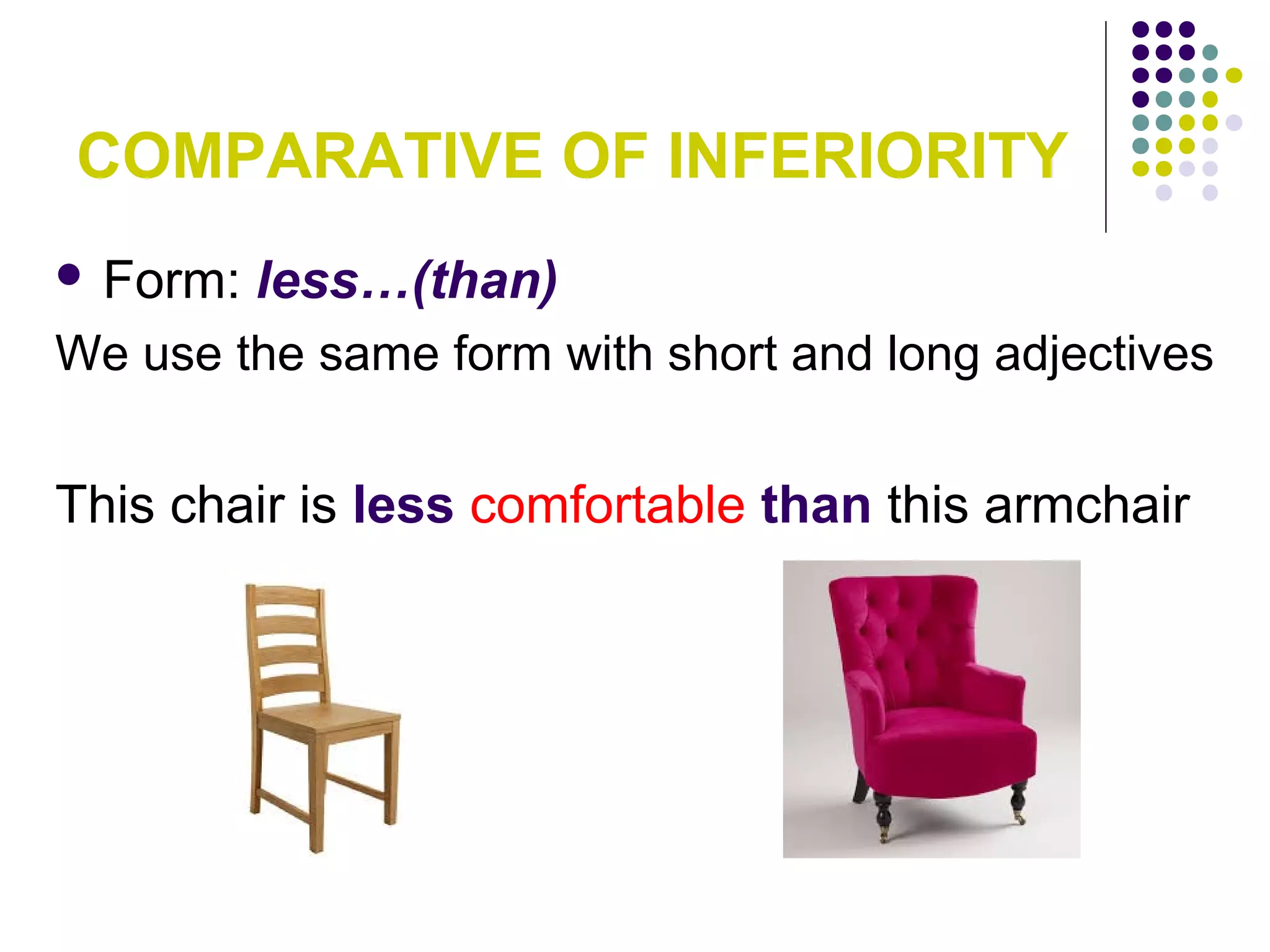
 Form: less…(than)
We use the same form with short and long adjectives
This chair is less comfortable than this armchair
COMPARATIVE OF INFERIORITY
 Form: as…as
We use the same form with short and long adjectives
This elephant is as big as that elephant
COMPARATIVE OF EQUALITY
COMPARATIVE OF SUPERIORITY
Rules:
 One-syllable adjectives:
- We normally add –er
- Adjectives ending in –e add –r
- Adjectives ending in vowel + consonant = double
the consonant + –er
The turtle is slower than the rabbit
COMPARATIVE OF SUPERIORITY
Rules:
 Two-syllable adjectives:
- We normally add more before the adjective
- When the adjective ends in –y, we drop the y
and add -ier
This man is happier than that man
COMPARATIVE OF SUPERIORITY
Rules:
 Three-syllable-or-more adjectives:
- We add more before the adjective
The lion is more dangerous than the sheep
 Comparatives are often used on their own if it
is clear what or who is being compared. If
you want to specify what you are comparing,
you can do this using than followed by the
noun you are comparing.
Mary is taller
Mary is taller than Sarah
 After “than” we can also use an object
pronoun or a subject pronoun + a verb.
She is older than me / than I am.
COMPARATIVE ADJECTIVES
 We use the superlative adjectives to compare
3 or more things: people, objects, animals…
 We use it to say which is the biggest, most
beautiful… in a group
SUPERLATIVE ADJECTIVES
SUPERLATIVE
Rules:
 One-syllable adjectives:
- We normally add –est
- Adjectives ending in –e add –st
- Adjectives ending in vowel + consonant = double
the consonant + –est
The turtle is the slowest animal
SUPERLATIVE
Rules:
 Two-syllable adjectives:
- We normally add most before the adjective
- When the adjective ends in –y, we drop the y
and add -iest
This man is the happiest in the world
SUPERLATIVE
Rules:
 Three-syllable-or-more adjectives:
- We add the most before the adjective
The lion is one of the most dangerous animals
in the world
 Superlatives are often used on their own if it is clear
what or who is being compared. If you want to
specify what you are comparing, you can do this
with a noun or phrase beginning with in or of.
She is the youngest
She is the youngest child
She is the youngest of the children
She is the youngest in the class
 We normally use the before a superlative.
The last question is the most difficult.
SUPERLATIVE ADJECTIVES
IRREGULAR ADJECTIVES
AdjectiveAdjective ComparativeComparative SuperlativeSuperlative
GoodGood BetterBetter The bestThe best
BadBad WorseWorse The WorstThe Worst
FarFar FurtherFurther The furthestThe furthest
There are adjectives that don’t follow the norm.
 We use comparative and superlative adverbs to
compare actions:
He drives more slowly than me
 Some adverbs have the same form as an
adjective. They add –er / -est, e.g.
earlier, fastest, harder, highest…
 Many adverbs are an adjective + ly. They form
the comparative and superlative with more /
most, e.g.
more easily, most carefully, more slowly…
COMPARISON OF ADVERBS
IRREGULAR FORMS
 Some adverbs have irregular forms:
 well
 badly
 far
 better best
 worse worst
 further furthest
Let’s practise!
Use the words given to
compare the following
pictures.
FRUIT
FRIES
CHOCOLATE
HEALTHY
EXPENSIVE
SWEET
TASTY
FATTENING
DIFFICULT
EASY
BEAUTIFUL
FAST
SPAIN
CANADA
JAMAICA
COLD
HOT
LARGE
POPULAR
POPULATED
IRONING
CLEANING
COOKING
BORING
USEFUL
POPULAR
BAD
TIME CONSUMING
BIKE
SUV
ELECTRIC CAR
CHEAP
SLOW
SMALL
ECO-FRIENDLY
COMFORTABLE
CONTAMINANT
AMUSING
POPULAR
DANGEROUS
HEALTHY
EXPENSIVE
ICE SKATING
AMERICAN
FOOTBALL
FOOTBALL
SNOWBOARDING
TOKYO
CORDOBA
MAUI
COSMOPOLITAN
NOISY
POLLUTED QUIET
CROWDED

Comparative and Superlative Adjectives