Transitive and
Intransitive Verbs
Key terms for transitive/intransitive verbs
 Direct

objects are words that receive the
action of the verb.
 Some verbs have direct objects and
others do not.
 If the verb has a direct object, it is
transitive.
 If it does not, it is intransitive.
Does it have a direct object?
 To

determine whether a verb has a direct
object,
 Ask:

 Some

whom or what after it

verbs will be both transitive and
intransitive. It depends on how the verb is
used.
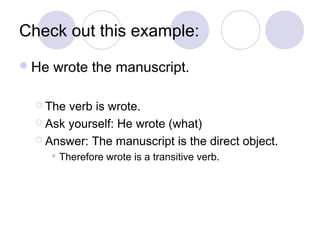
Check out this example:
 He

wrote the manuscript.

 The

verb is wrote.
 Ask yourself: He wrote (what)
 Answer: The manuscript is the direct object.
 Therefore

wrote is a transitive verb.
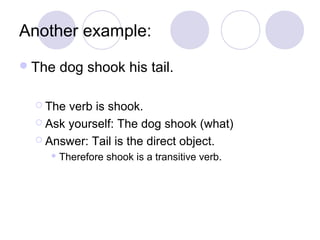
Another example:
 The

dog shook his tail.

 The

verb is shook.
 Ask yourself: The dog shook (what)
 Answer: Tail is the direct object.
 Therefore

shook is a transitive verb.
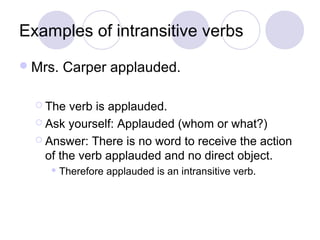
Examples of intransitive verbs
 Mrs.

Carper applauded.

 The

verb is applauded.
 Ask yourself: Applauded (whom or what?)
 Answer: There is no word to receive the action
of the verb applauded and no direct object.
 Therefore

applauded is an intransitive verb.
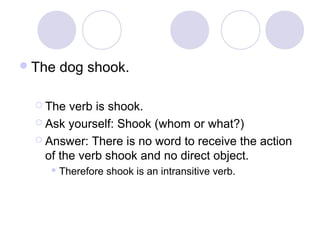
 The

dog shook.

 The

verb is shook.
 Ask yourself: Shook (whom or what?)
 Answer: There is no word to receive the action
of the verb shook and no direct object.
 Therefore

shook is an intransitive verb.
The wild, wild world of verbs
 Verbs

are the most confusing part of
speech.
 However, every sentence must have a
verb to complete the meaning of the
subject.
 Do not become overwhelmed by all the
types of verbs. Write simply and clearly
are my words of advice to you.

Transitive and intertransitive verbs

  • 1.
  • 2.
    Key terms fortransitive/intransitive verbs  Direct objects are words that receive the action of the verb.  Some verbs have direct objects and others do not.  If the verb has a direct object, it is transitive.  If it does not, it is intransitive.
  • 3.
    Does it havea direct object?  To determine whether a verb has a direct object,  Ask:  Some whom or what after it verbs will be both transitive and intransitive. It depends on how the verb is used.
  • 4.
    Check out thisexample:  He wrote the manuscript.  The verb is wrote.  Ask yourself: He wrote (what)  Answer: The manuscript is the direct object.  Therefore wrote is a transitive verb.
  • 5.
    Another example:  The dogshook his tail.  The verb is shook.  Ask yourself: The dog shook (what)  Answer: Tail is the direct object.  Therefore shook is a transitive verb.
  • 6.
    Examples of intransitiveverbs  Mrs. Carper applauded.  The verb is applauded.  Ask yourself: Applauded (whom or what?)  Answer: There is no word to receive the action of the verb applauded and no direct object.  Therefore applauded is an intransitive verb.
  • 7.
     The dog shook. The verb is shook.  Ask yourself: Shook (whom or what?)  Answer: There is no word to receive the action of the verb shook and no direct object.  Therefore shook is an intransitive verb.
  • 8.
    The wild, wildworld of verbs  Verbs are the most confusing part of speech.  However, every sentence must have a verb to complete the meaning of the subject.  Do not become overwhelmed by all the types of verbs. Write simply and clearly are my words of advice to you.