Noun Clause
What is a Noun Clause?
 A noun clause is a dependent clause that
contains a subject and a verb. A noun clause
functions as noun in a sentence
A noun clause cannot stand alone because it is
not a complete thought. It must always be paired
with an independent (main) clause.
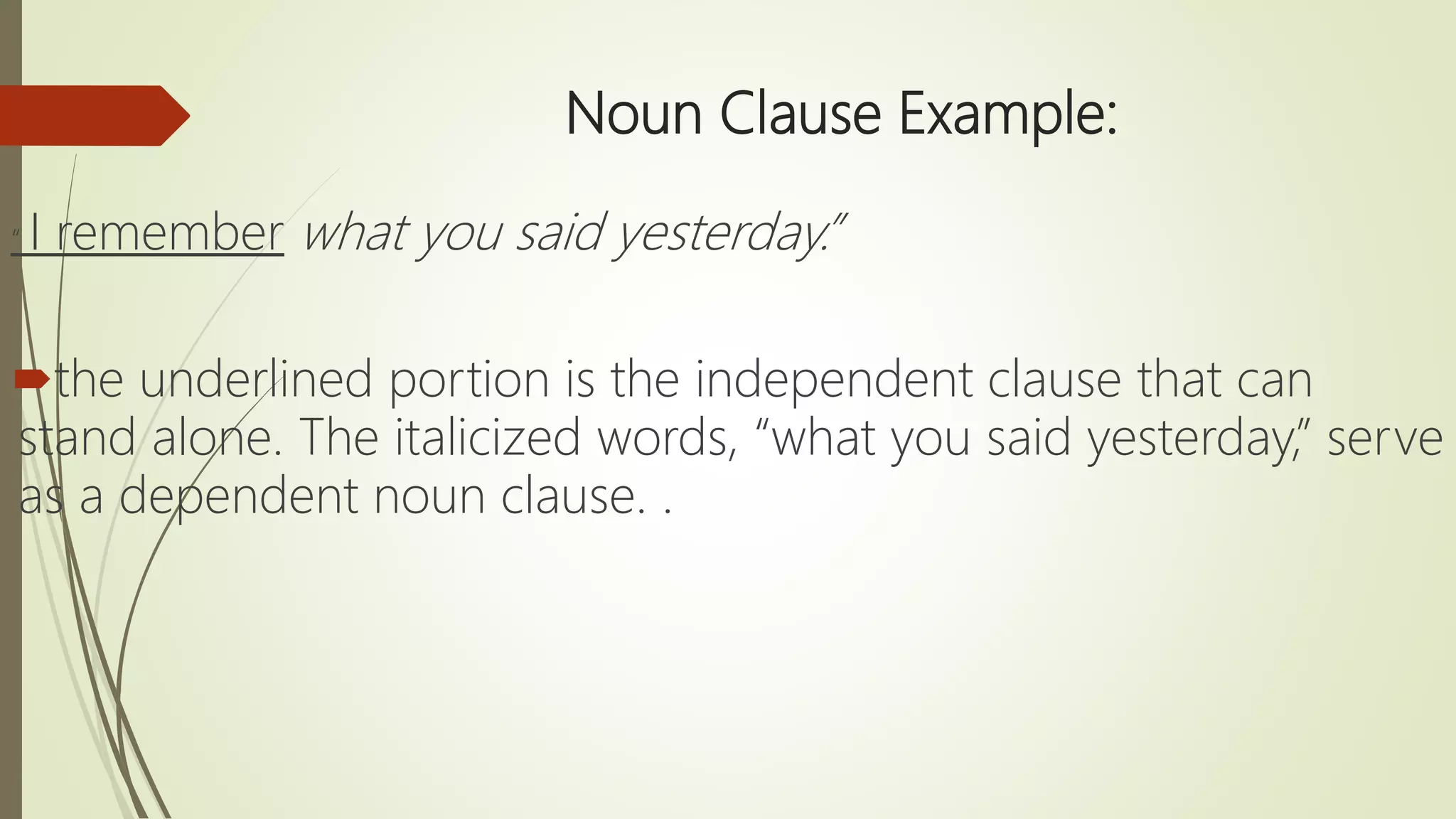
Noun Clause Example:
“ I remember what you said yesterday.”
the underlined portion is the independent clause that can
stand alone. The italicized words, “what you said yesterday,” serve
as a dependent noun clause. .
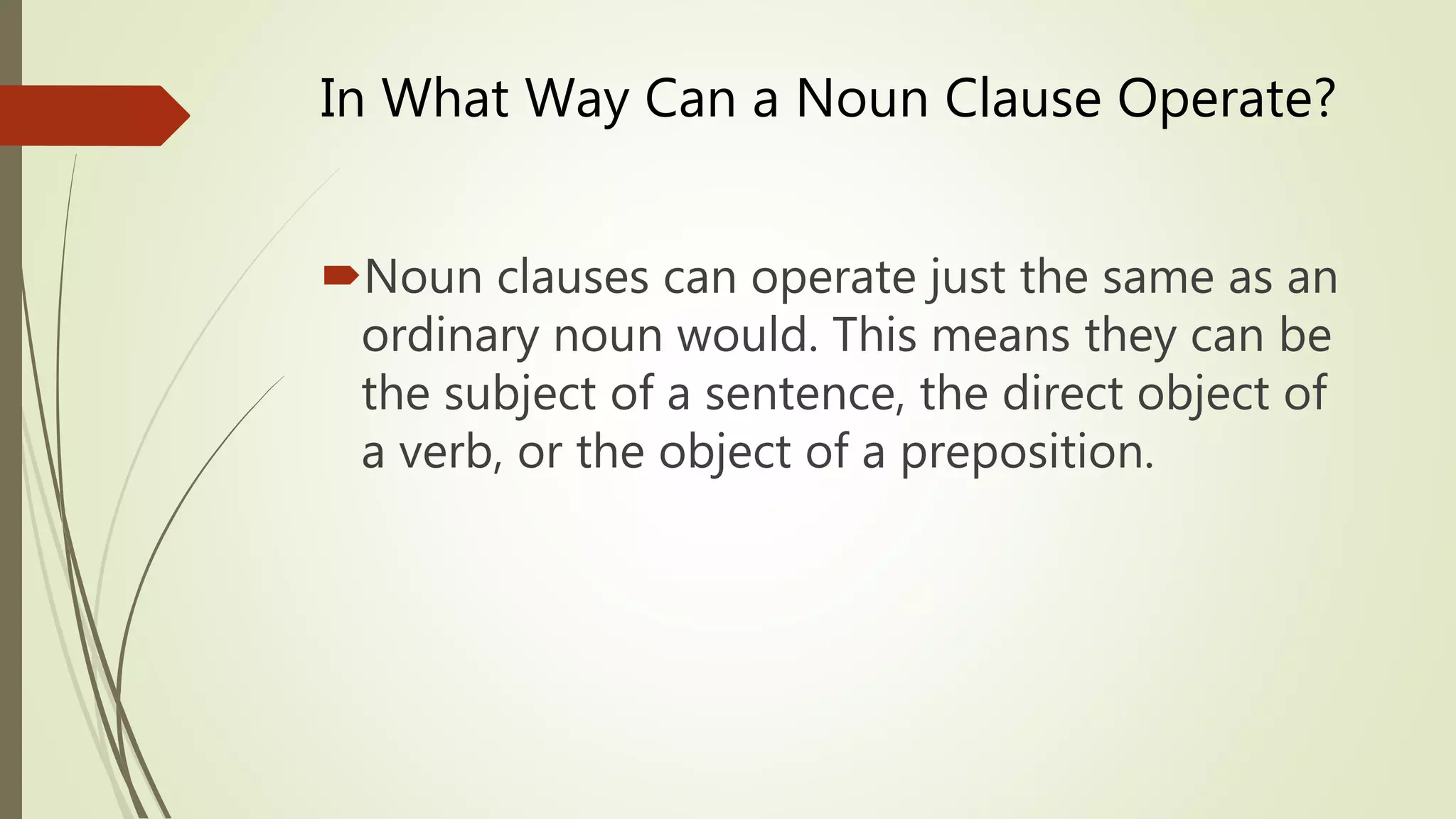
In What Way Can a Noun Clause Operate?
Noun clauses can operate just the same as an
ordinary noun would. This means they can be
the subject of a sentence, the direct object of
a verb, or the object of a preposition.
Noun Clause as an Object
A noun clause can function as:
a direct object,
an indirect object,
or the object of a preposition.
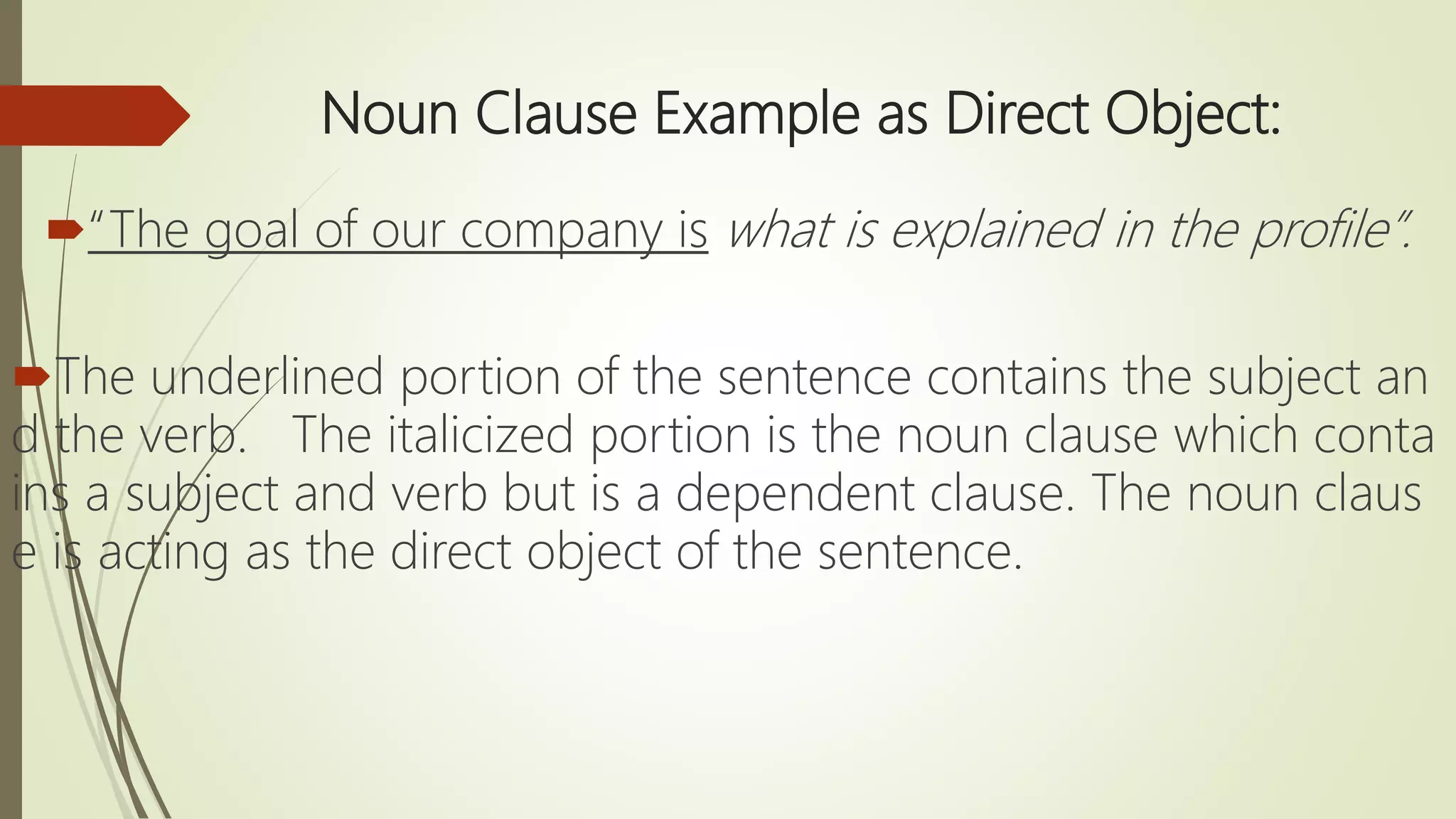
Noun Clause Example as Direct Object:
“The goal of our company is what is explained in the profile”.
The underlined portion of the sentence contains the subject an
d the verb. The italicized portion is the noun clause which conta
ins a subject and verb but is a dependent clause. The noun claus
e is acting as the direct object of the sentence.
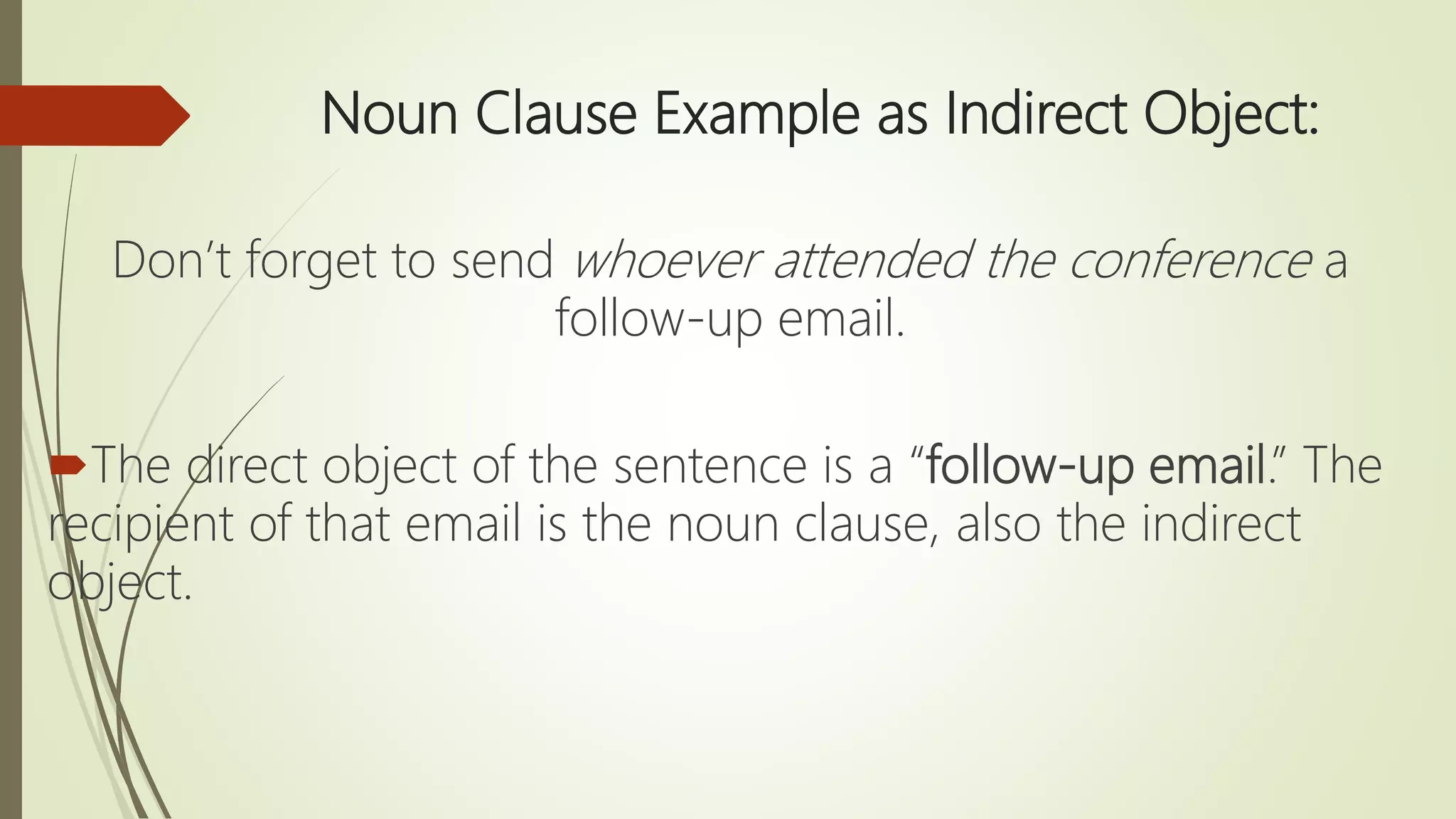
Noun Clause Example as Indirect Object:
Don’t forget to send whoever attended the conference a
follow-up email.
The direct object of the sentence is a “follow-up email.” The
recipient of that email is the noun clause, also the indirect
object.
Noun Clause Example as
Object of Preposition:
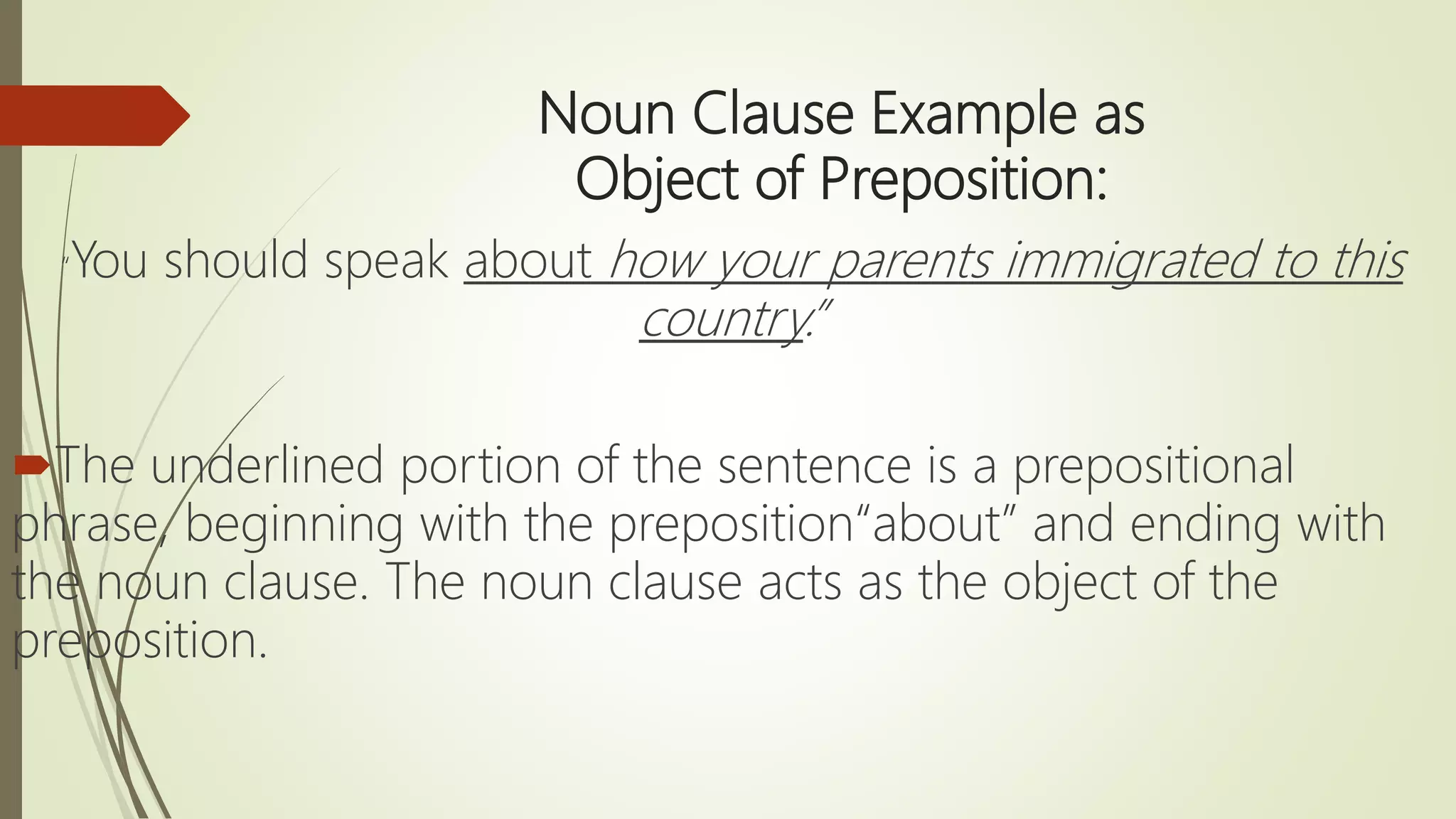
“You should speak about how your parents immigrated to this
country.”
The underlined portion of the sentence is a prepositional
phrase, beginning with the preposition“about” and ending with
the noun clause. The noun clause acts as the object of the
preposition.
Noun Clause as a Subject
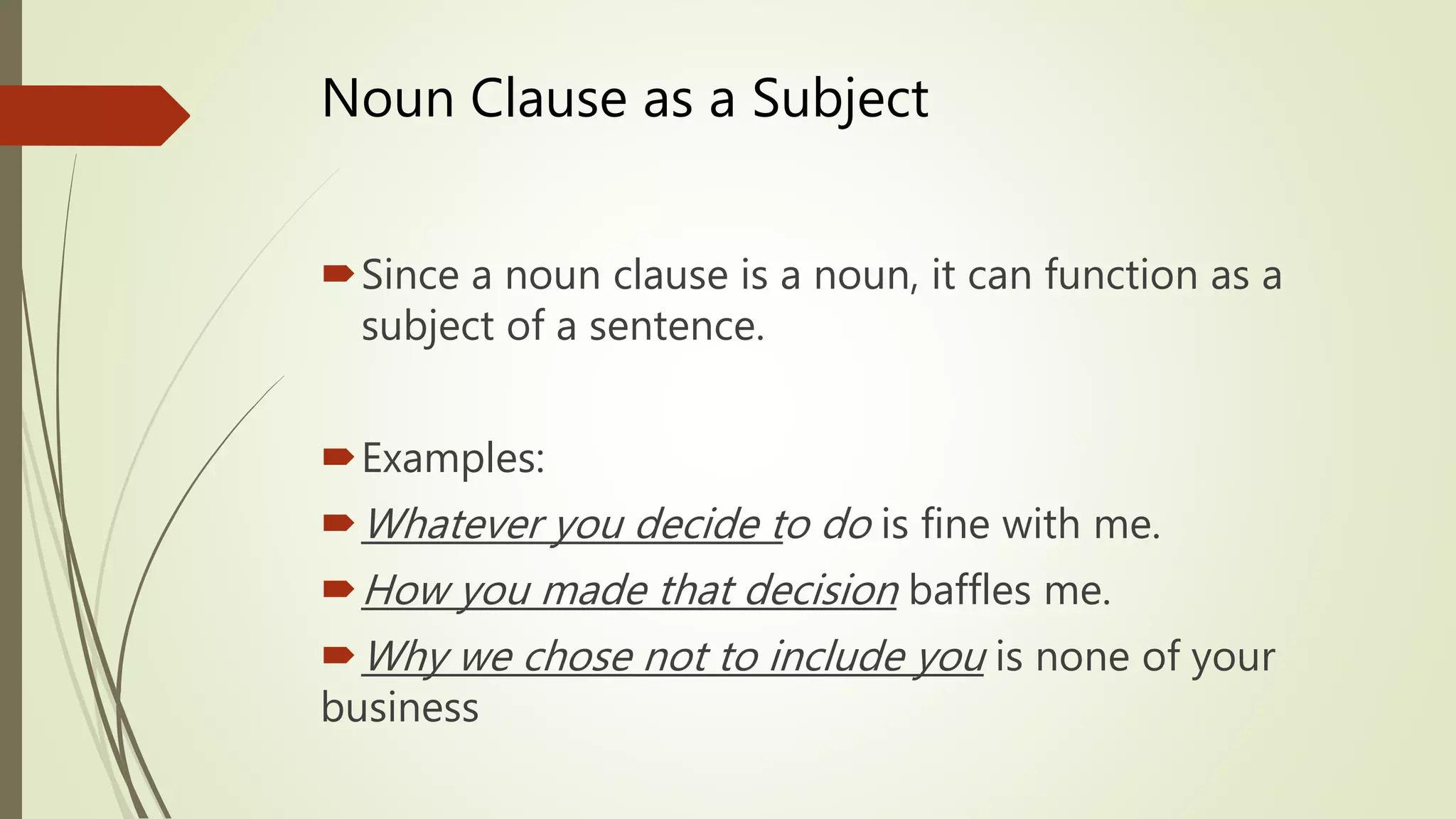
Since a noun clause is a noun, it can function as a
subject of a sentence.
Examples:
Whatever you decide to do is fine with me.
How you made that decision baffles me.
Why we chose not to include you is none of your
business
How to Identify a Noun Clause
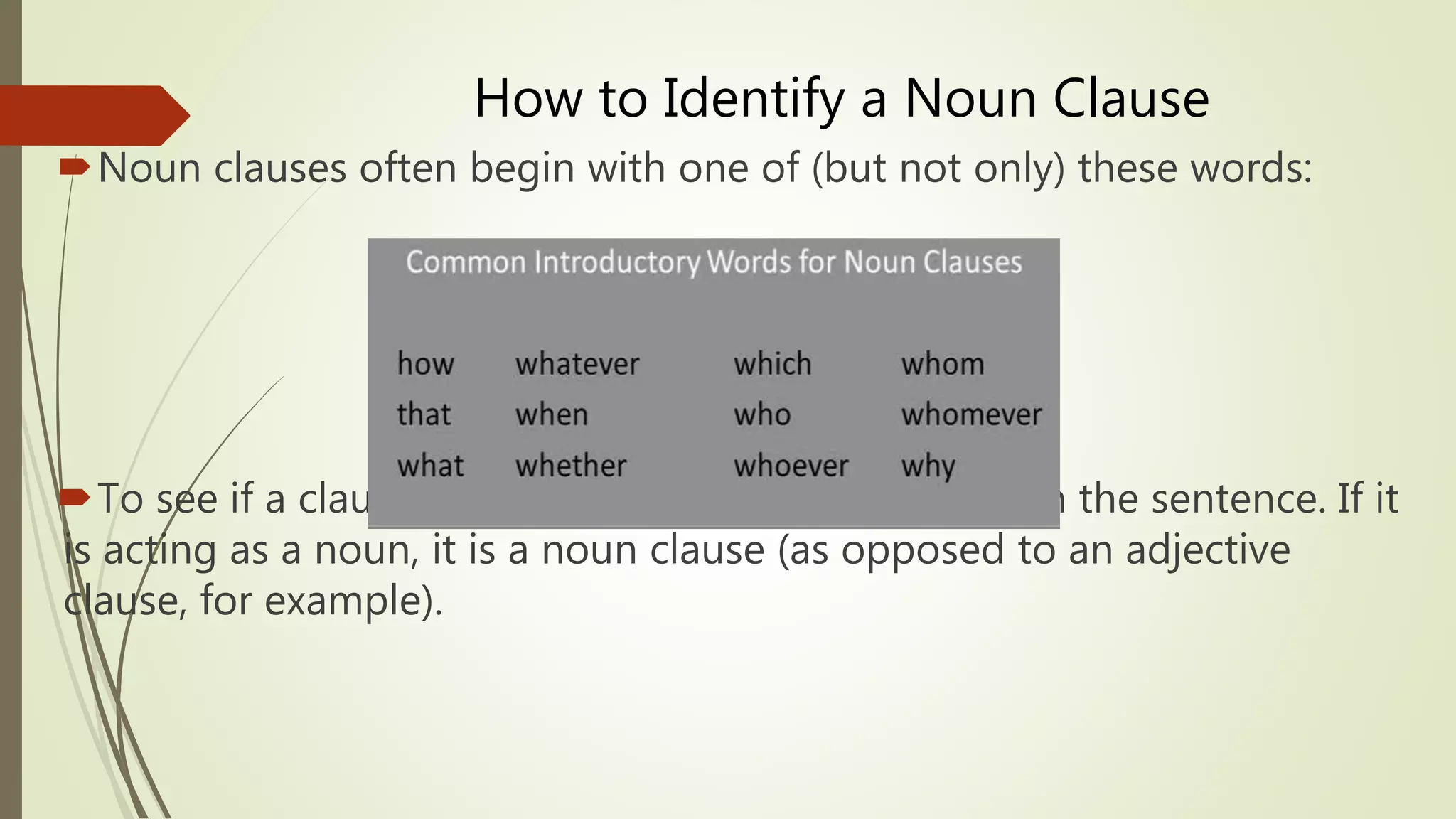
Noun clauses often begin with one of (but not only) these words:
To see if a clause is a noun clause, identify its role in the sentence. If it
is acting as a noun, it is a noun clause (as opposed to an adjective
clause, for example).
Using Subjunctive in Noun Clauses
The subjunctive case appears in noun clauses. It is
acceptable in formal writing and speaking but is not
common in everyday language.
The common use of the subjunctive case in a noun clause
is after verbs like: advise, ask, demand, insist, urge and
require.
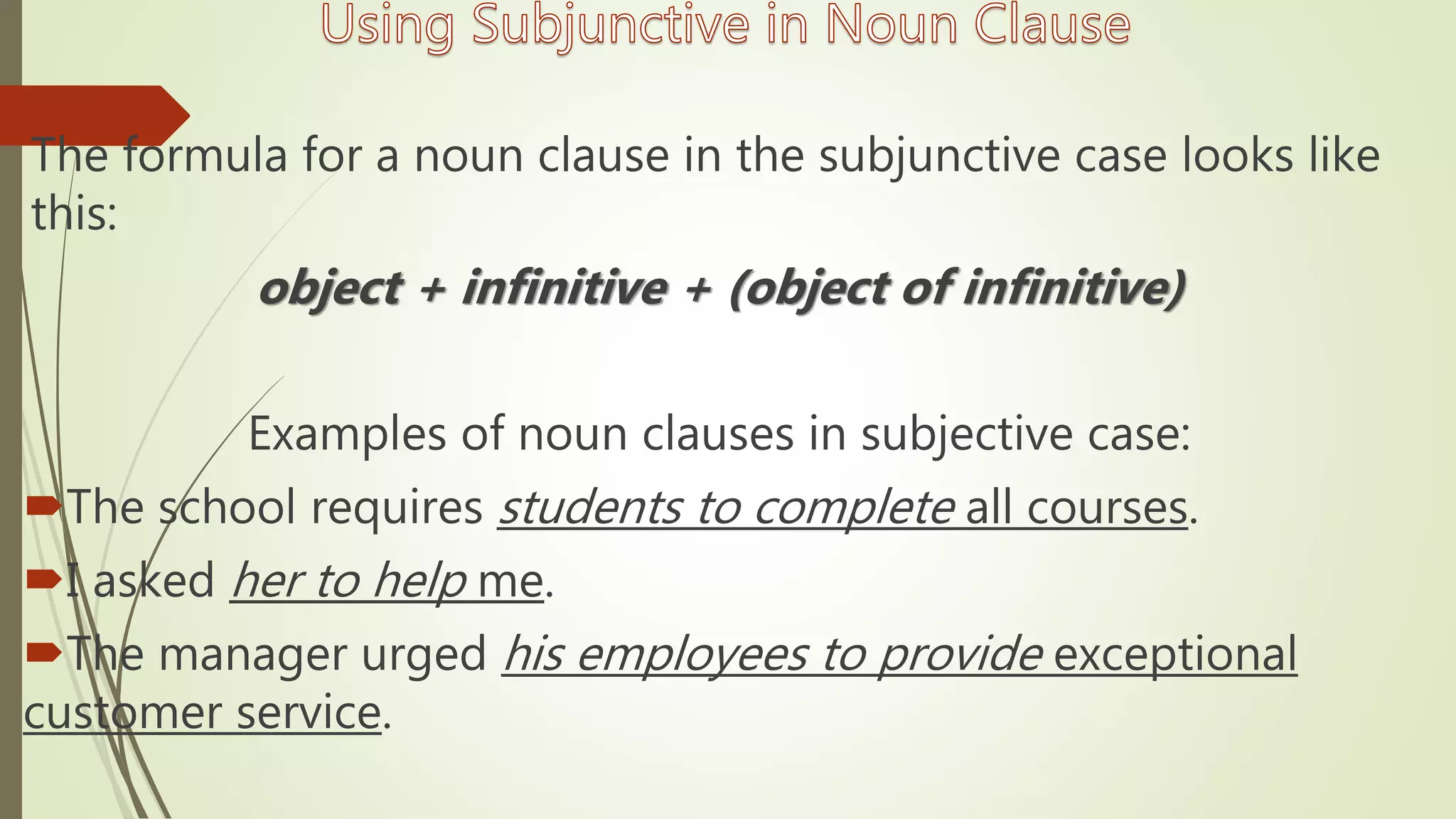
The formula for a noun clause in the subjunctive case looks like
this:
object + infinitive + (object of infinitive)
Examples of noun clauses in subjective case:
The school requires students to complete all courses.
I asked her to help me.
The manager urged his employees to provide exceptional
customer service.
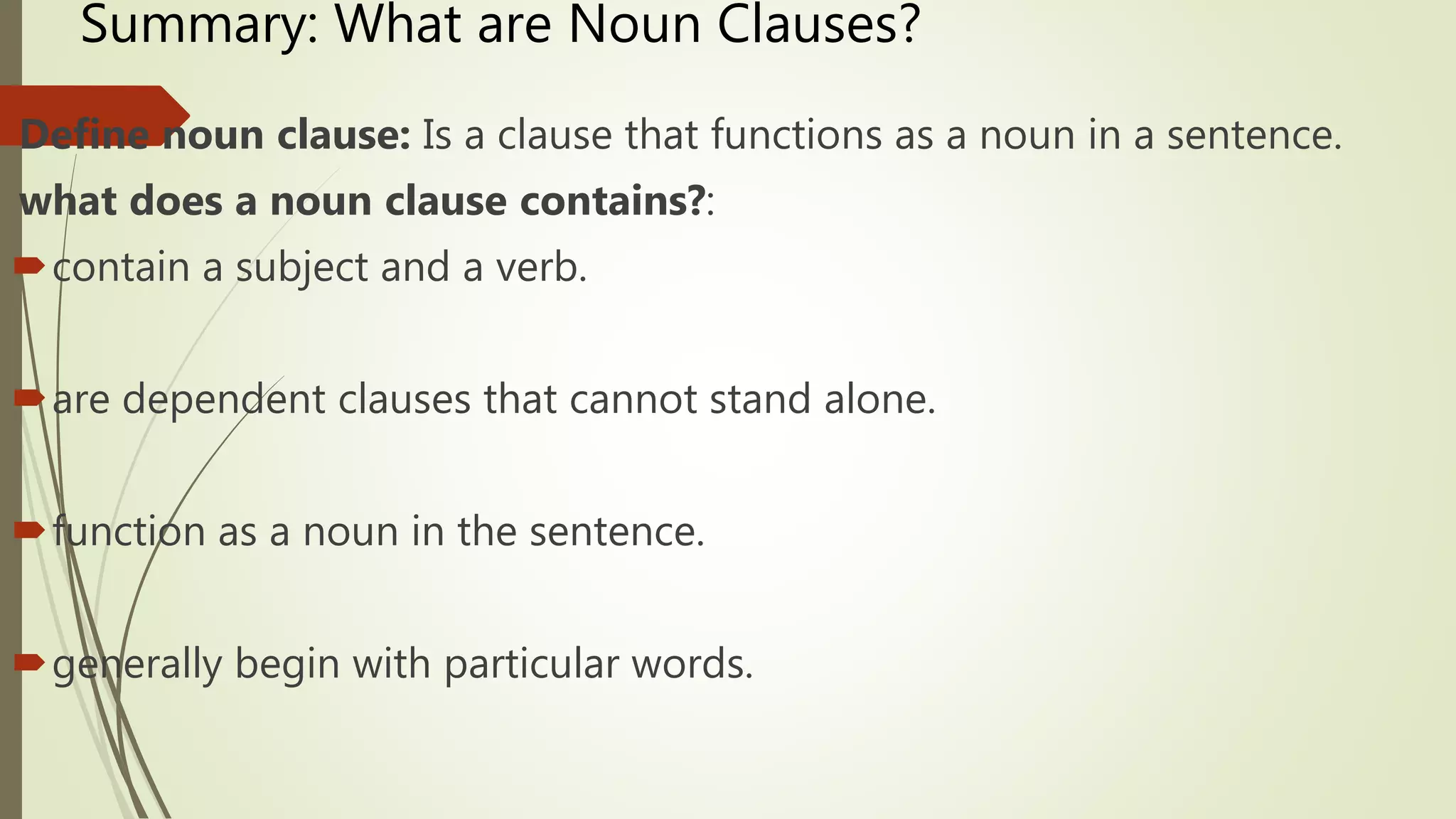
Summary: What are Noun Clauses?
Define noun clause: Is a clause that functions as a noun in a sentence.
what does a noun clause contains?:
contain a subject and a verb.
are dependent clauses that cannot stand alone.
function as a noun in the sentence.
generally begin with particular words.
Exercises
Underline the noun clauses.
 I cannot understand why she is angry with me.
They said that they would accept the offer.
I think I will win.
He told me that he would come.
Exercises
. You can eat whatever you want.
. Can you guess what I want?
. I feel certain that she will come.
. I do not know what she wants.
. No one knows where he is.
Bibliography
 https://writingexplained.org/grammar-dictionary/noun-clause
Links
 https://www.easel.ly/create?id=https://s3.amazonaws.com/easel.ly/all_easels/46182
18/1553708735&key=pri
 https://es.surveymonkey.com/r/XRG3TQB

Noun clause presentation mssl

  • 1.
  • 2.
    What is aNoun Clause?  A noun clause is a dependent clause that contains a subject and a verb. A noun clause functions as noun in a sentence A noun clause cannot stand alone because it is not a complete thought. It must always be paired with an independent (main) clause.
  • 3.
    Noun Clause Example: “I remember what you said yesterday.” the underlined portion is the independent clause that can stand alone. The italicized words, “what you said yesterday,” serve as a dependent noun clause. .
  • 4.
    In What WayCan a Noun Clause Operate? Noun clauses can operate just the same as an ordinary noun would. This means they can be the subject of a sentence, the direct object of a verb, or the object of a preposition.
  • 5.
    Noun Clause asan Object A noun clause can function as: a direct object, an indirect object, or the object of a preposition.
  • 6.
    Noun Clause Exampleas Direct Object: “The goal of our company is what is explained in the profile”. The underlined portion of the sentence contains the subject an d the verb. The italicized portion is the noun clause which conta ins a subject and verb but is a dependent clause. The noun claus e is acting as the direct object of the sentence.
  • 7.
    Noun Clause Exampleas Indirect Object: Don’t forget to send whoever attended the conference a follow-up email. The direct object of the sentence is a “follow-up email.” The recipient of that email is the noun clause, also the indirect object.
  • 8.
    Noun Clause Exampleas Object of Preposition: “You should speak about how your parents immigrated to this country.” The underlined portion of the sentence is a prepositional phrase, beginning with the preposition“about” and ending with the noun clause. The noun clause acts as the object of the preposition.
  • 9.
    Noun Clause asa Subject Since a noun clause is a noun, it can function as a subject of a sentence. Examples: Whatever you decide to do is fine with me. How you made that decision baffles me. Why we chose not to include you is none of your business
  • 10.
    How to Identifya Noun Clause Noun clauses often begin with one of (but not only) these words: To see if a clause is a noun clause, identify its role in the sentence. If it is acting as a noun, it is a noun clause (as opposed to an adjective clause, for example).
  • 11.
    Using Subjunctive inNoun Clauses The subjunctive case appears in noun clauses. It is acceptable in formal writing and speaking but is not common in everyday language. The common use of the subjunctive case in a noun clause is after verbs like: advise, ask, demand, insist, urge and require.
  • 12.
    The formula fora noun clause in the subjunctive case looks like this: object + infinitive + (object of infinitive) Examples of noun clauses in subjective case: The school requires students to complete all courses. I asked her to help me. The manager urged his employees to provide exceptional customer service.
  • 13.
    Summary: What areNoun Clauses? Define noun clause: Is a clause that functions as a noun in a sentence. what does a noun clause contains?: contain a subject and a verb. are dependent clauses that cannot stand alone. function as a noun in the sentence. generally begin with particular words.
  • 14.
    Exercises Underline the nounclauses.  I cannot understand why she is angry with me. They said that they would accept the offer. I think I will win. He told me that he would come.
  • 15.
    Exercises . You caneat whatever you want. . Can you guess what I want? . I feel certain that she will come. . I do not know what she wants. . No one knows where he is.
  • 16.
  • 17.