Tense• What is tense?
• Brief introduction to verbs.
• Varieties of tenses.
Presented by Rinky Gupta
M.Phil ( English Language Teaching)
Banasthali Vidyapeth, Rajasthan, India
What does a tense mean?
• Tense is the grammaticalisation of
time reference.
• The tenses simply show the time of
an action or state of being as shown
by a verb.
• The verb ending is changed
(conjugated) to show what time it is
referring to. Therefore verb plays an
important role in a sentence.
Tense divides time into…..
What is a Verb?
Types of verbs.
Auxiliary Verbs
Regular Verbs
Irregular Verbs
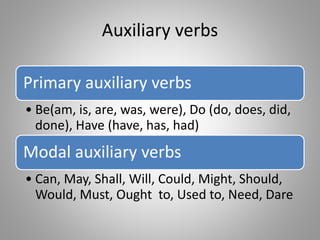
Auxiliary verbs
Primary auxiliary verbs
• Be(am, is, are, was, were), Do (do, does, did,
done), Have (have, has, had)
Modal auxiliary verbs
• Can, May, Shall, Will, Could, Might, Should,
Would, Must, Ought to, Used to, Need, Dare
Regular verbs
• Regular
verbs have
four forms.
Form Verb
example
Base form Walk Play
-s form (3rd
person
singular
present)
Walks Plays
Past Walked Played
-ing
participle
(past
participle)
Walking playing
Irregular verb
• Irregular verbs
can have more
than four
forms.
Form Verb
example
Base Drink
-s form (3rd
person
singular
present)
Drinks
Past Drank
-ing participle
(present
participle)
Drinking
-ed participle
(past
participle)
drunk
List of regular and irregular verb
Regular verbs
Love Kill Pin Kick
Like Live Look Mail
Meas
ure
Mix Tip Move
Open Paint Want Pass
Pour Prom
ise
Was
h
Prove
Push Race wipe Rain
jump stay Stop tip
Irregular verbs
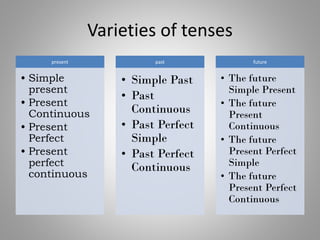
Varieties of tenses
present
• Simple
present
• Present
Continuous
• Present
Perfect
• Present
perfect
continuous
past
• Simple Past
• Past
Continuous
• Past Perfect
Simple
• Past Perfect
Continuous
future
• The future
Simple Present
• The future
Present
Continuous
• The future
Present Perfect
Simple
• The future
Present Perfect
Continuous
Thank you

Tense

  • 1.
    Tense• What istense? • Brief introduction to verbs. • Varieties of tenses. Presented by Rinky Gupta M.Phil ( English Language Teaching) Banasthali Vidyapeth, Rajasthan, India
  • 2.
    What does atense mean? • Tense is the grammaticalisation of time reference. • The tenses simply show the time of an action or state of being as shown by a verb. • The verb ending is changed (conjugated) to show what time it is referring to. Therefore verb plays an important role in a sentence.
  • 3.
  • 4.
    What is aVerb?
  • 5.
    Types of verbs. AuxiliaryVerbs Regular Verbs Irregular Verbs
  • 6.
    Auxiliary verbs Primary auxiliaryverbs • Be(am, is, are, was, were), Do (do, does, did, done), Have (have, has, had) Modal auxiliary verbs • Can, May, Shall, Will, Could, Might, Should, Would, Must, Ought to, Used to, Need, Dare
  • 7.
    Regular verbs • Regular verbshave four forms. Form Verb example Base form Walk Play -s form (3rd person singular present) Walks Plays Past Walked Played -ing participle (past participle) Walking playing
  • 8.
    Irregular verb • Irregularverbs can have more than four forms. Form Verb example Base Drink -s form (3rd person singular present) Drinks Past Drank -ing participle (present participle) Drinking -ed participle (past participle) drunk
  • 9.
    List of regularand irregular verb Regular verbs Love Kill Pin Kick Like Live Look Mail Meas ure Mix Tip Move Open Paint Want Pass Pour Prom ise Was h Prove Push Race wipe Rain jump stay Stop tip Irregular verbs
  • 10.
    Varieties of tenses present •Simple present • Present Continuous • Present Perfect • Present perfect continuous past • Simple Past • Past Continuous • Past Perfect Simple • Past Perfect Continuous future • The future Simple Present • The future Present Continuous • The future Present Perfect Simple • The future Present Perfect Continuous
  • 11.