Noun Clauses
ESL 11B
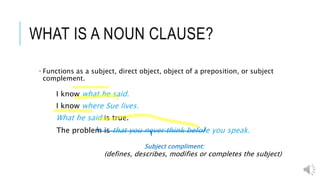
WHAT IS A NOUN CLAUSE?
 Functions as a subject, direct object, object of a preposition, or subject
complement.
I know what he said.
I know where Sue lives.
What he said is true.
The problem is that you never think before you speak.
Subject compliment:
(defines, describes, modifies or completes the subject)
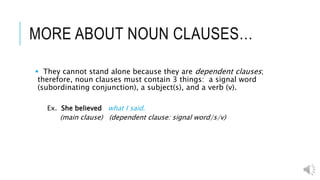
MORE ABOUT NOUN CLAUSES…
 They cannot stand alone because they are dependent clauses;
therefore, noun clauses must contain 3 things: a signal word
(subordinating conjunction), a subject(s), and a verb (v).
Ex. She believed what I said.
(main clause) (dependent clause: signal word/s/v)
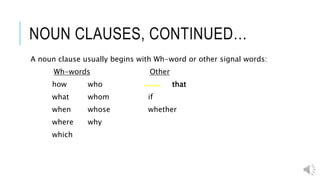
NOUN CLAUSES, CONTINUED…
A noun clause usually begins with Wh-word or other signal words:
Wh-words Other
how who that
what whom if
when whose whether
where why
which
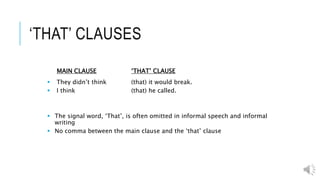
‘THAT’ CLAUSES
MAIN CLAUSE ‘THAT’ CLAUSE
 They didn’t think (that) it would break.
 I think (that) he called.
 The signal word, ‘That’, is often omitted in informal speech and informal
writing
 No comma between the main clause and the ‘that’ clause
‘THAT’ CLAUSES
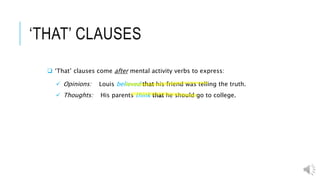
 ‘That’ clauses come after mental activity verbs to express:
 Opinions: Louis believed that his friend was telling the truth.
 Thoughts: His parents think that he should go to college.
‘THAT’ CLAUSES
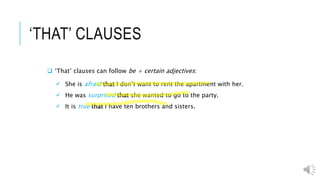
 ‘That’ clauses can follow be + certain adjectives:
 She is afraid that I don’t want to rent the apartment with her.
 He was surprised that she wanted to go to the party.
 It is true that I have ten brothers and sisters.
‘IF’ & ‘WHETHER’ CLAUSES
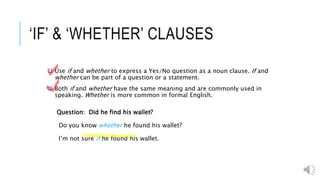
 Use if and whether to express a Yes/No question as a noun clause. If and
whether can be part of a question or a statement.
 Both if and whether have the same meaning and are commonly used in
speaking. Whether is more common in formal English.
Question: Did he find his wallet?
Do you know whether he found his wallet?
I’m not sure if he found his wallet.
‘IF’ & ‘WHETHER’ CLAUSES
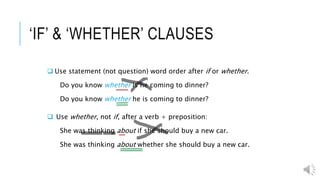
 Use statement (not question) word order after if or whether.
Do you know whether is he coming to dinner?
Do you know whether he is coming to dinner?
 Use whether, not if, after a verb + preposition:
She was thinking about if she should buy a new car.
She was thinking about whether she should buy a new car.
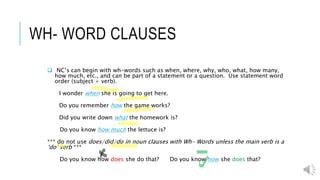
WH- WORD CLAUSES
 NC’s can begin with wh-words such as when, where, why, who, what, how many,
how much, etc., and can be part of a statement or a question. Use statement word
order (subject + verb).
I wonder when she is going to get here.
Do you remember how the game works?
Did you write down what the homework is?
Do you know how much the lettuce is?
*** do not use does/did/do in noun clauses with Wh- Words unless the main verb is a
‘do’ verb ***
Do you know how does she do that? Do you know how she does that?
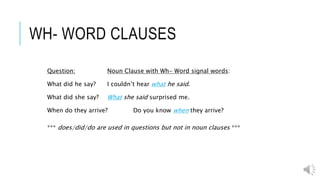
WH- WORD CLAUSES
Question: Noun Clause with Wh- Word signal words:
What did he say? I couldn’t hear what he said.
What did she say? What she said surprised me.
When do they arrive? Do you know when they arrive?
*** does/did/do are used in questions but not in noun clauses ***
~THE END~


Introduction to Noun Clauses

  • 1.
  • 2.
    WHAT IS ANOUN CLAUSE?  Functions as a subject, direct object, object of a preposition, or subject complement. I know what he said. I know where Sue lives. What he said is true. The problem is that you never think before you speak. Subject compliment: (defines, describes, modifies or completes the subject)
  • 3.
    MORE ABOUT NOUNCLAUSES…  They cannot stand alone because they are dependent clauses; therefore, noun clauses must contain 3 things: a signal word (subordinating conjunction), a subject(s), and a verb (v). Ex. She believed what I said. (main clause) (dependent clause: signal word/s/v)
  • 4.
    NOUN CLAUSES, CONTINUED… Anoun clause usually begins with Wh-word or other signal words: Wh-words Other how who that what whom if when whose whether where why which
  • 5.
    ‘THAT’ CLAUSES MAIN CLAUSE‘THAT’ CLAUSE  They didn’t think (that) it would break.  I think (that) he called.  The signal word, ‘That’, is often omitted in informal speech and informal writing  No comma between the main clause and the ‘that’ clause
  • 6.
    ‘THAT’ CLAUSES  ‘That’clauses come after mental activity verbs to express:  Opinions: Louis believed that his friend was telling the truth.  Thoughts: His parents think that he should go to college.
  • 7.
    ‘THAT’ CLAUSES  ‘That’clauses can follow be + certain adjectives:  She is afraid that I don’t want to rent the apartment with her.  He was surprised that she wanted to go to the party.  It is true that I have ten brothers and sisters.
  • 8.
    ‘IF’ & ‘WHETHER’CLAUSES  Use if and whether to express a Yes/No question as a noun clause. If and whether can be part of a question or a statement.  Both if and whether have the same meaning and are commonly used in speaking. Whether is more common in formal English. Question: Did he find his wallet? Do you know whether he found his wallet? I’m not sure if he found his wallet.
  • 9.
    ‘IF’ & ‘WHETHER’CLAUSES  Use statement (not question) word order after if or whether. Do you know whether is he coming to dinner? Do you know whether he is coming to dinner?  Use whether, not if, after a verb + preposition: She was thinking about if she should buy a new car. She was thinking about whether she should buy a new car.
  • 10.
    WH- WORD CLAUSES NC’s can begin with wh-words such as when, where, why, who, what, how many, how much, etc., and can be part of a statement or a question. Use statement word order (subject + verb). I wonder when she is going to get here. Do you remember how the game works? Did you write down what the homework is? Do you know how much the lettuce is? *** do not use does/did/do in noun clauses with Wh- Words unless the main verb is a ‘do’ verb *** Do you know how does she do that? Do you know how she does that?
  • 11.
    WH- WORD CLAUSES Question:Noun Clause with Wh- Word signal words: What did he say? I couldn’t hear what he said. What did she say? What she said surprised me. When do they arrive? Do you know when they arrive? *** does/did/do are used in questions but not in noun clauses ***
  • 12.