Conditionals
sentences contain two clauses:
the condition clause (if clause)
and
the result clause
Conditional sentences show a
relationship between a condition
and a result of the condition
1) factual conditionals
express general truths, habits, and
logical possibilities.
Present or past in both clauses
If I have money, I spend it
If a bird is happy, it sings.
You see a lot of bears if you live in
Montana.
My cat moves her tail a lot if she’s
nervous.
If I needed help, she gave it to me.
2) future conditionals
Express conditions and results in the future.
The if clause is in the present and the result
clause is in the future with will or be going to.
If it rains tomorrow, we won’t go to the pool.
Future conditionals express what
will happen in the future if certain
conditions occur. They are often
used to make predictions, plans,
offers, suggestions, requests.
If you study, you’ll pass the test.
If you go to New York next week,
you’ll see the show.
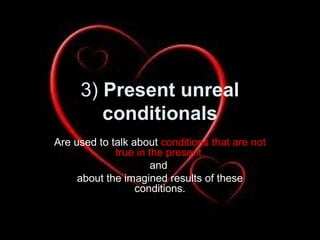
3) Present unreal
conditionals
Are used to talk about conditions that are not
true in the present
and
about the imagined results of these
conditions.
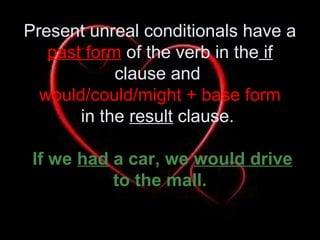
Present unreal conditionals have a
past form of the verb in the if
clause and
would/could/might + base form
in the result clause.
If we had a car, we would drive
to the mall.
Were is used for all persons of be
in the if clause.
(I, you, she, he, we, they were)
If I were the teacher, I’d give a lot
less homework.
The if clause expresses a condition
that is not true at the present time.
The condition might be highly
unlikely or impossible.
The result clause tells what would
happen if this untrue condition were
true. It expresses the imagined
result of an imagined condition.
If I were a cat, I would sleep all
day.
If I had time, I would study another
language.
If I had a lot of money, …..
If I were you, I wouldn’t worry.
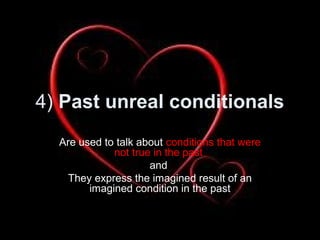
4) Past unreal conditionals
Are used to talk about conditions that were
not true in the past
and
They express the imagined result of an
imagined condition in the past
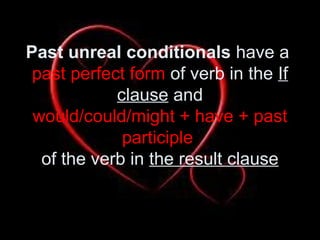
Past unreal conditionals have a
past perfect form of verb in the If
clause and
would/could/might + have + past
participle
of the verb in the result clause
The if clause of the past unreal
conditional expresses a condition
that was not true in the past.
The result clause tells what would
have happened if the untrue
condition had been true.
Factual
If the temperature falls below 32
degrees F., water freezes
future
If it continues to rain, there will be
a flood.
Present unreal
If I were you, I would watch the
weather forecast.
Past unreal
If I had studied, I would have
passed the test.
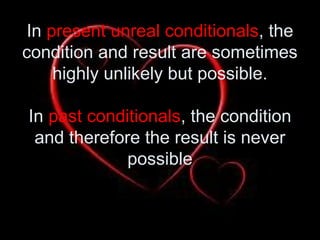
In present unreal conditionals, the
condition and result are sometimes
highly unlikely but possible.
In past conditionals, the condition
and therefore the result is never
possible
If you were coming tonight, we
could go to a movie (highly unlikely,
but possible)
If you had come last night, we
could have gone to a movie.
(impossible; you didn’t come last
night.)
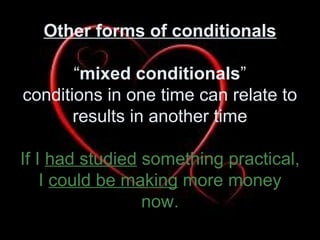
Other forms of conditionals
“mixed conditionals”
conditions in one time can relate to
results in another time
If I had studied something practical,
I could be making more money
now.
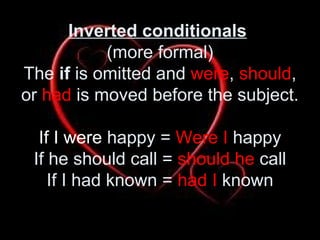
Inverted conditionals
(more formal)
The if is omitted and were, should,
or had is moved before the subject.
If I were happy = Were I happy
If he should call = should he call
If I had known = had I known
If so, if not
The condition is clear from a
previous sentence. It is not
necessary to repeat the entire
condition
I should pass all my courses this
semester. If not, I’ll enroll in
summer school.
Hope
is about what is possible (like
factual and future conditionals)
I hope I can come to the picnic.
Wish
is about what is not likely or not
possible.
Wish about the present or future:
wish + past form of verb or would
or could + base form
He wishes he had more money.
Wish about the past: wish + past
perfect
We wish you had been here.
Alternatives to IF
In the event, providing, provided,
as long as, whether or not, even
if, only if, unless
I will pass my exam only if I study.
I will fail my exam unless I study.
Only if it rains, will we cancel the
picnic.
Only if he asks do I help her .
Whether I pass or not, I am going
to Columbia in June.
As long as he ‘s going to be there,
I’ll be there too.
Implied conditions
With, without, or else, otherwise
With proper identification, you can
board the plane.
Without proper documentation, you
can’t take the test.
He will go or I won’t stay.
He will go. Otherwise, I am
leaving.
The End!

Conditionals

  • 1.
  • 2.
    sentences contain twoclauses: the condition clause (if clause) and the result clause Conditional sentences show a relationship between a condition and a result of the condition
  • 3.
    1) factual conditionals expressgeneral truths, habits, and logical possibilities. Present or past in both clauses If I have money, I spend it
  • 4.
    If a birdis happy, it sings. You see a lot of bears if you live in Montana. My cat moves her tail a lot if she’s nervous. If I needed help, she gave it to me.
  • 5.
    2) future conditionals Expressconditions and results in the future. The if clause is in the present and the result clause is in the future with will or be going to. If it rains tomorrow, we won’t go to the pool.
  • 6.
    Future conditionals expresswhat will happen in the future if certain conditions occur. They are often used to make predictions, plans, offers, suggestions, requests. If you study, you’ll pass the test. If you go to New York next week, you’ll see the show.
  • 7.
    3) Present unreal conditionals Areused to talk about conditions that are not true in the present and about the imagined results of these conditions.
  • 8.
    Present unreal conditionalshave a past form of the verb in the if clause and would/could/might + base form in the result clause. If we had a car, we would drive to the mall.
  • 9.
    Were is usedfor all persons of be in the if clause. (I, you, she, he, we, they were) If I were the teacher, I’d give a lot less homework.
  • 10.
    The if clauseexpresses a condition that is not true at the present time. The condition might be highly unlikely or impossible.
  • 11.
    The result clausetells what would happen if this untrue condition were true. It expresses the imagined result of an imagined condition.
  • 12.
    If I werea cat, I would sleep all day. If I had time, I would study another language. If I had a lot of money, ….. If I were you, I wouldn’t worry.
  • 13.
    4) Past unrealconditionals Are used to talk about conditions that were not true in the past and They express the imagined result of an imagined condition in the past
  • 14.
    Past unreal conditionalshave a past perfect form of verb in the If clause and would/could/might + have + past participle of the verb in the result clause
  • 15.
    The if clauseof the past unreal conditional expresses a condition that was not true in the past. The result clause tells what would have happened if the untrue condition had been true.
  • 16.
    Factual If the temperaturefalls below 32 degrees F., water freezes
  • 17.
    future If it continuesto rain, there will be a flood.
  • 18.
    Present unreal If Iwere you, I would watch the weather forecast.
  • 19.
    Past unreal If Ihad studied, I would have passed the test.
  • 20.
    In present unrealconditionals, the condition and result are sometimes highly unlikely but possible. In past conditionals, the condition and therefore the result is never possible
  • 21.
    If you werecoming tonight, we could go to a movie (highly unlikely, but possible) If you had come last night, we could have gone to a movie. (impossible; you didn’t come last night.)
  • 22.
    Other forms ofconditionals “mixed conditionals” conditions in one time can relate to results in another time If I had studied something practical, I could be making more money now.
  • 23.
    Inverted conditionals (more formal) Theif is omitted and were, should, or had is moved before the subject. If I were happy = Were I happy If he should call = should he call If I had known = had I known
  • 24.
    If so, ifnot The condition is clear from a previous sentence. It is not necessary to repeat the entire condition I should pass all my courses this semester. If not, I’ll enroll in summer school.
  • 25.
    Hope is about whatis possible (like factual and future conditionals) I hope I can come to the picnic.
  • 26.
    Wish is about whatis not likely or not possible. Wish about the present or future: wish + past form of verb or would or could + base form He wishes he had more money. Wish about the past: wish + past perfect We wish you had been here.
  • 27.
    Alternatives to IF Inthe event, providing, provided, as long as, whether or not, even if, only if, unless
  • 28.
    I will passmy exam only if I study. I will fail my exam unless I study. Only if it rains, will we cancel the picnic. Only if he asks do I help her . Whether I pass or not, I am going to Columbia in June. As long as he ‘s going to be there, I’ll be there too.
  • 29.
  • 30.
    With proper identification,you can board the plane. Without proper documentation, you can’t take the test. He will go or I won’t stay. He will go. Otherwise, I am leaving.
  • 31.