Transitive and Intransitive
Verbs
Unit 9 Lesson 1
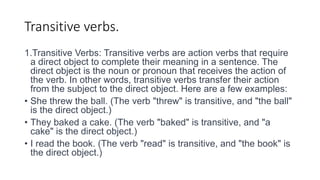
Transitive verbs.
1.Transitive Verbs: Transitive verbs are action verbs that require
a direct object to complete their meaning in a sentence. The
direct object is the noun or pronoun that receives the action of
the verb. In other words, transitive verbs transfer their action
from the subject to the direct object. Here are a few examples:
• She threw the ball. (The verb "threw" is transitive, and "the ball"
is the direct object.)
• They baked a cake. (The verb "baked" is transitive, and "a
cake" is the direct object.)
• I read the book. (The verb "read" is transitive, and "the book" is
the direct object.)
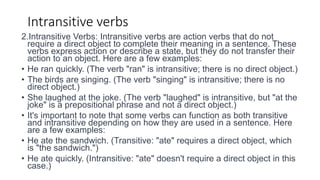
Intransitive verbs
2.Intransitive Verbs: Intransitive verbs are action verbs that do not
require a direct object to complete their meaning in a sentence. These
verbs express action or describe a state, but they do not transfer their
action to an object. Here are a few examples:
• He ran quickly. (The verb "ran" is intransitive; there is no direct object.)
• The birds are singing. (The verb "singing" is intransitive; there is no
direct object.)
• She laughed at the joke. (The verb "laughed" is intransitive, but "at the
joke" is a prepositional phrase and not a direct object.)
• It's important to note that some verbs can function as both transitive
and intransitive depending on how they are used in a sentence. Here
are a few examples:
• He ate the sandwich. (Transitive: "ate" requires a direct object, which
is "the sandwich.")
• He ate quickly. (Intransitive: "ate" doesn't require a direct object in this
case.)
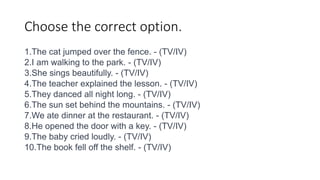
Choose the correct option.
1.The cat jumped over the fence. - (TV/IV)
2.I am walking to the park. - (TV/IV)
3.She sings beautifully. - (TV/IV)
4.The teacher explained the lesson. - (TV/IV)
5.They danced all night long. - (TV/IV)
6.The sun set behind the mountains. - (TV/IV)
7.We ate dinner at the restaurant. - (TV/IV)
8.He opened the door with a key. - (TV/IV)
9.The baby cried loudly. - (TV/IV)
10.The book fell off the shelf. - (TV/IV)
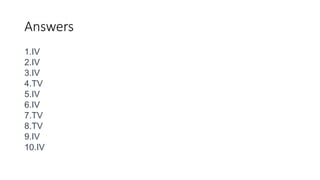
Answers
1.IV
2.IV
3.IV
4.TV
5.IV
6.IV
7.TV
8.TV
9.IV
10.IV
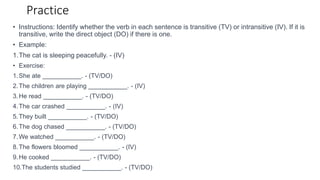
Practice
• Instructions: Identify whether the verb in each sentence is transitive (TV) or intransitive (IV). If it is
transitive, write the direct object (DO) if there is one.
• Example:
1.The cat is sleeping peacefully. - (IV)
• Exercise:
1.She ate ___________. - (TV/DO)
2.The children are playing ___________. - (IV)
3.He read ___________. - (TV/DO)
4.The car crashed ___________. - (IV)
5.They built ___________. - (TV/DO)
6.The dog chased ___________. - (TV/DO)
7.We watched ___________. - (TV/DO)
8.The flowers bloomed ___________. - (IV)
9.He cooked ___________. - (TV/DO)
10.The students studied ___________. - (TV/DO)
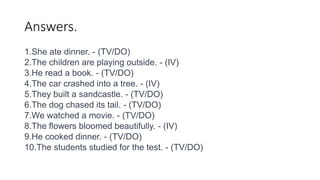
Answers.
1.She ate dinner. - (TV/DO)
2.The children are playing outside. - (IV)
3.He read a book. - (TV/DO)
4.The car crashed into a tree. - (IV)
5.They built a sandcastle. - (TV/DO)
6.The dog chased its tail. - (TV/DO)
7.We watched a movie. - (TV/DO)
8.The flowers bloomed beautifully. - (IV)
9.He cooked dinner. - (TV/DO)
10.The students studied for the test. - (TV/DO)

Transitive and Intransitive Verbs b1 Afternoon.pptx

  • 1.
  • 2.
    Transitive verbs. 1.Transitive Verbs:Transitive verbs are action verbs that require a direct object to complete their meaning in a sentence. The direct object is the noun or pronoun that receives the action of the verb. In other words, transitive verbs transfer their action from the subject to the direct object. Here are a few examples: • She threw the ball. (The verb "threw" is transitive, and "the ball" is the direct object.) • They baked a cake. (The verb "baked" is transitive, and "a cake" is the direct object.) • I read the book. (The verb "read" is transitive, and "the book" is the direct object.)
  • 3.
    Intransitive verbs 2.Intransitive Verbs:Intransitive verbs are action verbs that do not require a direct object to complete their meaning in a sentence. These verbs express action or describe a state, but they do not transfer their action to an object. Here are a few examples: • He ran quickly. (The verb "ran" is intransitive; there is no direct object.) • The birds are singing. (The verb "singing" is intransitive; there is no direct object.) • She laughed at the joke. (The verb "laughed" is intransitive, but "at the joke" is a prepositional phrase and not a direct object.) • It's important to note that some verbs can function as both transitive and intransitive depending on how they are used in a sentence. Here are a few examples: • He ate the sandwich. (Transitive: "ate" requires a direct object, which is "the sandwich.") • He ate quickly. (Intransitive: "ate" doesn't require a direct object in this case.)
  • 4.
    Choose the correctoption. 1.The cat jumped over the fence. - (TV/IV) 2.I am walking to the park. - (TV/IV) 3.She sings beautifully. - (TV/IV) 4.The teacher explained the lesson. - (TV/IV) 5.They danced all night long. - (TV/IV) 6.The sun set behind the mountains. - (TV/IV) 7.We ate dinner at the restaurant. - (TV/IV) 8.He opened the door with a key. - (TV/IV) 9.The baby cried loudly. - (TV/IV) 10.The book fell off the shelf. - (TV/IV)
  • 5.
  • 6.
    Practice • Instructions: Identifywhether the verb in each sentence is transitive (TV) or intransitive (IV). If it is transitive, write the direct object (DO) if there is one. • Example: 1.The cat is sleeping peacefully. - (IV) • Exercise: 1.She ate ___________. - (TV/DO) 2.The children are playing ___________. - (IV) 3.He read ___________. - (TV/DO) 4.The car crashed ___________. - (IV) 5.They built ___________. - (TV/DO) 6.The dog chased ___________. - (TV/DO) 7.We watched ___________. - (TV/DO) 8.The flowers bloomed ___________. - (IV) 9.He cooked ___________. - (TV/DO) 10.The students studied ___________. - (TV/DO)
  • 7.
    Answers. 1.She ate dinner.- (TV/DO) 2.The children are playing outside. - (IV) 3.He read a book. - (TV/DO) 4.The car crashed into a tree. - (IV) 5.They built a sandcastle. - (TV/DO) 6.The dog chased its tail. - (TV/DO) 7.We watched a movie. - (TV/DO) 8.The flowers bloomed beautifully. - (IV) 9.He cooked dinner. - (TV/DO) 10.The students studied for the test. - (TV/DO)