The document is a presentation on transition elements, covering topics such as electronic configuration, physical and chemical properties, ionization energy, and alloy formation. It highlights the unique characteristics of these elements including their variable oxidation states, catalytic and magnetic properties, and the lanthanide contraction. Additionally, it includes trends in atomic and ionic radii, and the formation of complex ions.
Name. MARYAM AKHTAR
DEPT:BS CHEMISTRY
ID: 19002067004
COURSE :Principles of
chemistry 3
TOPIC: transition elements
SUBMITTED TO : Sir
khizar 1
2.
2
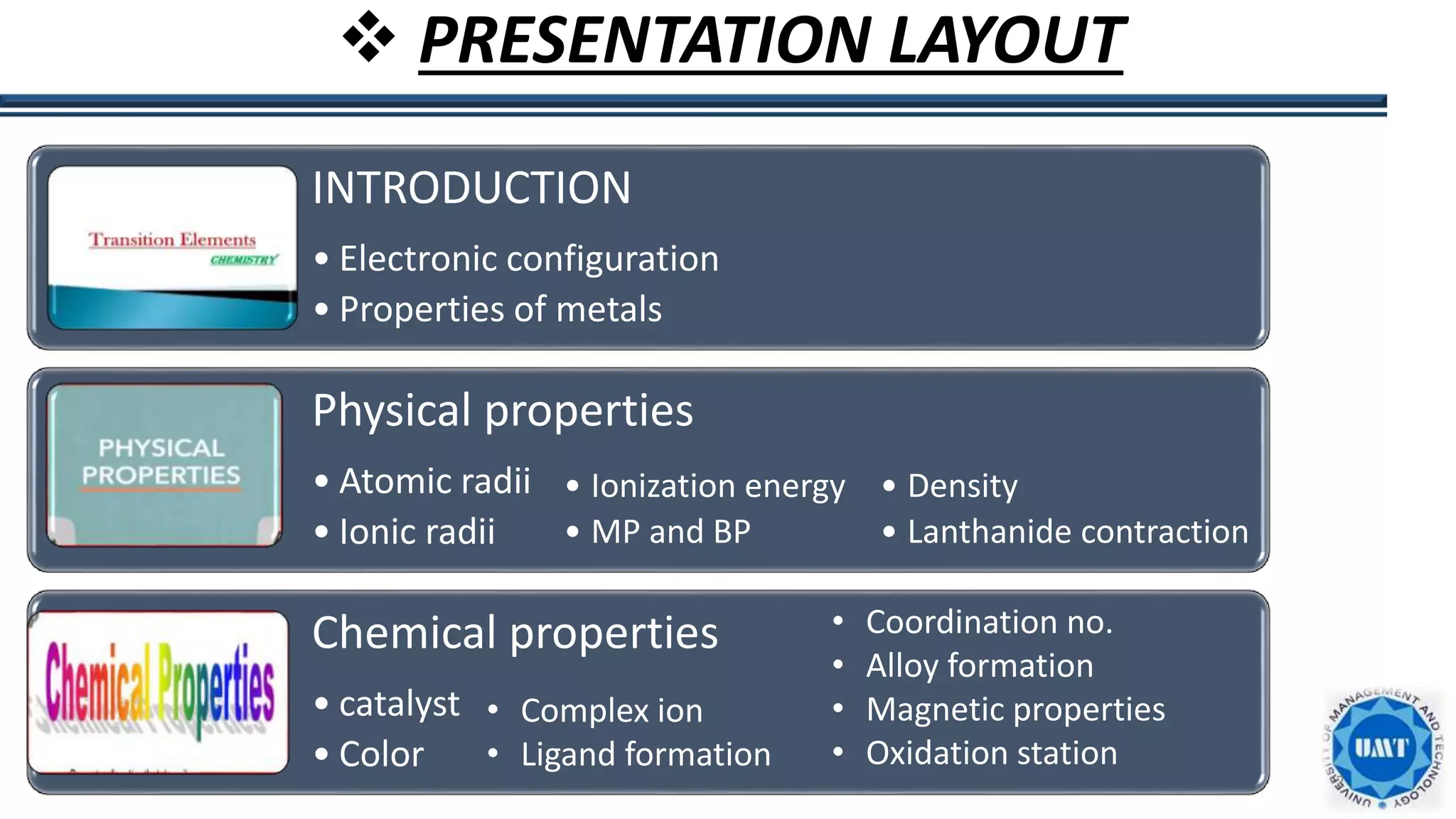
PRESENTATION LAYOUT
INTRODUCTION
•Electronic configuration
• Properties of metals
Physical properties
• Atomic radii
• Ionic radii
Chemical properties
• catalyst
• Color
• Ionization energy
• MP and BP
• Density
• Lanthanide contraction
• Coordination no.
• Alloy formation
• Magnetic properties
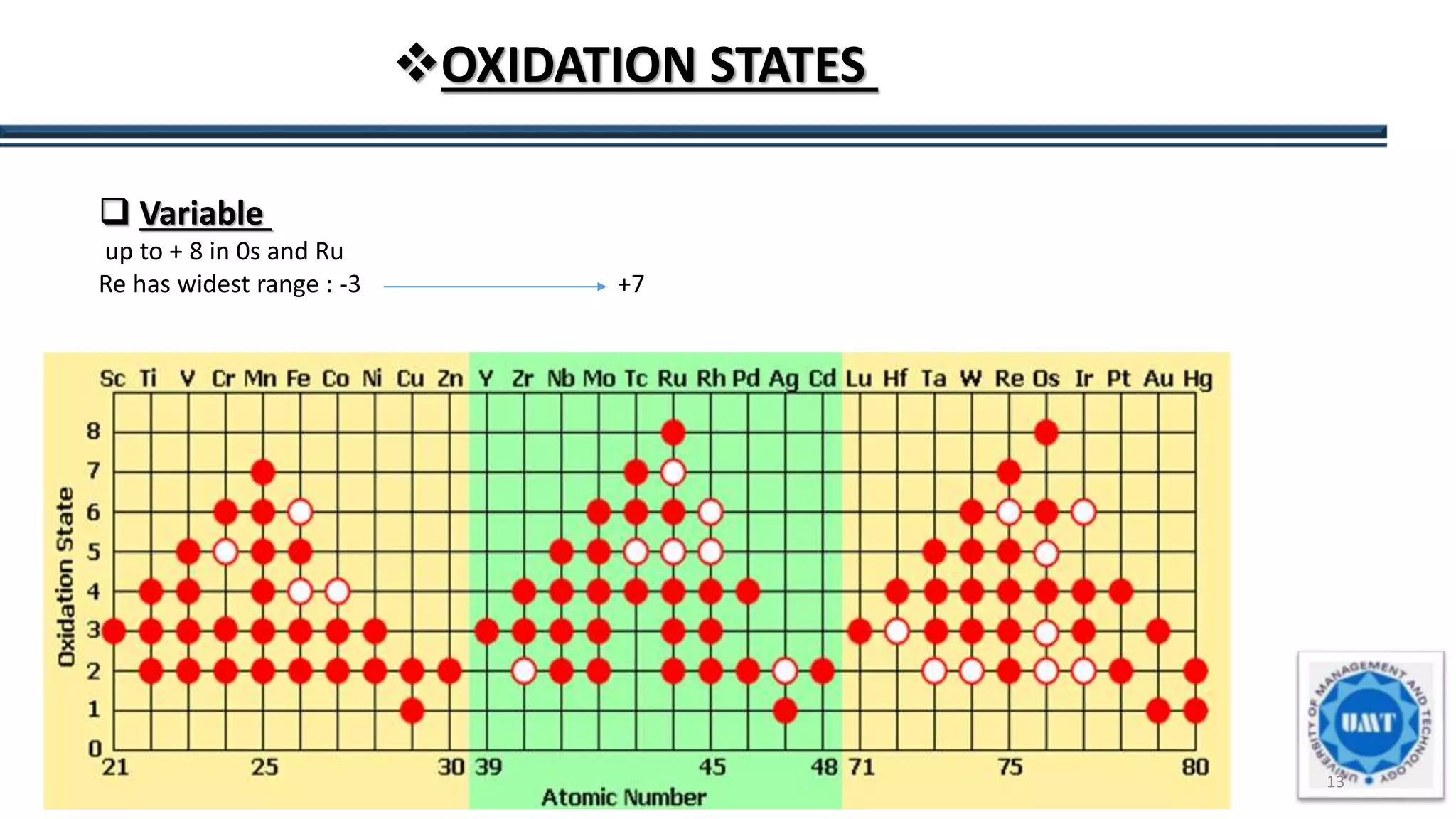
• Oxidation station
• Complex ion
• Ligand formation
3.
3
TRANSITION ELEMENT
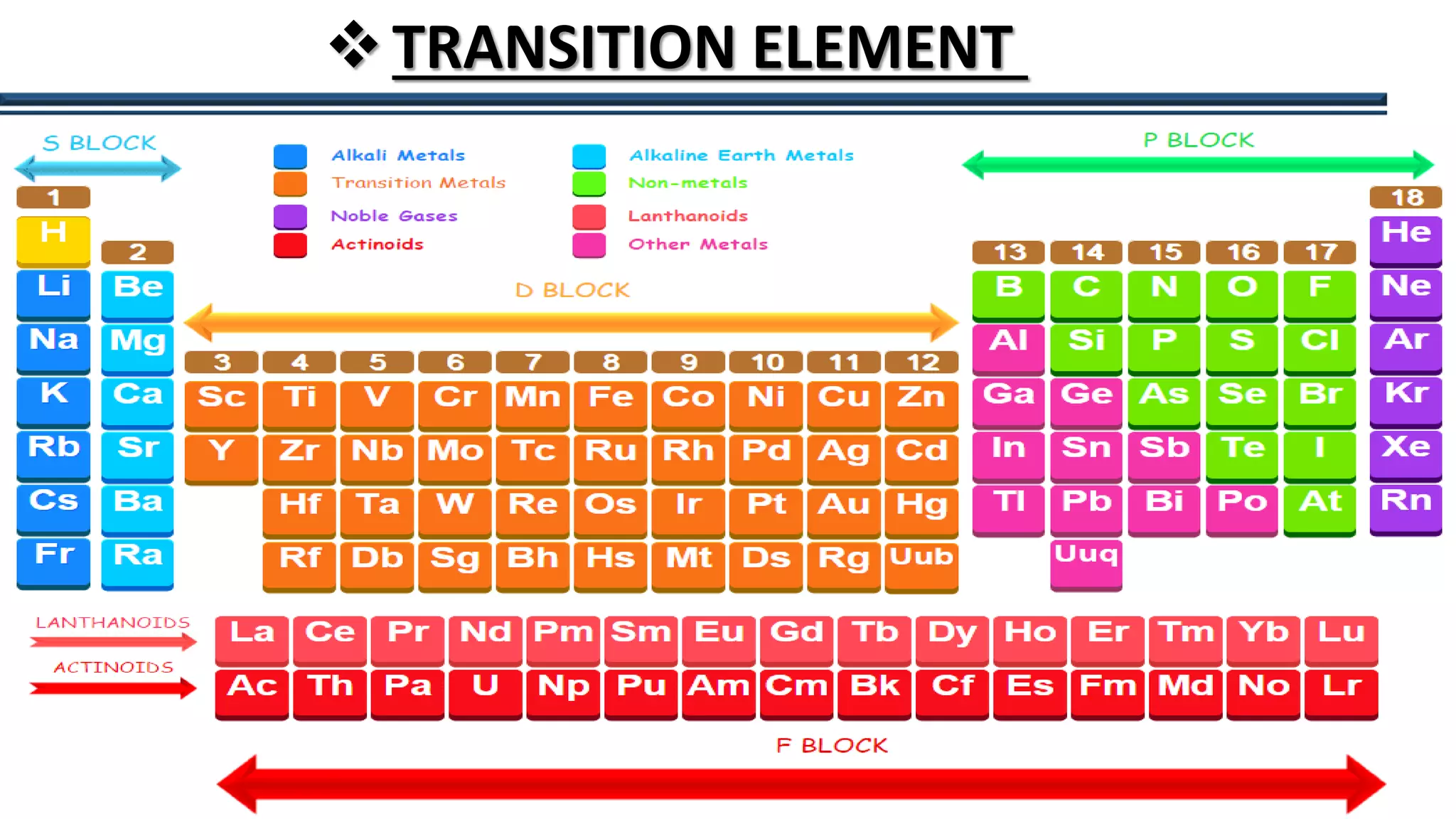
Theelement in which differentiating electron enter in (n-1)d
orbitals of (n-1) the main shell are called transition elements .
These elements are also known as bridge elements as they are lying
between s and p block elements in a periodic table .
Because the differencing electron in these elements enter in d
orbital so these elements are called as d-block elements .
Partially filled d orbital in its atom in the ground state or in any one
of its oxidation state.
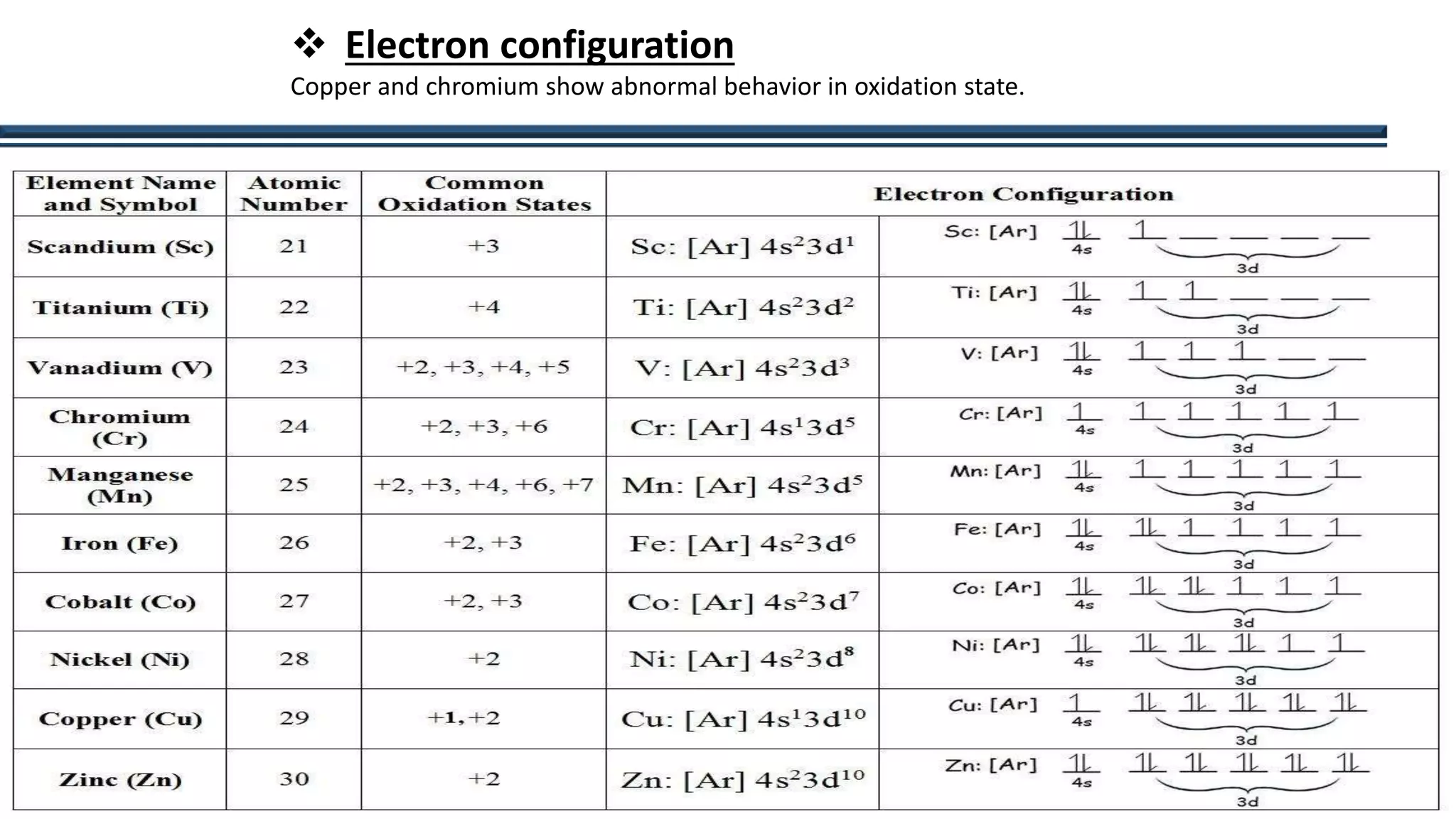
General Electronic Configuration (n-1) d1-10 ns1-2 .
Zn , Cd and Hg – Group 12 – pseudo transition elements – filled d
orbital (n-1) d10 ns2 d 10
7
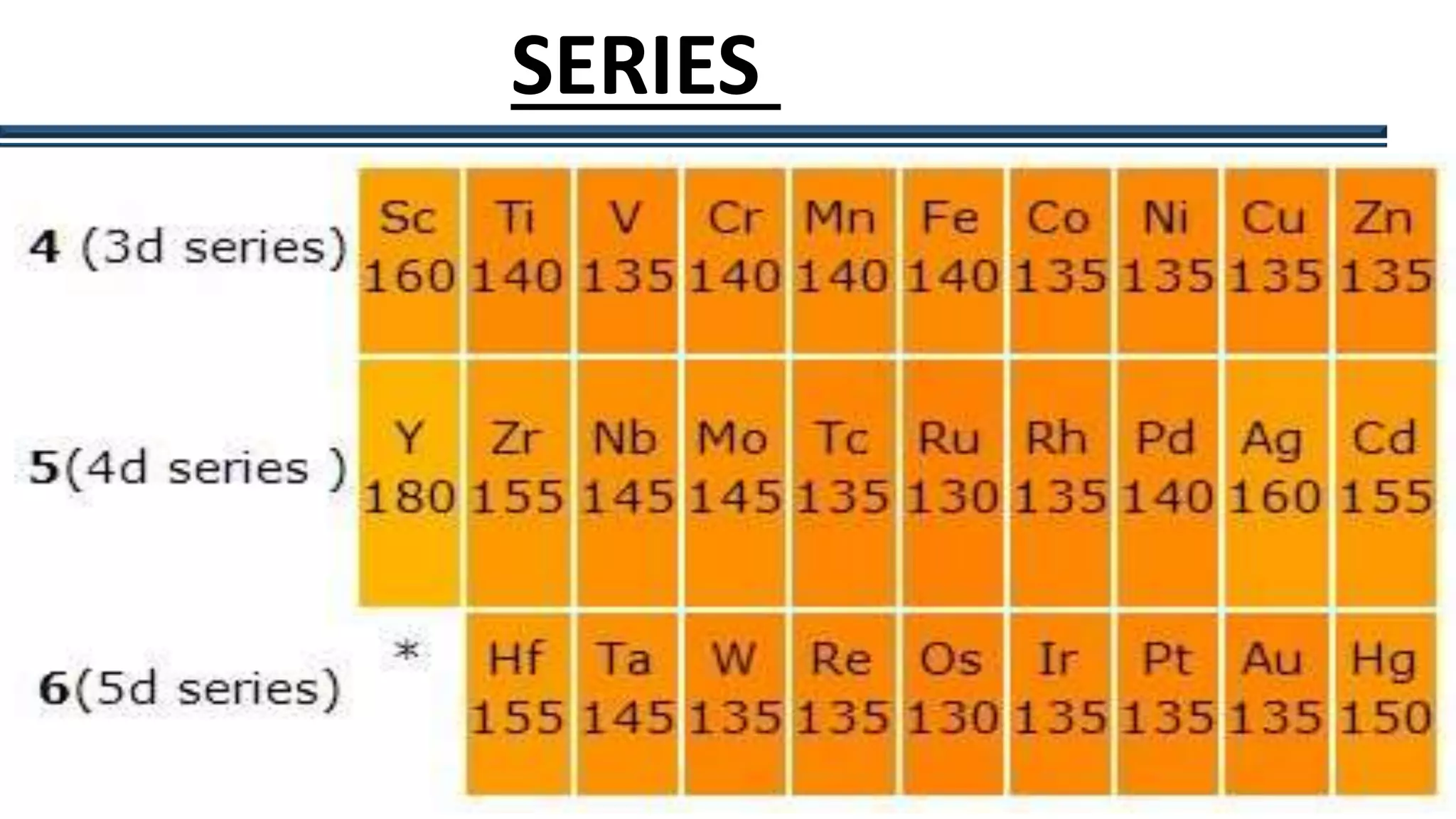
SERIES
Yttrium 39 Y……………………….
Zirconium 40 Zr ……………………...
Niobium 41 Nb ………………………..
Molybdenum 42 Mo
Technetium 43 Tc
Ruthenium 44 Ru
Rhodium 45 Rh
Palladium 46 Pd
Silver 47 Ag
Cadmium 48 Cd ………………
8.
8
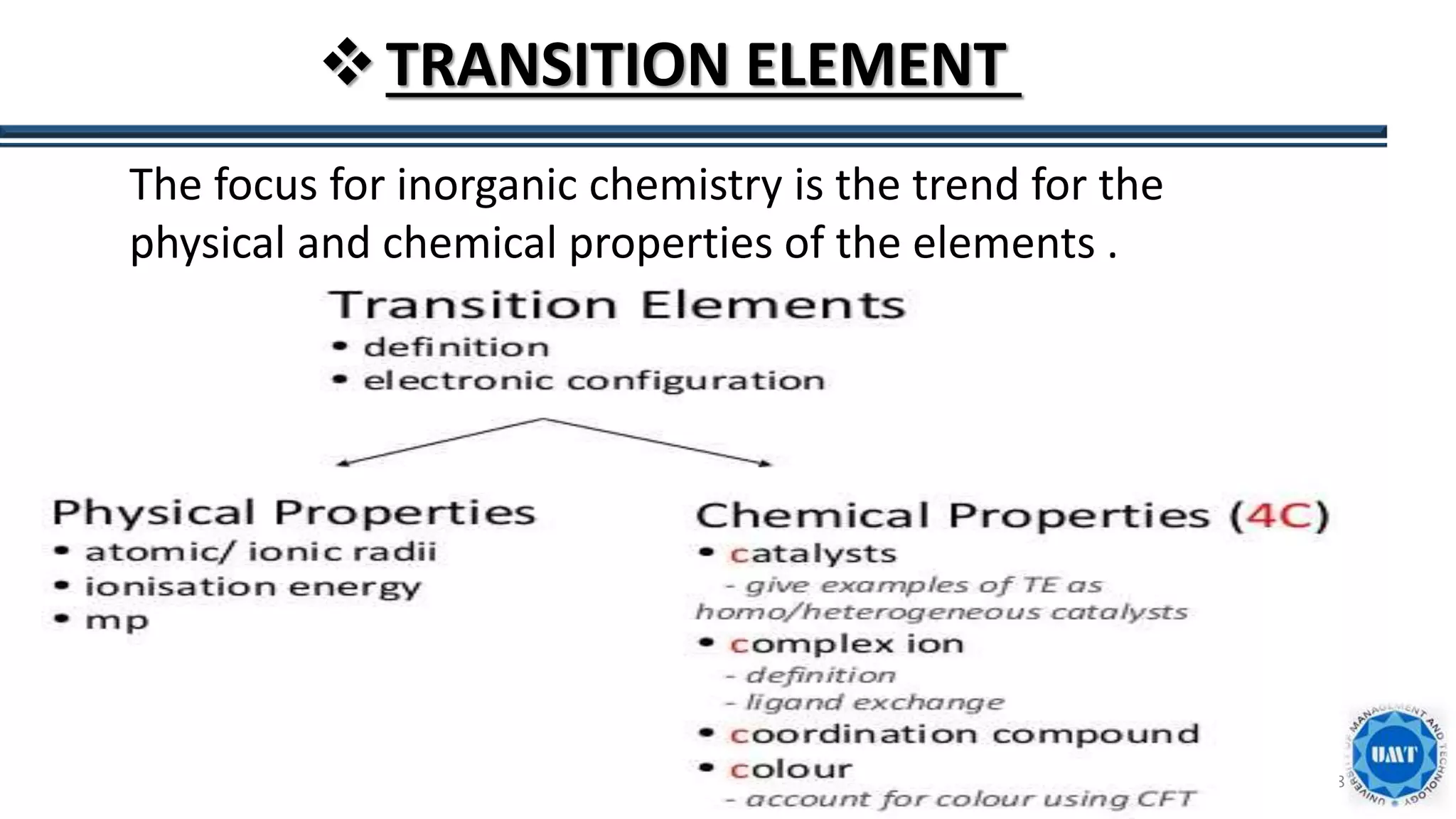
The focus forinorganic chemistry is the trend for the
physical and chemical properties of the elements .
TRANSITION ELEMENT
9.
9
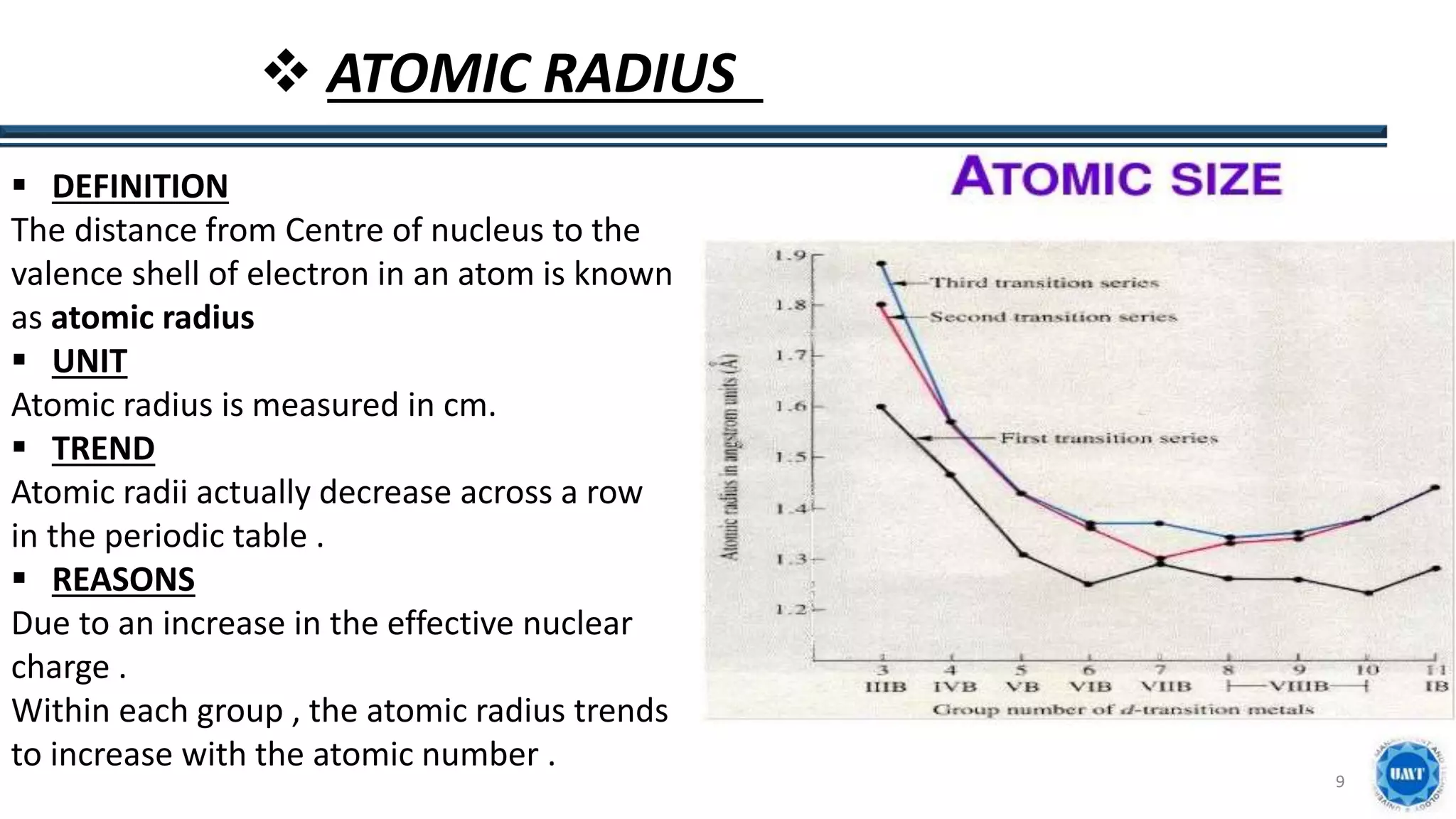
ATOMIC RADIUS
DEFINITION
The distance from Centre of nucleus to the
valence shell of electron in an atom is known
as atomic radius
UNIT
Atomic radius is measured in cm.
TREND
Atomic radii actually decrease across a row
in the periodic table .
REASONS
Due to an increase in the effective nuclear
charge .
Within each group , the atomic radius trends
to increase with the atomic number .
10.
10
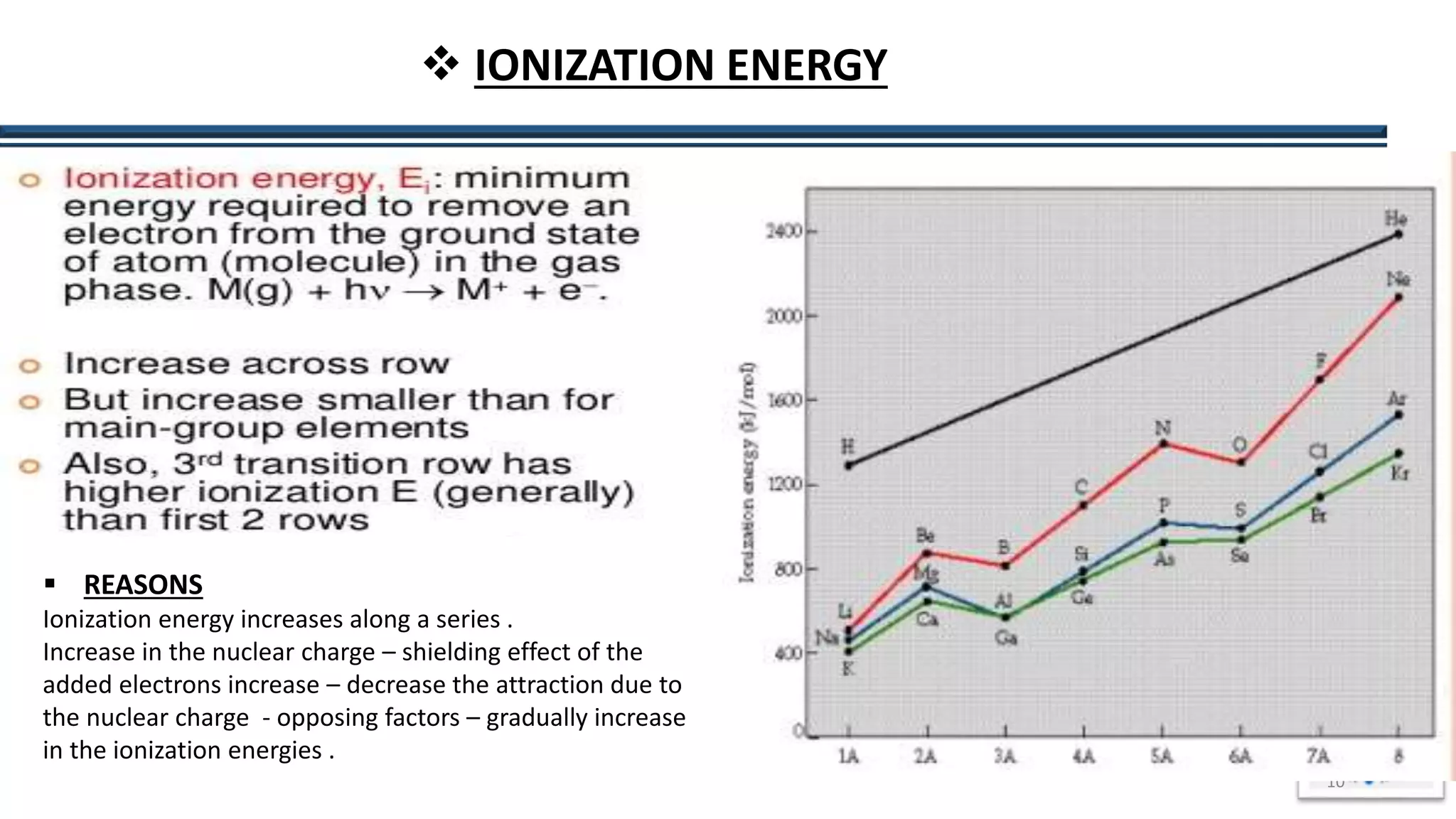
IONIZATION ENERGY
REASONS
Ionization energy increases along a series .
Increase in the nuclear charge – shielding effect of the
added electrons increase – decrease the attraction due to
the nuclear charge - opposing factors – gradually increase
in the ionization energies .
11.
11
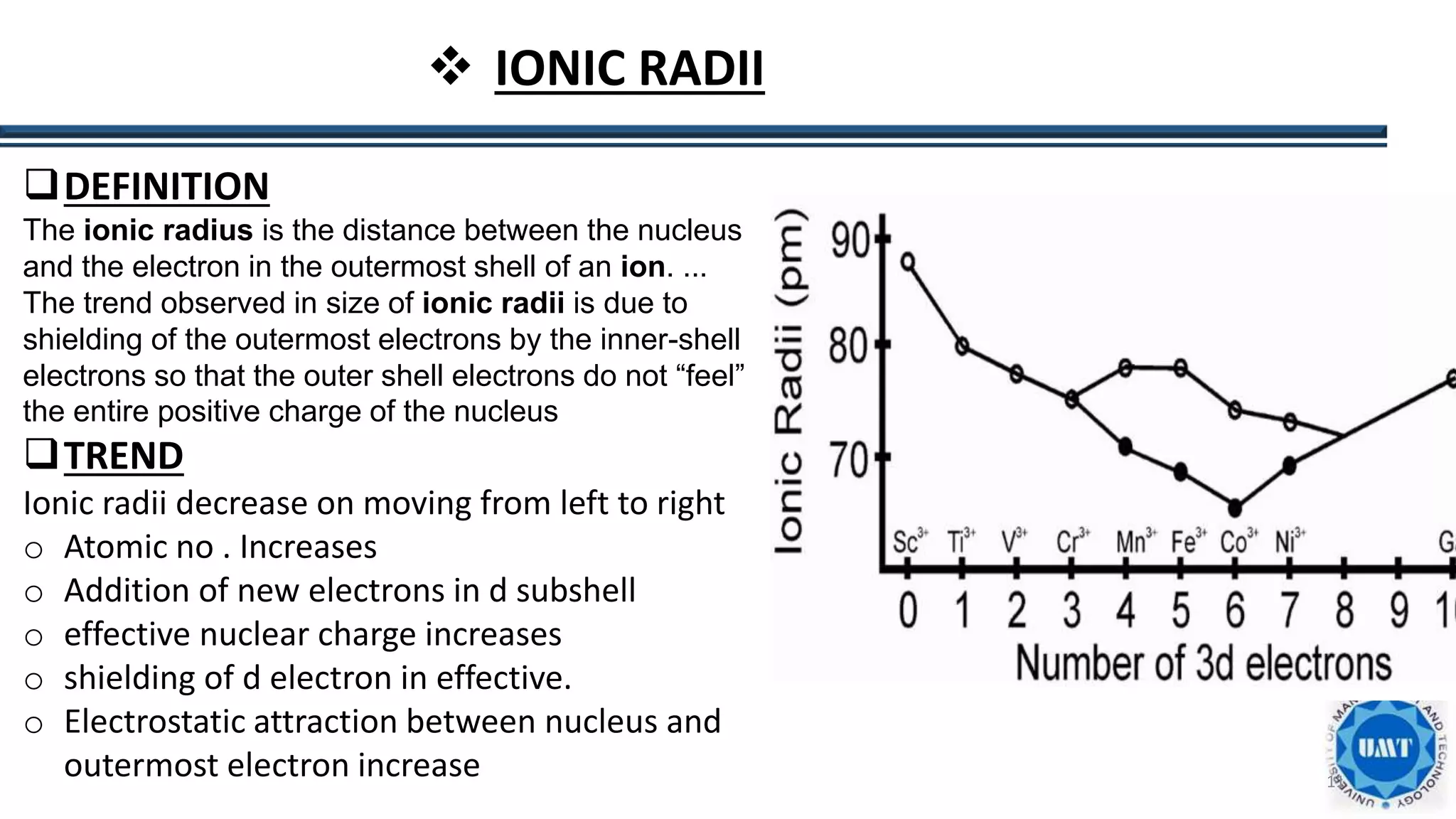
IONIC RADII
DEFINITION
Theionic radius is the distance between the nucleus
and the electron in the outermost shell of an ion. ...
The trend observed in size of ionic radii is due to
shielding of the outermost electrons by the inner-shell
electrons so that the outer shell electrons do not “feel”
the entire positive charge of the nucleus
TREND
Ionic radii decrease on moving from left to right
o Atomic no . Increases
o Addition of new electrons in d subshell
o effective nuclear charge increases
o shielding of d electron in effective.
o Electrostatic attraction between nucleus and
outermost electron increase
12.
12
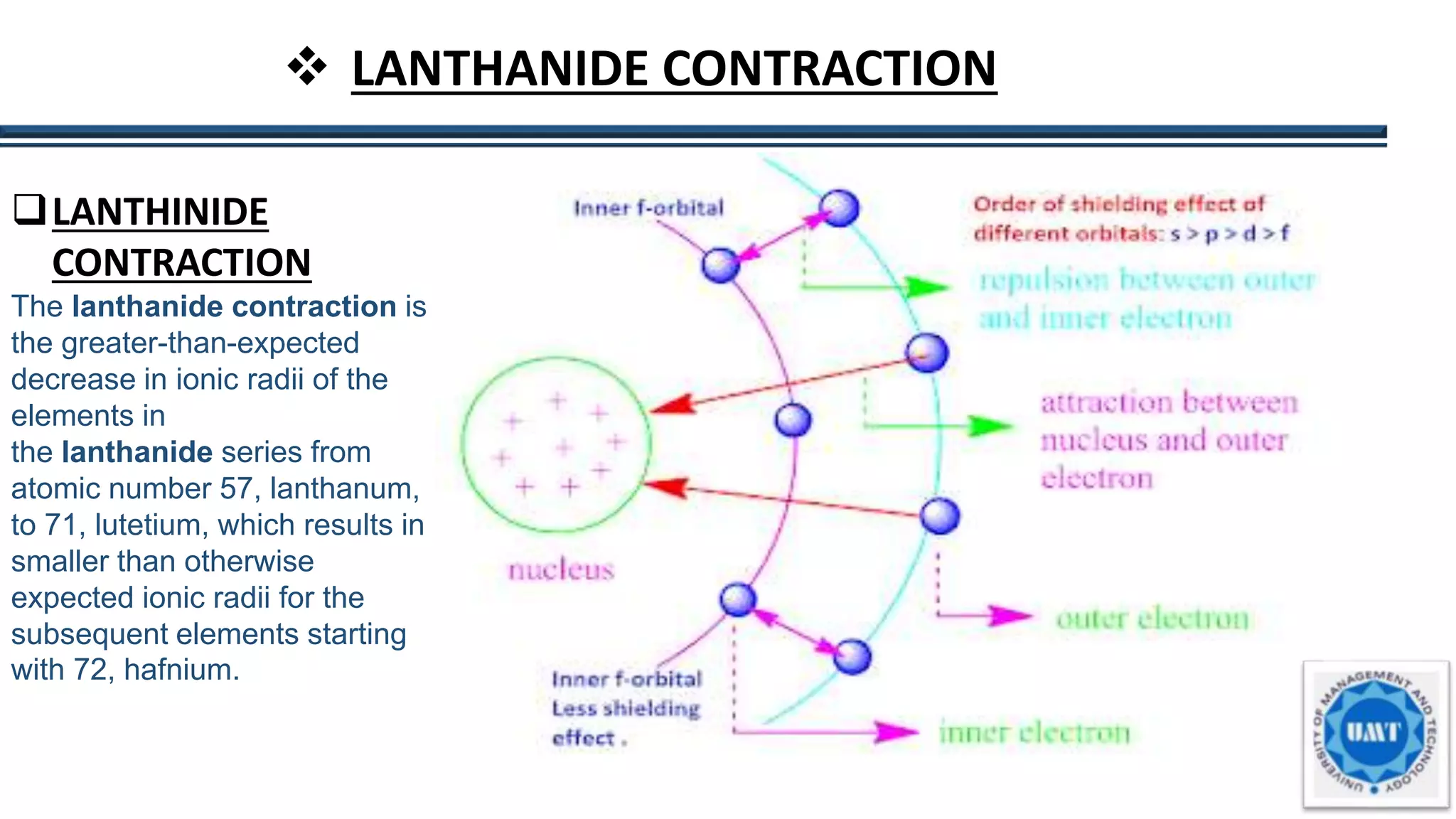
LANTHANIDE CONTRACTION
LANTHINIDE
CONTRACTION
Thelanthanide contraction is
the greater-than-expected
decrease in ionic radii of the
elements in
the lanthanide series from
atomic number 57, lanthanum,
to 71, lutetium, which results in
smaller than otherwise
expected ionic radii for the
subsequent elements starting
with 72, hafnium.
14
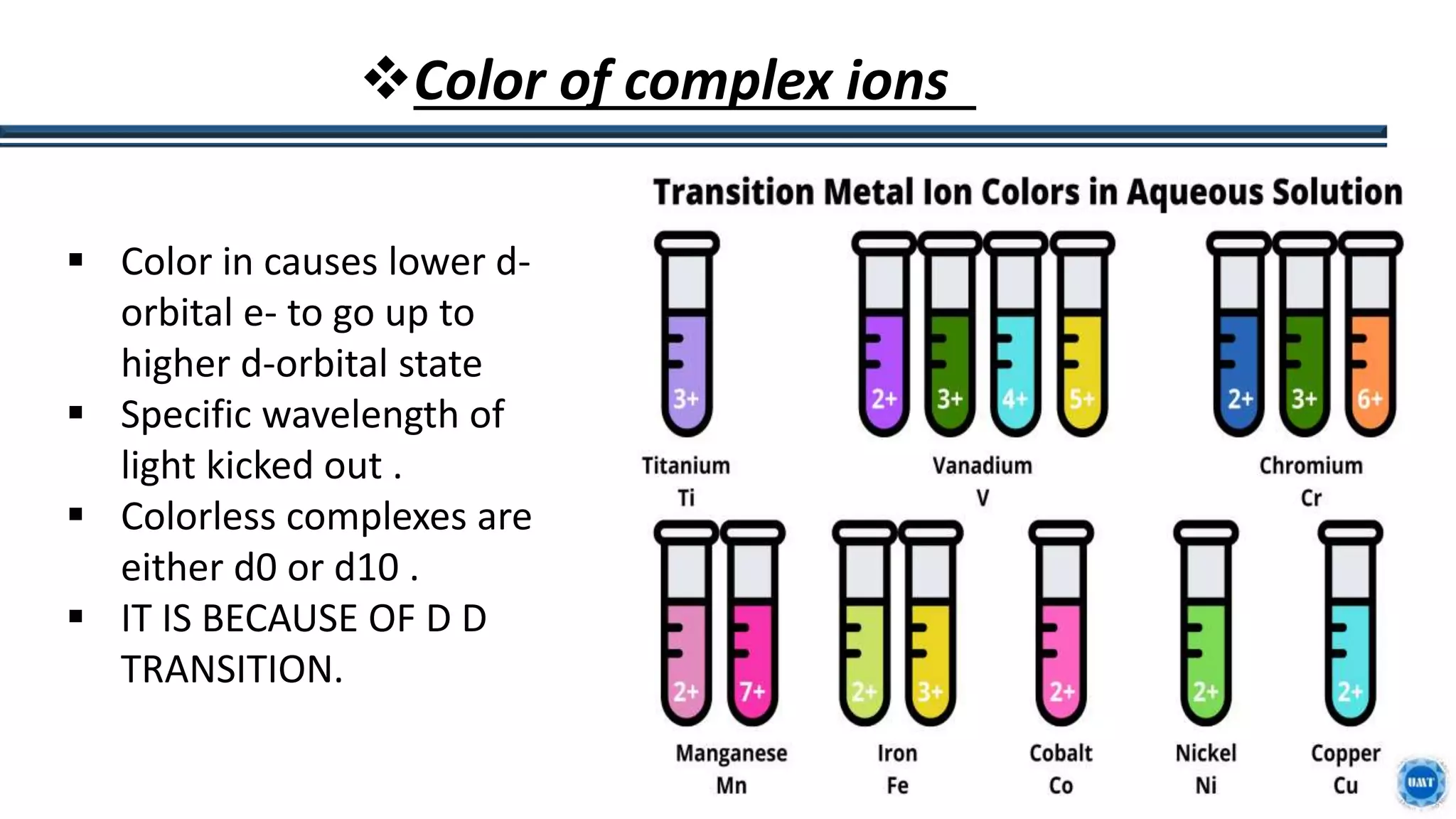
Color of complexions
Color in causes lower d-
orbital e- to go up to
higher d-orbital state
Specific wavelength of
light kicked out .
Colorless complexes are
either d0 or d10 .
IT IS BECAUSE OF D D
TRANSITION.
15.
15
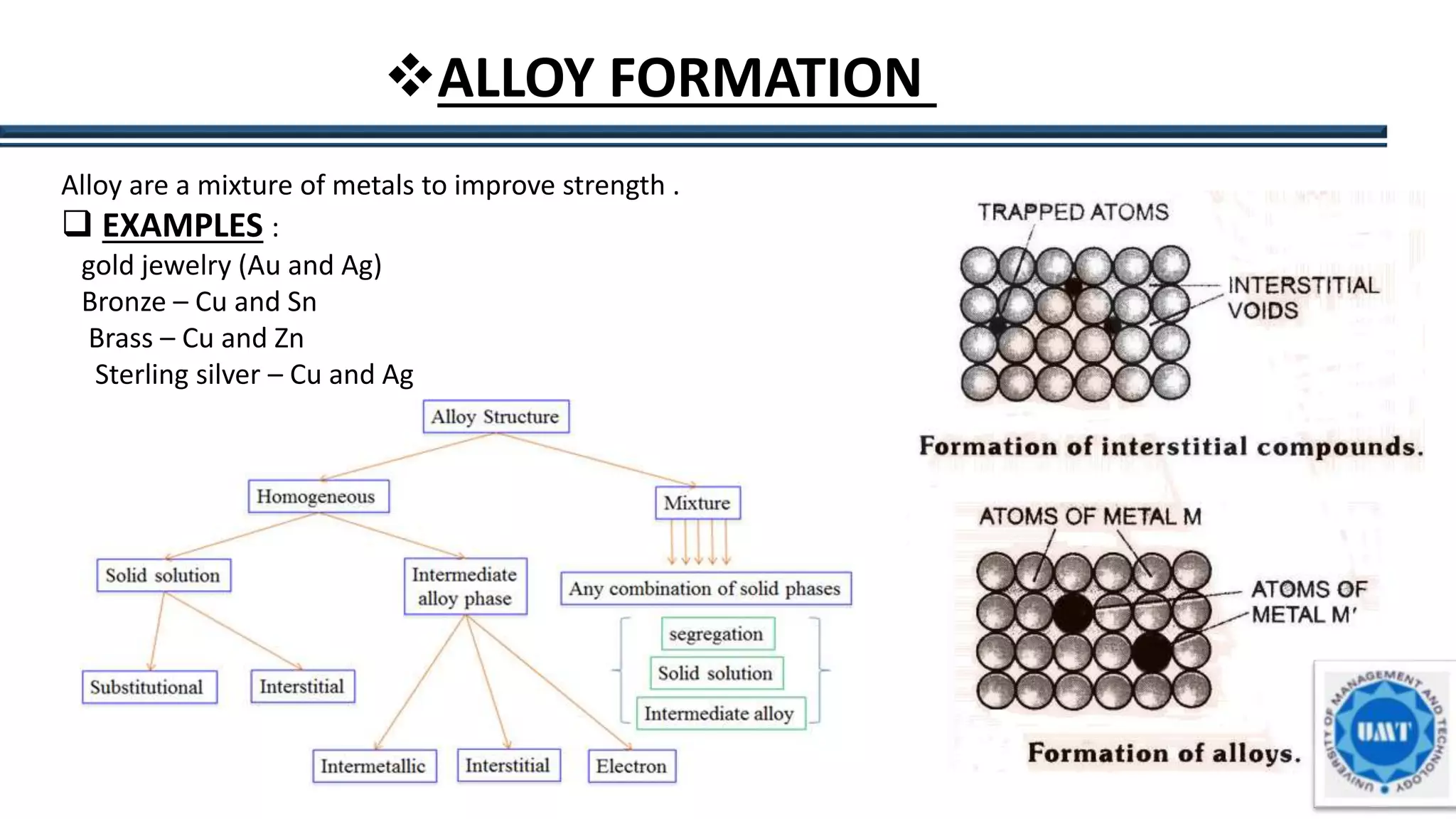
ALLOY FORMATION
Alloy area mixture of metals to improve strength .
EXAMPLES :
gold jewelry (Au and Ag)
Bronze – Cu and Sn
Brass – Cu and Zn
Sterling silver – Cu and Ag
16.
16
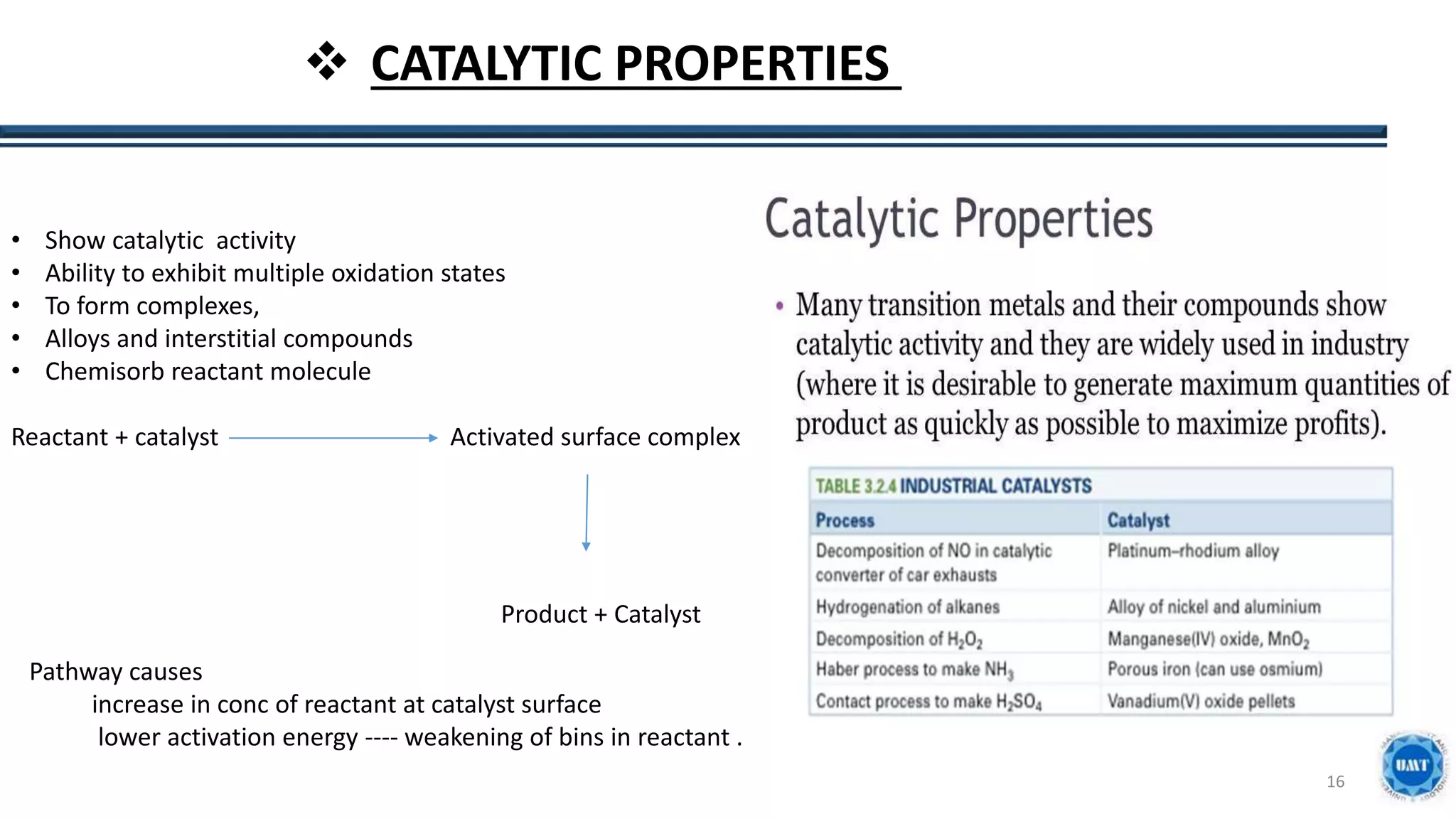
CATALYTIC PROPERTIES
•Show catalytic activity
• Ability to exhibit multiple oxidation states
• To form complexes,
• Alloys and interstitial compounds
• Chemisorb reactant molecule
Reactant + catalyst Activated surface complex
Product + Catalyst
Pathway causes
increase in conc of reactant at catalyst surface
lower activation energy ---- weakening of bins in reactant .
17.
17
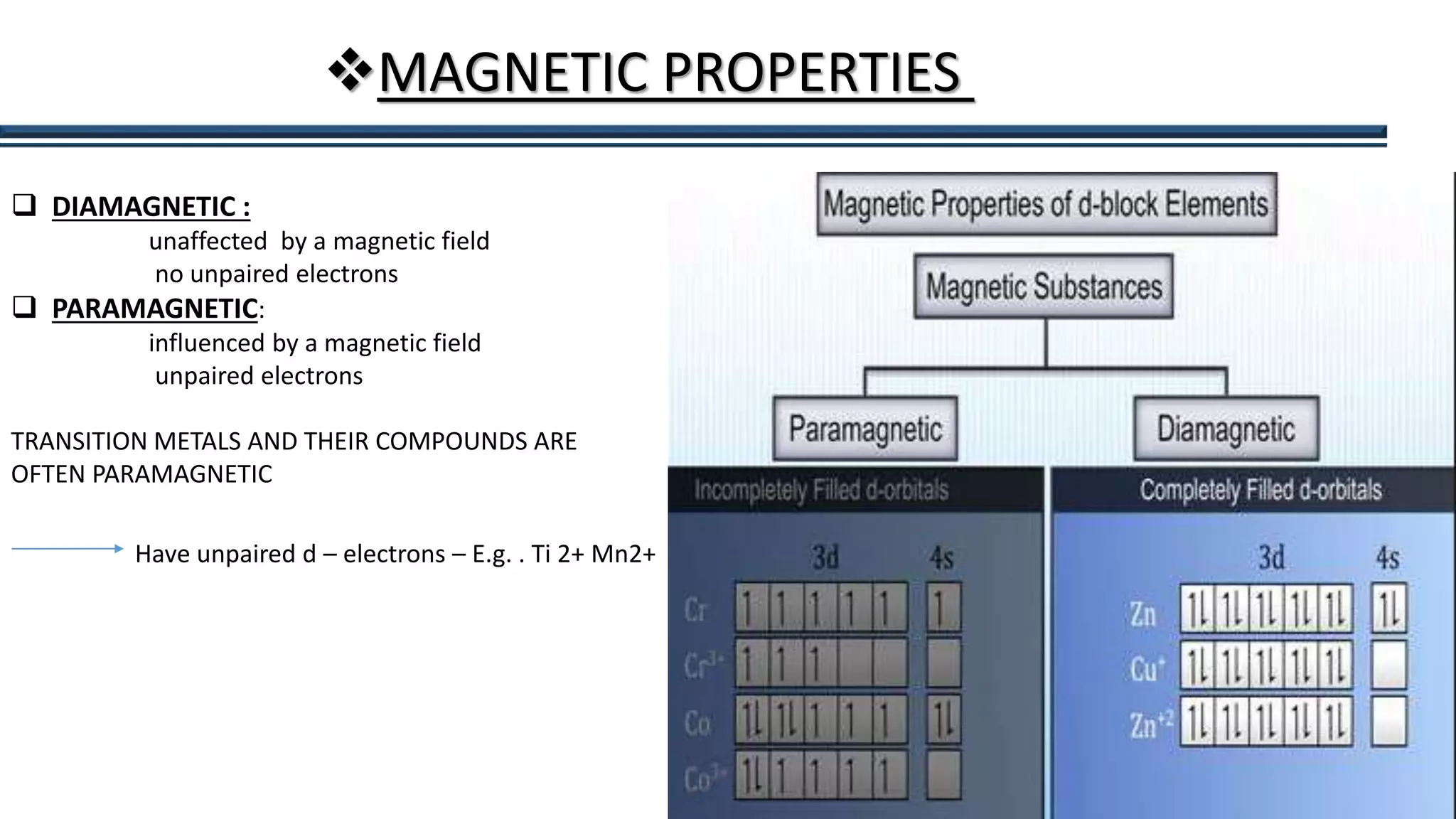
MAGNETIC PROPERTIES
DIAMAGNETIC:
unaffected by a magnetic field
no unpaired electrons
PARAMAGNETIC:
influenced by a magnetic field
unpaired electrons
TRANSITION METALS AND THEIR COMPOUNDS ARE
OFTEN PARAMAGNETIC
Have unpaired d – electrons – E.g. . Ti 2+ Mn2+