Impact on intersection efficiency and safety
for all users
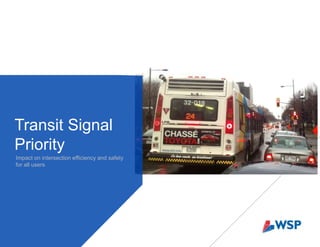
Transit Signal
Priority
Authors
 Stephan Kellner, Eng., P.Eng., MS
 François Bélisle, Eng. jr., B.Sc., M.Sc.
2
Presentation outline
3
 Introduction
 Basic operation principles
 Operation strategies
 System test
 Considerations
 Impact on all users
 Conclusion
Introduction
4
 Transit Signalisation Priority
(TSP)
− Operational strategy to
facilitate transit vehicle
movements (1)
− Enhances transit
movements without
undue impact on other
users
Basic operation principles
5
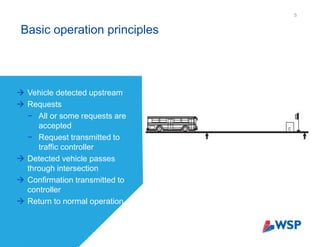
 Vehicle detected upstream
 Requests
− All or some requests are
accepted
− Request transmitted to
traffic controller
 Detected vehicle passes
through intersection
 Confirmation transmitted to
controller
 Return to normal operation
Basic operation principles
6
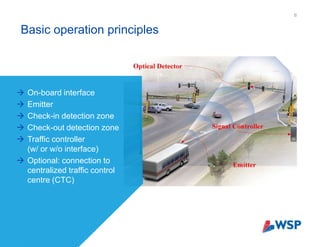
 On-board interface
 Emitter
 Check-in detection zone
 Check-out detection zone
 Traffic controller
(w/ or w/o interface)
 Optional: connection to
centralized traffic control
centre (CTC)
Operation strategies
7
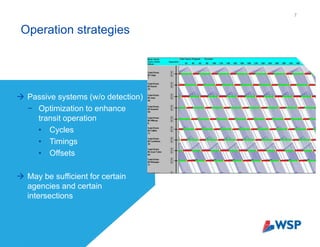
 Passive systems (w/o detection)
− Optimization to enhance
transit operation
• Cycles
• Timings
• Offsets
 May be sufficient for certain
agencies and certain
intersections
Operation strategies
8
 Active systems (w/ detection)
− Green extension
− Red truncation
− Phase rotation
− Addition of transit phases
 May be too costly for certain
problems and agencies
 May have too much impact on
other users
Operation strategies
9
 Simple strategies
− All requests from vehicles
executed
• Detection upstream,
according to speed
• Assumes constant speed
• Works w/ green extension
 Complex strategies
 Transit priority for vehicles
behind schedule only
- Intelligent interface, or
- CTC
 Eliminating queues in front
of transit vehicles
- Queue detection needed
- Exact location of transit
vehicle
System test
10
 System test
− TSP can be a complex
system
− Apply software integration
procedures
 Establish procedures to
− Test
− Verify
− Validate
 Testing of all components
 On test-bench
 Before installation
 After installation
 Validation of detection zones
with equipment in place
 Validation of communication
with CTC
Considerations
11
 Physical
− Bus stop location (far-
side, near-side)
− Detection (equipment,
zones)
− Screening of requests
(vehicle ready, stopped,
behind schedule, etc.)
Considerations
12
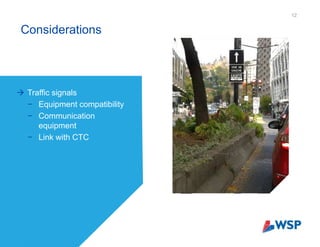
 Traffic signals
− Equipment compatibility
− Communication
equipment
− Link with CTC
Considerations
13
 Strategic
− Delays due to signals?
− Regularity impacted by
signals?
− Use of passive TSP?
− Use of active TSP?
− Other agencies?
− Cost/benefit ratio
positive?
 Expected results (2,3,4,5)
 Signal priority mostly affects
travel time variability
 May not reduce wholesale
travel time
 Often unrealistic to expect to
reduce number of buses
Impact on all users
14
 TSP is best for schedule
reliability
 Often side benefit of travel-
time savings
 One priority request can
impact another
 Vehicles running ahead of
schedule are not positive
 Impact on other users
 Cars
 Pedestrians
 Cyclists
 Other transit users
 The extra time for transit comes
from somewhere…
Impact on all users
15
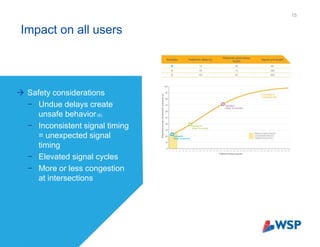
 Safety considerations
− Undue delays create
unsafe behavior(6)
− Inconsistent signal timing
= unexpected signal
timing
− Elevated signal cycles
− More or less congestion
at intersections
Impact on all users
16
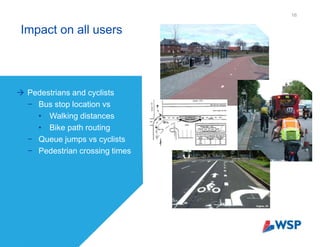
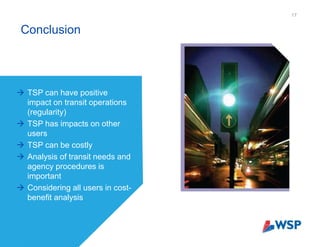
 Pedestrians and cyclists
− Bus stop location vs
• Walking distances
• Bike path routing
− Queue jumps vs cyclists
− Pedestrian crossing times
Conclusion
17
 TSP can have positive
impact on transit operations
(regularity)
 TSP has impacts on other
users
 TSP can be costly
 Analysis of transit needs and
agency procedures is
important
 Considering all users in cost-
benefit analysis
References
1. Transit Signal Priority: A Planning and Implementation Handbook. ITS
America. 2005.
2. Transit Signal Priority: Advanced Control Logic to Really Benefit Transit.
Peter G. Furth, Northeastern University. Boston, MA. 2009.
3. TCRP 110: Commonsense Approaches for Improving Transit Bus
Speeds. TRB 2014.
4. Simulation of Transit Signal Priority Using the NTCIP Architecture.
Hongchao Liu, Texas Tech University; Alexander Skabardonis, University
of California, Berkeley; Meng Li, University of California, Berkeley.
Journal of Public Transportation, 2006 BRT Special Edition.
5. Transit Signal Priority Systems Application and Technology Investigation.
Christopher G. Hedden. NJDOT. 2009.
6. Traffic Safety on Bus Priority Systems, World Resources Institute report,
2014.
Questions?
19
 Stephan.Kellner@wspgroup.com
 Francois.Belisle@wspgroup.com

Transit Signal Priority

  • 1.
    Impact on intersectionefficiency and safety for all users Transit Signal Priority
  • 2.
    Authors  Stephan Kellner,Eng., P.Eng., MS  François Bélisle, Eng. jr., B.Sc., M.Sc. 2
  • 3.
    Presentation outline 3  Introduction Basic operation principles  Operation strategies  System test  Considerations  Impact on all users  Conclusion
  • 4.
    Introduction 4  Transit SignalisationPriority (TSP) − Operational strategy to facilitate transit vehicle movements (1) − Enhances transit movements without undue impact on other users
  • 5.
    Basic operation principles 5 Vehicle detected upstream  Requests − All or some requests are accepted − Request transmitted to traffic controller  Detected vehicle passes through intersection  Confirmation transmitted to controller  Return to normal operation
  • 6.
    Basic operation principles 6 On-board interface  Emitter  Check-in detection zone  Check-out detection zone  Traffic controller (w/ or w/o interface)  Optional: connection to centralized traffic control centre (CTC)
  • 7.
    Operation strategies 7  Passivesystems (w/o detection) − Optimization to enhance transit operation • Cycles • Timings • Offsets  May be sufficient for certain agencies and certain intersections
  • 8.
    Operation strategies 8  Activesystems (w/ detection) − Green extension − Red truncation − Phase rotation − Addition of transit phases  May be too costly for certain problems and agencies  May have too much impact on other users
  • 9.
    Operation strategies 9  Simplestrategies − All requests from vehicles executed • Detection upstream, according to speed • Assumes constant speed • Works w/ green extension  Complex strategies  Transit priority for vehicles behind schedule only - Intelligent interface, or - CTC  Eliminating queues in front of transit vehicles - Queue detection needed - Exact location of transit vehicle
  • 10.
    System test 10  Systemtest − TSP can be a complex system − Apply software integration procedures  Establish procedures to − Test − Verify − Validate  Testing of all components  On test-bench  Before installation  After installation  Validation of detection zones with equipment in place  Validation of communication with CTC
  • 11.
    Considerations 11  Physical − Busstop location (far- side, near-side) − Detection (equipment, zones) − Screening of requests (vehicle ready, stopped, behind schedule, etc.)
  • 12.
    Considerations 12  Traffic signals −Equipment compatibility − Communication equipment − Link with CTC
  • 13.
    Considerations 13  Strategic − Delaysdue to signals? − Regularity impacted by signals? − Use of passive TSP? − Use of active TSP? − Other agencies? − Cost/benefit ratio positive?  Expected results (2,3,4,5)  Signal priority mostly affects travel time variability  May not reduce wholesale travel time  Often unrealistic to expect to reduce number of buses
  • 14.
    Impact on allusers 14  TSP is best for schedule reliability  Often side benefit of travel- time savings  One priority request can impact another  Vehicles running ahead of schedule are not positive  Impact on other users  Cars  Pedestrians  Cyclists  Other transit users  The extra time for transit comes from somewhere…
  • 15.
    Impact on allusers 15  Safety considerations − Undue delays create unsafe behavior(6) − Inconsistent signal timing = unexpected signal timing − Elevated signal cycles − More or less congestion at intersections
  • 16.
    Impact on allusers 16  Pedestrians and cyclists − Bus stop location vs • Walking distances • Bike path routing − Queue jumps vs cyclists − Pedestrian crossing times
  • 17.
    Conclusion 17  TSP canhave positive impact on transit operations (regularity)  TSP has impacts on other users  TSP can be costly  Analysis of transit needs and agency procedures is important  Considering all users in cost- benefit analysis
  • 18.
    References 1. Transit SignalPriority: A Planning and Implementation Handbook. ITS America. 2005. 2. Transit Signal Priority: Advanced Control Logic to Really Benefit Transit. Peter G. Furth, Northeastern University. Boston, MA. 2009. 3. TCRP 110: Commonsense Approaches for Improving Transit Bus Speeds. TRB 2014. 4. Simulation of Transit Signal Priority Using the NTCIP Architecture. Hongchao Liu, Texas Tech University; Alexander Skabardonis, University of California, Berkeley; Meng Li, University of California, Berkeley. Journal of Public Transportation, 2006 BRT Special Edition. 5. Transit Signal Priority Systems Application and Technology Investigation. Christopher G. Hedden. NJDOT. 2009. 6. Traffic Safety on Bus Priority Systems, World Resources Institute report, 2014.
  • 19.