

Incorporating Pedestrian Level of Service into
Traffic Analysis for Improved Decision-Making
Session : Active Transportation Safety
Updated Traffic Analysis
Tools for Complete
Streets
2015-09-28
Authors
 Paul Tétreault, Eng., Urb., P.Eng., M.U.P.
 François Bélisle, Eng., B.Sc., M.A.
2
Presentation outline
 Introduction : Issues with incorporating pedestrians in traffic analysis
 State of the Practice : Techniques for evaluating pedestrian LOS
− Highway Capacity Manual (HCM 2010)
− New York City Method (based on HCM)
− Dynamic methods
 Case studies
 Conclusion
3
INTRODUCTION
Issues with incorporating pedestrians in traffic analysis
4
Introduction : Issues with incorporating pedestrians in
traffic analysis and generalizing complete streets
5
 Pedestrians are generally not well integrated in typical traffic
analysis
 General methodologies exist to incorporate pedestrians for a LOS
analysis (static and dynamic)
 Complementary method to complete street policies
 Some methodologies are used in specific contexts where there is
high pedestrian demand (public transit stations, airports, etc.). Often,
this is not even done at high demand intersections.
 Apart from these specific contexts, when incorporated in traffic
analysis, pedestrians are mainly used as an impedance to cars
Introduction : Issues with incorporating pedestrians in
traffic analysis and generalizing complete streets
6
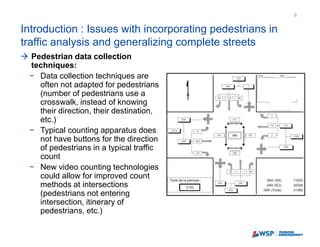
 Pedestrian data collection
techniques:
− Data collection techniques are
often not adapted for pedestrians
(number of pedestrians use a
crosswalk, instead of knowing
their direction, their destination,
etc.)
− Typical counting apparatus does
not have buttons for the direction
of pedestrians in a typical traffic
count
− New video counting technologies
could allow for improved count
methods at intersections
(pedestrians not entering
intersection, itinerary of
pedestrians, etc.)
Introduction : Issues with incorporating pedestrians in
traffic analysis and generalizing complete streets
7
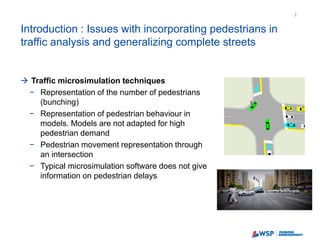
 Traffic microsimulation techniques
− Representation of the number of pedestrians
(bunching)
− Representation of pedestrian behaviour in
models. Models are not adapted for high
pedestrian demand
− Pedestrian movement representation through
an intersection
− Typical microsimulation software does not give
information on pedestrian delays
Introduction : Issues with incorporating pedestrians in
traffic analysis and generalizing complete streets
8
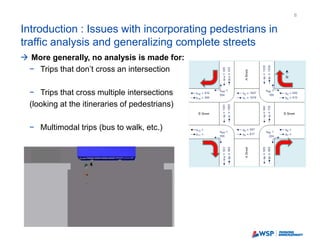
 More generally, no analysis is made for:
− Trips that don’t cross an intersection
− Trips that cross multiple intersections
(looking at the itineraries of pedestrians)
− Multimodal trips (bus to walk, etc.)
Introduction : Issues with incorporating pedestrians in
traffic analysis and generalizing complete streets
9
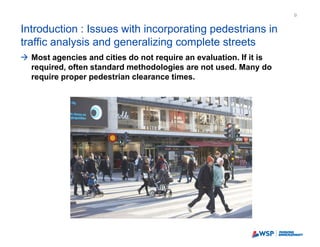
 Most agencies and cities do not require an evaluation. If it is
required, often standard methodologies are not used. Many do
require proper pedestrian clearance times.
Why consider pedestrian conditions?
10
 Every trip starts and ends by foot
 Some modes are dependent on walking (transit, biking, on-street
parking, etc.)
 Improved safety for all modes of travel
 Some users do not have alternatives
 “If you cannot measure it, you cannot improve it.”
Pedestrian Behaviour
11
 Do not abide by as many specific rules when compared to vehicles
 Vast range of characteristics which are not the same for all
pedestrians based on individual characteristics, type of area and
social preferences (walking speeds, reactiveness, compliance, etc.)
STATE OF THE
PRACTICE
12
State of the practice
13
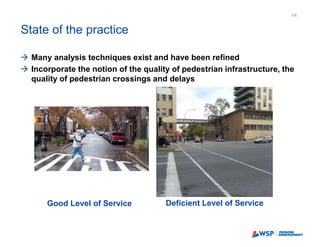
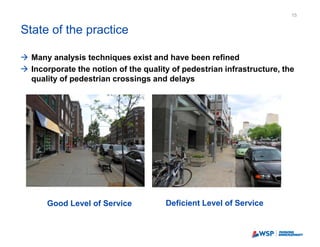
 Many analysis techniques exist and have been refined
 Incorporate the notion of the quality of pedestrian infrastructure, the
quality of pedestrian crossings and delays
Good Level of Service Deficient Level of Service
State of the practice
14
 Many analysis techniques exist and have been refined
 Incorporate the notion of the quality of pedestrian infrastructure, the
quality of pedestrian crossings and delays
Good Level of Service Deficient Level of Service
State of the practice
15
 Many analysis techniques exist and have been refined
 Incorporate the notion of the quality of pedestrian infrastructure, the
quality of pedestrian crossings and delays
Good Level of Service Deficient Level of Service
State of the Practice : HCM 2010 and NCHRP 616
pedestrian LOS
16
 Revised from HCM2000
 Average space per pedestrian : circulation area (other measures for
stairwells, platforms, etc.)
 Average pedestrian speed
 Inclusion of external variables to the pedestrian :
− Number of car lanes
− Traffic flows
− Speed of vehicles
− Buffer space between vehicles (bikes, cars, etc.) and pedestrians
− Geometric considerations
 HCM 2010 Analysis is included in Synchro 8
State of the Practice : NYC City pedestrian LOS
17
 NYC is unique in North-America in terms of transportation modes
and in particular pedestrian trips
 HCM methodology can be adapted for the NYC context to improve
LOS analysis
− Pedestrian impedance as predictor of LOS
− Delay as a method of evaluating LOS
− « Shy distance » evaluation using video data collection
 NYC DP wants to include more variables in pedestrian LOS analysis
in Phase II of this project
State of the Practice : Level of service based on delays
18
 Pedestrian Level of Service based on average delays (FHWA, 2004)
 Shorter delays increase the likelihood of traffic signal compliance,
although other factors have an incidence
 Very sensitive to cycle length, type of pedestrian priority, pedestrian
detection and pedestrian green engagement time (usually shorter on
longer cycle lengths)
Source: FHWA, 2004
State of the Practice : Microsimulation techniques
19
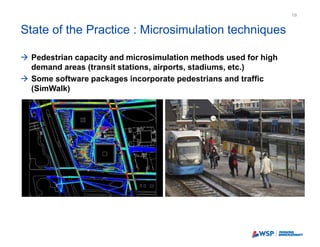
 Pedestrian capacity and microsimulation methods used for high
demand areas (transit stations, airports, stadiums, etc.)
 Some software packages incorporate pedestrians and traffic
(SimWalk)
CASE STUDIES
20
Case Study 1: Pedestrian phasing
21
 Urban intersection with exclusive pedestrian phase and two
successive phases for vehicles with a short cycle length (70
seconds). Pedestrian crossing is not allowed during vehicular
phases, but very low compliance.
 Level of service developed using the delay approach
 Even though pedestrians were given an exclusive phase, they had
much higher delays than vehicles and bicycles
 The elimination of the pedestrian phase can reduce delays by
reducing the cycle length to 50 seconds
Case Study 1: Pedestrian phasing
22
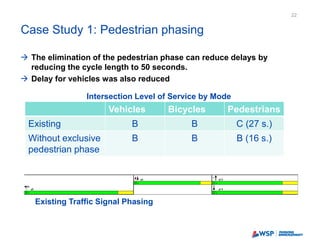
 The elimination of the pedestrian phase can reduce delays by
reducing the cycle length to 50 seconds.
 Delay for vehicles was also reduced
Existing Traffic Signal Phasing
Vehicles Bicycles Pedestrians
Existing B B C (27 s.)
Without exclusive
pedestrian phase
B B B (16 s.)
Intersection Level of Service by Mode
Case Study 2: Management of pedestrian crossings
23
 Crossings are often considered “separately”, without considering
“trips” combining two or more crossings within an intersection
 In the case of high left-turn volumes, often the pedestrian crossing is
eliminated. That said, pedestrians must use three crossings instead
of one and need to wait between 1.5 to 2 cycles to cross to the other
side (150 to 200 seconds with a 100 second cycle). Leads to high risk
of non-compliance.
Case Study 2: Management of pedestrian crossings
Combined pedestrian crossings
24
Pedestrian travel in straight
lines
Pedestrian travel in a
combination of lines (or …)
Case Study 2: Management of pedestrian crossings
Combined pedestrian crossings
25
Intersection LOS : C Intersection LOS : D
Case Study 3: bus stops
26
 Bus stops are often not considered as pedestrian generators in an
intersection
 Pedestrians are counted at the intersection with no knowledge of
their origin or their arrival distribution
Case Study 3: bus stops
27
Bus stops and pedestrians
as traffic « obstacles »
Bus stops and pedestrians
are included in traffic study
Pedestrian crossings are
separated from the bus stop;
bus riders are not linked with
pedestrians on the street
Pedestrian crossings are
linked to the bus plateforms
edges; bus riders are linked
with pedestrians on the street
Case Study 3: bus stops
28
Bus stops and pedestrians
as traffic « obstacles »
Bus stops and pedestrians
are included in traffic study
Intersection LOS : C Intersection LOS : D
CONCLUSION
29
Conclusion
30
 Essential to incorporate pedestrians into decision-making and the
development of solutions
 Essential for “normalizing” complete street policies throughout a
city
 Requires changes to data collection and use new analysis
techniques. Agencies and cities have a crucial role to play to require
evaluations of pedestrian levels of service (“If you cannot measure
it, you cannot improve it.”)
 Could lead to improved solutions and safer travel for all modes of
travel
 Pedestrian levels of service should be presented separately from
vehicular levels of service instead of an average-weighted score, but
still need to balance decision based on other considerations
 Best level of services are more easily attainable if land use and the
connectivity of the street grid allows that improves traffic
distribution (narrower streets = shorter crossings with fewer
conflicting vehicles)
References
 Federal Highway Administration (2004). Signalized Intersections:
Informational Guide, FHWA-HRT-04-091, 372 pages.
 New York City Pedestrian Level of Service Study (phase1), New York
City, Department of City Planning, 2006.
 Pedestrian and Bicycle Information Center (2011). Pedestrian Safety
Action Plan Webinars,
http://www.pedbikeinfo.org/training/webinars_PSAP.cfm
 Transportation Research Board (2010). HCM-2010 Highway Capacity
Manual – 2010, 3 volumes
 Transportation Research Board (2010). Multimodal Level of Service
Analysis for Urban Streets, NCHRP 616
Questions?
32
 Paul.Tetreault@wspgroup.com
 Francois.Belisle@wspgroup.com

Updated Traffic Analysis Tools for Complete Streets

  • 1.
    Incorporating Pedestrian Levelof Service into Traffic Analysis for Improved Decision-Making Session : Active Transportation Safety Updated Traffic Analysis Tools for Complete Streets 2015-09-28
  • 2.
    Authors  Paul Tétreault,Eng., Urb., P.Eng., M.U.P.  François Bélisle, Eng., B.Sc., M.A. 2
  • 3.
    Presentation outline  Introduction: Issues with incorporating pedestrians in traffic analysis  State of the Practice : Techniques for evaluating pedestrian LOS − Highway Capacity Manual (HCM 2010) − New York City Method (based on HCM) − Dynamic methods  Case studies  Conclusion 3
  • 4.
    INTRODUCTION Issues with incorporatingpedestrians in traffic analysis 4
  • 5.
    Introduction : Issueswith incorporating pedestrians in traffic analysis and generalizing complete streets 5  Pedestrians are generally not well integrated in typical traffic analysis  General methodologies exist to incorporate pedestrians for a LOS analysis (static and dynamic)  Complementary method to complete street policies  Some methodologies are used in specific contexts where there is high pedestrian demand (public transit stations, airports, etc.). Often, this is not even done at high demand intersections.  Apart from these specific contexts, when incorporated in traffic analysis, pedestrians are mainly used as an impedance to cars
  • 6.
    Introduction : Issueswith incorporating pedestrians in traffic analysis and generalizing complete streets 6  Pedestrian data collection techniques: − Data collection techniques are often not adapted for pedestrians (number of pedestrians use a crosswalk, instead of knowing their direction, their destination, etc.) − Typical counting apparatus does not have buttons for the direction of pedestrians in a typical traffic count − New video counting technologies could allow for improved count methods at intersections (pedestrians not entering intersection, itinerary of pedestrians, etc.)
  • 7.
    Introduction : Issueswith incorporating pedestrians in traffic analysis and generalizing complete streets 7  Traffic microsimulation techniques − Representation of the number of pedestrians (bunching) − Representation of pedestrian behaviour in models. Models are not adapted for high pedestrian demand − Pedestrian movement representation through an intersection − Typical microsimulation software does not give information on pedestrian delays
  • 8.
    Introduction : Issueswith incorporating pedestrians in traffic analysis and generalizing complete streets 8  More generally, no analysis is made for: − Trips that don’t cross an intersection − Trips that cross multiple intersections (looking at the itineraries of pedestrians) − Multimodal trips (bus to walk, etc.)
  • 9.
    Introduction : Issueswith incorporating pedestrians in traffic analysis and generalizing complete streets 9  Most agencies and cities do not require an evaluation. If it is required, often standard methodologies are not used. Many do require proper pedestrian clearance times.
  • 10.
    Why consider pedestrianconditions? 10  Every trip starts and ends by foot  Some modes are dependent on walking (transit, biking, on-street parking, etc.)  Improved safety for all modes of travel  Some users do not have alternatives  “If you cannot measure it, you cannot improve it.”
  • 11.
    Pedestrian Behaviour 11  Donot abide by as many specific rules when compared to vehicles  Vast range of characteristics which are not the same for all pedestrians based on individual characteristics, type of area and social preferences (walking speeds, reactiveness, compliance, etc.)
  • 12.
  • 13.
    State of thepractice 13  Many analysis techniques exist and have been refined  Incorporate the notion of the quality of pedestrian infrastructure, the quality of pedestrian crossings and delays Good Level of Service Deficient Level of Service
  • 14.
    State of thepractice 14  Many analysis techniques exist and have been refined  Incorporate the notion of the quality of pedestrian infrastructure, the quality of pedestrian crossings and delays Good Level of Service Deficient Level of Service
  • 15.
    State of thepractice 15  Many analysis techniques exist and have been refined  Incorporate the notion of the quality of pedestrian infrastructure, the quality of pedestrian crossings and delays Good Level of Service Deficient Level of Service
  • 16.
    State of thePractice : HCM 2010 and NCHRP 616 pedestrian LOS 16  Revised from HCM2000  Average space per pedestrian : circulation area (other measures for stairwells, platforms, etc.)  Average pedestrian speed  Inclusion of external variables to the pedestrian : − Number of car lanes − Traffic flows − Speed of vehicles − Buffer space between vehicles (bikes, cars, etc.) and pedestrians − Geometric considerations  HCM 2010 Analysis is included in Synchro 8
  • 17.
    State of thePractice : NYC City pedestrian LOS 17  NYC is unique in North-America in terms of transportation modes and in particular pedestrian trips  HCM methodology can be adapted for the NYC context to improve LOS analysis − Pedestrian impedance as predictor of LOS − Delay as a method of evaluating LOS − « Shy distance » evaluation using video data collection  NYC DP wants to include more variables in pedestrian LOS analysis in Phase II of this project
  • 18.
    State of thePractice : Level of service based on delays 18  Pedestrian Level of Service based on average delays (FHWA, 2004)  Shorter delays increase the likelihood of traffic signal compliance, although other factors have an incidence  Very sensitive to cycle length, type of pedestrian priority, pedestrian detection and pedestrian green engagement time (usually shorter on longer cycle lengths) Source: FHWA, 2004
  • 19.
    State of thePractice : Microsimulation techniques 19  Pedestrian capacity and microsimulation methods used for high demand areas (transit stations, airports, stadiums, etc.)  Some software packages incorporate pedestrians and traffic (SimWalk)
  • 20.
  • 21.
    Case Study 1:Pedestrian phasing 21  Urban intersection with exclusive pedestrian phase and two successive phases for vehicles with a short cycle length (70 seconds). Pedestrian crossing is not allowed during vehicular phases, but very low compliance.  Level of service developed using the delay approach  Even though pedestrians were given an exclusive phase, they had much higher delays than vehicles and bicycles  The elimination of the pedestrian phase can reduce delays by reducing the cycle length to 50 seconds
  • 22.
    Case Study 1:Pedestrian phasing 22  The elimination of the pedestrian phase can reduce delays by reducing the cycle length to 50 seconds.  Delay for vehicles was also reduced Existing Traffic Signal Phasing Vehicles Bicycles Pedestrians Existing B B C (27 s.) Without exclusive pedestrian phase B B B (16 s.) Intersection Level of Service by Mode
  • 23.
    Case Study 2:Management of pedestrian crossings 23  Crossings are often considered “separately”, without considering “trips” combining two or more crossings within an intersection  In the case of high left-turn volumes, often the pedestrian crossing is eliminated. That said, pedestrians must use three crossings instead of one and need to wait between 1.5 to 2 cycles to cross to the other side (150 to 200 seconds with a 100 second cycle). Leads to high risk of non-compliance.
  • 24.
    Case Study 2:Management of pedestrian crossings Combined pedestrian crossings 24 Pedestrian travel in straight lines Pedestrian travel in a combination of lines (or …)
  • 25.
    Case Study 2:Management of pedestrian crossings Combined pedestrian crossings 25 Intersection LOS : C Intersection LOS : D
  • 26.
    Case Study 3:bus stops 26  Bus stops are often not considered as pedestrian generators in an intersection  Pedestrians are counted at the intersection with no knowledge of their origin or their arrival distribution
  • 27.
    Case Study 3:bus stops 27 Bus stops and pedestrians as traffic « obstacles » Bus stops and pedestrians are included in traffic study Pedestrian crossings are separated from the bus stop; bus riders are not linked with pedestrians on the street Pedestrian crossings are linked to the bus plateforms edges; bus riders are linked with pedestrians on the street
  • 28.
    Case Study 3:bus stops 28 Bus stops and pedestrians as traffic « obstacles » Bus stops and pedestrians are included in traffic study Intersection LOS : C Intersection LOS : D
  • 29.
  • 30.
    Conclusion 30  Essential toincorporate pedestrians into decision-making and the development of solutions  Essential for “normalizing” complete street policies throughout a city  Requires changes to data collection and use new analysis techniques. Agencies and cities have a crucial role to play to require evaluations of pedestrian levels of service (“If you cannot measure it, you cannot improve it.”)  Could lead to improved solutions and safer travel for all modes of travel  Pedestrian levels of service should be presented separately from vehicular levels of service instead of an average-weighted score, but still need to balance decision based on other considerations  Best level of services are more easily attainable if land use and the connectivity of the street grid allows that improves traffic distribution (narrower streets = shorter crossings with fewer conflicting vehicles)
  • 31.
    References  Federal HighwayAdministration (2004). Signalized Intersections: Informational Guide, FHWA-HRT-04-091, 372 pages.  New York City Pedestrian Level of Service Study (phase1), New York City, Department of City Planning, 2006.  Pedestrian and Bicycle Information Center (2011). Pedestrian Safety Action Plan Webinars, http://www.pedbikeinfo.org/training/webinars_PSAP.cfm  Transportation Research Board (2010). HCM-2010 Highway Capacity Manual – 2010, 3 volumes  Transportation Research Board (2010). Multimodal Level of Service Analysis for Urban Streets, NCHRP 616
  • 32.